An Analysis on Different Data Aggregation
Techniques in Wireless Sensor Networks
Ms. N. Divya
1, Dr. P. Sumathi
2,
1Research Scholar, PG & Research Department of Computer Science, Government Arts College (Autonomous),
Coimbatore, INDIA
2Assistant Professor, PG & Research Department of Computer Science, Government Arts College (Autonomous),
Coimbatore, INDIA
ABSTRACT: A wireless sensor network is a most growing field which consists of number of sensor nodes in the distributed manner. Data gathering and transferring data’s that are collected from multiple sensor nodes would be more difficult process. This needs to be gathered well for the better result. The data aggregation is one of the most popular approaches which are used for combining more number of data’s that are gathered from multiple sensor nodes. Data aggregation is the process of gathering the data’s from multiple sensor nodes and combining together to convert it into the single value. There are various approaches are proposed in the previous research works that is used to aggregate the multiple data’s that are gathered from the different sensor nodes. In this analysis work, those methodologies are discussed and their merits and demerits are discussed in the detailed manner. The evaluation is conducted to find the better approach that can aggregate the data’s that are gathered from multiple sensor nodes in the efficient manner.
KEYWORDS: Data aggregation, Sensor nodes, base station, Data fusion
I. INTRODUCTION
Wireless sensor network is a group of sensor nodes which are present in the environment in the distributed manner. Sensor nodes present in the geographical environment would generate large volume of data’s which need to be gathered and send to the base station for further processing. Aggregation of data’s thus requires having enough resources for completing the task. Lack of resources in the wireless sensor nodes might lead to failure of data transmission. The secured data transmission need to be ensured in the wireless network environment which can gather and forward the data’s without corruption. There may be many factors that influence the transmission of data packets across multiple nodes. Those factors need to be identified and the packets transmission should be done successfully.
Data aggregation is the process of gathering data’s from multiple sensor nodes which would be combined together into single value due to lack of resources. By combining these values together, resources can be utilized efficiently without wasting them by allocating for multiple data forwarding path. The data aggregation would take average value of data points that are gathered from multiple sensor nodes which would then considered as aggregated value. The aggregated value of the multiple sensor nodes will be forwarded to the base station with less resource consumption.
The major challenge that might occur in the data aggregation environment is the security where the malicious nodes present in between the genuine sensor nodes might generate the noise data. These noise data would impact the aggregated data value, thus the base station can’t get the correct data value. These malicious behaviors should be avoided in the data aggregation environment to prevent base station from getting wrong data values. Another issue that might corrupt the original value of aggregated value is inclusion of hackers in the environment who might hack the original data value that is transmitted and will corrupt it.
One of the applications that might get affected more due to this malicious behavior of data environment is the health care monitoring system. The sensors present in the environment would gather the data’s from multiple sensor nodes that indicates the health monitoring values of patients. The malicious node presence in the environment might corrupt those values, thus the centralized server can’t get accurate monitoring result. This would lead to wrong patient in case by taking decision wrongly. Likewise many of the real world applications would be impacted by these malicious behaviors of sensor nodes.
sensor nodes present in the wireless sensor network under the consideration of the various security issues. Finally evaluation of this work is concluded with the better approach that can securely forward the data packets to the multiple nodes.
The overall organization of this analysis work is given as follows: In this section detailed introduction about the wireless sensor network and the data aggregation concept is given. In section 2, discussion about the different secure data aggregation research works are discussed and analyzed in the detailed manner. In section 3, merits and demerits different research works that has been discussed previously has been given. In section 4, final conclusion of this research work is given.
II. ANALYSIS OF RESEARCH METHODOLOGIES
In this section various previous research methodologies that has been conducted in terms of achieving the secured data aggregation transmission concept is given briefly. The methodology used for secured data aggregation, and their working procedure is given in the detailed manner.
Huseyin et al [1] introduced a novel approach for data aggregation in the wireless sensor network in terms of different embedding capacities. This is done by introducing two novel protocols namely LEACH and PEGASIS which aggregates and transmit the data’s with the consideration of the power resources. The power aware data transmission is enabled adapting the methodology called the minimum spanning tree which would find the most nearest path that are generated based on the list of neighboring nodes. The aggregated data would be transmitted through the path where the maximum energy resources are available to avoid the data loss in case of drained energy source. The proposed protocols ensure the correct establishment of the better routing path with the consideration of the limited energy sources.
In the previous research, selections of route path with maximum energy sources are presented. This approach cannot be suitable for the situations where the ongoing processed are already happening in the network environment. It would be failed to provide security in case of drained energy on the available nodes.
Konstantinos Kalpakis et al [2] introduced the maximum lifetime data gathering with aggregation approach which concentrates on the energy source availability of the current running nodes. This approach would lead to a better identification of the available energy source capacities of the sensor nodes in the improved manner. This approach attempts to maximize the life time of the sensor nodes to ensure the successful transmission of the aggregated data values in the improved manner. Energy resource availability is found by analyzing the sensor nodes that are present in the wireless network environment. This approach would maximize the life time of the networking environment by allocating the energy sources to the available nodes.
The previous research works only concern about the converge casting process while gathering the data from multiple sensor nodes in terms of improved energy consumption and security parameter. However, broadcasting is also a major task which is not discussed in depth in the previous research work, thus high security violation might arises.
V. Annamalai et al [3] in introduced Converge casting Tree Construction and Channel Allocation Algorithm which concentrates on the energy resources availability for the secured transmission of aggregated values in terms of both broadcasting and converge casting mechanisms. This proposed research methodology leads to a successful transmission of data packets with assured guarantee of minimized total duration taken for data transmission and improved security. The proposed research of this work constructs a tree in which details about the nodes and its neighbouring nodes in terms of resource capacity available would be update periodically. This proposed research leads to a guaranteed delivery of dates gathered from multiple sensor nodes with the satisfaction of all constraints.
In the previous research work, energy of the sensor nodes can’t be maintained well due to high computation overhead which might lead to reduced security guarantee.
In all the research works discussed previously, issues that occur while aggregating the data points in terms of energy are discussed. None of these approaches discussed about the aggregation process in the detailed manner which is done in the following work.
Shigang Chen et al [5] introduced the localization algorithm that is used for aggregating the data points that are gathered from multiple sensor nodes. The efficient aggregation process is achieved by using the fairness algorithm which would perform the aggregation in the local nodes itself. This localized operation leads to an improved performance in terms of less data violation where the data might be corrupted while transferring from one node to another. This approach attempts to allocate the bandwidth of resources fairly to all the available nodes that are grouped together based on the correlation values. This correlation leads to an effective finding of more similar results in terms of better identities that are available in the system. The localization algorithm is proved to provide better results than the existing work for handling the aggregated values with improved security level.
The above approach doesn’t look up on latency that might occurs while aggregating the data points that are extracted from different wireless sensor nodes which is resolved in the following research work.
Liqun Shan et al [6] introduced the novel approach that can aggregate the data’s collected from multiple sensor nodes with the consideration of the delay and the energy resource availability. This process provides a way of handling the different aggregated data points by collecting them from the different sensor nodes. This is done by introducing the connected dominated set which would combine the data points that are gathered from the different sensor nodes in the efficient manner. The data point aggregation is done over the nodes that satisfied the connected dominated set rules, thus the energy optimization is obtained clearly. And the aggregation of data points leads to reduced latency where the all the data’s are combined into single data points which would be forwarded to the other data points.
K.Venkatraman et al [7] discussed a way of efficient gathering and aggregation of data points that are more related to each other. The data gathering process is more important in the data aggregation concept, where the data’s that are gathered in the corrupted manner might lead to the inaccurate and erroneous data aggregated value generation. Thus the efficient data collection can lead to better data aggregation concept, which is focussed in this research. To do so, this work introduces a converge cast mechanism that concentrate on perfect extraction and processing of the data values that are extracted from different data points. This gathers the data points from the sensor nodes that are more correlated with each other, thus the most similar data points can be extracted.
Mohsen Rezvani et al [8] introduced the secure data aggregation technique which concentrates on prevention of malicious activities that are created by the peoples who are resides within the environment. This approach leads to a finding and removing the malicious behaviour of the invalid sensor nodes that are present between the set of genuine sensor nodes. It is done to avoid the generation of the error aggregated data value in terms of multiple data points that are gathered from the malicious sensor nodes. The malicious node might generate the noisy data that is avoided in this research work in the improved manner. The experimental tests conducted in this work proves that the better data aggregation concept in terms of improved prevention of malicious behaviour of invalid sensor nodes.
All these research works are conducted to provide the secured data aggregation which are all having both merits and demerits based on their working procedures.
III.COMPARISON ANALYSIS
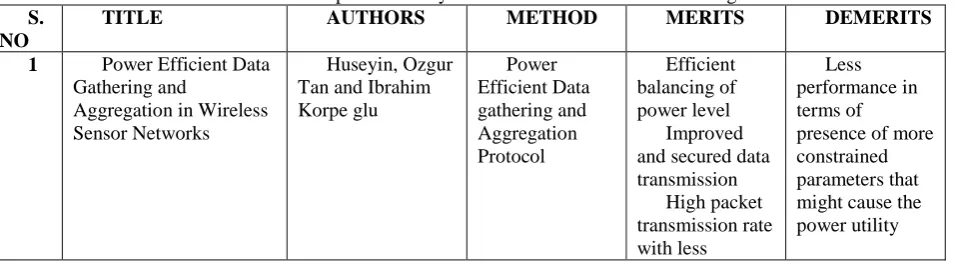
This In this section, all the research methodologies that are introduced and discussed in the previous section were discussed in the detailed manner and their merits and demerits are given as like follows:
Table 1. Comparison Analysis of different research methodologies S.
NO
TITLE AUTHORS METHOD MERITS DEMERITS
1 Power Efficient Data
Gathering and
Aggregation in Wireless Sensor Networks
Huseyin, Ozgur Tan and Ibrahim Korpe glu
Power Efficient Data gathering and Aggregation Protocol
Efficient balancing of power level
Improved and secured data transmission
High packet transmission rate with less
Less performance in terms of
corruption
2 Efficient algorithms
for maximum lifetime data gathering and aggregation in wireless sensor networks Konstantinos Kalpakis, Koustuv Dasgupta, Parag Namjoshi Maximum lifetime data gathering with aggregation Improved handling of energy sources Better data aggregation with reduced energy consumption Capacity of the sensor nodes should known in advance for the efficient aggregation process More computation overhead
3 On Tree-Based
Convergecasting in Wireless Sensor Networks
V. Annamalai, S. K. S. Gupta L. Schwiebert Convergecast ing Tree Construction and Channel Allocation Algorithm Better trade-odd between both convergecasting and the broadcasting process Improved security level with reduced tine consumption value Increased data missing rate where only energy resources are concerned
4 Distributed Data
Gathering in Multi-Sink Sensor Networks with Correlated Sources
Kevin Yuen, Baochun Li, Ben Liang Lagrangian dualization technique Highly correlated sensor nodes can be found
Energy consumption can be reduced in the considerable manner in the correlation based bandwidth allocation process Redundant network nodes cant be supported well in the aggregation process
5 Localized Algorithm
for Aggregate Fairness in Wireless Sensor Networks
Shigang Chen, Zhan Zhang
Aggregate fairness model and a localized algorithm
The aggregation fusion is done for the nodes in the localized manner which leads to efficient output in terms of better identification results
Bandwidth utilization can be preserved well for the better
result
6 An Energy-Efficient
Aggregation Scheduling Algorithm with Minimal Latency in Wireless Sensor Networks
Liqun Shan, Jinkuan Wang, Wei Wei, Zhigang Liu
Connected dominating set
Reduced latency of the data aggregation process
Improved security in data aggregated values transmission
Less energy consumption
Maximum node degree is high which might lead to reduced system performance
7 Effectual Data
Collection in WSN with Path Controlled Mobile Sinks
K.Venkatraman , P.Manjula, B.Sivakumar, D.Anandan, S.Venkatesan
Converge cast
Improved handling of data points
Efficient accessing and handling of the data points that are most similar in nature
Less accuracy
Data might get corrupted by the inside malicious users
8 Secure Data
Aggregation Technique for Wireless Sensor Networks in the Presence of Collusion Attacks
Mohsen Rezvani, Aleksandar Ignjatovic, Elisa Bertino, and Sanjay Jha
Secure Data Aggregation
Improved security
Reduced energy consumption
Successful packet
transmission in terms of secured data aggregation
Aggregator node might act as malicious node
IV.EXPERIMENTAL RESULTS
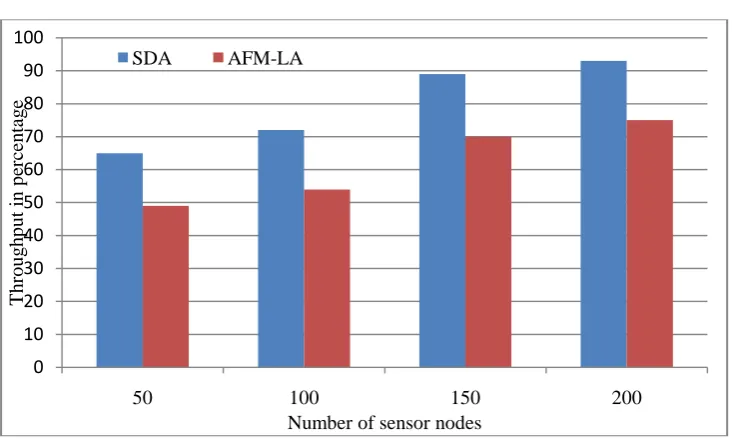
Figure 1. Throughput Comparison
Throughput is defined as the total number of packets that are transmitted successfully over a different number of sensor nodes. Throughput of the proposed research work should be high in number for the better performance improvement. In the above figure 1, throughput comparison is plotted between two research works from which it is proved that the secure data aggregation provides better result than the existing research works in terms of improved throughput values.
V. CONCLUSION AND FUTURE WORK
Data aggregation is the most essential task in the wireless sensor network, where the multiple sensor nodes would gather the different data’s for a particular processing. The bandwidth allocation problem is resolved in the data aggregation approach by combining the multiple sensor node data point values together. This analysis work discussed the various research works that has been proposed previously by different researchers. Those research works are discussed in the detailed manner along with its merits and demerits values. From the performance evaluation it is concluded that the secured data aggregation is the most efficient approach. In further scenario, it is expected to proceed with the secured data aggregation concept implementation.
REFERENCES
1. Huseyin, Ozg ur Tan and Ibrahim Korpeoglu,”Power Efficient Data Gathering and Aggregation in Wireless Sensor Networks”, SIGMOD
Record, Vol. 32, No. 4, December 2003
2. Konstantinos Kalpakis, Koustuv Dasgupta, Parag Namjoshi, “Efficient algorithms for maximum lifetime data gathering and aggregation in
wireless sensor networks”, Computer Networks 42 (2003) 697–716
3. V. Annamalai, S. K. S, Gupta L. Schwiebert, “On Tree-Based Convergecasting in Wireless Sensor Networks”, Wireless Communications and
Networking, WCNC 2003. IEEE (Volume:3 ), 20-20 March 2003
4. Kevin Yuen, Baochun Li, Ben Liang, “Distributed Data Gathering in Multi-Sink Sensor Networks with Correlated Sources”, NETWORKING
2006. Networking Technologies, Services, and Protocols; Performance of Computer and Communication Networks; Mobile and Wireless Communications Systems, Volume 3976 of the series Lecture Notes in Computer Science pp 868-879
5. Shigang Chen, Zhan Zhang, “Localized Algorithm for Aggregate Fairness in Wireless Sensor Networks”, Proceedings of the 12th annual
international conference on Mobile computing and networking, Pages 274-285, 2006
6. Liqun Shan, Jinkuan Wang, Wei Wei, Zhigang Liu, “An Energy-Efficient Aggregation Scheduling Algorithm with Minimal Latency in
Wireless Sensor Networks”, International Journal of Digital Content Technology and its Applications(JDCTA), Volume 6, Number 9, May 2012
0 10 20 30 40 50 60 70 80 90 100
50 100 150 200
T
h
ro
u
g
h
p
u
t in
p
er
ce
n
tag
e
Number of sensor nodes
7. K.Venkatraman, P.Manjula, B.Sivakumar, D.Anandan, S.Venkatesan, “Effectual Data Collection in WSN with Path Controlled Mobile Sinks”, (IJCSIT) International Journal of Computer Science and Information Technologies, Vol. 5 (1) , 2014, 441-445
8. Mohsen Rezvani, Aleksandar Ignjatovic, Elisa Bertino, and Sanjay Jha, “Secure Data Aggregation Technique for Wireless Sensor Networks in
the Presence of Collusion Attacks”, IEEE Transactions On Dependable And Secure Computing, Vol. 12, No. 1, January/February 2015
BIOGRAPHY
N. Divya is an M.Phil Research Scholar in the Department of Computer Science, Government Arts College, Coimbatore. She completed M.Sc Computer Science at Government Arts College, Coimbatore. She completed B.Sc Computer Science at Government Arts College, Ooty.