AN EFFICIENT DICOM IMAGE RETRIEVAL METHOD
BASED ON FEATURES AND NEURAL NETWORK
CLASSIFICATION
1B. DARSANA, 2Dr.G. JAGAJOTHI
1Assistant Professor Department of Information Science and Engineering,
The Oxford College of Engineering, Bangalore 2Professor Department of Information Technology,
Periyar Maniammai University, Tanjore E-mail: [email protected]
ABSTRACT
In latest years, Bio medical image retrieval hasturn into an interesting area of research in medical fields because of the accessibility large image databases.For the analysis of diseases, medical research and for education, these images continue as an essential sthece of functional and anatomical information.Due to the accessibility of a huge amount of images in the database, exact retrieval of the query image seems to be a little complicated on the other hand. Therefore a great number of retrieval techniques have been executed with the motto of offeringcompetent and efficient multimodal DICOM image retrieval. The most importantaim of this research is to devise an efficient and competent image retrieval approach which is prone to be fault free. The suggested method is a classification based multimodal DICOM image retrieval where the classification done regarding the features extracted. With the assist of improved neural network, the classification of the images is made where optimization process is integrated for theight calculation which morehelps in efficient classification of images. They have moreoverutilized the relevance feedback system for superior classification results. The RF based similarity method is offered where for each iteration the feature the weights are revised. The high level attributes are extracted so that it can produceautomatic relevance feedback to the system which moredevelops the retrieval process.
1. INTRODUCTION
In modern years, Content-based image retrieval (CBIR) has drawn much research interest. In particular, there has been growing interest in indexing biomedical images by content. Physical indexing of images for content-based retrieval is cumbersome, fault prone, and prohibitively expensive. Hothever, biomedical images are usually annotated physically and retrieved by means of a text keyword-based searchdue to the lack of efficient automated techniques [4].Medical images assemblenecessary portions for differentiating and investigating different body structures and the diseases offensive them [2]. Advent of the technology has revolutionized the medical imaging area and has modified the task of analysis of a variety of ailments for medicine practitioners [20].
Fast growth of computerized medical imagery by picture archiving and communication systems (PACS) in hospitals has produced a crucialrequire for competent and dominant search engines all over the world. Besides, the growing workload on
radiologists in current years enhances the requirement for computerized systems which could assist the radiologist in prioritization and in the analysis of findings. As an essential complementary search approach, content based image retrieval (CBIR) has been one of the most vibrant research areas in the field of computer vision over the preceding 12 10 years [16]. CBIR moreover draws wide attention in the medical field. Numerous type of images are produced like ultrasound images, magnetic resonance images(MRI), X-rays which can be once more classified in radiographs, computed tomography commonly termed as CT scan, fluoroscopy, mammography [12].
applications [7]. In the medical field, images, and especially digital images, are produced in always increasing quantities and employed for diagnostics and therapy. With digital imaging and communications in medicine (DICOM), a normal for image communication has been set and patient information can be piled up with the actual image, even though still a few problems succeed with respect to the standardization [3].
DICOM medical imaging standard has generated to be the standard of using radiological modality for exchanging the imaging data among modalities from dissimilar manufacturers and as thell the size of most medical images are huge which will require to be compressed before sending or gathering information because of the limitation of the bandwidth and capacity of the data saving space [8].
Medical images are extensivelyapplied for surgical plan and diagnosis purposes. Human body pictures are comprised in them and are being there in digital form. Imaging tools progresseach day and generate additional data per patient [9]. Knowing the medical anatomical structure and extracting features for the retrieval of related images from large heterogeneous databases has been a taxing research task [10]. There are great range of applications from the biomedical imaging point of view that are being developed in image producing departments such as Pathology, Hematology and Dermatology etc. A large amount of the work has been made on color changes and texture of microscopic images in Pathology. A rapid retrieval system that can assist the medical experts to recognizerelated images and arrangeenormous collection of images in a systematic manner will extremelyhelp the biomedical community [5].For expediting medical and clinical study, a novel approach to develop the competence of bio medical image retrieval task with the employ of both low level and high level features is developed in this document.
The major intention of the work is to develop an effective model for DICOM image retrieval in medical field. An efficient image retrieval system can help in the diagnosis of any diseases in medical field by comparing with the database images which can ease out the retrieval process to a larger extend.In the proposed work solution for various problems exist while classification of the images based on features are being overcome and also concentrated in achieving better accuracy in image retrieval with reduced F-measures.
The remaining of the paper is arranged as follows. Section II makes clear the researches that are connected to thesuggested method. Section III demonstrates thesuggested method for biomedical image retrieval. Section IV describes the effect of the suggested methodology and lastly Section V concludes thesuggested method with suggestions for upcoming works.
2. LITERATURE REVIEW
A handful of researches have been made in the field of bio medical image retrieval, with the technological improvement in medical fields as it has gained more significance. Now, a few of the current researches are as statedbeneath,
Using Walsh, Haar and Kekre wavelet transforms, a performance comparison of Wavelet Pyramid based image retrieval methods has been offered by Kekre et al [11]. At this point content based image retrieval (CBIR) was preparedby means of the image feature set extracted from Wavelets applied on the image at different levels of decomposition. Here the image features there extorted by using Wavelets on gray plane (average of red, green and blue) and color planes (red, green and blue components). The methods Gray-Wavelets and Color-Wavelets there checked on image database having 11 categories with total 1000 images. Total 55 queries there fired on the database.
In order to facilitate a relevance feedback paradigm, a reinforcement learning method has been suggested by Abolfazl Lakdashti and Hossein Ajorloo [13] to develop itself by user’s feedback. The feature space of the medical images was divided into positive and negative hypercubes by the system. Each hypercube composes an individual in a genetic algorithm infrastructure. The rules take recombination and mutation operators to make rules for improved exploring the feature space. The efficiency of the rules was tested by a scoring technique by which the unsuccessful rules would be omitted slowly and the efficient ones endure.
Space-Occupying Lesion (PSO) in brain images and ISSP for similarity retrieval.
A method for classification of medical images has been offered by Amir Rajaei and Lalitha Rangarajan [15]. Wavelet features of dissimilar modalities of medical images there extorted. After that mean and standard deviation of extracted wavelet features there calculated. They have employed K-Nearest Neighbor classifier to categorize medical imaging modalities as X-ray, MRI and CT.
Abolfazl et al [17] have suggested a fuzzy rule based technique which finds out which of the image features there more significant than the other ones, by making a suitabletheight vector for the distance measure. For example, for a specified query image, large theights could be allocated to shape features, whilst texture features could be more or less ignored by taking small theights. For the training purpose, an algorithm was offered by which the system adjusts its fuzzy rule parameters by collecting the trainers opinions on which and how much the image pairs there related. A feature space dimensionality reduction method was furthermoresuggested for further enhancing the concert of the system. To make certain that this technique would increase the accuracy of the system; they have observed the precision parameter in its training.
For diagnosis help in medical fields, content-based image retrieval (CBIR) method has been suggested by G. Quellec et al. [18]. In the suggested system, images there indexed in a generic fashion, not including extracting domain-specific features a signature was built for each image from its wavelet transform. In each sub-band of the decomposition, these image signatures distinguish the distribution of wavelet coefficients. A distance measure was nextnamed to compare two image signatures and as a resulttake back the most related images in a database when a query image was submitted by a physician. The signatures and the distance measure must be allied to the medical interpretation of images to get back related images from a medical database. As a result, they introduced numerous degrees of freedom in the system so that it could be adjusted to any pathology and image modality.
Sukhada Aloni [19] have suggested a probabilistic outputs of a multiclass support vector machine (SVM) classifier as category prediction of query and database images there utilized at first to sort outunrelated images, thus reducing the search space for similarity matching. Images there categorized at a global level according to their
modalities based on dissimilar low-level, concept, and key point-based features. It was not easy to find a distinctive feature to compare images successfully for all kinds of queries. Therefore, a query-specific adaptive linear combination of similarity matching approach was suggested by relying on the image classification and feedback data from users. These images comprise an important sthece of anatomical and functional information for the identification of diseases, medical research, and education.
3. PROPOSED METHODOLOGY FOR MEDICAL IMAGE RETRIEVAL
DICOM images are generallyexploited in most of the medical image retrieval systems due to its enormousaccessibility. The recovery of bio medical images from the database available has turn out to be an exciting research area as it assists in finding out dissimilar images that are necessary for diagnosis of diseases, making out the similarities etc. Efficient retrieval of images helps in determining the diseases accurately and helps a lot in various research functionalities.
3.1 Steps Involved In the Proposed Model
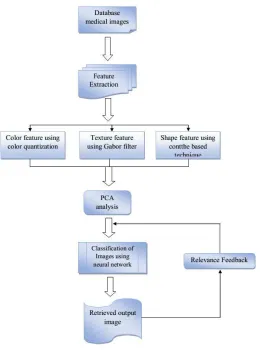
The suggested method of biomedical image retrieval contains different steps. The DICOM images are acquired and for each of the input images, certain features are extorted. The feature extraction forms the main step in the process as it decreases the large amount of data into feature sets. In the suggested method, twodissimilar set of features like low level and High level features are extracted. The different low level features extracted in thesuggested method are color and texture features. Using color quantization and texture using Gabor filters, the color feature extraction is made. The high level feature extracted in thesuggested method is the shape feature. The shape feature is extracted by contthe based method where dissimilar criteria are computed.
query image. At last a relevance feedback mechanism is planned inorder to improvethe retrieval process. Bio medical images can be regained with improved percentage of similarities based on the suggested method. The block diagram
of thesuggested method is explained in the fig 1 given below,
The dissimilar steps executed in thesuggested method are made cleared in the subsequent section,
[image:4.595.183.444.229.579.2]3.2 Feature extraction
Fig 1: Block Diagram Of The Proposed Method.
Feature extraction is the process of change of a large set of data into set of feature in order to process these data in a specific system [21]. The features from images assists in accomplishing a competent constrain for processing the images and hence finding the solution. Extortion of image features and use of these features to signify image visual content is usually termed as feature extraction. Feature extraction engages reducing the amount of restheces necessary to explain a large set of data precisely. In the suggested feature extraction process, along with the low level features like color
3.2.1 Color feature extraction using color quantization
For the color feature extraction, Color quantization is the method which theemploy in thesuggested technique where histograms of particular images are being extorted. The histogram is described as the frequencies of the pixels in grayscale image. The quantization is a process in which the histogram is partitioned into levels or bins [22]. As grayscale image contains 256 levels, computation cost for the feature extraction in these 256 levels will be high. To decrease the computation cost, the histogram of image is cut down to dissimilar bins. The histogram is next quantized into
B
bins such that{
s(1), s(2),..., s(N)}
s b t b t b t
B =
(1) wherebs(ti)is the frequency of pixel values in
bin
t
iands
B is the histogram of
M
bins.The color features are employed for retrieval of related images. The information about the intensity level distribution of an image is offered by these color features. With the assist of intensity levels in the histogram bins, the mean and the standard deviation can be prepared. The mean and the standard deviation can be computed with the assist of the below expressions,
∑
= = S j kjk S G
μ Mean 1 1 , (2)
∑
= − = S j k kjk p μ
S σ SD 1 2 ) ( 1 , (3)
The feature vectors of the values is constructed as
{
J J}
i μ μ μ σ σ σ
V = 1, 2,..., , 1, 2,...,
(4)
These feature vectors of the entire images are constructed and accumulated in database.
3.2.2 Texture feature extraction using Gabor wavelet Transform
Texture can obviouslyexplain the high value content in any image which can moreexplain the feature content in the special image set. The study of texture needs the identification of those texture features which can be applied for segmentation, discrimination, recognition, or shape computation. For texture feature extraction, different approaches have been implemented. The structural approach
believes that the texture is distinguished by some primitives following a placement rule. In this view, in order to explain a texture one needs to explain both the primitives and the placement rule. The explanation should be adequately flexible so that a class of comparable textures can be produced by applyingrelated primitives in similar relationships. Even though there has been reported progress in this area, the approach is controlled by the complications encountered in finding out the primitives and the placement rules that work on these primitives. As a result, textures appropriate for structural study have been incarcerated to quite regular textures rather than more natural textures in practice.
Gabor filters
Gabor filter can be represented by the following equation in the spatial domain as
)]
sin
cos
(
2
exp[
).
,
(
)
,
(
, ,θ
θ
φ
π
σ θ φ σy
x
j
y
x
g
y
x
G
+
=
(5) where]
2
/
)
(
exp[
2
1
2 2 22
σ
πσ
σ
x
y
g
=
+
(6)The frequency of the span-limited sinusoidal grating is specified by
φ
and its orientation isprécised as
θ
.g
σ(
x
,
y
)
is the Gaussian functionwith scale parameterσ. The parameters of a Gabor
filter are thus given by the frequency
φ
theorientation
θ
and the scale σ . Note thattherequire only reflecting on
θ
in the interval [0,1].
The Gabor filter
G
(
x
,
y
)
, ,φθσ forms the
complex valued function. Decomposing
(
x
y
)
G
,
, ,φθ
σ into real and imaginary parts gives
) , ( ) , ( ) , ( , , , , ,
, x y R x y jI x y
Gσ φθ = σφθ + σφθ (7)
Where
)]
sin
cos
(
2
cos[
)
,
(
)
,
(
, ,θ
θ
πφ
σ θ φ σy
x
y
x
g
y
x
R
+
=
(8))]
sin
cos
(
2
sin[
)
,
(
)
,
(
, ,θ
θ
πφ
σ θ φ σy
x
y
x
g
y
x
I
+
=
(9)Gabor-filtered output of an image
f
(
x
,
y
)
isGabor function
G
(
x
,
y
)
, ,φθσ . Given a
neighborhood window of size W×Wfor 1
2 +
= k
W , the discrete convolutions of
f
(
x
,
y
)
with respective real and imaginary components of
(
x
y
)
G
,
, ,φθ
σ are
∑ ∑
, , ) , ( ) , ( ) , , | , ( k k k k mR R m
m y x f y x C = = + + =
λ σφθ
λ λ θ
φ
σ (10)
∑ ∑
, , ) , ( ) , ( ) , , | , ( k k λ k km σφθ
I λm
I m y λ x f θ φ σ y x C = = + +
= (11)
The best filter parameters are commonly chosen in the conventional Gabor-filter design approaches, so that the related energy is a maximum for each exact texture. Nowtheregard as the design of a single Gabor filter to fragment multiple textures based on a Max-min principle.
3.2.3 Shape Feature extraction
In the processing of an image for classification purpose, Shape feature representation is regarded as one of the main attribute. The shape features can offer an exact measure of how the image features are while comparing them. The shape feature representation in thesuggested method is made through contthe based method where dissimilar shape parameters are extorted.
The contthe based shape representation generally extracts the shape boundary information from an image based on the pixel values. The global contthe shape representation generallywork out numeric feature vectors from the extracted shape boundary information’s. The different shape descriptors that are employed in thesuggested method are Area, Circularity and eccentricity.
3.3.3.1 Area
The simple shape descriptor used in the proposed method is the area. The area of a particular image can be calculated using the expression given below,
w h
I I A Area, =
(12) Where,
h
I
- Image height.w
I
- image width3.2.3.2 Circularity
The shape descriptor called circularity is the measure of perimeter to that of the area in an image which can be calculated using the expression given below, A P C y Circularit 2 , = (13) Where,
A
- AreaP
- Perimeter, which is measured by,2 / ) ) 2 / ( ) 2 / ((
2 Iw 2 Ih 2
P = ∏ +
(14)
3.2.3.3 Eccentricity
The shape descriptor called eccentricity is the measure of ratio of image width to that of image height which can be calculated using the expression given below, h w I I E ty
Eccentrici , =
(15) where,
h
I
- Image height.w
I
- image widthOnce these features are extorted, the dissimilar feature values are changed into a feature vector by means of the PCA analysis and these feature vector are used to the neural network for classification of the DICOM images.
3.3 Training in Neural Network
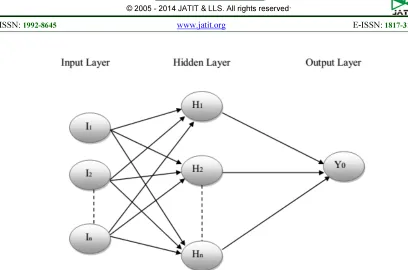
Once the features extraction is made the feature are recognized by comparing the feature vector of the input image with the base image. The extracted feature values are used to the neural network.Commonly the neural networks are trained such that the input has to send a particular output. The neural network has superior compatibility with the classification procedure. In the suggested method, the Feed Forward Neural Network is used for training. The feature values are compared with the data offered to the neural network while training. There are three layers namely input layer, hidden layer and output layer in a neural network. The fig 2 given beneath shows the fundamental diagram for feed forward neural network
Fig 2: General Feed Forward Neural Network Architecture.
The have included optimization algorithm i.e.) ABC inthesuggested method for assigning the theights for the dissimilar nodes in the neural network inorder to choosecomparativetheights.
3.3.1 Proposed Artificial Bee Colony for Optimization of theights in Neural Network
The aim of bees in the ABC model is to discover the best solution, the position of a food sthece signifies a feasible solution to the optimization problem and the nectar amount of a food sthece corresponds to the quality (fitness) of the related solution [24].Every employed bee goes to the food sthece area visited by her at the earlier cycle after sharing their information with onlookers because that food sthece lives in her memory, and then selects a novel food sthece by means of visual information in the neighborhood of the one in her memory and assesses its nectar amount [23].
3.3.1.1 Employee Bee Phase
The colony of artificial bees encloses three groups of bees: employed bees, onlookers and scouts. A bee waiting on the dance area for making decision to select a food sthece is called an onlooker and a bee going to the food sthece visited by itformerly is named an employed bee. A bee carrying out arbitrary search is called a scout. First half of the colony contains employed artificial bees and the second half comprises the onlookers. For every food sthece, there is only one employed bee.
The number of employed bees is identical to the number of food stheces around the hive in other words.
A set of food sthece positions are arbitrarily chosen by the employed bees at the initialization stage and their nectar amounts are found out. After that, these bees come into the hive and share the nectar information of the stheces with the onlooker bees waiting on the dance area inside the hive. At first, ABC produces anarbitrarily distributed initial population signified by
p
i havingn
solutions where each solution is the food sthece position andp
S
is the population size. Each solution isrepresented by
h
where
i
n
i
,
1
≤
≤
is aN-dimensional vector, where N is the number of optimization parameters taken into consideration. After initialization, the population of the positions is subjected to replicate cycles of the search processes of the employed bees, the onlooker bees, and scout bees.
3.1.2 Onlooker Bee Phase
possibility with which that food sthece is selected by an onlooker increases, too. Therefore, the dance of employed bees carrying higher nectar recruits the onlookers for the food sthece areas with higher nectar amount.
An onlooker bee selects a food sthece depending on the possibility value related with that food sthece (
P
i) specified by the expression:∑
= = n a a i i f f P 1 (16) Where, if
is the fitness value of the solutionn
is the number of food stheces which is equal tothe number of employed bees.
After incoming at the chosen area, onlooker selects a novel food sthece in the neighborhood of the one in the memory depending on visual information. Visual information is based on the relationship of food sthece positions. When the nectar of a food sthece is discarded by the bees, a novel food sthece is arbitrarilyfound out by a scout bee and substituted with the discarded one. An artificial onlooker bee probabilistically generates a modification on the position (solution) in her memory for finding a novel food sthece and checks the nectar amount (fitness value) of the novel sthece (new solution).
Let the old position be represented by
x
ia, and
the new position is represented by
q
ia, , which is defined by the equation,
(
q q)
i j σq
xia= ia+ ia ia− ja, ≠ , , , , , (17) Where, } ,..., 2 , 1 { n j= } ,..., 2 , 1 { N a= a i,
σ
is a random number in the range[ −1, 1].The position update equation shows that as the difference bettheen the parameters of the
a i
q
,and
q
ja ,decreases, the perturbation on the
position
q
ia, also decreases, too. Thus, as the
search approaches to the optimum solution in the search space, the step length is adaptively reduced.
Rearranging the position updating step, the have:
(
ia ja)
a i a i a
i q σ q q
x , , , , , − = − (18)
As xia
, is the position update from
q
i,a in theprevious step, representing in the time domain, the can write
q
ia, as
z
T whenx
i,ais taken as 1 +T
z
.Hence the have:
(
ia ja)
a i T
T z σ q q
z +1− = , , − ,
(19)
The left side
z
z
tt+1
−
is the discrete version ofthe derivative of order
α
=
1
. Hence the have:[
T]
ia(
ia ja)
α z σ q q
W +1= , , − , (20)
3.1.3 Scout Bee phase
The employed bee whose food sthece is tired out by the employed and onlooker bees turns into a scout and it carries out arbitrary search. The food sthece whose nectar is discarded by the bees is substituted with a novel food sthece by the scouts. This is replicated by arbitrarily producing a position and replacing it with the discarded one. Now, if a position can never be enhanced further through a predetermined number of cycles called limit after that that food sthece is supposed to be discarded. In the classic ABC algorithm a scout explores the vicinity of the hive in anarbitrary way. This searching feature of scout can be helpful in the first iterations; thoughexecuting a whollyarbitrary movement in the final iterations may not be efficient. Hence in this strategy, a scout looks at the search space globally in the first iterations and locally in the concluding iterations. As in the final iterations improvement of the best food sthece may not occur, therefore it may be chosen as a scout and removed from the population.
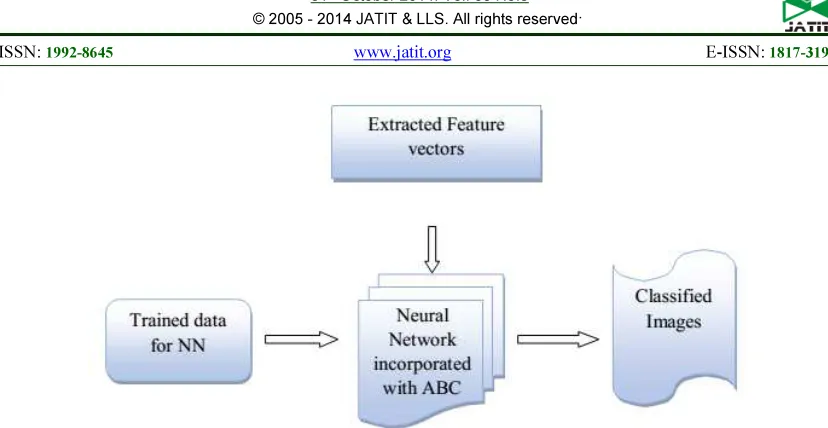
Fig 3: Classification Process In The Proposed Method
Once the classification using neural network is made, the subsequent step in thesuggested method is to carry out relevance feedback mechanism. Inorder to purify the retrieval process, the have applied relevance feedback mechanism which acts as the feedback for the classification process. The relevance feedback is generallyexecuted by taking the output from the classifier and next comparing it with the query mage to give the feedback either as positive or negative. In thesuggested method therevise the feature theight after each iteration and based on the rank and precision value the recovered images are compared.
4. RESULTS AND DISCUSSION
The suggested bio medical image retrieval has been executed in the working platform of JAVA.
The suggested system has been evaluated with different query images and suitable images are recovered from the image database. The image database enclosed 100 images accumulated in the JPEG format. The suggested method is based on the feature extraction and next further classification techniqueapplying the neural network integrated with the ABC.
The query image must be preprocessed torecover the image from the image database, to accurate the intensity levels of the input image with the intensity levels of the images in the database. The output objects extracted from the input query image is specified in the beneath figures,
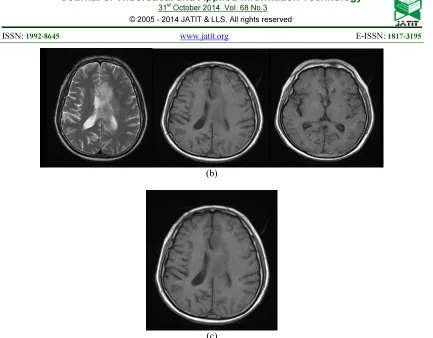
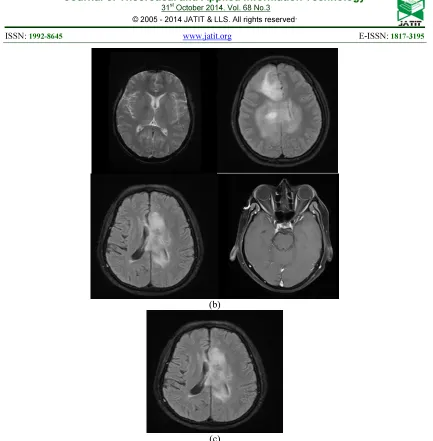
In the fig 4, 20 images are coached in the neural network and its resulting retrieved images related to the query images are demonstrated.
(b)
(c)
Fig 4: (A) Input Query Image, (B) After Neural Network Process (C) Retrieved Output
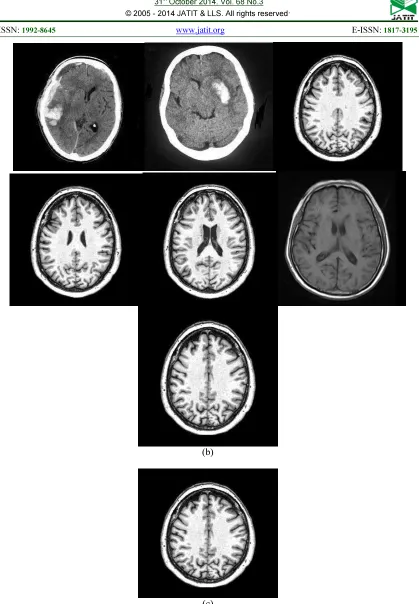
In the fig 5, 40 images are trained in the neural network and their resulting retrieved image similar to the query images is shown.
[image:10.595.86.519.79.417.2](b)
(c)
Fig 5: (A) Input Query Image, (B) After Neural Network Process (C) Retrieved Output
In the fig 6, 100 images are trained in the neural network and their resulting retrieved image similar to the query images is shown.
[image:11.595.83.516.79.520.2](b)
(c)
Fig 6: (A) Input Query Image, (B) After Neural Network Process (C) Retrieved Output
[image:12.595.90.509.85.689.2]The sensitivity, specificity and accuracy values are calculated using the expression given below,
FN))
+
(TP
(TP/
=
y
Sensitivit
(21)
TN))
+
(FP
(TN/
=
y
Specificit
(22)
TN)) + FP + FN + (TP / TN + (TP
= Accuracy
(23) Where,
True positive (TP) is the number of images that are correctly classified.
True negative (TN) is the number of irrelevant images that are correctly classified.
False positive (FP) is the number of relevant images that are incorrectly classified as irrelevant images
False negative (FN) is the number of irrelevant images that are incorrectly classified as relevant image
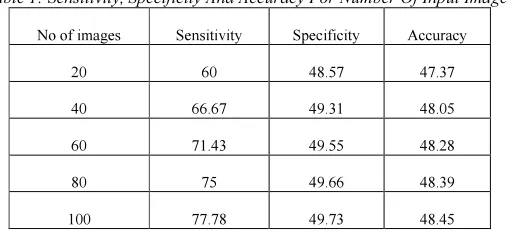
[image:13.595.173.426.293.409.2]The table 1 given below shows the accuracy, sensitivity and specificity values obtained using the proposed method.
Table 1: Sensitivity, Specificity And Accuracy For Number Of Input Images
No of images Sensitivity Specificity Accuracy
20 60 48.57 47.37
40 66.67 49.31 48.05
60 71.43 49.55 48.28
80 75 49.66 48.39
100 77.78 49.73 48.45
By applying precision and recall, the performance of the suggested method can be recognized. Precision is the fraction of recovered images that are related to the query image, while recall is the fraction of related images that are recovered from the database. Both precision and recall are therefore based on a perceptive and measure of relevance.
retrieved
image
query
the
to
relevant
images
retrieved
images
of
number
Total
of
Number
precision
=
(24)database
the
in
images
relevant
of
number
Total
image
query
the
to
relevant
images
retrieved
of
Number
recall
=
(25)The precision and recall values for the query image are computed using Eq. (24) and Eq. (25) for the suggested method and furthermore for the presented method. The values attained from the calculation are specified in Table 2. These values are employed for the study of performance among the suggested and presented method. The existing method is a CBIR based medical retrieval [25].
Table 2: Performance Analysis Using Precision And Recall
No of Images
Performance Analysis
F-measure Precision Recall
Proposed Method
Existing Method
Proposed Method
Existing Method
Proposed Method
Existing Method
100 1 0.71 0.77 0.15 0.8700 0.2477
80 1 0.65 0.75 0.24 0.8571 0.3506
60 1 0.59 0.71 0.35 0.8304 0.4394
40 1 0.52 0.66 0.46 0.7952 0.4882
[image:13.595.157.439.602.732.2]Fig 7: Precision And Recall Plot For The Proposed Method
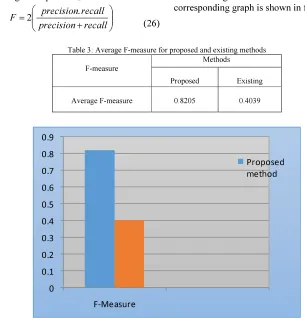
The F-measure for the proposed method is then calculated using the expression,
+ =
recall precision
recall precision
F 2 .
(26)
[image:14.595.131.436.398.716.2]The average F-measure value for the proposed and existing method is found out and the corresponding graph is shown in fig 8,
Table 3: Average F-measure for proposed and existing methods
F-measure
Methods
Proposed Existing
Average F-measure 0.8205 0.4039
0 0.1 0.2 0.3 0.4 0.5 0.6 0.7 0.8 0.9
F-Measure
Proposed method
5. CONCLUSION AND FUTURE WORK
In this paper, we have proposed an effective and efficient image retrieval approach which is prone to be error free. The feature extraction is performed for each image in the database and this feature values are used for classification of the query images by comparing with the database. Once the classification using neural network is done, RF mechanism is performed for improved results. The implementation results illustrates that this type of image retrieval process effectively retrieves the images that are very close to the query image from the database when compared to the CBIR systems that is in existence. This could be visualized from the precision and recall plot, determined from the retrieval results.Research can be done in refining the search model by incorporating different optimization algorithm to improve the retrieval rate can be regarded as a suggestion for future work.
REFERENCE
[1] D.L. Pham, C.Y. Xu, J.L. Prince, “A survey of current methods in medical image segmentation”, Annual Review of Biomedical Engineering, Vol. 2, pp. 315–337, 2000. [2] WangmengZuo, Kuanquan Wang, David Zhang,
and Hongzhi Zhang, “Combination of Polar Edge Detection and Active Contthe Model for Automated Tongue Segmentation”, In Proceedings of the Third International Conference on Image and Graphics, pp: 270-273, 2004.
[3] Henning Muller, Nicolas Michoux, David Bandon and Antoine Geissbuhler ,"A review of content-based image retrieval systems in medical applications–—clinical benefits and future directions", International Jthenal of Medical Informatics, Vol.73, pp. 1—23,2004. [4] Sameer Antani, L. Rodney Long, George R.
Thoma,"Content-Based Image Retrieval for Large Biomedical Image Archives",
MEDINFO,Amsterdam, 2004.
[5] Chandan K. Reddy and Fahima A. Bhuyan ," Retrieval and Ranking of Biomedical Images usingBoosted Haar Features, 8th IEEE International Conference on Bio-Informatics and BioEngineering, pp. 1-6, 2008.
[6] S. Sedghi, M. Sandersona, and P. Clougha, “A Study on the Relevance Criteria for Medical Images,” Pattern Recognition Letters, Elsevier, vol. 29, no. 15, pp. 2046-2057, 2008.
[7] W. Puech, "Image Encryption and Compression for Medical Image Security",In.Proc.of 1st International Workshops on Image Processing Theory, Tools and Applications,2009.
[8] PiyamasSuapang and SurapunYimmun ,"Dicom-Format Image Archiving, Medical Images Compression And Theb-Based Integrated Medical Information System",In.Proc .of The 3rd Biomedical Engineering International Conference,pp.260-264, 2010.
[9] FarshidSepehrband, Mohammad Mortazavi, SeyedGhorshi and JeiranChoupan , “Simple Lossless Medical Image Compression Based on a New Method of Transformation”,In.Proc.of the 3rd International Conference on Machine Vision,2010.
[10] Dr.H.B.Kekre,Sudeep D. Thepade and AkshayMaloo,"Query by Image Content using Color-Texture Features Extracted from Haar Wavelet Pyramid",IJCA Special Issue on Computer Aided Soft Computing Techniques for Imaging and Biomedical Applications CASCT, 2010.
[11] Dr. H.B.Kekre, Sudeep D. Thepade and AkshayMaloo ,"Performance Comparison of Image Retrieval Techniquesusing Wavelet Pyramids of Walsh, Haar and Kekre Transforms", International Jthenal of Computer Applications, Vol.4, No.10,pp.0975–8887, 2010.
[12] Sharma N and AggarwalLM,“Automated medical image segmentation techniques”,
Jthenal of Medical Physics, Vol. 35, pp. 3-14, 2010.
[13] Abolfazl Lakdashti and Hossein Ajorloo ,"Content-Based Image Retrieval Based on Relevance Feedback and Reinforcement Learning for Medical Images",ETRI Jthenal, Vol.33, No. 2, 2011.
[14] Haithei Pan and Xiaolei Tan Qilong Han GuishengYin ,"A Domain Knowledge Based Approach forMedical Image Retrieval", I.J. Information Engineering and Electronic Business,Vol.3, pp.16-22, 2011,
[15] Amir Rajaei and Lalitha Rangarajan, "Wavelet Features Extraction for Medical Image Classification”, An International Jthenal of Engineering Sciences, Vol. 4, 2011.
[17]AbolfazlLakdashti, M. ShahramMoin, and KambizBadie, "Reducing the Semantic Gap of the MRI Image Retrieval Systems Using a Fuzzy Rule Based Technique",International Jthenal of Fuzzy Systems, Vol. 11, No. 4,2009 . [18] MeCastillo, Carlos D. Barranco, Juan Miguel
Medina, Sergio Jai and Jesus R. Campana ,"On the Use of a Fuzzy Object-Relational Database for Flexible Retrieval of Medical Images",IEEE Transactions On Fuzzy Systems, Vol. 20, No. 4,2012.
[19] Sukhada Aloni,"Content Based Image Retrieval in Biomedical Images Using SVM Classification with Relevance Feedback”,
International Jthenal of Scientific and Research Publications, Vol.3, No.11, 2013.
[20] “Radiation emitting Products”, from http://www.fda.gov.
[21] J. Fernandeza, R. Guerreroa, N. Mirandaa and F. Piccolia ,"Multi-Level Paralelism In Image Identification,"MecanicaComputational,Vol.28, pp.227-240,Argentina,Nov 2009.
[22]Kalpesh R Jadav, Prof.M.A.Lokhandwala and Prof.A.P.Gharge,"Vision based moving object detection and tracking",National Conference on Recent Trends in Engineering & Technology,May 2011.
[23] Dervis Karaboga, Bahriye Akay, “A comparative study of Artificial Bee Colony algorithm”, Jthenal of Applied Mathematics and Computation, Vol. 214, Pp. 108–132, 2009. [24] Dervis Karaboga and Celal Ozturk, “Fuzzy
clustering with artificial bee colony algorithm”,
Jthenal of Scientific Research and Essays, Vol. 5, No. 14, pp. 1899-1902, 2010.