72
GENETIC - ZHLS ROUTING PROTOCOL FOR FAULT
TOLERANCE AND LOAD BALANCING
1
M V NARAYANA, 2G NARSIMHA, 3SSVN SARMA
1
Research Scholar, JNTUK Kakinada &Dept. of CSE, Global Group of Institutions, Hyderabad, AP, India
2
Department of CSE, JNTUH College of Engineering, Jagityal, AP, India
3
Department of CSE, Vagdevi College of Engineering, Warangal, AP, India
1
E-mail: [email protected]
ABSTRACT
Mobile ad hoc network (MANET) is a self-initiated and self-structured network of wireless mobile nodes. ZHLS is a peer-to-peer hierarchical mobile routing approaches that generates two routing tables i.e. an intra-zone routing table and an inter-zone routing table. Genetic algorithm is an evolutionary optimization approach, applicable to the issues which are large, non-deterministic, nonlinear and discrete in nature. As an extension to the existing ZHLS, this paper is proposed based on Genetic Algorithm known as Genetic ZHLS so as to have a restricted group of alternative paths to load balance the topology and have robustness in the course of node/linkage failure in the Inter Zone clustering and at the time of Route Discovery on Gateway Nodes. This paper presented the outcomes of the effects of load balancing and robustness depending on Packet Delivery Ratio, Control Overhead and End to End Delay by fluctuating the movement of the nodes on Genetic Zone based Hierarchal Link State Routing Protocol.
Keywords: Mobile Adhoc Networks, Routing protocol, Genetic Algorithm, Fault Tolerance, Load
Balancing
1. INTRODUCTION
Mobile ad hoc networks (MANETs) [1] are self- initiated and self- structured networks in which mobile nodes interact with one another through wireless connections and might be promptly organized without relying on pre-surviving topological infrastructure [2, 3] similar to base locations. The nodes in a MANET can energetically connect and vacate the topology frequently, lack of notification due to high flexibility. Since there are no base stations, every mobile node not merely act as a host but also as a router, sending packets for further mobile nodes in the topology that might not be in the interior of direct wireless communication varied from each other. Every node contributes in a routing protocol that permits it to determine multi-hop routes via the network to some other nodes.
Certain instances [3] [22] of the probable usages of ad hoc networking comprises of communicating data for circumstance consciousness on the battleground, emergency tragedy assisting personnel synchronizing work
later to cyclone or earthquake, students using laptops to contribute in a communicative lecture, and business acquaintances sharing data throughout conference.
The utmost appreciated methodology to classify the mobile Adhoc network routing protocol is based on what ways do the nodes sustain to obtain the information. Employing this methodology, MANET routing protocols are categorized into proactive, reactive and hybrid routing protocols.
73 transport policy in spite of traffic existence. Instances of certain proactive routing protocols are DRP, DSDV, and the FSR protocol.
Reactive routing algorithms for MANETs are named as ‘on-demand’ routing algorithm. In the reactive routing algorithm, routes are established whenever it is demanding, distinct from the proactive routing approach, it do not perform any episodic update that upsurges the overhead. It uninterruptedly controls the path unless there is a necessity, detection ends solitary whenever either path has been originated or no path is accessible subsequently after successful detection procedure for entire permissible paths. In certain circumstances, energetic path might be detached due to node flexibility. Thus route preservation is a significant procedure for reactive routing algorithms. However matched to proactive, reactive does fewer distinguishing overhead, this is an additional benefit of reactive routing protocol. Instances of certain reactive routing protocol are AODV, DSR and etc.
Hybrid routing protocols are suggested to associate the benefits of both proactive and reactive routing approaches. These approaches are considered to upsurge scalability using permitting nodes by means of nearby vicinity to function in combined with formulating certain kind of a support to minimize the route discovery overheads. This is typically achieved by proactively preserving paths to adjacent nodes and defining paths to distant nodes employing a route discovery approach. Hybrid routing protocols for MANETs operates on hierarchical constructions. Certain Example of hybrid protocols like ZRP, ZHLS, and HARP.
1.1 Zone Based Hierarchal Link State Routing Protocol
ZHLS is a peer-to-peer hierarchical routing protocol which generates two routing tables, an intra-zone routing table and an inter-zone routing table, by broadcasting Node LSP and Zone LSP. Zone-based Hierarchical Link State (ZHLS) routing protocol uses hierarchical organization suggested by Joa-Ng and Lu [6]. Nodes within a definite distance from the other node considered, or in the interior of a specific geographical area, are specified to be within the routing zone of the specified node. For routing within this zone, a table-driven methodology is employed and outside this zone, an on-demand methodology is employed.
The topology is separated into non-overlapping zones and every node has a node ID and a zone ID that is computed by means of a Global Positioning System (GPS).
This protocol is based on hierarchical structure. Therefore, the network contains two level structures for its topology. It exhibits two types of link state updates. They are known as node level and zone level link state updates. A node level LSP is broadcasted to the other nodes of the zone periodically. Thus the nodes in a single zone will have similar state information. Before transmitting starting node checks intra-zone first and determines whether the destination lies in the same zone or different zone. If found in the local zone routing table, it can send data to destination. Otherwise, it has to request all other zones to know the destination’s location. Once it is known, the source will be able to send data to destination.
The routing path is adjustable to the fluctuating network solitary as the node ID and zone ID of the destination are prerequisite for transmission. That means no additional position exploration is necessary providing that the destination do not transfer to alternative zone. Furthermost hybrid protocols offered upto now are zone-based, that is the topology is separated and perceived as a number of zones by every node. This protocol has low routing overhead when compared with DSR and AODV.
1.2 Motivation
ZHLS is one of the hybrid routing protocol which make use of shortest path algorithm within the intra zone cluster. But the actual problem comes when a path is to be found in the inter zone clusters that is outside the Zone and duplicate copies of Zone LSP occur for different Gateway nodes. In this case, the node receives the connection replies from the adjacent zones i.e. as gateway nodes. At the initial stage, every node of the identical zone engenders similar zone LSP and the gateway nodes formerly transmit zone LSP all through topology. When every node obtains entire zone LSP’s, the shortest path method is employed to discovery shortest route in term of zone hops and constructs inter zone routing table.
74 congestion occurrence, the gateway nodes employed in the inter zone cluster routing table will apply the Genetic Algorithm by making use of Zone LSP’s and constructs a Inter Zone Routing Table of every node. This process will provide the alternate paths which might be shortest or nearby shortest in terms of number of hops in the path and number of packets send to the destination by the path. Therefore, this paper introduced a novel Genetic ZHLS routing protocol.
1.3 Organization of the Paper
A brief discussion is given on Mobile Adhoc Networks and on the Zone based Hierarchal Link state Routing Protocol along with motivation in this section. Section 2 gives brief discussion on different existing and traditional routing protocol that is hybridized with various other techniques present in the machine learning. The Genetic Algorithm and its importance of proposed methodology is given in section 3. The proposed methodology that is genetic based Zone based Hierarchal Link state Routing protocol is briefly explained in the section 4. Section 5 briefly explains the experimental results and its analysis followed by conclusions of the proposed methodology and References in section 6 and section 7.
2. LITERATURE SURVEY
In the last two decades computing resource became cheaper that paved way for increased usage of different kinds of networks including mobile networks [4][20][21]. Since the emergence of mobile networks routing protocol has been a hot topic [14]. Innovations in routing and hybrid routing algorithms can extend life time of wireless networks [16]. A good survey of routing protocols is found in [7] and [8] for WSN and MANET respectively. Wireless infrastructure is fault tolerant, self-optimizing and self-configuring [11]. A good survey of multipath routing protocols like DSR and AODV can be found in [9] to achieve low packet loss ratio and low packet latency.
Wang et al. [10] proposed a hybrid routing algorithm named HOPNET. It is dependent on Ant Colony Optimization and one zone routing that are known for high scalability. Rajagopalan & Shen [13] proposed a new hybrid protocol for MANET. It is known as Ad Hoc Networking with Swam Intelligence (ANSI) which is congestion conscious. Cost-Bandwidth-Delay Genetic Algorithm
(CCBD-GA) for quality of services. Tseng et al [15] proposed NGA to construct a Delay and Degree Constrained Minimum Spanning Tree for multimedia broadcasting on overlay networks. Ting Lu et al [18] et al suggested an energy effective genetic algorithm to discover the delay-constrained multicast graph and minimize the entire energy ingestion of the graph.
A Genetic Algorithm (GA) grounded routing technique for Mobile Adhoc Networks (GAMAN) is suggested by Barolli et al [5]. It is a source centered routing algorithm. Limited nodes are included in path calculation by means of lesser population dimension. The nodes in sub-populace maintain solitary regarding the paths. The flooding is evaded since the data is communicated merely for the nodes in a populace. The GA discovers diverse paths and they are categorized by sorting. Consequently, the initial path is the finest one, but additional path ranks are employed as backup paths. By means of a tree constructed GA technique, the loops are evaded. This procedure usages the delay and communication achievement degree as QoS constraints. In [17] and [19], the authors functioned GA in MANETs for accomplishing safety and robustness correspondingly.
3. GENETIC ALGORITHM
Genetic algorithms (GA) proved to be an effective procedure for resolving the Optimization issue, where healthier designed individuals and suitable functions are significant aspects that regulate the performance. Efficiency of routing protocols plays an important role in having robust communications and also reduces resource consumption significantly. This leads to the increase of network lifetime. Though there are many existing protocols for routing in MANET, GA is ever need for optimizing them. Therefore there is much research interest in this area.
75 Genetic algorithms (GAs) consist of population size of individuals which are encoded and estimated conferring to a fitness evaluation. Even with current high-mechanized computers and for numerous issues, genetic algorithm can regularly find optimal results. This algorithm may be several times quicker compared to comprehensive search techniques. Conferring to the principle of existence of the fittest, high adaptive individuals are remained, and the low adaptive individual are rejected in the sequence of creating a novel populace. Thus the novel populace substitutes the ancient one, and the entire procedure is repeated unless precise conclusion situations are satisfied.
Procedure for Genetic Algorithm:
1. Encode and Initialize the Population size of the Individuals
2. Evaluate the Fitness of the every individual/Chromosomes in the populace.
The fitness function is stated by how fine the individual discovers the result. An appropriate individual is further suitable to be a parent for an individual in the subsequent iteration. This cycling lasts until either an optimal answer is established or the maximum number of iteration is attained.
3. Perform three Genetic Operations
a. Selection: Selection operator selects
those individuals in the populace that will be permissible to regenerate, where the appropriate individuals may generate further children’s compared to lower appropriated ones.
b. Crossover: This is the main operator
characterizing Genetic algorithms from other stochastic exploration approaches. Crossover operator selects and exchanges subparts of two chromosomes and creates a new offspring, unevenly impersonating organic recombination amongst two distinct chromosomes. The crossover operation is governed by crossover probability (pc).
c. Mutation: This operation plays
important role in Genetic algorithm to preserve and introduce diversity. Mutation casually alters the allele values of certain positions in the individual. Mutation is done if consecutive iteration values are same.
The mutation function is directed by Mutation Probability (pm).
4. Again Evaluate the Fitness of the newly Generated Chromosomes.
5. If Termination Criterion (Maximum Generation) is reached, stop the process else iteratively go to step 3.
It is important to determine what probability of mutation and crossover ought to be employed which is typically performed through trial-and-error. The optimum mutation or crossover rates never the less fluctuate beside issue of concern, even diverse generations of the genetic procedure in an issue.
4. GENETIC ZONE BASED HIERARCHAL
LINK STATE ROUTING PROTOCOL
This paper offered a novel peer-to-peer Genetic Zone based Hierarchal Link State Routing Protocol which is an enhancement of Zone based Hierarchal Link State Routing Protocol adapting the notion of Genetic Algorithm. The Genetic Algorithm is employed with the traditional Zone base Hierarchal Link State Routing Protocol as to discover the numerous efficient shortest or nearby optimal shortest path to provide the load balancing and fault tolerance in the network. The shortest path for the Genetic ZHLS routing protocol is specified in terms of minimum hop count and frequency that is the number of packets delivered from the source to the destination.
In this proposed methodology, the genetic algorithm approach is applied on the two different situations. They are:
In Genetic ZHLS also, the routing table for intra zone clustering is found using the shortest path of the Node LSP’s list. But whereas the routing table for inter zone clustering is found using the Genetic Algorithm based on multiple optimal shortest paths.
76
A. Encoding Method: The initial phase in Genetic
Algorithm is to encrypt the features of the individuals. A chromosome consists of sequence of positive integer that represent the ID’s of the Node LSP and Zone LSP between the source and destination through which the route passes. The chromosomes encode the problem by listing up the ID’s of the node level and zone level based on the Routing table of Zone LSP’s.
B. Initial Population: One of the problem in
choosing the initial populace is its dimension. The population is created with a group of individuals randomly and these individuals are evaluated. In this work, the population size is considered as twice the number of nodes in the network.
C. Fitness Function: This is usually the objective
function specifically to be enhanced. The fitness function is the shortest path computation that tends to find the minimum cost path. The multi hop network is identified by the directed graph G= (N, A) where N is the group of nodes and A is group of its linkage. The cost Cij accompanying to every linkage (i,
j) which is given by matrix C= [Cij] where Cij
represents the cost of transferring a packet on linkage (i, j). Every node has the link association specification represented by Iij,
providing the data if the linkage from node I to node j is comprised in the route or not. This can be specified as follows:
1,
0,
The fitness function is expressed as:
∑ ∑ !
"
! ∎
Rendering to the circumstance that the paths amid a source and destination have no loops
solitary:∑ $ ∑ !
" %
1, &
$1, '
0, !
"
and ∑ () 1, * '
0, '
! "
D. Selection: This function is envisioned to
enhance the eminence of the populace by providing the excellent individuals a healthier chance to come into the subsequent Iteration.
The proposed Genetic Algorithm employs the roulette wheel selection that is utmost broadly employed one. In this process, two individuals are nominated depending on the possibility. Nevertheless, the identical individual must not be selected twice as a parental.
E. Crossover: This function inspects the present
outcome so as to discover the improved ones. Crossover in the Shortest Path routing issue employs the function of replacing every partial path of two selected individuals in such a way that the offspring generates by the crossover characterizes solitary unique path. This commands selection of one-point crossover as a worthy applicant structure for the recommended Genetic Algorithm. One partial route links the source node to an intermediary node, and the additional partial route links the intermediary node to the destination node. In the suggested structure, two individuals selected for crossover must have at best unique common node excluding the source and destination nodes; however there is no necessity that they should be situated at the similar position. To be precise, the crossover does not reliant on the location of nodes in routing paths.
Before Crossover:
After Crossover:
F. Mutation: The populace endures mutation by a
definite alteration or flipping on one of the genes of the parental individual, in a way that preserves from local optimum. Substantially, it creates an alternate partial-route from the mutation node to the terminal node in the suggested approach. The network based information database is applied for this task. Based on the mutation point, a gene from the selected individual is node ZL2. One of the nodes, linked straightly to the node at mutation point, is picked arbitrarily as the initial node of the substituional partial route.
S ZL1 ZL2 ZL4 ZL5 D
S ZL2 ZL3 ZL5 ZL6 ZL7 D
S ZL1 ZL2 ZL3 ZL5 ZL6 ZL7 D
77 Before Mutation:
S ZL2 ZL4 ZL5 D
After Mutation:
S ZL2 ZL1 ZL3 D
Robustness and Load Balancing
Robustness or Fault Tolerance is an important in definite routing procedure. This will take care of route maintenance. The routing algorithm should be robust for packet harm affected by unpredictability of network as congestion or node/linkage damage. The genetic ZHLS reduces this problem by providing a set of alternatives routes to the Zone LSP nodes. The next best alternative route is employed for sending the packet. This provides the robustness for the topology and diminishes the control overhead in the Zone Level routing table. The frequency of the packets between the nodes will be beneficial so as to load balance the structure. This diminishes burden on unique node by distributing the packet delivery via existing alternative nodes.
5. EXPERIMENTAL RESULTS AND ITS
ANALYSIS
The Simulation used for evaluation of the protocols is Network Simulator 3 (NS3). The goal of simulation experiment is to examine influence of node movement on the capability of both the approaches, ZHLS and Genetic ZHLS. The measures employed for assessment are (i) Packet Delivery Ratio (PDR), (ii) Total Control Overhead (iii) Average end to end Delay. Table 1 represents the constraints applied for demonstrating the simulation to analyze the Approaches. Table 2 represents the constraints applied for Genetic Algorithm.
Table 1: Constraints used for Simulation
Parameters Value
Simulation Period 1000s # Experimental Trails 6 Network Coverage
Area 1400X200m2
Number of Nodes 100
Routing Zone Radius 1 Broadcast Range 100m
Table 2: Constraints used in GA
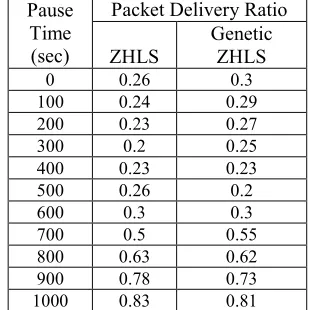
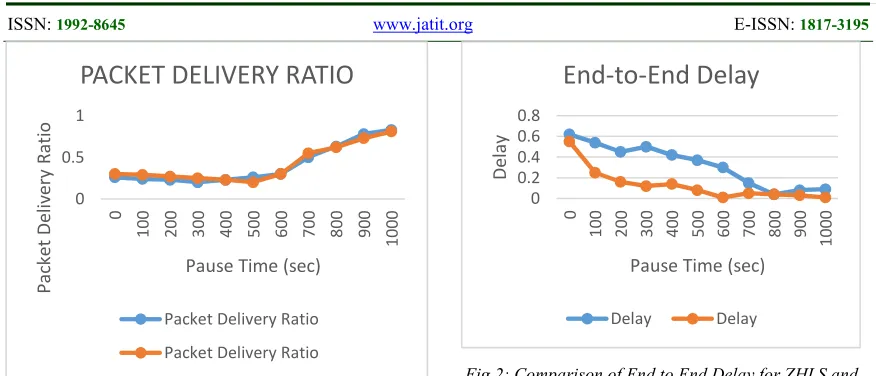
[image:6.612.339.496.404.559.2]The relative investigation of both ZHLS and Genetic ZHLS for diverse estimation on Packet Delivery Ratio, Total Control overhead and Average End-to-End Delay at diverse Mobile Environments of the node is specified. As given in Table 3 and Figure 1, the modification in PDR for Genetic ZHLS is nearly identical to ZHLS for diverse mobility circumstances. But still, there is an enhancement of approximately 3% in the entire mobility environments.
Table 3: Comparison of Packet Delivery Ratio for ZHLS and Genetic ZHLS
Pause Time
(sec)
Packet Delivery Ratio
ZHLS
Genetic ZHLS
0 0.26 0.3
100 0.24 0.29
200 0.23 0.27
300 0.2 0.25
400 0.23 0.23
500 0.26 0.2
600 0.3 0.3
700 0.5 0.55
800 0.63 0.62
900 0.78 0.73
1000 0.83 0.81
Parameters Value
Crossover
probability 65%
Crossover point Arbitrarily Nominated Two-point Crossover Mutation
probability 0.50%
Population Size 2xNo. Of Nodes
Selection Roulette-Wheel Selection Substitute Paths 3
78 Fig 1: Comparison of Packet Delivery Ratio for ZHLS
and Genetic ZHLS
The effect of average end-to-end delay on the movement of the nodes is given in Figure 2 and Table 4. Outcomes illustrates that the delay aspect is desperately minimized as the pause time is minimum with maximum mobility. At very high
mobility circumstance, Genetic
ZHLSprovidesapproximately10%-20% improved outcomes compared to ZHLS might be due to minimization in congestion owing to load balancing of the topology. However, as the flexibility of the nodes moves to a steady state, both the approaches behave identical.
Table 4: Comparison of End to End Delay for ZHLS and Genetic ZHLS Pause Time (sec) Delay ZHLS Genetic ZHLS
0 0.62 0.55
100 0.54 0.25
200 0.45 0.16
300 0.5 0.12
400 0.42 0.14
500 0.37 0.08
600 0.3 0.01
700 0.15 0.05
800 0.04 0.04
900 0.08 0.03
[image:7.612.87.525.75.263.2]1000 0.09 0.01
Fig 2: Comparison of End to End Delay for ZHLS and Genetic ZHLS
[image:7.612.133.258.477.653.2]The Figure 3 and Table 5 represents the influence of control overhead on the flexibility of the nodes. There is an enhancement in the minimization of control overhead in the topology owing to Genetic ZHLS to a maximum of 30% and a minimum of 10%. Genetic ZHLA has employed the benefit of availability of alternative paths. This minimized the control overhead due to relocation of the novel paths at any time when it is essential. Even at maximum mobility circumstances, outcomes are evidenced to be worthy with a significant minimization in control overhead to approximately 30%. At lesser mobility circumstances and while the nodes are not mobile, an enhancement of10% in the reduction of control overhead is found.
Table 5: Comparison of Total Control Overhead for ZHLS and Genetic ZHLS
Pause Time (sec) Control Overhead ZHLS Genetic ZHLS
0 2950 1900
100 2400 2200
200 2150 1850
300 2089 1760
400 1990 1520
500 1920 1490
600 1810 1440
700 1760 1350
800 1723 1280
900 1650 1176
1000 1550 1060
0 0.5 1 0 1 0 0 2 0 0 3 0 0 4 0 0 5 0 0 6 0 0 7 0 0 8 0 0 9 0 0 1 0 0 0 P a ck e t D e li v e ry R a ti o
Pause Time (sec)
PACKET DELIVERY RATIO
Packet Delivery Ratio
Packet Delivery Ratio
0 0.2 0.4 0.6 0.8 0 1 0 0 2 0 0 3 0 0 4 0 0 5 0 0 6 0 0 7 0 0 8 0 0 9 0 0 1 0 0 0 D e la y
Pause Time (sec)
End-to-End Delay
79 Fig 3: Comparison of Total Control Overhead for ZHLS
and Genetic ZHLS
6. CONCLUSIONS
An enhancement to the existing Zone based Hierarchal Link State Routing Protocol is proposed in this paper by employing the genetic Approach known as Genetic Zone based Hierarchal Link State Routing Protocol. Genetic ZHLS is further proficiently compared with ZHLS as it diminishes significantly the average end-to-end delay and control overhead. The outcomes represents that a minimization in the delay caused by novel method is 20% and the total control overhead by minimized is30%. These outcomes are evidenced fascinating. The proposed methodology employed Genetic Algorithmic to discovery restricted group of alternative paths so as to balance the load of the topology. The alternative paths are additionally effective that uses Genetic ZHLS to function in congestion conditions and likewise at the node/linkage damages situations.
REFERENCES
[1] S. Sesay, Z. Yang, and J. He, “A Survey on Mobile Ad Hoc Wireless Network”,
Information Technology Journal, Vol. 3, No. 2, 2004, pp. 168–175.
[2] C. K. Toh, Ad Hoc Mobile Wireless Networks protocols and Systems, Prentice Hall PTR, New Jersey, 2002.
[3] C. E. Perkins, “Ad Hoc Networking”, Addison-Wesley, March 2005.
[4] B.S. Manoja, R. Ananta padmanabhab, C. Siva Ram Murthya, “Multi-hop cellular networks: Architecture and protocols for best-effort and real-time communication”, Elsevier, Vol. 65, No. 1, 2005, pp.767 – 791.
[5] L. Barolli, A. Koyama, T. Suganuma, N. Shiratori, “GAMAN: A GA Based QoS Routing Method for Mobile Ad-hoc Networks”, Journal of Interconnection Networks (JOIN), Vol.4, No.3, 2003, pp.251-270.
[6] M. Joa Ng and I. Tai Lu, “A Peer-to-Peer Zone-Based Two Level Link State Routing for Mobile ad Hoc Networks”, IEEE on Selected Areas in Communications, Vol. 17, No. 8, 1999, pp. 1415-1425.
[7] Kemal Akkaya, Mohamed Younis, “A survey on routing protocols for wireless sensor networks”, Elsevier. Vol. 3, No. 1, 2005, pp. 325–349.
[8] Mehran Abol hasan, Tadeusz Wysocki, Eryk Dutkiewicz, “A review of routing protocols for mobile ad hoc networks”, Elsevier, Vol. 29, No. 1, 2004, pp. 23-33.
[9] Mohammed Tarique, Kemal E.Tepe, Sasan Adibi, Shervin Erfani, “Survey of multi path routing protocols for mobile Adhoc networks”, Elsevier, 2009, pp.32-44.
[10] Jianping Wang, Eseosa Osagie, Parimala Thulasi raman , Ruppa K. Thulasiram, “HOPNET: A hybrid ant colony optimization routing algorithm for mobile ad hoc network”,
Elsevier, Vol. 7, No. (1), 2009, pp.213- 313. [11] Sonia Waharte & Raouf Boutaba & Youssef
Iraqi & Brent Ishi bashi, “Routing protocols in wireless mesh networks: challenges and design considerations”, Springer Science and Business Media, vol. 29, No. 1, 2006, pp.285– 303.
[12] D. E. Goldberg, “Genetic algorithms in Search, Optimization and Machine learning”, Addison Wesley, 1989, pp. 412.
[13] Sundaram Raja gopalan, Chien-Chung Shen, “ANSI: A swarm intelligence-based unicast routing protocol for hybrid ad hoc networks”,
Elsevier, vol. 29, No. 1, 2006, pp.485–504. [14] Cheng Hong-bing Yang Geng, HU Su-jun.
(2008). “NHRPA: a novel hierarchical routing protocol algorithm for wireless sensor networks”, Elsevier,Vol. 15, No. 3, 2008, pp.75–81.
[15] Tseng S.Y, Huang Y.M, and Lin C.C, “Genetic algorithm for delay and degree-constrained multimedia broadcasting on
overlay networks”, Computer
Communication., Vol. 29, No. 17, November 2006, pp. 3625–3632.
[16]. Ahmed E.A.A. Abdulla, Hiroki Nishiyama, Nei Kato, “Extending the lifetime of wireless 0
1000 2000 3000 4000
0
1
0
0
2
0
0
3
0
0
4
0
0
5
0
0
6
0
0
7
0
0
8
0
0
9
0
0
1
0
0
0
C
o
n
tr
o
l
O
v
e
rh
e
a
d
Pause Time (sec)
Total Control Overhead
Control Overhead
80 sensor networks: A hybrid routing algorithm”,
Elsevier, Vol. 35, No. 1, 2012, pp.1056–1063. [17] Kumar S.D., Manikandan K. and Durai M.A.,
‘Secure On-Demand Routing Protocol for MANET using Genetic Algorithm’,
International Journal of Computer Applications, Vol. 19, No. 8, 2011, pp. 29- 34. [18] Ting Lu and Jie Zhu, ‘Genetic Algorithm for Energy-Efficient QoS Multicast Routing’,
IEEE Communication Letter, Vol .17, No.1, January 2013.
[19] Munetomo M., Takai Y. and Sato Y., ‘An Adaptive Routing Algorithm with Load Balancing by a Genetic Algorithm’,
Transaction on Information Processing Society of Japan, 1998, pp. 1-6.
[20] Arun Biradar, Ravindra C. Thool, “Reliable Genetic Algorithm Based Intelligent Routing for MANET”, International Journal of Wireless & Mobile Networks, Vol. 6, No. 2, April 2014
[21] Sara Aliabadi and Mehdi Agha Saram, “An approach to DSR routing QOS by fuzzy-genetic algorithms”, International Journal of Wireless & Mobile Networks, Vol. 6, No. 2, April 2014