www.ijraset.com Vol. 2 Issue IX, September 2014
ISSN: 2321-9653
I N T E R N A T I O N A L J O U R N A L F O R R E S E A R C H I N A P P L I E D S C I E N C E
AN D E N G I N E E R I N G T E C H N O L O G Y (I J R A S E T)
Page 52
DDoS Services Attacks In Mobile Ad-hoc Network
Anju#1, Vinod Saroha*2
#
M.Tech(NS),BPSMV Sonipat, Asstt. Prof. in BPSMV Sonipat
Abstract---In vision of the growing demand for wireless information and data services, it is very important to providing
faster and reliable mobile access to users. Today's, not only mobile phones, but also laptops and PDAs are used by people in
their professional and private lives. These devices are used separately for the most part that is their applications do not
interact. Sometimes, a group of mobile devices form a unstructured, temporary network as they move towards each other.
This allows users to share documents, secret information and other useful information. This kind of unstructured,
temporary network referred to as mobile ad hoc networks sometimes just called ad hoc networks or multi-hop wireless
networks, and are expected to play an important role in our daily lives in near future. As the use of ad-hoc network
increased the security concerned also needed to prevent the network from malicious users. In wired network , it is easy to
provided security during transmission than the Mobile ad-hoc network. DDoS attack is a big problem in MANET. In these,
paper we discussed about DDoS attacks and there detection mechanisms.
Keywords--- DDoS, MANETs, UDP, TCP SYN, Routing Protocol, Attacks, Prevent, Detection, hop.
I. INTRODUCTION
MANET is a unstructured network that can be established
with no fixed infrastructure. All its nodes act as routers and
perform its detection and maintenance of paths to other nodes
in the. Its routing protocol has to be able to deal with the
new challenges i.e nodes mobility, limited bandwidth and
limited power supply , security maintenance, quality of
services,. These challenges set new demands on MANET
routing protocols.
Ad hoc networks have a large range of military and
commercial applications. It is ideal in areas where
establishing an infrastructure network is not possible or
when the purpose of the network is transient.
Security in MANETs is hard to achieve due to spontaneous
network and fully decentralized topology as well as the
vulnerabilities and limitations of wireless data transmissions.
Existing solutions that are applied in wired networks can be
used to obtain a certain level of security. However, these
solutions are not always be suitable to wireless networks.
Therefore ad hoc networks have their own vulnerabilities that
cannot be always tackled by these wired network security
solutions. One of the distinct features of MANETs is that all
nodes have to be performing in the routing process.
Traditional routing protocols designed for wired networks
cannot be useful in ad hoc networks. The major factor is that
the wireless medium is less secure than wired network. The
routing protocol provides the upper limit to security in any
packet network. If routing can be misdirected, the entire
Page 53 This problem is enlarged in ad hoc networks. Another
difficulty is that it is hard to decide compromised nodes from
nodes that are affliction from broken links. Current wireless
research states that MANET presents a larger security
problem than conventional wired and wireless networks.
DDoS attacks has also become large problem for users. A
DDoS attack is a distributed, major attempt by malicious
users to flood the victim network with huge number of
packets. This exhausts the sufferer network of resources
such as bandwidth, computing power, etc. The victim is
incapable to provide services to its legal clients and network
performance is greatly deteriorated.
II. BACKGROUND
There are two distinct approaches for enabling wireless
communications between mobile hosts [1]. The one approach
is to use a fixed network communications that provides
wireless access points. In this network, a wireless host
communicates with the network through an access point within
its contact radius. When it goes out of range of one access
point than connects with a new access point and starts
communicating through it. An example is the cellular network
infrastructure. A most important problem of this approach
is handoff, which tries to handle the situation when a
connection should be smoothly handed over from one access
point to another access point without noticeable delay or
packet loss. Another problem is based on a fixed infrastructure
are limited to places.
The second approach is the wireless ad- hoc network with no
fixed infrastructure. Laptops and PDAs that communicate
directly with each other are examples of nodes in an ad hoc
network. Each of the nodes has a wireless interface and
communicates with others over either radio or infrared
channels. some well-known ad hoc network applications are:
Two-way Work
Crisis-management Applications
Personal Area Networking and Bluetooth MANETs Characteristics and Challenges:
Dynamic topologies
Bandwidth-constrained, variable capacity links
Energy-constrained operation.
Security
Security Attacks in MANETs:The security attacks in MANETs are Active attacks and Passive attacks.Active Attack is an attack when disobedient node has to paid some energy costs in
order to perform the threat and consider as malicious node .
Passive Attacks are mainly due to lack of support with the purpose of saving energy selfishly and considered as selfish.
Various types of attacks in MANETs are:Denial of Service, Impersonation,Modification, Fabrication, Replay,
Eavesdropping , Malicious Software and Lack of
Cooperation.
III. DISTRIBUTED DENIAL OF SERVICE (DDoS)
ATTACK
DoS Attack:A denial of service attack is categorized by an unambiguous attempt by an attacker to prevent legal users of
a service from using the required resources [3]. DoS attacks
include:
Flood a network
Interrupt connections between two machines
Prevent a particular individual from accessing a service
www.ijraset.com Vol. 2 Issue IX, September 2014
ISSN: 2321-9653
I N T E R N A T IO N A L J O U R N A L F O R R E S E A R C H I N A P P L I E D S C I E N C E
AN D E N G I N E E R I N G T E C H N O L O G Y (I J R A S E T)
number of packets [4]. This exhausts the victim network of
resources such as bandwidth, computing power, etc. The
sufferer node is unable to provide services to its legal clients
and network performance is very much deteriorated. The
distributed format the many to one dimension. A distributed
denial of service attack is consists of four elements, as shown
in Figure 1.The following steps take place during a
distributed attack:
The real attacker sends an “execute” message to the control master program.
The control master program receives the “execute” message and propagates the command to the attack
daemons under its control.
Upon receiving the attack command, the attack daemons begin the attack on the victim.
Figure 1: The four Components of DDoS Attacks.
Architecture of DDoS Attacks: The flooding traffic reaches the victim, the attacker must work together with all its agents.
This communication is provided with the help of control
channels between the agents and the attacker [5]. This
teamwork requires all agents send traffic based on command
signals received from the attacker. The network which consists
of the attacker, agents, and control channels is called the attack
networks. The attack networks are divided into three types:
The agent-handle model
The Internet Relay Chat (IRC)-based model
The reflector model.
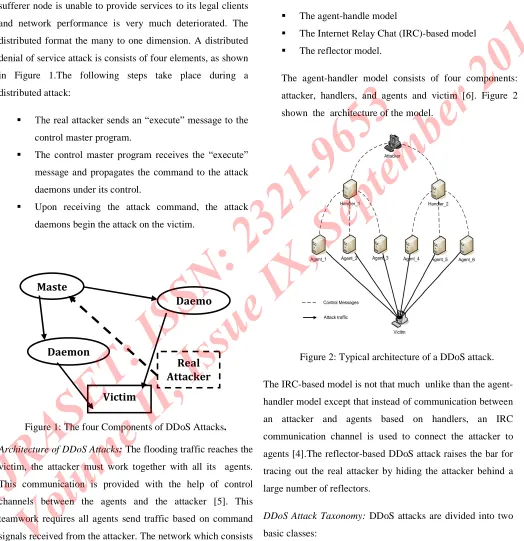
The agent-handler model consists of four components:
attacker, handlers, and agents and victim [6]. Figure 2
[image:4.612.44.568.142.683.2]shown the architecture of the model.
Figure 2: Typical architecture of a DDoS attack.
The IRC-based model is not that much unlike than the
agent-handler model except that instead of communication between
an attacker and agents based on handlers, an IRC
communication channel is used to connect the attacker to
agents [4].The reflector-based DDoS attack raises the bar for
tracing out the real attacker by hiding the attacker behind a
large number of reflectors.
DDoS Attack Taxonomy:DDoS attacks are divided into two basic classes:
Maste
Daemo
Daemon
Victim
Bandwidth depletion attacks
Resource depletion attacks.
Bandwidth Depletion Attacks is considered to flood the victim network with unnecessary traffic that prevents legal
traffic from reaching the main victim. Example of bandwidth
depletion attacks are:
Flood attacks
Amplification attacks.
Flood Attacksinvolves sending large volumes of traffic to a victim system, to block the victim system’s network
bandwidth with IP traffic. It have been done using both
UDP and ICMP packets.
An flood attack occurs when the large volumes of ICMP_ECHO_REPLY packets and UDP
unreachable” send to the victim system.
Amplification Attacksinvolves the attacker to send messages to a broadcast IP address, using this to cause all systems in
the subnet reached by the broadcast address to send a reply to
the victim system. The example of an amplification attack :
Smurf attack and Fraggle attack.
Resource Depletion Attacksconsidered to tie up the resources of a victim system to prevent it from using that resources and
unable to process legal requests for service. The
resource depletion attack is: misusing the TCP SYN
protocol, and the other misusing the PUSH+ACK protocol. is considered to flood the
victim network with unnecessary traffic that prevents legal
traffic from reaching the main victim. Example of bandwidth
es sending large volumes of traffic to a victim system, to block the victim system’s network
bandwidth with IP traffic. It have been done using both
occurs when the large volumes of
ICMP_ECHO_REPLY packets and UDP “ Destination
involves the attacker to send messages
to a broadcast IP address, using this to cause all systems in
the subnet reached by the broadcast address to send a reply to
em. The example of an amplification attack :
considered to tie up the resources
of a victim system to prevent it from using that resources and
The example of
misusing the TCP SYN
[image:5.612.45.578.104.689.2]protocol, and the other misusing the PUSH+ACK protocol.
Figure 3: DDoS Attack Taxonomy
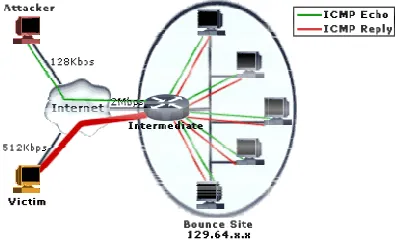
The Smurf attack: The attacker sends a huge amount of ICMP echo packets to the router at 128Kbps. The attacker modifies
the packets by changing the source IP to the IP address of the victim’s computer so replies to the echo packets will be sent
to that address. The destination address of the packets is a
broadcast address.. A same attack that uses UDP echo
packets instead of ICMP echo packets is called a Fraggle
attack.
Figure 4: Smurf Attack in progress DDoS Attack Resource Depletion Bandwidth Depletion 1.Flood Attack
2. Amplification Attack 2.Protocol Exploit Attack 1.Malformed Packet Attack
Active Attack Passive Attack
Packet Dropping
3: DDoS Attack Taxonomy
: The attacker sends a huge amount of ICMP
echo packets to the router at 128Kbps. The attacker modifies
the packets by changing the source IP to the IP address of the victim’s computer so replies to the echo packets will be sent
ation address of the packets is a
broadcast address.. A same attack that uses UDP echo
packets instead of ICMP echo packets is called a Fraggle
4: Smurf Attack in progress. Protocol Exploit Attack Malformed Packet Attack
Passive Attack
[image:5.612.328.527.512.635.2]www.ijraset.com Vol. 2 Issue IX, September 2014
ISSN: 2321-9653
I N T E R N A T I O N A L J O U R N A L F O R R E S E A R C H I N A P P L I E D S C I E N C E
AN D E N G I N E E R I N G T E C H N O L O G Y (I J R A S E T)
Page 56 IV. DETECTION OF DDOS ATTACKS
It is important that a detection system identifies both the
malicious node and attack types. Without them, it is hard to
resolve how to respond significantly without interrupting
normal communication. [9]. The basic idea is to find out the
detailed attack information from a set of identification rules,
which are pre-computed for known attacks.For each attack,
the node that runs the corresponding detection rule the is
called monitoring node, and the node whose behavior is being analyzed known as monitored node. Now, some
notations of statistics (features) used in these rules are
described. Here, K is used to represent the monitoring node
and k the monitored node.
# (*, k): the number of incoming packets on the monitored node k.
# (k, *): the number of outgoing packets from the monitored node k.
# ([k], *): the number of outgoing packets of which the monitored node k is the source.
# (*, [k]): the number of incoming packets of which the monitored node k is the destination.
# ([s], k): the number of incoming packets on k of which node s is the source.
# (k, [d]): the number of outgoing packets from k of which node d is the destination.
# (k, n): the number of outgoing packets from k of which n is the next hop.
# ([s], K, k): the number of packets that are originated from s and transmitted from K to k.
# ([s], K, [k]): the number of packets that are originated from s and transmitted from K to k, of which k is the
final destination.
# ([s], [d]): the number of packets received on the monitored node (k) which is originated from s and
destined to d.
These statistics are computed over sampling interval time Ts
and over long period T. We always assume that time interval T
is multiples of Ts.
Detection of Malicious Packet Dropping Based DDoS Attack:
Unconditional Packet Dropping: calculate the statistics Forward Percentage over time period T.
#T(k, K)- #T([k], K)
#T(K, k)- #T(K, [k])
Random Packet Dropping:Calculate the same statistics FP as Unconditional Packet Dropping. If the denominator is not zero
and FPm is less than a chosen threshold εFP (εFP < 1) but not
zero, the attack is detected as Random Packet Dropping and
node k is identified as the attacker.
Selective Packet Dropping: Calculate the statistics Local
Forward Percentage over a time period T for each source s.
#T([s], k, K)
# T([s], M, k)–#T([s], K, [k])
If the denominator is not zero and the statistics is zero
(unconditional dropping), the attack is unconditional Packet Dropping targeted at s. Likewise, if the LFP is less than εLFP (εLFP< 1), the attack is random Packet Dropping targeted at s.
In either case, m is identified as the attacker.
FP
k=
Page 57 V. CONCLUSIONS
This paper presents introduction to MANETs and DDoS
attacks. We presented the security goals and challenges that
the field of ad hoc networking faces. It also presents various
security goals for MANETs and types of attacks in MANETs.
we have discussed two types of DDoS attacks and their attack
mechanisms. These are: Malicious Packet Dropping Based
DDoS attack and Flooding Based DDoS attack. Then, we
have presented their detection mechanism which will help in
detecting attacking node and attack type.
ACKNOWLEDGEMENT
I want to acknowledge my guide Mr.. Vinod Saroha (Asst. prof. In CSE&IT deptt., BPSMV,Sonipat) for his guidelines. I also want to thank my parent’s for their support.
REFERENCES
[1] Schiller J; Mobile Communication; Second Edition,
Pearson Edition.
[2] R. Duggirala; A Novel Route Maintenance
Technique for Ad Hoc Routing Protocols; M.S.
Thesis; University of Cincinnati; November 2000.
[3] Pfleeger C P, Pfleeger S L; Security in Computing;
Third Edition, Pearson Edition.
[4] Stephen M. Specht and Ruby B. Lee; Distributed
Denial of Service: Taxonomies of Attacks, Tools,
and Countermeasures; Proceedings of the 17th
International Conference on Parallel and Distributed
Computing Systems, 2004 International Workshop
on Security in Parallel and Distributed Systems, pp.
543-550; September 2004.
[5] J. MÄolsÄa; Mitigating denial of service attacks in
computer networks; PhD thesis; Helsinki University
of Technology, Espoo, Finland; June 2006.
[6] Yonghua You; A defense framework for
flooding-based DDoS attacks; Master of Sc. Thesis; Queen's
University Kingston, Ontario, Canada; August 2007.
[7] TFreak;smurf.c;www.phreak.org/archives/exploits/
denial/smurf.c; May 6, 2003.
[8] Federal Computer Incident Response Center
(FedCIRC); Defense Tactics for Distributed Denial
of Service Attacks; Washington, DC; 2000.
[9] Yi-an Huang and Wenke Lee; A Cooperative
Intrusion Detection System for Ad Hoc Networks;