A Survey on DV-Hop localization Techniques in
Three-Dimensional Wireless Sensor Networks
https://doi.org/10.3991/ijoe.v16i10.15371
Fengrong Han ()
University Malaysia Pahang, Pekan, Malaysia Baoji University of Arts and Sciences, Baoji, China
Izzeldin Ibrahim Mohamed Abdelaziz, Xinni Liu, Kamarul Hawari Ghazali University Malaysia Pahang, Pahang, Malaysia
Hao Wang
University Malaysia Pahang, Pahang, Malaysia
Abstract—Location information is prerequisite for wireless sensor networks (WSNs) monitoring and control applications, since there is no meaning without position information for collected data. Distance vector hop (DV-Hop) localiza-tion algorithm as the typical range-free algorithm that has been widely applied in various applications. Nowadays, the research on range-free localization for WSNs is mostly based on two-dimensional (2D) space. Hence, there are few surveys concentrated on range-free localization in three-dimensional (3D) WSNs. This motivated us to present an extensive overview of enhanced DV-Hop localization algorithms in 3D WSNs. This paper focused on critical chal-lenge between 2D and 3D in localization model, representative range-free 3D localization technique surveys. Moreover, a comprehensive taxonomy of most essential enhanced methods applied in 3D DV-Hop is illustrated. A considera-ble comparison in term of localization error, computational complexity and node type is given. Future research directions dealing with localization under 3D DV-Hop is also discussed.
Keywords—Wireless sensor networks (WSNs), Range-free, Three-dimensional Localization algorithm, DV-Hop algorithm.
1
Introduction
corresponding location information, otherwise, these data will be lost collected mean-ing. Therefore, localization technology plays a fundamental role in WSNs, and it is also a hot spot in current research direction [1-2].
Location information also can be used for other purpose besides report where the incident occurred [3]. It can be utilized to establish geographic routing protocol for data transfer and query target information. It is critical for network management to build network topology based on location information for timely calculate network coverage and take necessary action to low node density area. In addition, users can transfer data to specific area at fixed time. In short, obtaining location information can make WSNs work more purposeful and efficient [4].
It is impossible if manually label location of each sensor node, since WSNs contain thousands of nodes that are randomly distributed in target or monitoring area. It is much easier that equipped each node with a Global Positioning System (GPS). How-ever, considering the constraints of price, volume, power consumption and other fac-tors, such as GPS has strict requirement of deploy environment, this solution is usual-ly not adopted. Therefore, onusual-ly a small amount number of nodes is attached GPS or marked exact location in advance. Over past two decades, many scholars have pro-posed multitude localization algorithms based on characteristics of WSNs. Those mainstream localization algorithms are commonly divided into range-based and range-free algorithms based on whether it needs additional ranging equipment or not. Comparing with range-based scheme, range-free has attracted much attention in WSNs since it only depended on network connection information without extra rang-ing equipment.
The distance vector hop (DV-Hop) localization algorithm as typical range-free al-gorithm that has been widely used for its simplicity and economy. However, it has a large error during location process, which results in suffering from low localization accuracy. Several methods have been suggested in literature to improve localization accuracy in DV-Hop localization algorithm. However, nowadays, research on range-free localization of WSNs is mostly based on two-dimensional (2D) space. Hence, there are few surveys concentrate on range-free localization in three-dimensional (3D) WSNs. For our best knowledge there is no review paper focus on DV-Hop localiza-tion algorithms for 3D WSNs. Kaur et al. [5]. proposed a thorough survey on DV-Hop localization techniques, but it is only involved ten plus paper under 2D WSNs. What’s more, the latest literature is 2016. It motivated us to investigate a large body of en-hanced localization algorithms in DV-Hop for 3D WSNs.
With this paper, readers can have a more thorough understanding of DV-Hop local-ization under 3D WSNs, as well as research trends and future research directions in this area. In this survey, we present key issues and inherent challenges faced by DV-Hop localization techniques in 3D WSNs.
2
Related Surveys on DV-Hop Localization
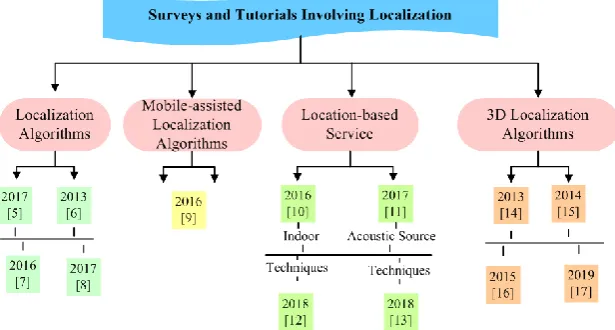
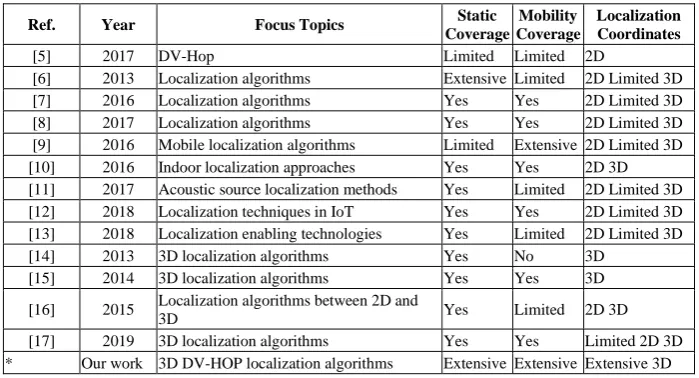
In recent years, it have been several surveys and tutorials on localization for WSNs, which focus on different concern points, such as [5-8] highlights localization algorithms, [9] spotlights mobile localization algorithms, [10-13] concentrates on location protocols, location-services applications and IoT infrastructure, location security, location techniques etc., [14-17] are in terms of 3D localization algorithms, all of them are illustrated in Fig 1.
Fig. 1. Recent representative surveys and tutorials involving localization
Table 1. Comparison of existing surveys relating localization in WSNs.
Ref. Year Focus Topics Static
Coverage Mobility Coverage
Localization Coordinates
[5] 2017 DV-Hop Limited Limited 2D
[6] 2013 Localization algorithms Extensive Limited 2D Limited 3D
[7] 2016 Localization algorithms Yes Yes 2D Limited 3D
[8] 2017 Localization algorithms Yes Yes 2D Limited 3D
[9] 2016 Mobile localization algorithms Limited Extensive 2D Limited 3D
[10] 2016 Indoor localization approaches Yes Yes 2D 3D
[11] 2017 Acoustic source localization methods Yes Limited 2D Limited 3D
[12] 2018 Localization techniques in IoT Yes Yes 2D Limited 3D
[13] 2018 Localization enabling technologies Yes Limited 2D Limited 3D
[14] 2013 3D localization algorithms Yes No 3D
[15] 2014 3D localization algorithms Yes Yes 3D
[16] 2015 Localization algorithms between 2D and
3D Yes Limited 2D 3D
[17] 2019 3D localization algorithms Yes Yes Limited 2D 3D
* Our work 3D DV-HOP localization algorithms Extensive Extensive Extensive 3D
3
Basic DV-Hop Algorithm
DV-Hop localization scheme was first came up with Dragons Niculescu and his team [18] for 2D WSNs. It is already successful applied under 3D WSNs. The locali-zation process of DV-Hop is consisting of 3 basic steps. Here, we take 2D as an illus-tration.
Step 1: Estimate minimum hop counts between nodes
All anchor nodes broadcast information packet with position and hop count to neighbor nodes. The communicable neighbor node after received collected data, it will compare with precious hop count, if it is smaller, data hop count plus 1. Then, transfer to next neighbor nodes, until the whole network gets minimum hop counts between each node.
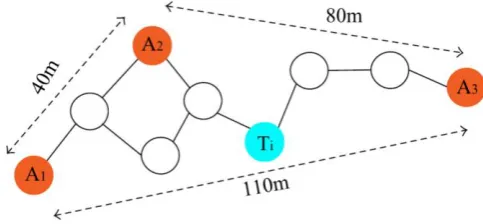
Here, Fig. 2 is one case of DV-Hop algorithm, A1, A2 and A3 are anchor nodes, and the rest nodes are unknown nodes. It is assumed unknown node Ti is the one that needs to be located. The minimum hop A1 to A2, A2 to A3 and A1 to A3 is 2, 5 and 7,
respectively, based on first phase. The minimum hop of Ui to A1, A2 and A3 is 4, 2 and
Fig. 2. An instance of DV-Hop
Step2: Estimate average hop size (AHS)
All anchor nodes obtained minimum hop counts and node position information af-ter Step 1. It employed Equation (1) to calculate AHS.
𝐴𝑣𝑔𝐻𝑜𝑝𝑆𝑖𝑧𝑒𝑖=𝛴ⅈ≠𝑗 𝑚√(𝑥
𝑖−𝑥𝑗)2+(𝑦𝑖−𝑦𝑗)2
𝛴ⅈ≠𝑗𝑚𝐻𝑖𝑗 (1)
Where (xi, yi) and (xj, yj) are the coordinate of anchor node i and j, respectively. Hij
is the hop count between anchor node i and j. AvgHopSizei represents the AHS of
anchor node i.
The AHS of A1, A2and A3 can be calculated as following.
AvgHopSize_A1 = (40 + 110) / (2+7) = 16.67
AvgHopSize_A2 = (40 + 80) / (2+5) = 17.14
AvgHopSize_A3 = (110 + 80) / (7+5) = 15.83
Equation (2) is employed to calculate estimate distance dijbetween anchor node i
and unknown node U.
𝑑𝑖𝑢 = 𝐴𝑣𝑔𝐻𝑜𝑝𝑆𝑖𝑧𝑒𝑖× 𝐻𝑖𝑢 (2)
Here, we still employed Fig. 2 as an instance. Since the minimum hop of Ui to A1,
A2 and A3 are 4, 2 and 3, respectively, so it chose AvgHopSize_A2 to estimate the
dis-tance of Ui to A1, A2 and A3, it can be obtained by Equation (2).
d_ A1_Ti = 17.14 ×4 = 68.56
d_ A2_Ti = 17.14 ×2 = 32.48
d_ A3_Ti = 17.14 ×3 = 51.42
Step 3: Estimate unknown node coordinate.
When unknown node received at least three estimated distance form anchor nodes, maximum likelihood method or multilateral measurement method can be utilized to estimate the coordinate of unknown node.
Let (xu, yu) is coordinates of unknown node u, and diu is the distance between
un-known node u and anchor node Ai, ∈ {1, 2, 3…n}, diu can be obtained based on
(𝑥𝑢− 𝑥1)2+ (𝑦𝑢− 𝑦1)2= 𝑑1𝑢2 (𝑥𝑢− 𝑥2)2+ (𝑦𝑢− 𝑦2)2= 𝑑2𝑢2 (𝑥𝑢− 𝑥𝑛)2+ (𝑦𝑢− 𝑦𝑛)2= 𝑑𝑛𝑢2
(3)
Equation (3) can formulated into AX=B, see as follow.
𝐴 = −2 × [
𝑥1− 𝑥𝑛 𝑦1− 𝑦𝑛 𝑥2− 𝑥𝑛 𝑦2− 𝑦𝑛 𝑥𝑛−1− 𝑥𝑛 𝑦𝑛−1− 𝑦𝑛
] (4)
𝑋 = [𝑥𝑦𝑢𝑢] (5)
𝐵 = [
𝑑12− 𝑑𝑛2− 𝑥12+ 𝑥𝑛2− 𝑦12+ 𝑦𝑛2 𝑑22− 𝑑𝑛2− 𝑥22+ 𝑥𝑛2− 𝑦22+ 𝑦𝑛2 𝑑𝑛−12 − 𝑑𝑛2− 𝑥𝑛−12 + 𝑥𝑛2− 𝑦𝑛−12 + 𝑦𝑛2
] (6)
The coordinate (xu, yu) of unknown node can be estimated by Equation (7).
𝑋 = (𝐴𝑇𝐴)−1𝐴𝑇𝐵 (7)
4
Error Analysis of DV-Hop in 3D WSNs
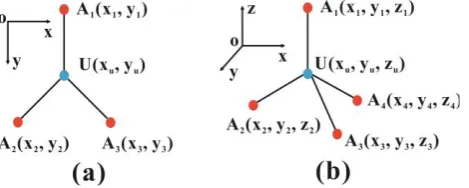
DV-Hop utilized hop multiple hop size to instead straight-line distance. There is inevitable error in estimate coordinate of unknown node. In addition, there are some distinguishes between 2D and 3D localization algorithm, the later one has more chal-lenges. Fig.3 demonstrated difference between 2D and 3D localization model in WSNs. Where, U and A denote unknown node and anchor nodes, respectively. It takes at least three anchor nodes in 2D space, but it must employ four in 3D environ-ment, that means more anchor nodes are needed under 3D environenviron-ment, which brings not only higher requirement to anchor density, but also higher algorithm complexity.
Fig. 3. Localization model in (a)2D and (b)3D
influ-enced by terrain obstacle, especially, in harsh environment. DV-Hop localization algorithm will perform badly without considering these issues.
Fig. 4. Localization coplanarity issue in 3D model
5
Enhanced DV-Hop localization in 3D WSNs
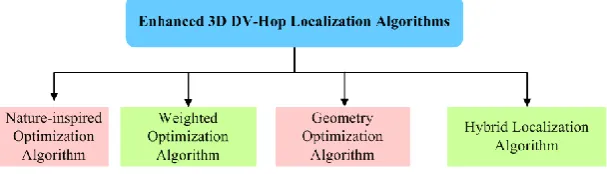
In recent years, researchers in various countries have proposed numerous enhanced Hop localization algorithms for 3D WSNs. We classified recent improved DV-Hop localization algorithms under 3D into four categories according to the character of localization process, based on nature-inspired optimization algorithm, weighted optimization algorithm, geometry optimization algorithm and hybrid localization algorithm. The classification is illustrated in Fig.5 and comprehensive summary and comparison of enhanced DV-Hop localization algorithm is discussed in next follow-ing sections.
Fig. 5. Classification of enhanced 3D DV-Hop
5.1 Based on nature-inspired optimization algorithm
Non-dominated genetic algorithm (NSGA Ⅱ), Particle Swarm Optimization (PSO), Cuck-oo Search (CS), Genetic Algorithm (GA) etc. are successful exploited in DV-Hop localization scheme with transformed locate node problem into optimal solution. The most popularity converted function is as below.
𝑓(𝑥, 𝑦, 𝑧) = 𝑀𝑖𝑛 1
𝑚 ∑ |√(𝑥 − 𝑥𝑖)
2+ (𝑦 − 𝑦𝑖)2+ (𝑧 − 𝑧𝑖)2− 𝑑𝑖| 𝑚
𝑖=1,2,…𝑚 (8)
Where, f (x, y, z) is the value of particle position (x, y, z). And (xi, yi, zi) is
coordi-nate of anchor node i. And di is estimated distance between unknown u and anchor
node i.
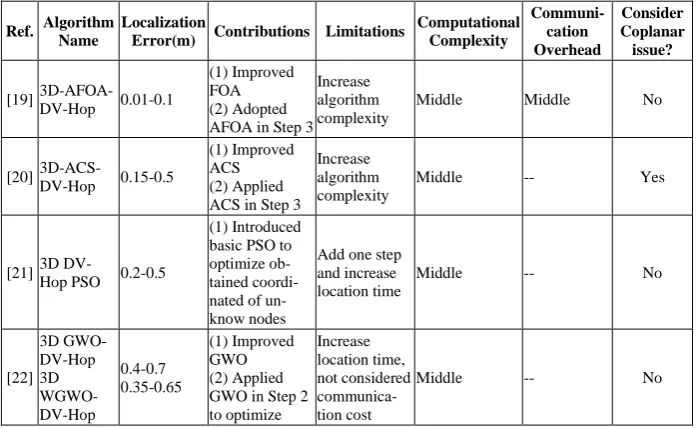
Qu [19] proposed adaptive fruit fly optimization algorithm (AFOA) to enhance the drawbacks of FOA in 2D DV-Hop by adopted a weight coefficient, named as 3D-AFOA. It boosted search ability through learn from merits of PSO and FOA. Howev-er, even it obtained better result, but did not conduct same experiment with DV-Hop. Similarly, Zhang et al. [20] introduced adaptive cuckoo search (ACS) algorithm to conquer slow convergence issue of original CS. The ACS mainly concentrated on search step, abandoned nest strategy, and introduced convergence function which greatly boost stability and efficiency. Besides, the author also considered multicollin-earity problem by adopted tetrahedron mesh. To reduce the complexity of nature-inspired optimization algorithm, Chen et al. [21] introduced basic PSO in 3D DV-Hop, its initial population is generated around unknown nodes. But the 3D DV-Hop PSO increased one phase comparing with traditional DV-Hop algorithm that need much time to locate unknown nodes. Grey wolf optimization (GWO) is employed to optimize optimal AHS in DV-Hop algorithm, named as GWO-DV-Hop [22]. The author also introduced weighted GWO to further enhance estimate distance between unknow node and anchor nodes. Both GWO-DV-Hop and WGWO-DV-Hop conduct-ed under 2D and 3D network environment, results shown both boost localization accuracy to some extent, but computational complexity is increased.
N2-3DDV-Hop demonstrated strong stability and higher localization accuracy under diversions complex topologies.
All before-mentioned optimization algorithms are improved localization accuracy of 3D DV-Hop at some degree, that mainly take advantage of each nature-inspired algorithm characteristic. Besides, converted function or fitness function will largely affect located results. The summary of Table 2, which briefly describe representative nature-inspired optimization algorithm of DV-Hop algorithms in 3D WSNs with their key characteristics.
It can be summarised from Table 2 that nature-inspired based algorithms can high-ly reduce localization error, but computational complexity is increased. Most above-mentioned algorithm transformed localization issue into single optimization problem, average localization error is largely reduced based on multi-objective optimization. We can conduct below outcomes, see as following:
• Those enhanced localization methods based on nature-inspired optimization algo-rithms for DV-Hop to are most concentrated in the third step instead of lease squares to obtain more accuracy coordinate of unknown nodes [19-20, 23, 25]. It did not add any communication cost, but add algorithm complexity to a certain de-gree.
• In addition, it applied to optimize AHS in step two by take advantage of its great search ability, since AHS is the main reason that lead to greater location error [22, 24]. It also did not increase communication overhead.
• Besides, nature-inspired optimization algorithm is adopted to narrow coordinate error of unknown node that calculated by basic DV-Hop [21]. It added one step that not only increase computational complexity but also consume more energy.
Table 2. Comparing of enhanced 3D DV-Hop based on nature-inspired optimization algorithm
Ref. Algorithm Name Localization Error(m) Contributions Limitations Computational Complexity
Communi-cation Overhead Consider Coplanar issue?
[19] 3D-AFOA-DV-Hop 0.01-0.1
(1) Improved FOA (2) Adopted AFOA in Step 3
Increase algorithm complexity
Middle Middle No
[20]
3D-ACS-DV-Hop 0.15-0.5
(1) Improved ACS (2) Applied ACS in Step 3
Increase algorithm complexity
Middle -- Yes
[21] 3D
DV-Hop PSO 0.2-0.5
(1) Introduced basic PSO to optimize ob-tained coordi-nated of un-know nodes
Add one step and increase location time
Middle -- No
[22] 3D GWO-DV-Hop 3D WGWO-DV-Hop 0.4-0.7 0.35-0.65 (1) Improved GWO (2) Applied GWO in Step 2 to optimize Increase location time, not considered communica-tion cost
AHS (3) Adopted WGWO in Step 3 [23] 3DAC- PSO-DV-Hop 0.3-0.45 (1) Combined AC and PSO (2) applied AC+PSO in Step 3 Increase algorithm complexity
High -- No
[24] 3D- GAIDV-Hop 0.15-0.65 (1) Corrected AHS by dis-tance
(2) Applied GA in Step 3
Increase communica-tion overhead
High -- Yes
[25]
N2-3DDV-Hop 0.25-0.55
(1) Consider two constrained factors (2) Applied NSGAⅡ in Step 3
Increase algorithm complexity
High High No
5.2 Based on weighted optimization algorithm
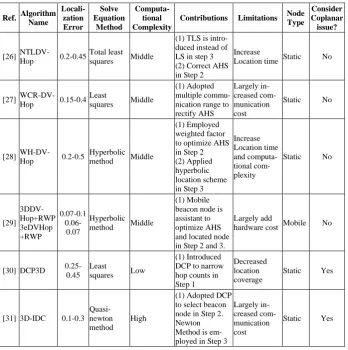
The main drawbacks of DV-hop are inaccurate AHS that lead to more hop counts more errors. Accordingly, some academics brought forward weighted factors to bal-ance priority of less hop counts in whole networks. Zhang et al. [26] introduced dis-tance deviation correction and total least squares (TLS) in DV-Hop, named as NTLDV-HOP. AHS is corrected by distance deviation correction that depend on actual distance between anchor nodes. Besides, TLS is instead of least square to solve non-linear equation. The NTLDV-HOP illustrated good performance under low an-chor node density. Correspondingly, AHS is redressed by weighted value that based on multiple communication radius in paper [27]. However, employed more communi-cation radius will greatly increase energy consumption. A. Hadir et al. [28] adopted weighted average method to optimize AHS and employed hyperbolic location scheme in third stage. He [29] also adopted mobile beacon nodes to further improve localiza-tion coverage, but it extremely increased hardware cost. The new concept of DCP in 3D is proposed in paper [30]. The authors introduced DCP3D to heighten localization accuracy of DV-Hop by narrow hop counts and DCP value. The idea of DCP is also applied in paper [31] to address coplanar issue, called 3D-IDC. Every four communi-cable anchor nodes are divided into one group, best anchor group is selected based on DCP value. Furthermore, quasi-newton method is utilized to address unconstrained optimization equation. It is highlight that located node as auxiliary anchor nodes to participate in location process under next round. Table 3 is outlined typical DV-Hop localization schemes in 3D WSNs based on weighted optimization algorithms. It is observed from Table 3, strengthen algorithm localization accuracy based on mobile nodes is hugely enhanced.
Following conclusions can be draw, see as below.
mo-bile beacon node [29]. Besides, it is adopted to correct hop count by multiple commu-nication range [27], selected high quality beacon node [30-31], which will increase communication cost at some degree.
Table 3. Comparing of enhanced 3D DV-Hop based on weighted optimization algorithm
Ref. Algorithm Name Locali-zation Error Solve Equation Method Computa-tional Complexity
Contributions Limitations Node Type
Consider Coplanar issue?
[26]
NTLDV-Hop 0.2-0.45
Total least squares Middle
(1) TLS is intro-duced instead of LS in step 3 (2) Correct AHS in Step 2
Increase
Location time Static No
[27]
WCR-DV-Hop 0.15-0.4
Least
squares Middle
(1) Adopted multiple commu-nication range to rectify AHS
Largely in-creased com-munication cost
Static No
[28]
WH-DV-Hop 0.2-0.5
Hyperbolic
method Middle
(1) Employed weighted factor to optimize AHS in Step 2 (2) Applied hyperbolic location scheme in Step 3
Increase Location time and computa-tional com-plexity
Static No
[29] 3DDV-Hop+RWP 3eDVHop +RWP 0.07-0.1 0.06-0.07 Hyperbolic
method Middle
(1) Mobile beacon node is assistant to optimize AHS and located node in Step 2 and 3.
Largely add
hardware cost Mobile No
[30] DCP3D 0.25-0.45 Least squares Low
(1) Introduced DCP to narrow hop counts in Step 1
Decreased location coverage
Static Yes
[31] 3D-IDC 0.1-0.3 Quasi-newton method
High
(1) Adopted DCP to select beacon node in Step 2. Newton Method is em-ployed in Step 3
Largely in-creased com-munication cost
Static Yes
5.3 Based on geometry optimization algorithm
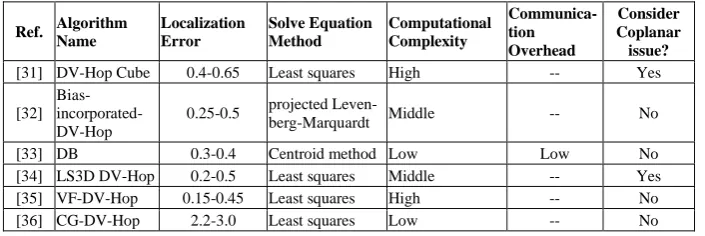
method to estimate the coordinate of unknown nodes. DV-Hop is integrated with layered structure by Dai et al. [35] to address the monitoring building issue that needs more anchor nodes. The AHS is optimized by projection-based distance measuring method. Virtual force theory is employed to enhance localization accuracy in paper [36], but its computational complexity is high. similarly, DV-Hop is also collaborated with coal mine roadway localization scheme by Wang et al. [37]. It is based on com-putational geometry that by comprehensively analyzed Voronoi diagram model to boost position accuracy. However, it is only favorable in underground roadways. In summary, most geometry optimization algorithms are taken advantages spatial struc-ture characteristics or based on specific application area. The advanced 3D DV-Hop approaches based on geometry were depicted in Table 4.
Table 4. Comparing of enhanced 3D DV-Hop based on geometry optimization algorithm
Ref. Algorithm Name Localization Error Solve Equation Method Computational Complexity
Communica-tion Overhead
Consider Coplanar issue?
[31] DV-Hop Cube 0.4-0.65 Least squares High -- Yes
[32] Bias- incorporated-DV-Hop
0.25-0.5 projected
Leven-berg-Marquardt Middle -- No
[33] DB 0.3-0.4 Centroid method Low Low No
[34] LS3D DV-Hop 0.2-0.5 Least squares Middle -- Yes
[35] VF-DV-Hop 0.15-0.45 Least squares High -- No
[36] CG-DV-Hop 2.2-3.0 Least squares Low -- No
5.4 Based on hybrid localization algorithm
Range-based scheme demonstrated superior performance in location accuracy, so, several scholars applied it in DV-Hop algorithm. Received signal strength indicator (RSSI) [38] is utilized to calculate weighted factor based on its first order partial de-rivative by Gou et al. [39]. AHS and estimate distance to unknown nodes are en-hanced by above mentioned weighted factor. In addition, weighted least squares method is instead of least square to address equation in last phase. Zhang et al. [40] proposed 3D-RDH to reduce the dependency on more anchor nodes, which taken advantage of RSSI to correct estimate distance of unknown nodes in one hop count. Anchor node deployment configuration is optimized by maximal independent set. Besides RSSI, representative range-free scheme, approximate point in triangle test (APIT) [41] is combined with DV-Hop in 3D to address low location accuracy under dense anchor nodes condition in paper [42]. The hybrid localization integrated merit of both two algorithms that obtain better performance under low network coverage. Both hybrid range-based and range-free localization reduced localization error at some extent, however, it will increase algorithm complexity and extra cost, especially based on range-based schemes.
since range-based location technique has high requirement of hardware. The hybrid range-free one is used in Step 3 to narrow position error of coordinate, it did not in-crease any hardware cost since it only depended on connectivity information. Since combined range-based or range-free will greatly increase algorithm complexity, espe-cially, range-based add hardware cost. Hence, hybrid localization algorithm is the mainstream method that be adopted to enhance localization accuracy of DV-Hop.
5.5 Summary
It can be conducted that nature-inspired optimization algorithm and weighted op-timization are recommended method to enhance localization accuracy of DV-Hop. The other two categories are constrained for high hardware cost or only suitable for specific scenarios or geographical environment. Most of them demonstrated superior performance of localization accuracy. The localization error of DV-Hop is largely reduced, nearly reduced by two times. It can satisfy the requirement of large-scale location-based applications. The DV-Hop localization algorithm is fit for large scale wireless sensor networks, for it only need connectivity information and wireless sen-sor networks consist of thousands of sensen-sor nodes since monitoring areas are usually great large. Besides, its location accuracy is fundamental improved after adopted optimize method. So, it can be conducted that DV-Hop will be a hot research area, it is with great potential to fulfill requirement of high location-based applications.
6
Conclusion
Location information is prerequisite for wireless sensor network monitoring and control applications. In this paper, we have provided a tutorial and survey of enhanced DV-Hop localization algorithms under 3D WSNs since most previous works concen-trated on 2D space. We summarized representative survey of range-free localization algorithms that concentrated both under 2D and 3D WSNs. Moreover, improved DV-Hop algorithms proposed in literature are investigated, with comparing in terms of localization error, computational complexity, energy consumption, node type and coplanar issue. We divided enhanced 3D DV-Hop localization into four types based on location processing characteristic. Each type of enhanced method is needed to balance location performance and algorithm cost, like nature-inspired based algorithm is greatly boosted localization accuracy, but computational complexity is high. Future probably hot topics of 3D DV-Hop localization are mobility network, irregular topol-ogy networks and multiple-objective optimization model-based localization schemes.
7
Acknowledgement
by college-level key projects under Baoji University of Arts and Sciences, project number is 209011012.
8
References
[1]Akyildiz, I. F., Su, W., Sankarasubramaniam, Y., & Cayirci, E. (2002). A survey on sensor networks. IEEE Communications magazine, 40(8), 102-114. https://doi.org/10.1109/mc om.2002.1024422
[2]Yick, J., Mukherjee, B., & Ghosal, D. (2008). Wireless sensor network survey. Computer networks, 52(12), 2292-2330. https://doi.org/10.1016/j.comnet.2008.04.002
[3]Liu, Y., Yang, Z., Wang, X., & Jian, L. (2010). Location, localization, and localizability. Journal of Computer Science and Technology, 25(2), 274-297.
[4]Viani, F., Rocca, P., Oliveri, G., Trinchero, D., & Massa, A. (2011). Localization, tracking, and imaging of targets in wireless sensor networks: An invited review. Radio Science, 46(05), 1-12. https://doi.org/10.1029/2010rs004561
[5]Kaur, A., Gupta, G. P., & Kumar, P. (2017). A survey of recent developments in DV-Hop localization techniques for wireless sensor network. Journal of Telecommunication, Elec-tronic and Computer Engineering (JTEC), 9(2), 61-71.
[6]Han, G., Xu, H., Duong, T. Q., Jiang, J., & Hara, T. (2013). Localization algorithms of wireless sensor networks: a survey. Telecommunication Systems, 52(4), 2419-2436. https ://doi.org/10.1007/s11235-011-9564-7
[7]Chowdhury, T. J., Elkin, C., Devabhaktuni, V., Rawat, D. B., & Oluoch, J. (2016). Ad-vances on localization techniques for wireless sensor networks: A survey. Computer Net-works, 110, 284-305. https://doi.org/10.1016/j.comnet.2016.10.006
[8]Paul, A. K., & Sato, T. (2017). Localization in wireless sensor networks: A survey on algo-rithms, measurement techniques, applications and challenges. Journal of Sensor and Ac-tuator Networks, 6(4), 24. https://doi.org/10.3390/jsan6040024
[9]Halder, S., & Ghosal, A. (2016). A survey on mobility-assisted localization techniques in wireless sensor networks. Journal of Network and Computer Applications, 60, 82-94. https ://doi.org/10.1016/j.jnca.2015.11.019
[10]Yassin, A., Nasser, Y., Awad, M., Al-Dubai, A., Liu, R., Yuen, C., ... & Aboutanios, E. (2016). Recent advances in indoor localization: A survey on theoretical approaches and applications. IEEE Communications Surveys & Tutorials, 19(2), 1327-1346. https://doi. org/10.1109/comst.2016.2632427
[11]Meng, W., & Xiao, W. (2017). Energy-based acoustic source localization methods: a sur-vey. Sensors, 17(2), 376. https://doi.org/10.3390/s17020376
[12]Shit, R. C., Sharma, S., Puthal, D., & Zomaya, A. Y. (2018). Location of Things (LoT): A review and taxonomy of sensors localization in IoT infrastructure. IEEE Communications Surveys & Tutorials, 20(3), 2028-2061. https://doi.org/10.1109/comst.2018.2798591 [13]Laoudias, C., Moreira, A., Kim, S., Lee, S., Wirola, L., & Fischione, C. (2018). A survey
of enabling technologies for network localization, tracking, and navigation. IEEE Commu-nications Surveys & Tutorials, 20(4), 3607-3644. https://doi.org/10.1109/comst.2018.2855 063
[15]Shah, B., & Kim, K. I. (2014). A survey on three-dimensional wireless ad hoc and sensor networks. International Journal of Distributed Sensor Networks, 10(7), 616014. https://doi. org/10.1155/2014/616014
[16]Negma, S., El-Rabaieb, S., & El-Sayeda, L. Comparative Study between Two and Three Dimensional Localization Algorithms in WSN.
[17]Kumari, J., Kumar, P., & Singh, S. K. (2019). Localization in three-dimensional wireless sensor networks: a survey. The Journal of Supercomputing, 75(8), 5040-5083. https://doi. org/10.1007/s11227-019-02781-1
[18]Niculescu, D., & Nath, B. (2003). DV based positioning in ad hoc networks. Telecommu-nication Systems, 22(1-4), 267-280.
[19] Li, S., Zhang, C., & Qu, J. (2018). Location Optimization of Wireless Sensor Network in Intelligent Workshop Based on the Three-Dimensional Adaptive Fruit Fly Optimization Algorithm. International Journal of Online and Biomedical Engineering (iJOE), 14(11), 202-211. https://doi.org/10.3991/ijoe.v14i11.9544
[20]Zhang, L., Peng, F., Cao, P., & Ji, W. (2017). An improved three-dimensional DV-Hop lo-calization algorithm optimized by adaptive cuckoo search algorithm. International Journal of Online and Biomedical Engineering (iJOE), 13(02), 102-118. https://doi.org/10.3991/ij oe.v13i02.6358
[21]Chen, X., & Zhang, B. (2014). 3D DV-hop localisation scheme based on particle swarm optimisation in wireless sensor networks. International Journal of Sensor Networks, 16(2), 100-105. https://doi.org/10.1504/ijsnet.2014.065869
[22]Kaur, A., Kumar, P., & Gupta, G. P. (2018). Nature inspired algorithm-based improved variants of DV-Hop algorithm for randomly deployed 2D and 3D wireless sensor net-works. Wireless Personal Communications, 101(1), 567-582. https://doi.org/10.1007/s1127 7-018-5704-7
[23]Xiao, J., & Zheng, X. (2014, May). Research of three-dimensional localization algorithm based on DV-Hop AC-PSO. In The 26th Chinese Control and Decision Conference (2014 CCDC) (pp. 5380-5384). IEEE. https://doi.org/10.1109/ccdc.2014.6852225
[24]Sharma, G., & Kumar, A. (2018). Improved range-free localization for three-dimensional wireless sensor networks using genetic algorithm. Computers & Electrical Engineering, 72, 808-827. https://doi.org/10.1016/j.compeleceng.2017.12.036
[25]Cai, X., Wang, P., Du, L., Cui, Z., Zhang, W., & Chen, J. (2019). Multi-objective three-dimensional DV-hop localization algorithm with NSGA-II. IEEE Sensors Journal, 19(21), 10003-10015. https://doi.org/10.1109/jsen.2019.2927733
[26]Chen, M., Ding, X., Wang, X., & Xu, X. (2014, August). A novel three-dimensional local-ization algorithm based on DV-HOP. In 2014 IEEE International Conference on Signal Processing, Communications and Computing (ICSPCC) (pp. 70-73). IEEE. https://doi.org/ 10.1109/icspcc.2014.6986154
[27] Zhang, J., & Zhang, L. (2017, November). A modified DV-hop localization algorithm based on communication radius dynamic adjustment. In 2017 9th International Conference on Advanced Infocomm Technology (ICAIT) (pp. 260-264). IEEE. https://doi.org/10.11 09/icait.2017.8388926
[28] Hadir, A., Zine-Dine, K., Bakhouya, M., & El Kafi, J. (2018, July). An Enhanced Locali-zation Approach for Three-Dimensional Wireless Sensor Networks. In International Con-ference on Advanced Intelligent Systems for Sustainable Development (pp. 941-954). Springer, Cham. https://doi.org/10.1007/978-3-030-11928-7_85
Interna-tional Conference on Wireless Networks and Mobile Communications (WINCOM) (pp. 1-8). IEEE. https://doi.org/10.1109/wincom.2018.8629752
[30]He, W., Chen, L., Mao, K., Shao, B., & Chen, Q. (2013). 3D localization algorithm base on degree of coplanarity for WSN. JOURNAL OF INFORMATION & COMPUTATIONAL SCIENCE, 10(18), 5911-5918. https://doi.org/10.12733/jics20102 580
[31]Xu, Y., Zhuang, Y., & Gu, J. J. (2015). An improved 3D localization algorithm for the wireless sensor network. International Journal of Distributed Sensor Networks, 11(6), 315714. https://doi.org/10.1155/2015/315714
[32]Yang, H., Wu, M., Sha, C., & Wang, R. C. (2014, October). A Three-Dimensional Locali-zation Algorithm Based on DV-Hop in Wireless Sensor Networks. In China Conference on Wireless Sensor Networks (pp. 155-163). Springer, Berlin, Heidelberg. https://doi.org/10. 1007/978-3-662-46981-1_15
[33]Feng, R. J., Guo, X. L., Wan, J. W., Wu, Y. F., & Yu, N. (2012). Multihop localisation with distance estimation bias for 3D wireless sensor networks. Electronics letters, 48(14), 884-886. https://doi.org/10.1049/el.2012.1019
[34]Shen, Y., Zhang, B., Wang, K., & Cao, H. (2011, May). DB: A Developed 3D positioning algorithm in WSN based on DV-Hop and bounding cube. In 2011 International Confer-ence on Computer and Management (CAMAN) (pp. 1-4). IEEE. https://doi.org/10.1109/ca man.2011.5778735
[35]Dai, G., Mao, K., Lei, Y., Fan, C., Shao, B., & Chen, Q. (2013). 3D Localization Algo-rithm Base on Layered Structure for Wireless Sensor Networks. JOURNAL OF INFORMATION &COMPUTATIONAL SCIENCE, 10(5), 1337-1343. https://doi.org/10. 12733/jics20101675
[36]Lv, J. L., Wang, Y. L., Cui, H. Q., Wei, N., & Liu, R. X. (2014, June). Study on the locali-zation method of wireless sensor network based on anchor optimilocali-zation. In 11th IEEE In-ternational Conference on Control & Automation (ICCA) (pp. 886-891). IEEE. https://doi. org/10.1109/icca.2014.6871038
[37]Wang, F., Shi, L., Fan, W., & Wang, C. (2018). Application of computational geometry in coal mine roadway 3D localization. Int. Arab J. Inf. Technol., 15(4), 668-674.
[38]Girod, L., Bychkovskiy, V., Elson, J., & Estrin, D. (2002, September). Locating tiny sen-sors in time and space: A case study. In Proceedings. IEEE International Conference on Computer Design: VLSI in Computers and Processors (pp. 214-219). IEEE. https://doi.org/ 10.1109/iccd.2002.1106773
[39]Gou, P., Li, F., Jia, X., Mao, G., & Sun, M. (2018, December). A Three-dimensional DV-Hop Localization Algorithm Based on RSSI. In 2018 3rd International Conference on Smart City and Systems Engineering (ICSCSE) (pp. 830-833). IEEE. https://doi.org/10.11 09/icscse.2018.00179
[40]Zhang, B., Fan, J., Dai, G., & Luan, T. H. (2015). A hybrid localization approach in 3D wireless sensor network. International Journal of Distributed Sensor Networks, 11(10), 692345. https://doi.org/10.1155/2015/692345
[41]He, T., Huang, C., Blum, B. M., Stankovic, J. A., & Abdelzaher, T. (2003, September). Range-free localization schemes for large scale sensor networks. In Proceedings of the 9th annual international conference on Mobile computing and networking (pp. 81-95). https:// doi.org/10.1145/938985.938995
9
Authors
Fengrong Han is currently working toward the Ph.D. degree in faculty of electri-cal & electronics engineering, University Malaysia Pahang, Malaysia. Her research interests include Localization in wireless sensor networks, Routing protocols, Multi-objective optimization, Signal processing, Intelligent system, Deep learning for Image and Signal classification. She has 3 years of software developing experience and 2 years of research experience. E-mail: [email protected]
Izzeldin Ibrahim Mohamed Abdelaziz is a senior lecture of faculty of electrical & electronics engineering at University Malaysia Pahang, Malaysia. He received his PHD degree in Microelectronics and Computer Engineering from Universiti Teknologi Malaysia, Johor, in 2006. His research interests include Rehabilitation Robotics, Bio-Signal Control Systems and Human-Machine Interaction. His other research interests are in the areas of performance Analysis, Simulation and Modeling and Network Security. He has published over 30 peer reviewed journal papers, and 10 peer reviewed full conference papers. E-mail: [email protected]
Xinni Liu is currently working toward the Ph.D. degree in faculty of electrical & electronics engineering, University Malaysia Pahang, Malaysia. Her research interests include Image processing, Deeping learning. She has 5 years of software developing experience. E-mail: [email protected]
Kamarul Hawari Ghazali is a Professor of faculty of electrical & electronics en-gineering at University Malaysia Pahang, Malaysia. He is a senior member IEEE and a member of IEEE communications society chapter. He received his PhD in Electron-ic and System from Universiti Kebangsaan Malaysia in 2009. His research interest is Machine Vision System, Image Processing, Signal Processing, Intelligent System, Deep learning for Image and Signal classification. He has published over 50 peer reviewed journal papers, 80 peer reviewed full conference papers, and 5 books in computer vision system area. E-mail: [email protected]
Hao Wang is currently pursuing PHD degree program in Faculty of Manufacturing and Mechatronic Engineering Technology, University Malaysia Pahang. His research interests include Autonomous Vehicle, Quality Management, Natural Language Pro-cessing, and Machine Learning. He has 10 years quality management experience in automotive industry and 5 years R&D and research experience. E-mail: