417 | P a g e
Interdisciplinarity in Humanities and Social Sciences:
Bringing Sociology and Linguistics Together.
Aban Parvaz Mullick
1, Azra Rashid
2Research Scholar/Dept.of Linguistics. University of Kashmir
Abstract
Thepresent paper is an attempt to examine the claimed language proficiency of Sheikhs/ Watals in terms of four
language skills i.e. understanding, speaking, reading and writing for their mother tongue i.e. Sheikhgal and
Kashmiri. This community is placed at the lowest social status in the social order of Kashmiri society.
Keywords:
language proficiency, ANOVA, post-hoc, mean score
1.
Introduction
The linguistic profile of Kashmir valley incorporates within it the language of Sheikhs/Watals generally known as Sheikhgal/Watali (Census of India 2001). They address their language as [Opedigal] and [Phiri kathI].This language is used by the group at home and within their community. It has speakers in all the main regions of Kashmir. In Srinagar they are concentrated in the areas like Parimpora, Nowhatta, Dargah, Natipora, Hawal etc. They are also found in Sopore (Baramulla), Lolaab, Lassipora (Pulwama), Kanthpora, Kulgam, Haihama, Magam, Handwara, Tarathpora (Kupwara).
The origin of the people belonging to Sheikh/Watal community is unclear. Some respondents claimed orally that generations back they were basically the residents of Pakistan and after an attack by tribals there, they migrated to different places. After migration to Kashmir, the Sheikhgal speech community used to move from place to place and led a nomadic life. (Kak & Panzoo 2010:202) ([1]). Earlier the community claimed that they were Harmaadaani Sheikhs (living in open fields) and now the term has been transformed to Baskeen Sheikhs (living in present residences).The other name besides Sheikh/Watals by which they address themselves is [Chəzsāz] Sheikh being skilled in the making of winnowing trays. Majority of the population in the Sheikhgal community are illiterate. However the education among new generation is spreading slowly but not beyond school level. Sheikhs do not prefer a joint family settlement system and promote the nuclear family.
418 | P a g e
1.1shupir sheikh
: The people involved in making of winnowing trays [shup] are known as shupIr sheikh. This group has been further classified into the following sub castes but they all are addressed under an umbrella term Sheikh.1.1.1
paba
:
It stands highest in the social ladder in this community. The people of this sub caste are relatively financially stable. They call themselves as “Dasgeeris” and claim to be co-operative, calm and cool in nature.1.1.2
kawri
:
They are quiet humble people maintaining good relationships with others.1.1.3
sunder
: This group shares most of the social features with other groups of the community but differ in one trait that they abstain from eating the heart of sheep, goat etc. The reason is some locally based myth as eating this food may lead them to bad omen.1.1.4
arkhol
:
They possess lowest position in the social order within this community. This group is usually marked by other groups of the community as troublesome in behaviour.1.2
tshi:nts
:
This group of people is commonly identified as a group who have adopted scavenging as their routine occupation.1.3
kə
:Sir sheikh or duvan watal
:
It has been observed during the present field work that the group of people labeled as “kə:Sir sheikh” or “duvan watal” are mostly sweepers working in the municipal sector of J&K government. Few among them may also earn their livelihood as cobblers.2. Methodology
The present study is based on the data collected from 83 Sheikhgal speakers. The respondents have been taken from the areas Fruit mandi (Parimpora), Kathi Darwaza (Hawal) and Tujgari mohalla (Nowhatta) in Srinagar. The questionnaire has been the main tool employed for eliciting the sociolinguistic data from the Sheikhgal speech community. It contains two sections. Each section has its own focus.
Section 2.1
focused on discovering the background information of the subjects such as age, gender, education level and occupation.419 | P a g e
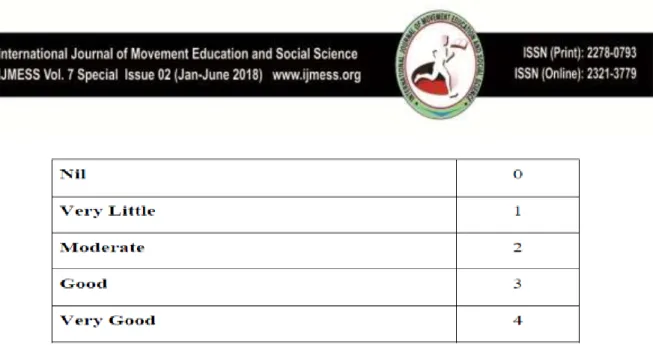
Table 1.1: Scale for levels of claimed proficiencyTo find out the claimed language proficiency of the respondents for Sheikhgal and Kashmiri the sample has been divided into two social variables viz age and gender. The data for each respondent has been codified, fed into an excel sheet and tabulated. Overall claimed proficiency in languages has been obtained by using SPSS version 12. ANOVA and Post-hoc test has been employed to check out the significant differences in language proficiency.
3.
Claimed proficiency in Sheikhgal
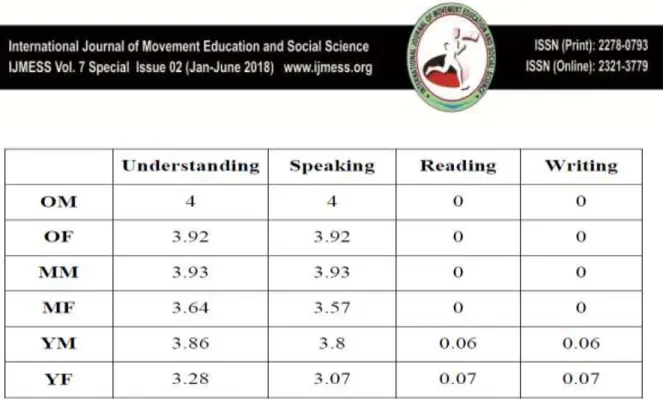
The claimed proficiency in Sheikhgal has been elicited in terms of four skills-understanding, speaking, reading and writing across the genders i.e. Old aged males(OM), Old aged females(OF), Middle aged males(MM), Middle aged females (MF), Young aged males(YM) and Young aged females(YF). Table1.2 shows the mean scores in these four skills.
420 | P a g e
Table1.2 clearly shows that out of four components of proficiency i.e. reading, writing speaking and understanding two skills i.e. reading and writing falls at zero. Proficiency in terms of understanding and speaking is still maintained among the Sheikh communities but in case of young females speaking skill appears to be slightly low. The claimed proficiency in Sheikhgal also declines as we move from understanding to writing in all genders. The writing script of Sheikhgal has not been developed so far, therefore no written literature is available in the language. So the zero score in reading and writing skills in Sheikhgal is obvious. Thus it can be concluded that Sheikhs of Kashmir are proficient in two language skills of Sheikhgal i.e. understanding and speaking.
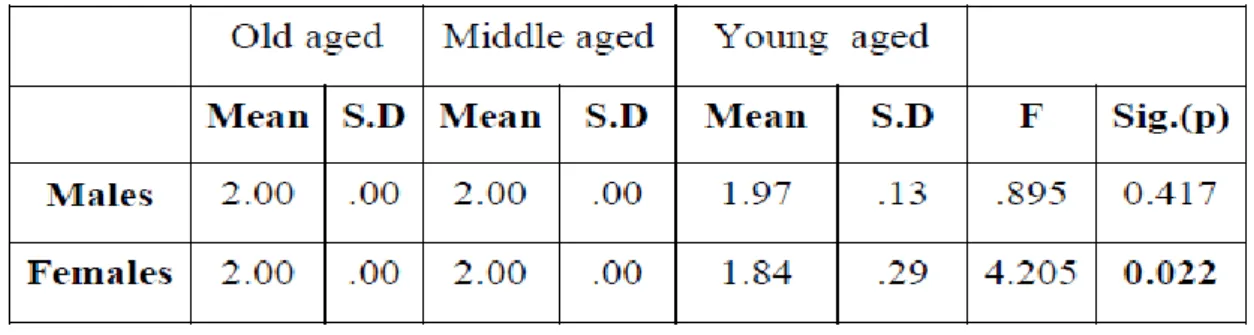
To ascertain whether there is any significant difference between the mean proficiency levels of the three age groups. One way analysis of variance (ANOVA) has been carried out which shows that there is a significant difference between the mean proficiency levels of Sheikhgal speaking females between the groups with F value =4.205 and p value=0.022. However there is no significant difference between the mean proficiency of Sheikhgal speaking males. So Post-hoc test is not applicable.
Table 1.3: ANOVA in case of Sheikhgal speakers
Table 1.3 shows that the mean proficiency level in case of males remains same in all the three age groups. However the same can be seen in case of female groups were the old and middle aged females have the highest proficiency 2.00 with the standard deviation of 0.00. There is significant difference in case of Sheikhgal speaking females (p value<0.05). So Post-hoc test has been employed to see the pair wise difference.
POST-HOC TEST MULTIPLE COMPARISONS
421 | P a g e
Table 1.4: Post-hoc test in case of Sheikhgal speaking femalesThe table1.4 depicts that old-aged females differ significantly in the mean proficiency level in comparison with young-aged female group with significance (p) value of 0.018. Similarly there is also a difference in the proficiency level when middle-aged females are compared to the young-aged female group with significance (p) value of 0.016.
In case of old and middle-aged groups the reason for high claimed proficiency in Sheikhgal can be attributed to the fact that they are more restricted in their home domain where the dominant language is Sheikhgal. Illiteracy among this group is prevalent. While young females show low claimed proficiency in Sheikhgal because they are more prestige conscious as they feel inferior in using their mother tongue showing affinity towards other prestige associated languages spoken in the valley i.e. Kashmiri and Urdu.
4. Claimed proficiency in Kashmiri
422 | P a g e
Table 1.5: Mean scores of claimed proficiency in KashmiriIt is interesting to observe that the scores in Kashmiri reading and writing for all the age groups of both genders fall at zero, except for the younger-age groups. Another point which we observe is that for all the groups there is a decline as we move from understanding to speaking , reading and writing. In case of different skills in different age groups there is not a systematic pattern. Females appear to show decrease in understanding and speaking as we move from older to younger age groups. Males on the other hand also show a decline in understanding Kashmiri as we move from older to younger males. In reading and writing the younger females and younger males are observed to be slightly proficient, this can be attributed to the late inclusion of Kashmiri in the curriculum.
To ascertain whether there is any significant difference between the mean proficiency levels of the three age groups. One way analysis of variance(ANOVA) has been carried out which shows that there is not a significant difference between the mean proficiency levels of Kashmiri speaking females and males between the groups with F value =2.262 and p value=0.118 and F value=0.206 and p value= 0.815 respectively.
ANOVA
423 | P a g e
However there is no significant difference between the mean proficiency of Kashmiri speaking females and males (p value>0.05) as can be seen from table 1.6. So no Post-hoc test is applicable.
5. Conclusion
The study has attempted to give a brief sociolinguistic account of Sheikhgal speakers of the Kashmir valley. As a minority community Sheikhs have been living in Kashmir from several decades and settled as in various districts of Kashmir valley. In spite of being a minority community, Sheikhs have maintained their language and culture and have kept themselves distinct from the main stream society.
The present paper depicted the high claimed proficiency in Sheikhgal among old and middle-aged groups. This can be attributed to the fact that the speakers of old and middle-aged groups are more restricted in their home domain where the dominant language is Sheikhgal. Illiteracy among this group is prevalent. The low claimed proficiency in Kashmiri among middle-aged females and old-aged females is due to illiteracy and limited exposure. While young females show low claimed proficiency in Sheikhgal because they are more prestige conscious as they feel inferior in using their mother tongue showing affinity towards Kashmiri considering it as a prestige associated language spoken in the valley. In young females exposure to mass media, pursuing formal education from educational institutions can be reasons for their slightly claimed proficiency in Kashmiri reading and writing skills. Some of the characteristic features of the community as per the study are as follows:
1) Sheikhs in general have low socio-economic status in comparison with the mainstream society i.e. Kashmiri speakers. In general, Sheikhs are not highly educated. Education hardly goes above the primary level among the educated.
2) Generally the marriage has been restricted within the community and is endogamous. However very few cases have been recorded in which the cross community marriage has taken place.
3) Sheikhs are strictly patriarchal.
4) Sheikhs have weak affinity in terms of language and cultural maintenance.
References
424 | P a g e
Bhat, R.K. A Descriptive Study of Kashmiri. Delhi: Amar Prakashan, 1987.
Bright, W. Social Factors in Language Change. Coulmas (Ed). The Handbook of Sociolinguistics. Oxford: Basil Blackwell, 1997.
Dhar, N.A. A Sociolinguistic Study of Kamarazi Dialect of Kashmiri. Ph.D. Dissertation. Deccan College: Poona, 1985.