A SECURED EMBEDDED SCHEME BASED ON
MULTI-CRYPTOGRAPHIC PROTOCOLS
*1S. A. ONASHOGA, 2O. OYELEKE, 1O. A. OJESANMI AND 3A. A. A AGBOOLA
1 Department of Computer Science, Federal University of Agriculture Abeokuta, Nigeria 2Department of Physical Sciences, Mountain Top University, Ogun State, Nigeria 3 Department of Mathematics, Federal University of Agriculture Abeokuta, Nigeria *Corresponding author: [email protected], Tel: +2348033537505
ii. Data integrity: ensuring that the data has not been tampered with or altered by unauthorized means during transmis-sion.
iii. Authenticity: Verifying that the mes-sage was truly sent by the claimed send-er.
Cryptography is an efficient means of pro-tecting sensitive information as it is transmit-ted over any untrustransmit-ted medium which in-cludes any network particularly the internet. (Asafe et al., 2014). Producing a cipher text with use of encryption algorithm and Mes-sage Authentication Code (MAC) gives the message a more secure platform and also the parties involved would be able to verify the identity of one another.
ABSTRACT
Transmission of information via unsecured channel requires confidentiality, authorization and authenti-cation as part of major factors that must be put into consideration. This work proposes a scheme that can take care of these major factors at once. The method involves a multi-level approach that compris-es of a key exchange protocol, a mcompris-essage authentication code, a key derivation function and a sym-metric encryption known as polyalphabetic substitution that makes use of a 94x94 Vigenere table. The four cryptographic techniques are combined to form an encryption protocol, coined MLES for a mes-sage to be securely transmitted. In order to test the functionality of MLES scheme, it was implemented using Java 1.8.0 and tested on a text data. The result shows a feasible protocol that can secure a message in steganography.
Keywords: Cryptography, MLES and polyalphabetic substitution
INTRODUCTION
Security of information is now of great con-cern as all information are sent over an un-secure channel now-a-days. Cryptography is the design and analysis of mathematical techniques that enable secure communica-tions in the presence of malicious adver-saries. Aside protecting data from being sto-len or altered, cryptography can also be used for authentication. It can further be defined as a method of storing and trans-mitting data in a form that only the intend-ed party or parties can understand it. The main objectives of any good crypto-graphic technique or scheme are:
i. Confidentiality: keeping data secret from all unauthorized parties.
Journal of Natural Science, Engineering
and Technology
ISSN:
Print - 2277 - 0593 Online - 2315 - 7461
This leads to the motivation of this work by using a scheme known as Elliptic Curve Integrated Encryption Scheme (ECIES). The ECIES was proposed by Bellare and Rogaway and it is a variation of the El-Gamal public –key encryption scheme (Hankerson et al., 2003). The scheme pro-posed in this work also makes use of Ellip-tic Curve Diffie-Hellman (EDCH), Key Derivation Function (KDF), polyalphabetic substitution and Message Authentication Code which is HMAC.
This work focuses on design and imple-mentation of an encryption scheme by combining more than two cryptographic techniques together to ensure integrity, au-thenticity and confidentiality of the message sent over an insecure channel. Combining several cryptographic schemes together in securing data gives more strength to its se-curity.
RELATED WORK
OVERVIEW OF
CRYPTOGRAPHY
Cryptography is the practice and study of techniques for secure communication in the presence of third parties otherwise known as adversaries (Yekinni et al., 2014). Cryp-tography is the science and study of secret writing. It is about the design and analysis of mathematical techniques that enable se-cure communications in the presence of malicious adversaries (Hankerson et al., 2003). Cryptography not only protects the data from theft or alteration, but also be used for user authentication. Cryptography is combination of encryption and decryp-tion. Encryption is a process of converting the plain text to cipher text using with some keys, while decryption is process of con-verting the cipher text to plain text using same key or another key (Reddy et al., 2012). Cryptography algorithms are mainly into
two ways based on the key distribution. They are Symmetric Key algorithm (Private Key algorithm), Asymmetric key algorithm (Public Key algorithm) (Reddy et al., 2012).
VIGENERE CIPHER
The Vigenere cipher is a method of encrypt-ing alphabetic text by usencrypt-ing series of differ-ent Ceaser ciphers based on the letters of a keyword. It is a simple form of polyalphabet-ic substitution. What is now known as the Vigenère cipher was originally described by Giovan Battista Bellaso in his 1553 book La cifra del. Sig. Giovan Battista Bellaso. He built upon the tabula recta of Trithemius, but add-ed a repeating "countersign" (a key) to switch cipher alphabets every letter (wiki, 2015).
SYMMETRIC KEY
CRYPTOGRAPHY
This type of cryptography uses the same key (or keys that are trivially related) for both encryption and decryption of data. Symmet-ric algorithm is also called secrete key algo-rithm private key, or single key. In secret key algorithm, both the sender and receiver will use the same key to encrypt and decrypt the data. Symmetric schemes are generally faster as compared to asymmetric keys and used to establish session keys since it involves only a key. Examples of symmetric key algorithms are data encryption standard (DES), Triple DES, Cipher Block Chaining (CBC) and Blowfish (Reddy et al., 2012).
Symmetric key ciphers are implemented as either block ciphers or stream ciphers. A block cipher enciphers input in blocks of plaintext that is work on blocks of plaintext and cipher text, as opposed to individual characters, the input form used by a stream cipher.
Block Cipher: When a block cipher
algo-rithm is used for encryption and decryption purposes, the message is divided into blocks of bits. These blocks are then put through substitution, transposition, and other math-ematical functions. The algorithm dictates all the possible functions available to be used on the message, and it is the key that will determine what order these functions will take place. Strong algorithms make reengineering, or trying to figure out all the functions that took place on the message, basically impossible.
Stream Cipher: A stream cipher does not
divide a message up into blocks; instead, a stream cipher treats the message as a stream of bits or bytes and performs mathematical functions on them individually When using a stream cipher, the same plaintext bit or byte will be transformed into a different cipher text bit or byte each time it is en-crypted. Some stream ciphers use a key stream generator, which produces a stream of bits that is XORed with the plaintext bits to produce cipher text. Exclusive OR (XOR) is an operation that is applied to two bits. It is a function in binary mathematics. If both bits are the same, the result is zero (1 + 1= 0). If the bits are different than each other, the result is one (1 + 0= 1) (Asafe et al., 2014).
Cipher Block Chaining (CBC) Mode:
Cipher Block Chaining (CBC) does not re-veal a pattern because each block of text, the key, and the value based on the previous block is processed in the algorithm and ap-plied to the next block of text. This gives a more random resulting cipher text. A value is extracted and used from the previous block of text. This provides dependence between the blocks and in a sense they are chained together. This is where the title of
Cipher Block Chaining (CBC) comes from, and it is this chaining effect that hides any repeated patterns (Asafe et al., 2014).
Data Encryption Standard (DES): is a
symmetric algorithm based on block encryp-tion algorithm (that is, message is divided into blocks of bits. These blocks are then put through substitution, transposition and other mathematical functions). DES uses a 64-bit key in which 56 bits makes up the main key and 8 bits are used for parity. When DES is applied to data, it splits the message up into blocks and performs operation on them one at a time (Asafeet al., 2014).
Advantages of symmetric-key cryptog-raphy
1. Symmetric-key ciphers can be designed to have high rates of data throughput.
2. Keys for symmetric-key ciphers are rela-tively short.
3. Symmetric-key ciphers can be employed as primitives to construct various cryptographic mechanisms including pseudorandom num-ber generators, hash functions and computa-tionally efficient digital signature schemes. 4. Symmetric-key ciphers can be composed to produce stronger ciphers. Simple transfor-mations which are easy to analyze, but on their own weak, can be used to construct strong product ciphers (Menezes et al., 1997).
Disadvantages of symmetric-key cryp-tography
1. In a two-party communication, the key must remain secret at both ends.
2. In a large network, there are many key pairs to be managed. Consequently, effective key management requires the use of an un-conditionally trusted third party
3. In a two-party communication between entities A and B, sound cryptographic prac-tice dictates that the key be changed
fre-quently and perhaps for each communica-tion session.
4. Digital signature mechanisms arising
from symmetric-key encryption typically re-quire either large keys for the public verifica-tion funcverifica-tion.
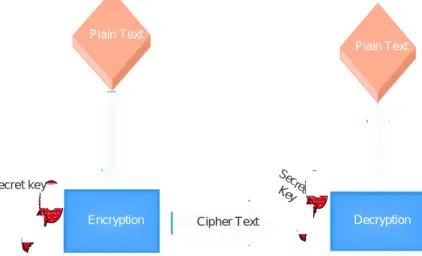
Plain Text
Plain Text
Encryption Cipher Text Decryption
secret key KSecret
ey
Figure 1: Secret key algorithm
ASYMMETRIC
CRYPTOGRAPHY
Asymmetric key algorithms are also called public key algorithms. In public key algo-rithm both parties (sender and receiver) have their own different keys. In public key cryptography each user or the device taking part in the communication generally have a pair of keys, a public key and a private key, and a set of operations associated with the keys to do the cryptographic operations. The sender encrypts the data with his own key, and the receiver decrypts the data with his own key. First they will do the encryp-tion or decrypencryp-tion with the same key, and again do the encryption or decryption with their own key. (Reddy et al., 2012). Com-monly used public key schemes are:
i. RSA public key encryption and signature schemes.
ii. The discrete logarithm (DL) problems
whose hardness us essential for the security of the ElGamal public key encryption and signature schemes and their variants such as the Digital Signature Algorithm (DSA). (whitepaper, 2012)
iii. The elliptic curve discrete logarithm prob-lem whose hardness is essential for the secu-rity of all elliptic curve cryptographic schemes (Hankerson et al. 2004).
Kester, (2012) presented a cryptosystem based on Vigenere Cipher with varying key. Vigenere cipher encryption algorithm auto-matically changes the cipher key after each encryption step. The successive keys will be dependent on the initial key value during the encryption process. The algorithm ultimately makes it possible for encryption and decryp-tion of the text and also makes the Vigenère cryptosystem more difficult against frequen-cy attack using varying keys.
Asafe et al., (2014) designed a crypto system for preventing unauthorized access using stand-alone software that implements cryp-tography using polyalphabetic substitution. The algorithm is a simple method of
en-crypting alphabetic text using a series of dif-ferent shift ciphers based on the letters of a keyword. The system does have a high confi-dentiality rating in order to defend against sniffing and man-in-the-middle attacks.
MATERIALS AND METHODS
PROPOSED SCHEME
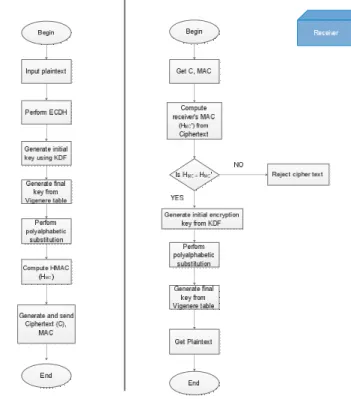
Figure 2: Multi-level Encryption Scheme (MLES) flow diagram
Gamal public-key encryption scheme. It has been standardized in ANSI X9.63 and ISO/ IEC 15946-3, and is in the IEEE P1363a draft standard. ECC is a good choice for low power environments. ECC has got applica-tions as a public key sharing scheme and as digital signature authentication scheme. The applications of ECC are:
A. Elliptic Curve Diffie-Hellman (ECDH) Key Exchange
This work makes use of a scheme known as Multi-level Encryption Scheme (MLES) which is based on the idea of the Elliptic Curve Integrated Encryption Scheme (ECIES).
Elliptic Curve Integrated Encryption Scheme
The Elliptic Curve Integrated Encryption Scheme (ECIES) was proposed by Bellare and Rogaway, and is a variant of the
El-B. Elliptic Curve Menezes-Qu-Vanstone (ECMQV) Key Exchange and Verification C. Elliptic Curve Digital Signature Algo-rithm (ECDSA). (Malik, 2010).
The best known ECC schemes and proto-cols are ECDH (Elliptic Curve Diffie Hell-man), a key agreement protocol (Martinez and Encinas 2013).
In the proposed scheme, an Elliptic Curve Diffie-Hellman (ECDH) key exchange is used to derive two symmetric keys k1 and k2. Key k1 is used to encrypt the plaintext using a symmetric-key cipher, while key k2 is used to authenticate the resulting cipher text. Intuitively, the authentication guards against chosen cipher text attacks since the adversary cannot generate valid cipher texts on her own. The following cryptographic primitives us are employed:
Definition: Domain Parameters:
i. The field order q. which indicates number of elements in Fp
ii. Two coefficients that define the equation of the elliptic curve E over in a prime field. iii. Two field elements
t h a t d e f i n e a f i n i t e p o i n t in affine coordi-nates. P has prime order and is called the base point.
iv. The order n of P.
v. The cofactor . (It is neces-sary that be divisible by a sufficient-ly large prime n. At a minimum, one should
have n.
MULTI-LEVEL ENCRYPTION SCHEME (MLES)
The proposed scheme consists of the follow-ing sub modules
(i) Elliptic Curve Diffie-Hellman would be used for key exchange protocol in the proposed scheme. Public keys would be exchanged between the sender and the receiver prior to encryption and decryp-tion.
(ii) A Key Derivation Function (KDF) would be used and it would be con-structed from a hash function (SHA-256). SHA-256 (secure hash algorithm, FIPS 182-2) is a cryptographic hash function with digest length of 256 bits. It is a keyless hash function; that is, an MDC (Manipulation Detection Code). The KDF would be used in generating encryption key and Hash based Message Authentication Code (HMAC) key for the Message Authentication.
(iii) HMAC algorithm which would be used for the signature of the message to verify if it is truly from the claimed sender. HMAC is a hash function based message authentication code. The algorithm is given in algorithm 4 H denotes the SHA-256 hash function, C denotes the cipher-text to be transmitted and KD is the unique HMACkey generated by the KDF. (iv) A symmetric encryption technique
would be combined with the above to get the cipher text. Polyalphabetic Sub-stitution is a simple method of encrypt-ing alphabetic text by usencrypt-ing a series of different shift ciphers based on the let-ters of a keyword. For this work, a poly-alphabetic substitution using one-time pad key system including a Vigenere cryptosystem would be employed. The polyalphabetic encryption and decryp-tion procedures involved in this work are outlined in figures 3 and 4 respectively.
The proposed scheme would be implement-ed using Java object orientimplement-ed programming
language and Netbeans Integrated Develop-ment EnvironDevelop-ment (IDE) with Java 1.8.0
Algorithm 1: Polyalphabetic Encryption Input: Plain text M, Encryption Key K. Output: Ciphertext C.
Process: Step 1: Generate a 94 X 94 vigenere table consisting of lowercase alphabets, uppercase alphabets, and special characters.
Step 2: Convert derived key from integer to ASCII characters. Step 3: Convert integer k to string S.
Step 4: If S.length> 1
Sum up all elements of S to get int R Convert R to ASCII character Else,
Convert integer k to ASCII character Step 5: Return initial encryption key
Step 6: While (Encryption key < plaintext)
Step 7: Get the character at plaintext [Encryption key.length] = x Step 8: Get the character at plaintext [Encryption key.length-1] = y Step 9: Convert x and y to binary.
Step 10: Get the complement of the binary of x and y Step 11: XOR the complements of x and y to get Z Step 12: Add Z to each initial encryption key
Step 13: NewEncKey = Number of characters in InitialEncKey equivalent to plaintext length.
Step 14: For int i = 1 to plaintext length N
introwpos = row position of EncKey: in vigenere table intcolpos = column position of plaintext: in vegenere table ciphertext i= vigeneretable[rowpos][colpos]
return ciphertext. Step 15: End
Algorithm 2: Polyalphabetic Decryption
Input: Ciphertext C Output: Plaintext
Process: Step1: Generate a 94 X 94 vigenere table
Step 2: Convert derived key from integer to ASCII characters. Step 3: Convert integer k to string S.
Step 4: If S.length> 1
RESULTS
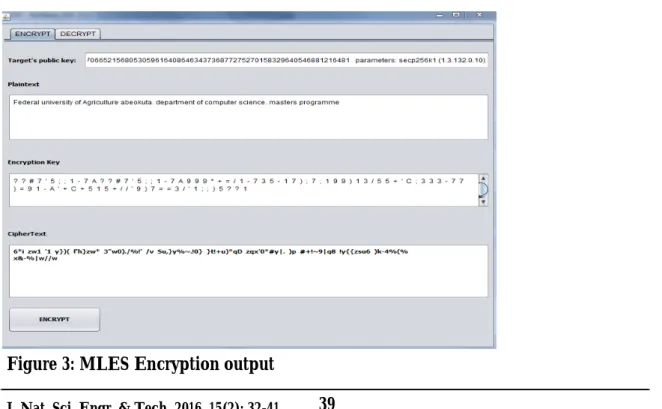
The scheme had been tested with small text data to know its feasibility. Work is in pro-gress in making it more efficient by accept-ing larger size of messages or word
docu-ments. Figures 3 and 4 show the encryption and decryption outputs of the proposed Multi-level encryption scheme (MLES) re-spectively.
Convert R to ASCII character Else,
Convert integer k to ASCII character Step 5: Return initial encryption key
Step 6: While (decryption <ciphertext)
introwpos = Get last character in decryption key from table intcipherpos = Get position of pos2 on rowpos in table
plaintext2 = table [0] [cipherpos] Step 7: XOR plaintext1 and plaintext2 to get int Step 8: Add Z to each initial decryption key Return decryptionkey;
Step 9: For int i = 1 to ciphertext length N
introwpos = get row position of decryption key [i] intcipherpos = get pos of ciphertext [i] in table plaintext [i] = table [0] [cipherpos]
Return plaintext. Step 10: End
CONCLUSION
The work presents combination of different cryptographic schemes for securing messag-es to be sent across unsecure channel. The proposed approach can be deployed in mili-tary sector and other sectors that require high security of messages. In this paper, a new encryption scheme known as Multi lev-el Embedded Encryption Scheme had been implemented using polyalphabetic substitu-tion that involves a 94 x 94 Vigenere cipher. The Vigenere Cipher comprises of upper case and lower case characters, special char-acters, symbols which is a novel approach. The combination of four cryptographic techniques makes it more secured against attacks such as man in the middle attack.
REFERENCES
Asafe, Y.N., Aigbokhan E. E., Okiki F. M. 2014. Cryptography System for Online
Communication Using Polyalphabetic
Sub-stitution Method. International Journal of Ad-vanced Networking and Applications 6: 2151-2157.
Hankerson, D., Menezes A.J., Vanstone S 2004. Guide to Elliptic Curve
Cryptog-raphy Springer-VL-rlag New York, Incorporated. Pp. 1-311.
Martinez V.G., Encinas L.H. 2013.
Imple-menting ECC with Java Standard Edition 7”. International Journal of Computer Science and Arti-ficial Intelligence. Vol. 3, Issue 4, pp. 134-142.
Reddy, S., Sowjanya, P., Praveena P., Shalini L. 2012. Poly-alphabetic Symmetric
Key Algorithm Using Randomized Prime Numbers. International Journal of Scientific and Research Publications 2 (9): 1-3.
Bundesamt fur Sicherheit in der Infor-mationstechnik. 2012. Technical Guideline
Elliptic Curve Cryptography. http://
w w w . b s i . b u n d . d e / c a e / s e r v l e t / contentblob/471398/publicationFile/3061/BSI-TR-03111_pdf.pdf.
Malik M.Y. 2010. Efficient
Implementa-tion of Elliptic Curve Cryptography Using Low-power Digital Signal Processor” 12th
International Conference on Advanced Communi-cations Technology ISBN 978-89-5519-146.
2: 1464-1468.
Kester Q. A. 2012. “A cryptosystem Based
on Vigenère cipher with varying key” Interna-tional Journal of Advanced Research in Computer Engineering & Technology. 1 (10): 108-113.