Open Access
Research
Biochemical and morphological changes in endothelial cells in
response to hypoxic interstitial edema
Laura Botto, Egidio Beretta, Rossella Daffara, Giuseppe Miserocchi and
Paola Palestini*
Address: Department of Experimental, Environmental Medicine and Biotechnologies (DIMESAB), University of Milano-Bicocca, Via Cadore 48 20052 Monza, Italy
Email: Laura Botto - [email protected]; Egidio Beretta - [email protected]; Rossella Daffara - [email protected]; Giuseppe Miserocchi - [email protected]; Paola Palestini* - [email protected]
* Corresponding author
Abstract
Background: A correlation between interstial pulmonary matrix disorganization and lung cellular response was recently documented in cardiogenic interstitial edema as changes in the signal-cellular transduction platforms (lipid microdomains: caveoale and lipid rafts). These findings led to hypothesize a specific "sensing" function by lung cells resulting from a perturbation in cell-matrix interaction. We reason that the cell-matrix interaction may differ between the cardiogenic and the hypoxic type of lung edema due to the observed difference in the sequential degradation of matrix proteoglycans (PGs) family. In cardiogenic edema a major fragmentation of high molecular weight PGs of the interfibrillar matrix was found, while in hypoxia the fragmentation process mostly involved the PGs of the basement membrane controlling microvascular permeability. Based on these considerations, we aim to describe potential differences in the lung cellular response to the two types of edema.
Methods: We analysed the composition of plasma membrane and of lipid microdomains in lung tissue samples from anesthetized rabbits exposed to mild hypoxia (12 % O2 for 3–5 h) causing interstitial lung edema. Lipid analysis was performed by chromatographic techniques, while protein analysis by electrophoresis and Western blotting. Lipid peroxidation was assessed on total plasma membranes by a colorimetric assay (Bioxytech LPO-586, OxisResearch). Plasma membrane fluidity was also assessed by fluorescence. Lipid microdomains were isolated by discontinuous sucrose gradient. We also performed a morphometric analysis on lung cell shape on TEM images from lung tissue specimen.
Results: After hypoxia, phospholipids content in plasma membranes remained unchanged while the cholesterol/ phospholipids ratio increased significantly by about 9% causing a decrease in membrane fluidity. No significant increase in lipid peroxidation was detected. Analysis of lipid microdomains showed a decrease of caveolin-1 and AQP1 (markers of caveolae), and an increase in CD55 (marker of lipid rafts). Morphometry showed a significant decrease in endothelial cell volume, a marked increase in the cell surface/volume ratio and a decrease in caveolar density; epithelial cells did not show morphological changes.
Conclusion: The biochemical, signaling and morphological changes observed in lung endothelial cell exposed to hypoxia are opposite to those previously described in cardiogenic edema, suggesting a differential cellular response to either type of edema.
Published: 13 January 2006
Respiratory Research 2006, 7:7 doi:10.1186/1465-9921-7-7
Received: 28 October 2005 Accepted: 13 January 2006
This article is available from: http://respiratory-research.com/content/7/1/7 © 2006 Botto et al; licensee BioMed Central Ltd.
Background
The interstitial compartment of the lung is kept at a subat-mospheric pressure in physiological conditions, a feature shared by other compartments where extravascular water is kept at a least amount. In the lung, a relatively "dry" interstitial space allows a minimum thickness of the air-blood barrier to optimize gas diffusion. A rise in extravas-cular lung water may occur because of an increase in the pressure gradient across the microvascular barrier and/or by an increase in perm-porosity of the endothelial barrier. The first case, the so called cardiogenic lung edema, may represent the consequence of left ventricular failure with increased left atrial and pulmonary capillary pressure. Conversely, hypoxia exposure may fall into the second case as it may augment microvascular permeability. Severe lung edema is indeed a life threatening complication of high altitude exposure with presence of protein rich fluid in the alveolar spaces.
An important finding concerning the initial phase of edema development in both models is that a minor increase in extravascular water, about 5%, leads to a marked increase in interstitial pressure (from about -10 to
about 5 cm H2O [1]), indicating a fairly low compliance
of the lung extracellular matrix that obviously represents a strong "tissue safety factor" against edema development as it balances further microvascular filtration [2]. It was also found that in interstitial lung edema, some degree of dis-organization of the extracellular matrix occurs, despite its strong mechanical resistance, particularly at the expense of proteoglycans (PGs) [3]. These molecules are responsi-ble for the structural integrity of pulmonary interstitium as they control fluid dynamics through their influence on microvascular permeability and tissue compliance. Fur-thermore, proteoglycans are also involved in cell-cell and cell-matrix interactions and in the cytokine network [4] as they regulate the traffic of the molecules within the inter-stitial space and promote interactions. A possible correla-tion between matrix disorganizacorrela-tion and cellular funccorrela-tion was documented in the cardiogenic model of interstitial edema as changes in composition of plasma membrane lipid microdomains involved in signal-transduction [5]. These findings led to hypothesize a specific "sensing" function by lung cells resulting from a perturbation in matrix interaction [6]. We may reason that the cell-matrix interaction may differ between the two types of edema as a difference was found in the sequential degra-dation of PGs family and in the interaction properties of PGs to some matrix components [7,8]. Indeed, in the car-diogenic model we found a major fragmentation of high molecular weight chondroitin sulphate PGs of the interfi-brillar matrix, while in hypoxia the fragmentation process mostly involved the intermediate molecular weight heparansulphate PGs, such as perlecan of the basement membrane. Furthermore, for a similar increase in
extravascular water, PGs degradation, as judged from total hexuronate recovery, was greater in hypoxia [7]. Based on these considerations, we aim to describe potential differ-ences in the lung cellular response to the two types of edema that imply differences in the process of disorgani-zation of the extracellular matrix. We performed a bio-chemical and morphometric study focusing in particular on the plasma membrane bilayer lipid pattern, including a particular subset of phospholipids (lyso-phospholipids and plasmalogens) that are implicated in the oxidant-antioxidant phenomena and on lipid microdomains (caveolae and lipid rafts).
Methods
ChemicalThe reagents used (analytical grade) and HPTLC plates (Kieselgel 60) were purchased from Merck GmbH (Darm-stadt, Germany). CAPS, MES, Percoll, PMSF, HRP-CTB were from Sigma Chem. Co. (Milano, Italy). Antibody against caveolin-1 (C2297) and flotillin (F65020) were from Transduction Labs (Lexington, KY, USA). Antibody against aquaporin-1 (sc-9878) was from Santa Cruz Bio-technology (CA, USA). CD55 (1A10) was from BD Phar-migen. Antibody against actin (A 2066) was from SIGMA. All the material for the electrophoresis was from BioRad, (Milano, Italy). Autoradiographic films was from Amer-sham Pharmacia Biotech (Uppsala, Sweden).
Lung tissue preparation and plasma membrane purification
General preparation. Experiments were done in rabbits (2.5 ± 0.5 (SD) Kg body wt) anesthetized with a mixture of 2.5 ml/kg of 50% urethane (wt/vol, in saline solution) and 40 ml/kg body wt of ketamine injected into an ear vein. Subsequent doses of anesthetic were administered during the experiments judging from the arousal of ocular reflexes.
The study was based a protocol accepted by D.L. 116/ 1992, art.3, 4, 5 and performed according to the estab-lished rules of animal care.
The trachea was cannulated. We considered the following groups of animals for biochemical determinations:1) ani-mals exposed to room air breathing sacrificed immedi-ately after anesthesia and tracheotomy (control N = 5); 2) animals exposed to room air and left to breath in anesthe-sia for up to 3 h (sham N = 4); 3) animals exposed to hypoxia (12 % O2 in nitrogen) for 3 h (N = 4); 4) animals exposed to hypoxia for 5 hours (N = 3).
present both in control and treated animal samples; there-fore the observed differences in membrane protein response when comparing control and sham to treated animals should be due to the specific conditions caused by hypoxia. After this, the lungs were flushed with 50 ml of solution 1 (0.25 M sucrose, 20 mM Tricine pH 7.4 and 40 µg/ml of the protease inhibitors aprotinin, chymosta-tin, leupeptin and antipapain), excised from the chest and immersed in ice cold solution 1.
We also estimated the level of lipid peroxidation in con-trol, sham, hypoxia exposure and saline induced lung edema (i.v. infusion 0.5 ml/kg min for 3 h) that mimics cardiogenic edema: in these animals, we added butylate hydroxytoluene in solution 1 to reach a concentration 0.2 mM.
The lung tissue was finely minced at 4°C and homoge-nated in solution 1, then filtered sequentially through 53
and 30 µm filters. The homogenate was subjected to
cen-trifugation (1,000 g for 10 min) at 4°C, and the superna-tants were saved. The resulting pellet was resuspended in 3 ml of buffer and subjected again to centrifugation as above. The pooled supernatants were overlaid over 25 ml of 30% Percoll in buffer. After centrifugation using a SW28 rotor at 84,000 g for 45 min at 4°C, we collected a single membranous band (about 1 ml) readily visible at about 2/3 from bottom of the tube. To reduce the vol-umes and concentrate the membranes, the bands were pelleted by first diluting the suspension 3 fold with PBS before centrifugation at 100,000 g for 20 min at 4°C. These membrane fractions were collected and called PMC (for control), PMH3 and PMH5 (for 3 and 5 hours of hypoxia) respectively, and aliquots were taken for differ-ent analysis.
Isolation of detergent-resistant fraction
The plasma membrane pellets (PMC and PMH3) were resuspended in 1 ml of MBS buffer (25 mM of MES buffer, pH 6.5, containing 150 mM NaCl, 1 mM phenylmethyl-sulfonylfluoride and 75 units/ml aprotinin) and we deter-mined its protein content (BCA methods). Next, we took a volume containing 4.5 mg of protein, a quantity required for each gradient procedure. In order to maintain
a constant protein/detergent ratio in all experiments, we added MBS buffer containing Triton X-100 up to a volume of 2 ml to reach a final Triton concentration of 1%. All the procedure was carried on ice for 20 min to maintain the integrity of lipid rafts. Finally, the 2 ml were diluted with an equal volume of 80% (w\v) sucrose in MBS lacking Tri-ton X-100 and placed at the bottom of a tube where a dis-continuous sucrose concentration gradient was created (40, 30, 5 % sucrose, from bottom up) in MBS lacking Tri-ton X-100. After centrifugation at 250,000 g for 18 hrs at 4°C with a TW-41 rotor (Beckman Instruments), 1 ml fractions were collected from the top of the gradient and submitted to further analysis. From now on, fraction #5 (from the top) is referred as DRF (Detergent Resistant Fraction); fractions from # 6 to 8 as IDF (Intermediate Density Fraction); fractions from # 9 to 12 as HDF (High Density Fraction).
Phosphorus analysis and fluorescence spectroscopy
Aliquots of PMC, and PMH3 and PMH5 from all animals were used for phospholipid phosphorus determination [9]. Data were expressed as micromoles per milligrams of protein. The membrane fluidity of different samples was assessed by fluorescence anisotropy measurements of the fluorescent probe 1, 6-diphenyl-1, 2, 5-hexatriene (DPH) as described [10] with minor modification. A suspension of PMC, PMH3 and PMH5, containing ~200 nmol of phosphorus per 1.5 ml of PBS was used. The fluorescent probe molecule DPH was added to membrane suspension at a final concentration of 10-3 M. Light scattering was cor-rected by using a blank containing the sample but not DPH. Membranes with and without fluorescent probe were incubated in the dark under stirring for 45 min at 37°C and were used for fluorescence polarization studies immediately after preparation. A polarization spectrofluo-rimeter (Cary Eclipse, Varian) with fixed excitation and emission polarization filters was used to measure fluores-cence intensity parallel (Ipa) and perpendicular (Iper) to the polarization plane of the exciting light [10]. Excitation and emission wavelengths were 360 and 430 nm, respec-tively. Fluorescence anisotropy was calculated as r (Ipa-Iper/
Ipa+Iper). The sample was continuously stirred with a
microstirrer, and the temperature (37°C) was monitored by a thermistor in the cuvette.
Table 1: Lipid content of plasma membrane fractions in control (PMC; N of animals = 3) and after 3 (PMH3; N of animals = 3) and 5 hours of hypoxia exposure (PMH5; N of animals = 3).
PMC PMH3 PMH5
Phosphorus Phospholipid (µmol/mg protein) 1.10 ± 0.2 (8) 1.24 ± 0.25 (10) 1.2 ± 0.3 (7)
Cholesterol (nmol/mg protein) 247 ± 9.8 (10) 299 ± 23.7 (24) # 296 ± 26.7 (17) #
Cholesterol/Phospholipids (nmol/µmol) 0.224 0.241# 0.246#
Lipids and fatty acid analysis
Aliquots of PMC, PMH3 and PMH5, were submitted to lipid extraction [10]. An organic phase (containing all lip-ids with the exception of gangliosides) and an aqueous phase (containing gangliosides) were obtained. The lipids were separated on HPTLC plates. The phospholipids from
PMC, PMH3 and PMH5 were chromatographed in
solu-tion B (chloroform:methanol:acetic acid:water, 60:45:4:2, each by vol). The cholesterol, from plasma membranes,
was chromatographed in solution D
(hexane:diethyl-ether:acetic acid, 20:35:1, each by vol). In the case of neu-tral glycosphingolipids (GLS), the lipids extracted were submitted to alkaline methanolysis (1 h at 37°C in 0.6 N NaOH in methanol) to remove contaminating phosphol-ipids. After extensive dialysis, the GLS were
chromato-graphed in solution E (chloroform:methanol:water,
110:40:6, each by vol). For the analysis of the
plasmalo-gens, the phospholipids were chromatographed in
solu-tion B. The plates were then exposed to HCl vapors for 10
min and subsequently chromatographed in solution F for
second dimension (chloroform:methanol:acetone:acetic acid:water, 50:15:15:10:5, each by vol).
For the analysis of the lysophospholipids, the
phospholi-pids were chromatographed in solution B and
subse-quently chromatographed in solution G for second
dimension (chloroform:methanol:88% formic acid, 65:25:10, each by vol).
Phospholipids and cholesterol were visualized with anis-aldehyde, and neutral glycosphyngolipids with orcinol.
The plates were scanned with Bio-Rad system and spot identification, and quantification was accomplished by comparison with authentic standard lipids. Aliquots of different total lipids extracted, corresponding to 100–150 nmol of phosphorus, were submitted to fatty acid analysis [10].
The double bound index (DBI), commonly considered as an index of the ratio of saturated to unsaturated fatty acids, was calculated as follows: ∑ saturated fatty acids/∑
unsaturated fatty acids, where ∑ unsaturated f.a. is
obtained by adding the percentage of each unsaturated fatty acid multiplied by the number of the double bounds in its molecule.
Lipid peroxidation
Lipid peroxidation was assessed on total plasma mem-branes in 1 animal for each group (control, sham, 3 h of hypoxia exposure) by a colorimetric assay (Bioxytech LPO-586, OxisResearch) of malondialdehyde (MDA) as indicator of peroxidation. Data of MDA from lung tissue
were expressed as nmol/µmol of plasma membrane
phos-pholipidic phosphorous sampled.
Protein analysis
Aliquots of PMC, PMH3 and PMH5 and all fractions col-lected from the gradient, were submitted to trichloroacetic acid precipitation. The pellets, washed with acetone, were suspended in water and protein quantity determined by
BCA method (SIGMA, USA). Thereafter, 50 µg of PMC,
PMH3 and PMH5 and 10 µg of proteins collected from
the gradient, respectively, were loaded on SDS-PAGE; 10% -polyacrylamide gel, and submitted to electrophore-sis. Subsequently, the proteins were transferred to mem-branes that were stained with Ponceau S to assess protein loading by densitometry (BIORAD Densitometry 710, program Quantity one) [6,11]. We compared on our sam-ples the densitometry of the whole lane for protein load-ing obtained from total plasma membranes and all gradient fractions from control and treated animals.
Actin contents was used to normalize total plasma mem-brane protein contents. This normalisation is not possible for proteins from fractions obtained from discontinuous sucrose concentration gradient because actin contents dif-fers among these fractions [12].
Subsequently the membranes were submitted to Western blotting. After blocking, blots were incubated for 2 h with the primary antibody diluted in PBS-T/milk (anti-cav1 1:1000, anti-flotillin-1 1:250, anti AQP1 1:100, anti CD55 1:100, anti actin 1:1000). Then, blots were incu-bated for 2 hr with horseradish peroxidase-conjugated anti-mouse/goat IgG (5,000–10,000-fold diluted in PBS-T/milk). The protein samples were obtained from 3
con-Content of phospholipids in plasma membrane fractions
Figure 1
trols and 3 treated animals. Proteins were detected by the SuperSignal detection kit (Pierce, Rockford, IL). We per-formed in parallel immunoblot analysis of samples from one control and one treated animal for total plasmamem-brane, and proteins from all gradient fractions. Immuno-blot bands were analyzed by BIORAD Densitometry 710.
Statistical analysis
Biochemical determinations were repeated at least three times for each animal. Biochemical results were expressed as means ± SD, averaging data from the different animals. The significance of the differences among groups was
determined using one-way ANOVA and t-test.
Morphometry
The morphometric analysis was done in the following animal groups:1) rabbits exposed to room air breathing sacrificed immediately after anesthesia and tracheotomy (control; N = 2); 2) rabbits kept under anesthesia for 3 hours (sham 3 h; N = 3); 3) rabbits kept under anesthesia for 5 hours (sham 5 h; N = 2), 4) rabbits exposed to hypoxia (12% O2 in nitrogen) for 3 h (N = 3); 5) rabbits exposed to hypoxia for 5 hours (N = 3); 6) rabbits receiv-ing i.v. saline infusion (0.5 ml/kg min for 3 h; N = 4) to cause an increase in lung extravascular water similar to that caused by hypoxia exposure.
For morphometric analysis we performed lung perfusion-fixation in situ following a technique carefully detailed in a previous paper [13]. Animals were killed by an overdose of anesthetic just prior to the perfusion procedure; next,
with pleural sacs intact, we infused through the pulmo-nary artery first saline (11.06 g NaCl/l plus 3% dextran T-70 and 1,000 U heparin/dl, 350 m O sm) and then fixa-tive (phosphate buffered 2.5% glutaraldehyde plus 3% dextran T-70, 500, under a pressure head of 15 cm H2O.
Tissue samples were obtained following a stratified ran-dom sampling procedure from ventral (top) to dorsal (bottom) lung region and immersed in 2.5% glutaralde-hyde for 1 hour at room temperature and subsequently processed for resin embedding.
For light microscopy analysis, 1 µm thick sections were
obtained and stained with methylene blue. For electron microscopy, 60 nm thick sections were obtained; they were mounted on uncoated 200-mesh copper grids, stained with uranyl acetate and lead citrate, finally observed in a Zeiss EM900 electron microscope.
Morphometry at light microscopy
Micrographs were originally obtained at 100× (Olympus BX51) and brought to a final magnification of 2600× on the computer video screen for morphometric measure-ments that were done according to established stereologi-cal techniques [14]. We evaluated the surface area of the capillaries (Sc) from the number of intersections of test lines with the boundary profile of the capillaries accord-ing to Sc = (2 × I)/Lt, where Lt is the total length of all the test lines of the grid (length of each test line = 8.57 µm). The data base for morphometric analysis at light
micros-Table 3: Double bound index (DBI) and fluorescence anisotropy (r) in plasma membrane fraction in control (PMC; N of animals = 3) and after 3 (PMH3; N of animals = 3) and 5 hours of hypoxia exposure (PMH5; N of animals = 3).
PMC PMH3 PMH5
DOUBLE BOUND INDEX (DBI) 0.643 ± 0.01 0.563 ± 0.03 0.605 ± 0.02
FLUORESCENCE ANISOTROPY (r) 0.250 ± 0.009 0.269 ± 0.007* 0.265 ± 0.006*
The data are means ± SD (n = 6). * P < 0.001 vs control
Table 2: Fatty acid composition of total lipids in plasma membrane fraction in control (PMC; N of animals = 3) and after 3 (PMH3; N of animals = 3) and 5 hours of hypoxia exposure (PMH5; N of animals = 3)
Fatty acid PMC PMH3 PMH5
14:0 1.59 ± 0.37 1.57 ± 0.38 2.48 ± 0.73 *
16:0 38.49 ± 0.58 33.36 ± 2.1* 35.2 ± 2.16 *
16:1 2.83 ± 0.22 2.38 ± 0.49 3.6 ± 0.53
18:0 14.07 ± 1.8 13.50 ± 1.4 16.1 ± 3.10
18:1 18.8 ± 0.9 18.30 ± 2.6 18.3 ± 0.92
18:2 13.36 ± 2.3 13.60 ± 1.6 13.3 ± 1.06
20:0 0.78 ± 0.25 2.0 ± 0.7 § 1.09 ± 0.17
20:1 0.42 ± 0.01 0.68 ± 0.9 0.53 ± 0.44
20:4 9.16 ± 0.2 12.46 ± 2.35 § 10.43 ± 1.97
copy was obtained from about 1000 fields from each ani-mal group.
Morphometry at transmission electron microscopy of the thin portion of the air-blood barrier
The thin portion of the air-blood barrier is primarily involved in gas diffusion and corresponds to septal regions were only a fused basement membrane separates endothelium and epithelium. In these regions we per-formed a morphometric evaluation of endothelial, epi-thelial and interstitial compartments on micrographs obtained at 22,000×, brought at a final magnification of 66,000×.
The mean arithmetic thickness (τ) of the interstitial layer separating the endothelial and the epithelial compart-ments was determined using a multipurpose M168 grid (40) as given by: τ = (d·P)/[2·(I tot)], were d is the length
of test line (d = 0.174 µm), P being the number of points falling in the compartment and I tot being its overall sur-face boundary profile.
Volume densities (Vv) of endothelial and epithelial com-partments were obtained by the point counting method, while total surface areas (Stot) of each of these compart-ments were obtained by the intersection counting method, using a cycloidal test system [15]. For a given compartment, total surface area and volume density are linked by the relationship Stot = Vv × Sv, where Sv is defined as surface density, namely surface area per unit volume (µm2/µm3). Surface density is given by Sv = 2 × I
i, where Ii is the number of intersections between the surface area and the test lines per unit length of test line (0.1855
µm).
We also evaluated the numerical density (Nv) of
plasma-lemmal vesicles (PVs) in endothelial and epithelial cells; vesicles were identified by their morphology as being non-coated and 50–90 nm in diameter. Numerical
den-sity was obtained as Nv = number of PVs/unit volume
multiplied by a correction factor given by ( + T - 2h)
where: is the true mean diameter of the PVs
(consid-ered to average 70 nm, as commonly accepted in litera-ture); T is the thickness of the ultrathin sections (60 nm);
h is the depth by which a vesicle must penetrate the sec-tion before it is detected [14,16].
The data base for the analysis came, for each animal group, from about 150 counting fields randomly chosen on the micrographs.
For morphometric analysis, primary data (point, line intersection and vesicle counts) were summed over all the micrographs derived from each section and the parame-ters were computed as the ratio of sums. The parameparame-ters were then averaged over the various section samples. Data were expressed as means ± SE. The significance of the dif-ferences among groups was determined using one-way ANOVA and t-test.
An estimate of the extravascular water accumulation was obtained for the ratio between the weight of the fresh tis-sue samples and after drying in the oven at 70°C for at least 24 h (W/D ratio).
Results
Lipid analysisThe amount of phospholipidic phosphorus in plasma membranes, normalized to total protein quantity did not change significantly in hypoxic lungs relative to control
D D
Protein contents of total plasma membranes
Figure 2
(Table 1). Data referring to sham animals were pooled with control as they did not differ significantly.
Aliquots of samples were submitted to lipid extraction, and the different lipids (cholesterol, glycolipid, and phos-pholipid) were separated on HPTLC plates. The choles-terol concentration increased significantly at 3 h, remaining steady up to 5 h (P < 0.001) of hypoxia expo-sure and, consequently, also the cholesterol/phospholip-ids ratio increased significantly (Table 1). Some differences were found in the pattern of neutral glycolip-ids obtained from plasma membranes. The most
abun-dantglycolipid, the lacto-N-neotetraesosylceramide
decreased in PMH3 and PMH5, relative to PMC (from 73 % to 65 %, respectively), whereas triesosylceramide increased from 8 % to 14 %, respectively, both changes being significant (P < 0.01).
The phospholipid pattern, normalized to protein quan-tity, is shown in Fig. 1. When comparing to control, only phosphatidylethanolamine (PE) and phosphatidylcho-line (PC) showed significant differences. The PE increased
by ~24 % in PMH3 and PMH5 (P < 0.02), while PC decreased by ~7% and ~13 % in PMH3 and PMH5, respectively. The PC/PE ratio increased from 1.3 in con-trol, to 1.67 and 1.84 at 3 and 5 h of hypoxia, respectively. Phosphatidylglycerol quantity was similar in control and treated lungs, averaging ~3% of total phospholipids.
In PMC the amount of choline plasmalogen (included in PC) and ethanolamine plasmalogen (included in PE) were 0.024 and 0.16 nmoles/mg proteins, respectively. In PMH3, these values increased (0.048 and 0.215 nmoles/ mg proteins, for choline and ethanolamine plasmalogen, respectively) while in PMH5, they returned towards con-trol values (0.021 and 0.192 nmoles/mg proteins, respec-tively).
Lysophsophatidylethanolamine, as determined by 2D-HPTLC, was unchanged after hypoxia exposure and aver-aged about 0.07 nmoles/mg protein. Lysophsophatidyl-choline was undetectable in all conditions.
Lipid peroxidation
MDA values (nmol/µmol phosphorous) were 5.7 ± 0.32
(control plus sham), 6.8 ± 2.66 (hypoxia 3 h) and 6.51 ± 0.32 (saline infusion); the increase observed in hypoxia and saline infusion (19 and 14%, respectively) were not significant.
Fatty acid analysis and fluorescence spectroscopy
Table 2 reports the percentage composition of total lipid fatty acids obtained from plasma membranes. A
signifi-Distribution of phospholipids in the plasma membrane deter-gent resistant fraction
Figure 4
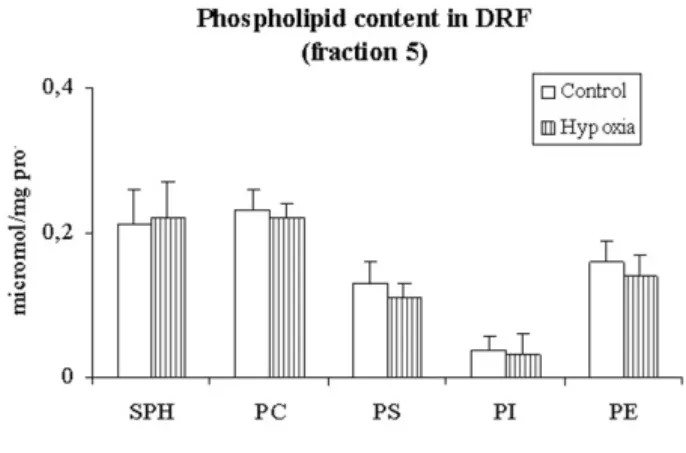
Distribution of phospholipids in the plasma mem-brane detergent resistant fraction. Distribution of dif-ferent phospholipids in fraction 5 (detergent resistant fraction) in control and after exposure to 3 h of hypoxia (Control and hypoxia, respectively). SPH, sphingomyelin; PC, phosphatidylcholine; PS, phosphatidylserine; PI, phosphati-dylinositol; PE, phosphatidylethanolamine
Immunoblot analysis of plasma membrane proteins in sucrose gradient fractions
Figure 3
cant decrease of palmitic acid (16:0) was observed both in PMH3 and PMH5. Arachidonic (20:4) and arachidic acid (20:0) increased significantly only in PMH3, while miris-tic acid (14:0) increased significantly only in PMH5. These modifications in fatty acid composition caused a decrease, though not significant, of the DBI (Table 3).
Using the fluorescent probe of the membrane fluidity DPH, a significant increase of the anisotropy parameter r
was detected in PMH3 and PMH5, indicating a decrease in fluidity of the plasma membrane (Table 3).
Protein analysis in DRF
The protein quantity of lipid microdomains obtained from DRF amounted to about 3% of total plasma mem-brane protein quantity and this value did not change sig-nificantly on comparing control to 3 h hypoxia exposure. Caveolin-1, flotillin-1, aquaporin-1 (AQP1), and CD55 were assessed by Western blotting analysis in total plasma membranes fractions (Fig. 2) and in sucrose gradient frac-tions (Fig. 3) of lung tissue samples from animals exposed to 3 h of hypoxia. Fig. 2 shows that the caveolin-1 content in total plasma membranes, evaluated from the densitom-etry, decreased significantly (P < 0.01) by about 36% at 3 h of hypoxia but returned towards control value at 5 h. AQP1, flotillin-1 and CD55 did not change in hypoxic lungs with respect to control as well as beta- actin.
Fig. 3 shows the protein distribution in the detergent resistant fractions after 3 h of hypoxia. Flotillin-1 content in fractions 4 and 5 was unchanged on comparing control to hypoxia. Caveolin-1 was enriched in fraction 5 in con-trol, while it decreased about 7 fold in hypoxia in this frac-tion; furthermore it was also found in intermediate density fractions. AQP1 was mainly present in fractions 4–6 in control while in hypoxia it spread also towards higher density fractions. CD55 was mostly present in frac-tions 4 and 5 in control and in minor amount in fraction 7, while in hypoxia almost doubled in fractions 4 and 5.
Lipid analysis in DRF
Cholesterol was enriched in DRF in control (878 ± 80, nmol/mg prot) and did not significantly change after 3 h
of hypoxia (802 ± 77, nmol/mg prot). Fig. 4 shows that the phospholipid content in DRF, expressed as µ moles of phosphorous/mg protein, remained essentially unchanged after 3 h of hypoxia.
Morphometry
The morphometric analysis did not show differences between sham and control, therefore the data were pooled. Table 4 shows that the average thickness τ of the interstitial space in the various groups of rabbits. Data rel-ative to controls were pooled with those of sham referring to 3 and 5 h as no differences were found. As Table 4
shows, τ increased with hypoxia exposure, doubling
sig-nificantly at 5 h; a similar increase occurred in the saline infusion group, indicating a similar degree of interstitial
Ultrastructural appearance of the thin portion of the air-blood barrier
Figure 5
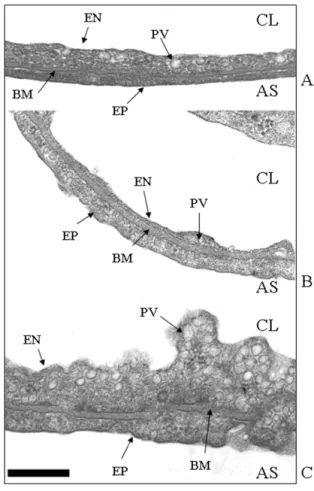
Ultrastructural appearance of the thin portion of the air-blood barrier. Micrographs at transmission electron microscope of the air-blood barrier in control lungs (A), in hypoxia (B) and in cardiogenic edema (C) at high magnifica-tion (x66000). CL, capillary lumen; AS, alveolar space; EN, endothelium; PV, plasmalemmal vesicle; BM, basement mem-brane; EP, epithelium. Scale bar = 0.5 µm.
Table 4: Thickness of the interstitial layer of the air-blood barrier (τ int, derived from transmission electron microscopy images) and surface density of pulmonary capillaries (Sc, from light microscopy images).
τ int, µm Sc cm2/cm3
CONTROL + SHAM 0.03 ± 0.004 803.15 ± 28.06
HYPOXIA 3 h 0.05 ± 0.002 1018.25* ± 11.27
HYPOXIA 5 h 0.06* ± 0.01 857.05 ± 19.72
CARDIOGENIC EDEMA 0.06*$ ± 0.01 890.84$ ± 47.47
edema. Hypoxia also induced a remarkable increase in lung perfusion as indicated by the increase in surface area (Sc) of capillaries at 3 h, with a subsequent return towards control values at 5 h (Table 4).
Fig.5 shows high magnification (× 66000) micrographs of the thin portion of the air blood-barrier made of endothe-lial and epitheendothe-lial cells, separated by a layer of fused base-ment membrane. Relative to control (A), hypoxia exposure (B) induced a thickening of the basement mem-brane, a considerable thinning of the endothelial layer but no appreciable changes in the epithelial layer. Fig. 5 C allows to evaluate the response of endothelial and epithe-lial cells of the air blood barrier in the cardiogenic edema group; for an increase in basement membrane thickness similar to that occurring in hypoxia, there was a
consider-able increase in cell volume and, particularly for endothe-lial cells, in surface area and in density of plasmalemmal vesicles.
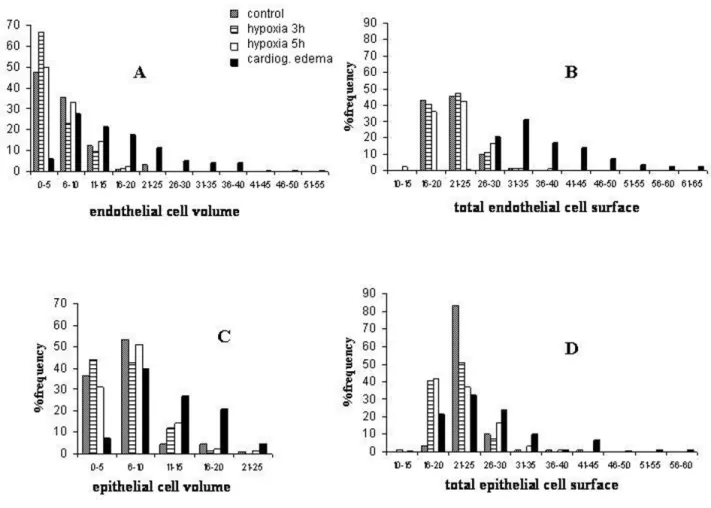
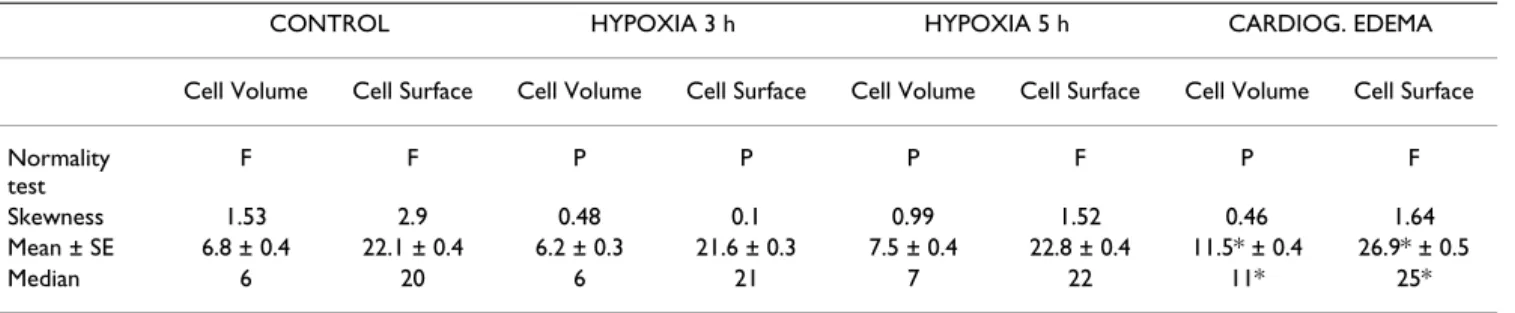
Fig. 6A shows the frequency distribution of the volume of the endothelial cell compartment in the various groups. One can appreciate that in control (data pooled with sham) and after hypoxia exposure, the frequency distribu-tions of cellular volumes depart from normality showing a marked skewness as the median value was smaller than the mean (Table 5 provides the results of the normality test). After 3h of hypoxia, the highest frequency distribu-tion (67%) occurred for the smallest volume range and both the mean and the median values significantly decreased (Table 5). After 5 h of hypoxia, cell volume tended to return towards control values. By contrast, in
Frequency distribution of volume and surface of endothelial and epithelial cells in the air-blood barrier
Figure 6
the cardiogenic model group, endothelial volume signifi-cantly increased (both for the mean and the median val-ues) as the distribution extended towards high cell volume values, remaining skew (Table 5). Fig. 6B shows the frequency histograms for total endothelial cell surface: the distribution appears fairly similar in control (pooled data with sham) and hypoxia while, in the cardiogenic edema group, the distribution of surface values extended towards higher values with a significant increase in mean and median values (Table 5).
A similar analysis was carried on the epithelial cells. The epithelial cell volume distributions (Fig. 6C) were sub-stantially similar in control (pooled data with sham) and after 3 and 5 h of hypoxia exposure; in the cardiogenic edema group, the average volume significantly increased (Table 6) because of a shift in volume towards higher val-ues, although the overall range of volume distribution was the same in all conditions. Fig. 6D reports the fre-quency histograms for the total surface of epithelial cells. Despite the mean surface values do not differ on compar-ing control (pooled data with sham) to 3 and 5 h of hypoxia exposure (Table 6), there was a considerable increase in frequency in the low range of surface values (a ten fold increase, from ~ 4 to ~ 40% for the surface range 16–20). In the cardiogenic edema group, the epithelial
cell surface distribution was shifted towards higher values and indeed the mean and median surface values were sig-nificantly increased relative to the other groups (Table 6).
Fig. 7 allows to better estimate the modifications induced on cellular morphology by either type of edema by plot-ting the plasma membrane surface to cell volume ratio (Sv) vs cell volume (Vv) for the endothelial and epithelial layers. These relationships are hyperbolic in nature and one can appreciate that in control conditions (closed cir-cles, pooled data with sham) the data cover a wide spec-trum of variation both in endothelial (Fig. 7A) and epithelial cells (Fig. 7C). In response to hypoxia (open cir-cles, pooled data from 3 and 5 h), there is a definite trend for the data to scatter towards high Sv values and, corre-spondingly, very low cell volume in endothelial cells (Fig. 7A), while no significant variations, relative to control, were observed in epithelial cells (Fig. 7C). Conversely, in the cardiogenic edema model (open triangles), the data scatter towards high cell volume and correspondingly very low Sv values in endothelial cells (Fig. 7B), with no signif-icant variations in epithelial cells (Fig. 7D).
Fig. 8 shows that a significant regression could be found
by plotting caveolar density (Nv) in endothelial cell vs
endothelial cell volume.
Table 6: Statistics on frequency histograms of volume and surface distribution of epithelial compartment of the thin portion of the air-blood barrier. F and P indicate either failed or passed for the normality test. For the significance of the median values the Dunn's method was used, while for that of the mean values the Holm-Sidak method was used.
CONTROL HYPOXIA 3 h HYPOXIA 5 h CARDIOG. EDEMA
Cell Volume Cell Surface Cell Volume Cell Surface Cell Volume Cell Surface Cell Volume Cell Surface
Normality test
F F P P P F P F
Skewness 1.53 2.9 0.48 0.1 0.99 1.52 0.46 1.64
Mean ± SE 6.8 ± 0.4 22.1 ± 0.4 6.2 ± 0.3 21.6 ± 0.3 7.5 ± 0.4 22.8 ± 0.4 11.5* ± 0.4 26.9* ± 0.5
Median 6 20 6 21 7 22 11* 25*
Mean ± SD. * significantly different (P < 0.05) relative to control and hypoxia exposure.
Table 5: Statistics on frequency histograms of volume and surface distribution of endothelial compartment of the thin portion of the air-blood barrier. F and P indicate either failed or passed for the normality test. For the significance of the median values, the Dunn's method was used, while for that of the mean values the Holm-Sidak method was used.
CONTROL HYPOXIA 3 h HYPOXIA 5 h CARDIOG. EDEMA
Cell volume Cell surface Cell volume Cell surface Cell volume Cell surface Cell volume Cell surface
Normality test
F F F P P P F F
Skewness 1.53 1.36 1.24 0.77 0.67 0.98 1.07 1.39
Mean ± SE 6.5 ± 0.5 22.1 ± 0.3 4.6# ± 0.4 21.9 ± 0.3 5.9 ± 0.5 22.6 ± 0.4 16.2* ± 0.8 27.8* ± 0.7
Median 5.7 21 3.5 # 21 5.2 22 14* 25*
The W/D ratio was 4.98 ± 0.3 in control conditions (aver-age data from zero time and sham for 3 h), 5.12 ± 0.1 and 5.16 ± 0.2 at 3 and 5 h of hypoxia exposure (for compari-son, W/D was 5.42 ± 0.2 in the animals receiving saline infusion).
Discussion
This study provides a contribution to the understanding of the cellular response to interstitial lung edema, a con-dition characterized by a relatively small increase in extravascular water, but considerable changes in intersti-tial space mechanics [2] and extracellular matrix composi-tion [3]. particularly considering that recent findings led to hypothesize a specific "sensing" function by lung cells resulting from a perturbation in cell-matrix interaction [6].
Plasma membrane composition
We found essentially no change in content of phospholi-pid phosphorous after 3 or 5 h of hypoxia. This finding is in line with the morphometric evaluation of lung cells in the air-blood barrier of animals exposed to similar hypoxic conditions indicating essentially minor changes in overall surface area of plasma membranes after hypoxia exposure, as also documented in isolated pulmonary endothelial cells [17]. This finding is at variance with the previous observation that phospholipid phosphorous was found to increase in response to saline infusion, reflecting in particular the increase in plasma membrane surface in endothelial cells [6,10].
Furthermore, the changes in pattern of total plasma mem-brane phospholipids differed in the two types of edema, as in hypoxia PC decreased and PE increased, while in saline induced edema they both increased [10].
PC is also an important component of surfactant phos-pholipids and therefore its modifications may potentially reflect changes in surfactant turnover. The increase in PE may contribute to the modification in lipid microenviron-ment surrounding plasma membrane channels whose activity could monitor changes in cell-matrix interaction [18,19].
We considered the plasmalogen production as this partic-ular subset of phospholipids, by virtue of its ether bond, acts as endogenous antioxidant protecting cells and mem-brane from reactive oxygen species [20]. Plasmalogens were found to increase, as much as in the case of the saline induced edema [10]; this increase may buffer the decrease in glutathione level in hypoxia [21]. In the latter case we found no increase in lysophospholipids, suggesting no activation of PLA2, a finding similar to that observed in cultured endothelial cells exposed to 3% O2 for 4 h [17]. The no activation of PLA2, stems for a relative preservation of cellular integrity, considering that PLA2 activation in anoxia may lead to cellular death through a caspase inde-pendent mechanism by inducing nuclear shrinkage [22]. In line, with these findings, we did not find a significant increase of MDA, suggesting that the level of peroxidation remained unchanged in both models of interstitial edema.
Membrane fluidity and cell surface-volume regulation
The biochemical determination of fluidity of plasma membrane is an estimate of its deformability that reflects its composition and the mobility of the lipid bilayer. Plasma membrane is relatively rigid as it can stretch elas-tically until the area increases up to 2–4%, beyond which rupture occurs [23]. Deformability increases when the phospholipids/cholesterol and PC/PE ratios increase. This occurred in the cardiogenic edema, allowing an increase in surface profile of endothelial cells [6], while opposite changes are found following hypoxia exposure.
Data of Fig. 6 and 7 also suggest that surface area and cell volume regulation are correlated and differently regulated in the two edema models, likely reflecting the specificity of cell-matrix mechanical interaction. Indeed, variations in cell volume may represent a step in the signalling proc-ess involving changes in the conductance of membrane ion channels [18,19].
Lipid microdomains
Lipid microdomains include caveolae and lipid rafts that represent specialized sites of the plasma membranes since
Relationship between caveolar density and endothelial cell volume
Figure 8
they host some important proteins implicated in signal-transduction [5,12]. We decided to monitor proteins that are known markers of either caveolae or lipid rafts. For caveolae we estimated the presence of cav-1, a structural protein responsible for the flask-like shape, and AQP1, a specialized protein channel found in endothelial cells for
water and small nonionic molecules. In the present inves-tigation we only determined the total amount of marker proteins, without determining their phosphorylated form, that is known to influence their redistribution and translocation from cytosol to membrane [24,25]. As spe-cific marker of lipid rafts we considered CD55, a
GPI-Surface-volume relationships in endothelial and epithelial cells
Figure 7
anchor proteins [26]. We also determined flotillin-1, a membrane protein expressed both in lipid rafts and cave-olae [27,28]. After 3 h of hypoxia exposure, the decrease of cav-1 and AQP1 in DRF and their corresponding increase in IDFs and HDFs (Fig. 3), suggests an inhibition of the vesicle formation, as confirmed by the decrease in caveolar density in endothelial cells of the air-blood bar-rier (Fig. 8). These modifications are opposite to those previously documented in cardiogenic edema where cave-olar expression was increased [5].
In the cardiogenic edema model, an increase in lipid microdomains was suggested by the increase in specific lipid components (PE, cholesterol). In hypoxia induced edema, where an inhibition of caveolae was found, the quantity of these lipids remained unchanged in DRF; therefore, this lends support to the hypothesis that these lipids may be used for lipid rafts formation. This hypoth-esis is strengthened by the observation that CD55 signifi-cantly increased at 3 h of hypoxia. In fact, each lipid raft can host a limited number of GPI- anchored protein [29], given the large size of its head, compared to the relatively small surface area of the lipid rafts. Therefore, an increased number of these molecules can only be accom-modated by a corresponding increased number of lipid rafts. Since the total amount of flotillin-1 in DRF was unchanged, this further supports the hypothesis of a trans-location of this protein from caveolae to lipid rafts. The inverse correlation between caveolin-1 and GPI-anchored protein was described in mutant cells lines either deficient in GPI biosynthesis or after overexpression of caveolin-1 [30].
A rearrangement of plasma membrane lipid microdo-mains suggests a modification in the expression of signal transduction proteins in response to the two edema mod-els.
Lung cellular response to interstitial edema
The morphometric studies indicate that mostly endothe-lial but not epitheendothe-lial cells showed morphological changes in response to either type of edema, therefore, one may hypothesize that pulmonary interstitial edema (extracellular volume increase not exceeding 5%) evokes a response predominantly in endothelial cells as a result of a perturbation induced in their microenvironment. In both of our edema models, no alveolar flooding was present.
Alveolar epithelial cells regulate the volume and electro-lyte composition of the alveolar lining fluid through the AQP5 and ENaC channels. For the level of hypoxia induced, no changes in AQP5 were found by western blot-ting (data not shown) and furthermore other data suggest
that in mild hypoxia no inhibition of ENaC channels was found [31,32].
Conclusion
We suggest a differential response of lung endothelial cells to cardiogenic and hypoxic pulmonary edema that reflect different pathophysiological mechanisms. In fact, the dif-ference in the sequence of matrix macromolecules frag-mentation [7] in the two models, might induce a specific cascade of cellular events from signalling – transduction to cellular functional attitude aimed at tissue repair.
List of abbreviations
PGs: proteoglycans
PMC: plasma membrane fractions in control
PMH3 and PMH5: plasma membrane fractions at 3 and 5 h of hypoxia
DRF: Detergent Resistant Fraction
IDF: Intermediate Density Fraction
HDF: High Density Fraction
DBI: double bound index
MDA: malondialdehyde
DPH: 1, 6-diphenyl-1, 2, 5-hexatriene
PC: phosphatidylcholine
PE: phosphatidylethanolamine
PLA2: phospholipase A2
Vv: cellular volume density
Stot: total cellularsurface area
Sv: cellularsurface density (surface area per unit volume,
µm2/µm3)
Sc: surface area of capillaries
Nv: numerical density of plasmalemmal vesicles
PVs: plasmalemmal vesicles
Publish with BioMed Central and every scientist can read your work free of charge "BioMed Central will be the most significant development for disseminating the results of biomedical researc h in our lifetime."
Sir Paul Nurse, Cancer Research UK
Your research papers will be:
available free of charge to the entire biomedical community
peer reviewed and published immediately upon acceptance
cited in PubMed and archived on PubMed Central
yours — you keep the copyright
Submit your manuscript here:
http://www.biomedcentral.com/info/publishing_adv.asp
BioMedcentral
Competing interests
The author(s) declare that they have no competing inter-ests.
Authors' contributions
LB and EB performed the biochemical studies; RD per-formed the morphometric studies; GM and PP conceived the study, participated in design and coordination and gave their contribution to write the manuscript.
Acknowledgements
This research was supported by Fondazione Banca del Monte di Lombardia.
References
1. Miserocchi G, Negrini D, Del Fabbro M, Venturoli D: Pulmonary interstitial pressure in intact in-situ lung: transition to inter-stitial edema. J Appl Physiol 1993, 74(3):1171-1177.
2. Miserocchi G, Negrini D, Passi A, De Luca G: Development of lung edema: interstitial fluid dynamics and molecular structure.
News Physiol Sci 2001, 16:66-71.
3. Negrini D, Passi A, De Luca G, Miserocchi G: Matrix proteogly-cans in development of pulmonary edema. In Proteoglycans in lung disease Edited by: Garg HG, Roughley PJ, Hales CA. Marcel Dekker, Inc; 2002.
4. Roberts CR, Weight TN, Hascall VCH: Proteoglycans. In The Lung: Scientific FoundationVolume Chapt. 52. 2nd edition. Edited by: Crystal RG, West JB, Barnes PJ, Weibel ER. Philadelphia, PA: Lippincott-Raven; 1997:757-767.
5. Palestini P, Calvi C, Conforti E, Daffara R, Botto L, Miserocchi G: Compositional changes in lipid microdomains of ABB plasma membranes in pulmonary interstitial edema. J Appl Physiol 2003, 95(4):1446-1452.
6. Daffara R, Botto L, Beretta E, Conforti E, Faini A, Palestini P, Miser-occhi G: Endothelial cells as early sensors of pulmonary inter-stitial edema. J Appl Physiol 2004, 97:1575-1583.
7. Miserocchi G, Passi A, Negrini D, Del Fabbro M, De Luca G: Pulmo-nary interstitial pressure and tissue matrix structure in acute hypoxia. Am J Physiol Lung Cell Mol Physiol 2001, 280:L881-L887.
8. Negrini D, Passi A, De Luca G, Miserocchi G: Pulmonary intersti-tial pressure and proteoglycans during development of pul-monary edema. Am J Physiol Heart Circ Physiol 1996, 270:H2000-H2007.
9. Barlett GR: Phosphorus assay in column chromatography. J Biol Chem 1959, 234:466-468.
10. Palestini P, Calvi C, Conforti E, Botto L, Fenoglio C, Miserocchi G: Composition, biophysical properties and morphometry of plasma membranes in pulmonary interstitial edema. Am J Physiol Lung Cell Mol Physiol 2002, 282:L1382-L1390.
11. Moore MK, Viselli SM: Staining and quantification of proteins transferred to polyvinylidine fluoride membranes. Anal Bio-chem 2000, 279:241-242.
12. Lisanti MP, Sherer PE, Vidugiriene J, Tang ZL, Hermanowski-Vosatka A, Ya-Huei Tu, Cook RF, Sargiacomo M: Characterisation of cave-olin rich membrane domains isolated from an endothelial rich source: implications for human disease. J Cell Biol 1994, 126:111-126.
13. Conforti E, Fenoglio C, Bernocchi G, Bruschi O, Miserocchi G: Mor-pho-functional analysis of lung tissue in mild interstitial edema. Am J Physiol (Lung Cell Mol Physiol) 2002, 282:L766-L774. 14. Weibel ER: Stereological Methods. Practical Methods for Biological
Mor-phometry New York: Academic; 1979.
15. Howard CV, Reed MG: Unbiased Stereology: Three-dimensional meas-urements in microscopy New York: Springer; 1998.
16. Gil J, Silage DA: Morphometry of pinocytotic PVs in the capil-lary endothelium of rabbit lungs using automated equip-ment. Circ Res 1980, 47:384-391.
17. Tretyakov AV, Farber HW: Endothelial cell phospholipid distri-bution and phospholipases activity during acute and chronic hypoxia. Am J Physiol 1993, 265:C770-C780.
18. Danthi S, Enyeart JA, Enyart JJ: Modulation of native TREK-1 and Kv1.4 K+ channels by polyunsaturated fatty acids and
lyso-phospholipids. J Membrane Biol 2003, 195:147-164.
19. Eggermont J, Trouet D, Carton I, Nilius B: Cellular function and control of volume -regulated anion channels. Cell Biochem Bio-phys 2001, 35:263-274.
20. Zoeller RA, Grazia TJ, La Camera P, Park J, Gaposchkin DP, Farber HW: Increasing plasmalogen levels protects human endothe-lial cells during hypoxia. Am J Physiol Heart Cir Physiol 2002, 283:H671-H679.
21. Mansfield KD, Simon MC, Keith B: Hypoxic reduction in cellular glutathione levels requires mitochondrial reactive oxygen species (mtROS). J Appl Physiol 2004, 97:1358-1366.
22. Shinzawa K, Tsujimoto Y: PLA2activity is required for nuclear shrinkage in caspase-independent cell death. J Cell Biol 2003, 163:1219-1230.
23. Morris CE, Homann U: Cell surface area regulation and mem-brane tension. J Membrane Biol 2001, 179:79-102.
24. Schlegel A, Arvan P, Lisanti MP: Caveolin-1 binding to endoplas-mic reticulum membranes and entry into the regulated secretory pathway are regulated by serine phosphorylation.
J Biol Chem 2001, 276:4398-4408.
25. Han Z, Patil RV: Protein kinase A-dependent phosphorylation of Aquaporin-1. Biochem Biophys Res Com 2000, 273:328-332. 26. Legler DF, Doucey MA, Schneider P, Chapatte L, Bender FC, Bron C:
Differential insertion of GPI-anchored GFPs into lipid rafts of live cells. FASEB J 2004. doi:10.1096/fj.03-1338fje
27. Chatenay-Rivauday C, Cakar ZP, Jeno P, Kuzmenko ES, Fiedler K: Caveolae: biochemical analysis. Mol Biol Rep 2004, 31:67-84. 28. Gallegos AM, McIntosh AL, Atshaves BP, Schroeder F: Structure
and cholesterol domains dynamics of an enriched caveolae/ raft isolate. Biochem J 2004, 382:451-461.
29. Sharma P, Varma R, Sarasij RC, Ira , Gousset K, Krishnamoorthy G, Rao M, Mayor S: Nanoscale organization of multiple GPI-anchored proteins in living cell membranes. Cell 2004, 116:577-589.
30. Abrami L, Fivaz M, Kobayashi T, Kinoshita T, Parton RG, van der Goot FG: Cross-talk between caveolae and glycosylphosphati-dylinositol-rich domains. J Biol Chem 2001, 276:30729-30736. 31. Matthay MA, Folkesson HG, Clerici C: Lung epithelial fluid
trans-port and the resolution of pulmonary edema. Physiol Rev 2002, 82:569-600.