Proceedings of the 45th Annual Meeting of the Association of Computational Linguistics, pages 432–439,
Structured Models for Fine-to-Coarse Sentiment Analysis
Ryan McDonald∗ Kerry Hannan Tyler Neylon Mike Wells Jeff Reynar Google, Inc.
76 Ninth Avenue New York, NY 10011 ∗
Contact email: [email protected]
Abstract
In this paper we investigate a structured model for jointly classifying the sentiment of text at varying levels of granularity. Infer-ence in the model is based on standard se-quence classification techniques using con-strained Viterbi to ensure consistent solu-tions. The primary advantage of such a model is that it allows classification deci-sions from one level in the text to influence decisions at another. Experiments show that this method can significantly reduce classifi-cation error relative to models trained in iso-lation.
1 Introduction
Extracting sentiment from text is a challenging prob-lem with applications throughout Natural Language Processing and Information Retrieval. Previous work on sentiment analysis has covered a wide range of tasks, including polarity classification (Pang et al., 2002; Turney, 2002), opinion extraction (Pang and Lee, 2004), and opinion source assignment (Choi et al., 2005; Choi et al., 2006). Furthermore, these systems have tackled the problem at differ-ent levels of granularity, from the documdiffer-ent level (Pang et al., 2002), sentence level (Pang and Lee, 2004; Mao and Lebanon, 2006), phrase level (Tur-ney, 2002; Choi et al., 2005), as well as the speaker level in debates (Thomas et al., 2006). The abil-ity to classify sentiment on multiple levels is impor-tant since different applications have different needs. For example, a summarization system for product
reviews might require polarity classification at the sentence or phrase level; a question answering sys-tem would most likely require the sentiment of para-graphs; and a system that determines which articles from an online news source are editorial in nature would require a document level analysis.
This work focuses on models that jointly classify sentiment on multiple levels of granularity. Consider the following example,
This is the first Mp3 player that I have used ... I thought it sounded great ... After only a few weeks, it started having trouble with the earphone connec-tion ... I won’t be buying another.
Mp3 player review from Amazon.com
This excerpt expresses an overall negative opinion of the product being reviewed. However, not all parts of the review are negative. The first sentence merely provides some context on the reviewer’s experience with such devices and the second sentence indicates that, at least in one regard, the product performed well. We call the problem of identifying the senti-ment of the docusenti-ment and of all its subcomponents, whether at the paragraph, sentence, phrase or word level,fine-to-coarse sentiment analysis.
The simplest approach to fine-to-coarse sentiment analysis would be to create a separate system for each level of granularity. There are, however, obvi-ous advantages to building a single model that clas-sifies each level in tandem. Consider the sentence,
My 11 year old daughter has also been using it and it is a lot harder than it looks.
for a piece of fitness equipment, wherehard essen-tially meansgood workout. In this domain, hard’s sentiment can only be determined in context (i.e., hardto assemble versus ahardworkout). If the clas-sifier knew the overall sentiment of a document, then disambiguating such cases would be easier.
Conversely, document level analysis can benefit from finer level classification by taking advantage of common discourse cues, such as the last sentence being a reliable indicator for overall sentiment in re-views. Furthermore, during training, the model will not need to modify its parameters to explain phe-nomena like the typically positive word great ap-pearing in a negative text (as is the case above). The model can also avoid overfitting to features derived from neutral or objective sentences. In fact, it has al-ready been established that sentence level classifica-tion can improve document level analysis (Pang and Lee, 2004). This line of reasoning suggests that a cascaded approach would also be insufficient. Valu-able information is passed in both directions, which means any model of fine-to-coarse analysis should account for this.
In Section 2 we describe a simple structured model that jointly learns and infers sentiment on dif-ferent levels of granularity. In particular, we reduce the problem of joint sentence and document level analysis to a sequential classification problem us-ing constrained Viterbi inference. Extensions to the model that move beyond just two-levels of analysis are also presented. In Section 3 an empirical eval-uation of the model is given that shows significant gains in accuracy over both single level classifiers and cascaded systems.
1.1 Related Work
The models in this work fall into the broad class of global structured models, which are typically trained with structured learning algorithms. Hidden Markov models (Rabiner, 1989) are one of the earliest struc-tured learning algorithms, which have recently been followed by discriminative learning approaches such as conditional random fields (CRFs) (Lafferty et al., 2001; Sutton and McCallum, 2006), the structured perceptron (Collins, 2002) and its large-margin vari-ants (Taskar et al., 2003; Tsochantaridis et al., 2004; McDonald et al., 2005; Daum´e III et al., 2006). These algorithms are usually applied to sequential
labeling or chunking, but have also been applied to parsing (Taskar et al., 2004; McDonald et al., 2005), machine translation (Liang et al., 2006) and summa-rization (Daum´e III et al., 2006).
Structured models have previously been used for sentiment analysis. Choi et al. (2005, 2006) use CRFs to learn a global sequence model to classify and assign sources to opinions. Mao and Lebanon (2006) used a sequential CRF regression model to measure polarity on the sentence level in order to determine thesentiment flowof authors in reviews. Here we show that fine-to-coarse models of senti-ment can often be reduced to the sequential case.
Cascaded models for fine-to-coarse sentiment analysis were studied by Pang and Lee (2004). In that work an initial model classified each sentence as being subjective or objective using a global min-cut inference algorithm that considered local label-ing consistencies. The top subjective sentences are then input into a standard document level polarity classifier with improved results. The current work differs from that in Pang and Lee through the use of a single joint structured model for both sentence and document level analysis.
Many problems in natural language processing can be improved by learning and/or predicting mul-tiple outputs jointly. This includes parsing and rela-tion extracrela-tion (Miller et al., 2000), entity labeling and relation extraction (Roth and Yih, 2004), and part-of-speech tagging and chunking (Sutton et al., 2004). One interesting work on sentiment analysis is that of Popescu and Etzioni (2005) which attempts to classify the sentiment of phrases with respect to possible product features. To do this an iterative al-gorithm is used that attempts to globally maximize the classification of all phrases while satisfying local consistency constraints.
2 Structured Model
Extensions to the model are also examined.
2.1 A Sentence-Document Model
Let Y(d) be a discrete set of sentiment labels at the document level and Y(s) be a discrete set of sentiment labels at the sentence level. As input a system is given a document containing sentences s = s1, . . . , sn and must produce sentiment labels for the document, yd ∈ Y(d), and each individ-ual sentence, ys = ys1, . . . , yns, whereyis ∈ Y(s)∀
1≤i≤n. Definey = (yd,ys) = (yd, ys1, . . . , yns)
[image:3.612.334.521.74.170.2]as the joint labeling of the document and sentences. For instance, in Pang and Lee (2004), yd would be the polarity of the document andysi would indicate whether sentencesi is subjective or objective. The models presented here are compatible with arbitrary sets of discrete output labels.
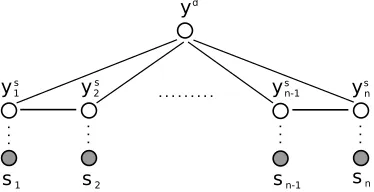
Figure 1 presents a model for jointly classifying the sentiment of both the sentences and the docu-ment. In this undirected graphical model, the label of each sentence is dependent on the labels of its neighbouring sentences plus the label of the docu-ment. The label of the document is dependent on the label of every sentence. Note that the edges between the input (each sentence) and the output labels are not solid, indicating that they are given as input and are not being modeled. The fact that the sentiment of sentences is dependent not only on the local sentiment of other sentences, but also the global document sentiment – and vice versa – al-lows the model to directly capture the importance of classification decisions across levels in fine-to-coarse sentiment analysis. The local dependencies between sentiment labels on sentences is similar to the work of Pang and Lee (2004) where soft local consistency constraints were created between every sentence in a document and inference was solved us-ing a min-cut algorithm. However, jointly modelus-ing the document label and allowing for non-binary la-bels complicates min-cut style solutions as inference becomes intractable.
[image:3.612.332.518.275.343.2]Learning and inference in undirected graphical models is a well studied problem in machine learn-ing and NLP. For example, CRFs define the prob-ability over the labels conditioned on the input us-ing the property that the joint probability distribu-tion over the labels factors over clique potentials in undirected graphical models (Lafferty et al., 2001).
Figure 1: Sentence and document level model.
In this work we will use structured linear classi-fiers (Collins, 2002). We denote the score of a la-belingyfor an inputsasscore(y,s)and define this score as the sum of scores over each clique,
score(y,s) = score((yd,ys),s)
= score((yd, y1s, . . . , ysn),s)
=
n X
i=2
score(yd, yis−1, ysi,s)
where each clique score is a linear combination of features and their weights,
score(yd, yis−1, ysi,s) =w·f(yd, ysi−1, yis,s) (1)
and f is a high dimensional feature representation of the clique andwa corresponding weight vector. Note thatsis included in each score since it is given as input and can always be conditioned on.
In general, inference in undirected graphical mod-els is intractable. However, for the common case of sequences (a.k.a. linear-chain models) the Viterbi al-gorithm can be used (Rabiner, 1989; Lafferty et al., 2001). Fortunately there is a simple technique that reduces inference in the above model to sequence classification with a constrained version of Viterbi.
2.1.1 Inference as Sequential Labeling
The inference problem is to find the highest scor-ing labelscor-ingyfor an inputs, i.e.,
arg max
y
score(y,s)
Input:s=s1, . . . , sn
1. y= null
2. for eachyd∈ Y(d)
3. ys= arg max
ys score((yd,ys),s) 4. y0= (yd,ys)
5. ifscore(y0,s)>score(y,s)ory= null
6. y=y0
7. returny
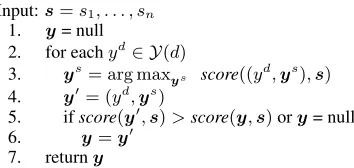
Figure 2: Inference algorithm for model in Figure 1. The argmax in line 3 can be solved using Viterbi’s algorithm sinceydis fixed.
highest scoring sentiment labels for all sentences, given a particular document labelyd, can be solved efficiently using Viterbi’s algorithm.
The general inference problem can then be solved by iterating over each possibleyd, findingys max-imizing score((yd,ys),s) and keeping the single besty= (yd,ys). This algorithm is outlined in Fig-ure 2 and has a runtime ofO(|Y(d)||Y(s)|2n), due
to running Viterbi|Y(d)|times over a label space of size|Y(s)|. The algorithm can be extended to pro-duce exact k-best lists. This is achieved by using k-best Viterbi techniques to return thek-best global labelings for each document label in line 3. Merging these sets will produce the finalk-best list.
[image:4.612.74.251.70.154.2]It is possible to view the inference algorithm in Figure 2 as a constrained Viterbi search since it is equivalent to flattening the model in Figure 1 to a sequential model with sentence labels from the set
Y(s) × Y(d). The resulting Viterbi search would then need to be constrained to ensure consistent solutions, i.e., the label assignments agree on the document label over all sentences. If viewed this way, it is also possible to run a constrained forward-backward algorithm and learn the parameters for CRFs as well.
2.1.2 Feature Space
In this section we define the feature representa-tion for each clique,f(yd, ysi−1, yis,s). Assume that each sentence si is represented by a set of binary predicatesP(si). This set can contain any predicate over the inputs, but for the present purposes it will include all the unigram, bigram and trigrams in the sentencesi conjoined with their part-of-speech (obtained from an automatic classifier). Back-offs of each predicate are also included where one or more word is discarded. For instance, ifP(si)
con-tains the predicate a:DT great:JJ product:NN,
then it would also have the predicates
a:DT great:JJ *:NN, a:DT *:JJ product:NN, *:DT great:JJ product:NN, a:DT *:JJ *:NN, etc. Each predicate,p, is then conjoined with the label information to construct a binary feature. For exam-ple, if the sentence label set isY(s) = {subj,obj}
and the document set is Y(d) = {pos,neg}, then the system might contain the following feature,
f(j)(yd, ysi−1, yis,s) =
1 ifp∈ P(si) andys
i−1=obj
andyis=subj andyd=neg
0 otherwise
Wheref(j)is thejthdimension of the feature space. For each feature, a set of back-off features are in-cluded that only consider the document labelyd, the current sentence labelys
i, the current sentence and document labelyisandyd, and the current and pre-vious sentence labelsysi andyis−1. Note that through these back-off features the joint models feature set will subsume the feature set of any individual level model. Only features observed in the training data were considered. Depending on the data set, the di-mension of the feature vectorfranged from350K to
500K. Though the feature vectors can be sparse, the feature weights will be learned using large-margin techniques that are well known to be robust to large and sparse feature representations.
2.1.3 Training the Model
Let Y = Y(d) × Y(s)n be the set of all valid sentence-document labelings for an input s. The weights, w, are set using the MIRA learning al-gorithm, which is an inference based online large-margin learning technique (Crammer and Singer, 2003; McDonald et al., 2005). An advantage of this algorithm is that it relies only on inference to learn the weight vector (see Section 2.1.1). MIRA has been shown to provide state-of-the-art accuracy for many language processing tasks including parsing, chunking and entity extraction (McDonald, 2006).
Training data:T ={(yt,st)}Tt=1
1. w(0)= 0; i= 0
2. forn: 1..N 3. fort: 1..T
4. w(i+1)= arg minw* ‚ ‚ ‚w*−w
(i)‚‚ ‚
s.t.score(yt,st)−score(y0,s)≥L(yt,y0)
relative to w*
∀y0∈ C ⊂ Y, where|C|=k 5. i=i+ 1
[image:5.612.316.538.73.136.2]6. returnw(N×T)
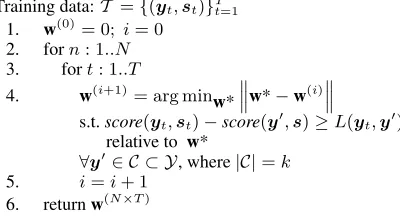
Figure 3: MIRA learning algorithm.
that the score of the correct labeling is larger than the score of every labeling in a constraint setCwith a margin proportional to the loss. The constraint set
Ccan be chosen arbitrarily, but it is usually taken to be theklabelings that have the highest score under the old weight vectorw(i)(McDonald et al., 2005). In this manner, the learning algorithm can update its parameters relative to those labelings closest to the decision boundary. Of all the weight vectors that sat-isfy these constraints, MIRA chooses the one that is as close as possible to the previous weight vector in order to retain information about previous updates.
The loss function L(y,y0)is a positive real val-ued function and is equal to zero wheny=y0. This function is task specific and is usually the hamming loss for sequence classification problems (Taskar et al., 2003). Experiments with different loss functions for the joint sentence-document model on a develop-ment data set indicated that the hamming loss over sentence labels multiplied by the 0-1 loss over doc-ument labels worked best.
[image:5.612.75.275.74.182.2]An important modification that was made to the learning algorithm deals with how thekconstraints are chosen for the optimization. Typically these con-straints are thekhighest scoring labelings under the current weight vector. However, early experiments showed that the model quickly learned to discard any labeling with an incorrect document label for the instances in the training set. As a result, the con-straints were dominated by labelings that only dif-fered over sentence labels. This did not allow the al-gorithm adequate opportunity to set parameters rel-ative to incorrect document labeling decisions. To combat this, k was divided by the number of doc-ument labels, to get a new valuek0. For each doc-ument label, the k0 highest scoring labelings were
Figure 4: An extension to the model from Figure 1 incorporating paragraph level analysis.
extracted. Each of these sets were then combined to produce the final constraint set. This allowed con-straints to be equally distributed amongst different document labels.
Based on performance on the development data set the number of training iterations was set toN = 5and the number of constraints tok = 10. Weight averaging was also employed (Collins, 2002), which helped improve performance.
2.2 Beyond Two-Level Models
To this point, we have focused solely on a model for two-level fine-to-coarse sentiment analysis not only for simplicity, but because the experiments in Sec-tion 3 deal exclusively with this scenario. In this section, we briefly discuss possible extensions for more complex situations. For example, longer doc-uments might benefit from an analysis on the para-graph level as well as the sentence and document levels. One possible model for this case is given in Figure 4, which essentially inserts an additional layer between the sentence and document level from the original model. Sentence level analysis is de-pendent on neighbouring sentences as well as the paragraph level analysis, and the paragraph anal-ysis is dependent on each of the sentences within it, the neighbouring paragraphs, and the document level analysis. This can be extended to an arbitrary level of fine-to-coarse sentiment analysis by simply inserting new layers in this fashion to create more complex hierarchical models.
Sentence Stats Document Stats
Pos Neg Neu Tot Pos Neg Tot
Car 472 443 264 1179 98 80 178
Fit 568 635 371 1574 92 97 189
Mp3 485 464 214 1163 98 89 187
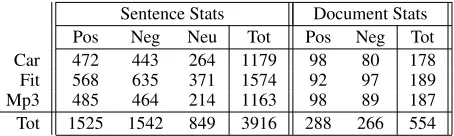
[image:6.612.75.302.71.139.2]Tot 1525 1542 849 3916 288 266 554
Table 1: Data statistics for corpus. Pos = positive polarity, Neg = negative polarity, Neu = no polarity.
for space reasons.
Other models are possible where dependencies occur across non-neighbouring levels, e.g., by in-serting edges between the sentence level nodes and the document level node. In the general case, infer-ence is exponential in the size of each clique. Both the models in Figure 1 and Figure 4 have maximum clique sizes of three.
3 Experiments
3.1 Data
To test the model we compiled a corpus of 600 on-line product reviews from three domains: car seats for children, fitness equipment, and Mp3 players. Of the original 600 reviews that were gathered, we dis-carded duplicate reviews, reviews with insufficient text, and spam. All reviews were labeled by on-line customers as having a positive or negative polar-ity on the document level, i.e.,Y(d) = {pos,neg}. Each review was then split into sentences and ev-ery sentence annotated by a single annotator as ei-ther being positive, negative or neutral, i.e.,Y(s) =
{pos,neg,neu}. Data statistics for the corpus are given in Table 1.
All sentences were annotated based on their con-text within the document. Sentences were anno-tated as neutral if they conveyed no sentiment or had indeterminate sentiment from their context. Many neutral sentences pertain to the circumstances un-der which the product was purchased. A common class of sentences were those containing product features. These sentences were annotated as having positive or negative polarity if the context supported it. This could include punctuation such as excla-mation points, smiley/frowny faces, question marks, etc. The supporting evidence could also come from another sentence, e.g., “I love it. It has 64Mb of memory and comes with a set of earphones”.
3.2 Results
Three baseline systems were created,
• Document-Classifieris a classifier that learns to predict the document label only.
• Sentence-Classifier is a classifier that learns to predict sentence labels in isolation of one another, i.e., without consideration for either the document or neighbouring sentences sen-timent.
• Sentence-Structuredis another sentence clas-sifier, but this classifier uses a sequential chain model to learn and classify sentences. The third baseline is essentially the model from Fig-ure 1 without the top level document node. This baseline will help to gage the empirical gains of the different components of the joint structured model on sentence level classification.
The model described in Section 2 will be called
Joint-Structured. All models use the same ba-sic predicate space: unigram, bigram, trigram con-joined with part-of-speech, plus back-offs of these (see Section 2.1.2 for more). However, due to the structure of the model and its label space, the feature space of each might be different, e.g., the document classifier will only conjoin predicates with the doc-ument label to create the feature set. All models are trained using the MIRA learning algorithm.
Results for each model are given in the first four rows of Table 2. These results were gathered using 10-fold cross validation with one fold for develop-ment and the other nine folds for evaluation. This table shows that classifying sentences in isolation from one another is inferior to accounting for a more global context. A significant increase in perfor-mance can be obtained when labeling decisions be-tween sentences are modeled (Sentence-Structured). More interestingly, even further gains can be had when document level decisions are modeled (Joint-Structured). In many cases, these improvements are highly statistically significant.
suspect this because the document level error rate on the Mp3 training set converges to zero much more rapidly for the Joint-Structured model than the Document-Classifier. This suggests that the Joint-Structured model might be relying too much on the sentence level sentiment features – in order to minimize its error rate – instead of distributing the weights across all features more evenly.
One interesting application of sentence level sen-timent analysis is summarizing product reviews on retail websites like Amazon.com or review aggrega-tors like Yelp.com. In this setting the correct polar-ity of a document is often known, but we wish to label sentiment on the sentence or phrase level to aid in generating a cohesive and informative sum-mary. The joint model can be used to classify sen-tences in this setting by constraining inference to the known fixed document label for a review. If this is done, then sentiment accuracy on the sentence level increases substantially from 62.6% to 70.3%.
Finally we should note that experiments using CRFs to train the structured models and logistic gression to train the local models yielded similar re-sults to those in Table 2.
3.2.1 Cascaded Models
Another approach to fine-to-coarse sentiment analysis is to use a cascaded system. In such a sys-tem, a sentence level classifier might first be run on the data, and then the results input into a docu-ment level classifier – or vice-versa.1 Two cascaded systems were built. The first uses the Sentence-Structured classifier to classify all the sentences from a review, then passes this information to the document classifier as input. In particular, for ev-ery predicate in the original document classifier, an additional predicate that specifies the polarity of the sentence in which this predicate occurred was cre-ated. The second cascaded system uses the docu-ment classifier to determine the global polarity, then passes this information as input into the Sentence-Structured model, constructing predicates in a simi-lar manner.
The results for these two systems can be seen in the last two rows of Table 2. In both cases there
1
Alternatively, decisions from the sentence classifier can guide which input is seen by the document level classifier (Pang and Lee, 2004).
is a slight improvement in performance suggesting that an iterative approach might be beneficial. That is, a system could start by classifying documents, use the document information to classify sentences, use the sentence information to classify documents, and repeat until convergence. However, experiments showed that this did not improve accuracy over a sin-gle iteration and often hurt performance.
Improvements from the cascaded models are far less consistent than those given from the joint struc-ture model. This is because decisions in the cas-caded system are passed to the next layer as the “gold” standard at test time, which results in errors from the first classifier propagating to errors in the second. This could be improved by passing a lattice of possibilities from the first classifier to the second with corresponding confidences. However, solutions such as these are really just approximations of the joint structured model that was presented here.
4 Future Work
One important extension to this work is to augment the models for partially labeled data. It is realistic to imagine a training set where many examples do not have every level of sentiment annotated. For example, there are thousands of online product re-views with labeled document sentiment, but a much smaller amount where sentences are also labeled. Work on learning with hidden variables can be used for both CRFs (Quattoni et al., 2004) and for in-ference based learning algorithms like those used in this work (Liang et al., 2006).
Another area of future work is to empirically in-vestigate the use of these models on longer docu-ments that require more levels of sentiment anal-ysis than product reviews. In particular, the rela-tive position of a phrase to a contrasrela-tive discourse connective or a cue phrase like “in conclusion” or “to summarize” may lead to improved performance since higher level classifications can learn to weigh information passed from these lower level compo-nents more heavily.
5 Discussion
de-Sentence Accuracy Document Accuracy
Car Fit Mp3 Total Car Fit Mp3 Total
Document-Classifier - - - - 72.8 80.1 87.2 80.3
Sentence-Classifier 54.8 56.8 49.4 53.1 - - -
-Sentence-Structured 60.5 61.4 55.7 58.8 - - -
-Joint-Structured 63.5∗ 65.2∗∗ 60.1∗∗ 62.6∗∗ 81.5∗ 81.9 85.0 82.8
[image:8.612.115.508.71.169.2]Cascaded Sentence→Document 60.5 61.4 55.7 58.8 75.9 80.7 86.1 81.1 Cascaded Document→Sentence 59.7 61.0 58.3 59.5 72.8 80.1 87.2 80.3
Table 2: Fine-to-coarse sentiment accuracy. Significance calculated using McNemar’s test between top two performing systems.∗Statistically significantp <0.05.∗∗Statistically significantp <0.005.
scribed a simple model for sentence-document anal-ysis and showed that inference in it is tractable. Ex-periments show that this model obtains higher ac-curacy than classifiers trained in isolation as well as cascaded systems that pass information from one level to another at test time. Furthermore, extensions to the sentence-document model were discussed and it was argued that a nested hierarchical structure would be beneficial since it would allow for efficient inference algorithms.
References
Y. Choi, C. Cardie, E. Riloff, and S. Patwardhan. 2005. Identi-fying sources of opinions with conditional random fields and extraction patterns. InProc. HLT/EMNLP.
Y. Choi, E. Breck, and C. Cardie. 2006. Joint extraction of enti-ties and relations for opinion recognition. InProc. EMNLP. M. Collins. 2002. Discriminative training methods for hidden Markov models: Theory and experiments with perceptron algorithms. InProc. EMNLP.
K. Crammer and Y. Singer. 2003. Ultraconservative online algorithms for multiclass problems.JMLR.
Hal Daum´e III, John Langford, and Daniel Marcu. 2006. Search-based structured prediction. In Submission. J. Lafferty, A. McCallum, and F. Pereira. 2001. Conditional
random fields: Probabilistic models for segmenting and la-beling sequence data. InProc. ICML.
P. Liang, A. Bouchard-Cote, D. Klein, and B. Taskar. 2006. An end-to-end discriminative approach to machine translation. InProc. ACL.
Y. Mao and G. Lebanon. 2006. Isotonic conditional random fields and local sentiment flow. InProc. NIPS.
R. McDonald, K. Crammer, and F. Pereira. 2005. Online large-margin training of dependency parsers. InProc. ACL. R. McDonald. 2006. Discriminative Training and Spanning
Tree Algorithms for Dependency Parsing. Ph.D. thesis, Uni-versity of Pennsylvania.
S. Miller, H. Fox, L.A. Ramshaw, and R.M. Weischedel. 2000. A novel use of statistical parsing to extract information from text. InProc NAACL, pages 226–233.
B. Pang and L. Lee. 2004. A sentimental education: Sen-timent analysis using subjectivity summarization based on minimum cuts. InProc. ACL.
B. Pang, L. Lee, and S. Vaithyanathan. 2002. Thumbs up? Sentiment classification using machine learning techniques. InEMNLP.
A. Popescu and O. Etzioni. 2005. Extracting product features and opinions from reviews. InProc. HLT/EMNLP. A. Quattoni, M. Collins, and T. Darrell. 2004. Conditional
random fields for object recognition. InProc. NIPS. L. R. Rabiner. 1989. A tutorial on hidden Markov models and
selected applications in speech recognition. Proceedings of the IEEE, 77(2):257–285, February.
D. Roth and W. Yih. 2004. A linear programming formula-tion for global inference in natural language tasks. InProc. CoNLL.
C. Sutton and A. McCallum. 2006. An introduction to con-ditional random fields for relational learning. In L. Getoor and B. Taskar, editors,Introduction to Statistical Relational Learning. MIT Press.
C. Sutton, K. Rohanimanesh, and A. McCallum. 2004. Dy-namic conditional random fields: Factorized probabilistic models for labeling and segmenting sequence data. InProc. ICML.
B. Taskar, C. Guestrin, and D. Koller. 2003. Max-margin Markov networks. InProc. NIPS.
B. Taskar, D. Klein, M. Collins, D. Koller, and C. Manning. 2004. Max-margin parsing. InProc. EMNLP.
M. Thomas, B. Pang, and L. Lee. 2006. Get out the vote: Determining support or opposition from congressional floor-debate transcripts. InProc. EMNLP.
I. Tsochantaridis, T. Hofmann, T. Joachims, and Y. Altun. 2004. Support vector learning for interdependent and structured output spaces. InProc. ICML.
P. Turney. 2002. Thumbs up or thumbs down? Sentiment ori-entation applied to unsupervised classification of reviews. In