Active Semi-Supervised Learning for Improving Word Alignment
Vamshi Ambati, Stephan Vogel and Jaime Carbonell {vamshi,vogel,jgc}@cs.cmu.edu
Language Technologies Institute, Carnegie Mellon University 5000 Forbes Avenue, Pittsburgh, PA 15213, USA
Abstract
Word alignment models form an important part of building statistical machine transla-tion systems. Semi-supervised word align-ment aims to improve the accuracy of auto-matic word alignment by incorporating full or partial alignments acquired from humans. Such dedicated elicitation effort is often ex-pensive and depends on availability of bilin-gual speakers for the language-pair. In this paper we study active learning query strate-gies to carefully identify highly uncertain or most informative alignment links that are pro-posed under an unsupervised word alignment model. Manual correction of such informative links can then be applied to create a labeled dataset used by a semi-supervised word align-ment model. Our experialign-ments show that using active learning leads to maximal reduction of alignment error rates with reduced human ef-fort.
1 Introduction
The success of statistical approaches to Machine Translation (MT) can be attributed to the IBM mod-els (Brown et al., 1993) that characterize word-levelalignments in parallel corpora. Parameters of these alignment models are learnt in an unsupervised manner using the EM algorithm oversentence-level aligned parallel corpora. While the ease of auto-matically aligning sentences at the word-level with tools like GIZA++ (Och and Ney, 2003) has enabled fast development of statistical machine translation (SMT) systems for various language pairs, the qual-ity of alignment is typically quite low for language
pairs that diverge from the independence assump-tions made by the generative models. Also, an im-mense amount of parallel data enables better estima-tion of the model parameters, but a large number of language pairs still lack parallel data.
Two directions of research have been pursued for improving generative word alignment. The first is to relax or update the independence assumptions based on more information, usually syntactic, from the language pairs (Cherry and Lin, 2006). The sec-ond is to use extra annotation, typicallyword-level human alignment for some sentence pairs, in con-junction with the parallel data to learn alignment in a semi-supervised manner. Our research is in the direction of the latter, and aims to reduce the effort involved in hand-generation of word alignments by using active learning strategies for careful selection of word pairs to seek alignment.
per-forms an improved word alignment over the entire parallel corpus.
Rest of the paper is organized as follows. We present related work in Section 2. Section 3 gives an overview of unsupervised word alignment mod-els and its semi-supervised improvisation. Section 4 details our active learning framework with discus-sion of the link selection strategies in Section 5. Ex-periments in Section 6 have shown that our selection strategies reduce alignment error rates significantly over baseline. We conclude with discussion on fu-ture work.
2 Related Work
Semi-supervised learning is a broader area of Ma-chine Learning, focusing on improving the learn-ing process by usage of unlabeled data in conjunc-tion with labeled data (Chapelle et al., 2006). Many semi-supervised learning algorithms use co-training framework, which assumes that the dataset has mul-tiple views, and training different classifiers on a non-overlapping subset of these features provides additional labeled data (Zhu, 2005). Active query selection for training a semi-supervised learning al-gorithm is an interesting method that has been ap-plied to clustering problems. Tomanek and Hahn (2009) applied active semi supervised learning to the sequence-labeling problem. Tur et al. (2005) de-scribe active and semi-supervised learning methods for reducing labeling effort for spoken language un-derstanding. They train supervised classification al-gorithms for the task of call classification and apply it to a large unlabeled dataset to select the least con-fident instances for human labeling.
Researchers have begun to explore semi-supervised word alignment models that use both labeled and unlabeled data. Fraser and Marcu (2006) pose the problem of alignment as a search problem in log-linear space with features coming from the IBM alignment models. The log-linear model is trained on the available labeled data to improve performance. They propose a semi-supervised training algorithm which alternates between discriminative error training on the la-beled data to learn the weighting parameters and maximum-likelihood EM training on unlabeled data to estimate the parameters. Callison-Burch et
al. (2004) also improve alignment by interpolating human alignments with automatic alignments. They observe that while working with such datasets, alignments of higher quality should be given a much higher weight than the lower-quality alignments. Wu et al. (2006) learn separate models from labeled and unlabeled data using the standard EM algo-rithm. The two models are then interpolated as a learner in the semi-supervised AdaBoost algorithm to improve word alignment.
Active learning has been applied to various fields of Natural Language Processing like statistical pars-ing, entity recognition among others (Hwa, 2004; Tang et al., 2001; Shen et al., 2004). In case of MT, the potential of active learning has remained largely unexplored. For Statistical Machine Transla-tion, application of active learning has been focused on the task of selecting the most informative sen-tences to train the model, in order to reduce cost of data acquisition. Recent work in this area dis-cussed multiple query selection strategies for a Sta-tistical Phrase Based Translation system (Haffari et al., 2009). Their framework requires source text to be translated by the system and the translated data is used in a self-training setting to train MT models. To our knowledge, we are not aware of any work that has looked at reducing human effort by selec-tive elicitation of alignment information using acselec-tive learning techniques.
3 Word Alignment
3.1 IBM models
IBM models provide a generative framework for performing word alignment of parallel corpus. Given two strings from source and target languages
sJ1 = s1,· · ·, sj,· · ·sJ and tI1 = t1,· · ·, ti,· · ·tI,
an alignmentAis defined as a subset of the Carte-sian product of the word indices as shown in Eq 1. In IBM models, since alignment is treated as a func-tion, all the source positions must be covered exactly once (Brown et al., 1993).
A ⊆ {(j, i) :j= 0· · ·J;i= 0· · ·I} (1)
and so it is then factored over the word alignment
Afor the sentence pair, which is a hidden variable. Word alignment is therefore a by-product in the pro-cess of modeling translation. We can also represent the same under some parameterization ofθ, which is the model we are interested to estimate.
P(sJ1|tI1) = X
aJ
1
P r(sJ1, A|tJ1) (2)
= X
A
pθ(sJ1, A|t
I
1) (3)
Given a parallel corpus U of sentence pairs {(sk, tk) : k = 1,· · ·, K}the parameters can be
estimated by maximizing the conditional likelihood over the data. IBM models (Brown et al., 1993) from 1 to 5 are different ways of factoring the probability model to estimate the parameter setθ. For example in the simplest of the models, IBM model 1, only the lexical translation probability is considered treating each word being translated independent of the other words.
ˆ
θ= arg max
θ K
Y
k=1 X
A
pθ(sk, A|tk) (4)
The parameters of the model above are estimated as θˆ, using the EM algorithm. We can also extract theViterbi alignment,Aˆ, for all the sentence pairs, which is the alignment with the highest probability under the current model parametersθ:
ˆ
A= arg max
A pθˆ(s J
1, A|t
I
1) (5)
The alignment models are asymmetric and dif-fer with the choice of translation direction. We can therefore perform the above after switching the di-rection of the language pair and obtain models and Viterbi alignments for the corpus as represented be-low:
ˆ
θ = arg max
θ K
Y
k=1 X
a
pθ(tk, a|sk) (6)
ˆ
A = arg max
A pθˆ(t I
1, A|sJ1) (7)
Given the Viterbi alignment for each sentence pair in the parallel corpus, we can also compute the word-level alignment probabilities using simple rel-ative likelihood estimation for both the directions.
As we will discuss in Section 5, the alignments and the computed lexicons form an important part of our link selection strategies.
P(sj/ti) =
P
scount(ti, sj; ˆA)
P
scount(ti)
(8)
P(ti/sj) =
P
scount(ti, sj; ˆA)
P
scount(sj)
(9)
We perform all our experiments on a symmetrized alignment that combines the bidirectional align-ments using heuristics as discussed in (Koehn et al., 2007). We represent this alignment asA = {aij :
i= 0· · ·J∈sJ1;j= 0· · ·I ∈tI1}.
3.2 Semi-Supervised Word Alignment
We use an extended version of MGIZA++ (Gao and Vogel, 2008) to perform the constrained semi-supervised word alignment. To get full benefit from the manual alignments, MGIZA++ modifies all alignment models used in the standard training pro-cedure, i.e. the IBM1, HMM, IBM3 and IBM4 mod-els. Manual alignments are incorporated in the EM training phase of these models as constraints that restrict the summation over all possible alignment paths. Typically in the EM procedure for IBM mod-els, the training procedure requires for each source sentence position, the summation over all positions in the target sentence. The manual alignments al-low for one-to-many alignments and many-to-many alignments in both directions. For each positioni
in the source sentence, there can be more than one manually aligned target word. The restricted train-ing will allow only those paths, which are consistent with the manual alignments. Therefore, the restric-tion of the alignment paths reduces to restricting the summation in EM.
4 Active Learning for Word Alignment
is reached or a desired accuracy level is achieved. Several studies (Tong and Koller, 2002; Nguyen and Smeulders, 2004; Donmez and Carbonell, 2008) show that active learning greatly helps to reduce the labeling effort in various classification tasks.
We discuss our active learning setup for word alignment in Algorithm 1. We start with an un-labeled dataset U = {(Sk, Tk)}, indexed by k,
and a seed pool of partial alignment links A0 = {akij,∀si ∈ Sk, tj ∈ Tk}. Eachakij represents an
alignment link from a sentence pairk that connects source wordsiwithtj.
This is usually an empty set at iterationt= 0. We iterate forT iterations. We take a pool-based active learning strategy, where we have access to all the au-tomatically aligned links and we can score the links based on our active learning query strategy. The query strategy uses the automatically trained align-ment modelθt from the current iterationt, for
scor-ing the links. Re-trainscor-ing and re-tunscor-ing an SMT sys-tem for each link at a time is computationally infea-sible. We therefore perform batch learning by se-lecting a set of N links scored high by our query strategy. We seek manual corrections for the se-lected links and add the alignment data to the cur-rent labeled dataset. The word-level aligned labeled dataset is then provided to our semi-supervised word alignment algorithm, which uses it to produces the alignment modelθt+1forU.
Algorithm 1ALFORWORDALIGNMENT
1: Unlabeled Data Set:U ={(sk, tk)}
2: Manual Alignment Set : A0 = {akij,∀si ∈
Sk, tj∈Tk}
3: Train Semi-supervised Word Alignment using (U,A0)→θ0
4: N: batch size 5: fort= 0toT do
6: Lt = LinkSelection(U,At,θt,N)
7: Request Human Alignment forLt
8: At+1=At+Lt
9: Re-train Semi-Supervised Word Align-ment on (U, At+1)→θt+1
10: end for
We can iteratively perform the algorithm for a de-fined number of iterationsTor until a certain desired performance is reached, which is measured by
align-ment error rate (AER) (Fraser and Marcu, 2007) in the case of word alignment. In a more typical sce-nario, since reducing human effort or cost of elici-tation is the objective, we iterate until the available budget is exhausted.
5 Query Strategies for Link Selection
We propose multiple query selection strategies for our active learning setup. The scoring criteria is designed to select alignment links across sentence pairs that are highly uncertain under current au-tomatic translation models. These links are diffi-cult to align correctly by automatic alignment and will cause incorrect phrase pairs to be extracted in the translation model, in turn hurting the transla-tion quality of the SMT system. Manual correctransla-tion of such links produces the maximal benefit to the model. We would ideally like to elicit the least num-ber of manual corrections possible in order to reduce the cost of data acquisition. In this section we dis-cuss our link selection strategies based on the stan-dard active learning paradigm of ‘uncertainty sam-pling’(Lewis and Catlett, 1994). We use the au-tomatically trained translation modelθt for scoring
each link for uncertainty. In particularθt consists of
bidirectional lexicon tables computed from the bidi-rectional alignments as discussed in Section 3.
5.1 Uncertainty based: Bidirectional Alignment Scores
The automatic Viterbi alignment produced by the alignment models is used to obtain translation lexi-cons, as discussed in Section 3. These lexicons cap-ture the conditional distributions of source-given-targetP(s/t)and target-given-sourceP(t/s) prob-abilities at the word level wheresi ∈Sandtj ∈T.
We define certainty of a link as the harmonic mean of the bidirectional probabilities. The selection strat-egy selects the least scoring links according to the formula below which corresponds to links with max-imum uncertainty:
Score(aij/sI1, t
J
1) =
2∗P(tj/si)∗P(si/tj)
P(tj/si) +P(si/tj)
(10)
5.2 Confidence Based: Posterior Alignment probabilities
et al., 2004; Ueffing and Ney, 2007). Given a sen-tence pair(sI
1, tJ1)and its word alignment, we com-pute two confidence metrics at alignment link level – based on the posterior link probability and a simple IBM Model 1 as seen in Equation 13. We select the alignment links that the initial word aligner is least confident according to our metric and seek manual correction of the links. We uset2sto denote com-putation using higher order (IBM4) target-given-source models ands2tto denote source-given-target models. Targeting some of the uncertain parts of word alignment has already been shown to improve translation quality in SMT (Huang, 2009). In our current work, we use confidence metrics as an ac-tive learning sampling strategy to obtain most infor-mative links. We also experiment with other con-fidence metrics as discussed in (Ueffing and Ney, 2007), especially the IBM 1 model score metric which showed some improvement as well.
Pt2s(aij, tJ1/s
I
1) =
pt2s(tj/si, aij ∈A)
PM
i pt2s(tj/si)
(11)
Ps2t(aij, sI1/t
J
1) =
ps2t(si/tj, aij ∈A)
PN
i pt2s(tj/si)
(12)
Conf(aij/S, T) =
2∗Pt2s∗Ps2t
Pt2s+Ps2t
(13)
5.3 Agreement Based: Query by Committee
The generative alignments produced differ based on the choice of direction of the language pair. We use
As2t to denote alignment in the source to target
di-rection andAt2sto denote the target to source
direc-tion. We consider these alignments to be two experts that have two different views of the alignment pro-cess. We formulate our query strategy to select links, where the agreement differs across these two align-ments. In general query by committee is a standard sampling strategy in active learning(Freund et al., 1997), where the committee consists of any number of experts with varying opinions, in this case align-ments in different directions. We formulate a query by committee sampling strategy for word alignment as shown in Equation 14. In order to break ties, we extend this approach to select the link with higher average frequency of occurrence of words involved in the link.
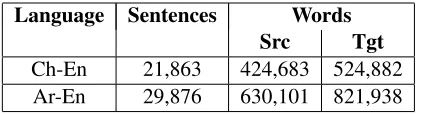
Language Sentences Words Src Tgt
Ch-En 21,863 424,683 524,882
[image:5.612.320.532.63.120.2]Ar-En 29,876 630,101 821,938
Table 1: Corpus Statistics of Human Data
Alignment Automatic Links Manual Links
Ch-En 491,887 588,075
Ar-En 786,223 712,583
Table 2: Alignment Statistics of Human Data
Score(aij) = α where (14)
α =
2 aij ∈At2s∩At2s
1 aij ∈At2s∪At2s
0 otherwise
6 Experiments
6.1 Data Analysis
[image:5.612.94.300.345.432.2]To run our active learning and semi-supervised word alignment experiments iteratively, we simulate the setup by using a parallel corpus for which the gold standard human alignment is already available. We experiment with two language pairs - Chinese-English and Arabic-Chinese-English. Corpus-level statistics for both language pairs can be seen in Table 1 and their alignment link level statistics can be seen in Table 2. Both datasets were released by LDC as part of the GALE project.
Chinese-English dataset consists of 21,863 sen-tence pairs with complete manual alignment. The human alignment for this dataset is much denser than the automatic word alignment. On an aver-age each source word is linked to more than one target word. Similarly, the Arabic-English dataset consisting of 29,876 sentence pairs also has a denser manual alignment. Automatic word alignment in both cases was computed as a symmetrized version of the bidirectional alignments obtained from using GIZA++ (Och and Ney, 2003) in each direction sep-arately.
6.2 Word Alignment Results
Figure 1: Chinese-English: Link Selection Results
in running our link selection algorithm over the en-tire alignments to determine the most uncertain links according to each active learning strategy. The links are then looked up in the gold standard human align-ment database and corrected. In scenarios where an alignment link is not present in the gold stan-dard data for the source word, we introduce a NULL alignment constraint, else we select all the links as given in the gold standard. The aim of our work is to show that active learning can help in selecting infor-mative alignment links, which if manually labeled can reduce the overall alignment error rate of the given corpus. We, therefore measure the reduction of alignment error rate (AER) of a semi-supervised word aligner that uses this extra information to align the corpus. We plot performance curves for both Chinese-English, Figure 1 and Arabic-English, Fig-ure 2, with number of manual links elicited on x-axis and AER on y-axis. In each iteration of the experi-ment, we gradually increase the number of links se-lected from gold standard and make them available to the semi-supervised word aligner and measure the overall reduction of AER on the corpus. We com-pare our link selection strategies to a baseline ap-proach, where links are selected at random for man-ual correction.
All our approaches perform equally or better than the baseline for both language pairs. Query by committee (qbc) performs similar to the baseline in Chinese-English and only slightly better for
Arabic-Figure 2: Arabic-English: Link Selection Results
English. This could be due to our committee con-sisting of two alignments that differ only in direc-tion and so are not sufficient in deciding for uncer-tainty. We will be exploring alternative formulations to this strategy. Confidence based and uncertainty based metrics perform significantly better than the baseline in both language pairs. We can interpret the improvements in two ways. For the same number of manual alignments elicited, our selection strate-gies select links that provide higher reduction of er-ror when compared to the baseline. An alternative interpretation is that assuming a uniform cost per link, our best selection strategy achieves similar per-formance to the baseline, at a much lower cost of elicitation.
6.3 Translation Results
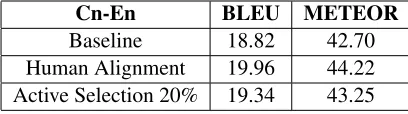
[image:6.612.77.300.63.258.2]Cn-En BLEU METEOR
Baseline 18.82 42.70
[image:7.612.85.289.64.121.2]Human Alignment 19.96 44.22 Active Selection 20% 19.34 43.25
Table 3: Effect of Alignment on Translation Quality
We first obtain the baseline score by training in an unsupervised manner, where no manual alignment is used. We also train a configuration, where we substitute the final word alignment with gold stan-dard manual alignment for the entire parallel corpus. This is an upper bound on the translation accuracy that can be achieved by any alignment link selec-tion algorithm for this dataset. We now take our best link selection criteria, which is the confidence based method and re-train the MT system after elic-iting manual information for only 20% of the align-ment links. We observe that at this point we have reduced the AER from 37.09 to 26.57. The trans-lation accuracy reported in Table 3, as measured by BLEU (Papineni et al., 2002) and METEOR (Lavie and Agarwal, 2007), also shows significant improve-ment and approaches the quality achieved using gold standard data. We did not perform MT experiments with Arabic-English dataset due to the incompatibil-ity of tokenization schemes between the manually aligned parallel corpora and publicly available eval-uation sets.
7 Conclusion
Word-Alignment is a particularly challenging prob-lem and has been addressed in a completely unsuper-vised manner thus far (Brown et al., 1993). While generative alignment models have been successful, lack of sufficient data, model assumptions and lo-cal optimum during training are well known prob-lems. Semi-supervised techniques use partial man-ual alignment data to address some of these issues. We have shown that active learning strategies can reduce the effort involved in eliciting human align-ment data. The reduction in effort is due to care-ful selection of maximally uncertain links that pro-vide the most benefit to the alignment model when used in a semi-supervised training fashion. Experi-ments on Chinese-English have shown considerable improvements.
8 Future Work
In future, we wish to work with word alignments for other language pairs as well as study the effect of manual alignments by varying the size of available parallel data. We also plan to obtain alignments from non-experts over online marketplaces like Amazon Mechanical Turk to further reduce the cost of an-notation. We will be experimenting with obtain-ing full-alignment vs. partial alignment from non-experts. Our hypothesis is that, humans are good at performing tasks of smaller size and so we can extract high quality alignments in the partial align-ment case. Cost of link annotation in our current work is assumed to be uniform, but this needs to be revisited. We will also experiment with active learning techniques for identifying sentence pairs with very low alignment confidence, where obtain-ing full-alignment is equivalent to obtainobtain-ing multi-ple partial alignments.
Acknowledgments
This research was partially supported by DARPA under grant NBCHC080097. Any opinions, find-ings, and conclusions expressed in this paper are those of the authors and do not necessarily reflect the views of the DARPA. The first author would like to thank Qin Gao for the semi-supervised word align-ment software and help with running experialign-ments.
References
John Blatz, Erin Fitzgerald, George Foster, Simona Gan-drabur, Cyril Goutte, Alex Kulesza, Alberto Sanchis, and Nicola Ueffing. 2004. Confidence estimation for machine translation. InProceedings of Coling 2004, pages 315–321, Geneva, Switzerland, Aug 23–Aug 27. COLING.
Peter F. Brown, Vincent J. Della Pietra, Stephen A. Della Pietra, and Robert L. Mercer. 1993. The mathemat-ics of statistical machine translation: parameter esti-mation.Computational Linguistics, 19(2):263–311. Chris Callison-Burch, David Talbot, and Miles Osborne.
2004. Statistical machine translation with word- and sentence-aligned parallel corpora. InACL 2004, page 175, Morristown, NJ, USA. Association for Computa-tional Linguistics.
Colin Cherry and Dekang Lin. 2006. Soft syntactic constraints for word alignment through discriminative training. InProceedings of the COLING/ACL on Main conference poster sessions, pages 105–112, Morris-town, NJ, USA.
Pinar Donmez and Jaime G. Carbonell. 2008. Opti-mizing estimated loss reduction for active sampling in rank learning. InICML ’08: Proceedings of the 25th international conference on Machine learning, pages 248–255, New York, NY, USA. ACM.
Alexander Fraser and Daniel Marcu. 2006. Semi-supervised training for statistical word alignment. In ACL-44: Proceedings of the 21st International Con-ference on Computational Linguistics and the 44th annual meeting of the Association for Computational Linguistics, pages 769–776, Morristown, NJ, USA. Association for Computational Linguistics.
Alexander Fraser and Daniel Marcu. 2007. Measuring word alignment quality for statistical machine transla-tion. Comput. Linguist., 33(3):293–303.
Yoav Freund, Sebastian H. Seung, Eli Shamir, and Naf-tali Tishby. 1997. Selective sampling using the query by committee algorithm. Machine. Learning., 28(2-3):133–168.
Qin Gao and Stephan Vogel. 2008. Parallel implemen-tations of word alignment tool. In Software Engi-neering, Testing, and Quality Assurance for Natural Language Processing, pages 49–57, Columbus, Ohio, June. Association for Computational Linguistics. Gholamreza Haffari, Maxim Roy, and Anoop Sarkar.
2009. Active learning for statistical phrase-based ma-chine translation. In Proceedings of HLT NAACL 2009, pages 415–423, Boulder, Colorado, June. As-sociation for Computational Linguistics.
Fei Huang. 2009. Confidence measure for word align-ment. InProceedings of the Joint ACL and IJCNLP, pages 932–940, Suntec, Singapore, August. Associa-tion for ComputaAssocia-tional Linguistics.
Rebecca Hwa. 2004. Sample selection for statistical parsing.Comput. Linguist., 30(3):253–276.
Philipp Koehn, Hieu Hoang, Alexandra Birch Mayne, Christopher Callison-Burch, Marcello Federico, Nicola Bertoldi, Brooke Cowan, Wade Shen, Chris-tine Moran, Richard Zens, Chris Dyer, Ondrej Bojar, Alexandra Constantin, and Evan Herbst. 2007. Moses: Open source toolkit for statistical machine translation. InACL Demonstration Session.
Alon Lavie and Abhaya Agarwal. 2007. Meteor: an au-tomatic metric for mt evaluation with high levels of correlation with human judgments. In WMT 2007, pages 228–231, Morristown, NJ, USA.
David D. Lewis and Jason Catlett. 1994. Heterogeneous uncertainty sampling for supervised learning. In In
Proceedings of the Eleventh International Conference on Machine Learning, pages 148–156. Morgan Kauf-mann.
Hieu T. Nguyen and Arnold Smeulders. 2004. Active learning using pre-clustering. InICML.
Franz Josef Och and Hermann Ney. 2003. A system-atic comparison of various statistical alignment mod-els.Computational Linguistics, pages 19–51.
Kishore Papineni, Salim Roukos, Todd Ward, and Wei-Jing Zhu. 2002. Bleu: a method for automatic evalua-tion of machine translaevalua-tion. InACL 2002, pages 311– 318, Morristown, NJ, USA.
Dan Shen, Jie Zhang, Jian Su, Guodong Zhou, and Chew-Lim Tan. 2004. Multi-criteria-based active learning for named entity recognition. InACL ’04: Proceed-ings of the 42nd Annual Meeting on Association for Computational Linguistics, page 589, Morristown, NJ, USA. Association for Computational Linguistics. Min Tang, Xiaoqiang Luo, and Salim Roukos. 2001.
Ac-tive learning for statistical natural language parsing. In ACL ’02, pages 120–127, Morristown, NJ, USA. Katrin Tomanek and Udo Hahn. 2009. Semi-supervised
active learning for sequence labeling. InProceedings of the Joint Conference of the 47th Annual Meeting of the ACL and the 4th International Joint Conference on Natural Language Processing of the AFNLP, pages 1039–1047, Suntec, Singapore, August. Association for Computational Linguistics.
Simon Tong and Daphne Koller. 2002. Support vector machine active learning with applications to text clas-sification.Journal of Machine Learning, pages 45–66. Gokhan Tur, Dilek Hakkani-Tr, and Robert E. Schapire. 2005. Combining active and semi-supervised learning for spoken language understanding. Speech Commu-nication, 45(2):171 – 186.
Nicola Ueffing and Hermann Ney. 2007. Word-level confidence estimation for machine translation. Com-put. Linguist., 33(1):9–40.
Hua Wu, Haifeng Wang, and Zhanyi Liu. 2006. Boosting statistical word alignment using labeled and unlabeled data. InProceedings of the COLING/ACL on Main conference poster sessions, pages 913–920, Morris-town, NJ, USA. Association for Computational Lin-guistics.