Characterisation and Performance
Analysis of Random Linear Network
Coding for Reliable and Secure
Communication
Author:
Amjad Saeed Khan
Supervisor:
Dr. Ioannis Chatzigeorgiou
A thesis submitted in partial fulfillment
for the degree of Doctor of Philosophy
Communication Systems Group
School of Computing and Communications
I, Amjad Saeed Khan, declare that this thesis titled, ‘Characterisation and Performance Analysis of Random Linear Network Coding for Reliable and Secure Communication’ and the work presented in it are my own. I confirm that:
This work was done wholly or mainly while in candidature for a research degree
at this University.
Where any part of this thesis has previously been submitted for a degree or any
other qualification at this University or any other institution, this has been clearly stated.
Where I have consulted the published work of others, this is always clearly
at-tributed.
Where I have quoted from the work of others, the source is always given. With
the exception of such quotations, this thesis is entirely my own work.
I have acknowledged all main sources of help.
Where the thesis is based on work done by myself jointly with others, I have made
clear exactly what was done by others and what I have contributed myself.
Signed:
Date:
First of all, I would like to thank Almighty God, the one, who bless me with the oppor-tunity to pursue the journey towards a PhD.
I would like to express my sincere gratitude and very special thanks to Dr. Ioannis Chatzigeorgiou for being no less than a perfect supervisor I could ever possibly imagine. In fact, Ioannis has always impressed me by exceeding all my expectations. He is a real gentleman and excellent teacher: very supportive, encouraging, understanding, kind, sincere, honest and generous. Throughout my PhD, Ioannis was not only supporting me to improve my knowledge and writing expertise, but also seemed to have always a better thought and plan for my exposure and future development. Apart from the research, he has given me great advices from his life experience that added a lot of positivity in my personality, which is priceless to me. I will always be very grateful to Ioannis for making my graduate experience very productive, enjoyable and memorable.
I wish to thank the Lancaster University for their excellent resources. In particular, thanks to the School of Computing and Communications (InfoLab21) for providing the research environment and resources, and for their friendly and supporting faculty and staff members including: Prof. Zhiguo Ding, Prof. Qiang Ni, Vicky Waddington, Gillian Balderstone and Debbie Stubbs. Moreover, I am very grateful and thankful to the Faculty of Science and Technology (FST) for granting me a very precious PhD scholarship, and providing me support to attend the number of summer schools. The op-portunity of studying in the Lancaster University will always be a remarkable experience in my life.
I specially thanks to my father and mother for their never-ending love, prayers, encour-agements, support and showing confidence on me, without which it would be impossible for me to pursue my studies up to this stage. In addition, thanks to my sisters and brother for their love, prayers and encouragements throughout my studies. Further-more, I wish to thank all my colleagues and sincere friends for helping me with their valuable discussions and guidance during my PhD. Last but not least, I would like to thank Andrew Wood and Elspeth Wood, the organizers of Friends International Lan-caster, for beautifying my stay here at LanLan-caster, and for being a part of wonderful memories.
Most of the work documented in this thesis has been published or under preparation for publication in journals or conference proceedings, as listed below:
Journal
1. A. S. Khan and I. Chatzigeorgiou, “Non-Orthogonal Multiple Access Combined With Random Linear Network Coded Cooperation”, IEEE Signal Processing Let-ters, vol. 24, no. 9, pp. 1298-1302, Sept. 2017.
2. A. S. Khan and I. Chatzigeorgiou, “Improved bounds on the decoding failure probability of linear NC over multi-source multi-relay networks”, IEEE Commu-nications Letters, vol. 20, no. 10, pp. 2035-2038, Oct. 2016.
3. A. S. Khan, A. Tassi and I. Chatzigeorgiou, “Rethinking the intercept probability of random linear network coding”, IEEE Communications Letters, vol. 19, no. 10, pp. 1762-1765, October 2015.
4. A. S. Khan and I. Chatzigeorgiou, “Opportunistic relaying and random linear network coding for secure and reliable communication”, IEEE Transactions on Wireless Communications, (accepted with minor revisions).
5. A. S. Khanand I. Chatzigeorgiou, “A Framework for the Analysis of Network-Coded Schemes Characterized by Random Block Matrices”, IEEE Transactions on Wireless Communications, (in preparation).
Conference
1. A. S. Khan and I. Chatzigeorgiou, “Performance analysis of random linear net-work coding in two-source single-relay netnet-works”, in Proc. IEEE International Conference on Communications Workshops (ICC), Workshop on Cooperative and Cognitive Networks, London, United Kingdom, June 2015.
Abstract
Faculty of Science and Technology School of Computing and Communications
Doctor of Philosophy
Characterisation and Performance Analysis of Random Linear Network Coding for Reliable and Secure Communication
In this thesis, we develop theoretical frameworks to characterize the performance of Random Linear Network Coding (RLNC), and propose novel communication schemes for the achievement of both reliability and security in wireless networks. In particular, (i) we present an analytical model to evaluate the performance of practical RLNC schemes suitable for low-complexity receivers, prioritized (i.e., layered) coding and multi-hop communications, (ii) investigate the performance of RLNC in relay assisted networks and propose a new cross-layer RLNC-aided cooperative scheme for reliable communication, (iii) characterize the secrecy feature of RLNC and propose a new physical-application layer security technique for the purpose of achieving security and reliability in multi-hope communications.
At first, we investigate random block matrices and derive mathematical expressions for the enumeration of full-rank matrices that contain blocks of random entries arranged in a diagonal, lower-triangular or tri-diagonal structure. The derived expressions are then used to model the probability that a receiver will successfully decode a source message or layers of a service, when RLNC based on non-overlapping, expanding or sliding generations is employed. Moreover, the design parameters of these schemes allow to adjust the desired decoding performance.
Contents
Declaration of Authorship i
Acknowledgements ii
List of Publications iii
Abstract iv
Contents vii
List of Figures x
Abbreviations xiii
1 Introduction 1
1.1 Background and Motivations . . . 1
1.2 Basic Examples of Network Coding . . . 2
1.2.1 NC in a Butterfly Network . . . 3
1.2.2 NC in a Wireless Network . . . 4
1.3 Random Linear Network Coding . . . 4
1.3.1 RLNC Encoding and Decoding . . . 5
1.3.2 RLNC Example. . . 6
1.3.3 RLNC Limitation and Literature Work . . . 7
1.4 RLNC Applications . . . 8
1.4.1 RLNC for Heterogeneous Devices and Broadcast Communication . 9 1.4.2 Random Linear Network Coded Cooperation . . . 9
1.4.3 RLNC for Secure Communication . . . 9
1.4.4 RLNC Integrated with Opportunistic Relaying and Intentional Jamming . . . 10
1.5 Overview and Contributions of Thesis . . . 12
1.5.1 Thesis Structure and Organization . . . 13
2 A Framework for the Assessment of Network Coding Techniques Char-acterised by Random Block Matrices 16 2.1 Fundamental Preliminary Expressions . . . 17
2.2 Partitioning of Random Matrices . . . 18
2.3 Structures of Random Block Matrices . . . 20
2.3.1 Block Diagonal (BD) Matrices . . . 21
2.3.2 Block Lower-Triangular (BLT) Matrices . . . 22
2.3.3 Block Tri-Diagonal (BTD) Matrices . . . 23
2.4 Assessment of Network Coding Techniques. . . 26
2.4.1 Non-Overlapping Generations RLNC (NOG-RLNC) . . . 27
2.4.2 Expanding Generations RLNC (EG-RLNC) . . . 28
2.4.3 Sliding Generations RLNC (SG-RLNC) . . . 30
2.5 Results and Discussions . . . 31
2.5.1 Performance Comparison between NOG-RLNC, SG-RLNC and EG-RLNC over Non-erasure Channels . . . 32
2.5.2 Performance Comparison between SG-RLNC and EG-RLNC over Erasure Channels. . . 35
2.6 Summary . . . 36
3 Random Linear Network Coding for Coded Cooperation 38 3.1 Random Linear Network Coded Cooperation in Two Source Single Relay Networks . . . 39
3.1.1 System Model and Problem Statement . . . 39
3.1.2 Performance Analysis . . . 42
3.1.2.1 Preliminaries: fundamental probability expressions. . . . 42
3.1.2.2 Decoding probability for non-systematic network coding . 43 3.1.2.3 Decoding probability for systematic network coding . . . 45
3.1.3 Results and Discussions . . . 47
3.2 Random Linear Network Coded Cooperation in Multi-source Multi-relay Networks . . . 49
3.2.1 System Model. . . 49
3.2.2 Preliminary Results and Former Bounds on the Probability of De-coding Failure. . . 50
3.2.3 Improved Bounds on the Probability of Decoding Failure . . . 52
3.2.3.1 Upper bound . . . 52
3.2.3.2 Lower bound . . . 54
3.2.4 Results and Discussions . . . 54
3.3 Random Linear Network Coded Cooperation Combined with Non-Orthogonal Multiple Access . . . 57
3.3.1 System Model. . . 57
3.3.2 Achievable Rate and Link Outage Probability . . . 59
3.3.3 Decoding Probability and Analysis . . . 61
3.3.4 Results and Discussions . . . 63
3.4 Summary . . . 65
4 Random Linear Network Coding for Secure Communication 67 4.1 The Intercept Probability of RLNC . . . 68
4.1.1 System Model. . . 69
4.1.2 Performance Analysis . . . 69
4.1.3 Optimization Model . . . 72
4.2 Opportunistic Relaying and RLNC for Secure and Reliable Communication 75
4.2.1 System Model. . . 75
4.2.2 Relay Selection and Outage Analysis . . . 78
4.2.2.1 Relay selection protocols without jammer . . . 79
4.2.2.2 Relay selection protocols with jammer . . . 82
4.2.3 Secrecy Analysis . . . 87
4.2.3.1 Preliminaries . . . 87
4.2.3.2 Derivation of theτ-intercept probability. . . 88
4.2.4 Results and Discussions . . . 90
4.3 Summary . . . 96
5 Conclusions and Future Research Directions 97 5.1 Summary and Conclusions of the Thesis . . . 97
5.2 Future Directions . . . 98
A Analytical proof of Lemma 2.1 100
B Reformulation of the intercept probability of FT 101
C Proof of Proposition 4.2 for the case of FT 102
1.1 Example of network coding in wired network . . . 3
1.2 Example of network coding in wireless network . . . 4
1.3 Structure of transmitted coded packet . . . 6
1.4 Example of RLNC in multi-path network . . . 6
1.5 Applications of RLNC . . . 8
1.6 Thesis Flowchart . . . 13
2.1 Examples of 25×20 random block matrices, which have been constructed by vertically concatenating three matrices. Random elements are depicted by ‘’, while zero-valued entries are represented by ‘’. . . 21
2.2 Example of NOG-RLNC. The source packets x1, . . . , xm have been orga-nized into L generations G1, . . . ,GL. Generation Gi contains ki source packets. . . 28
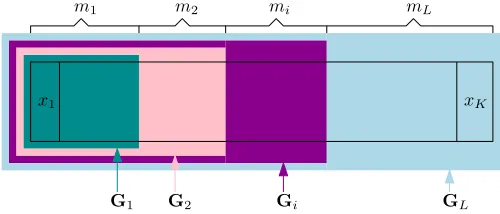
2.3 Example of EG-RLNC. Each generationGi is nested in generationGi+1. The number of source packets that belong to a generationGi but not to lower-indexed generations is denoted by mi. . . 29
2.4 Example of SG-RLNC. Themsource packets are members ofLcontiguous generations G1, . . . ,GL. For i >1, generations Gi−1 and Gi have wi−1 source packets in common.. . . 30
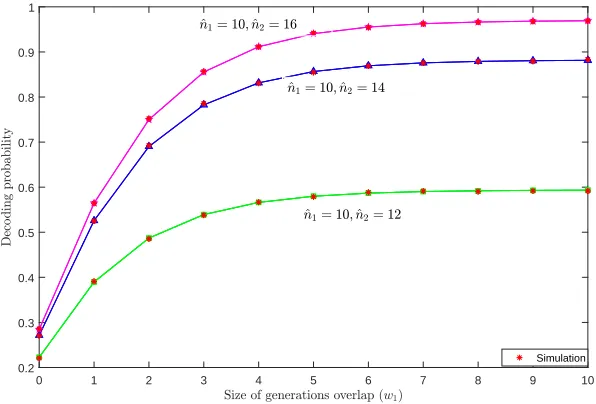
2.5 Comparison between theoretical results for SG-RLNC obtained from (2.25) and simulation results for L = 2 generations and different values of ˆn2. The remaining parameters have been set as follows: q = 2, m = 20, m1=m2= 10, n1= ˆn1= 10, n2= ˆn2 and = 0. . . 32
2.6 Comparison between NOG-RLNC, SG-RLNC and EG-RLNC forL = 3, m= 60, m1 =m2=m3 = 20, ˆn1 = ˆn2 = 20 and ˆn3= 20 +δ3. Various percentages of overlap in the case of SG-RLNC have been considered. Furthermore, ni = ˆni for all values ofi,q = 2 and = 0. . . 33
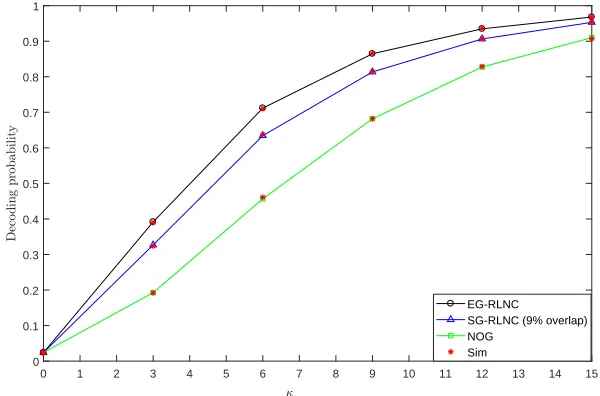
2.7 Comparison between NOG-RLNC, SG-RLNC and EG-RLNC forL = 3, m= 60, m1=m2=m3= 20, ˆn1= ˆn2= ˆn3= 20 +κ, where κ represents overhead per generation. In addition, q = 2, = 0 and the overlap in SG-RLNC is set to 9% . . . 33
2.8 Theoretical predictions and simulation results for SG-RLNC and EG-RLNC, when the field size q is 2, 3, 5 or 7. The system parameters are L= 3, m = 60,m1=m2=m3= 20,n1= ˆn1= 20, n2= ˆn2= 20 and = 0. The overlap in SG-RLNC is fixed at 9%. . . 34
2.9 Effect of the field size q on the decoding probability of SG-RLNC and EG-RLNC for L = 3, m= 60, m1=m2= m3= 20 and = 0.2. If the overhead per generation isκ= 0,1, . . . ,15, the overall overhead isδ = 3κ, i.e., δ = 0,3, . . . ,45. . . 34
2.10 Performance comparison between SG-RLNC and EG-RLNC form= 60,
m1=m2 =m3 = 20, n1 =n2 = 26, ∈ {0.1,0.2,0.3,0.4} and q = 256.
Various percentages of overlap for SG-RLNC have been considered. . . 35
3.1 Block diagram of a network consisting of two source nodes S1 and S2, a
relay node R and a destination node D. The packet erasure probability of each link as well as the number of transmitted and received coded packets at each node are also depicted. . . 41
3.2 Comparison between theoretical upper bounds obtained from (3.12) and simulation results for different values ofm andn. The erasure probabili-ties have been set toSD= 0.3,SR= 0.1 and RD = 0.2. . . 47
3.3 Comparison between theoretical upper bounds obtained from (3.12) and simulation results for different values of SD. The remaining system
pa-rameters have been set to m= 20, n= 30, SR= 0.1 and RD= 0.2. . . . 47
3.4 Performance comparison of systematic and non-systematic network cod-ing as a function of the excess coded packets n−m transmitted by each source node for various values of SR. The remaining system parameters
have been set to m= 20, nR = 15, SD= 0.3 and RD= 0.1. . . 48
3.5 A network consisting of m source nodes, n≥m relay nodes and a desti-nation D. The packet erasure probability of a source-to-relay link and a relay-to-destination link is represented bySR andRD, respectively. . . . 50
3.6 Comparison between simulation results and the theoretical upper bounds obtained from (3.24) and (3.28) for different values of m and n, when
q = 2,RD= 0.1 and SR ∈[0.1,0.9]. . . 55
3.7 Effect of field sizeq on network performance and comparison between the proposed bounds and the old bounds for SR ∈ [0.1,0.9], when m = 20,
n= 25 andRD= 0.1. . . 55
3.8 Performance of the network for an increasing number of relays n. The proposed bounds and the old bounds have been plotted for m = 10,
SR = 0.7,RD = 0.2 and different values of field size q. . . 56
3.9 Network performance and comparison between the proposed bounds and the old bounds for m= 10, an increasing number of relays n,SR= 0.3,
RD= 0.1 and different field size q. . . 56
3.10 Block diagram of the system model . . . 58
3.11 Simulation results and performance comparison between NOMA-RLNC and OMA-RLNC, when m= 20, n= 10 and q = 4. . . 63
3.12 Effect of the field size q and the number of relay nodes n on the joint decoding probability, whenm= 20.. . . 64
3.13 Comparison between the two schemes in terms of the required average number of relay nodes and the SNR when m= 20 and q= 4. . . 65
3.14 Effect of target rates on the system throughput against the system SNR, when m= 20 and q= 4. . . 65
4.1 Block diagram of the system model, where B and E denote the
era-sure probabilities of the channels linking Alice to Bob and Alice to Eve, respectively. . . 69
4.2 Comparison between analytical and simulation results for FT and UT, when E ∈[0.1,0.5], B = {0.01,0.03,0.05,0.07,0.09}, m = 50, ˙n = 150,
4.3 Contour map (solid lines) depicting the loss in intercept probability caused by the change from UT to FT, as a function of E and B. The value of
n∗ (dashed line) as a function ofB has been superimposed on the plot. . 74
4.4 Block diagram of the system model. . . 76
4.5 Comparison between simulation and theoretical results, and secrecy-reliability performance of the considered protocols for different values of m, when
q = 2 andτ /m= 0.6.. . . 91
4.6 Effect of the field size q on the secrecy performance of both CSWJ and OSWJ, as a function of the SNR, when τ = 8 andm= 15.. . . 92
4.7 Performance comparison in terms of the amount of decoded data and the SNR value, for q= 2 and m= 15.. . . 93
4.8 Delay performance as a function of SNR for q = 2 and q = 64, when
m= 15 is considered.. . . 94
4.9 Secrecy-reliability trade-off as a function of the SNR for two different transmission schemes, m= 15, q= 2 and τ = 8. . . 94
Abbreviations
ARQ Automatic Repeat Request BD Block diagonal
BLT Block Lower-Triangular BTD Block Tri-Diagonal
CSI Channel State Information
CDF Cumulative Distribution Function CS Conventional Selection
CSWJ Conventional Selection with Jammer EG Expanding Generations
FT Feedback-aided transmission LTE Long Term Evolution
NC Network Coding
NOMA Non-Orthogonal Multiple Access NOG Non-Overlapping Generations OMA Orthogonal Multiple Access
OFDM Orthogonal Frequency Division Multiplexing OFDMA Orthogonal Frequency Division Multiple Access OSWJ Optimal Selection with Preset Jammer
OS Optimal Selection
PMF Probability Mass Function PLS Physical-Layer Security RAM Resource Allocation Model RMT Random Matrix Theory
RLNC Random Linear Network Coding
RLNCC Random Linear Network Coded Cooperation
SG Sliding Generations SNR Signal-to-Noise Ratio
SINR Signal-to-Interference-plus-Noise Ratio SIC Successive Interference Cancellation UT Unaided Transmissions
UEP Unequal Error Protection
Introduction
This thesis deals with RLNC based communication schemes which are suitable for the reliability and security in wireless networks. More specifically, the thesis focuses on sparse structures of random matrices over finite fields and makes design recommenda-tions suitable for low-complexity receivers, prioritised coding for reliable multimedia content delivery, and multicast/broadcast communications. In addition, it exploits the use of RLNC in cooperative networks, and focuses on a cross layer design for attain-ing high reliability gains. Moreover, the thesis aims to quantify the secrecy features of RLNC, and design a cross-layer technique for the purpose of achieving a perfectly secure communication.
This chapter continues with the background and motivations of the thesis. Then overview and contributions are presented. Finally, the organization of the thesis is explained and linked with the list of author’s publications to each contribution.
1.1
Background and Motivations
Network coding (NC) is a great breakthrough in the field of information theory. It was originally proposed by R. Ahlswede et al. [1] in 2000, and has since attracted an increas-ing interest of researchers in the area of both wired and wireless communication. We can broadly define network coding as allowing intermediate nodes to perform decoding and process the incoming information flows, as opposed to traditional store-and-forwarding routing techniques. Moreover, in contrast to traditional routing, network coding can exploit the full capacity of the network. For example, it has been demonstrated in [1] that network coding can be used to solve the bottleneck problem in wired networks and therefore can achieve the multicast capacity. The reliability benefits of network coding
compared with Automatic Repeat Request (ARQ) baseline protocols has been exhibited in [2–4]. In addition, network coding is proposed in [5] and [6] for efficient multicast routing. Network coding has the inherent capability to achieve spatial diversity. It has been shown in [7] that network coding can improve the diversity gain of networks that either contain distributed antenna systems or support cooperative relaying. Research has revealed that NC offers a performance gain in terms of not only network reliability, throughput, transmission delay and robustness, but also in terms of energy consump-tion [8], scalability, routing complexity [9] and security. Furthermore, these benefits are not restricted to error free communication networks, but can also be exploited in sensor networks, device to device networks, industrial wireless networks, optical networks and heterogeneous networks. Thus, network coding is considered as one of the attractive solutions for integration into or combination with existing as well as future communica-tion technologies. For example, it has been shown in [10] that by modifying the IEEE 802.11g frame structure, network coding combined with Orthogonal Frequency Division Multiplexing (OFDM) can significantly improve the network throughput. In addition, the importance of network coded cooperation has been demonstrated in [11], and a prac-tical implementation of network-coded cooperation based on Orthogonal Frequency Di-vision Multiple Access (OFDMA) has been presented in [12]. Recently, Non-Orthogonal Multiple Access (NOMA) has been recognized as a promising multiple access technique for 5G mobile networks [13,14]. It has been shown in [15], [16] that combining NOMA with OFDM can improve the spectral efficiency and accommodate more users than the conventional OFDMA-based systems. Moreover, the usefulness of network coding for downlink NOMA-based transmissions has been studied in [17].
1.2
Basic Examples of Network Coding
issue, a concept of opportunistic network coding [19, 20] and progressive decoding has been introduced in the literature [21–23]. According to the opportunistic network coding scheme, a node combines all the data packets that have been successfully received and stored in its buffer. Whereas, in the progressive decoding approach, a receiver can start decoding as soon as the first coded block is received, and progressively decodes the new incoming coded blocks as soon as they are received. In the rest of this section, we present two well known examples to demonstrate the basic principle of network coding, and its potential to improve throughput and achieve the capacity of a network.
1.2.1 NC in a Butterfly Network
Consider a butterfly network as shown in Fig. 1.1, where source nodes s1 and s2 want
to transmit their data packets x1 and x2 respectively to destination nodes d1 and d2.
Let us assume that the capacity of each link is equal to one packet. Without network coding, a possible transmission scheme is shown in Fig.1.1a. The link connecting nodes r1 and r2 acts as a bottleneck, that is, r1 can only transmit one packet at a time.
Consequently, if r1 transmitsx1 then d1 cannot receivex2, or, if r1 transmitsx2 then d2
cannot receivex1. On the other hand as shown in Fig.1.1b, network coding is employed
at the bottleneck that is r1 adds the received data packetsx1 and x2 and transmits the
coded packetx3=x1+x2 towards the destinations. In this case, d1 can easily retrieve
x2 by subtracting the packet x1 fromx3, and similarly d2can retrievex1 by subtracting
x2 from x3. Thus, network coding helps us in the delivery of the data packets to both
destinations at the same time, and therefore multicast capacity of the network increases from 1 to 2.
s
1
s
2
d
1
d
2
r
1
x
1x
2x
1x
1x
1x
1x
2r
2
(a) without network
cod-ing
s
1
s
2
d
1
d
2
r
1
x
1x
2x
3x
2r
2
s
1
s
2
d
1
d
2
r
1
x
1x
2x
2r
2
s
1
s
2
d
1
d
2
r
1
x
1x
2x
3=
x
1+
x
2x
3x
1x
2r
2
[image:18.596.162.470.519.711.2](b)with network coding
1.2.2 NC in a Wireless Network
Consider a network as shown in Fig. 1.2a, where two source nodes s1 and s2 want to
communicate with each other via a relay node r. There are no direct links available between the nodes s1 and s2. In addition, it is assumed that the network is operated
in half duplex mode, whereby a node cannot transmit and receive at the same time. Therefore, nodes s1 and s2 need to transmit their packets to the relay node r. After the
relay node receives both packets, it forwards the packet of s1 to s2 and the packet of
s2 to s1. Thus, a total of 4 transmissions are needed for nodes s1 and s2 to exchange
packets. In Fig.1.2b, network coding is employed at the relay node r, such that, instead of the relay node transmittingx1 andx2 separately broadcasts a single packetx1+x2to
both s1 and s2. When node s1 receivesx1+x2, it extractsx2 using the self-information
x1 as (x1 +x2)−x1 = x2. Similarly s2 extracts x1 from (x1 +x2)−x2. Thus, in
this example network coding helps in reducing the number of transmissions from 4 to 3. By reducing the number of transmissions from 4 to 3, network coding achieves a throughput improvement of 25% over the traditional forwarding scheme. Note that, in network coding all the arithmetic operations are carried out in a finite field Fq, with
size q. Note that, the idea of NC in a wireless network has also been proposed as a physical layer network coding scheme [24,25], where where the natural superposition of electromagnetic waves is equivalent to the NC encoding operations.
x1
x2
s
1r
s
2x2
x1
(a)without network coding
x1+x2
x2
s
1r
s
2x1
x1+x2
(b)with network coding
Figure 1.2: Example of network coding in wireless network
1.3
Random Linear Network Coding
RLNC is capable to adapt to any transmission rate on the fly. Because of these fea-tures, RLNC is easy to implement and is considered as a suitable technique for dynamic topologies and varying connections. Thus, RLNC is a powerful method for node coop-eration, in particular for broadcast communication, and in distributed networks, where nodes cannot easily coordinate the routing of information through the network. Further-more in [6], it has been proved that RLNC due to its inherent randomness achieves the multicast capacity in a distributed fashion. In energy-constraint wireless networks, such as sensor networks, the communicating nodes are typically battery powered and have a limited energy budget. The improvement of the network lifetime without a reduction in network reliability is a major challenge. RLNC can decrease the number of distinct packet transmissions in a network and minimize or eliminate packet retransmissions due to poor channel conditions [6]. Consequently, RLNC has the potential to both improve energy efficiency [26] and reduce the overall latency in a network [27], which effectively leads to an increase in the lifetime of the network.
1.3.1 RLNC Encoding and Decoding
The encoding process is employed on packets/symbols, where a packet could be com-posed of multiple symbols. These packets could be either obtained after dividing the information at the source node or could be packets of different information flows received at intermediate nodes. In order to understand the encoding process, let us assume that there are m packets {x1, x2, . . . , xm} which need to be encoded using RLNC. A coded
packetyi can be obtained by simple vector multiplication, as follows
yi= h
c1,i, c2,i, . . . , cm,i i
x1
x2
.. .
xm
(1.1)
where, [c1,i, c2,i, . . . , cm,i] is the coding vector whose elements (coding coefficients) are
selected independently at random over the finite fieldFqwith sizeq. In this way, we can
intended destination. A sink node after receiving a transmitted packet, extracts both
Header
Coding vector Coded packet
Figure 1.3: Structure of transmitted coded packet
the coded packet and the coding vector, and stores them into two separate matrices that could be termed as payload matrix and decoding matrix respectively, provided that the coding vector is linearly independent. In order for a sink to decodemoriginal packets, it must collect at leastm coded packets with linearly independent coding vectors. Finally, the sink node employs Gaussian elimination on the decoding matrix augmented with the payload matrix to decode the packets.
1.3.2 RLNC Example
s
r
2r
3d
r
1x1 x2 x3
x1 x2x3
x1x2 x3
x1 x2 x3 x1 x3
x1 x2
x1 x2 x3
(a)Without RLNC
s
r
2r
3d
r
1x1x2 x3
x1 x2 x3
x1 x2 x3
y11y12 y13 y
31y32
y21y22
x1 x2 x3
[image:21.596.160.469.323.520.2](b)With RLNC
Figure 1.4: Example of RLNC in multi-path network
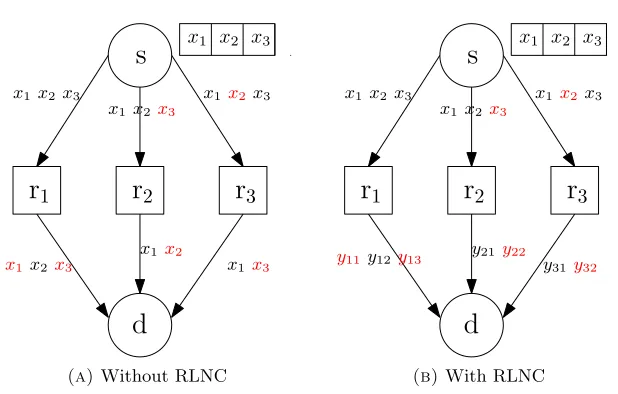
In order to understand the benefits of RLNC in comparison to normal transmission scheme, let us consider a simple example of RLNC in a multi-path network, shown in Fig. 1.4. A source node s wants to transmit packets x1, x2 and x3 to destination d
through relay nodes r1, r2 and r3. All the channels between the nodes are assumed to
be packet erasure channels with erasure probabilities between source to relay and relay to destination nodes set assr= 0.33 and rd = 0.66 , respectively. The communication
scheme is divided into two phases. In the first phase, the source s broadcasts all the packets simultaneously through orthogonal channel, while the relay nodes are operated in the receiving mode. Because of the erasure channels sometimes transmission failures occur, therefore consider that r1 receives all three packets, but r2 and r3 fail to receive
x3 and x2, respectively. In the second phase of the scheme that is devoid of RLNC, as
r3 forwardsx1 and x3 to the destination d. Because of the transmission failures, we see
that the destination d could only receivex2 from r1 and x1 from both r2 and r3. On the
other hand, as shown in Fig. 1.4b, all the relay nodes employ RLNC for transmitting the packets. By this strategy r1 produces the output coded packets y11, y12 and y13,
correspondingly y21 and y22 are produced by r2, and y31 and y32 are produced by r3.
We see that because of the packet failures, at the end of second phase, the destination d receivesy12,y21andy31. The received coded packets can be represented by the following
linear equations:
y12=c1,1x1+c1,2x2+c1,3x3 (1.2)
y21=c2,1x1+c2,2x2 (1.3)
y31=c3,1x1+c3,3x3 (1.4)
wherec1,j,c2,j andc3,j are the non-zero coding coefficients generated by the relay nodes
r1, r2and r3, respectively. Thus, by solving these equations the destination d can recover
all the packets x1, x2 and x3, because the received coded packets are combinations of
linear independent packets
1.3.3 RLNC Limitation and Literature Work
Decoding complexity is a main limitation of RLNC. For example, in order to decode
m packets, each of size L symbols from a given finite field, the decoder employs the Gaussian elimination algorithm to invert an m×m matrix and needs O(m3 +m2
overall throughput. In order to further reduce both the decoding complexity and the overhead while maintaining the delay performance, the concept of sparse RLNC within each generation as well as a feedback mechanism to control the amount of overlap be-tween generations were proposed in [29,37].
1.4
RLNC Applications
Today, RLNC has made its place from mathematical theories to practical implementa-tions [38–41]. As shown in Fig. 1.5, RLNC has been demonstrated to be able to im-prove the performance of many applications, such as multimedia streaming [42], broad-casting [43,44], cooperative communication, reliability in unreliable wireless networks, support heterogeneous devices [45], distributed storage [46], network monitoring and management [47, 48], memory management [49], on-chips communication [50], energy efficiency [51], and security [52]. Details of specific applications that this thesis has focused on are presented in the remainder of this section.
Wireless networks
Distributed storage Multimedia
streaming File sharing
Network Monitoring
Memory management
Multiple unicast
Heterogeneous devices Broadcasting Energy
efficiency
Network stability
Cooperative Communication
Security
On-chips communication
[image:23.596.176.461.407.708.2]Random linear network coding
1.4.1 RLNC for Heterogeneous Devices and Broadcast
Communica-tion
RLNC can be used to facilitate heterogeneous devices with different processing power, size and storage limitations. In order to accommodate a diverse set of receiving devices, the data that are about to be transmitted by a base station or access point can be divided into priority layers, which are encoded using RLNC that offers Unequal Error Protection (UEP) [31,53]. The priority layers usually consist of a base layer and multiple enhancement layers. The base layer is responsible for providing a basic level of service, suitable for all types of devices with small storage and limited processing power. On the other hand, the enhancement layers contain data which can improve the quality of service. Thus, access to all or as many as possible layers offers a high quality of service. This layered structure of RLNC has fitted well into different applications. For example, in [54] as Prioritized Random Linear Coding (PRLC) for layered data delivery from multiple servers, in [44] as UEP RLNC for wireless layered video broadcasting and in [43] as Expanding Window-RLNC (EW-RLNC) for multimedia multicast services based on the H.264/SVC standard.
1.4.2 Random Linear Network Coded Cooperation
RLNC has attracted substantial research efforts due to its appealing benefits in coop-erative communications. Several works in the literature have exploited Random Linear Network Coded Cooperation (RLNCC) for achieving reliability, energy efficiency,and diversity gain. For example in [55], RLNC-based cooperation was employed in coop-erative compressed sensing for achieving energy efficiency and robustness against link failures. In [56, 57], network coded cooperation was employed to achieve maximum diversity gain. Cooperative communication with deterministic and random network coding schemes were studied in [58], where it has been demonstrated that both schemes outperform conventional cooperation in terms of diversity-multiplexing tradeoff. More-over in [59] and [60], the authors proposed an analytical framework to characterize the performance of an RLNCC system in terms of bounds of decoding failure probability.
1.4.3 RLNC for Secure Communication
and Yeung [61] first formulated the concept of secure network coding, which avoids in-formation leakage to a wiretapper. They imposed a security requirement, that is, the mutual information between the source symbols and the symbols received by the wire-tapper must be zero for secure communication. Based on a well-designed precoding matrix, Wang et al.[62] proposed a secure broadcasting scheme with network coding to obtain perfect secrecy. Probabilistic weak security for linear network coding was pre-sented in [63], which devised network coding rules that can improve security depending on the adopted field size, the number of transmitted symbols and the ability of the attacker to eavesdrop on one or more independent channels. Moreover, the intercept probability of fountain coding, which is equivalent to random linear network coding for wireless broadcast applications, was formulated in [64] and exploited for industrial wireless sensor networks in [52].
1.4.4 RLNC Integrated with Opportunistic Relaying and Intentional
Jamming
The dynamic nature of the wireless medium often introduces problems to the operation of wireless networks, which are related to node connectivity, communication reliability and robustness [65]. Methods that can ameliorate the side effects of wireless environments include opportunistic relaying and node cooperation [66]. For example, opportunistic relaying was proposed as an alternative to distributed space-time relaying; it achieves full diversity gain [67] but can also improve energy efficiency [68, 69]. Opportunistic routing based on cooperative forwarding was presented in [70] to combat errors and link failures in sensor networks. Multi-phase node cooperation for indoor industrial monitoring was described in [71] as a means to reduce energy consumption. Moreover, an experimental study of selective cooperative relaying was provided in [72]. Advantages from using opportunistic relaying with network coding in two-way relay communications have been reported in [73–75].
as an alternative to achieve perfect resilience against eavesdropping attacks without re-quiring special key distribution and complex encryption/decryption algorithm [76,77]. The core idea behind this paradigm is to exploit the dynamic nature of radio channel, such as fading and noise, for maximizing the uncertainty concerning the source messages at the eavesdropper [78, 79]. These properties are traditionally interpreted as impair-ments, but PLS take advantage of these properties for achieving secrecy in wireless transmission. PLS was first introduced in [80], where the wiretap channel was charac-terised as the fundamental element to protect information at the application layer. In this seminal work, the security is evaluated by establishing a metric called secrecy ca-pacity as the maximum rate of transmission at which the information is considered to be secure without being interpreted by an eavesdropper. Later the subsequent result was employed to the broadcast channel in [79] and basic Gaussian channel in [81]. Moreover in the literature, several techniques are proposed for enhancing the PLS, including: se-cure on-off power allocation designs [82], secrecy enhancing channel coding scheme [83], and beamforming/precoding and artificial interference-aided techniques relying on mul-tiple antennas [84]. Furthermore, PLS can be easily integrated into wireless networks that combine opportunistic relaying with cooperative communication [85–87]. For exam-ple in [85], a relay selection metric that utilizes knowledge of the relay-to-eavesdropper instantaneous channel conditions was presented and the network performance was eval-uated in terms of the secrecy outage probability. Opportunistic relay selection protocols in the presence of multiple eavesdroppers were studied in [86]. The effect of single-relay and multi-single-relay selection on the performance of physical layer security in wireless networks was investigated in [87] and security-reliability tradeoffs were identified us-ing comparisons between the intercept probability and the outage probability of direct transmission. On the other hand, jamming is a well-known PLS approach to enhance the quality of security in wireless transmissions [88,89]. In this scheme, additional in-terference signals are transmitted to confuse the potential eavesdroppers or to degrade the channel’s quality of unintentional receivers. These interference signals can be intro-duced by embedding them in the intended signals, which are also referred as artificial noise approach in the literature [90]. Moreover, cooperative jamming scheme has at-tained significant attention in the literature [91–94], and has become an effective way for improving the achievable secrecy rate. In this technique, a friendly jammer node aims to disturb the eavesdroppers and protect the legitimate users. For example, coop-erative jamming strategy is provided in [91] for improving the secrecy rate. In addition, joint relay-and-jammer selection techniques were proposed in [92] to increase the secrecy capacity in wireless networks, whereas suboptimal relay selection and suboptimal joint relay-and-jammer selection protocols were compared in [93].
and the destination, while ensuring that the transmitted information cannot be accessed by an eavesdropper. Strict information-theoretic security is achieved if and only if the mutual information between the packets available to an eavesdropper and the source packets is zero [61]. The performance of PLS schemes is often measured by the secrecy capacity, which is the maximum rate for reliable and perfectly secure communication, and the secrecy outage probability, which is the probability that secure communication will fail. However, these two metrics are used to optimize the transmission rate, so that the legitimate destination will fully recover the transmitted data with perfect secrecy. If information-theoretic secrecy cannot be achieved, the secrecy capacity and the secrecy outage probability do not provide any insight into the likelihood of an eavesdropper recovering only a fraction of the transmitted confidential information. To the best of our knowledge, only few studies that exploit the properties of RLNC in PLS are available. For example, fountain coding based secure wireless communication was analyzed in [64], and to enhance the secrecy of cooperative transmissions in sensor networks, fountain-coding aided cooperative relaying with jamming was proposed in [52].
1.5
Overview and Contributions of Thesis
This thesis is concerned with the development of probabilistic frameworks to evaluate and characterize the performance of RLNC based communications. More specifically, the problems which are considered in this thesis provide answers to the following main questions:
• Research Question 1 (RQ1): How can we exploit random matrix theory over finite fields to formulate and characterize the performance of RLNC with layered structures and tunable sparsity?
• Research Question 2 (RQ2): How can we develop probabilistic models to evaluate the performance of RLNCC and design a framework which integrates the benefits of physical layer multiplexing using the emerging NOMA and RLNCC?
• Research Question 3 (RQ3): How can we evaluate and quantify the intrinsic security level provided by RLNC, and how can we design a cross layer security scheme which exploits the intrinsic security of RLNC on top of physical layer security techniques with minimum effect on reliability?
point-to-multipoint prioritized communication. On the other hand, RQ2 mainly deals with tunable sparse RLNC and its applications for opportunistic coded cooperation. RQ3 deals with the resilience of RLNC against eavesdropping, and also deals with the combination of RLNC, and relay and jammer selection techniques to discourage eaves-dropping and support reliability.
1.5.1 Thesis Structure and Organization
Characterising the performance of RLNC for reliable and secure communication
Thesis goal
Practical issues
Channel models
Performance metrics
Decoding success/failure
probability
Throughput and delay Intercept probability
RLNC with layered structures and tuneable
sparsity Chapter 2—RQ1
Packet erasure
RLNCC, RLNCC combined with NOMA
Chapter 3—RQ2
Packet erasure/Block fading
Intrinsic nature of RLNC and cross layer security
Chapter 4—RQ3
[image:28.596.122.513.256.459.2]Packet erasure/Block fading
Figure 1.6: Thesis Flowchart
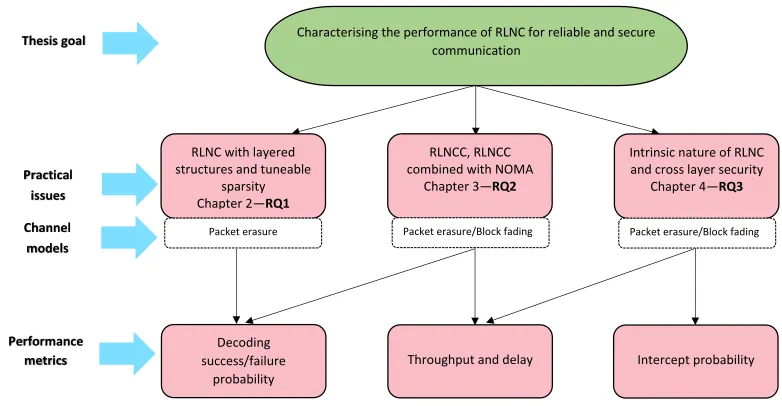
Fig. 1.6 exhibits the flowchart of the thesis structure. Chapter 2 tackles the research question RQ1, by focusing on random block matrices over finite fields and investigating different matrix structures, which model the encoding process of layered structures of RNLC schemes. In order to address the decoding complexity of RLNC and support low power devices, these structures also allow to adjust the sparsity level of encoding. More specifically in this chapter, we employ fundamental expressions of random matrix the-ory over finite fields and develop a mathematical framework for the considered matrix structures. The proposed framework can be used to accurately characterize the prob-ability that a receiver will successfully decode transmitted data or layers of a service. Numerical results and discussions are provided.
The results in this chapter have been presented in the following journal paper:
Chapter 3 attempts to answer the research question RQ2, by studying three different network models. Here, we first consider a relay assisted network with two source nodes and a single destination node, where source nodes employ intra-session RLNC and the relay node employs inter-session RLNC for coded cooperation. The performance of the network is characterized by the probability of decoding success at the destination node. Closed form mathematical expressions are derived to evaluate the performance, and at the end, results and discussions are provided. Secondly, we consider a multi-source multi-relay network, where only relay nodes employ RLNC for coded cooperation. The performance of the network is characterized by the decoding failure probability. Exact theoretical expressions to evaluate this probability is still an open problem. However in this chapter, we derive mathematical closed form expressions to evaluate tighter upper and lower bounds to the failure probability. Simulation results and discussions are pro-vided to exhibit the tightness of the derived expressions and characterize the network performance. Thirdly, we consider a multiple relay network with two source groups and two destination nodes, and propose a framework which integrates the advantages of RLNCC and NOMA based communication. Theoretical closed form expressions are derived to evaluate the network performance mainly in terms of throughput and suc-cessful decoding probability at the destination nodes. Simulation results and discussions are provided to demonstrate the benefits of NOMA based RLNCC as compared to the conventional OMA based communication.
The results in this chapter have been presented in the following conference and journal publications:
C1: A. S. Khanand I. Chatzigeorgiou, “Performance analysis of random linear network coding in two-source single-relay networks”, in Proc. IEEE International Conference on Communications Workshops (ICC), Workshop on Cooperative and Cognitive Networks, London, United Kingdom, June 2015.
J2: A. S. Khan and I. Chatzigeorgiou, “Improved bounds on the decoding failure probability of linear NC over multi-source multi-relay networks”, IEEE Communications Letters, vol. 20, no. 10, pp. 2035-2038, Oct. 2016.
J3: A. S. Khan and I. Chatzigeorgiou, “Non-Orthogonal Multiple Access Combined With Random Linear Network Coded Cooperation”, IEEE Signal Processing Letters, vol. 24, no. 9, pp. 1298-1302, Sept. 2017.
corresponding to each protocol. Moreover, an optimization model is presented for further improving the network security. All the analyses are supported by simulation results and discussions. Secondly, a multi-relay network is considered to integrate the advantages of RLNC and physical layer security techniques. In particular, we consider relay/jam-mer selection techniques for physical layer security and RLNC at the application layer for self-encryption of data. Closed form outage expressions are derived corresponding to each relay/jammer selection technique. Furthermore, network security is accurately quantified by developing a framework which characterizes the probability of the eaves-dropper intercepting a sufficient number of coded packets and partially or fully decoding the confidential data. Simulation results and discussions are presented to support the analysis and to exhibit a tradeoff between reliability and security corresponding to each relay/jammer selection technique.
The results in this chapter have been presented in the following journal publications: J4: A. S. Khan, A. Tassi and I. Chatzigeorgiou, “Rethinking the intercept probability of random linear network coding”, IEEE Communications Letters, vol. 19, no. 10, pp. 1762-1765, October 2015.
J5: A. S. Khan and I. Chatzigeorgiou, “Opportunistic relaying and random linear network coding for secure and reliable communication”, IEEE Transactions on Wireless Communications, accepted with minor revisions.
A Framework for the Assessment
of Network Coding Techniques
Characterised by Random Block
Matrices
Random matrix theory (RMT) was first introduced by Wishart [95] in 1928. From its inception, numerous fields of science, engineering and statistics have been heavily influ-enced. Nowadays it is a key subject in topics of information theory, wireless communica-tions, graph theory, signal processing, probability, multivariate statistics, combinatorics, statistical physics and quantum communication. Two fundamental reasons for the ever growing success of RMT can be identified. Firstly, RMT techniques offer remarkably precise predictions of analytical computations that grow to infinity in the context they are modeling. Secondly, RMT outcomes can be applied on any kind of random matrix, as long as the entries are independent and can be formalized in a given environment [96, 97]. This implies that RMT does not depend on the probability distribution that defines the matrix entries, but depends only on the invariant properties of their dis-tribution [98]. Thus, RMT is a valuable tool for modeling a large number of complex mathematical and physical problems.
The modeling and performance evaluation of information processing techniques, includ-ing random linear network codinclud-ing RLNC, relies on RMT over the finite fields. Practical methods that are designed to reduce decoding complexity or introduce unequal error protection properties, add constraints to the entries of matrices that characterize RLNC schemes. These constraints permit only entries within particular blocks of an RLNC ma-trix to take random values from a finite field, while the remaining entries are set to zero.
This chapter considers random block matrices and presents a mathematical framework for the enumeration of full-rank matrices that contain blocks of random entries arranged in a diagonal, lower-triangular or tri-diagonal structure. The derived expressions are then used to model the probability that a receiver will successfully decode a source mes-sage or layers of a service, when RLNC based on non-overlapping, expanding or sliding generations is employed. In particular, this framework is suitable for the study of sys-tems employing random linear network coding to broadcast or multicast information, including content streaming and data distribution.
This chapter has been organized as follows: Section 2.1introduces fundamental expres-sions for the rank of random matrices over finite fields. Section 2.2 treats partitioned random matrices as a special case of random block matrices and derives an equivalent formula for the number of full-rank matrices. Section2.3investigates the aforementioned structures of random block matrices and obtains theoretical expressions for the full-rank of each matrix. Section 2.4briefly describes three existing RLNC implementations and establishes links between the previously derived theoretical formulas and the decoding probability of each RLNC scheme. Results are discussed in Section2.5, and finally the contributions in this chapter are summarized in Section2.6.
2.1
Fundamental Preliminary Expressions
Finite or Galois fields have been receiving steady attention because of their applications in many cryptographic techniques and error correcting codes. Let M∈Fnq×m be a
matrix that has been sampled uniformly at random from the set of all n×m matrices with elements from Fq, where q is a prime power pr (such that, p is a prime number
andr is a positive integer) [99]. MatrixMis said to be a full-rank matrix if it has rank min(n, m) or, equivalently, min(n, m) rows of Mare linearly independent. For n≥m, the number of full-rank n×mmatrices can be computed as follows [100]
γ(n, m) =
Qm−1
i=0 (qn−qi), ifm≥1
1, ifm= 0.
(2.1)
The probability that a matrix M is a full-rank matrix can be obtained by dividing
γ(n, m) by qnm, which represents the total number of matrices in
Fnq×m, that is,
P(n, m) = γ(n, m)
If the rank of Misr, where 0≤r ≤min(n, m), the number of all matrices of rankr in Fnq×m, is given by [101,102]
γr(n, m) =
n r
q
γ(m, r) (2.3)
where the termnrqspecifies the number ofr-dimensional subspaces of ann-dimensional vector space over the finite field Fq. It is widely known as the Gaussian or q-binomial
coefficient [103] and is defined as
n r
q
=
(1−qn)(1−qn−1)...(1−qn−r+1)
(1−q)(1−q2)...(1−qr) , ifr≤n
0, ifr > n.
(2.4)
The q-binomial coefficient can also be expressed as the ratio of the number of full-rank matrices in Fnq×r to the number of full-rank matrices inFrq×r [102], that is,
n r
q
= γ(n, r)
γ(r, r). (2.5)
The probability of M having rank r can be obtained by dividingγr(n, m) by the total
number ofn×m matrices as follows
Pr(n, m) =
γr(n, m)
qnm . (2.6)
The fundamental expressions presented in this section will be invoked in the derivation of proofs in the following sections.
2.2
Partitioning of Random Matrices
Even though the formula that computes the number ofn×mfull-rank random matrices is derived in [100] as presented in (2.1), an exact equivalent expression that treats a random matrix as the concatenation of sub-matrices is also of interest and will be derived in this section. The derived expression will then be adapted to specific structures of random block matrices, which can be used in the performance modelling of network-coded systems.
Before we proceed with the proof of a lemma, which will lead us to the main proposition of this section, we first introduce some additional notation. IfM1, . . . ,ML are matrices
having the same number of columns, then (M1;. . .;ML) denotes the matrix obtained
by thevertical concatenation of the Lmatrices or, equivalently, by appending Mi+1 to
Lemma 2.1. Let M= (M1;M2) ∈F(qn1+n2)×m be a random matrix obtained by
verti-cally concatenatingM1 ∈Fnq1×m andM2 ∈ Fqn2×m, wheren1+n2 ≥m. The number of
combinations of all realisations of matricesM1 andM2 that result in a full-rank random
matrix Mis equal to
γ(n1+n2, m) = X
r1
γr1(n1, m)γ(n2, m−r1)q
n2r1 (2.7)
where max(0, m−n2)≤r1 ≤min(n1, m).
Proof. Matrix M is a full-rank matrix iff it contains m linearly independent columns. Let r1 columns of M1 be linearly independent. The corresponding columns of M2 can
takeqn2r1 possible values, while the remainingm−r
1 columns ofM2 can be selected in
γ(n2, m−r1) possible ways to give a full-rankn2×(m−r1) submatrix. Therefore, the
number of matrices M having m linearly independent columns is equal to the number of all possible matricesM1 of rankr1 given byγr1(n1, m), multiplied by the number of
all possible matrices M2 of rank m−r1 given by γ(n2, m−r1)qn2r1, summed over all
valid values of r1. A proof, which analytically demonstrates that the right-hand side
of (2.7) is equal to the right-hand side of (2.1) for n = n1 +n2, is presented in the
AppendixA.
Proposition 2.2. Let Lrandom matrices M1, . . . ,ML, whereMi ∈Fnqi×m for 1≤i≤
L, be vertically concatenated in order to generateM= (M1;M2;. . .;ML)∈Fnq×m, where
n=n1+. . .+nL. Equivalently, we can write
M=
M1
M2
.. .
ML
.
The number of all possible matrices M1, M2, . . . ,ML that result in a full-rank matrix
M is equal to
γ(n, m) =X
r1
γr1(n1, m)γ(n−n1, m−r1)q
(n−n1)r1 (2.8)
in recursive form, or
γ(n, m)=X
r1
· · ·X
rL−1
L Y
i=1
γri(ni, m−Ri−1)q PL−1
k=1nk+1Rk (2.9)
in non-recursive form, where:
Rk =r1+r2+. . .+rk and R0 = 0 for k= 0,
and ri, for i= 1, . . . , L−1, takes values in the range
ri ≥max(0, m−Ri−1−PLj=i+1nj) and
ri ≤min(ni, m−Ri−1), whilerL=m−RL−1 for i=L.
Proof. The expression (2.8) is a recursive formulation ofγ(n, m) in terms ofγ(n−n1, m−r1)
given that the vertical concatenation ofL matrices can be viewed as the concatenation of two matrices, that is,M1 and (M2;M3;. . .;ML) or, equivalently,
(M1;M2;. . .;ML)≡(M1; (M2;M3;. . . ,ML)).
The non-recursive expression (2.9) can be derived from (2.8) if Lemma2.1is repeatedly applied on γ(n−n1, m−r1) in (2.8), given that argument n−n1 can be written as
n2+. . .+nL. This process is equivalent to expressing the vertical concatenation of L
matrices as follows
(M1;. . .;ML)≡(M1;(M2;(M3;. . .;(ML−1;ML)))).
Note that (2.3) has been used to express the number of both full-rank and rank-deficient matrices becauseγri(ni, m−Ri−1) in (2.9) reduces toγ(ni, m−Ri−1) forri =m−Ri−1.
This section established that expression (2.1), which provides the number of full-rank
n×m random matrices, can also take the form of (2.9), which partitions the random matrix into L sub-matrices and counts all possible combinations of each sub-matrix having a particular rank. The advantage of (2.9) over (2.1) is that it can be readily adapted to random block matrices, as will become evident in the following section.
2.3
Structures of Random Block Matrices
Whereas entries of a random matrix over a finite fieldFq can take any of theq available
values with equal probability, there exist cases where only a constrained number of entries can take values from Fq while the remaining entries are set to zero. We refer to
matrices that contain blocks of random entries as random block matrices and we focus on the following general matrix structure in this chapter:
M=
M1(n1, s1 :e1)
M2(n2, s2 :e2)
.. .
ML(nL, sL:eL)
According to this structure, then×mmatrixMis the vertical concatenation of matrices Mi(ni, si:ei) of dimensionsni×m, fori= 1, . . . , L. Parameterssiandei signify the first
and last columns of anni×(ei−si+ 1) random sub-matrix within Mi. The remaining
elements of Mi are equal to zero. Depending on the values of si and ei, columns ofMi
that contain random elements will be connected to columns of matrices above or below Mi that contain either random elements or zeros. This section will study three
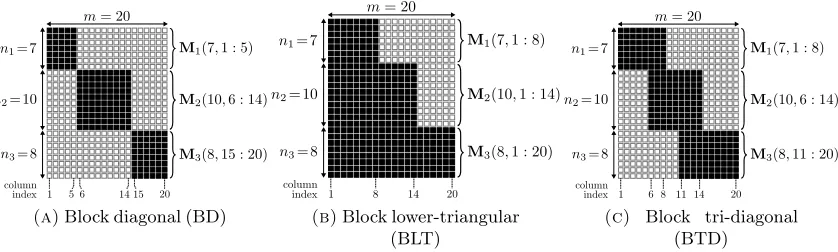
spe-cific structures of random block matrices, namely Block Diagonal (BD) matrices, Block Lower-Triangular (BLT) matrices and Block Tri-Diagonal (BTD) matrices, and will de-rive exact expressions for the number of full-rank matrices in each case. The examples of random block matrices with the considered structures are exhibited in Fig. 2.1.
(a)Block diagonal (BD) (b)Block lower-triangular
(BLT)
(c) Block tri-diagonal
[image:36.596.112.531.271.397.2](BTD)
Figure 2.1: Examples of 25×20 random block matrices, which have been constructed by
vertically concatenating three matrices. Random elements are depicted by ‘’, while
zero-valued entries are represented by ‘’.
2.3.1 Block Diagonal (BD) Matrices
Consider ann×m matrixMwith the following structure
M=
M1(n1,1 :e1)
M2(n2, e1+ 1 :e2)
.. .
ML(nL, eL−1+ 1 :m)
where n=n1+. . .+nL, si =ei−1+ 1 for i= 2, . . . , L, while s1 = 1 and eL=m. An
example of a BD matrix forL= 3 is presented in Fig.2.1a.
Ifmi =ei−ei−1 denotes the number of columns inMi that consist of random elements,
we can infer that then×mmatrixMcontainsLrandom sub-matrices along its diagonal, each of dimensionsni×mi, as shown in Fig.2.1a. Observe that if a column ofMiconsists
full-rank matrix realizations ofMcan be reduced to a set of independent problems, each associated to the number of full-rankni×mi random sub-matrices. This implies thatM
is a full-rank matrix only if eachni×mi matrixMi, for i= 1, . . . , L, has a full rank or,
using mathematical notation, ifni ≥mi,m1+· · ·+mL=m andri=mi. Substituting
these conditions into (2.9) reduces the general expression of Proposition 2.2 into the following well-known relationship [43]
γBD(M) =
L Y
i=1
γ(ni, mi) (2.10)
Therefore, the structure of BD matrices requires a reduced version of (2.9) to compute the number of full-rank matrices. Expression (2.9) can also be adjusted for the case of BLT matrices, as will be discussed in the following section.
2.3.2 Block Lower-Triangular (BLT) Matrices
The general structure of an n×m BLT matrixM is
M=
M1(n1,1 :e1)
M2(n2,1 :e2)
.. . ML(nL,1 :m)
wheresi= 1,ei ≤ei+1 and eL=m. An example of a BLT matrix forL= 3 is depicted
in Fig. 2.1b. The expression for the number of full-rank BLT matrices follows from Proposition2.2and will be presented as part of the following corollary:
Corollary 2.3. Let M= (M1;. . .;ML)∈Fnq×m be a BLT matrix obtained by vertically
concatenating Mi ∈ Fnqi×m for i = 1, . . . , L, where n = n1 +. . . +nL. Denote by
ei the number of the leftmost columns of Mi that contain elements from Fq while the
remaining columns consist of zeros, where ei ≤ ei+1 and eL = m. The number of
full-rank realizations of M is given by
γBLT(M)=
X
r1
· · ·X
rL−1
L Y
i=1
γri(ni, ei−Ri−1)q PL−1
k=1nk+1Rk (2.11)
where:
Rk =r1+r2+. . .+rk and R0 = 0 for k= 0,
n=n1+n2+. . .+nL≥m
ri ≥max(0, m−Ri−1−PLj=i+1nj) and
ri ≤min(ni, ei−Ri−1), while rL=m−RL−1 for i=L.
Proof. Whereas Proposition 2.2 is valid for constituent matrices Mi, for i = 1, . . . , L,
which all comprisemcolumns that contain random elements fromFq, this corollary
con-siders the fact that only the firstei columns ofMi contain random elements. Therefore,
the maximum number of linearly independent columns that could remain inMidepends
onei rather thanm. Expression (2.11) can thus be obtained from (2.9) ifm is replaced
by ei in the second argument of γri and the upper limit of ri.
We note that Corollary2.3 is not restricted to BLT matrices. It is valid for any matrix that can be transformed into a BLT matrix by swapping rows and columns, including rotated BLT structures such as block upper-triangular matrices.
2.3.3 Block Tri-Diagonal (BTD) Matrices
We refer to an n×m matrix M as a BTD matrix if it can be written in the following form
M=
M1(n1,1 :e1)
M2(n2, s2 :e2)
.. .
ML(nL, sL:m)
where s1 = 1, ei−2 < si ≤ si+1,ei ≤ei+1 and eL =m. Fig. 2.1c shows an example of
a BTD matrix for L= 3. In order to enumerate all full-rank BTD matrices for a given set of parameters, we will revisit and extend (2.2), so that the constraints of the BTD structure are incorporated. In an effort to facilitate the analysis, we will first discuss two relevant lemmata and introduce the notation (Φ1, . . . ,ΦL) to represent the horizontal
concatenation ofL matrices.
Lemma 2.4. Let M= (Φ1,Φ2)∈Fnq×(m1+m2) be a random matrix that has been
con-structed by horizontally concatenating Φ1 ∈ Fnq×m1 and Φ2 ∈ Fnq×m2. The number of
full-rank matrix realizations of Mcan be expressed as
γ(n, m1+m2) =γ(n, m1)γ(n−m1, m2)qm1m2 (2.12)
or
γ(n, m1+m2) =γ(n−m2, m1)γ(n, m2)qm1m2 (2.13)
Proof. Matrix M has full rank if its m1 +m2 columns are linearly independent or,
equivalently, m1 +m2 out of the n rows are linearly independent. This implies that
Φ1 and Φ2 should be not only full-rank matrices but their columns should span
non-overlapping vector subspaces. ForΦ1 to have full rank,m1of its rows should be linearly
independent. As we have already seen, there exist γ(n, m1) full-rank random matrices
of dimensions n×m1. For Φ2 to have full rank, m2 of its rows should also be linearly
independent. However, the columns ofΦ1 andΦ2 will span non-overlapping subspaces,
only if the m2 linearly independent rows of Φ2 are connected not to the m1 linearly
independent rows of Φ1 but to the remainingn−m1 rows. Therefore, the number of
full-rank realizations of Φ2 is equal to the number of full-rank (n−m1)×m2 random
matrices multiplied by the number of arbitrarily defined elements in the remainingm1
rows of Φ2. The former quantity is given by γ(n−m1, m2) and the latter quantity is
equal to qm1m2. This concludes the proof of (2.12). The same line of reasoning can be
followed to derive (2.13) if we first considerΦ2and then compute the number of possible
realizations ofΦ1.
Lemma 2.5. Let M = (Φ1,Φ2) ∈ Fqn×(m1+m2) be a BTD matrix, where Φ1 ∈ Fnq×m1
and Φ2 ∈ Fnq×m2. The structure of M and the dimensions of its sub-matrices are as
follows
and n=n1+n2+n3 ≥m1+m2. The number of full-rank matrices that have the same
structure as M is
γ(M) =X
r1 X
r2 2 Y
i=1
γri(ni+1, wi)γ(ni−ri−1, mi−ri)q
ϕi (2.14)
where max(0, mi−ni +ri−1) ≤ ri ≤ min(ni+1, wi) and ϕi = (mi−ri)wi−1+niri for
i= 1,2 while w0 = 0.
Proof. As explained in Lemma 2.4, M will be a full-rank matrix if both Φ1 and Φ2
have full rank and their columns span non-overlapping subspaces. Observe that Φ1
can be transformed into a BLT matrix and Corollary 2.3 can be invoked to compute the number of full-rank matrices that have the structure of Φ1. If Φ(3)1 contains r1
linearly independent columns, the remainingm1−r1 columns of (Φ(1)1 ,Φ(2)1 ) should also
of full-rank realizations ofΦ1 can be obtained by
γΦ1 =γr1(n2, w1)γ(n1, m1−r1)q
n1r1
where max(0, m1−n1) ≤ r1 ≤ min(n2, w1). When the rank of Φ(3)1 is r1, the number
of linearly independent rows of Φ(3)
1 is also r1. Therefore, as per Lemma 2.4, n2−r1
rows of (Φ(1)
2 ,Φ
(2)
2 ) should only be considered in the enumeration of all valid full-rank
realizations ofΦ2 given by
γΦ2=γr2(n3, w2)γ(n2−r1, m2−r2)q
(m2−r2)w1qn2r2
where min(0, m2−n2+r1)≤r2≤max(n3, w2). If the productγΦ1γΦ2 is summed over
all values ofr1 and r2, expression (2.14) is obtained.
Proposition 2.6. A BTD matrix M= (M1;. . .;ML)∈Fnq×m has been built by
verti-cally concatenating Mi ∈Fnqi×m for i= 1, . . . , L, where n=n1+. . .+nL. For si ≤ei,
let all elements of Mi in columns si, ei and in-between take values from Fq while the
remaining columns of Mi consist of zeros. As per the BTD structure requirements,
we have s1 = 1, ei−2 < si ≤ si+1, ei ≤ ei+1 and eL = m. The number of full-rank
realizations of M is given by
γBTD(M)=
X
r1
···X
rL−1
L Y
i=1
γri(ni+1, wi)γ(ni−ri−1, mi−ri)q
ϕi (2.15)
where:
mi=ei−ei−1 for i= 2, . . . , L and m1=e1 for i= 1,
wi=ei−si+1+ 1 for i= 1, . . . , L−1 and wL= 0 for i=L, ϕi = (mi−ri)wi−1+niri,
n=n1+n2+. . .+nL≥m
and ri, for i= 1, . . . , L−1, takes values in the range
ri ≥max(0, mi−ni+ri−1) and
ri ≤min(ni+1, wi), while r0=rL= 0.
Proof. The BTD matrixMcan be rewritten as a horizontal concatenation ofLmatrices (Φ1, . . . ,ΦL), where
Φi = 0i; Φ(1)i ,Φ
(2)
i
; 0i,Φ(3)i
;0i
for i= 1, . . . , L−1. Using the notation of Lemma 2.5, the dimensions of the random
matricesΦ(1)
i ,Φ
(2)
i andΦ
(3)
i areni×(mi−wi), ni×wi and ni+1×wi, respectively. On
the other hand, the dimensions of the zero matrices0i,0i and 0i are ( Pi−1
k=1nk)×mi,
structure
ΦL= 0L;Φ
(1)
L
where 0L is the (n−nL)×mL zero matrix and Φ
(1)
L is an nL×mL random matrix.
If we consider the first L−1 sub-matrices only, the number of full-rank matrices with structure (Φ1, . . . ,ΦL−1) is
γ(Φ1,...,ΦL−1)=X
r1
···X
rL−1
L−1 Y
i=1
γri(ni+1, wi)γ(ni−ri−1, mi−ri)q
ϕi (2.16)
as per Lemma2.5. The inclusion of the last sub-matrixΦLwill increase the number of
full-rank realisations of Mby a factor of γΦL, where
γΦL=γ(nL−rL−1, mL)q
mLwL−1. (2.17)
The product of (2.16) and (2.17) gives (2.15). Notice that (2.17) can be incorporated into (2.16) if we change the upper limit of the summation index ifrom L−1 to L and set rL= 0.
This section focused on random block matrices and demonstrated that Proposition 2.2
can be used to compute the number of full-rank BD matrices but, as Corollary 2.3
explained, it can also be extended to the case of BLT matrices. Proposition 2.6 was introduced for the enumeration of full-rank BTD matrices. The following section will discuss how the analysis of random block matrices can be used in the performance assessment of practical network coding techniques.
2.4
Assessment of Network Coding Techniques
In conventional network coding (NC), a source node segments a message intom source packets of equal length, linearly combines them over the finite field Fq and generates
n coded packets. This implies that the ith coded packet y
i, for i = 1, . . . , n, can be
expressed as follows
yi=
m X
j=1
ci,jxj (2.18)
wherexj represents thejth source packet of the message. As already described in
Chap-ter1, that the coefficientsci,j are selected uniformly at random over the finite fieldFqin
RLNC. For a given value of i, the sequence ci,1, ci,2, . . . , ci,m forms a row vector, which
is known as the coding vector of the output coded packet yi, and is transmitted along