A Novel Approach on Image Processing based on
Complex Network Analysis Using Graphic Search
Algorithm
KavitaHadimani
M.Tech, Dept of Computer Science and Engineering, Visvesvaraya Technological University, Belagavi - 590018, Karnataka, India
Abstract: Image process is a form of conversion of the image into digital form and it is to analyze and simulation of an image in the system. Especially, it helps to improve the quality of the image helps to search a quick and simple based on complex network. In this system is implemented in graphic search algorithm in the complex network with the unweighted graph and undirected links has been analyzed and detected. In a complex network could be a graph is as set of nodes and set of links. In this network is intended and analyzed victimization of the information of images that is EIP method. The image is partitioning or isolating into sub elements, is called segments using image segmentation technique. Each sub element is considered as a window of the complex network. After segmentation each node or window can be detected using graphic search algorithm. In an image detection is a task of finding and identifying the object. After image detection, it can calculate the performance of the images. Performance, has taken the 4x4, 8x8 and 16x16 matrices in this three matrices 8x8 matrix is excellent because it takes less execution time, less windows and has well as more accuracy compare to 4x4 and 16x16 matrix. In this system a novel approach is implemented, hence the image is been analyzed and detected based on complex network using graphic search algorithm (GSA).
Keywords: Complex network, Image processing, Segmentation, Graphic Search Algorithm.
I. INTRODUCTION
Image process is the process to conversion of the image in digital form and it is used to analyze and simulation of an image within the system. It is used to search the image quick and simple based on complex network using graphic search algorithm. A complex network is a graph, and it is collection of nodes and links.
Once the image segmentation is completed and after a network is built an image. There, every node could be a component, and all these nodes are classified by the position and intensity of every component.
These nodes are classified as to only 3 parameters such as color entropy that is red, green and blue. During this methodology, the image is divided in sub elements, and every node is considered as a window. Each node is detecting and analysing the three parameters as follows are Entropy, Intensity and Position. Once calculating the EIP method and make the joint adjacent matrices is used to multiply by these three methods.
In the EIP method, the entropy, intensity and position are parameter characterizing the variation in the image. Entropy is transform the information to every window when it is detected the image and intensity is calculating the average intensity of the each pixel for all windows. Next position is to identifying the exact location of the images these three parameters are happen when starts search the images. The main goal of this EIP method is search the images vary fast and it helps to remove the unwanted pixels of the images.
A. Image Processing
1) Image process is done in the following steps
a) Step 1: upload the image with the optical scanner by photography.
b) Step 2: Analysing and manipulating the image that has information compression and image analysing and recognizing patterns are not human eye like satellite photos.
c) Step 3: The last step is within result will be modified image or report that is supported in an image analysis.
2) Purposes
a) Visualization: Capture those objects are not visible human eyes.
b) Image sharpening and restoration: Form higher images.
c) Image retrieval: Image retrieving includes color, texture and shape in images. Supported these contents the images are retrieved from the information images.
d) Patterns for measurement: The various objects in images are measured.
e) Image Recognition: Identifying the objects in images.
3) Real Time Applications
a) Remote sensing: In this approach is capturing the images for world surface using in sensors. These photos area unit measure processed by transmission into the world station, techniques was not to interrupt the objects and regions area unit measure utilized on top of things, town management, resource mobilization, agricultural production observation.
4) Advantages and Disadvantages of Image Processing a) Advantages
i) Remove noises.
ii) Correct image density and distinction.
iii) Helps to simply store and retrieve in computers.
iv) Image is often created obtainable in any desired formats like black and white, negative image.
b) Disadvantages
i) Initial value is high relying upon the system.
ii) Once the system is broken the image are going to be lost.
B. Image Segmentation
Segmentation is the process the image is dividing into sub elements is called segments using image segmentation. It can be referred to as segments it is helpful for applications like compression and objects recognition, as a result of for these sorts of applications; it is inefficient to method the full image. The main goal of segmentation is simplification that is representing an image is meaningful and easily advanced method. In this method is crucial commencement in picture analysis. In this technique is to partition an image into subparts having similar options. The results of segmentation technique are a set of segments that combining a large of the whole image are extracted from the image. Every pixels is a region are similar with relevant some characteristic like colour, intensity, or texture. Adjacent regions are considering to totally different with relevant an equivalent characteristic.
C. Dataset and Pre-processing
[image:2.612.194.416.625.717.2]In this system is used to BSDS300 dataset. This dataset consist of all the grey scale and color segmentations for 300 pictures. The picture is divided into a set of 200 pictures, and a check set of 100 pictures in numerous sizes. The pictures area unit each color and grey scale. Hence it provides objects to developing detection algorithms. In pre-processing method, it matches these images so as to own the dimensions of output image being portable of the node. To design the given technique, an image within this dataset as shown in Figure 1.1 is employed. This image includes for many imaginary regions. In calculating, the partition of the shape in the image have a distributed of shapes are as follows horizontal lines, vertical lines, roads, curves.
The pre-processing process compares these images in order to have the size of output image being divided for that of window. Further, to design the given method, an image in the Brodatz texture dataset as Figure 1.1 is used. This image includes of several large regions.
D. Shannon Entropy
In this entropy method works to deal with the minimum variety of bits required to code a string of symbols, supported the frequency of the symbols.
n
H (A) = -∑ pi log2 pi i=0
Where pi is the probability of a given symbol, to calculate log2 from another log base (e.g., log 10 or log e): Log2 (n) =log b (n)/log b (2)
The range of bits is per image is num Bits= [H(X)]. Applied scientist entropy provides an edge for the compression which will be designed by the data illustration compression step.
E. Problem Statement
A Novel Approach on Image Processing Based on Complex Network Analysis using Graphic Search Algorithm; In this system presents a design method for image search process, which mainly includes the image processing, complex network, segmentation using graphic search algorithm. User needs the search the images very past without any errors.
Some images may be large and sometimes images are getting the small piece of the image in that cases it helps to search the whole image. In the image search concept is helps to user can easily identifying and analysing images.
II. COMPLEX NETWORK AND GRAPHIC SEARCH ALGORITHM
A. Complex Network
Complex network may be networks with significant topological options that do not occur in understand in networks like grid the graphs. In this case advanced networks may be new and active space of research project motivate for the most part of the real-world networks like computer networks, technological networks and social networks.
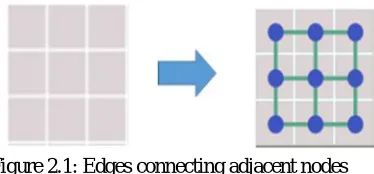
[image:3.612.245.432.491.578.2]An advanced network is a graph and it is collection of nodes and links. Once the image segmentation is completed, Once a network is built victimisation a picture as within the study by L. There, every node could be a component, and every node is classified into the position and intensity of every component. After the image segmentation every window represents the node. Edges are connecting adjacent cells.
Figure 2.1: Edges connecting adjacent nodes
A complex network is during evaluated by multiple attributes as follows mean degree, shortest path, and area unit common ones for a typical network.
1) Vertex Degree: The degree of vertex x is that the number of vertices connected to that network. During the network, a node is consisting of degree 8 at most. The upper degree is the correlation of intensity of a node.
2) Patterns: Pattern is a design of network and it is very small part of the network. The activity of the pattern represents the frequency of the pattern in the network as shown in figure 2.2.
B. Graphic Search Algorithm
1) Graph: A graph is network is a collection of objects are connected each other. The connections between the vertices are called edges or links. A directed graph is graph that is a collection of objects that are connected together, where all links are directed from one vertex to another and where all links are bidirectional is called an undirected graph.
Graphs can be undirected or directed. Edges can have weights is a weighted graph and Edges cannot have weights is an un weighted graph as shown in figure 2.3.
As shown in a graph represents the G, it consisting of number of nodes and links, can be taken the two nodes u; v a node v is visited from another node u if there is a path from u to v. A node v is in the frontier if v is not visited but it is connected via one edge (u; v) to visited node u.
2) Steps
a) Step 1: This algorithm specifies in way to search through the nodes of a graph.
b) Step 2: It will start the source node and keep searching until find the target node.
c) Step 3: The frontier consists of nodes that I have seen but have not explored yet.
d) Step 4: Each step, takes a node off the frontier, and adds its neighbours to the frontier.
III. OBJECTIVE AND PROPOSED WORK
A. Objectives
The main objectives of the system as follows:
1) To select the captured input images. It has a specific timing requirement to detect images.
2) In this system of the image starts with segmentation process and it is done in gray and RGB method.
3) Image is analysed or detected based on complex network using graphic search algorithm.
B. Proposed Work
A novel approach Image processing based on complex network Using Graphic Search, the entire procedure is being isolated into three steps image segmentation, search selected images and accurate calculation. In this system it has taken that image size is 400×400, the window size is 8 and getting the total number of windows are 2500. Each window is detected in the EIP method and makes a matrix for entropy, intensity, and position, combining all three methods using the joint adjacent matrix, then detecting the specific windows and measure the complex network analysis. As shown in the figure 4.1, the first step is to select the input image then start the image segmentation.
Once completed the segmentation, the third step is searching the image. The fourth step if the image is available then it displays the image is found otherwise it displays a message the image not found. The fifth step is to search the selected image part; in this selected part is detected using the complex network.
IV. DESIGN AND IMPLEMENTATION
A. Design
In this design is used to BSDS300 dataset, in that dataset is consist of 300 images will be stored. In this system is used 8x8 matrices and each window size are 8 and image size is 400x400. Next the image segmentation process done and apply the EIP method. After detecting and analysing each node, then search images as shown figure 6.1.
The above figure 6.1 shows that First step, read the image from dataset then start the image segmentation process. In image segmentation process is define, dividing the image into sub elements. Second step, once complete the image segmentation. Detecting and analysing all windows by using EIP method. In EIP method, the entropy, intensity and position are parameter characterizing the variation in the image. The image is analysed and detected before designing a network.
In third step, once design the network for the image and it is detecting that network. In fourth step, search the images based on complex network using graphic search algorithm. In this case, search the image if it is image is there on dataset then display the message image is found otherwise the image is not found. Finally, if the image is found then calculate the performance otherwise it is go to first step.
B. Scope of Application
The main goal of this project is to search the images quickly and simple method based on complex network using graphic search algorithm. And also remove the unwanted pixels in the images and it helps to reduce the size of the images and only display the selected image.
Implementation
In this system is to select the captured input images. It has a have specific timing requirement to detect images.
1) Select the input image then start the image segmentation in that process the image is divided into method Gray and RGB colour.
2) Search image when complete the image segmentation, the selected image is matched then display the message found otherwise it is not found the message will be displayed.
3) Next, Search the selected image part, exactly where it as in the image and find the location of the particular cropped image in the original image.
4) Find the cropped image and apply the complex network using a graphic search algorithm it is dividing that cropped image and find the accuracy of both input and output of the cropped image.
C. Test Cases
[image:7.612.189.427.135.279.2]1) Case 1: In this case, the 4×4 matrix input image size is 400 and the window size is eight and got the total number of windows are 100000. Select the part of the image then search it and the accuracy of the image is 98. 1139% and the total execution time is 21.4278 sec, and it takes them long time and more accuracy as shown in figure 6.2.
Figure 6.2: 4x4 matrixes
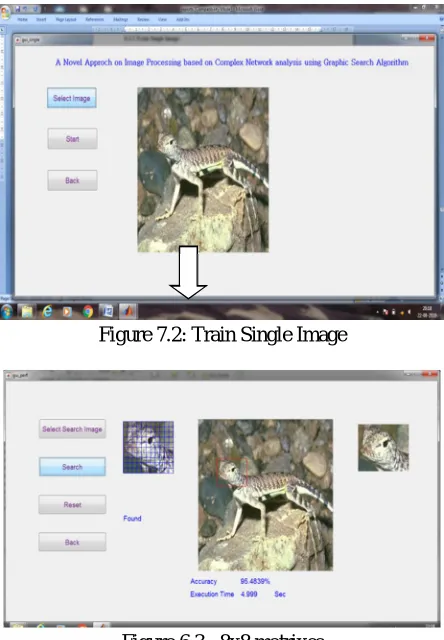
2) Case 2: In this case, the 8×8 matrix the input image size is 400 and the window size is eight and got the total number of windows is 2500. Select the part of the image then search it and find the accuracy of the image is 95.4839% and the total execution time is 4.999 sec, and it takes them less time and more accuracy compare to 4×4 and 16×16 window size as shown in figure 6.3.
D. Train Single Image
The figure 7.2 shows that Train Single Image process, first select the image and after selecting image then start the image segmentation process. Once complete the segmentation it display the message is segmentation process is done.
[image:7.612.195.417.394.714.2]Figure 7.2: Train Single Image
V. RESULTS AND PERFORMANCE NALYSIS
1) Train Single Image: The figure 7.2 shows that Train Single Image process, first select the image and after selecting image then start the image segmentation process. Once complete the segmentation it display the message is segmentation process is done.
2) Train Multiple Images: The figure 7.3 shows that Train Multiple Images process, this process is done on segmentation process. In this process, whatever images are stored in the dataset those images are automatically starting the segmentation process. Once complete the segmentation process and it display the message, all images are segmented/segmentation process is completed.
A. Performance Analysis
In this case explain the performance analysis of result. Table 7.1 shows the performance in 4x4 matrices it takes more time and more window sizes it will get more accuracy. In 8x8 matrices it takes less time and less window sizes it will get more accuracy. In 16x16 matrices it takes more time and more window sizes it will get less accuracy. So that is the reason 8x8 matrices is good compare to 4x4 and 16x16 matrices.
Table7.1: Performance Analysis for different image window sizes
1) Graph of Performance Analysis for Different image Window Sizes: Graph of different image sizes; it is a show in figure 7.6. Pixel value of image is uniformly distributed. In this graph displays the variation in the execution time and efficiency of the different image window sizes.
Figure 7.6: Graph of different image window sizes
The above figure 7.6 shows that 4x4, 8x8 and 16x16 matrices in these three matrices the 8x8 matrices is good because it takes less time and less window sizes are 2500 it will get high accuracy compare to 4x4 and 16x16 matrices.
85.00% 90.00% 95.00% 100.00%
4x4 8x8 16x16
Accuracy
VI. CONCLUSION
In this system presented a design method for image search process, which mainly includes image analysis, detection, image segmentation using graphic search algorithm. In this system is implemented in graphic search algorithm in the complex network with the unweighted graph and undirected links has been analysed and detected. The input image is partitioned/divided into sub element, is called segments using image segmentation technique. After segmentation technique, every node is been detected based on complex network using GSA. After detection image, it has been calculated the performance of the image. The performance of this system has taken entropy; intensity and position (EIP) are parameters characterized variation in the image. Performance of the image is been taken the matrices of 4x4, 8x8 and 16x16, hence these three matrices the 8x8 matrix is excellent because it takes the windows are 2500 and less execution time, accuracy is good compare to 4x4 and 16x16. Hence the process by which image is analysed and detected based on complex network using graphic search algorithm.
REFERENCES
[1] Nguyen Van Giang, Thang Manh Hoang, Hoang Xuan Thanh, and Ta Thi Kim Hue, in 2018
[2] S. E. Umbaugh, Computer Vision and Image Processing: A Practical Approach Using Cviptools. Prentice hall, 1997.
[3] M. Newman, Networks: an introduction. Oxford University Press, USA, 1st ed., 2010.
[4] L. da Fontoura Costa, “Complex Networks, Simple Vision,” reprint arXiv: cond-mat/0403346, Mar. 2004.
[5] A. L. Barbieri, G. de Arruda, F. A. Rodrigues, O. M. Bruno, and L. da Fontoura Costa, “An entropy-based approach to automatic image segmentation of satellite images,” Physical A: Statistical Mechanics and its Applications, vol. 390, no. 3, pp. 512 – 518, 2011.
[6] G. V. L. de Lima, T. R. Castilho, P. H. Bugatti, P. T. M. Saito, and F. M. Lopes, “A complex network-based approach to the analysis and classification of