DAG-Structured Long Short-Term Memory for Semantic Compositionality
Xiaodan Zhu
National Research Council Canada 1200 Montreal Road, M50 Ottawa, ON K1A 0R6, Canada
Parinaz Sobhani EECS, University of Ottawa
800 King Edward Avenue Ottawa, ON K1N 6N5, Canada
Hongyu Guo
National Research Council Canada 1200 Montreal Road, M50 Ottawa, ON K1A 0R6, Canada [email protected]
Abstract
Recurrent neural networks, particularly long short-term memory (LSTM), have recently shown to be very effective in a wide range of sequence modeling problems, core to which is effective learning of distributed representation for subsequences as well as the sequences they form. An assumption in almost all the previ-ous models, however, posits that the learned representation (e.g., a distributed representa-tion for a sentence), is fully composirepresenta-tional from the atomic components (e.g., representa-tions for words), while non-compositionality is a basic phenomenon in human languages. In this paper, we relieve the assumption by extending the chain-structured LSTM to di-rected acyclic graphs (DAGs), with the aim to endow linear-chain LSTMs with the capa-bility of considering compositionality together with non-compositionality in the same seman-tic composition framework. From a more general viewpoint, the proposed models in-corporate additional prior knowledge into re-current neural networks, which is interesting to us, considering most NLP tasks have rela-tively small training data and appropriate prior knowledge could be beneficial to help cover missing semantics. Our experiments on sen-timent composition demonstrate that the pro-posed models achieve the state-of-the-art per-formance, outperforming models that lack this ability.
1 Introduction
Recurrent neural networks, particularly long short-term memory (LSTM), have recently shown to be
very effective in a wide range of sequence modeling problems, including speech recognition (Graves et al., 2013), automatic machine translation (Sutskever et al., 2014; Cho et al., 2014), and image-to-text con-version (Vinyals et al., 2014), among many others. The specific memory copying and gating configura-tions in LSTM’s memory blocks render an effective mechanism in capturing both short and distant inter-plays in an input sequence.
In modeling sequences, core to many problems is to learn effective distributed representations for sub-sequences and the sub-sequences they form. A strong as-sumption in most previous models, however, posits that the learned representation (e.g., a distributed representation for a sentence) is fully compositional from the atomic components (e.g., representations for words), while non-compositionality is a basic phenomenon in human languages and other modal-ities, which does not only include rather rigid cases such as idiomatic expressions (e.g.,kick the bucket) but alsosoftcases that are harder to make a binary judgment.
A framework with the capability to consider both compositionality and non-compositionality in se-mantic composition are of theoretic interest. From a more pragmatical viewpoint, if one is able to holisti-cally obtain the representations for a sequence (e.g., for the bigrammust tryin a customer-review corpus for sentiment analysis), it would be desirable that a composition model has the ability to choose the sources of knowledge it can trust more: the compo-sition of subsequences of this sequence, the holistic representation, or a soft combination of them, in the process of semantic composition. In such situations,
whether this sequence (must try) is indeed composi-tional or non-composicomposi-tional may often be blurry or may not be an explicit concern of applications.
In this paper, we extend the popular chain-structured LSTM to directed acyclic graph (DAG) structures, with the aim to endow conventional LSTM with the capability of considering composi-tionality and non-composicomposi-tionality together. From a more general viewpoint, the proposed models are along the line of incorporating external knowledge into recurrent neural models, which is interesting to us, considering that most NLP tasks have relatively limited amount of training data, and external prior knowledge could be beneficial to help cover missing semantics. The proposed models unify the compo-sitional power of recurrent neural networks (RNN) and additional prior knowledge. In general, neu-ral nets are powerful approaches for composition, which can fit very complicated compositional func-tions underlying the annotated data (Cybenko, 1989; Hornik, 1991). Over that, externally obtained se-mantics could help cope with missing information in limited training data.
We demonstrated the models’ effectiveness in sentiment composition, a popular semantic compo-sition problem that optimizes a sentiment objective. We show that the proposed models achieve the state-of-the-art performance on two benchmark datasets, without any feature engineering, by unifying the compositional strength of LSTM with external se-mantic knowledge.
2 Related Work
Linear and Structured RNN Linear-chain RNN, particularly LSTM, has been applied to a wide range of problems as in (Graves et al., 2013; Sutskever et al., 2014; Cho et al., 2014; Vinyals et al., 2014), among many others. While the models take a linear encoding process to absorb input symbols, they are capable of implicitly capturing rather complicated structures embedded in the input sequences.
Recent research has also moved beyond linear-chain LSTM. For example, in (Tai et al., 2015; Zhu et al., 2015b; Le and Zuidema, 2015), LSTM was extended to tree structures. The results show that tree-structured LSTM achieves the-state-of-the-art performance on semantic tasks such as paraphrasing
detection and sentiment analysis, due to its abilities in capturing both local and long-distance interplay over the structures.
In this work, we proposed DAG-structured LSTM for modeling sequences of text. Unlike the tree-structured LSTM, where the structures are used for considering syntax, the proposed models leverage DAG structures to incorporate external semantics including non-compositional or holistically learned semantics.
Compositionality Semantic composition exists in multiple modalities, including images and vi-sion (Lake, 2014; Hummel, 2001; Socher et al., 2011; van der Velde and de Kamps, 2006). In hu-man languages, the recent years have seen extensive interests on distributional approaches. The research includes the influential pioneering work that exam-ined a number of explicit forms of compositional functions (Mitchell and Lapata, 2008).
More recent works explored neural networks, e.g., (Socher et al., 2013; Irsoy and Cardie, 2014; Kalch-brenner et al., 2014; Tai et al., 2015; Le and Zuidema, 2015; Zhu et al., 2015c) among many oth-ers, which extended the success of word-level em-beddings (Collobert et al., 2011; Mikolov et al., 2013; Chen et al., 2015) and modeled sentences through semantic composition. In general, neural models can fit very complicated functions and can be a universal approximator (Cybenko, 1989; Hornik, 1991).
In obtaining the distributed representation for longer spans of text from its subsequences, pre-vious neural models assume full compositionality from the atomic components and disregard non-compositionality and in general prior semantics. Some very recent work (Zhu et al., 2015a) has started to address this problem in recursive neu-ral networks with the assumption of the availability of parse information. In this work, we extend the general sequence models, chain-structured LSTM, to directed acyclic graphs (DAGs) in order to con-sider prior semantics, including non-compositional or holistically learned semantics. We utilize DAG structures to unify different sources of semantics.
as well, by avoiding backpropagating unnecessary errors to the atom level. For example, the errors re-ceived by the block kick the bucket, may not need to be passed down to the word level and potentially confuse the embedding of the component wordskick orbucket.
3 DAG-Structured LSTM
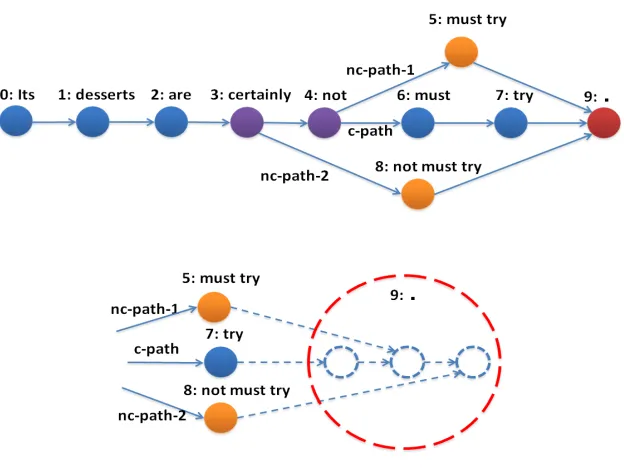
The DAG-structured LSTM aims to integrate com-positional, non-comcom-positional, and in general exter-nal semantics in semantic composition. Figure 1 de-picts an example of DAG-structured LSTM (referred to as DAG-LSTM in the remainder of the paper) in modeling a sentence.
The proposed DAG-LSTM networks consist of four types of nodes, denoted in Figure 1 with dif-ferent colors. The blue nodes (0, 1, 2, 6, and 7) correspond to normal chain-structured LSTM mem-ory blocks. The yellow nodes (5 and 8) model non-compositional knowledge. The purple nodes (3 and 4), which we call fork blocksorfork nodes in this paper, are the modified versions of regular LSTM nodes, summarizing history for different types of outgoing blocks. The merging memory block is depicted in red (node 9), aiming at infusing infor-mation from multiple histories and deciding which sources will be considered more. Each category of these four types of memory blocks share its own pa-rameters or weight matrices; e.g., the two yellow blocks share the same parameters.
3.1 Compositional and Non-compositional Memory Blocks
The conventional components of DAG-LSTM in Figure 1 are nodes 0, 1, 2, 6, and 7, which implement linear-chain LSTM memory blocks that we will not discuss in detail here (refer to (Graves, 2012) for a good introduction and discussion.)
The yellow nodes (blocks 5 and 8) model non-compositional knowledge. In general, the goal is incorporating external, holistic knowledge. Specifi-cally for the sentiment composition task that we ex-periment with in this paper, we leverage two differ-ent types of such external knowledge: (1) sdiffer-entimdiffer-ent of words and ngrams holistically learned from exter-nal, larger corpora, and (2) sentiment of words and phrases from human prior, i.e., annotation assigned
by human subjects. We concatenate these two re-sources (in form of vectors) to be a longer vector for nodes 5 and 8. Note that the models allow both the number of hidden units and the embedding spaces of a non-compositional node to be different from those of a compositional node.
Accordingly, the DAG-LSTM employs two types of paths, compositional path (shortened as c-path) and non-compositional path (nc-path), to incorpo-rate different knowledge sources. For example, the c-path in the figure connects nodes 3, 4, 6, 7, and 9, which model the regular sequential compo-sitional procedure. The two nc-paths explore non-compositional knowledge. The path 4-5-9 considers the composition vector accumulated at node 4 so far with the non-compositional knowledge of the phrase must try. Similarly, the path 3-8-9 considers holistic representation for the negated phrasenot must try. Note that negation by itself has shown to be a rather complicated non-linear function (Zhu et al., 2014a), if being modeled only compositionally. The model here provides the flexibility to consider both compo-sitional and non-compocompo-sitional representations. All knowledge from these three paths are then merged, to obtain the comprehensive representation so far, at node 9. Later in the experiment section, we will dis-cuss how to obtain prior non-compositional knowl-edge, from both human heuristics/annotation and from automatically learned resources.
3.2 Fork Memory Blocks
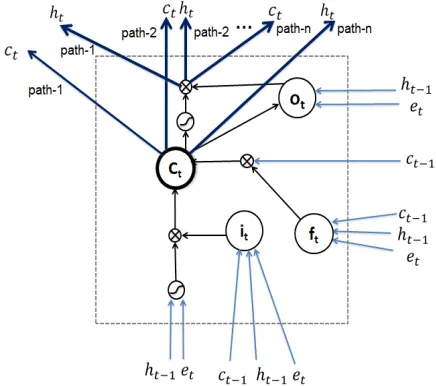
The fork blocks (node 3 and 4) summarize history obtained so far for different types of outgoing blocks (node 5 and 6 from node 4) that are either composi-tional or non-composicomposi-tional. More specifically, the cell and output vectors of a fork node will be passed to multiple paths as intuitively shown in Figure 2. While the forward propagation of a fork block is the same as that of a regular LSTM block, during backpropagation, the errors are summed over multi-ple outgoing blocks and passed back to the memory cell and output layer of the current node.
More specifically, for each memory block, as-sume that the error passed to the hidden vector is h
t. The derivatives of the output gateδto, forget gate δtf and input gateδi
Figure 1: An example of DAG-LSTM in modeling a sentence. Nodes with different colors contain different types of LSTM memory blocks.
h t =
∂PpOp
∂ht (1)
δto=ht ⊗tanh(ct)⊗σ0(ot) (2)
δtf =c
t⊗ct−1⊗σ0(ft) (3) δti=ct⊗tanh(xt)⊗σ0(it) (4)
whereσ0(x)is the element-wise derivative of the lo-gistic function over vectorx. Since it can be com-puted with the activation ofx, we relax the notation a bit to write it over the activated vectors in these equations. The underscript p is representative of parent over different paths (both non-compositional paths and compositional path). c
t is the derivative over the cell vector and it is calculated as follows:
ct =ht ⊗ot⊗g0(ct) + (Wco)Tδto
+X
p [(WL
ci)Tδpi +cp⊗fpL+ (WcfL)Tδpf] (5)
where g0(x) is the element-wise derivative of the tanhfunction. It can also be directly calculated from
thetanhactivation ofx. The superscriptT over the weight matrices means matrix transpose.
3.3 Merging Blocks
Merging blocks (node 9 in Figure 1) accumulate and summarize multiple histories. For the specific exam-ple in Figure 1, the merging block combines infor-mation from two non-compositional paths and one compositional path.
dimen-sion of the output vectors and memory cell vectors of different paths are the same, one has the choice of using other variants of memory blocks such as those described in (Tai et al., 2015; Le and Zuidema, 2015; Zhu et al., 2015c).
[image:5.612.76.294.265.458.2]Again, note that we use merging node to consider noncompositional and prior knowledge in DAG, but the above tree-LSTM was proposed to wire with syntactic structures to consider syntactic informa-tion. In addition, in DAG, the merging nodes work together with fork nodes to correctly forward-propagate and back-forward-propagate compositional and non-compositional knowledge jointly.
Figure 2:An example of a fork memory block. Both the hidden vectorshtand cell vectorsctare passed along multiple outgo-ing paths to the future blocks.⊗denotes a Hadamard product, and the ”s” shape sign is a squashing function (in this paper the tanhfunction).
4 Experiment Set-Up
In this paper, we study the proposed models on a semantic composition task that determine the senti-ment of a piece of text. We use social-media mes-sages from the official SemEval Sentiment Analysis in Twitter competition. Analyzing social-media text has attracted extensive attention (Nakov et al., 2016; Kiritchenko et al., 2014; Mohammad et al., 2014; Mohammad et al., 2015; Zhu et al., 2014b; Moham-mad et al., 2013a) and have many applications.
Sen-timental analysis of such data presents a unique set of challenges as well; for example, the tweet posts are often short, use informal languages, and are of-ten not linguistically well-formed. Syntactic analy-sis such as parsing is much less reliable in such data than in news articles, and sequential models without depending on deep linguistic analysis (e.g., parsing) are adopted by most previous work.
In obtaining the sentiment of a text span, e.g., a sentence, early work often factorized the problem to consider smaller pieces of component words or phrases with bag-of-words or bag-of-phrases mod-els (Liu and Zhang, 2012; Pang and Lee, 2008). More recent work has started to model composition process (Choi and Cardie, 2008; Moilanen and Pul-man, 2007; Socher et al., 2012; Socher et al., 2013; Irsoy and Cardie, 2014; Kalchbrenner et al., 2014; Tai et al., 2015; Zhu et al., 2015b; Le and Zuidema, 2015), more closely. In general, the composition process is critical in the formation of the sentiment of a text span, which has not been well modeled yet and more work would be desirable.
4.1 Data and Evaluation Metric
In our experiments, we use the official data from the 2013 (Wilson et al., 2013) and SemEval-2014 (Rosenthal et al., SemEval-2014) Sentiment Analysis in Twitter challenges. The task attempts to determine the sentiment category of a tweet; that is, detecting whether an entire tweet message conveys a positive, negative, or neutral sentiment.
To give a rough idea about the data, the SemEval-2013 tweets were collected through the public streaming Twitter API during a period of one year: between January 2012 and January 2013. The dataset is comprised of 5,192 positive and 2,150 negative and 6,383 neutral tweets split into the train-ing (8,258 tweets), development (1,654 tweets), and test (3,813 tweets) sets. For more details, please re-fer to (Wilson et al., 2013; Rosenthal et al., 2014). In our experiments, we report our results on the of-ficial in-domain (tweets) test data but not out-of-domain (e.g., SMS) test data to better observe the supervised performances of our models but not the domain adaptation performance.
4.2 Prior Knowledge
As briefly discussed in Section 3, we use two differ-ent sources of prior, non-compositional knowledge. These two types of resources encode: (1) sentiment of ngrams automatically learned from an external, much larger corpus, and (2) sentiment of ngrams as-signed by human annotators. Below, we introduce them in further details.
Automatically Learned KnowledgeFollowing the method proposed in (Mohammad et al., 2013b), we learn sentimental ngrams from Tweets, e.g., the sen-timent knowledge for the bigrammust try. The un-supervised approach utilizeshashtags, which can be regarded as conveying freely available (but noisy) human annotation of sentiment. More specifically, certain words in tweets are specially marked with the hash character (#) to indicate the topic, sentiment polarity, or emotions such as joy, sadness, angry, and surprised. With enough data, such artificial annota-tion can be used to learn the sentiment of ngrams by their likelihood of co-occurring with such hash-tagged words.
More specifically, a collection of 78 seed hash-tags closely related topositiveandnegativesuch as #good, #excellent, #bad,and#terriblewere used (32 positive and 36 negative). These terms were chosen from entries forpositiveandnegativein the Roget’s Thesaurus. A set of 775,000 tweets that contain at least a positive hashtag or a negative hashtag were used as the learning corpus. A tweet was considered positive if it had one of the 32 positive seed hash-tags, and negative if it had one of the 36 negative seed hashtags. The association score for an ngram wwas calculated from these pseudo-labeled tweets as follows:
score(w) =P MI(w, positive)−P MI(w, negative)
(6)
where PMI stands for pointwise mutual information, and the two terms in the formula calculate the PMI between the target ngram and the pseudo-labeled positive tweets as well as that between the ngram and the negative tweets, respectively. Accordingly, a positive score(.) indicates association with pos-itive sentiment, whereas a negative score indicates association with negative sentiment.
We use in our experiments the unigrams, bigrams and trigrams learned from the dataset with the oc-currences higher than 5. We assign these ngrams into one of the 5 bins according to their senti-ment scores obtained with Formula 6: (−∞,−2], (−2,−1],(−1,1),[1,2), and[2,+∞). Each ngram is now given a one-hot vector, indicating the polar-ity and strength of its sentiment. For example, a bigram with a score of -1.5 will be assigned a 5-dimensional vector [0,1,0,0,0], indicating a weak negative. Note that we can also take into other forms of sentiment embeddings, such as those learned in (Tang et al., 2014).
Manually Encoded SemanticsIn addition, we also leveraged prior knowledge from human, i.e., manu-ally encoded semantics, for the task here. This in-cludes a widely used sentiment lexicon, the MPQA Subjectivity Lexicon (Wilson et al., 2005), which encodes the prior knowledge that the human annota-tors have about the sentiment of words. The MPQA, which draws from the General Inquirer and other sources, has sentiment labels for about 8,000 words. The contained words marked with their prior polar-ity (positive or negative) and a discrete strength of evaluative intensity (strong or weak). We convert them to value -1.0, -0.5, 0, 0.5, 1, corresponding to strong negative,weak negative,neutral, weak posi-tive,strong positive, respectively.
4.3 Training Details
Our networks aim to minimize the cross-entropy er-ror (Socher et al., 2013). The models learn the weight matrices used in those different memory blocks described above in addition to learning word embedding. For all Twitter messages, the error is calculated as a regularized sum:
E(θ) =X i
X
j
tijlogysenij +λkθk22 (7)
The DAG-LSTM and LSTM results reported here are all obtained by setting the size of the hidden units to 10, batch size to 10 and learning rate to 0.1, which achieved the best performance during development.
5 Results
5.1 Overall Performance
Table 1 presents the macro-averaged F-scores of different models on the official test sets of the SemEval-2013 and SemEval-2014 Sentiment Anal-ysis in Twitter. The first row of results show the majority baseline where a majority classifier simply predicts all test cases into the most frequent class observed in training data. SVM is a support vector machine classifier applied to unigram features, as re-ported in (Nakov et al., 2016). In addition, we list the results of top three models described in the of-ficial reports of SemEval-2013 (Wilson et al., 2013) and SemEval-2014 (Rosenthal et al., 2014), respec-tively.
Method SemEval-13 SemEval-14
Majority baseline 29.19 34.46
Unigram (SVM) 56.95 58.58
3rdbest model 64.86 69.95
2ndbest model 65.27 70.14
The best model 69.02 70.96
[image:7.612.314.548.462.592.2]LSTM-DAG 70.88 71.97
Table 1:Performances of different models in official evaluation metric (macro F-scores) on the test sets of SemEval-2013 and SemEval-2014 Sentiment Analysis in Twitter in predicting the sentiment of the tweet messages.
The results show DAG-LSTM achieves a macro-averaged F-score of 70.88% on the SemEval-2013 test set and 71.97% on the SemEval-2014 test set, which outperform the models officially reported in the competition. Note that DAG-LSTM performs no feature engineering, but unifies LSTM with the external semantic knowledge to perform seman-tic composition within the DAG structures, where LSTM, as discussed earlier in the paper, possesses strong modeling and composition power through capturing distant interplay and complicated struc-tures embedded in sequences, while prior
knowl-edge used covers missing semantics in the limited training data.
Note that further improvement, including that re-ported in (Zhu et al., 2014b), is additionally possi-ble, which was achieved by building better resources through discriminating affirmative and negative con-text. Such improvement could be orthogonally com-bined with our model, while in this paper, we are interested in the basic modeling problems and leave such engineering as future work. Note also that the external resources we use in this paper is the same or less than the top official system we compare to in Table 1.
5.2 Effect of DAG Paths
To provide a more detailed analysis on the effect of different paths in DAG-LSTM, Table 2 include the ablation results obtained by removing different types of paths gradually. The table show that by remov-ing all the paths that incorporate the prior seman-tics, a regular LSTM (last row of the table) achieves the f-scores of a 64.0% and 66.4% on the two test sets, which is far less than the best result we have achieved; But the performance of the regular LSTM is still much better than that of unigram-based SVM reported in Table 1, suggesting the usefulness of the LSTM composition compared to bag-of-word mod-els.
Method SemEval-13 SemEval-14
DAG-LSTM
Full paths 70.88 71.97
Full –{autoPaths} 69.36 69.27
Full –{triPaths} 70.16 70.77
Full –{triPaths, biPaths} 69.55 69.93
Full –{manuPaths} 69.88 70.58
LSTM without DAG
Full –{autoPaths,manuPaths} 64.00 66.40
Table 2:Ablation performances (macro-averaged F-scores) of DAG-LSTM with different types of paths being removed.
dropped to 69.88% and 70.58%. In both test sets, the paths corresponds to automatic lexicon have more impact on the ablation performance than manual-lexicon paths, which agree with the observation re-ported in previous top systems that use conventional feature-based classifiers (Mohammad et al., 2013a), suggesting the usefulness of the automatically ac-quired semantics. The table also lists more details of removing trigram and bigram paths.
In addition to the ablation models reported in Ta-ble 2, we also created an additional model that in-corporated into the basic chain LSTM the exter-nal knowledge only for longest n-grams but not for their substrings. This experiment is supposed to investigate the effect of DAG structures that integrate knowledge for different granularities of ngrams in comparison to the LSTM that incorpo-rates the external knowledge only for the longest n-grams. On SemEval-2014 official set, the perfor-mance (Macro-F) of this model is 69.37, compared with DAG-LSTM (71.97) and chain LSTM (66.40). On Semeval-2013, Macro-F is 68.81, compared with DAG-LSTM (70.88) and chain LSTM (64.00). Af-ter some manual analysis, we observe that in tweets where DAG-LSTM works better than this baseline model, the prior sentiment of the longest n-grams is often noisy and not very reliable; in this case, the weight matrix of DAG-LSTM helps choose more re-liable resources, e.g., composition from lower-order ngrams.
6 Conclusions and Discussions
In obtaining the distributed representation for longer text spans from its subsequences, previous neu-ral models assume fully compositionality from the atomic components and often disregard the non-compositionality and in general prior semantics. In this paper, we extend chain-structured LSTM to a di-rected acyclic graph (DAG) structure, with the aim to provide the popular chain LSTM with the capa-bility of considering both compositionality and non-compositionality in a single semantic composition framework. We demonstrated the models’ effec-tiveness in a sentiment composition task, a popu-lar semantic composition problem that optimizes a sentiment objective. We use two official SemEval datasets to detect the sentiment expressed by
social-media messages. The proposed models achieve the state-of-the-art performance without any fea-ture engineering, through unifying the composition strength of LSTM with external holistic semantics.
We consider our work as an attempt towards uni-fying the strong modeling power of neural models with proper prior or external knowledge. This is an intriguing direction for us, as most NLP tasks lack training data, compared with speech recogni-tion or image classificarecogni-tion where neural models have achieved more significant successes.
While we specifically treat LSTM in this paper, it should be rather straightforward to adapt the pro-posed idea to other architectures of recurrent neural networks.
Acknowledgments
The second author of this paper was supported by the Natural Sciences and Engineering Research Council of Canada under the CREATE program.
References
Zhigang Chen, Wei Lin, Qian Chen, Si Wei, Hui Jiang, and Xiaodan Zhu. 2015. Revisiting word embedding for contrasting meaning. InProceedings of ACL. Kyunghyun Cho, Bart van Merrienboer, C¸aglar G¨ulc¸ehre,
Fethi Bougares, Holger Schwenk, and Yoshua Ben-gio. 2014. Learning phrase representations using RNN encoder-decoder for statistical machine transla-tion. CoRR, abs/1406.1078.
Yejin Choi and Claire Cardie. 2008. Learning with com-positional semantics as structural inference for subsen-tential sentiment analysis. InProceedings of the Con-ference on Empirical Methods in Natural Language Processing, EMNLP ’08, pages 793–801, Honolulu, Hawaii.
R. Collobert, J. Weston, L. Bottou, M. Karlen, K. Kavukcuoglu, and P. Kuksa. 2011. Natural language processing (almost) from scratch. JMLR, 12:2493–2537.
George Cybenko. 1989. Approximations by superposi-tions of sigmoidal funcsuperposi-tions. Mathematics of Control, Signals, and Systems, 2(4):303–314.
Alex Graves, Abdel-rahman Mohamed, and Geoffrey E. Hinton. 2013. Speech recognition with deep recurrent neural networks. CoRR, abs/1303.5778.
Kurt Hornik. 1991. Approximation capabilities of multilayer feedforward networks. Neural Networks, 4(2):251–257.
John E Hummel. 2001. Complementary solutions to the binding problem in vision: Implications for shape per-ception and object recognition. Visual cognition, 8(3-5):489–517.
Ozan Irsoy and Claire Cardie. 2014. Deep recur-sive neural networks for compositionality in language. In Z. Ghahramani, M. Welling, C. Cortes, N.D. Lawrence, and K.Q. Weinberger, editors, Advances in Neural Information Processing Systems 27, pages 2096–2104. Curran Associates, Inc.
Nal Kalchbrenner, Edward Grefenstette, and Phil Blun-som. 2014. A convolutional neural network for mod-elling sentences. Proceedings of the 52nd Annual Meeting of the Association for Computational Linguis-tics, June.
Svetlana Kiritchenko, Xiaodan Zhu, and Saif Moham-mad. 2014. Sentiment analysis of short informal texts. Journal of Artificial Intelligence Research, 50:724– 762, August.
Brenden M Lake. 2014. Towards more human-like con-cept learning in machines : compositionality, causal-ity, and learning-to-learn. Ph.D. thesis, Massachusetts Institute of Technology. Department of Brain and Cog-nitive Sciences.
Phong Le and Willem Zuidema. 2015. Compositional distributional semantics with long short term memory. CoRR, abs/1503.02510.
Bing Liu and Lei Zhang. 2012. A survey of opinion mining and sentiment analysis. In Charu C. Aggar-wal and ChengXiang Zhai, editors,Mining Text Data, pages 415–463. Springer US.
Tomas Mikolov, Ilya Sutskever, Kai Chen, Greg S Cor-rado, and Jeff Dean. 2013. Distributed representa-tions of words and phrases and their compositionality. InAdvances in neural information processing systems, pages 3111–3119.
Jeff Mitchell and Mirella Lapata. 2008. Vector-based models of semantic composition. In Proceedings of the 46th Annual Meeting of the Association for Com-putational Linguistics, June.
S. Mohammad, S. Kiritchenko, and X. Zhu. 2013a. NRC-Canada: Building the state-of-the-art in senti-ment analysis of tweets. InProceedings of the Inter-national Workshop on Semantic Evaluation, SemEval ’13, Atlanta, Georgia, USA, June.
Saif M. Mohammad, Bonnie J. Dorr, Graeme Hirst, and Peter D. Turney. 2013b. Computing lexical contrast. Computational Linguistics, 39(3):555–590.
Saif Mohammad, Xiaodan Zhu, and Joel Martin. 2014. Semantic role labeling of emotions in tweets. In
Proceedings of ACL Workshop on Computational Ap-proaches to Subjectivity, June.
Saif Mohammad, Xiaodan Zhu, Svetlana Kiritchenko, and Joel Martin. 2015. Sentiment, emotion, purpose, and style in electoral tweets. Information Processing and Management, 51:480–499.
Karo Moilanen and Stephen Pulman. 2007. Senti-ment composition. InProceedings of RANLP 2007, Borovets, Bulgaria.
Preslav Nakov, Sara Rosenthal, Svetlana Kiritchenko, Saif M. Mohammad, Zornitsa Kozareva, Alan Ritter, Veselin Stoyanov, and Xiaodan Zhu. 2016. Devel-oping a successful semeval task in sentiment analysis of twitter and other social media texts. Language Re-sources and Evaluation, 50(1):35–65.
Bo Pang and Lillian Lee. 2008. Opinion mining and sentiment analysis. Foundations and Trends in Infor-mation Retrieval, 2(1–2):1–135.
Sara Rosenthal, Preslav Nakov, Alan Ritter, and Veselin Stoyanov. 2014. Semeval-2014 task 9: Sentiment analysis in twitter. Proc. SemEval, pages 73–80. Richard Socher, Cliff Chiung-Yu Lin, Andrew Y. Ng,
and Christopher D. Manning. 2011. Parsing natural scenes and natural language with recursive neural net-works. InProceedings of the 28th International Con-ference on Machine Learning, ICML, pages 129–136, Washington, USA.
Richard Socher, Brody Huval, Christopher D. Manning, and Andrew Y. Ng. 2012. Semantic compositionality through recursive matrix-vector spaces. In Proceed-ings of the Conference on Empirical Methods in Nat-ural Language Processing, EMNLP ’12, Jeju, Korea. Association for Computational Linguistics.
Richard Socher, Alex Perelygin, Jean Y. Wu, Jason Chuang, Christopher D. Manning, Andrew Y. Ng, and Christopher Potts. 2013. Recursive deep models for semantic compositionality over a sentiment treebank. InProceedings of the Conference on Empirical Meth-ods in Natural Language Processing, EMNLP ’13, Seattle, USA. Association for Computational Linguis-tics.
Ilya Sutskever, Oriol Vinyals, and Quoc V. Le. 2014. Sequence to sequence learning with neural networks. CoRR, abs/1409.3215.
Kai Sheng Tai, Richard Socher, and C hristopher D. Manning. 2015. Improved semantic representa-tions from tree-structured long short-term memory networks. CoRR, abs/1503.00075.
F. van der Velde and M. de Kamps. 2006. Neural black-board architectures of combinatorial structures in cog-nition.Behavioral and Brain Sciences, 29:37–70. Oriol Vinyals, Alexander Toshev, Samy Bengio, and
Du-mitru Erhan. 2014. Show and tell: A neural image caption generator. CoRR, abs/1411.4555.
Theresa Wilson, Janyce Wiebe, and Paul Hoffmann. 2005. Recognizing contextual polarity in phrase-level sentiment analysis. In Proceedings of the Confer-ence on Human Language Technology and Empirical Methods in Natural Language Processing, HLT ’05, pages 347–354, Stroudsburg, PA, USA. Association for Computational Linguistics.
Theresa Wilson, Zornitsa Kozareva, Preslav Nakov, Sara Rosenthal, Veselin Stoyanov, and Alan Ritter. 2013. SemEval-2013 Task 2: Sentiment analysis in Twit-ter. InProceedings of the International Workshop on Semantic Evaluation, SemEval ’13, Atlanta, Georgia, USA, June.
Xiaodan Zhu, Hongyu Guo, Saif Mohammad, and Svet-lana Kiritchenko. 2014a. An empirical study on the effect of negation words on sentiment. InProceedings of ACL, Baltimore, Maryland, USA, June.
Xiaodan Zhu, Svetlana Kiritchenko, and Saif Moham-mad. 2014b. Nrc-canada-2014: Recent improvements in the sentiment analysis of tweets. InProceedings of the International Workshop on Semantic Evaluation, August.
Xiaodan Zhu, Hongyu Guo, and Parinaz Sobhani. 2015a. Neural networks for integrating compositional and non-compositional sentiment in sentiment composi-tion. In Proceedings of Joint Conference on Lexical and Computational Semantics, June.
Xiaodan Zhu, Parinaz Sobhani, and Hongyu Guo. 2015b. Long short-term memory over recursive structures. In Proceedings of International Conference on Machine Learning, July.