Proceedings of NAACL-HLT 2019, pages 673–681 673
SEQ
3: Differentiable Sequence-to-Sequence-to-Sequence Autoencoder for
Unsupervised Abstractive Sentence Compression
Christos Baziotis1,2, Ion Androutsopoulos2, Ioannis Konstas3, Alexandros Potamianos1 1School of ECE, National Technical University of Athens, Athens, Greece
2Department of Informatics, Athens University of Economics and Business, Athens, Greece 3 Interaction Lab, School of Math. and Comp. Sciences, Heriot-Watt University, Edinburgh, UK
[email protected], [email protected] [email protected], [email protected]
Abstract
Neural sequence-to-sequence models are cur-rently the dominant approach in several nat-ural language processing tasks, but require large parallel corpora. We present a sequence-to-sequence-to-sequence autoencoder (SEQ3), consisting of two chained encoder-decoder pairs, with words used as a sequence of dis-crete latent variables. We apply the pro-posed model to unsupervised abstractive sen-tence compression, where the first and last sequences are the input and reconstructed sentences, respectively, while the middle se-quence is the compressed sentence. Constrain-ing the length of the latent word sequences forces the model to distill important infor-mation from the input. A pretrained lan-guage model, acting as a prior over the latent sequences, encourages the compressed sen-tences to be human-readable. Continuous re-laxations enable us to sample from categori-cal distributions, allowing gradient-based op-timization, unlike alternatives that rely on re-inforcement learning. The proposed model does not require parallel text-summary pairs, achieving promising results in unsupervised sentence compression on benchmark datasets.
1 Introduction
Neural sequence-to-sequence models (SEQ2SEQ)
perform impressively well in several natural lan-guage processing tasks, such as machine trans-lation (Sutskever et al., 2014; Bahdanau et al.,
2015) or syntactic constituency parsing (Vinyals et al.,2015). However, they require massive par-allel training datasets (Koehn and Knowles,2017). Consequently there has been extensive work on utilizing non-parallel corpora to boost the per-formance of SEQ2SEQ models (Sennrich et al.,
2016;G¨ulc¸ehre et al.,2015), mostly in neural ma-chine translation where models that require ab-solutely no parallel corpora have also been
pro-𝑦1, 𝑦2, … , 𝑦𝑀
𝑥1, 𝑥2, … , 𝑥𝑁 𝑥ො1, ො𝑥2, … , ො𝑥𝑁
Compressor
(encoder-decoder)
Reconstructor
(encoder-decoder) Reconstruction Loss
[image:1.595.309.527.220.311.2]LM Prior Loss Topic Loss
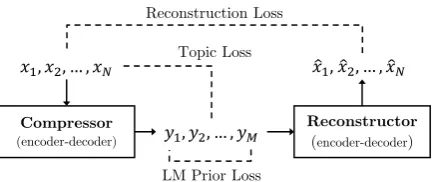
Figure 1: Overview of the proposedSEQ3autoencoder.
posed (Artetxe et al.,2018;Lample et al.,2018b). Unsupervised (or semi-supervised) SEQ2SEQ
models have also been proposed for summariza-tion tasks with no (or small) parallel text-summary sets, including unsupervised sentence compres-sion. Current models, however, barely reach
lead-N baselines (Fevry and Phang, 2018;Wang and Lee, 2018), and/or are non-differentiable (Wang and Lee, 2018; Miao and Blunsom, 2016), thus relying on reinforcement learning, which is un-stable and inefficient. By contrast, we propose a sequence-to-sequence-to-sequence autoencoder, dubbed SEQ3, that can be trained end-to-end via gradient-based optimization. SEQ3 employs
dif-ferentiable approximations for sampling from cat-egorical distributions (Maddison et al.,2017;Jang et al., 2017), which have been shown to outper-form reinforcement learning (Havrylov and Titov,
2017). Therefore it is a generic framework which can be easily extended to other tasks, e.g., machine translation and semantic parsing via task-specific losses. In this work, as a first step, we applySEQ3
to unsupervised abstractive sentence compression.
SEQ3 (§2) comprises two attentional encoder-decoder (Bahdanau et al.,2015) pairs (Fig.1): a compressorCand a reconstructorR. C(§2.1) re-ceives an input textx=⟨x1, . . . , xN⟩ofNwords,
and generates a summaryy =⟨y1, . . . , yM⟩ofM
words (M<N), y being a latent variable. R and
try-…
𝑒0𝑐
𝑥1 𝑥2
𝑦1
𝑒1𝑠
ℎ1𝑠
𝑒2𝑠
𝑥𝑁
𝑒𝑁𝑠
ℎ2𝑠 ℎ𝑁𝑠
…
ℎ0𝑐
𝑒1𝑐
ℎ1𝑐
𝑒1𝑐
ℎ𝑀−1𝑐
𝑒𝑀−1𝑐
… …
𝑦1
𝑒2𝑐
𝑦Μ
𝑒𝑀𝑐
Topic Loss …
ℎ1𝑧 ℎ
2𝑧 ℎ𝑁𝑧
…
Compressor
Reconstructor
LM prior Loss … …
𝑒0𝑟
ො 𝑥1
ℎ0𝑟
ℎ1𝑟
𝑒1𝑟
ො 𝑥2
ℎ𝑁−1𝑟
𝑒𝑁−1𝑟
[image:2.595.71.289.65.270.2]ො 𝑥𝑁
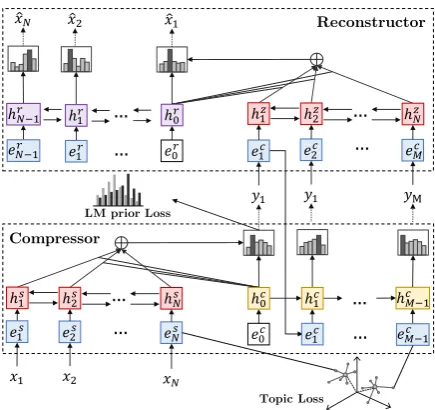
Figure 2: More detailed illustration ofSEQ3. The com-pressor (C) produces a summary from the input text, and the reconstructor (R) tries to reproduce the input from the summary. RandC comprise an attentional encoder-decoder each, and communicate only through the (discrete) words of the summary. The LM prior incentivizesCto produce human-readable summaries, while topic loss rewards summaries with similar topic-indicating words as the input text.
ing to minimize a reconstruction lossLR= (x,xˆ)
(§2.5). A pretrained language model acts as a prior ony, introducing an additional lossLP(x,y)that
encouragesSEQ3to produce human-readable
sum-maries. A third lossLT(x,y)rewards summaries
ywith similar topic-indicating words asx. Experi-ments (§3) on the Gigaword sentence compression dataset (Rush et al.,2015) and theDUC-2003 and
DUC-2004 shared tasks (Over et al., 2007) pro-duce promising results.
Our contributions are: (1) a fully differentiable sequence-to-sequence-to-sequence (SEQ3) autoen-coder that can be trained without parallel data via gradient optimization; (2) an application of SEQ3
to unsupervised abstractive sentence compression, with additional task-specific loss functions; (3) state of the art performance in unsupervised ab-stractive sentence compression. This work is a step towards exploring the potential of SEQ3 in other tasks, such as machine translation.
2 Proposed Model
2.1 Compressor
The bottom left part of Fig.2illustrates the inter-nals of the compressor C. An embedding layer projects the source sequence x to the word em-beddings es = ⟨es1, . . . , esN⟩, which are then
en-coded by a bidirectional RNN, producing hs = ⟨hs
1, . . . , hsN⟩. Eachhstis the concatenation of the
corresponding left-to-right and right-to-left states (outputs inLSTMs) of the bi-RNN.
hst = [−−→RNNs(est,
− →
hst−1);←−−RNNs(est,
←− hst+1)]
To generate the summaryy, we employ the atten-tional RNN decoder of Luong et al. (2015), with their global attention and input feeding. Con-cretely, at each timestep (t ∈ {1, . . . ,M}) we compute a probability distributionai over all the
states hs1, . . . , hsN of the source encoder condi-tioned on the current statehct of the compressor’s decoder to produce a context vectorct.
ai =softmax(hsi⊺Wahct), ct= N
∑
i=1
aihsi
The matrixWais learned. We obtain a probability
distribution forytover the vocabularyV by
com-biningctand the current statehctof the decoder.
oct =tanh(Wo[ct;hct] +bo) (1)
uct =Wvoct+bv (2)
p(yt|y<t,x) =softmax(uct) (3)
Wo, bo, Wv, bv are learned. ct is also used when
updating the state hct of the decoder, along with the embeddingec
tofytand a countdown argument
M−t (scaled by a learnable wd) indicating the
number of the remaining words of the summary (Fevry and Phang,2018;Kikuchi et al.,2016).
hct+1=−−→RNNc(hct, ect, ct, wd(M−t)) (4)
For each inputx=⟨x1, . . . , xN⟩, we obtain a
tar-get lengthMfor the summaryy = ⟨y1, . . . , yM⟩
by sampling (and rounding) from a uniform dis-tribution U(αN, βN); α, β are hyper-parameters (α < β < 1); we setM = 5, if the sampled M
is smaller. SamplingM, instead of using a static compression ratio, allows us to train a model ca-pable of producing summaries with varying (e.g., user-specified) compression ratios. Controlling the output length in encoder-decoder architectures has been explored in machine translation (Kikuchi et al.,2016) and summarization (Fan et al.,2018).
2.2 Differentiable Word Sampling
To generate the summary, we need to sample its words yt from the categorical distributions
Soft-Argmax Instead of sampling yt, a simple
workaround during training is to pass as input to the next timestep ofC’s decoder and to the corre-sponding timestep ofR’s encoder a weighted sum of all the vocabulary’s (V) word embeddings, us-ing a peaked softmax function (Goyal et al.,2017):
ect = |V|
∑
i
e(wi)softmax(uct/τ) (5)
whereuct is the unnormalized score in Eq.2(i.e., the logit) of each wordwi andτ ∈ (0,∞)is the
temperature. As τ → 0 most of the probability mass in Eq. 5 goes to the most probable word, hence the operation approaches thearg max.
Gumbel-SoftmaxWe still want to be able to per-form sampling, though, as it has the benefit of adding stochasticity and facilitating exploration of the parameter space. Hence, we use the Gumbel-Softmax (GS) reparametrization trick (Maddison et al.,2017; Jang et al., 2017) as a low variance approximation of sampling from categorical distri-butions. Sampling a specific wordytfrom the
soft-max (Eq.3) is equivalent to adding (element-wise) to the logits an independent noise sampleξ from the Gumbel distribution1and taking thearg max:
yt∼softmax(uct)↔yt= arg max(uct+ξ) (6)
Therefore, using theGStrick, Eq.5becomes:
˜ ect=
|V|
∑
i
e(wi)softmax((uct+ξ)/τ) (7)
Straight-Through Both relaxations lead to
mix-tures of embeddings, which do not correspond to actual words. Even though this enables the compressor to communicate with the reconstruc-tor using continuous values, thus fully utilizing the available embedding space, ultimately our aim is to constrain them to communicate using only
natural language. In addition, an unwanted dis-crepancy is created between training (continuous embeddings) and test time (discrete embeddings). We alleviate these problems with the Straight-Through estimator (ST) (Bengio et al., 2013). Specifically, in the forward pass of training we dis-cretizee˜ct by using the arg max(Eq.6), whereas in the backward pass we compute the gradients us-ing theGS(Eq.7). This is a biased estimator due
1ξ
i=−log(−log(xi)), xi∼U(0,1)
to the mismatch between the forward and back-ward passes, but works well in practice. ST GS re-portedly outperforms scheduled sampling (Goyal et al., 2017) and converges faster than reinforce-ment learning (Havrylov and Titov,2017).
2.3 Reconstructor
The reconstructor (upper right of Fig. 2) works like the compressor, but its encoder operates on the embeddings ec1, . . . , ecM of the words y1, . . . , yM
of the summary (exact embeddings of the sampled wordsytin the forward pass, approximate
differ-entiable embeddings in the backward pass).
2.4 Decoder Initialization
We initialize the hidden state of each decoder us-ing a transformation of the concatenation[−→hsN;←h−s1]
of the last hidden states (from the two directions) of its bidirectional encoder and a length vector, followingMallinson et al.(2018). The length vec-tor for the decoder of the compressorCconsists of the target summary lengthM, scaled by a learnable parameterwv, and the compression ratioMN.
hc0=tanh(Wc[
−→
hsN;←h−s1;wvM;
M N]) Wcis a trainable hidden layer. The decoder of the
reconstructorRis initialized similarly.
2.5 Loss Functions
Reconstruction Loss LR(x,ˆx) is the (negative)
log-likelihood assigned by the (decoder of)R to the input (correctly reconstructed) words x = ⟨x1, . . . , xN⟩, wherepRis the distribution ofR.
LR(x,ˆx) =− N
∑
i=1
logpR(ˆxi=xi)
We do not expectLR(x,ˆx)to decrease to zero, as
there is information loss through the compression. However, we expect it to drive the compressor to produce such sentences that will increase the like-lihood of the target words in the reconstruction.
LM Prior LossTo ensure that the summariesyare readable, we pretrain anRNNlanguage model (see Appendix) on thesourcetexts of the full training set. We compute the Kullback-Leibler divergence
DKL between the probability distributions of the
(decoder of) the compressor (p(yt|y<t,x), Eq. 3)
and the language model (pLM(yt|y<t,x)).
We also use the following task-specific losses.
Topic LossWords with highTF-IDFscores are in-dicative of the topic of a text (Ramos et al.,2003;
Erkan and Radev, 2004). To encourage the com-pressor to preserve in the summary y the topic-indicating words of the input x, we compute the
TF-IDF-weighted averagevx of the word embed-dings ofxand the averagevy of the word embed-dings ofyand use their cosine distance as an ad-ditional lossLT = 1−cos(vx, vy).
vx =
N
∑
i=1
IDF(xi)esi
∑N
t=1IDF(xt)
vy = 1 M
M
∑
i=1
eci
(UsingTF-IDFinvy did not help.) AllIDFscores
are computed on the training set.
Length Penalty A fourth lossLL (not shown in
Fig. 1) helps the (decoder of the) compressor to predict the end-of-sequence (EOS) token at the
tar-get summary lengthM.LLis the cross-entropy
be-tween the distributionsp(yt|y<t,x) (Eq.3) of the
compressor at t = M+ 1 and onward, with the one-hot distribution of theEOStoken.
2.6 Modeling Details
Parameter SharingWe tie the weights of layers
encoding similar information, to reduce the num-ber of trainable parameters. First, we use a shared embedding layer for the encoders and decoders, initialized with 100-dimensional GloVe embed-dings (Pennington et al.,2014). Additionally, we tie the shared embedding layer with the output lay-ers of both decodlay-ers (Press and Wolf,2017;Inan et al., 2017). Finally, we tie the encoders of the compressor and reconstructor (see Appendix).
OOVsOut-of-vocabulary words are handled as in
Fevry and Phang(2018) (see Appendix).
3 Experiments
DatasetsWe trainSEQ3on theGigawordsentence compression dataset (Rush et al.,2015).2 It con-sists of pairs, each containing the first sentence of a news article (x) and the article’s headline (y), a total of 3.8M/189k/1951 train/dev/test pairs. We also test (without retraining) SEQ3 on DUC-2003
and DUC-2004 shared tasks (Over et al., 2007), containing 624/500 news articles each, paired with 4 reference summaries capped at 75 bytes.
Methods compared We evaluated SEQ3 and an
ablated version ofSEQ3. We only used the article
2github.com/harvardnlp/sent-summary
sentences (sources) of the training pairs from Gi-gaword to trainSEQ3; our model isneverexposed to target headlines (summaries) during training or evaluation, i.e., it is completely unsupervised. Our code is publicly available.3
We compare SEQ3 to other unsupervised sen-tence compression models. We note that the ex-tractive model of Miao and Blunsom (2016) re-lies on a pre-trained attention model using at least 500K parallel sentences, which is crucial to miti-gate the inefficiency of sampling-based variational inference and REINFORCE. Therefore it is not comparable, as it is semi-supervised. The re-sults of the extractive model ofFevry and Phang
(2018) are also not comparable, as they were ob-tained on a different, not publicly available test set. We note, however, that they report that their sys-tem performs worse than the LEAD-8 baseline in
ROUGE-2 and ROUGE-Lon Gigaword. The only directly comparable unsupervised model is the ab-stractive ‘Pretrained Generator’ ofWang and Lee
(2018). The version of ‘Adversarial REINFORCE’ thatWang and Lee(2018) consider unsupervised is actually weakly supervised, since its discrimi-nator was exposed to the summaries of the same sources the rest of the model was trained on.
As baselines, we use LEAD-8 for Gigaword, which simply selects the first 8 words of the source, and PREFIX for DUC, which includes the first 75 bytes of the source article. We also compare to supervised abstractive sentence com-pression methods (Tables 1-3). Following previ-ous work, we report the average F1 of ROUGE -1, ROUGE-2, ROUGE-L (Lin, 2004). We
imple-mentedSEQ3withLSTMs (see Appendix) and dur-ing inference we perform greedy-sampldur-ing.
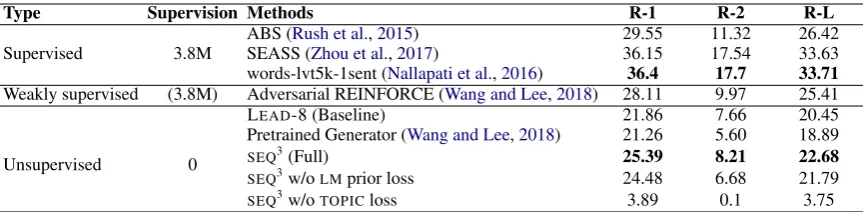
Results Table 1 reports the Gigaword results.
SEQ3 outperforms the unsupervised Pretrained Generator across all metrics by a large margin. It also surpassesLEAD-8. If we remove theLMprior, performance drops, esp. inROUGE-2 andROUGE
-L. This makes sense, since the pretrainedLM re-wards correct word order. We also tried remov-ing the topic loss, but the model failed to con-verge and results were extremely poor (Table 1). Topic loss acts as a bootstrap mechanism, bias-ing the compressor to generate words that main-tain the topic of the input text. This greatly re-duces variance due to sampling in early stages of training, alleviating the need to pretrain individual
Type Supervision Methods R-1 R-2 R-L
Supervised 3.8M
ABS (Rush et al.,2015) 29.55 11.32 26.42
SEASS (Zhou et al.,2017) 36.15 17.54 33.63
words-lvt5k-1sent (Nallapati et al.,2016) 36.4 17.7 33.71
Weakly supervised (3.8M) Adversarial REINFORCE (Wang and Lee,2018) 28.11 9.97 25.41
Unsupervised 0
LEAD-8 (Baseline) 21.86 7.66 20.45
Pretrained Generator (Wang and Lee,2018) 21.26 5.60 18.89
SEQ3(Full) 25.39 8.21 22.68
SEQ3w/oLMprior loss 24.48 6.68 21.79
[image:5.595.82.515.61.167.2]SEQ3w/oTOPICloss 3.89 0.1 3.75
Table 1: Average results on the (English) Gigaword dataset for abstractive sentence compression methods.
Model R-1 R-2 R-L
ABS(Rush et al.,2015) 28.48 8.91 23.97
PREFIX 21.3 6.38 18.82
SEQ3(Full) 20.90 6.08 18.55
Table 2: Averaged results on theDUC-2003 dataset; the top part reports results of supervised systems.
Model R-1 R-2 R-L
TOPIARY(Zajic et al.,2007) 25.12 6.46 20.12 Woodsend et al.(2010) 22 6 17 ABS(Rush et al.,2015) 28.18 8.49 23.81
PREFIX 20.91 5.52 18.20
SEQ3(Full) 22.13 6.18 19.3
Table 3: Averaged results on theDUC-2004 dataset; the top part reports results of supervised systems.
components, unlike works that rely on reinforce-ment learning (Miao and Blunsom, 2016; Wang and Lee,2018). Overall, both losses work in syn-ergy, with the topic loss drivingwhatand theLM
prior loss driving how words should be included in the summary. SEQ3behaves similarly onDUC -2003 andDUC-2004 (Tables2-3), although it was trained on Gigaword. In DUC-2003, however, it does not surpass thePREFIXbaseline.
Finally, Fig. 3 illustrates three randomly sam-pled outputs of SEQ3 on Gigaword. In the first one,SEQ3 copies several words esp. from the be-ginning of the input (hence the highROUGE-L) ex-hibiting extractive capabilities, though still being adequately abstractive (bold words denote para-phrases). In the second one, SEQ3 showcases its true abstractive power by paraphrasing and com-pressing multi-word expressions to single content words more heavily, still without losing the overall meaning. In the last example,SEQ3progressively becomes ungrammatical though interestingly re-taining some content words from the input.
4 Limitations and Future Work
The model tends to copy the first words of the in-put sentence in the compressed text (Fig. 3). We
input:the american sailors whothwartedsomali pirates flew home to the u.s. on wednesday but without their cap-tain , who was still aboard a navy destroyer after being rescued from thehijackers.
gold: us sailors who thwarted pirate hijackers fly home SEQ3: the american sailors whofoiledsomali pirates flew home after crewhijacked.
input: the central election commission -lrb- cec -rrb- on mondaydecided that taiwan will hold another election
of national assembly members on may # .
gold: national<unk>election scheduled for may SEQ3: the central election commission -lrb- cec UNK an-nounced elections.
input:dave bassett resigned as manager of struggling en-glish premier league side nottingham forest on saturday after they were knocked out of the f.a. cup in the third round , according to local reports on saturday .
gold: forest manager bassett quits .
SEQ3: dave bassett resigned as manager of struggling en-glish premier league side UNK forest on knocked round press
Figure 3: Good/bad example summaries on Gigaword.
hypothesize that since the reconstructor is autore-gressive, i.e., each word is conditioned on the pre-vious one, errors occurring early in the generated sequence have cascading effects. This inevitably encourages the compressor to select the first words of the input. A possible workaround might be to modifySEQ3so that the first encoder-decoder pair would turn the inputs to longer sequences, and the second encoder-decoder would compress them trying to reconstruct the original inputs. In future work, we plan to explore the potential ofSEQ3 in other tasks, such as unsupervised machine trans-lation (Lample et al.,2018a;Artetxe et al.,2018) and caption generation (Xu et al.,2015).
Acknowledgments
References
Mikel Artetxe, Gorka Labaka, Eneko Agirre, and Kyunghyun Cho. 2018. Unsupervised neural ma-chine translation. In Proceedings of the Annual Meeting of International Conference on Learning Representations.
Jimmy Lei Ba, Jamie Ryan Kiros, and Geoffrey E Hin-ton. 2016. Layer normalization.
Dzmitry Bahdanau, Kyunghyun Cho, and Yoshua Ben-gio. 2015. Neural machine translation by jointly learning to align and translate. In Proceedings of the International Conference on Learning Represen-tations, San Diego, California.
Yoshua Bengio, Nicholas L´eonard, and Aaron Courville. 2013. Estimating or propagating gradi-ents through stochastic neurons for conditional com-putation.arXiv preprint arXiv:1308.3432.
Samuel R. Bowman, Luke Vilnis, Oriol Vinyals, An-drew Dai, Rafal Jozefowicz, and Samy Bengio. 2016. Generating sentences from a continuous space. InProceedings of the SIGNLL Conference on Computational Natural Language Learning, pages 10–21, Berlin, Germany. Association for Computa-tional Linguistics.
Sumit Chopra, Michael Auli, and Alexander M. Rush. 2016. Abstractive sentence summarization with at-tentive recurrent neural networks. InProceedings of the Conference of the NAACL:HLT, pages 93–98, San Diego, California.
G¨unes Erkan and Dragomir R. Radev. 2004. Lexrank: Graph-based lexical centrality as salience in text summarization. Journal of Artificial Intelligence Research, 22:457–479.
Angela Fan, David Grangier, and Michael Auli. 2018. Controllable abstractive summarization. In Pro-ceedings of the Workshop on Neural Machine Trans-lation and Generation, pages 45–54, Melbourne, Australia.
Thibault Fevry and Jason Phang. 2018. Unsuper-vised sentence compression using denoising auto-encoders. In Proceedings of the Conference on Computational Natural Language Learning, pages 413–422, Brussels, Belgium.
Kartik Goyal, Chris Dyer, and Taylor Berg-Kirkpatrick. 2017. Differentiable scheduled sampling for credit assignment. In Proceedings of the Annual Meeting of the ACL, pages 366–371, Vancouver, Canada.
Jiatao Gu, Daniel Jiwoong Im, and Victor O. K. Li. 2018. Neural machine translation with gumbel-greedy decoding. In Proceedings of the AAAI Conference on Artificial Intelligence, New Orleans, Louisiana, USA, February 2-7, 2018, pages 5125– 5132.
Caglar Gulcehre, Sarath Chandar, and Yoshua Ben-gio. 2017. Memory augmented neural net-works with wormhole connections. arXiv preprint arXiv:1701.08718.
C¸ aglar G¨ulc¸ehre, Orhan Firat, Kelvin Xu, Kyunghyun Cho, Lo¨ıc Barrault, Huei-Chi Lin, Fethi Bougares, Holger Schwenk, and Yoshua Bengio. 2015. On us-ing monolus-ingual corpora in neural machine transla-tion. arXiv preprint arXiv:1503.03535.
Serhii Havrylov and Ivan Titov. 2017. Emergence of language with multi-agent games: Learning to com-municate with sequences of symbols. In I. Guyon, U. V. Luxburg, S. Bengio, H. Wallach, R. Fergus, S. Vishwanathan, and R. Garnett, editors, Proceed-ings of the Advances in Neural Information Process-ing Systems, pages 2149–2159.
Sepp Hochreiter and Jrgen Schmidhuber. 1997. Long short-term memory. Neural Computation, 9(8):1735–1780.
Hakan Inan, Khashayar Khosravi, and Richard Socher. 2017. Tying word vectors and word classifiers: A loss framework for language modeling. CoRR, abs/1611.01462.
Eric Jang, Shixiang Gu, and Ben Poole. 2017. Cate-gorical reparametrization with gumble-softmax. In
Proceedings of the International Conference on Learning Representations, Toulon, France.
Yuta Kikuchi, Graham Neubig, Ryohei Sasano, Hiroya Takamura, and Manabu Okumura. 2016. Control-ling output length in neural encoder-decoders. In
Proceedings of the Conference on Empirical Meth-ods in Natural Language Processing, pages 1328– 1338, Austin, Texas.
Diederik P. Kingma and Jimmy Ba. 2015. Adam: A method for stochastic optimization. InProceedings of the International Conference on Learning Repre-sentations.
Diederik P. Kingma and Max Welling. 2014. Auto-encoding variational bayes. InProceedings of the International Conference on Learning Representa-tions, Banff, AB, Canada.
Philipp Koehn and Rebecca Knowles. 2017. Six challenges for neural machine translation. arXiv preprint arXiv:1706.03872.
Guillaume Lample, Alexis Conneau, Ludovic Denoyer, Herv´e J´egou, et al. 2018a. Word translation without parallel data. In Proceedings of the International Conference on Learning Representations, Vancou-ver, Canada.
Chin-Yew Lin. 2004. Rouge: A package for auto-matic evaluation of summaries. Text Summarization Branches Out.
Thang Luong, Hieu Pham, and Christopher D. Man-ning. 2015. Effective approaches to attention-based neural machine translation. InProceedings of the Conference on Empirical Methods in Natural Lan-guage Processing, pages 1412–1421, Lisbon, Portu-gal.
Chris J. Maddison, Andriy Mnih, and Yee Whye Teh. 2017. The concrete distribution: A continuous re-laxation of discrete random variables. In Proceed-ings of the International Conference on Learning Representations, Toulon, France.
Jonathan Mallinson, Rico Sennrich, and Mirella Lap-ata. 2018. Sentence compression for arbitrary lan-guages via multilingual pivoting. In Proceedings of the Conference on Empirical Methods in Natural Language Processing, pages 2453–2464, Brussels, Belgium.
Yishu Miao and Phil Blunsom. 2016. Language as a Latent Variable: Discrete Generative Models for Sentence Compression. InProceedings of the Con-ference on Empirical Methods in Natural Language Processing, pages 319–328, Austin, Texas.
Ramesh Nallapati, Bowen Zhou, Cicero dos Santos, Caglar Gulcehre, and Bing Xiang. 2016. Abstrac-tive text summarization using sequence-to-sequence rnns and beyond. In Proceedings of the Confer-ence on Computational Natural Language Learning, pages 280–290, Berlin, Germany.
Paul Over, Hoa Dang, and Donna Harman. 2007. Duc in context. Information Processing and Manage-ment, 43(6):1506–1520.
Adam Paszke, Sam Gross, Soumith Chintala, Gre-gory Chanan, Edward Yang, Zachary DeVito, Zem-ing Lin, Alban Desmaison, Luca Antiga, and Adam Lerer. 2017.Automatic differentiation in pytorch.
Jeffrey Pennington, Richard Socher, and Christo-pher D. Manning. 2014. Glove: Global vectors for word representation. In Proceedings of the Con-ference on Empirical Methods in Natural Language Processing, pages 1532–1543, Doha, Qatar.
Ofir Press and Lior Wolf. 2017. Using the output embedding to improve language models. In Pro-ceedings of the Conference of the European Chap-ter of the Association for Computational Linguis-tics, pages 157–163, Valencia, Spain. Association for Computational Linguistics.
Juan Ramos et al. 2003. Using tf-idf to determine word relevance in document queries. In Proceedings of the 1st International Conference on Machine Learn-ing, volume 242, pages 133–142.
Alexander M. Rush, Sumit Chopra, and Jason Weston. 2015. A neural attention model for abstractive sen-tence summarization. In Proceedings of the Con-ference on Empirical Methods in Natural Language Processing, pages 379–389, Lisbon, Portugal.
Abigail See, Peter J. Liu, and Christopher D. Manning. 2017.Get to the point: Summarization with pointer-generator networks. InProceedings of the Annual Meeting of the ACL, pages 1073–1083, Vancouver, Canada.
Rico Sennrich, Barry Haddow, and Alexandra Birch. 2016.Improving neural machine translation models with monolingual data. InProceedings of the An-nual Meeting of the ACL, pages 86–96, Berlin, Ger-many.
Ilya Sutskever, Oriol Vinyals, and Quoc V Le. 2014. Sequence to sequence learning with neural net-works. In Proceedings of the Advances in Neural Information Processing Systems, pages 3104–3112.
Oriol Vinyals, Ł ukasz Kaiser, Terry Koo, Slav Petrov, Ilya Sutskever, and Geoffrey Hinton. 2015. Gram-mar as a foreign language. InProceedings of the Ad-vances in Neural Information Processing Systems, pages 2773–2781.
Yaushian Wang and Hung-yi Lee. 2018. Learning to encode text as human-readable summaries using generative adversarial networks. InProceedings of the Conference on Empirical Methods in Natural Language Processing, pages 4187–4195, Brussels, Belgium.
Kristian Woodsend, Yansong Feng, and Mirella Lap-ata. 2010. Title generation with quasi-synchronous grammar. InProceedings of the Conference on Em-pirical Methods in Natural Language Processing, pages 513–523, Cambridge, MA.
Kelvin Xu, Jimmy Ba, Ryan Kiros, Kyunghyun Cho, Aaron Courville, Ruslan Salakhudinov, Rich Zemel, and Yoshua Bengio. 2015. Show, attend and tell: Neural image caption generation with visual atten-tion. InProceedings of the International Confer-ence on Machine Learning, volume 37, pages 2048– 2057, Lille, France. PMLR.
David Zajic, Bonnie J. Dorr, Jimmy Lin, and Richard Schwartz. 2007. Multi-candidate reduction: Sen-tence compression as a tool for document summa-rization tasks. Information Processing Management Special Issue on Summarization, 43(6):1549–1570.
A Appendix
A.1 Temperature for Gumbel-Softmax
Even though the value of the temperatureτ does not affect the forward pass, it greatly affects the gradient computation and therefore the learning process.Jang et al.(2017) propose to annealτ dur-ing traindur-ing towards zero. Gulcehre et al. (2017) propose to learnτ as a function of the compres-sor’s decoder state hct, in order to reduce hyper-parameter tuning:
τ(hct) = 1
log(1 + exp(wτ⊺hct)) + 1
(8)
where wτ is a trainable parameter and τ(hct) ∈
(0,1). Havrylov and Titov (2017) add τ0 as a
hyper-parameter which controls the upper bound of the temperature.
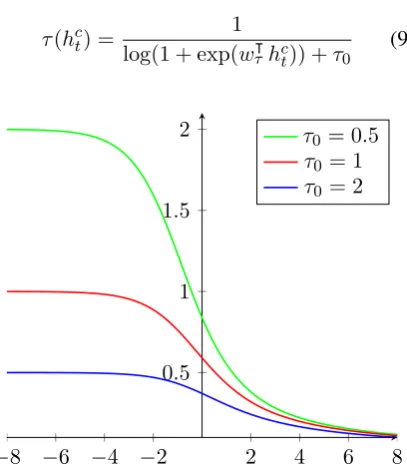
τ(hct) = 1
log(1 + exp(wτ⊺hct)) +τ0
(9)
−8 −6 −4 −2 2 4 6 8
0.5 1 1.5
2 τ0 = 0.5
[image:8.595.82.286.306.544.2]τ0= 1 τ0= 2
Figure 4: Plot of Eq.9, with different values for the upper boundτ0.
In our experiments, we had convergence prob-lems with the learned temperature technique. We found that the compressor preferred values close to the upper bound, which led to unstable training, forcing us to set τ0 > 1 to stabilize the training
process. Our findings align with the behavior re-ported byGu et al.(2018). Consequently, we fol-low their choice and fix τ = 0.5, which worked well in practice.
A.2 Out of Vocabulary (OOV) Words
The vocabulary of our experiments comprises the 15k most frequent words of Gigaword’s training
input texts (without looking at their summaries). To handle OOVs, we adopt the approach of Fevry and Phang (2018), which can be thought of as a simpler form of copying compared to pointer networks (See et al., 2017). We use a small set (10 in our experiments) of special OOV to-kensOOV1,OOV2, . . . ,OOV10, whose embeddings
are updated during learning. Given an input text
x = ⟨x1, . . . , xN⟩, we replace (before feeding x
toSEQ3) each unknown wordxiwith the first
un-used (for the particularx) OOVtoken, taking care to use the sameOOVtoken for all the occurrences of the same unknown word inx. For example, if ‘John’ and ‘Rome’ are not in the vocabulary, then “John arrived in Rome yesterday. While in Rome, John had fun.” becomes “OOV1 arrived in OOV2
yesterday. While in OOV2, OOV1 had fun.” If
a new unknown wordxi is encountered inx and
all the available OOV tokens have been used, xi
is replaced by ‘UNK’, whose embedding is also updated during learning. The OOV tokens (and ‘UNK’) are included in the vocabulary, and SEQ3
learns to predict them as summary words, in effect copying the corresponding unknown words of x. At test time, we replace theOOV tokens with the corresponding unknown words.
A.3 Reconstruction Word Drop
Our model is an instance of Variational Auto-Encoders (VAE) (Kingma and Welling, 2014). A common problem inVAEs is that the reconstructor tends to disregard the latent variable. We weaken the reconstructor R, in order to force it to fully utilize the latent sequenceyto generateˆx. To this end, we employ word dropout as inBowman et al.
(2016) and randomly drop a percentage of the in-put words, thus forcing R to rely solely on y to make good reconstructions.
A.4 Implementation and Hyper-parameters
We implemented SEQ3 in PyTorch (Paszke et al.,
2017). All the RNNs are LSTMs (Hochreiter and Schmidhuber, 1997). We use a shared encoder for the compressor and the reconstructor, consist-ing of a two-layer bidirectional LSTM with size
300per direction. We use separate decoders for the compressor and the reconstructor; each de-coder is a two-layer unidirectionalLSTMwith size
300. The (shared) embedding layer of the com-pressor and the reconstructor is initialized with
(projec-tion) layers of the decoders and jointly finetuned during training. We apply layer normalization (Ba et al., 2016) to the context vectors (Eq. 1) of the compressor and the reconstructor. We apply word dropout (§A.3) to the reconstructor withp= 0.5.
During training, the summary lengthMis sam-pled from U(0.4N,0.6N); during testing, M = 0.5N. The four losses are summed,λs being scalar hyper-parameters.
L=λRLR+λP LP +λTLT +λLLL
We setλR = λT = 1,λL = λP = 0.1. We use
the Adam (Kingma and Ba,2015) optimizer, with batch size 128 and the default learning rate0.001. The network is trained for 5 epochs.
LM Prior The pretrained language model is a
two-layerLSTMof size1024per layer. It uses its own embedding layer of size 256, which is ran-domly initialized and updated when training the language model. We apply dropout withp = 0.2
to the embedding layer and dropout withp = 0.5
to the LSTM layers. We use Adam (Kingma and
Ba,2015) with batch size 128 and the network is trained for 30 epochs. The learning rate is set ini-tially to0.001and is multiplied withγ = 0.5every 10 epochs.
EvaluationFollowingChopra et al.(2016), we fil-ter out pairs with empty headlines from the test set. We employ thePYROUGE package with “-m -n 2 -w 1.2” to compute ROUGE scores. We use the