Formal Polytypic Programs and Proofs
Wilhelmina Johanna Verbruggen
Declaration
This thesis has not been submitted as an exercise for a degree at this or any other university. It is entirely the candidate’s own work. The candidate agrees that the Library may lend or copy the thesis upon request. This permission covers only single copies made for study purposes, subject to normal conditions of acknowledgement.
Summary
Polytypic or datatype-generic programming is a form of generic programming where we abstract over the shape of datatypes: we define functions by induction over the structure of datatypes. In this thesis we show how to formalize polytypic programming within the proof assistant Coq and show how we can do fully formal proofs over polytypic programs.
Although the formalization of polytypic functions and polytypic proofs is challeng-ing, we provide an easy to use interface for the user which allows to define polytypic functions in a way that is familiar from Generic Haskell and makes it possible to give straight-forward proofs of properties of polytypic functions. Formal proofs are often time consuming, but support for polytypic proofs reduces the so-called “burden of proof”. A single polytypic proof corresponds to a family of proofs, proving that the property holds for each instance of the polytypic function.
To define a polytypic function, a programmer must give instances for each type constant (unit, int, sum and product) and give the type of the function when specialized to types of kind?. Given these, the function can be specialized to any datatype of any kind. We have reified the notion of a polytypic function within Coq as a datatypePolyFn
with fields for exactly these components, and programmers familiar with Generic Haskell should have little difficulty in translating their Generic Haskell definitions to Coq. Func-tion specializaFunc-tion is then defined as an ordinary (dependently typed) funcFunc-tion within Coq. It takes aPolyFnas input and returns something of the type computed by type specialization. This can be regarded as a formal proof that term specialization is correct with respect to type specialization. The main difficulties in this part of the development were the need for impredicativity of the type associated with kind?and the absence of universe polymorphism.
Implementing polytypic programming within a dependently typed language (such as Coq) gives us some distinct advantages. Since we can formalize type specialization within the host language, we get type checking of polytypic functions virtually for free. Furthermore, since polytypic functions are represented by an ordinary datatype within the host language they are first-class citizens. We can define polytypic functions in terms of other polytypic functions and it becomes possible to define combinators on polytypic functions.
arbitrary datatypes of arbitrary kinds. This can be interpreted as a formal proof that to prove a property of a polytypic function it is indeed sufficient to give the instances of the proof for the type constants.
Most problems in this part of the development stemmed from the fact that in the specialization of a polytypic proof we need to refer to the specialization of polytypic functions. A proof specialized to typeTis a proof that a property holds for a particular polytypic functionspecialized toT. Since the definition of term specialization involves a number of type conversions, reasoning about these specialized terms involves reasoning about heterogeneous equalities. However, while our definition of proof specialization is rather involved this does not affect proofs as seen by the user. The user still only needs to provide the proofs for the type constants. These proofs are straight-forward, and it should be possible to automate them to some extent through the use of a custom tactics library. We discuss how we can deal with (co)inductive datatypes and proofs, following the same approach that is taken in Generic Haskell. Unfortunately, this requires some manual work on behalf of the programmer or the prover, and the approach is limited because of restrictions posed by the Coq guardedness checker. Nevertheless, our proof of concept demonstrates that the Generic Haskell approach is feasible in a formal setting. Making the approach more generic, or lifting the restrictions of the guardedness checker, is discussed in future work.
We go on to review work related to our own. We mention a number of approaches to generic programming and explain the difference to the approach on which this thesis is based. We then compare our development to a number of other implementations of polytypic programming in dependently typed languages, and discuss some work that is of interest in improving our implementation of recursion.
We can extend the work in this thesis in a number of ways. There is some scope for automation and syntactic sugar to make defining polytypic functions and proofs more intuitive. We would like to extend the definition of polytypic properties to allow for properties about multiple polytypic functions. Other useful extensions include type-indexed types, the extraction of code to Generic Haskell and the addition of meta-information to our type universe to allow for such polytypic functions as pretty printers and parsers.
Acknowledgements
First and foremost I want to thank Dr Edsko de Vries for getting me through the past four years. He has been a tremendous help, both on a technical and personal front, and without him this thesis would not exist.
I thank my supervisor Arthur Hughes for his input in this work, for taking the time to listen to me trying to explain things over a cup of coffee, and supporting me in any way possible.
Thanks is also due to everyone who provided me with helpful feedback during the course of this work. Most recently, the people attending the Workshop on Generic Programming 2009 were very supportive and I am grateful to Stephanie Weirich, Conor McBride, Patrik Jansson and Philip Wadler for their helpful comments and suggestions. I am thankful to Ralf Hinze, Johan Jeuring and Yves Bertot for early feedback on my research proposal, and to Andrew Butterfield and William Harrison for their comments during the transfer process.
My colleagues in the Foundations and Methods Group have been supportive and through weekly meetings have introduced me to various other interesting aspects of theoretical computer science. A thank-you also to my office mates, especially Daniel Isemann and David Eadie, for many random conversations about nothing in particular over much needed cups of tea.
This thesis is based on two papers published at the Workshop on Generic Program-ming: (Verbruggen et al., 2008, 2009), and an abridged version of this thesis will appear in a special issue on Generic Programming of the Journal of Functional Programming (Verbruggen et al., 2010). The work done in these papers is all my own work, with insightful advice and help on some very particular problems in the development given by Edsko de Vries and Arthur Hughes, who appear as co-authors on the papers.
Contents
1 Introduction 7
1.1 Generic Programming . . . 8
1.1.1 Parametrization by Type . . . 8
1.1.2 Parametrization by Function . . . 9
1.1.3 STL and Type Classes . . . 9
1.1.4 Polytypic Programming . . . 10
1.1.5 Kind-Indexed Polytypic Programming . . . 13
1.2 Coq . . . 16
1.3 Proofs and Generic Haskell . . . 17
1.4 Thesis Overview . . . 18
2 Polytypic Programming 21 2.1 Introduction . . . 21
2.2 Coq . . . 22
2.2.1 Dependent Types . . . 22
2.2.2 Proofs . . . 24
2.2.3 Universe Inconsistencies . . . 25
2.2.4 Equality . . . 27
2.2.5 Coinduction . . . 30
2.3 Definition of the Generic View . . . 30
2.3.1 Kinding Derivations . . . 32
2.3.2 Decoding Kinds . . . 32
2.3.3 Decoding Types . . . 33
2.3.4 Example Types . . . 33
2.4 Defining Polytypic Functions . . . 36
2.4.1 Polytypic Types . . . 36
2.4.2 Polytypic Functions . . . 37
2.5 Type Specialization . . . 38
2.6 Term Specialization . . . 40
2.6.1 Constants . . . 41
2.6.2 Variables . . . 43
2.6.4 Lambda Abstraction . . . 45
2.7 Examples of Polytypic Types and Functions . . . 47
2.7.1 Equality . . . 47
2.7.2 Less Than . . . 48
2.7.3 Count . . . 49
2.7.4 Zero . . . 50
2.8 Higher-order Polytypic Functions . . . 51
3 Polytypic Properties and Proofs 53 3.1 Introduction . . . 53
3.2 Polytypic Properties and Proofs . . . 54
3.2.1 Stating Polytypic Properties . . . 55
3.2.2 Polytypic Properties, Formally . . . 57
3.2.3 Polytypic Proofs . . . 58
3.2.4 Alternative Definitions . . . 60
3.3 Reasoning about Equality . . . 61
3.4 Property Specialization . . . 64
3.5 Proof Specialization . . . 67
3.5.1 Constants . . . 69
3.5.2 Variables . . . 69
3.5.3 Application . . . 69
3.5.4 Lambda Abstraction . . . 70
3.6 Examples of Polytypic Properties and Proofs . . . 72
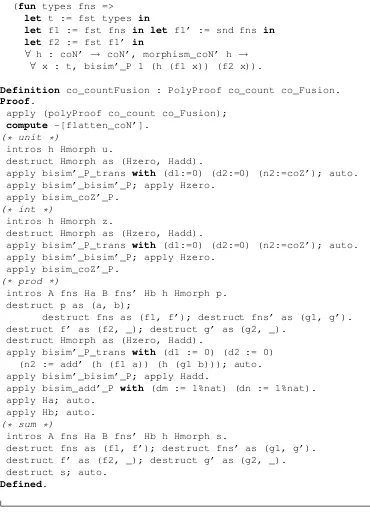
3.6.1 Fusion Law forcount . . . 72
3.6.2 Commutativity of Equality . . . 73
3.6.3 Non-Commutativity ofless than . . . 74
3.6.4 zerois Idempotent . . . 75
4 Recursion 77 4.1 Introduction . . . 77
4.2 Partiality . . . 79
4.3 Guardedness . . . 81
4.3.1 CPS Transforms . . . 82
4.3.2 µ-Reduction . . . 84
4.4 Proofs . . . 87
4.5 Restrictiveness of Syntactic Guardedness . . . 89
4.6 Count Example . . . 90
4.6.1 Conatural Numbers . . . 91
4.6.2 Domain-Specific Constructors . . . 91
4.6.3 Delaying Computation . . . 91
Contents
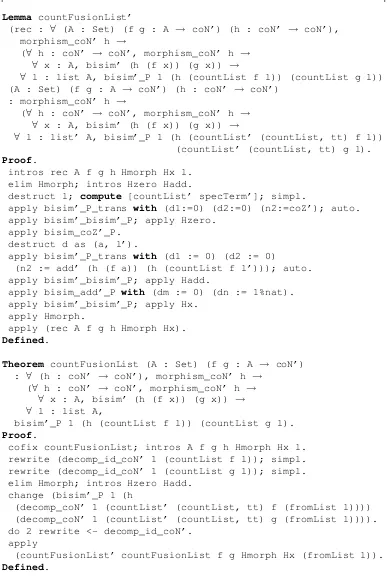
4.6.5 Count Fusion . . . 93
5 Related Work 97 5.1 Scrap Your Boilerplate . . . 98
5.2 Origami Programming . . . 100
5.3 Polytypic Programming in Haskell . . . 101
5.3.1 PolyP . . . 102
5.3.2 Generic Haskell . . . 103
5.4 Dependent Polytypic Programming . . . 104
5.4.1 PolyP-style Generics . . . 105
5.4.2 Strictly Positive Types . . . 107
5.4.3 Generic Haskell-style Generics . . . 110
5.4.4 Containers . . . 110
5.5 Dealing with Termination and Productivity . . . 113
6 Future Work and Conclusions 115 6.1 Automation . . . 115
6.1.1 Tactics for Polytypic Proofs . . . 115
6.1.2 Generate Support for Recursion . . . 116
6.2 Syntactic Sugar . . . 117
6.3 Extensions . . . 117
6.3.1 Expressivity of Polytypic Properties . . . 117
6.3.2 Meta-information . . . 118
6.3.3 Extraction to Generic Haskell . . . 119
6.3.4 Type-indexed Types . . . 119
6.4 Recursion . . . 121
6.4.1 Satisfying the Guardedness Checker . . . 121
6.4.2 Extending the Universe . . . 122
6.5 Conclusions . . . 123
List of Figures
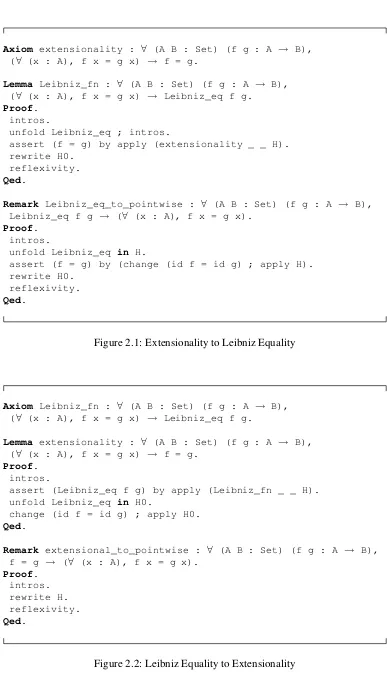
2.1 Extensionality to Leibniz Equality . . . 29
2.2 Leibniz Equality to Extensionality . . . 29
2.3 Guarded Recursive Call Becomes Unguarded . . . 31
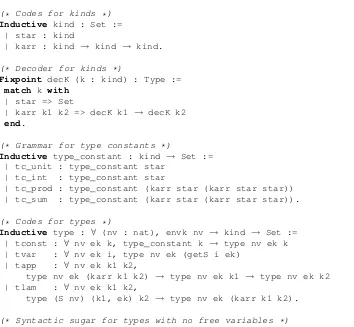
2.4 Generic View and Decoders . . . 34
2.5 Overview of Environments . . . 35
2.6 Type Specialization . . . 38
2.7 Term Specialization . . . 42
3.1 Property Specialization . . . 65
3.2 Proof Specialization . . . 68
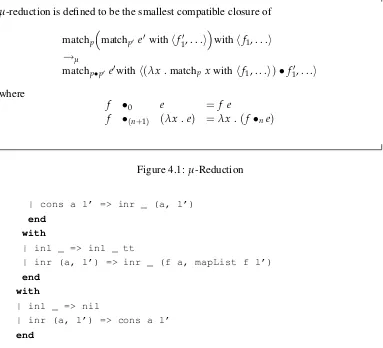
4.1 µ-Reduction . . . 86
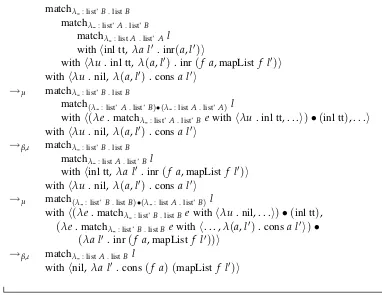
4.2 µ-Reduction Example . . . 87
4.3 Count Fusion, Coinductively . . . 95
4.4 Count Fusion Specialized tolist . . . 96
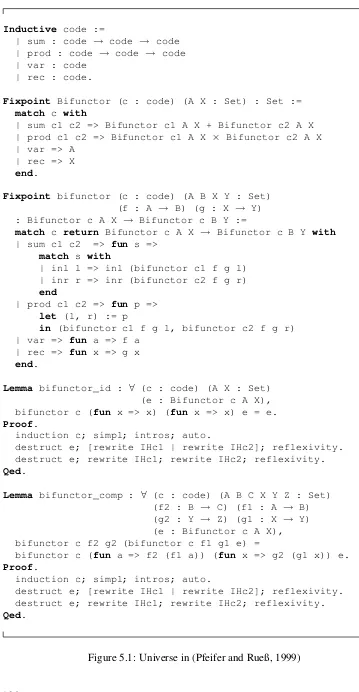
5.1 Universe in (Pfeifer and Rueß, 1999) . . . 106
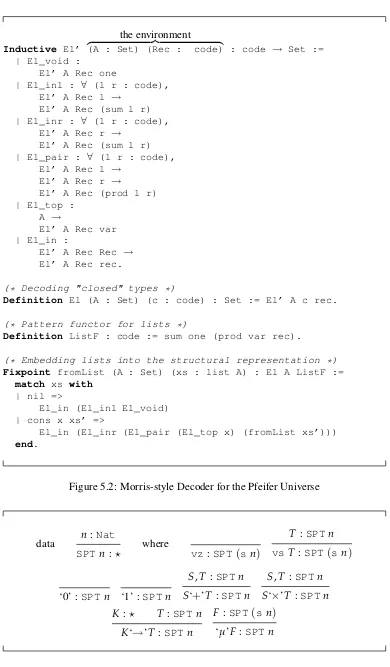
5.2 Morris-style Decoder for the Pfeifer Universe . . . 108
5.3 Universe of Strictly Positive Types . . . 108
5.4 Generic Map in (Morris et al., 2007a) . . . 109
Chapter 1
Introduction
The endless quest for higher levels of abstractions is one of the most fundamental topics in programming language research and in computer science in general. Abstraction is absolutely essential to computer science; even the most primitive programming languages depend on abstract concepts such as bytes or variables: abstractions over sequences of bits (an abstraction because they can be ordered high to low or low to high) and memory locations (an abstraction because the programmer does not have to worry about the exact value of the address, or deal with machine hardware details such as segmentation). As the complexity of computer systems increases, abstraction needs to increase accordingly: from simple concepts such as bytes to “larger” concepts such as procedures, abstract datatypes, application programmer interfaces or network protocols, to advanced concepts such as encapsulation in modern day imperative languages or mathematically inspired abstractions such as monads in functional languages.
Most sciences, including mathematics itself, attempt to build abstract mathematical models of the domain of discourse in order to study its properties. Abstraction here is key as it allows to ignore inessentials: Pythagoras’ theorem about the length of the sides of a triangle does not depend on the material that was used to build the triangle. This kind of abstraction can be characterized asinformation neglect(Colburn and Shute, 2007). Abstraction as used in computer science is different in a subtle but important way, and can be described asinformation hiding: information that is essential in one context (the exact ordering of the bits in a byte) can be ignored in another context. It is this distinction that makes it possible to develop large software systems.
not need to deal with “real” memory addresses at all. In contrast, languages such as C which break this abstraction and allow address arithmetic on variables are notoriously difficult to reason about.
When we do proofs about software systems, the use of abstraction is not only impor-tant in the construction of the software but also in the construction of the proof itself. This should come as no surprise: one of the most fundamental results of computer science is the Curry-Howard isomorphism which (informally) states that proofsareprograms. Consequently, many of the concerns of software engineering also apply to proof engineer-ing. This is especially important when we want to construct formal—that is, machine verified—proofs. Information neglect is commonplace in informal mathematical proofs where “inessential” details are simply left out, but is not usable when constructing proofs to be mechanically verified. Instead, we need to make use of information hiding.
Genericity is almost as general a term as abstraction; it refers to parametrization over some aspect of a system. The kind of genericity that we are interested in here is parametrization over a datatype. This can take various forms. In (qualified) parametric polymorphism (in functional languages) or templates (in imperative languages) parts of the datatype are completely hidden and as a consequence programs must operate uniformly over elements of these datatypes. The kind of genericity that is the topic of this thesis is often referred to asdatatype-genericityorpolytypicity: the program can abstract over a datatype but can nevertheless take advantage of thestructureof the datatype. As we shall see, this is a powerful abstraction mechanism which can be used both to define programsandto define proofs over these programs.
In Section 1.1 we will discuss the topic of genericity in programming languages in more detail, focusing eventually on polytypic programming. The topic of this thesis is the construction offormalproofs over polytypic programs. We motivate the need for formal proofs in Section 1.2 and briefly discuss the proof environment that we will use. Finally, we will give an overview of the rest of the thesis in Section 1.4.
1.1 Generic Programming
Generic programming is a much over-used term, and to different people has different meanings. What they all have in common is that they provide parametrization over some aspect of a programming language, making it possible to write more general programs.
1.1.1 Parametrization by Type
Parametric polymorphism is a well-known example of such an abstraction, in this case abstraction over a type. Let us take lists as an example. In Haskell, we can define two separate datatypes to represent lists of integers and lists of characters:
1.1. Generic Programming
data ListChar = CNil | CCons Char ListChar
These two datatypes are identical except for the type of the elements contained in the list. We can combine them into a single parametric datatype1List, which takes a typea as its argument and constructs lists containing elements of typea:
data List a = Nil | Cons a (List a)
To get the type of integer lists, all we need to do is instantiate aby the typeInt. Given a parametric type we can write a polymorphic function, which abstracts over the parameters of the type. A function that takes an element of typeList aas input does not have any information about the type of the elements contained in the list: it cannot examine the elements of the list, it can only rearrange or count them. Two examples of polymorphic functions on lists are thelengthandappendfunctions:
length :: List a ! Int length Nil = 0
length (Cons x xs) = 1 + length xs
append :: List a ! List a ! List a append Nil l = l
append (Cons x xs) l = Cons x (append xs l)
1.1.2 Parametrization by Function
Another form of genericity is parametrization by functions. This approach is a good fit for functional languages, because they treat functions as first-class citizens. Functions parametrized by other functions are called higher-order functions. An example of a higher-order function is the mapping function for lists, which abstracts over the function
f that is mapped across the list:
mapList :: (a ! b) ! List a ! List b mapList f Nil = Nil
mapList f (Cons x xs) = Cons (f x) (mapList f xs)
1.1.3 STL and Type Classes
In the world of object-oriented programming, generic programming is probably most often associated with the Standard Template Library (STL) in C++. This library provides containers, iterators and algorithms for many datatypes, and therefore allows for many different forms of abstraction. There is a similar notion in Haskell calledtype classes, which allows the programmer to define a function over elements of any typeaas long as ahas certain properties. For example, we could define a sort function on lists:
1The termpolymorphic datatypeis also often used to describeList(Gibbons, 2006, Section 2.2), but this is not strictly correct: a polymorphic type would have the form8a.t, whereas the type ofListis
sort :: Ord a => List a ! List a
which acts on lists containing elements of any typea, as long asasatisfies the properties defined by the type classOrd(in this case, the elements of typeamust be comparable). There are many more examples of different types of generic programming out there, but discussing them all is beyond the scope of this thesis. We refer the reader to (Gib-bons, 2006) for a comprehensive classification of generic programming methods. For a thorough survey and comparison of generic programming methods used by the functional programming community, see (Hinze et al., 2006a). We will now zoom in on the branch of generic programming that we will use in this thesis.
1.1.4 Polytypic Programming
The idea of polytypic programming first appeared in the languagePolyP(Jansson and Jeuring, 1997), and a number of related approaches have appeared since such as the style of polytypic programming often referred to asorigami programming(Gibbons, 2006), and the approach of kind-indexed types (Hinze, 2000b) as implemented in Generic Haskell. This last approach is the one that is the topic of this thesis.
The core concept of polytypic programming is that functions are defined by induction on thestructureof datatypes. Where for parametric polymorphism we abstract from the occurrence ofIntinList Int, here we abstract form the type constructorListitself. The most important difference between polytypic programming and type classes is that in addition to abstracting over the structure or shape of a datatype, polytypic programming also allows us to exploit this structure when defining a function. This is in fact the main feature of polytypic programming: we can write functions that behave differently for different datatypes.
As an example, consider the equality function that can compare any two terms, as long as they have the same type (independent of what that type is). This is a type-indexed function: it will look at the type parameter it is given and based on that it will determine how to compare the two elements it gets as input; comparing two boolean values is done differently than comparing two lists. One way to implement this function is to supply definitions for all datatypes we want to apply the function to:
data Bool = False | True
eqhBooli False False = True eqhBooli False True = False eqhBooli True False = False eqhBooli True True = True
data List a = Nil | Cons a (List a)
eqhList ai Nil Nil = True
1.1. Generic Programming
eqhList ai (Cons x xs) Nil = False eqhList ai (Cons x xs) (Cons y ys) =
eqhai x y && eqhList ai xs ys
data Tree a b = Leaf a | Node b (Tree a b) (Tree a b)
eqhTree a bi (Leaf x) (Leaf y) = eqhai x y eqhTree a bi (Leaf x) (Node y t1 t2) = False eqhTree a bi (Node x t1 t2) (Leaf y) = False eqhTree a bi (Node x t1 t2) (Node y u1 u2) =
eqhbi x y && eqhTree a bi t1 u1 && eqhTree a bi t2 u2
If we would continue this for all possible datatypes we would indeed get a function that is able to compare any two elements of any type. However, this might be a little difficult because there are infinitely many possible datatypes. This is the way equality is imple-mented in (non-generic) Haskell, using type classes. Such an approach is often referred to asad-hoc polymorphismoroverloading. There are some obvious disadvantages to this approach. We still have to define the equality function for every datatype, and when we define a new datatype we need to expand the equality function to include it.
So let us have a look at what the equality function actually does, and try to find some similarities that we can use to make this function a little easier to write generically.
The first thing we notice is that when the constructors of the two terms we want to compare are different the terms are never equal, so in that case we can always return
False. When the constructors are the same we want to compare the arguments to the constructors: if it has no arguments (like Nil) we are done and the terms are equal; otherwise we want to compare each of the arguments using the equality function recursively with the type argument set to the type of the constructor argument.
Notice that we have described the behaviour of the equality functionwithout using any datatype-specific information. We can use this information to give a simple structural representation of datatypes:
• We have a number of base types, likeIntandChar.
• Every other datatype consists of a series of constructors, one of which is selected each time we construct a term of that type. We represent this choice of constructors as a disjoint union, denoted by the symbol+.
• Each individual constructor is represented as a tuple, containing an element for each argument to the constructor. We denote this tuple of arguments by the symbol⇥.
• If a constructor has no arguments it is represented by the unit element, denoted by
Unit.
data Bool = False | True
type Bool = Unit + Unit
data List a = Nil | Cons a (List a)
type List a = Unit + a ⇥ (List a)
data Tree a b = Leaf a | Node b (Tree a b) (Tree a b)
type Tree a b = a + b ⇥ (Tree a b) ⇥ (Tree a b)
There is a technicality here: in most functional languages there is no recursion on the type level, except through algebraic datatypes. This means that we cannot refer toList in the definition ofList , and so we must refer toListinstead. A detailed discussion of this is beyond the scope of the current section and we will come back to it in Chapter 4. We also need a way to build elements of these structural types, and we can do this by the following datatype definitions:
data Unit = Unit
data a + b = Inl a | Inr b
data a ⇥ b = (a, b)
This means that we must translate all elements of arbitrary types to elements that only use these structural types. For example, we should apply the following translations:
False :: Bool 7!
Inl Unit :: Unit + Unit
Cons 2 (Cons 3 Nil) :: List Int 7!
Inr (2, Inr (3, Inl Unit)) :: Unit + Int x (List Int)
Fortunately, this is a fairly straightforward translation which can usually be automated. Now that we have determined the structure of datatypes, we can define a polytypic function by induction on this structure, i.e. we define the function for all base types, the unit type, the disjoint union of two types and a pair of types. We can then apply the function to any datatype that is built up of these components. We call this the specializationof a polytypic function to a particular type. The polytypic definition of the equality function is (where we separate the structural type argument from the other arguments by enclosing it in angular brackets for emphasis):
eqhTi :: T ! T ! Bool eqhInti i1 i2 = eqInt i1 i2 eqhUniti u1 u2 = True
eqha+bi (Inl x) (Inl y) = eqhai x y eqha+bi (Inr x) (Inr y) = eqhbi x y eqha+bi x y = False
eqha⇥bi (x1, y1) (x2, y2) = eqhai x1 x2 && eqhbi y1 y2
To see how this polytypic equality function can be specialized, we will give a few examples. Comparing the valuesTrueandFalseof typeBoolshould returnFalse
1.1. Generic Programming
Unit + Unit, and thatTrueandFalsecorrespond toInr UnitandInl Unit, respectively. Therefore, the specialization will take the following form:
eqhBooli True False
= eqhUnit+Uniti (Inr Unit) (Inl Unit) = False
BecauseBoolhas two possible constructors, we must first check whether the two elements we want to compare were built using the same constructor. This is not the case, and therefore the elements can never be equal.
For our next example we will use the slightly more complicated datatypeList Int. We want to compare the list containing only the integer 2 to the list containing 2 and 3. In order to keep the example readable we will only expand definitions when necessary. Nil
will be expanded toInl Unit(leftmost constructor with no arguments) andCons x ywill be expanded toInr (x, y)(rightmost constructor with a pair of arguments).
eqhList Inti (Cons 2 Nil) (Cons 2 (Cons 3 Nil)) = eqhUnit+Int⇥(List Int)i (Inr (2, Nil))
(Inr (2, (Cons 3 Nil))) = eqhInt⇥(List Int)i (2, Nil) (2, (Cons 3 Nil)) = eqhInti 2 2 && eqhList Inti Nil (Cons 3 Nil))
We now have two different cases we need to solve, and we will solve them separately, starting with the first case. The first case compares the integer 2 to itself, and ifeqIntis defined correctly it should returnTrue:
eqhInti 2 2
= eqInt 2 2 -- External definition of eqInt needed
= True
The second case is a little more complicated. First we need to expand the definitions ofList Int,ConsandNil. We end up with two different constructors (as was the case in the example forBool), which will always returnFalse—the empty list and the list containing the integer 3 are obviously not the same.
eqhList Inti Nil (Cons 3 Nil)
= eqhUnit+Int⇥(List Int)i (Inl Unit) (Inr (3, Nil)) = False
Combining our two results we getTrue && Falsewhich gives an overall result ofFalse: the list containing only 2 is not the same as the list containing both 2 and 3.
In addition to the equality function we can define numerous other useful func-tions by induction on the structure of types. Some well-known examples includemap,
encode/decode,zipandfold.
1.1.5 Kind-Indexed Polytypic Programming
so that we can give a definition of equality that can be specialized to types ofarbitrary kinds: not just toBoolorList Int, but also to the type constructorList a. This so-called kind-indexed polytypic programming is what sets the approach to polytypic programming in Generic Haskell apart from most other approaches, and it is the style that we want to formalize in this thesis.
To understand this approach, we need to understand what we mean by the kind of a type. A kind can be thought of as a type of a type:
• We use the kind?to represent nullary constructors (constructors without argu-ments), e.g. Bool,Int,Char. We often call nullary type constructors simply types.
• The kind k1 ! k2 represents type constructors that map type constructors of kindk1to type constructors of kindk2. For example, the type constructorList maps the typeato the typeList a, both of kind?. Therefore, the kind ofList
is?!?.
To determine the kind of a type constructor there are two things to take into account: the number of type arguments and their kinds. Let us consider a few examples:
data Bool = False | True
-- no arguments: kind ?
data Maybe a = Nothing | Just a
-- 1 argument a of kind ?: kind ?!?
data Tree a b = Leaf a | Node b (Tree a b) (Tree a b)
-- 2 arguments a and b of kind ?: kind ?!?!?
data GRose f a = GBranch a (f (GRose f a))
-- 2 arguments: f of kind ?!?; a of kind ?
-- This gives an overall kind of (?!?)!?!? to GRose. In other words: we can view the kind?as the kind of types that actually contain values, and the kind?!?as the kind of type constructors that take a type of kind?and return a type of kind?(i.e. it takes a type containing values and returns a type containing values). For example, there are values of typeBool:: ?andInt:: ?and there are no values of typeList:: ?!?, but there are values of typeList Bool:: ?andList Int::?.
We can now rewrite the signature for the polytypic equality functioneqto
eqhT::?i :: T ! T ! Bool
1.1. Generic Programming
eqhT::?!?i :: (a ! a ! Bool) ! T a ! T a ! Bool
In order to compare two lists, we must provide it with a function that can compare the elements of the lists. One solution would be to write a different polytypic equality function for each possible kind. This is a significant improvement over having to write a separate function for everytype, since the number of different kinds we might use is likely to be reasonably small. Ideally we would like a single equality function that works for all types of all kinds, but since the number of kinds is infinite we would never be able to cover them all. Even if we would write an equality function for every kind that we actually need, this goes against the generic programming philosophy. What we want is a single equality function that works foralltypes.
The problem is that we cannot give a straight-forward type for this equality function: the type changes depending on the kind ofT. The key insight in (Hinze, 2000b) is that a type-indexed function must have a kind-indexed type:
eqhT::ki :: Equalhki T
whereEqualis used as a type constructor indexed by a kindk, and can be defined as:
Equalhk::⇤i :: k ! ?
Equalh?i T = T ! T ! Bool
Equalhk1!k2i T = 8a.Equalhk1i a ! Equalhk2i (T a)
For the case where T :: ?, the type of the equality function will still beT ! T ! Bool, but for any other kinds the type will be different.
We can now give a type to the equality function for bothT = Int:: ?andT =
List::?!?(and all other types of any kind):
eqhInt::?i
:: Equalh?i Int
= Int ! Int ! Bool
eqhList::?!?i
:: Equalh?!?i List
= 8a.Equalh?i a ! Equalh?i (List a)
= 8a.(a ! a ! Bool) ! List a ! List a ! Bool
additional parameterseqAandeqBthat can be used to recursively determine equality on terms of typeaandb.
We can also think about this in a different way: rather than giving an instance for a+band a⇥b for some specific a andb—that is, for types of kind ?—we give an instance for(+)and for(⇥)—types of kind?!?!?. Hence, the instance for these two cases will be provided with two additional arguments.
eqhT::ki :: Equalhki T
eqhInti i1 i2 = eqInt i1 i2 eqhUniti u1 u2 = True
eqh+i eqA eqB (Inl x) (Inl y) = eqA x y eqh+i eqA eqB (Inr x) (Inr y) = eqB x y eqh+i eqA eqB x y = False
eqh⇥i eqA eqB (x1, y1) (x2, y2) = eqA x1 x2 && eqB y1 y2
1.2 Coq
Coq is a system developed by G´erard Huet and Thierry Coquand (Bertot and Cast´eran, 2004) for verifying proofs. Coq is often called aproof assistantbecause it greatly eases the construction of a proof with the use of libraries and automated proof searching. There are numerous advantages to using Coq and other proof assistants like Isabelle (Paulson, 1989), Lego (Luo and Pollack, 1992) and PVS (Owre et al., 1996):
• The final proof will be machine verified. A proof done by hand is never guaranteed to be correct: some cases can be overlooked or there might be some hidden assumptions that we are not aware of. If the proof is done in Coq this is not possible, as Coq will ensure that all the cases are covered and any assumptions that need to be made have to be stated explicitly so that we are always aware of them.
• Coq will keep track of all the necessary subgoals that need to be proven. This is especially useful for long and complicated proofs where there might be a large number of subgoals.
• Proof libraries can be developed in Coq to assist in the construction of (parts of) proofs.
• In addition to proof libraries, Coq also supports specialized tactics. Tactics are commands that can be applied to a goal. Their effect is to produce a new, possibly empty, list of goals. Ifg is the input goal andg1. . .gk are the output goals, the
tactic has an associated function that makes it possible to construct a solution ofg from the solutions of goalsgi (Bertot and Cast´eran, 2004). Proofs about generic
1.3. Proofs and Generic Haskell
The formal system underlying the Coq proof assistant is theCalculus of Constructions (Coquand and Huet, 1988). The Calculus of Constructions is a dependently typedl -calculus. Programs in the Calculus of Constructions correspond, via the Curry-Howard isomorphism, to proofs in higher-order impredicative logic. It is a close cousin of Martin-L¨of type theory (which is, however, predicative) and is one of the most powerful constructive logics in use today.
An advantage of this approach is that proofs written in Coq are terms in a small and well understood mathematical calculus and can therefore be verified independently. Hence, it is possible to write a proof verifier: a relatively simple tool which can be verified in its entirety. Once verified, proofs in Coq are indeed guaranteed to be correct. In contrast, proofs written using other proof assistants, such as PVS or Sparkle (de Mol et al., 2002), are simply large bodies of instructions to those theorem provers. Therefore the correctness of a proof written in PVS or Sparkle relies on the correctness of the entire proof assistant. In particular, any future additional feature to one of these proof assistants may make it possible to prove invalid properties. In Coq, new features (especially new tactics) do not extend the core language so that generated proofs can still be verified against the Calculus of Constructions.
Furthermore, Coq takes care to maintain a distinction between programs that are proofs and programs that are meant to be executed. This mechanism is used to provide program extraction. Programs can be written in Coq, proven correct in Coq and then extracted to a general purpose programming language such as Haskell. The extracted program can then be compiled by an optimizing compiler and run. This means that the gap between the program which is proven correct and the program that is executed—often quite large—is minimal.
1.3 Proofs and Generic Haskell
To be able to reason about Generic Haskell programs, we need a way of representing such programs in the proof assistant Coq. In other words, we need an embedding of Generic Haskell in Coq. There are some important semantic differences between these two languages that need to be taken into consideration when trying to embed one in the other.
A function in Coq can be either inductive or coinductive, but it must always betotal. For inductive functions Coq ensures the functions is total through a syntactic termination check. A coinductive function is considered total when it productive, and Coq verifies productivity through a syntactic guardedness check.
functions to total functions in Coq. For example, we could restrict the input type to lists of finite length (inductive datatypes). Another possibility is to use the partiality monad as described in (Capretta, 2005). We will give some pointers to other methods in Section 5.5.
Generic Haskell lives in the same world as Haskell and polytypic functions written in Generic Haskell can be partial. Programmers using our development will be able to write polytypic functions directly in the Coq proof assistant, and reason about those functions using all the tools available in Coq as well as the additional infrastructure for polytypic proofs that we provide. To reason about a partial polytypic function the programmer must use one of the available methods to encode this partiality as a total function in Coq.
1.4 Thesis Overview
Our work can be divided into three important stages: adding support for polytypic pro-gramming to Coq (Chapter 2), providing the necessary infrastructure to enable polytypic proofs about these programs (Chapter 3) and a way to deal with recursive datatypes and proofs (Chapter 4).
Chapter 2 is based on (Verbruggen et al., 2008) and discusses polytypic functions and their types. From a user’s perspective, these functions strongly resemble the corre-sponding functions in Generic Haskell. Throughout this thesis we will use the polytypic
mapfunction and its typeMapas our working example, both of which are defined in Section 2.4.
Once we have a polytypic definition formap, we can specialize it to any type in our generic view. For example, the specialization ofmapto the type of integers is simply the identity on integers:
Eval compute in specTerm tint map. = fun (z : Z) => z
: specType tint Map
“Eval compute in” instructs Coq to compute the normal form of a term;tintis the “code” that corresponds to the type of integers, andspecTermandspecTypeare our definitions of term and type specialization. In Section 2.6 we discuss term specialization. Coq reports the type of the result as the specialization ofMap(the type ofmap) totint; this evaluates to
Eval compute in specType tint Map. = Z ! Z : Set
as expected (Setis Coq’s name for kind ?). Type specialization is discussed in Sec-tion 2.5.
1.4. Thesis Overview
Eval compute in specTerm fork map.
= fun (A B : Set) (f : A ! B) (x : A ⇥ A) =>
let (a, b) := x in (f a, f b) : specType fork Map
The second stage of our development is discussed in Chapter 3, which is based on (Verbruggen et al., 2009). Polytypic properties are the Curry-Howard image of polytypic types, and are therefore defined by induction on kinds. As our working example we will use the property thatmappreserves identities:
map id=id
We define this property informally in Section 3.2.1 and give its formal definition in Section 3.2.2.
Just like polytypic types, we can specialize a property to a particular type in our universe, which is described in Section 3.4. For example, we can specialize the property thatmappreserves identities to the typeforkto get the following property:
= 8 (A : Set) (f : A ! A) (Hx : 8 x : A, f x = x) (p : A ⇥ A), map f p = p
We discuss the construction of a polytypic proof for such a property in Section 3.2.3. The interesting thing about polytypic proofs is that, just as for polytypic functions, the user only needs to provide the proofs for each of the type constants; we can then specialize this proof to any other type in our generic view. We discuss proof specialization and its difficulties in Section 3.5.
The last hurdle in our development is to introduce recursion, which is far from a trivial addition to the existing infrastructure. To avoid muddying the waters early on we will not discuss recursion in Chapters 2 and 3, but consider it as a separate problem in Chapter 4.
The approach to adding recursive datatypes and recursive proofs to our development closely follows the approach taken in Generic Haskell. Unfortunately, this will require some manual work on behalf of the programmer or the prover, and the approach is limited because of restrictions posed by the Coq guardedness checker. Nevertheless, our proof of concept demonstrates that the Generic Haskell approach is feasible in a formal setting. Making the approach more generic, or lifting the restrictions of the guardedness checker, is discussed in future work (Section 6.4).
We then finish off by discussing relevant related work in Chapter 5, followed by an overview of future work and conclusions in Chapter 6.
Chapter 2
Polytypic Programming
2.1 Introduction
The aim of our work is the development of an infrastructure in the proof assistant Coq for doing proofs over polytypic programs. In this chapter we present the first step towards this goal: the formalization of polytypic programming in Coq.
The approach to polytypic programming used in Generic Haskell was first introduced by Ralf Hinze (Hinze, 2000b,a) and has been implemented as a preprocessor for Haskell and as a language extension in Clean. It has since been recognized that in the context of a dependently typed language polytypic programming can be expressed entirelywithinthe language and can be implemented simply as a library (for example, see Altenkirch and McBride, 2003). Our implementation too takes the form of a Coq library.
The core idea is that if f is a polytypic function of typeFwe canspecialize f to an ordinary function fhTiover a datatypeT. The type of fhTiis the specializationFhTito the kind ofT. Term specialization (fhTi) is defined by induction on the structure ofT; type specialization (FhTi) is defined by induction on thekindofT.
The aim of this chapter is to provide an implementation of polytypic programming in Coq which is easily recognizable to programmers familiar with Generic Haskell or Generic Clean. In particular, our contributions are:
• We provide an infrastructure for defining polytypic functions and their types which is very similar to the infrastructure provided by Generic Haskell or Generic Clean (Section 2.4).
• We formalize term specialization and type specialization in Coq as defined in Generic Haskell/Clean. In particular, the definition of our type universe is identical (modulo syntactic differences).
The final point is important since it paves the way towards our ultimate goal of pro-viding an infrastructure in Coq to prove properties about Generic Haskell style programs, which we discuss in Chapter 3. For this goal to succeed, we must have a definition of polytypic programming which is both fully formal and as close as possible to the definition in Generic Haskell or Generic Clean. This chapter provides such as definition. After a brief introduction to Coq in Section 2.2, we define our generic view (universe) in Section 2.3. We then show that the interface we provide to programmers in very similar to the Generic Haskell interface (Section 2.4) and give the formalization of type and term specialization in Sections 2.5 and 2.6.
We assume that the reader is familiar with Haskell, and has at least some cursory knowledge of Generic Haskell or Generic Clean. We will not assume any prior knowledge of Coq.
This chapter is an expanded version of (Verbruggen et al., 2008), and the Coq sources associated with the formalization described in this chapter can be found online (Verbruggen, 2009).
2.2 Coq
Before we delve into our formalization of polytypic programming, we will first give a brief overview of Coq. Coq is a proof assistant developed in Inria (Bertot and Cast´eran, 2004) based on the calculus of constructions (higher-order predicate logic) extended with inductive and coinductive datatypes and an infinite hierarchy of universes. The examples we discuss in this section are all part of our development, and will be referred to in the rest of the chapter.
2.2.1 Dependent Types
The calculus of constructions (Coquand and Huet, 1988) is a dependently typed lambda calculus. This means that types are first-class and can be passed as arguments to functions or returned as results. For example, we can define a function tupleT A n which constructs the type of homogeneous tuples containingnelements of typeA1
A⇥A⇥· · ·⇥A
| {z }
n
as
Fixpoint tupleT (A : Type) (n : nat) {struct n} : Type :=
match n with
| O => unit
| S m => A * tupleT A m
end.
2.2. Coq
Fixpoint introduces a recursive definition, and match denotes pattern matching (comparable tocasein Haskell). Since all functions in Coq must terminate, recursive functions must be defined by structural induction on one of its arguments, denoted by the keywordstruct. The termination checker in Coq will verify that all recursive calls are made to structurally smaller arguments. Notice that for the case ofn=0we return the unit type (()in Haskell) which has one element denoted bytt. Thus we will usettto denote the empty tuple.
To define a function that returns theith element from ann-tuple, we must first define a datatype that describes the set of valid indices{0, 1, . . . ,n 1}. This datatype is known asindexand is defined as
Fixpoint index (n : nat) : Set :=
match n with
| O => Empty_set
| S m => option (index m)
end.
Theoptiontype can be compared to theMaybemonad in Haskell:
Inductive option (A : Type) : Type := | Some : A ! option A
| None : option A.
Inductiveintroduces an inductive datatype. The syntax can be compared to the syntax for GADTs in Haskell (Peyton Jones et al., 2006): we specify the kind of the datatype and list the types of the constructors. Theoptiontype has two constructors:Noneand
Some.
Theindextype is parametrized by a natural number—a term, not a type—and is therefore a so-calleddependentdatatype: a type depending on a term. For anyone not familiar with Coq and dependently typed programming languages, theindextype might seem a little strange. One way to view it is as a family of types:
For n = 0 we get the empty type Empty set, so index 0 represents the type containing no elements; i.e. for a tuple of length0there are no possible indices.
Forn= 1we get the typeoption (index 0), which further unrolls tooption Empty set. There are two ways to construct an element of typeoption A. To use theSome constructor we need to provide an element of type A, since
Empty set is the empty type no such element exists. That leaves us with the second constructor which can always be applied to give us the elementNone : option Empty set. In other words, for a tuple of length1there is one possible index which we callNone.
we can supply it with an element of the correct type. In this case we have A=option Empty set, and we have seen already that this contains the sin-gle elementNone, so we can construct the elementSome None : option (option Empty set. This gives us two possible indices for tuples of length 2.
This pattern continues for all values ofn: we take then 1elements of typeindex
(n 1), apply theSomeconstructor to all of them to getn 1elements of typeindex n and add in None : index n to get a total of n elements of type index n. Throughout this thesis we will often replace the syntax of indices by natural numbers for readability, where0=None,1=Some None, etc.
Given the datatype index we can write the indexing operator that takes the ith element from ann-tuple as
Fixpoint getT (A : Type) (n : nat) {struct n} : index n ! tupleT A n ! A :=
match n return index n ! tupleT A n ! A with
| O => fun i _ => match i with end
| S m => fun i tup => match i with
| None => fst tup
| Some i’ => getT A m i’ (snd tup)
end end.
The syntax “match e in T return s with” denotes a dependent pattern match one :T, where the type of each branch has types(which may depend on botheandT, but in this case only depends oneso we can leave theinclause empty). The use of an underscore in the case forn=0indicates an implicit variable that can be automatically inferred by Coq.
The case forn=0is slightly obscure. Sincen=0, we know thatimust have type
index 0, which we have already said is the type containing no elements. Matching on iwill therefore not generate any possible cases and we end up with an emptymatch
construct. This prevents us trying to extract an element from an empty tuple. Also, since the indeximust always be within bounds due to its type,getTis a total function.
2.2.2 Proofs
From a logical perspective, Coq’s language corresponds to constructive higher-order predicate logic where every program in Coq denotes the proof of its type. This fascinating result is known as the Curry-Howard isomorphism, but a discussion of this topic would take us too far afield; we refer the reader to the excellent textbook by Sørensen and Urzyczyn (2006) instead.
For simple cases we can write these proofs as programs. For example, here is a proof of modus ponens:
Lemma MP : 8 (A B : Prop), A ! (A ! B) ! B.
2.2. Coq
“Lemma. . .Proof” is alternative syntax for “Definition. . .:=” to make it clear that we are writing a proof rather than a program. Of course, there really is no distinction and this is syntactic sugar only. We could also write
Definition MP : 8 (A B : Prop), A ! (A ! B) ! B :=
fun (A B : Prop) (a : A) (f : A ! B) => f a.
The two definitions ofMPare indistinguishable. Coq does, however, make a formal distinction between terms that are “programs” and terms that are “proofs” in the type system. The type of a program (say,nat) lives inSet, as we saw above. The type of a proof (that is, a proposition such as1= 1) lives inProp(bothSetandProplive in
Type0). The reason for the two different sorts is that Coq supportsprogram extraction: Coq can extract all the computational content (that is, keep the programs but strip the proofs) to be exported to OCaml or Haskell for efficient compilation.
For more complicated proofs, however, writing proofs by hand (as “programs”) becomes difficult. Instead, we can make use oftactics. Tactics are small programs that can search for proofs in a particular domain. The use of tactics enablesproof automation, where Coq can handle most of the more mundane parts of our proofs automatically. This is a huge help in any realistic proof. One of the simplest tactics isauto, which attempts to solve the proof by repeated application of the currently available hypotheses. Other tactics include tactics for induction (i.e., recursion), inversion, arithmetic, etc. Moreover, Coq supports a language calledLtacin which custom tactics can be written. All tactics will search for proofs, and thenreturna proof if one can be found—which will be verified by Coq. This means that a “rogue” tactic cannot compromise the soundness of the system.
We will not make any significant use of tactics in our development, so we refer the reader to (Bertot and Cast´eran, 2004) for more information. However, the support for tactics and proof automation is an important reason for choosing Coq for our work (reasoning about polytypic programs) since they will ease the burden on users of our system; see also Section 6.1.1.
2.2.3 Universe Inconsistencies
In the next few sections we will give a short overview of some of the major stumbling blocks in dealing with Coq. In this section we will detail how we avoided universe inconsistencies in our development.
One definition that we will need later in our proof is a characterization of heteroge-neous tuples, in which every element has a different type. One natural way we might consider is to define a function which given a tuple of types
(A,B,C)
constructs the type
We can define this function as
Fixpoint gtupleT (n : nat) : tupleT Type n ! Type :=
match n return tupleT Type n ! Type with
| 0 => fun _ => unit
| S m => fun tup => fst tup * gtupleT m (snd tup)
end.
This definition works fine in most cases. However, if we want to construct a heterogeneous tuple where the elements themselves are tuples, i.e a heterogeneous tuple of the form
tupleT A1m1⇥tupleT A2m2⇥· · ·
Coq will come back with the uninformative error
Universe inconsistency
To understand this error, we must know a little more about universes in Coq. Like in Haskell, the natural number “5” has typenat. Like in Haskell, the typenathas kind (or type)Set(Setis called?in Haskell). Unlike in Haskell, however, this hierarchy continues ad infinitum: Sethas type Type0, Type0 has typeType1, and generally Typei has type Typei+1. Moreover, there is a coercion rule that if T : Typei then T : Typejfor any j i. ThisstratificationofTypeprevents the encoding of logical paradoxes (e.g., Hurkens, 1995).
The user cannot assign these universe levels manually, which is why we simply wrote
Typein the examples above. Coq attempts to assign a suitable level to each occurrence of
Type, infers the constraints on these levels, and verifies that there are no inconsistencies. FortupleTwe have
tupleT:Typei !nat!Typej (i j)
The constraint(ij)comes from the fact that the first argument, A:Typei, is used to construct the new typeA⇥A⇥· · ·⇥A:Typej.
Now consider what happens when we try to define our tuple of tuple types. The elements of the tuple are the result oftupleTand therefore have type Typej. The constructed type itself must then have type
(tupleT A m:Typej, . . .):tupleT Typej n
Since we passTypejas the first argument totupleT, and we have said that this first argument has typeTypei, we must haveTypej : Typeiwhich will hold only ifj<i. But the constraintsi jandj<icannot both be satisfied, and Coq reports a universe inconsistency: there is no suitable assignment that does not result in an inconsistency.
2.2. Coq
have typeTypei0 !nat!Typej0. This would change the constraints toj0 <i,i j andi0 j0, thus solving the inconsistency. This is, however, not a very elegant solution, especially since it would lead to further code duplication elsewhere. Fortunately, we can follow Morris et al. (2007b) and give an alternative definition of heterogeneous tuples which avoids universe inconsistency without the need for duplication (Morris et al. refer to this operator as the modality⇤). Given a tuple
(x,y,z)
of elements of some typeAand a function f : A!Type, we construct the type
f x⇥ f y⇥ f z
This is implemented as
Fixpoint gtupleT (A : Set) (n : nat) (f : A ! Type) : tupleS A n ! Type :=
match n return tupleS A n ! Type with
| O => fun _ => unit
| S m => fun tup => f (fst tup) * gtupleT m f (snd tup)
end.
While this definition is not formally equivalent, it is equally suitable for our purposes and avoids the universe inconsistency. The indexing operator associated withgtupleT
takes the following form:
ggetT : 8 (A : Set) (n : nat) (f : A ! Type) (i : index n) (tup : tupleS A n), gtupleT f tup ! f (getS i tup)
2.2.4 Equality
In Coq, equality is an inductive datatype with exactly one constructor (refl equal) which says thatx =x. Therefore, the expressionx=yis true if and only if bothxand yreduce to the same term, under the usualb,d,iandz-reductions (see Section 4.3.2 for an overview of these reductions).
Equality of Functions
This definition of equality implies the absence of an extensionality principle. Two functions to sort the elements of a list (e.g. quicksort and mergesort) will be regarded as different functions, even though they produce the same output for every possible input. This lack of extensionality is not unreasonable: after all, quicksort and mergesort are not the same function.
that the polytypicmapfunction preserves composition, i.e.
map f mapg=map(f g)
However, these two functions are constructed differently and because extensionality does not hold in Coq they can never be equal. Fortunately, while we cannot prove that the two functions are equal, wecanprove that the result of the functions is the same given the same input:
(map f map g)x=map(f g)x
We will define all properties in Chapter 3 in this point-wise style to avoid the problem of extensionality.
Extensionality as an Axiom
Another solution we could have adopted is to add an axiom of extensionality to Coq, which does not lead to an inconsistent theory (The Coq Development Team, 2008a, Section 5.2):
Axiom extensionality : 8 (A B : Set) (f g : A ! B), (8 x : A, f x = g x) ! f = g.
We have opted not to add extensionality in this thesis because our development can be done entirely without assuming the axiom. However, if desired, the axiom can be added and polytypic properties and proofs can be modified accordingly.
Leibniz Equality
Another common notion of equality isLeibniz Equality, which can be defined in Coq as follows:
Definition Leibniz_eq (A : Set) (x y : A) :=
8 (B : Set) (h : A ! B), h x = h y.
It can be shown that when extensionality is added as an axiom in Coq, Leibniz equality coincides with pointwise equality (see Figure 2.1). Alternatively, it is possible to add an axiom stating that pointwise equality implies Leibniz equality, from which extensionality can be shown (see Figure 2.2). Therefore, the two axioms are equivalent.
Heterogeneous Equality
2.2. Coq
Axiom extensionality : 8 (A B : Set) (f g : A ! B), (8 (x : A), f x = g x) ! f = g.
Lemma Leibniz_fn : 8 (A B : Set) (f g : A ! B), (8 (x : A), f x = g x) ! Leibniz_eq f g.
Proof. intros.
unfold Leibniz_eq ; intros.
assert (f = g) by apply (extensionality _ _ H). rewrite H0.
reflexivity.
Qed.
Remark Leibniz_eq_to_pointwise : 8 (A B : Set) (f g : A ! B), Leibniz_eq f g ! (8 (x : A), f x = g x).
Proof. intros.
unfold Leibniz_eq in H.
assert (f = g) by (change (id f = id g) ; apply H). rewrite H0.
reflexivity.
Qed.
Figure 2.1: Extensionality to Leibniz Equality
Axiom Leibniz_fn : 8 (A B : Set) (f g : A ! B), (8 (x : A), f x = g x) ! Leibniz_eq f g.
Lemma extensionality : 8 (A B : Set) (f g : A ! B), (8 (x : A), f x = g x) ! f = g.
Proof. intros.
assert (Leibniz_eq f g) by apply (Leibniz_fn _ _ H). unfold Leibniz_eq in H0.
change (id f = id g) ; apply H0.
Qed.
Remark extensional_to_pointwise : 8 (A B : Set) (f g : A ! B), f = g ! (8 (x : A), f x = g x).
Proof. intros. rewrite H. reflexivity.
[image:37.595.124.511.75.771.2]Qed.
2.2.5 Coinduction
Where all recursive functions and datatypes must be shown to be terminating, all corecur-sive functions and datatypes need to productive. Productivity guarantees that in each step the function takes at least one new constructor will be produced. Even if we can never produce the complete result (which could be an infinite list), at least we know that each step will give us a new piece of the puzzle.
Coq guarantees productivity of corecursive functions and datatypes using a syntactic guardedness check. In practise this means that every corecursive call must be guarded by a constructor of the output type of the function. For example, we can represent the conatural numbers as
CoInductive coN : Set := | coZ : coN
| coS : coN ! coN.
and define infinity as
CoFixpoint inf := coS inf.
where the corecursive call to inf is clearly guarded by the constructor coS of the datatypecoN.
The second condition is that the constructor guarding the corecursive call cannot in turn be passed as an argument to another function if that function cannot be unrolled by Coq. In Figure 2.3 we use a simple example to show that a guarded call passed as an argument to an unknown function can become unguarded. A corecursive function is regarded as an unknown function, so any argument passed to it will be considered unguarded.
This syntactic guardedness check is quite restrictive, especially considering the fact that Coq cannot unroll any coinductive functions and must therefore treat them as unknown functions during the guardedness check. We need to be careful in constructing our proofs to avoid passing the results of corecursive calls as arguments to coinductive (or otherwise “unknown”) functions.
In Chapter 4 we will show how we can use corecursive functions to deal with the specialization of polytypic functions (and proofs) to (co)recursive datatypes. In Section 4.5 we show that a small change in the construction of a particular proof can make that proof unguarded.
2.3 Definition of the Generic View
A generic view is a set ofcodesthat represent the datatypes that can be used as a target for specialization of polytypic functions. For example, if we want to specialize the polytypic map function to the product type (prod in Coq), we must pass the code forprod
2.3. Definition of the Generic View
CoInductive C : Set := | MkC : C ! C.
(* The corecursive call is guarded by the MkC constructor *)
CoFixpoint guarded_fn1 : C := MkC guarded_fn1.
(* This does not change the guardedness of its argument *)
Definition leave_guarded (c : C) : C :=
match c with
| MkC c’ => MkC c’
end.
(* The corecursive call is again guarded by MkC, but is then passed as an argument to leave_guarded. Since we can unroll the definition of leave_guarded, we can see that this does not affect guardedness. *)
CoFixpoint guarded_fn2 : C := leave_guarded (MkC guarded_fn2).
(* Stripping the top-level constructor *)
Definition unguard (c : C) : C :=
match c with
| MkC c’ => c’
end.
(* Even though the corecursive call is guarded by MkC, this constructor is stripped by the function unguard, leaving it unguarded. This function will not be accepted by Coq.
CoFixpoint not guarded1 : C := unguard (MkC not guarded1).
*)
(* An undefined function. *)
Variable unknown_fn : C ! C.
(* Since Coq cannot unroll an unknown function it cannot accept this definition - the unknown function could be unguard. Therefore it is assumed that all guarded corecursive calls become unguarded when passed to an unknown function.
CoFixpoint not guarded2 : C := unknown fn (MkC not guarded2).
*)
(* Coinductive functions cannot be unrolled in Coq and are thus treated as unknown function by the guardedness checker. *)
However, the result of term specialization should be a function on the product datatype proper (prod). This means that we must define a mapping from codes in the generic view to ordinary Coq datatypes. Such a mapping is known as adecoder. Similarly we need to encode kinds and define the associated decoder. The definitions for our generic view and its decoders are listed in Figure 2.4.
2.3.1 Kinding Derivations
In our definition of the generic view we do not define a datatype that encodes thegrammar of types, but rather encode kinding derivations to make sure that only well-kinded types can be represented. An element
T:typenv ek k
is a type of kindkwith at mostnvfree variables, whose kinds are defined in the kind environmentek. This corresponds to a kinding derivation
ek` T:k
The type of the environmentekisenvknv, which is annv-tuple of kinds. As an example, the rule for lambda abstraction encodes the kinding derivation
(k1,ek)`T :k2
ek`LT:k1!k2 LAM
Note that we are using De Bruijn indices to represent variables (de Bruijn, 1972). The indices in a type ofnvfree variables are of typeindexnv(see Section 2.2.1), which guarantees that no indices can be out of bounds.
2.3.2 Decoding Kinds
The decoder for kinds is straight-forward, but there is a subtlety with the choice ofSet
as the decoding of kind?. In the specialization of the arrow kind (Section 2.5), we will construct types of the form
(8(a:decK star). . . .):decK star
Since the bound variable (a) ranges over the very type that is defined, the type ofamust be impredicative. As we have seen in Section 2.2.3,Typein Coq is not impredicative (but stratified) and returningTypefor the decoding of kind?will result in a universe inconsistency when we subsequently attempt to define type specialization. Hence we chooseSetinstead, enabling the impredicativeSetoption2.
2.3. Definition of the Generic View
Another way to solve this problem is to stratify kinds themselves, i.e. to assign different levels to kind?depending on nesting depth. We would then get something of the form
(8(a:decK stari). . . .):decK starj
Here we can useTypeas the decoding of kind?, with different universe levels assigned to the different nesting levels of the kinds. We have opted to use impredicative Set
instead because we did not want to complicate the kind universe. It would be interesting to see how the infrastructure would change if we use stratified kinds.
2.3.3 Decoding Types
The decoder for types is more involved. To decode a typeTwithnvfree variables, we must know the decoded types of the free variables inT. Hence, we need an environment etof typeenvtthat associates a decoded typeTi with every free variableiinT. Since
the type ofTi(its kind, if you prefer) depends on the type ofi, each element inethas a
different type. We therefore calculateenvtfrom the kind environmentek:
Definition envt nv (ek:envk nv) := gtupleT decK ek.
using the heterogeneous tuple described in Section 2.2.3.
We have already introduced two different environments (ek : envk nv and et :
envtnv ek) and we will need two more in the remainder of this chapter. As it may be difficult to keep track of so many different environments we provide an overview of the definitions and their purpose in Figure 2.5.
Armed with the type environmentetwe can define the decoder for types as shown in Figure 2.4. Type constants map to their Coq counterparts, variables map to the corresponding elements in the environmentet, application maps to Coq type application and lambda abstraction maps to Coq type-level functions. To decode the body of a lambda abstraction we must add the type of the formal parameter to the type environment.
2.3.4 Example Types
In this section we will consider some examples of types, defined as codes in our generic view with the associated decoding. Consider the typefork: LA. A⇥A, which we can encode in our generic view as
Definition fork : closed_type (karr star star) :=
let var := tvar 1 (star, tt) in
tlam (var None ⇥ var None).
The type offorktells us that it is a closed type of kind ? ! ?. Unfortunately, the notation (var irepresents theith variable) is slightly heavy, but the addition of syntactic sugar is future work. We can decodeforkto an actual Coq type using our type decoder:
(* Codes for kinds *)
[image:42.595.86.440.117.444.2]Inductive kind : Set :=
| star : kind
| karr : kind ! kind ! kind.
(* Decoder for kinds *)
Fixpoint decK (k : kind) : Type :=
match k with
| star => Set
| karr k1 k2 => decK k1 ! decK k2
end.
(* Grammar for type constants *)
Inductive type_constant : kind ! Set :=
| tc_unit : type_constant star | tc_int : type_constant star
| tc_prod : type_constant (karr star (karr star star)) | tc_sum : type_constant (karr star (karr star star)).
(* Codes for types *)
Inductive type : 8 (nv : nat), envk nv ! kind ! Set :=
| tconst : 8 nv ek k, type_constant k ! type nv ek k | tvar : 8 nv ek i, type nv ek (getS i ek)
| tapp : 8 nv ek k1 k2,
type nv ek (karr k1 k2) ! type nv ek k1 ! type nv ek k2 | tlam : 8 nv ek k1 k2,
type (S nv) (k1, ek) k2 ! type nv ek (karr k1 k2).
(* Syntactic sugar for types with no free variables *)
Definition closed_type (k : kind) : Set := type 0 tt k.
(* Syntactic sugar for type constants *)
Definition tunit := tconst 0 tt tc_unit.
Definition tint := tconst 0 tt tc_int.
Definition tprod := tconst 0 tt tc_prod.
Definition tsum := tconst 0 tt tc_sum
(* Decoder for types *)
Fixpoint decT (nv : nat) (k : kind) (ek : envk nv) (t : type nv ek k)
{struct t} : envt nv ek ! decK k :=
match t in type nv ek k return envt nv ek ! decK k with
| tconst nv ek k tc =>
fun et => match tc in type_constant k return decK k with
| tc_unit => unit | tc_int => Z
| tc_prod => prod_set | tc_sum => sum_set
end
| tvar nv ek i => fun et => ggetT i et
| tapp nv ek k1 k2 t1 t2 => fun et => (decT t1 et) (decT t2 et) | tlam nv ek k1 k2 t’ => fun et arg => (decT t’ (arg, et))
end.
2.3. Definition of the Generic View
(* Kind environment:
associates a kind with each free variable *)
Definition envk (nv : nat) : Set := tupleS kind nv.
(* Type environment:
associates a Coq type with each free variable *)
Definition envt (nv : nat) (ek : envk nv) := gtupleT decK ek.
(* Environment of the form ((a1,b1, . . .),(a2,b2, . . .), . . . ,(anp,bnp, . . .)) to keep track of free variable replacements
in type and term specialization *)
Definition envts (np nv : nat) (ek : envk nv) :=
tupleT (envt nv ek) np.
(* Environment containing the functions associated with free variables in term specialization *)
Definition envf (np nv : nat) (ek : envk nv)
(Pt : PolyType np) (ets : envts np nv ek) := gtupleS (fun i => specType’ (tvar nv ek i) Pt ets)
(elements_of_index nv).
Figure 2.5: Overview of Environments
= fun A : Set => A ⇥ A : decK (karr star star)
and similarly we can decode its kind as
Eval compute in decK (karr star star). = Set ! Set : Type
As a slightly more complicated example let us consider the typemaybe prod, which has kind?! ? ! ?, and represents the type that is either the unit type or a product:
LA.LB. 1+A⇥B, defined in Coq as
Definition maybe_prod
: closed_type (karr star (karr star star)) :=
let var := tvar 2 (star, (star, tt)) in
tlam (tlam (1 + (var (Some None) ⇥ var None))).
We can decode this type to
Eval compute in decT maybe_prod tt. = fun A B : Set => unit + A ⇥ B
which gives us a Coq function in two arguments of typeSet. Note that hereunitrefers to the predefined unit type in Coq, and⇥and+refer to the predefined product and sum types.
Finally, we will show the code forapply : (?!?)!?!?, which takes a type constructorF:?!?and a type A:?and appliesFtoA:
closed_type (karr (karr star star) (karr star star)) :=
let var := tvar 2 (star, (karr star star, tt)) in
tlam (tlam (var (Some None) @ var None)).
The decoding will again be an actual Coq function, using proper Coq application to apply FtoA:
Eval compute in decT apply tt.
= fun (