Proceedings of NAACL-HLT 2018: Demonstrations, pages 31–35
360° Stance Detection
Sebastian Ruder, John Glover, Afshin Mehrabani, Parsa Ghaffari Aylien Ltd., Dublin, Ireland
{sebastian,john,afshin,parsa}@aylien.com
Abstract
The proliferation of fake news and filter bub-bles makes it increasingly difficult to form an unbiased, balanced opinion towards a topic. To ameliorate this, we propose 360° Stance Detection, a tool that aggregates news with multiple perspectives on a topic. It presents them on a spectrum ranging from support to opposition, enabling the user to base their opinion on multiple pieces of diverse evidence.
1 Introduction
The growing epidemic of fake news in the wake of the election cycle for the 45th President of the United States has revealed the danger of staying within our filter bubbles. In light of this devel-opment, research in detecting false claims has re-ceived renewed interest (Wang, 2017). However, identifying and flagging false claims may not be the best solution, as putting a strong image, such as a red flag, next to an article may actually en-trench deeply held beliefs (Lyons,2017).
A better alternative would be to provide addi-tional evidence that will allow a user to evaluate multiple viewpoints and decide with which they agree. To this end, we propose 360° Stance De-tection, a tool that provides a wide view of a topic from different perspectives to aid with forming a balanced opinion. Given a topic, the tool aggre-gates relevant news articles from different sources and leverages recent advances in stance detection to lay them out on a spectrum ranging from sup-port to opposition to the topic.
Stance detection is the task of estimating whether the attitude expressed in a text towards a given topic is ‘in favour’, ‘against’, or ‘neutral’. We collected and annotated a novel dataset, which associates news articles with a stance towards a specified topic. We then trained a state-of-the-art
stance detection model (Augenstein et al., 2016) on this dataset.
The stance detection model is integrated into the 360° Stance Detection website as a web service. Given a news search query and a topic, the tool retrieves news articles matching the query and an-alyzes their stance towards the topic. The demo then visualizes the articles as a 2D scatter plot on a spectrum ranging from ‘against’ to ‘in favour’ weighted by the prominence of the news outlet and provides additional links and article excerpts as context.1
The interface allows the user to obtain an overview of the range of opinion that is exhib-ited towards a topic of interest by various news outlets. The user can quickly collect evidence by skimming articles that fall on different parts of this opinion spectrum using the provided excerpts or peruse any of the original articles by following the available links.
2 Related work
Until recently, stance detection had been mostly studied in debates (Walker et al.,2012;Hasan and Ng, 2013) and student essays (Faulkner, 2014). Lately, research in stance detection focused on Twitter (Rajadesingan and Liu,2014;Mohammad et al., 2016; Augenstein et al., 2016), particu-larly with regard to identifying rumors (Qazvinian et al., 2011; Lukasik et al., 2015; Zhao et al., 2015). More recently, claims and headlines in news have been considered for stance detection (Ferreira and Vlachos, 2016), which require rec-ognizing entailment relations between claim and article.
1The demo can be accessed here: http://bit.do/
aylien-stance-detection-demo. A screencast of the demo is available here: https://www.youtube. com/watch?v=WYckOr2NhFM.
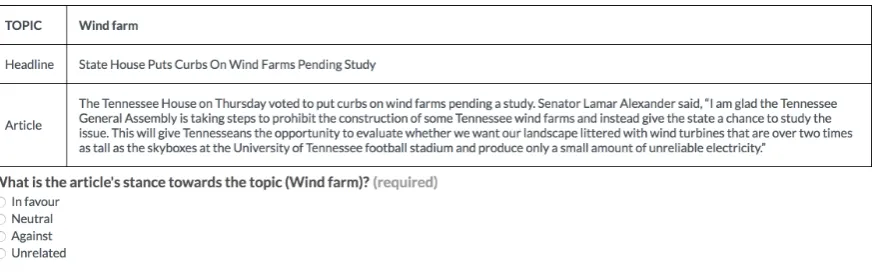
Figure 1: Interface provided to annotators. Annotation instructions are not shown.
3 Dataset
3.1 Task definition
The objective of stance detection in our case is to classify the stance of an author’s news article towards a given topic as ‘in favour’, ‘against’, or ‘neutral’. Our setting differs from previous instan-tiations of stance detection in two ways: a) We focus on excerpts from news articles, which are longer and may be more complex than tweets; and b) we do not aim to classify a news article with re-gard to its agreement with a claim or headline but with regard to its stance towards a topic.
3.2 Data collection
We collect data using the AYLIEN News API2,
which provides search capabilities for news ar-ticles enriched with extracted entities and other metadata. As most extracted entities have a neutral stance or might not be of interest to users, we take steps to compile a curated list of topics, which we detail in the following.
Topics We define a topic to include named entities, but also more abstract, controversial keywords such as ‘gun control’ and ‘abortion’. We compile a diverse list of topics that people are likely to be interested in from several sources: a) We retrieve the top 10 entities with the most mentions in each month from November 2015 to June 2017 and filter out entities that are not locations, persons, or organizations and those that are generally perceived as neutral; b) we manually curate a list of current important political figures; and c) we use DBpedia to retrieve a list of controversial topics. Specifically, we included all of the topics mentioned in the Wikipedia
2https://newsapi.aylien.com/
Topic type # topics Examples
Popular 44 Arsenal F.C., Russia Controversial 300 Abortion, Polygamy Political 22 Ted Cruz, Xi Jinping
[image:2.595.82.519.78.217.2]Total 366
Table 1: Types and numbers of retrieved topics.
list of controversial issues3 and converted
them to DBpedia resource URIs (e.g. http: //en.wikipedia.org/wiki/Abortion
→ http://dbpedia.org/resource/ Abortion) in order to facilitate linking between topics and DBpedia metadata. We then used DBpedia types (Auer et al.,2007) to filter out all entities of type Place, Person and Organisation. Finally, we ranked the remaining topics based on their number of unique outbound edges within the DBpedia graph as a measure of prominence, and picked the top 300. We show the final composition of topics in Table1. For each topic, we retrieve the most relevant articles using the News API from November 2015 to July 2017.
Annotation For annotation, we need to trade-off the complexity and cost of annotation with the agreement between annotators. Annotating en-tire news articles places a large cognitive load on the annotator, which leads to fatigue and inaccu-rate annotations. For this reason, we choose to annotate excerpts from news articles. In internal studies, we found that providing a context win-dow of 2-3 sentences around the mention of the entity together with the headline provides
suffi-3https://en.wikipedia.org/wiki/
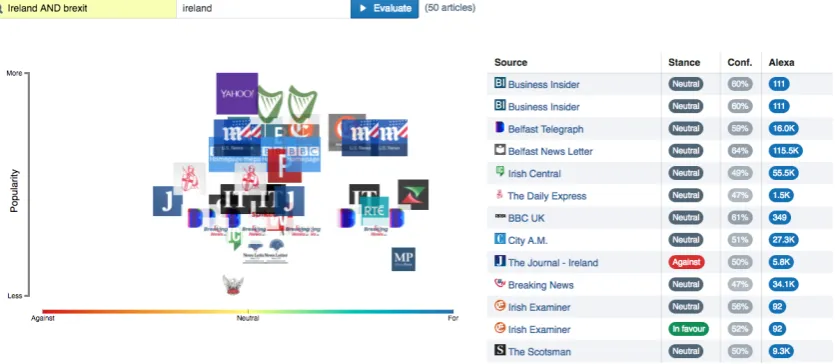
Figure 2: 360° Stance Detection interface. News articles about a query, i.e. ‘Ireland AND brexit’ are visualized based on their stance towards a specified topic, i.e. ‘ireland’ and the prominence of the source. Additional information is provided in a table on the right, which allows to skim article excerpts or follow a link to the source.
cient context to produce a reliable annotation. If the entity is not mentioned explicitly, we provide the first paragraph of the article and the headline as context. We annotate the collected data using CrowdFlower with 3 annotators per example using the interface in Figure1. We retain all examples where at least 2 annotators agree, which amounts to 70.5% of all examples.
Final dataset The final dataset consists of 32,227 pairs of news articles and topics annotated with their stance. In particular, 47.67% examples have been annotated with ‘neutral’, 21.9% with ‘against’, 19.05% with ‘in favour’, and 11.38% with ‘unrelated‘. We use 70% of examples for training, 20% for validation, and 10% for testing according to a stratified split. As we expect to en-counter novel and unknown entities in the wild, we ensure that entities do not overlap across splits and that we only test on unseen entities.
4 Model
We train a Bidirectional Encoding model (Augen-stein et al., 2016), which has achieved state-of-the-art results for Twitter stance detection on our dataset. The model encodes the entity using a
bidi-rectional LSTM (BiLSTM)4, which is then used to
initialize a BiLSTM that encodes the article and produces a prediction. To reduce the sequence length, we use the same context window that was presented to annotators for training the LSTM. We use pretrained GloVe embeddings (Pennington et al., 2014) and tune hyperparameters on a vali-dation set. The best model achieves a test accu-racy of61.7and a macro-averaged test F1 score of 56.9.5 It significantly outperforms baselines such
as a bag-of-n-grams (accuracy:46.3; F1:44.2).
5 360° Stance Detection Demo
The interactive demo interface of 360° Stance Detection, which can be seen in Figure 2, takes two inputs: a news search query, which is used to retrieve news articles using News API, and a stance target topic, which is used as the target of the stance detection model. For good results, the stance target should also be included as a keyword in the news search query. Multiple keywords can be provided as the query by connecting them with
4We tried other encoding strategies, such as averaging
pretrained embeddings, but this performed best.
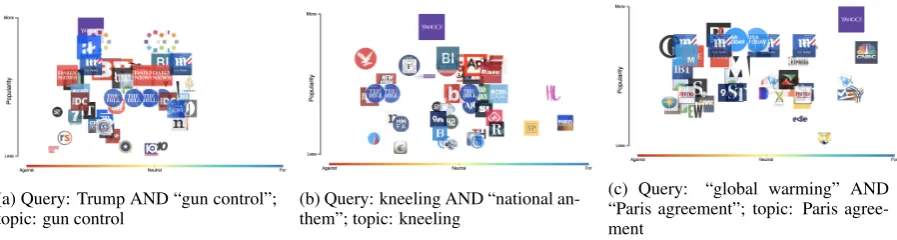
(a) Query: Trump AND “gun control”;
topic: gun control (b) Query: kneeling AND “national an-them”; topic: kneeling
[image:4.595.74.523.65.185.2](c) Query: “global warming” AND “Paris agreement”; topic: Paris agree-ment
[image:4.595.73.292.226.351.2]Figure 3: 360° Stance Detection visualizations for example queries and topics.
Figure 4: Visualization distribution of stance to-wards Donald Trump and number of CNN news articles mentioning Donald Trump from August 2016 to January 2018.
‘AND’ or ‘OR’ as in Figure2.
When these two inputs are provided, the appli-cation retrieves a predefined number of news arti-cles (up to 50) that match the first input, and ana-lyzes their stance towards the target (the second in-put) using the stance detection model. The stance detection model is exposed as a web service and returns for each article-target entity pair a stance label (i.e. one of ‘in favour’, ‘against’ or ‘neutral’) along with a probability.6
The demo then visualizes the collected news ar-ticles as a 2D scatter plot with each (x,y) coordi-nate representing a single news article from a par-ticular outlet that matched the user query. The x-axis shows the stance of the article in the range
[−1,1]. The y-axis displays the prominence of the
news outlet that published the article in the range
[1,1000000], measured by its Alexa ranking7. A
table displays the provided information in a com-plementary format, listing the news outlets of the articles, the stance labels, confidence scores, and
6We leave confidence calibration (Guo et al.,2017) for
future work.
7https://www.alexa.com/
prominence rankings. Excerpts of the articles can be scanned by hovering over the news outlets in the table and the original articles can be read by clicking on the source.
360° Stance Detection is particularly useful to gain an overview of complex or controversial top-ics and to highlight differences in their perception across different outlets. We show visualizations for example queries and three controversial top-ics in Figure 3. By extending the tool to enable retrieval of a larger number of news articles and more fine-grained filtering, we can employ it for general news analysis. For instance, we can high-light the volume and distribution of the stance of news articles from a single news outlet such as CNN towards a specified topic as in Figure4.
6 Conclusion
We have introduced 360° Stance Detection, a tool that aims to provide evidence and context in order to assist the user with forming a balanced opinion towards a controversial topic. It aggregates news with multiple perspectives on a topic, annotates them with their stance, and visualizes them on a spectrum ranging from support to opposition, al-lowing the user to skim excerpts of the articles or read the original source. We hope that this tool will demonstrate how NLP can be used to help combat filter bubbles and fake news and to aid users in obtaining evidence on which they can base their opinions.
Acknowledgments
References
S¨oren Auer, Christian Bizer, Georgi Kobilarov, Jens Lehmann, Richard Cyganiak, and Zachary Ives. 2007. Dbpedia: A nucleus for a web of open data. InThe semantic web, Springer, pages 722–735.
Isabelle Augenstein, Tim Rockt¨aschel, Andreas Vla-chos, and Kalina Bontcheva. 2016. Stance Detec-tion with BidirecDetec-tional CondiDetec-tional Encoding. In
Proceedings of the 2016 Conference on Empirical Methods in Natural Language Processing. http:
//arxiv.org/abs/1606.05464.
Adam Faulkner. 2014. Automated classification of stance in student essays: An approach using stance target information and the wikipedia link-based measure.Science376(12):86.
William Ferreira and Andreas Vlachos. 2016. Emer-gent: a novel data-set for stance classification. In
Proceedings of the 2016 conference of the North American chapter of the association for computa-tional linguistics: Human language technologies. pages 1163–1168.
Chuan Guo, Geoff Pleiss, Yu Sun, and Kilian Q. Wein-berger. 2017. On Calibration of Modern Neural Networks. Proceedings of ICML 2017 http://
arxiv.org/abs/1706.04599.
Kazi Saidul Hasan and Vincent Ng. 2013. Stance classification of ideological debates: Data, mod-els, features, and constraints. In Proceedings of the Sixth International Joint Conference on Natural Language Processing. pages 1348–1356.
Michal Lukasik, Trevor Cohn, and Kalina Bontcheva. 2015. Classifying tweet level judgements of rumours in social media. arXiv preprint arXiv:1506.00468.
Tessa Lyons. 2017. News Feed FYI: Replacing Dis-puted Flags with Related Articles. https://
bit.ly/2BTVuOx.
Saif Mohammad, Svetlana Kiritchenko, Parinaz Sob-hani, Xiaodan Zhu, and Colin Cherry. 2016. Semeval-2016 task 6: Detecting stance in tweets. In
Proceedings of the 10th International Workshop on Semantic Evaluation (SemEval-2016). pages 31–41.
Jeffrey Pennington, Richard Socher, and Christo-pher D. Manning. 2014. Glove: Global Vectors for Word Representation. Proceedings of the 2014 Conference on Empirical Methods in Natural Lan-guage Processing pages 1532–1543. https://
doi.org/10.3115/v1/D14-1162.
Vahed Qazvinian, Emily Rosengren, Dragomir R Radev, and Qiaozhu Mei. 2011. Rumor has it: Iden-tifying misinformation in microblogs. In Proceed-ings of the Conference on Empirical Methods in Nat-ural Language Processing. Association for Compu-tational Linguistics, pages 1589–1599.
Ashwin Rajadesingan and Huan Liu. 2014. Identi-fying users with opposing opinions in twitter de-bates. InInternational conference on social comput-ing, behavioral-cultural modelcomput-ing, and prediction. Springer, pages 153–160.
Marilyn A Walker, Pranav Anand, Robert Abbott, and Ricky Grant. 2012. Stance classification using dia-logic properties of persuasion. InProceedings of the 2012 Conference of the North American Chapter of the Association for Computational Linguistics: Hu-man Language Technologies. Association for Com-putational Linguistics, pages 592–596.
William Yang Wang. 2017. ”Liar , Liar Pants on Fire”: A New Benchmark Dataset for Fake News Detec-tion. InProceedings of the 55th Annual Meeting of the Association for Computational Linguistics (ACL 2017).