Statistical Modality Tagging
from Rule-based Annotations and Crowdsourcing
Vinodkumar Prabhakaran Michael Bloodgood Mona Diab
CS CASL CCLS
Columbia University University of Maryland Columbia University [email protected] [email protected] [email protected]
Bonnie Dorr Lori Levin Christine D. Piatko
CS and UMIACS LTI APL
University of Maryland Carnegie Mellon University Johns Hopkins University [email protected] [email protected] [email protected]
Owen Rambow Benjamin Van Durme
CCLS HLTCOE
Columbia University Johns Hopkins University [email protected] [email protected]
Abstract
We explore training an automatic modality tagger. Modality is the attitude that a speaker might have toward an event or state. One of the main hurdles for training a linguistic tag-ger is gathering training data. This is par-ticularly problematic for training a tagger for modality because modality triggers are sparse for the overwhelming majority of sentences. We investigate an approach to automatically training a modality tagger where we first gath-ered sentences based on a high-recall simple rule-based modality tagger and then provided these sentences to Mechanical Turk annotators for further annotation. We used the resulting set of training data to train a precise modality tagger using a multi-class SVM that delivers good performance.
1 Introduction
Modality is an extra-propositional component of meaning. In John may go to NY, the basic propo-sition is John go to NY and the word may indi-cates modality. Van Der Auwera and Ammann
(2005) define core cases of modality: John must go to NY (epistemic necessity), John might go to NY (epistemic possibility), John has to leave now (deontic necessity) and John may leave now (de-ontic possibility). Many semanticists (e.g. Kratzer (1981), Kratzer (1991), Kaufmann et al. (2006)) de-fine modality as quantification over possible worlds. John might go means that there exist some possi-ble worlds in which John goes. Another view of modality relates more to a speakers attitude toward a proposition (e.g. McShane et al. (2004)).
Modality might be construed broadly to include several types of attitudes that a speaker wants to ex-press towards an event, state or proposition. Modal-ity might indicate factivModal-ity, evidentialModal-ity, or senti-ment (McShane et al., 2004). Factivity is related to whether the speaker wishes to convey his or her be-lief that the propositional content is true or not, i.e., whether it actually obtains in this world or not. It distinguishes things that (the speaker believes) hap-pened from things that he or she desires, plans, or considers merely probable. Evidentiality deals with the source of information and may provide clues to the reliability of the information. Did the speaker
have firsthand knowledge of what he or she is re-porting, or was it hearsay or inferred from indirect evidence? Sentiment deals with a speaker’s positive or negative feelings toward an event, state, or propo-sition.
In this paper, we focus on the following five modalities; we have investigated the belief/factivity modality previously (Diab et al., 2009b; Prab-hakaran et al., 2010), and we leave other modalities to future work.
• Ability:can H do P?
• Effort:does H try to do P?
• Intention:does H intend P?
• Success:does H succeed in P?
• Want:does H want P?
We investigate automatically training a modality tagger by using multi-class Support Vector Ma-chines (SVMs). One of the main hurdles for training a linguistic tagger is gathering training data. This is particularly problematic for training a modality tag-ger because modality trigtag-gers are sparse for the over-whelming majority of the sentences. Baker et al. (2010) created a modality tagger by using a semi-automatic approach for creating rules for a rule-based tagger. A pilot study revealed that it can boost recall well above the naturally occurring proportion of modality without annotated data but with only 60% precision. We investigated an approach where we first gathered sentences based on a simple modal-ity tagger and then provided these sentences to an-notators for further annotation, The resulting anno-tated data also preserved the level of inter-annotator agreement for each example so that learning algo-rithms could take that into account during training. Finally, the resulting set of annotations was used for training a modality tagger using SVMs, which gave a high precision indicating the success of this ap-proach.
Section 2 discusses related work. Section 3 dis-cusses our procedure for gathering training data. Section 4 discusses the machine learning setup and features used to train our modality tagger and presents experiments and results. Section 5 con-cludes and discusses future work.
2 Related Work
Previous related work includes TimeML (Sauri et al., 2006), which involves modality annotation on events, and Factbank (Sauri and Pustejovsky, 2009), where event mentions are marked with degree of fac-tuality. Modality is also important in the detection of uncertainty and hedging. The CoNLL shared task in 2010 (Farkas et al., 2010) deals with automatic de-tection of uncertainty and hedging in Wikipedia and biomedical sentences.
Baker et al. (2010) and Baker et al. (2012) ana-lyze a set of eight modalities which include belief, require and permit, in addition to the five modalities we focus on in this paper. They built a rule-based modality tagger using a semi-automatic approach to create rules. This earlier work differs from the work described in this paper in that the our emphasis is on the creation of an automaticmodality tagger using machine learning techniques. Note that the anno-tation and automatic tagging of the belief modality (i.e., factivity) is described in more detail in (Diab et al., 2009b; Prabhakaran et al., 2010).
There has been a considerable amount of inter-est in modality in the biomedical domain. Negation, uncertainty, and hedging are annotated in the Bio-scope corpus (Vincze et al., 2008), along with infor-mation about which words are in the scope of nega-tion/uncertainty. The i2b2 NLP Shared Task in 2010 included a track for detecting assertion status (e.g. present, absent, possible, conditional, hypothetical etc.) of medical problems in clinical records.1 Apos-tolova et al. (2011) presents a rule-based system for the detection of negation and speculation scopes us-ing the Bioscope corpus. Other studies emphasize the importance of detecting uncertainty in medical text summarization (Morante and Daelemans, 2009; Aramaki et al., 2009).
Modality has also received some attention in the context of certain applications. Earlier work de-scribing the difficulty of correctly translating modal-ity using machine translation includes (Sigurd and Gawr´onska, 1994) and (Murata et al., 2005). Sig-urd et al. (1994) write about rule based frameworks and how using alternate grammatical constructions such as the passive can improve the rendering of the modal in the target language. Murata et al. (2005)
1
analyze the translation of Japanese into English by several systems, showing they often render the present incorrectly as the progressive. The authors trained a support vector machine to specifically han-dle modal constructions, while our modal annotation approach is a part of a full translation system.
The textual entailment literature includes modal-ity annotation schemes. Identifying modalities is important to determine whether a text entails a hy-pothesis. Bar-Haim et al. (2007) include polarity based rules and negation and modality annotation rules. The polarity rules are based on an indepen-dent polarity lexicon (Nairn et al., 2006). The an-notation rules for negation and modality of predi-cates are based on identifying modal verbs, as well as conditional sentences and modal adverbials. The authors read the modality off parse trees directly us-ing simple structural rules for modifiers.
3 Constructing Modality Training Data
In this section, we will discuss the procedure we followed to construct the training data for build-ing the automatic modality tagger. In a pilot study, we obtained and ran the modality tagger described in (Baker et al., 2010) on the English side of the Urdu-English LDC language pack.2 We randomly selected 1997 sentences that the tagger had labeled as not having the Want modality and posted them on Amazon Mechanical Turk (MTurk). Three differ-ent Turkers (MTurk annotators) marked, for each of the sentences, whether it contained the Want modal-ity. Using majority rules as the Turker judgment, 95 (i.e., 4.76%) of these sentences were marked as having a Want modality. We also posted 1993 sen-tences that the tagger had labeled as having a Want modality and only 1238 of them were marked by the Turkers as having a Want modality. Therefore, the estimated precision of this type of approach is only around 60%.
Hence, we will not be able to use the (Baker et al., 2010) tagger to gather training data. Instead, our approach was to apply a simple tagger as a first pass, with positive examples subsequently hand-annotated using MTurk. We made use of sentence data from the Enron email corpus,3derived from the
2
LDC Catalog No.: LDC2006E110.
3http://www-2.cs.cmu.edu/∼enron/
version owing to Fiore and Heer,4further processed as described by (Roark, 2009).5
To construct the simple tagger (the first pass), we used a lexicon of modality trigger words (e.g., try, plan, aim, wish, want) constructed by Baker et al. (2010). The tagger essentially tags each sentence that has a word in the lexicon with the corresponding modality. We wrote a few simple obvious filters for a handful of exceptional cases that arise due to the fact that our sentences are from e-mail. For example, we filtered outbest wishesexpressions, which otherwise would have been tagged asWantbecause of the word wishes.
The words that trigger modality occur with very different frequencies. If one is not careful, the training data may be dominated by only the com-monly occurring trigger words and the learned tag-ger would then be biased towards these words. In order to ensure that our training data had a diverse set of examples containing many lexical triggers and not just a lot of examples with the same lexical trig-ger, for each modality we capped the number of sen-tences from a single trigger to be at most 50. After we had the set of sentences selected by the simple tagger, we posted them on MTurk for annotation.
The Turkers were asked to check a box indicat-ing that the modality was not present in the sentence if the given modality was not expressed. If they did not check that box, then they were asked to highlight the target of the modality. Table 1 shows the number of sentences we posted on MTurk for each modal-ity.6 Three Turkers annotated each sentence. We restricted the task to Turkers who were adults, had greater than a 95% approval rating, and had com-pleted at least 50 HITs (Human Intelligence Tasks) on MTurk. We paid US$0.10 for each set of ten sen-tences.
Since our data was annotated by three Turkers, for training data we used only those examples for which at least two Turkers agreed on the modality and the target of the modality. This resulted in 1,008 examples. 674 examples had two Turkers agreeing and 334 had unanimous agreement. We kept track of the level of agreement for each example so that
4
http://bailando.sims.berkeley.edu/enron/enron.sql.gz
5Data received through personal communication
6More detailed statistics on MTurk annotations are available
Modality Count
Ability 190
Effort 1350
Intention 1320 Success 1160
[image:4.612.360.494.54.163.2]Want 1390
Table 1: For each modality, the number of sentences re-turned by the simple tagger that we posted on MTurk.
our learner could weight the examples differently depending on the level of inter-annotator agreement.
4 Multiclass SVM for Modality
In this section, we describe the automatic modal-ity tagger we built using the MTurk annotations de-scribed in Section 3 as the training data. Section 4.1 describes the training and evaluation data. In Sec-tion 4.2, we present the machinery and SecSec-tion 4.3 describes the features we used to train the tagger. In Section 4.4, we present various experiments and discuss results. Section 4.5, presents additional ex-periments using annotator confidence.
4.1 Data
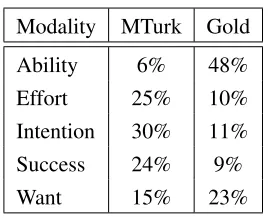
For training, we used the data presented in Section 3. We refer to it as MTurk data in the rest of this paper. For evaluation, we selected a part of the LU Corpus (Diab et al., 2009a) (1228 sentences) and our expert annotated it with modality tags. We first used the high-recall simple modality tagger described in Sec-tion 3 to select the sentences with modalities. Out of the 235 sentences returned by the simple modal-ity tagger, our expert removed the ones which did not in fact have a modality. In the remaining sen-tences (94 sensen-tences), our expert annotated the tar-get predicate. We refer to this as the Gold dataset in this paper. The MTurk and Gold datasets differ in terms of genres as well as annotators (Turker vs. Ex-pert). The distribution of modalities in both MTurk and Gold annotations are given in Table 2.
4.2 Approach
We applied a supervised learning framework us-ing multi-class SVMs to automatically learn to tag
Modality MTurk Gold
Ability 6% 48%
Effort 25% 10%
Intention 30% 11%
Success 24% 9%
[image:4.612.140.233.54.161.2]Want 15% 23%
Table 2: Frequency of Modalities
modalities in context. For tagging, we used the Yam-cha (Kudo and Matsumoto, 2003) sequence labeling system which uses the SVMlight (Joachims, 1999) package for classification. We usedOne versus All method for multi-class classification on a quadratic kernel with a C value of 1. We report recall and pre-cision on word tokens in our corpus for each modal-ity. We also report Fβ=1 (F)-measure as the har-monic mean between (P)recision and (R)ecall.
4.3 Features
We used lexical features at the token level which can be extracted without any parsing with relatively high accuracy. We use the term context width to denote the window of tokens whose features are considered for predicting the tag for a given token. For example, a context width of 2 means that the feature vector of any given token includes, in addition to its own features, those of 2 tokens before and after it as well as the tag prediction for 2 tokens before it. We did experiments varying the context width from 1to 5
and found that a context width of2gives the optimal performance. All results reported in this paper are obtained with a context width of2. For each token, we performed experiments using following lexical features:
• wordStem- Word stem.
• wordLemma- Word lemma.
• POS- Word’s POS tag.
• isNumeric- Word is Numeric?
• verbType- Modal/Auxiliary/Regular/Nil
We used the Porter stemmer (Porter, 1997) to ob-tain the stem of a word token. To determine the word lemma, we used an in-house lemmatizer using dictionary and morphological analysis to obtain the dictionary form of a word. We obtained POS tags from Stanford POS tagger and used those tags to determine verbTypeandwhichModalfeatures. The verbTypefeature is assigned a value ‘Nil’ if the word is not a verb and whichModalfeature is assigned a value ‘Nil’ if the word is not a modal verb. The fea-tureisNumericis a binary feature denoting whether the token contains only digits or not.
4.4 Experiments and Results
In this section, we present experiments performed considering all the MTurk annotations where two annotators agreed and all the MTurk annotations where all three annotators agreed to be equally cor-rect annotations. We present experiments applying differential weights for these annotations in Section 4.5. We performed 4-fold cross validation (4FCV) on MTurk data in order to select the best feature set configuration φ. The best feature set obtained
waswordStem, P OS, whichM odalwith a context
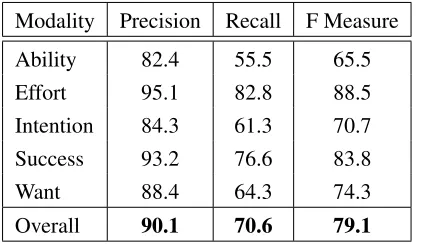
width of 2. For finding the best performing fea-ture set - context width configuration, we did an ex-haustive search on the feature space, pruning away features which were proven not useful by results at stages. Table 3 presents results obtained for each modality on 4-fold cross validation.
Modality Precision Recall F Measure
Ability 82.4 55.5 65.5
Effort 95.1 82.8 88.5
Intention 84.3 61.3 70.7
Success 93.2 76.6 83.8
Want 88.4 64.3 74.3
[image:5.612.82.293.477.599.2]Overall 90.1 70.6 79.1
Table 3: Per modality results for best feature set φon 4-fold cross validation on MTurk data
We also trained a model on the entire MTurk data using the best feature setφand evaluated it against the Gold data. The results obtained for each modal-ity on gold evaluation are given in Table 4. We at-tribute the lower performance on the Gold dataset to
its difference from MTurk data. MTurk data is en-tirely from email threads, whereas Gold data con-tained sentences from newswire, letters and blogs in addition to emails. Furthermore, the annotation is different (Turkers vs expert). Finally, the distri-bution of modalities in both datasets is very differ-ent. For example,Abilitymodality was merely 6% of MTurk data compared to 48% in Gold data (see Table 2).
Modality Precision Recall F Measure
Ability 78.6 22.0 34.4
Effort 85.7 60.0 70.6
Intention 66.7 16.7 26.7
Success NA 0.0 NA
Want 92.3 50.0 64.9
Overall 72.1 29.5 41.9
Table 4: Per modality results for best feature setφ evalu-ated on Gold dataset
We obtained reasonable performances for Effort andWantmodalities while the performance for other modalities was rather low. Also, the Gold dataset contained only 8 instances ofSuccess, none of which was recognized by the tagger resulting in a recall of 0%. Precision (and, accordingly, F Measure) for Successwas considered “not applicable” (NA), as no such tag was assigned.
4.5 Annotation Confidence Experiments
Our MTurk data contains sentence for which at least two of the three Turkers agreed on the modality and the target of the modality. In this section, we investi-gate the role of annotation confidence in training an automatic tagger. The annotation confidence is de-noted by whether an annotation was agreed by only two annotators or was unanimous. We denote the set of sentences for which only two annotators agreed as
Agr2 and that for which all three annotators agreed asAgr3.
We present four training setups. The first setup is T r23 where we train a model using both Agr2 andAgr3 with equal weights. This is the setup we used for results presented in the Section 4.4. Then, we have T r2 andT r3, where we train using only
TrainingSetup Tested onAgr2 andAgr3 Tested onAgr3only Precision Recall F Measure Precision Recall F Measure
T r23 90.1 70.6 79.1 95.9 86.8 91.1
T r2 91.0 66.1 76.5 95.6 81.8 88.2
T r3 88.1 52.3 65.6 96.8 71.7 82.3
[image:6.612.119.497.57.161.2]T r23W 89.9 70.5 79.0 95.8 86.5 90.9
Table 5: Annotator Confidence Experiment Results; the best results per column are boldfaced (4-fold cross validation on MTurk Data)
train a model giving different cost values forAgr2 and Agr3 examples. The SVMLight package al-lows users to input cost valuesci for each training
instance separately.7 We tuned this cost value for
Agr2 andAgr3 examples and found the best value at20and30respectively.
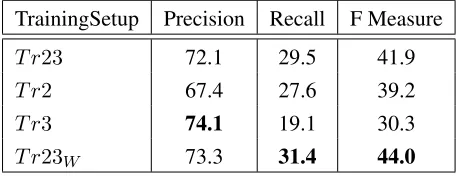
For all four setups, we used feature setφ. We per-formed4-fold cross validation on MTurk data in two ways — we tested against a combination of Agr2 andAgr3, and we tested against onlyAgr3. Results of these experiments are presented in Table 5. We also present the results of evaluating a tagger trained on the whole MTurk data for each setup against the Gold annotation in Table 6. TheT r23tested on both
Agr2andAgr3presented in Table 5 andT r23tested on Gold data presented in Table 6 correspond to the results presented in Table 3 and Table 4 respectively.
TrainingSetup Precision Recall F Measure
T r23 72.1 29.5 41.9
T r2 67.4 27.6 39.2
T r3 74.1 19.1 30.3
T r23W 73.3 31.4 44.0
Table 6: Annotator Confidence Experiment Results; the best results per column are boldfaced
(Evaluation against Gold)
One main observation is that including annota-tions of lower agreement, but still above a threshold (in our case, 66.7%), is definitely helpful.T r23 out-performed bothT r2 andT r3 in both recall and
F-7
This can be done by specifying ‘cost:<value>’ after the label in each training instance. This feature has not yet been documented on the SVMlight website.
measure in all evaluations. Also, even when evaluat-ing against only the high confidentAgr3cases,T r2 gave a high gain in recall (10 .1 percentage points) overT r3, with only a 1.2 percentage point loss on precision. We conjecture that this is because there are far more training instances inT r2than in T r3
(674 vs 334), and that quantity beats quality. Another important observation is the increase in performance by using varied costs for Agr2 and
Agr3 examples (the T r23W condition). Although
it dropped the performance by 0.1 to 0.2 points in cross-validation F measure on the Enron cor-pora, it gained 2.1 points in Gold evaluation F mea-sure. These results seem to indicate that differential weighting based on annotator agreement might have more beneficial impact when training a model that will be applied to a wide range of genres than when training a model with genre-specific data for appli-cation to data from the same genre. Put differently, using varied costs prevents genre over-fitting. We don’t have a full explanation for this difference in behavior yet. We plan to explore this in future work.
5 Conclusion
[image:6.612.71.299.462.550.2]not covered in this study.
6 Acknowledgments
This work is supported, in part, by the Johns Hop-kins Human Language Technology Center of Ex-cellence. Any opinions, findings, and conclusions or recommendations expressed in this material are those of the authors and do not necessarily reflect the views of the sponsor. We thank several anony-mous reviewers for their constructive feedback.
References
Emilia Apostolova, Noriko Tomuro, and Dina Demner-Fushman. 2011. Automatic extraction of lexico-syntactic patterns for detection of negation and spec-ulation scopes. In Proceedings of the 49th Annual Meeting of the Association for Computational Linguistics: Human Language Technologies: short papers -Volume 2, HLT ’11, pages 283–287, Portland, Oregon.
Eiji Aramaki, Yasuhide Miura, Masatsugu Tonoike, Tomoko Ohkuma, Hiroshi Mashuichi, and Kazuhiko Ohe. 2009. Text2table: Medical text summarization system based on named entity recognition and modal-ity identification. InProceedings of the BioNLP 2009 Workshop, pages 185–192, Boulder, Colorado, June. Association for Computational Linguistics.
Kathryn Baker, Michael Bloodgood, Bonnie J. Dorr, Nathaniel W. Filardo, Lori S. Levin, and Christine D. Piatko. 2010. A modality lexicon and its use in auto-matic tagging. InLREC.
Kathryn Baker, Michael Bloodgood, Bonnie J. Dorr, Chris Callison-Burch, Nathaniel W. Filardo, Christine Piatko, Lori Levin, and Scott Miller. 2012. Use of modality and negation in semantically-informed syn-tactic mt.Computational Linguistics, 38(22).
Roy Bar-Haim, Ido Dagan, Iddo Greental, and Eyal Shnarch. 2007. Semantic inference at the lexical-syntactic level. In Proceedings of the 22nd Na-tional Conference on Artificial intelligence - Volume 1, pages 871–876, Vancouver, British Columbia, Canada. AAAI Press.
Mona Diab, Bonnie Dorr, Lori Levin, Teruko Mitamura, Rebecca Passonneau, Owen Rambow, and Lance Ramshaw. 2009a. Language Understanding Anno-tation Corpus. Linguistic Data Consortium (LDC), USA.
Mona Diab, Lori Levin, Teruko Mitamura, Owen Ram-bow, Vinodkumar Prabhakaran, and Weiwei Guo. 2009b. Committed belief annotation and tagging. In
Proceedings of the Third Linguistic Annotation Work-shop, pages 68–73, Suntec, Singapore, August. Asso-ciation for Computational Linguistics.
Rich´ard Farkas, Veronika Vincze, Gy¨orgy Szarvas, Gy¨orgy M´ora, and J´anos Csirik, editors. 2010. Pro-ceedings of the Fourteenth Conference on Computa-tional Natural Language Learning. Association for Computational Linguistics, Uppsala, Sweden, July. Thorsten Joachims, 1999. Making large-scale support
vector machine learning practical, pages 169–184. MIT Press, Cambridge, MA, USA.
Stefan Kaufmann, Cleo Condoravdi, and Valentina Harizanov, 2006. Formal Approaches to Modality, pages 72–106. Mouton de Gruyter.
Angelika Kratzer. 1981. The Notional Category of Modality. In H. J. Eikmeyer and H. Rieser, editors,
Words, Worlds, and Contexts, pages 38–74. de Gruyter, Berlin.
Angelika Kratzer. 1991. Modality. In Arnim von Ste-chow and Dieter Wunderlich, editors, Semantics: An International Handbook of Contemporary Research. de Gruyter.
Taku Kudo and Yuji Matsumoto. 2003. Fast methods for kernel-based text analysis. In41st Meeting of the Association for Computational Linguistics (ACL’03), Sapporo, Japan.
Marjorie McShane, Sergei Nirenburg, and Ron Zacharsky. 2004. Mood and modality: Out of the theory and into the fray. Natural Language Engineering, 19(1):57–89.
Roser Morante and Walter Daelemans. 2009. Learn-ing the scope of hedge cues in biomedical texts. In
Proceedings of the BioNLP 2009 Workshop, pages 28– 36, Boulder, Colorado, June. Association for Compu-tational Linguistics.
Masaki Murata, Kiyotaka Uchimoto, Qing Ma, Toshiyuki Kanamaru, and Hitoshi Isahara. 2005. Analysis of machine translation systems’ errors in tense, aspect, and modality. InProceedings of the 19th Asia-Pacific Conference on Language, Information and Computa-tion (PACLIC), Tapei.
Rowan Nairn, Cleo Condorovdi, and Lauri Karttunen. 2006. Computing relative polarity for textual infer-ence. InProceedings of the International Workshop on Inference in Computational Semantics, ICoS-5, pages 66–76, Buxton, England.
M. F. Porter, 1997. An algorithm for suffix stripping, pages 313–316. Morgan Kaufmann Publishers Inc., San Francisco, CA, USA.
Brian Roark. 2009. Open vocabulary language model-ing for binary response typmodel-ing interfaces. Technical report, Oregon Health and Science University. Roser Sauri and James Pustejovsky. 2009. Factbank:
a corpus annotated with event factuality. Language Resources and Evaluation, 43(3):227–268.
Roser Sauri, Marc Verhagen, and James Pustejovsky. 2006. Annotating and recognizing event modality in text. InFLAIRS Conference, pages 333–339.
Bengt Sigurd and Barbara Gawr´onska. 1994. Modals as a problem for MT. InProceedings of the 15th In-ternational Conference on Computational Linguistics (COLING) Volume 1, COLING ’94, pages 120–124, Kyoto, Japan.
Johan Van Der Auwera and Andreas Ammann, 2005.
Overlap between situational and epistemic modal marking, chapter 76, pages 310–313. Oxford Univer-sity Press.