Tree Kernel-based Negation and Speculation Scope Detection with
Structured Syntactic Parse Features
Bowei Zou Guodong Zhou Qiaoming Zhu*
Natural Language Processing Lab, School of Computer Science and Technology Soochow University, Suzhou, 215006, China
[email protected], {gdzhou,qmzhu}@suda.edu.cn
Abstract
Scope detection is a key task in information ex-traction. This paper proposes a new approach for tree kernel-based scope detection by using the structured syntactic parse information. In addi-tion, we have explored the way of selecting compatible features for different part-of-speech cues. Experiments on the BioScope corpus show that both constituent and dependency structured syntactic parse features have the advantage in capturing the potential relationships between cues and their scopes. Compared with the state of the art scope detection systems, our system achieves substantial improvement.*
1 Introduction
The task of scope detection is to detect the linguis-tic scope dominated by a specific cue. Current re-searches in this field focus on two semantic as-pects: negation and speculation. The negative scope detection is to detect the linguistic scope which is repudiated by a negative word (viz., nega-tive cue, e.g., “not”). In other side, the speculative
scope detection is to detect the uncertain part in a sentence corresponding to the speculative word (viz., speculative cue, e.g., “seems”). See the
sen-tence 1) below, the negative cue “not” dominates
the scope of “not expensive”. Similarly, the
specu-lative cue “possible” in sentence 2) dominates the
uncertain scope “the possible future scenarios”. 1) The chair is [not expensive] but comfortable.
2) Considering all that we have seen, what are now
[the possible future scenarios]?
* Corresponding author
The negative and speculative scope detection task consists of two basic stages. The first one is to identify the sentences involving negative or specu-lative meaning. The second stage is to detect the linguistic scope of the cue in sentences (Velldal et al, 2012). In this paper, we focus on the second stage. That is, by given golden cues, we detect their linguistic scopes.
We propose a tree kernel-based negation and speculation scope detection with structured syntac-tic parse features. In detail, we regard the scope detection task as a binary classification issue, which is to classify the tokens in a sentence as be-ing inside or outside the scope. In the basic framework, we focus on the analysis and applica-tion of structured syntactic parse features as fol-lows:
Both constituent and dependency syntactic fea-tures have been proved to be effective in scope detection (Özgür et al, 2009; Øvrelid et al, 2010). However, these flat features are hardly to reflect the information implicit in syntactic parse tree structures. Our intuition is that the segments of the syntactic parse tree around a negative or specula-tive cue is effecspecula-tive for scope detection. The relat-ed structures normally underlay the indirect clues to identify the relations between cues and their scopes, e.g., in sentence 1), “but something”, as a
frequently co-occurred syntactic structure with “not something”, is an effective clue to determine
the linguistic scope of “not”.
The tree kernel classifier (Moschitti, 2006) based on support vector machines uses a kernel function between two trees, affording a compari-son between their substructures. Therefore, a tree kernel-based scope detection approach with struc-tured syntactic parse tree is employed. The tree
kernel has been already proved to be effective in semantic role labeling (Che et al, 2006) and rela-tion extracrela-tion (Zhou et al, 2007).
In addition, the empirical observation shows that features have imbalanced efficiency for scope classification, which is normally affected by the part-of-speech (abbr., POS) of cues. Hence, we build the discriminative classifiers for each kind of POS of cues, then explore and select the most compatible features for them.
We construct a scope detection system by using the structured syntactic parse features based tree kernel classification. Compared with the state of the art scope detection systems, our system achieves the performance of accuracy 76.90% on negation and 84.21% on speculation (on Abstracts sub-corpus). Additionally, we test our system on different sub-corpus (Clinical Reports and Full Papers). The results show that our approach has better cross-domain performance.
The rest of this paper is organized as follows: Section 2 reviews related work. Section 3 intro-duces the corpus and corresponding usage in our experiments. Section 4 describes our approach and the experiments are presented in Section 5. Finally, there is a conclusion in Section 6.
2 Related Work
Most of the previous studies on negation and spec-ulation scope detection task can be divided into two main aspects: the heuristic rule based methods and the machine learning based methods. We re-spectively introduce the aspects in below.
2.1 Heuristic Rule based Methods
The initial studies for scope detection are to com-pile effective heuristic rules (Chapman et al, 2001; Goldin et al, 2003). Recently, the heuristic rule based methods have further involved the syntactic features.
Huang et al (2007) implemented a hybrid ap-proach to automated negation scope detection. They combined the regular expression matching with grammatical parsing: negations are classified on the basis of syntactic categories and located in parse trees. Their hybrid approach is able to identi-fy negated concepts in radiology reports even when they are located at some distance from the negative term.
Özgür et al (2009) hypothesized that the scope of a speculation cue can be characterized by its part-of-speech and the syntactic structure of the sentence and developed rules to map the scope of a cue to the nodes in the syntactic parse tree. By given golden speculation cues, their rule-based method achieves the accuracies of 79.89% and 61.13% on the Abstracts and the Full-Papers sub-corpus, respectively.
Øvrelid et al (2010) constructed a small set of heuristic rules which define the scope for each cue. In developing these rules, they made use of the information provided by the guidelines for scope annotation in the BioScope corpus, combined with manual inspection of the training data in order to further generalize over the phenomena discussed by Vincze et al (2008) and work out interactions of constructions for various types of cues.
Apostolova et al (2011) presented a linguistical-ly motivated rule-based system for the detection of negation and speculation scopes that performs on par with state-of-the-art machine learning systems. The rules are automatically extracted from the Bi-oScope corpus and encode lexico-syntactic pat-terns in a user-friendly format. While their system was developed and tested using a biomedical cor-pus, the rule extraction mechanism is not domain-specific.
The heuristic rule based methods have bad ro-bustness in detecting scopes crossing different meaning aspects (e.g., negative vs. speculative) and crossing different linguistic resources (e.g., Technical Papers vs. Clinical Reports).
2.2 Machine Learning based Methods
The machine learning based methods have been ignored until the release of the BioScope corpus (Szarvas et al, 2008), where the large-scale data of manually annotated cues and corresponding scopes can support machine learning well.
Morante et al (2008) formulated scope detection as a chunk classification problem. It is worth not-ing that they also proposed an effective proper post-processing approach to ensure the consecu-tiveness of scope. Then, for further improving the scope detection, Morante et al (2009a) applied a meta-learner that uses the predictions of the three classifiers (TiMBL/SVM/CRF) to predict the scope.
memory-based classifier based on the k-nearest neighbor rule to determine if a token is the first token in a scope sequence, the last, or neither. Therefore, in order to guarantee that all scopes are continuous sequences of tokens they apply a first post-processing step that builds the sequence of scope.
The existing machine learning based approaches substantially improve the robustness of scope de-tection, and have nearly 80% accuracy. However, the approaches ignore the availability of the struc-tured syntactic parse information. This information involves more clues which can well reflect the re-lations between cues and scopes. Sánchez et al (2010) employed a tree kernel based classifier with CCG structures to identify speculative sentences on Wikipedia dataset. However, in Sánchez’s ap-proach, not all sentences are covered by the classi-fier.
3 Corpus
We have employed the BioScope corpus (Szarvas et al, 2008; Vincze et al, 2008)1, an open resource
from the biomedical domain, as the benchmark corpus. The corpus contains annotations at the to-ken level for negative and speculative cues and at the sentence level for their linguistic scope (as shown in Figure 1).
(Note: <Sentence> denotes one sentence and the tag “id” denotes its serial number; <xcope> denotes the scope of a cue; <cue> denotes the cue, the tag “type” denotes the specific kind of cues and the tag “ref” is the cue’s serial number.)
Figure 1. An annotated sentence in BioScope. The BioScope corpus consists of three sub-corpora: biological Full Papers from FlyBase and BMC Bioinformatics, biological paper Abstracts from the GENIA corpus (Collier et al, 1999), and Clinical Reports. Among them, the Full Papers sub-corpus and the Abstracts sub-corpus come from the same genre. In comparison, the Clinical Reports sub-corpus consists of clinical radiology reports with short sentences.
1 http://www.inf.u-szeged.hu/rgai/bioscope
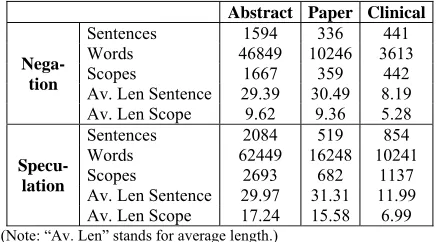
In our experiments, if there is more than one cue in a sentence, we treat them as different cue and scope (two independent instances). The statistical data for our corpus is presented in Table 1 in be-low.
The average length of sentences in the negation portion is almost as long as that in speculation, while the average length of scope in negation is shorter than that in speculation. In addition, the length of sentence and scope in both Abstracts and Full Papers sub-corpora is comparative. But in Clinical Reports sub-corpus, it is shorter than that in Abstracts and Full Papers. Thus, looking for the effective features in short sentences is especially important for improving the robustness for scope detection.
[image:3.612.314.533.283.404.2](Note: “Av. Len” stands for average length.)
Table 1. Statistics for our corpus in BioScope.
4 Methodology
We regard the scope detection task as a binary classification problem, which is to classify each token in sentence as being the element of the scope or not. Under this framework, we describe the flat syntactic features and employ them in our bench-mark system. Then, we propose a tree kernel-based scope detection approach using the struc-tured syntactic parse features. Finally, we con-struct the discriminative classifier for each kind of POS of cues, and select the most compatible fea-tures for each classifier.
4.1 Flat Syntactic Features
In our benchmark classification system, the fea-tures relevant to the cues or tokens are selected. Then, we have explored the constituent and de-pendency syntactic features for scope detection. These features are all flat ones which reflect the characteristic of tokens, cues, scopes, and the rela-tion between them.
Abstract Paper Clinical
Nega-tion
Sentences 1594 336 441
Words 46849 10246 3613
Scopes 1667 359 442
Av. Len Sentence 29.39 30.49 8.19 Av. Len Scope 9.62 9.36 5.28
Specu-lation
Sentences 2084 519 854
Words 62449 16248 10241
Scopes 2693 682 1137
Av. Len Sentence 29.97 31.31 11.99 Av. Len Scope 17.24 15.58 6.99
<sentence id=”S26.8”> These findings <xcope id=”X26.8.2”> <cue type=”speculation” ref=”X26.8.2”> indicate that </cue>
Basic Features: Table 2 shows the basic fea-tures which directly relate to the characteristic of cues or tokens in our basic classification.
Feature Remark B1 Cue.
B2 Candidate token.
B3 Part-of-speech of candidate token. B4 Left token of candidate token. B5 Right token of candidate token.
B6 Positional relation between cue and token.
Table 2. Basic features.
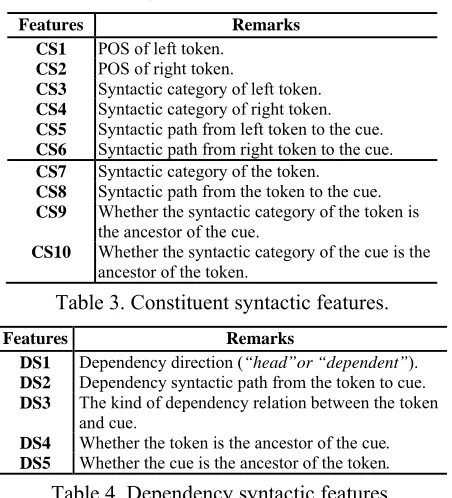
Constituent Syntactic Features: For improv-ing the basic classification, we employ 10 constit-uent features belonging to two aspects. On the one hand, we regard the linguistic information of the neighbor locating around the candidate tokens as the coherent features (CS1~CS6 in Table 3). These features are used for detecting the close coopera-tion of a candidate token co-occurring with its neighbors in a scope. On the other hand, we regard the linguistic characteristics of the candidate to-kens themselves in a syntactic tree as the inherent features (CS7~CS10 in Table 3). These features are used for determining whether the token has the direct relationship with the cue or not.
Features Remarks CS1 POS of left token.
CS2 POS of right token.
CS3 Syntactic category of left token. CS4 Syntactic category of right token. CS5 Syntactic path from left token to the cue. CS6 Syntactic path from right token to the cue. CS7 Syntactic category of the token.
CS8 Syntactic path from the token to the cue. CS9 Whether the syntactic category of the token is
the ancestor of the cue.
CS10 Whether the syntactic category of the cue is the
[image:4.612.88.287.121.202.2]ancestor of the token.
Table 3. Constituent syntactic features.
Features Remarks DS1 Dependency direction (“head”or “dependent”).
DS2 Dependency syntactic path from the token to cue. DS3 The kind of dependency relation between the token
and cue.
DS4 Whether the token is the ancestor of the cue.
DS5 Whether the cue is the ancestor of the token. Table 4. Dependency syntactic features.
Dependency Syntactic Features: For the effec-tiveness to obtain the syntactic information far apart from cues, we use 5 dependency syntactic features which emphasize the dominant
relation-ship between cues and tokens by dependency arcs as shown in Table 4.
The features in Table 2, 3, and 4 have imbal-anced classification for the scope classification. Therefore, we adopt the greedy feature selection algorithm as described in Jiang et al (2006) to pick up positive features incrementally according to their contributions. The algorithm repeatedly se-lects one feature each time, which contributes most, and stops when adding any of the remaining fea-tures fails to improve the performance.
4.2 Structured Syntactic Features
Syntactic trees involve not only the direct bridge (e.g., syntactic path) between cue and its scope but also the related structures to support the bridge (e.g., sub-tree). The related structures normally involve implicit clues which underlay the relation between cue and its scope. Therefore, we use the constituent and dependency syntactic structures as the supplementary features to further improve the benchmark system.
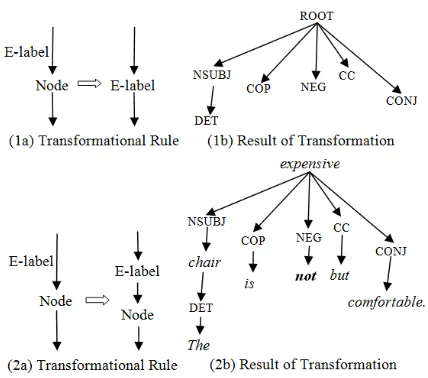
Furthermore, we employ the tree kernel-based classifier to capture the structured information both in constituent and dependency parsing trees. The results of the constituent syntactic parser are typical trees which always consist of the syntactic category nodes and the terminal nodes. Thus, the constituent syntactic tree structures could be used in tree kernel-based classifier directly, but not for the dependency syntactic tree structures. As Figure 2 shows, in sentence “The chair is not expensive
but comfortable.” the tree kernels cannot represent
the relations on the arcs (e.g., “CONJ” between
“expensive” and “comfortable”). It is hard to use
[image:4.612.77.303.391.640.2]the relations between tokens and cues in tree ker-nels.
Figure 2: The dependency tree of sentence “The
[image:4.612.323.522.543.658.2]Figure 3. Two transformational rules. To solve the problem, we transform the depend-ency tree into other two forms capable of being used directly as the compatible features in tree-kernel based classification. The transformational rules are described as below:
(1) Extracting the dependency relations to gen-erate a tree of pure relations (named dependency relational frame), where the tokens on the nodes of original dependency tree are ignored and only the relation labels are used. E.g., the tokens “chair”,
“is”, etc in Figure 2 are all deleted and replaced by
the corresponding relation labels. E.g., “NSUBJ”, “COP”, etc are used as nodes in the dependency relational frame, see (1a) & (1b) in Figure 3.
(2) Inserting the tokens which have been deleted in step (1) into the dependency relational frame and making them follow and link with their origi-nal dependency relations. E.g., the tokens “chair”,
“is”, etc are added below the nodes “NSUBJ”,
[image:5.612.92.299.544.646.2]“COP”, etc, see (2a) & (2b) in Figure 3.
Figure 4. Two transformations for tree-kernel. Within the constituent and dependency syntactic trees, we have employed both the Completed Sub-Tree and the Critical Path as the syntactic structure
features for our classification. The former is a min-imum sub-tree that involves the cues and the to-kens, while the latter is the path from the cues to the tokens in the completed tree containing the primary structural information. Figure 4 shows them.
4.3 Part-of-Speech Based Classification Op-timization
Motivating in part by the rule-based approach of Özgür et al (2009), we infer that features have im-balanced efficiency for scope classification, nor-mally affected by the part-of-speech (POS) of cues.
POS of Cues Number POS of Cues Number CC 157 VB 31
IN 115 VBD 131
JJ 238 VBG 225
MD 733 VBN 112 NN 43 VBP 561 RB 137 VBZ 207
Table 5. Distribution of different POSs of specula-tive cues in Abstracts sub-corpus.
Table 5 shows the distribution for different POSs of cues in the Abstracts sub-corpus of Bio-Scope for speculation detection task. The cues of different POS usually undertake different syntactic roles. Thus, there are different characteristics in triggering linguistic scopes. See the two examples below:
3) TCF-1 contained a single DNA box in the [putative
mammalian sex-determining gene SRY].
4) The circadian rhythm of plasma cortisol [either
disappeared or was inverted].
The speculative cue “putative” in sentence 3) is
an adjective. The corresponding scope is its modi-ficatory structure (“putative mammalian
sex-determining gene SRY”). In sentence 4), “
ei-ther…or…” is a conjunction speculation cue. Its
scope is the two connected components (“either
disappeared or was inverted”). Thus, the effective
features for the adjectival cue are normally the de-pendency features, e.g., the features of DS1 and DS5 in Table 4, while the features for the conjunc-tion cue are normally the constituent informaconjunc-tion, e.g., the features of CS9 in Table 3.
In Table 5, considering the different function of verb voice, we cannot combine the “VB(*)” POS. For instance, the POS of “suggest” in sentence 5)
The POS of “suggested” in sentence 6) is “VBN”
(the past participle). The scope involves the sub-ject “An age-related decrease”.
5) These results [suggest that the genes might be
in-volved in terminal granulocyte differentiation].
6) [An age-related decrease was suggested between subjects younger than 20 years].
As a result, we have built a discriminative clas-sifier for each kind of POS of cues, and then ex-plored and selected the most compatible features for each classifier.
5 Experiments and Results
5.1 Experimental Setting
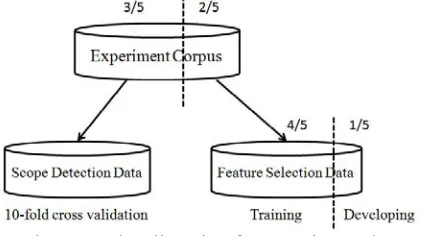
Considering the effectiveness of different features, we have split the Abstracts sub-corpus into 5 equal parts, within which 2 parts are used for feature selection (Feature Selection Data) and the rest for the scope detection experiments (Scope Detection Data). The Feature Selection Data are divided into 5 equal parts, within which 4 parts for training and the rest for developing. In our scope detection ex-periments, we divide the Scope Detection Data into 10 folds randomly, so as to perform 10-fold cross validation. As the experiment data is easily confusable, Figure 5 illustrates the allocation.
[image:6.612.81.292.508.626.2]Checking the validity of our method, we use the Abstracts sub-corpus in Section 5.2, 5.3 and 5.4, while in Section 5.5 we use all of the three sub-corpora (Abstracts, Full Papers, and Clinical Re-ports) to test the robustness of our system when applied to different text types within the same do-main.
Figure 5. The allocation for experiment data. The evaluation is made using the precision, re-call and their harmonic mean, F1-score. Addition-ally, we report the accuracy in PCS (Percentage of Correct Scopes) applied in CoNLL’2010, within which a scope is fully correct if all tokens in a
sen-tence have been assigned to the correct scope class for a given cue. The evaluation in terms of preci-sion and recall measures takes a token as a unit, whereas the evaluation in terms of PCS takes a scope as a unit. The key toolkits for scope classifi-cation include:
Constituent and Dependency Parser: All the sentences in BioScope corpus are tokenized and parsed using the Berkeley Parser (Petrov et al, 2007) 2 which have been trained on the GENIA
TreeBank 1.0 (Tateisi et al, 2005)3, a bracketed
corpus in PTB style. 10-fold cross-validation on GTB1.0 shows that the parser achieves 87.12% in F1-score. On the other hand, we obtain the de-pendency relations by the Stanford Dependencies Parser4.
Support Vector Machine Classifier: SVMLight5 is selected as our classifier, which provides a way to combine the tree kernels with the default and custom SVMLight kernels. We use the default
pa-rameter computed by SVMLight.
Besides, according to the guideline of the Bio-Scope corpus, scope must be a continuous chunk. The scope classifier may result in discontinuous blocks, as each token may be classified inside or outside the scope. Therefore, we perform the rule based post-processing algorithm proposed by Mo-rante et al (2008) to obtaincontinuous scopes.
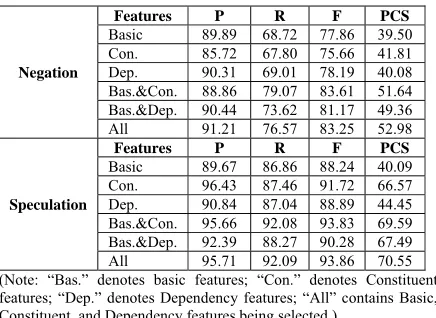
5.2 Results on Flat Syntactic Features Relying on the results of the greedy feature selec-tion algorithm (described in Secselec-tion 4.1), we ob-tain 9 effective features {B1, B3, B6, CS3, CS4, CS9, DS1, DS3, DS5} (see Table 2, 3 and 4) for negation scope detection and 13 effective features {B3, B4, B5, B6, CS1, CS5, CS6, CS8, CS9, CS10, DS1, DS4, DS5} for speculation. Table 6 lists the performances on the Scope Detection Data by per-forming 10-fold cross validation. It shows that flat constituent and dependency syntactic features sig-nificantly improve the basic scope detection by 13.48% PCS for negation and 30.46% for specula-tion (χ2; p < 0.01). It demonstrates that the selected
syntactic features are effective for scope detection.
Negation
Features P R F PCS
Basic 89.89 68.72 77.86 39.50 Con. 85.72 67.80 75.66 41.81 Dep. 90.31 69.01 78.19 40.08 Bas.&Con. 88.86 79.07 83.61 51.64 Bas.&Dep. 90.44 73.62 81.17 49.36 All 91.21 76.57 83.25 52.98
Speculation
Features P R F PCS
[image:7.612.79.297.78.237.2]Basic 89.67 86.86 88.24 40.09 Con. 96.43 87.46 91.72 66.57 Dep. 90.84 87.04 88.89 44.45 Bas.&Con. 95.66 92.08 93.83 69.59 Bas.&Dep. 92.39 88.27 90.28 67.49 All 95.71 92.09 93.86 70.55 (Note: “Bas.” denotes basic features; “Con.” denotes Constituent features; “Dep.” denotes Dependency features; “All” contains Basic, Constituent, and Dependency features being selected.)
Table 6. Performance of flat syntactic features. The results also show that the speculative scope detection achieves higher performance (16.98% higher in PCS) (χ2;
p < 0.01) than the negation
scope detection. The main reason is that although the average sentence length of negation and specu-lation are comparable (29.97 vs. 29.39 words, in Table 1), the average length of speculation scopes is much longer than the negation (17.24 vs. 9.62 words, in Table 1) in Abstracts sub-corpus. With the shorter scopes in training data, the classifier inevitably have more negative samples. Thus, by using a token as the basic unit in our classification, the imbalanced samples will seriously mislead the classifier and result in bias on the negative samples.
In addition, both constituent and dependency flat features can improve the scope classification, for the reason that the constituent features usually provide the nearer syntactic information of the cues, and that the further syntactic information between cues and scopes have been obtained by the dependency features.
[image:7.612.313.531.183.259.2]5.3 Results on Structured Syntactic Parse Features
Table 7 and Table 8 give the scope detection per-formance using the different structured syntactic parse features on negation and speculation respec-tively. Compared to the optimal system (using all of the selected flat features in Table 6) in Section 5.2, the structured syntactic parse features at best improve the scope classification nearly 17.29% on negation (PCS=70.27%) and 12.32% on specula-tion (PCS=82.87%) (χ2;
p < 0.01). It indicates that
the structured syntactic parse features can provide more implicit linguistic information, as supple-mentary clues, to support scope classification.
The improvements also show that both the com-pleted syntactic sub-trees and critical paths in con-stituent and dependency parsing trees are effective. The reason is that the completed syntactic sub-trees contain the surrounding information related to cues and tokens, while there are more direct syntactic information in the critical paths between cue and its scope.
Features P R F PCS
Con. CT 91.12 83.25 86.89 54.57
Con. CT&CP 93.31 89.32 91.20 66.58 Dep. T1 CT 87.29 84.37 85.81 53.07 Dep. T1 CT&CP 90.03 86.77 88.37 59.53 Dep. T2 CT 88.17 84.58 86.34 53.76 Dep. T2 CT&CP 91.09 87.31 89.16 60.11
All 93.84 91.94 92.88 70.27
(Note: “Con.” denotes Constituent features; “Dep.” denotes Depend-ency features; “T1” use the transformational rule (1) in Section 4.2 to get the dependency tree; “T2” use the transformational rule (2) in Section 4.2 to get the dependency tree; CT-“Completed syntactic sub-Tree”; CP-“Critical Path”; “All” contains Con CT&CP, Dep T1 CT&CP and Dep T2 CT&CP)
Table 7. Performance of structured syntactic parse features on negation.
Features P R F PCS
Con. CT 95.89 93.37 94.61 75.17
Con. CT&CP 96.05 94.36 95.20 76.73 Dep. T1 CT 93.24 90.77 91.99 72.31 Dep. T1 CT&CP 94.28 92.30 93.28 73.75 Dep. T2 CT 93.76 89.68 91.67 73.06 Dep. T2 CT&CP 95.29 94.55 94.92 75.69
All 96.93 96.86 96.89 82.87
Table 8. Performance of structured syntactic parse features on speculation.
5.4 Results on Part-of-Speech Based Classifi-cation
To confirm the assumption in Section 4.3, we have built a discriminative classifier for each kind of POS of cues. Considering that the features involv-ing the global structured syntactic parse infor-mation in Section 4.2 are almost effective to all instances, we only use the flat syntactic features in Section 4.1.
Negation
System P R F PCS
All Features 91.21 76.57 83.25 52.98 POS Classifier 91.79 78.29 84.50 56.77
Specula-tion
System P R F PCS
[image:7.612.319.531.580.640.2]All Features 95.71 92.09 93.86 70.55 POS Classifier 95.79 93.13 94.44 71.68 (Note: “All Features” System is the optimal system in Section 5.2) Table 9. Performances of POS based classification.
the POS based classification improves 1.13% on PCS (χ2;
p < 0.01), as different POS kinds of cues
involve respectively effective features with more related clues between cue and its scope.
Table 10 lists the performance of each POS kind of cues in speculation scope classification. There are still some low performances in some kinds of POS of cues. We consider it caused by two reasons. Firstly, some kinds of POS of cues (e.g. NN etc.) have fewer samples (just 43 samples shown in Ta-ble 5). For this reason, the training for classifier is limited. Then, for these low performance kinds of POS of cues, we may have not found the effective features for them. Although there are some kinds of cues with low performance, the whole perfor-mance of part-of-speech based classification is improved.
Cue’s POS
B1~B6 1 2 3 4 5 6
CS1~CS10 1 2 3 4 5 6 7 8 9 10
DS1~DS5 1 2 3 4 5 PCS
CC √ √ √ √ √ √ √ √ √ √ 38.45
IN √ √ √ √ √ √ √ √ √ √ √ 87.99
JJ √ √ √ √ √ √ 31.83
MD √ √ √ √ √ √ √ √ √ √ √ √ 79.84
NN √ √ √ √ √ √ √ √ 65.83
RB √ √ √ √ √ √ √ 37.03
VB √ √ √ √ 44.29
VBD √ √ √ √ √ √ √ √ √ √ √ 63.57
VBG √ √ √ √ √ √ √ √ √ √ √ 82.89
VBN √ √ √ √ √ √ √ √ √ 66.38
VBP √ √ √ √ √ √ √ √ √ √ √ √ 81.91
[image:8.612.73.300.287.460.2]VBZ √ √ √ √ √ √ √ √ √ √ √ √ 77.16
Table 10. Performance of each POS kind of cues in speculation scope classification.
5.5 Results of Comparison Experiments To get the final performance of our approach, we train the classifiers respectively by different effec-tive features in Section 4.1 for POS kinds of cues, and use the structured syntactic parse features in Section 4.2 on Abstracts sub-corpus by performing 10-fold cross validation.
Negation
System Abstract Paper Clinical
Morante (2008) 57.33 N/A N/A Morante (2009a) 73.36 50.26 87.27
Ours 76.90 61.19 85.31
Specula-tion
System Abstract Paper Clinical
Morante (2009b) 77.13 47.94 60.59 Özgür (2009) 79.89 61.13 N/A
[image:8.612.80.293.575.680.2]Ours 84.21 67.24 72.92
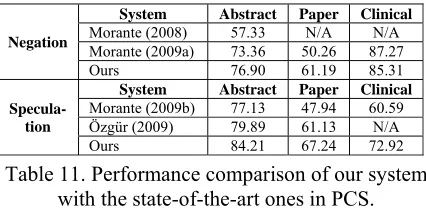
Table 11. Performance comparison of our system with the state-of-the-art ones in PCS. The results in Table 11 show that our system outperforms the state of the art ones both on
nega-tion and speculanega-tion scope detecnega-tion. Results also show that the system is portable to different types of documents, although performance varies de-pending on the characteristics of the corpus.
In addition, on both negation and speculation, the results on Clinical Reports sub-corpus are bet-ter than those on Full Papers sub-corpus. It is mainly due to that the clinical reports are easier to process than full papers and abstracts. The average length of sentence for negative clinical reports is 8.19 tokens, whereas for abstracts it is 29.39 and for full papers 30.49. Shorter sentences imply shorter scopes. The more unambiguous sentence structure of short sentence can make the structured constituent and dependency syntactic features eas-ier to be processed.
6 Conclusion
This paper proposes a new approach for tree ker-nel-based scope detection by using the structured syntactic parse information. In particular, we have explored the way of selecting compatible features for different part-of-speech cues. Experiments show substantial improvements of our scope clas-sification and better robustness.
However, the results on the Full Papers and the Clinical Reports sub-corpora are lower than those on the Abstracts sub-corpus for both negation and speculation. That is because the structured syntac-tic parse features contain some complicated and lengthy components, and the flat features cross corpus are sparse. Our future work will focus on the pruning algorithm for the syntactic structures and analyzing errors in depth in order to get more effective features for the scope detection on differ-ent corpora.
Acknowledgments
References
Emilia Apostolova, Noriko Tomuro and Dina Demner-Fushman. 2011. Automatic Extraction of Lexico-Syntactic Patterns for Detection of Negation and Speculation Scopes. In Proceedings of ACL-HLT short papers, pages 283-287.
Wendy W. Chapman, Will Bridewell, Paul Hanbury, Gregory F. Cooper, and Bruce G. Buchanan. 2001. A Simple Algorithm for Identifying Negated Findings and Diseases in Discharge Summaries. Journal of Biomedical Informatics, 34 (5): 301-310.
Wanxiang Che, Min Zhang, Ting Liu and Sheng Li. 2006. A Hybrid Convolution Tree Kernel for Seman-tic Role Labeling. In Proceedings of ACL, pages
73-80.
Nigel Collier, Hyun S. Park, Norihiro Ogata, et al. 1999. The GENIA Project: Corpus-Based Knowledge Ac-quisition and Information Extraction from Genome Research Papers. In Proceedings of EACL.
Richárd Farkas, Veronika Vincze, György Móra, János Csirik, and György Szarvas. 2010. The CoNLL-2010 Shared Task: Learning to Detect Hedges and their Scope in Natural Language Text. In Proceedings of CoNLL: Shared Task, pages 1-12.
Ilya M. Goldin and Wendy W. Chapman. 2003. Learn-ing to Detect Negation with ‘Not’ in Medical Texts. In SIGIR Workshop: Text Analysis and Search for Bioinformatics.
Yang Huang and Henry Lowe. 2007. A Novel Hybrid Approach to Automated Negation Detection in Clin-ical Radiology Reports. Journal of the American Medical Informatics Association, 14(3):304-311.
Zhengping Jiang and Hwee T. Ng. 2006. Semantic Role Labeling of NomBank: A Maximum Entropy Ap-proach. In Proceedings ofEMNLP, pages 138-145.
Roser Morante, Anthony Liekens, and Walter Daele-mans. 2008. Learning the Scope of Negation in Bio-medical Texts. In Proceedings of EMNLP, pages
715-724.
Roser Morante and Walter Daelemans. 2009a. A Met-alearning Approach to Processing the Scope of Ne-gation. In Proceedings ofCoNLL, pages 21-29.
Roser Morante and Walter Daelemans. 2009b. Learning the Scope of Hedge Cues in Biomedical Texts. In
Proceedings of the BioNLP Workshop, pages 28-36.
Roser Morante, Vincent Van Asch and Walter Daele-mans. 2010. Memory-Based Resolution of In-Sentence Scopes of Hedge Cues. In Proceedings of CoNLL Shared Task, pages 40-47.
Alessandro Moschitti. 2006. Making tree kernels practi-cal for natural language learning. In Proceedings of the 11th Conference of the European Chapter of the Association for Computational Linguistics, pages
113-120.
Lilja Øvrelid, Erik Velldal, and Stephan Oepen. 2010. Syntactic Scope Resolution in Uncertainty Analysis. In Proceedings of COLING, pages 1379-1387.
Arzucan Özgür and Dragomir R. Radev. 2009. Detect-ing Speculations and their Scopes in Scientific Text. In Proceedings of EMNLP, pages 1398-1407.
Slav Petrov and Dan Klein. 2007. Improved Inference for Unlexicalized Parsing. In Proceedings of NAACL,
pages 404-411.
Liliana M. Sánchez, Baoli Li, Carl Vogel. 2007. Ex-ploiting CCG Structures with Tree Kernels for Spec-ulation Detection. In Proceedings of the Fourteenth Conference on Computational Natural Language Learning: Shared Task, pages 126-131.
György Szarvas, Veronika Vincze, Richárd Farkas, and János Csirik. 2008. The BioScope corpus: Annota-tion for NegaAnnota-tion, Uncertainty and their Scope in Bi-omedical Texts. In Proceedings of BioNLP, pages
38-45.
Yuka Tateisi, Akane Yakushiji, Tomoko Ohta, and Jun’ichi Tsujii. 2005. Syntax Annotation for the GENIA Corpus. In Proceedings of IJCNLP, Com-panion volume, pages 222-227.
Erik Velldal, Lilja Øvrelid, Jonathon Read and Stephan Oepen. 2012. Speculation and Negation: Rules, Rankers, and the Role of Syntax. Computational Linguistics, 38(2):369-410.
Veronika Vincze, György Szarvas, Richárd Farkas, György Móra and János Csirik. 2008. The BioScope corpus: biomedical texts annotated for uncertainty, negation and their scopes. BMC Bioinformatics,
9(Suppl 11):S9.