Practical Papers, Articles
and Application Notes
Kye Yak See, Technical Editor
I
hope you enjoyed reading the three papers published inthe Spring 2011 issue in this section of the EMC News-letter. For this current issue, I am delighted to present to you an additional three quality contributions covering a wide range of EMC-related subjects: electrostatic discharge (ESD), the concept of electrical dimension, and a causality issue in electromagnetic simulation.
The first paper, “Easy Access to Pulsed Hertzian Dipole Fields Through Pole-Zero Treatment,” was contributed by Timothy J. Maloney from Intel Corporation. Tim’s rich expe-riences in ESD protection design for semiconductor devices have led to breakthroughs in ESD performance enhance-ments for a wide variety of Intel products. In this paper, based on a Laplace Transform approach, he cleverly derives the s-domain radiated field equations for a pulsed current source. The result is a pole-zero expression similar to that of the ordinary circuit analysis, where time-dependent fields at any distance can be calculated through easily accessible inverse Laplace Transform software. The time-domain radi-ated fields are useful for one to assess how the charged device model’s ESD radiations can be detected.
The second paper entitled “Physical Dimensions versus Electrical Dimensions” is authored by our regular contribu-tor, Professor Clayton Paul. With digital circuits operating at higher speeds and shorter logic transition times, digital circuit designers are confused about the condition in which to apply a lumped circuit or transmission line model for their circuit analyses. They will find the answer in this
pa-per. Dr. Paul shares with us how to determine the condition where the interconnect lines connecting the source and the load become electrically long. Hence, the standard lumped-circuit model is no longer valid and the transmission line model is necessary.
The last paper entitled, “A Simple Causality Checker and Its Use in Verifying, Enhancing, and Depopulating Tabulated Data from Electromagnetic Simulation,” is joint-ly authored by Brian Young and Amarjit S Bhandal from Texas Instruments USA and UK, respectively. With more powerful and accurate EM simulators available in the mar-ket, they become valuable tools for analyzing complex EMC problems. How do you know that the simulated results are correct, reliable, and usable? Causality check is one effective way to ensure that the simulated results are accurate and valid. Brian and Amarjit share with us the implementation details of a simple causality checker. The causality checker is used to derive an algorithm for selecting sampling rates and bandwidth for EM extractions of good interconnects, enabling a potentially large reduction in data points and run time. The improved extraction data has been shown to sig-nificantly improve S-parameter data and time domain simu-lation accuracy.
In conclusion, your active participation as authors and reviewers is needed so as to make this column a quality read. I wish you an enjoyable and fulfilling summer and feel free to share with me your feedback and comments, preferably by email at [email protected].
Easy Access to Pulsed Hertzian
Dipole Fields Through Pole-Zero Treatment
Timothy J. Maloney, Intel Corporation, Santa Clara, CA; [email protected]
Abstract: The equations for EM dipole near and far radiation fields are formulated for the complex frequency domain with a Laplace Transform analysis for Hertzian dipoles. An s-domain pulsed current source function from ordinary circuit analysis is used in the expressions, and is augmented as needed to refine the pulse. This formulation allows a lucid pole-zero treatment of the field transfer function, yielding any field at any distance through the inverse Laplace Transform. Zeros of these expres-sions always include the “radiation zeros”, essential properties of the dipole fields themselves. Methods for recovery of current pulse waveforms from E- and H-field measurements, using filter functions, are described. The inverse Laplace Transform of
pole-zero expressions through Heaviside expansion is more accessible than ever through free web applets and commonly available software. Study of the small pulsed dipole has become important in semiconductor manufacturing, as engineers seek to monitor and control charged device model ESD events that could destroy components.
Introduction
35
©2011 IEEEexpressions for the near and far fields is for the harmonic (sinu-soidal) source, but that is often generalized to the time-depen-dent dipole moment source, usually called p(t) for the electric dipole and m(t) for the magnetic dipole. The generalized time-dependent Hertzian (i.e., infinitesimal) dipole in free space will be useful for exploring pulsed fields. The complementary fea-tures of electric and magnetic dipole radiation and their E and H fields are well treated in EM textbooks, so we first will cen-ter the discussion on electric dipoles. Once the impact of the electric dipole moment p(t) and its time derivative on the fields is better understood, it will be clear how to apply these meth-ods to magnetic dipole radiation in the same way.
There are numerous motives for studying pulsed dipole radiation in free space, not least of which is an existing vast literature on antennas for pulsed applications. Many contem-porary works still refer to a landmark study from Caltech in 1974 called simply “Pulsed Antennas” [4], with 69 references and several lucid examples, beginning with the point source or Hertzian dipole. More recently, Schantz [5] studied the flow of electromagnetic power for pulsed Hertzian dipoles in the context of antenna design, and observed some interest-ing near and far field phenomena that relate to the present work, which will be discussed later. Atmospheric scientists who observe and often induce lightning strokes [6] have also produced a vast literature on pulsed fields; the present author hopes that this one reference could help lead the interested reader to more publications. While lightning is not an “infin-itesimal” source except at very far fields, researchers often start with the Hertzian dipole concept and may view lightning as a stack of such dipoles.
Another motivation to study pulsed dipole fields is closer to the present author’s interests, which include charged device model (CDM) electrostatic discharge (ESD) threats to semicon-ductor components. These phenomena have been known since the 1970s, and standardized tests have been formulated [7] to simulate the phenomena based on some well-designed equip-ment from the 1980s [8]. Radiation detection is not part of these semiconductor test activities, but it has been used to de-tect CDM events in the factory as part of a static control pro-gram [9]. More recently, semiconductor workers have looked more closely at the relation between CDM-like events and sig-nals from a nearby EMI-type antenna [10, 11]. Thus we have become highly interested in the fields produced by CDM pulses, including the strong near fields that a factory monitor antenna could pick up. The CDM test machine [7, 8] provides easy ac-cess to the current pulse information, so we would like to turn this into full, time-dependent near and far field information as easily as possible, using a Hertzian dipole approximation.
Figure 1 illustrates a familiar 3-axis scheme for electric di-pole radiation, showing the didi-pole (of presumed height dl) at the origin, and the names for Cartesian (x, y, z), spherical (r, u,
f), and cylindrical (r, f, z) coordinates that may be used.
Transforming Dipole Field Equations
If we pick and choose among textbook treatments of electric dipole time-dependent fields [1–3], we can formulate an expression in “practical” units for the most interesting field for electric dipole radiation, in terms of dipole moment p(t) and its first two time derivatives, the latter shown as p-dot and p-dou-ble-dot:
Eu1t25sin u 4pe0a
3p$4 c2r1
3p#4 cr21
3p4
r3b. (1)
c is, of course, the speed of light and e0 the permittivity of free
space. At all times the fields are understood to be delayed by the propagation time, so we will not be writing (t-r/c). There is also a radial E field and an azimuthal H field, but they do not con-tain all three terms in p(t), commonly called the static (p), inductive (p-dot) and far field radiative (p-double-dot) terms. We will treat these fields later. It is now clear that the pulsed field Eu is a maximum at the “equator” (sin u 5 1, where Euand Ez are the same magnitude) and that full knowledge of the
cur-rent I(t) plus the dipole moment length dl is sufficient to find p(t) and its derivatives, as p(t) 5 Q(t) ? dl, and I(t) 5 dQ(t)/dt.
How do we gain the promised “easy access” to these pulsed fields at all distances? Equation (1), in the context of current pulses beginning at time zero, is a perfect target for use of La-place Transforms [12], familiar to practitioners of electrical cir-cuit theory [13]. The use of Laplace Transforms (when named as such; we will avoid a digression on the near-equivalence of Fourier Transforms) for pulsed EM field problems seems to fall in and out of favor over the years. For example, in 1958 the well-respected physicist Paul I. Richards [14] used a Laplace Transform method and some very insightful coordinate trans-formations to look at pulsed EM waves in a conductive medium, seawater [15], without significant use of a computer. Despite such studies over the years showing the usefulness of Laplace Transforms in pulsed EM field problems, the present author has not been able to locate a simple Laplace Transform treatment of the pulsed Hertzian dipole in a popular EM textbook. But the Laplace Transform approach to pulsed (or even continuous wave) Hertzian dipole fields offers considerable insight into the phenomena and easy access to the fields for the engineer short on time and resources, so let us begin.
Equation (1) is transformed into to the Laplace (complex fre-quency; s 5s1 jv) domain by recalling [12] that the time derivative d/dt operator is s, and the integration operator is 1/s. This means that p(t) as above transforms to I(s)/s in the Laplace domain, and the time derivatives in (1) become s and s2. The
propagation time to radius r is t5 r/c so it can be a “constant” at a particular radius for the sake of an s-domain field equation. Eq. 1 can thus be expressed, very unusually, with 1/r3 factored
out, and transformed into the s-domain as
Eu1s25I1s2sin u
4pe0sr3dl# 111st 1s
2t22, t 5r
c. (2)
z
x
y r
dl θ
θ ∧
^ φ
φ ρ
r
dl θ
θ ∧
^ φ
φ ρ
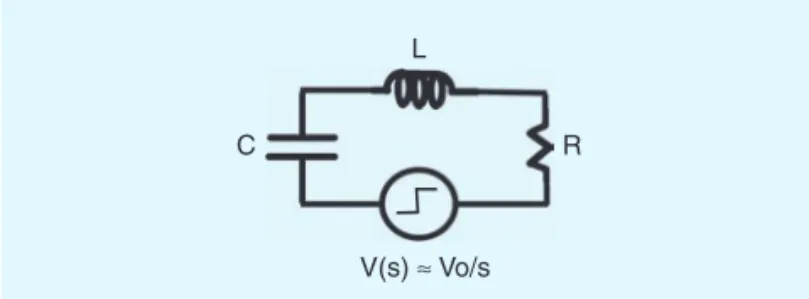
The radius becomes a scaling factor and it now simply remains to use circuit theory to express I(s) for the pulse source. That is not difficult; in the simplest approximation of the CDM source, it is a two-pole series RLC circuit responding to a step (collaps-ing dipole of a charged device touch(collaps-ing ground through one pin) as in Figure 2. Numerous works on CDM begin with this kind of circuit [16].
In a collapsing dipole, the capacitor begins with charge and ends with no charge (step-down), which in linear circuit theo-ry is equivalent to a step-up. The current expression emerges from the admittance Y(s) 5 1/Z(s) of the series RLC loop and, through standard methods, is found to be
I1s25V1s2Y1s25V0 s #
Cs
LCs21RCs115
CV0
LCs21RCs11. (3)
This is our two-pole RLC pulse source that, depending on cir-cuit model values, may or may not include ringing. It is now clear that Eu(s) becomes a pole-zero expression and that a time domain solution Eu(t) is available through the Heaviside expansion method of obtaining an inverse Laplace Transform in terms of a series of exponentials [12].
Eu1s25CV0#dl 4pe0r3 #
111st 1s2t22
s111RCs1LCs22 sin u. (4)
There are several things to notice about Eq. (4). The s factor in the denominator means the field is some kind of step function, which makes sense given that the step in voltage and charging or discharging of the capacitor means that a static field either appears or disappears. However, if the step is differentiated (finite width pulse for voltage) and the polarization begins and ends at zero, the s disappears from the denominator and the field also begins and ends with zero. This resembles the case of the Gaussian polarization pulse for a Hertzian dipole in [4], only now there is a defined t 5 0 and the ability to construct a slightly underdamped pseudo-Gaussian pulse [17] to represent how a real Gaussian-like Hertzian dipole would behave, with-out requiring infinite time. There is also the freedom to add some high-frequency poles to I(s) to produce a gradual rise of the pulse and make it even more like a Gaussian. In retrospect, there may have been too much reliance on Gaussian pulse examples in the antenna literature over the years, while this pole-zero alternative was not recognized.
The numerator of Eq. (4) contains the essentials of the dipole radiation field in the compact expression 11st1s2t2
, also an
unchanging feature of (2) and (4). For a given radius r such that
t 5 r/c, this expression gives the complex frequency zeros of the Eu field (let’s call them radiation zeros or field zeros) as
z1,25216j"3
2t . (5)
These, along with the poles (roots of the denominator of (4)) play a role in the Heaviside inversion to the time domain [12], and have the general effect of sharpening the field compared to the current, as will be seen below. But the student of circuit theory looks at (4) and is immediately likely to ask about the curious case of pole-zero cancellation, where in this case, we would have RC 5 "LC 5 t 5 r/c, possibly true at a particu-lar radius r. This leaves only the s term in the denominator, meaning that for a collapsing dipole there is a sharp drop in the static field at that radius, nothing more. Is this a paradox?
It turns out that this unusual case of dipole field collapse was lucidly described by Schantz [5], although not called pole-zero cancellation. Figure 3 is from [5], showing energy density and flow and a stationary sphere at the expected radius. No energy crosses the radius where there is pole-zero cancellation.
Figure 4 shows the sort of I(t) pulse that results in pole-zero cancellation as described above for Eq. (4). This one was done for t5 500 psec because it is closer to a CDM pulse that will interest us. All such pulses for Eu look the same; only the time scale changes. The damping factor (D 5 RC/2!LC) is 0.5, un-derdamped as is the case when the two poles are complex con-jugates. In this case, the dark sphere as in Fig. 3 would occur at 15 cm or about 6 inches.
In discussion of the material in Fig. 3, above, Schantz notes that since no energy crosses the dark sphere, the stored energy outside it must escape to infinity (i.e., be radiated), and the en-ergy inside it must of necessity collapse back into the dipole as the pulse finishes, as it cannot escape. Such a boundary is thus unusually definitive because of pole-zero cancellation. Mean-while, we suspect Schantz is correct about no energy crossing the sphere boundary at any time, but the Laplace Transform method gives us good tools to confirm this rigorously, particu-larly for t 5 01. To do so we must know the H field, and then confirm there is no impulse (delta function) at t 5 0.
For the electric dipole, the H field is entirely azimuthal, or-thogonal to Eu and thus produces inward or outward flow of en-ergy through the Poynting vector. The H expression to go with Eq. (1) has no static field component and is as follows [1–3]:
Hf1t25csin u 4p a
3p$4 c2r1
3p#4
cr2b. (6)
Using the same methods as above, the s-domain expression is
Hf1s25cI1s2 #dl
4psr3 #st111st2sin u 5
I1s2#dl#111st2
4pr2 sin u.
(7)
Note the cancellation of s-terms, now that there is no static field, and of an r since ct 5 r. Hf1t2 can thus be seen as a mixture of I(s) and its derivative. The two-pole I(s) of Eq. (3) starts at 0 and has a finite derivative (as in Fig. 4), so clearly Hf1t2 is finite at t 5 0 (i.e., no impulse due to differentiating a perfect step), so we agree that, for pole-zero cancellation, there is no energy flow through the dark sphere even at t 5 0. The radiation zero for Hf is real and negative, at 21/t, but there
L
R C
V(s) ≈ Vo/s
37
©2011 IEEEwas also a zero at zero, cancelling the s of electric polarization I(s)/s. The complementary Ef expression for the magnetic dipole also has a zero at zero, but recall that the magnetic dipole moment m(t) goes as I(s) times an area.
For completeness, we should record the last electric dipole field component, radial E-field. This component goes as cos u (peaks at polar regions) and has only static and inductive com-ponents, no 1/r fields radiated to infinity:
Er1t25cos u 2pe0a
3p#4 cr21
3p4
r3b. (8)
The cross product of Er with H is necessarily in the u direction,
so it does not produce radial energy flow. The s-domain expres-sion for Er is
Er1s25 I1s2 #dl
2pe0r3 #
111st2cos u
s . (9)
Due to the static field, the s is back in the denominator. Er has
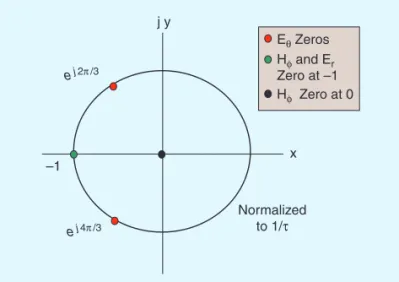
the same radiation zero as Hf, at 21/t. The radiation zeros are shown in the complex plane in Figure 5. Students of circuit analysis will recognize that the field equations have been turned into transfer functions, and that a pole-zero plot expresses all the amplitude and phase information at once. The radiation zeros as in Fig. 5 are always the starting point, and the field problem is essentially solved once the current-related poles join the plot.
Before we leave Fig. 5 and do some pole-zero expansions to calculate time-dependent fields, it is useful to view Fig. 5 in the context of the “radiansphere” as described by Harold Wheeler in 1959 [18]. Wheeler was also concerned with small dipoles but with continuous wave (cw) harmonic signals (s 5 jv), and marked the boundary between near and far fields as the sphere with a radius of one radian of wavelength, i.e., vt5 1. Fig. 5 is thus seen as the case where poles 6jv would be plotted at 6j for the radiansphere boundary. At closer distances, the zeros are further out (they start at infinity at the dipole source) and have much stronger influence, but then they cross the unit circle at the radiansphere, as described, and continue on at larger dis-tances toward the origin in a straight line, as the far field comes to dominate. Wheeler also recognized (what we call) 1 1 st 1 s2t2in the context of a transfer impedance between dipoles at a
distance defined by our t 5 r/c, and in terms of an RLC network with values based on EM properties of free space. If Wheeler had been more interested in complex frequencies and pulsed dipoles, the analysis could have been extended to a pole-zero treatment as we have here, and the history might be different.
Time-Domain Dipole Fields
As noted previously, inversion of the above s-domain equations into the time domain involves Heaviside expansion of a ratio of polynomials, as described in [12] and in a host of college-level calculus texts. Essentially, if f1s25p1s2
/
q1s2, q1s251s2a12 1s2a22c1s2am2, p1s2 a polynomial of degree,m,
F1t25 a m
n51
p1an2
qr1an2e
ant. (10)
A simple example with no zeros would be two complex conjugate poles following Eq. (5) for t 5 500 psec and a normalized (inte-grating to 1) version of the current (3) as plotted in Fig. 4, or
x (m)
1
0.75
0.5
0.25
0
–0.25
–0.5
–0.75
0.25 0.5 0.75 1 1.25 1.5 1.75 2 y (m)
3 nsec
x (m)
1
0.75
0.5
0.25
0
–0.25
–0.5
–0.75
0.25 0.5 0.75 1 1.25 1.5 1.75 2 y (m)
(a)
(b) 4 nsec
Fig. 3. from Schantz [5], © 2001, IEEE. Energy density and flow at t = 3 nsec (Fig. 3a) and t = 4 nsec (Fig. 3b) for a damped harmonic with poles matching the zeros in Eq. (5) and t = 1 nsec or 30 cm. Note the stationary sphere at 30 cm, regardless of time.
2-Pole Response, Balancing Rad at 15 cm
–0.4 –0.2 0 0.2 0.4 0.6 0.8 1 1.2
0 500 1,000 1,500 2,000 2,500 3,000 3,500 4,000 4,500
Time (psec)
arb Units
I1s25 1
110.5s10.25s2 1I1t25 4 "3
e2tsin1"3t2. (11)
Here the time is in nanoseconds and s in GHz. Note that for “ordinary” passive circuit elements describing the pulse source as in Eq. (3), the polynomial coefficients of q(s) will be positive and real, thus giving poles that are negative and real, or com-plex conjugates with negative real parts. In [5], Schantz solved for the polarization of a collapsing dipole (our I(s)/s or inte-grated current) and its derivatives for the case of a current source producing stationary dark sphere at 30 cm (t 5 1 nsec),
as described above, and found the expected participation of !3 in the natural frequencies and precisely the same current wave-form as Fig. 4, aside from the time scale set by t. The appear-ance of the dark sphere as discussed above is, again, explained by pole-zero cancellation at a critical radius. Now let us try some field calculations.
Inverting Laplace Transforms through Heaviside expansion can be done with one- or two-line commands on a computer. Many software packages do this (the present author uses Math-ematica) but this paper has promised “easy access” to field solu-tions for the reader, and that should mean free software with a very short learning curve. There is indeed a free Java applet for the inverse Laplace Transform, available on the Internet [19]. The user need only type in numerator and denominator polyno-mials in s (our p(s) and q(s)) and push a button, which certainly amounts to a lower barrier to this kind of computational assis-tance than was the case in years past. It is why the author thinks that these highly accessible tools are what students and working engineers need to acquire a feel for pulsed and cw dipole radia-tion in any environment, and without wanting to gloss over the dreaded near field effects when r #l/2p.
Let us look at a few current and E-field profiles of CDM-like events with realistic parameters. Spark resistance for CDM is around 25 ohms [16] and there is usually some mild under-shoot after the main pulse so that D 5 0.5–0.7 is appropriate. External capacitance to ground for ICs could be 5 pF for a fairly small to mid-size package and 10 pF for a larger one. Package inductance varies, but it should scale with trace length (roughly square root of area) while capacitance should scale with area. Thus D should increase by 21/4for the larger package (D goes
from 0.5 to 0.595), so the normalized (integrates to unity) cur-rent expressions become (s in GHz, coefficients in nanoseconds)
I15pF25 1
110.125s10.15625s2, and
I110pF25 1
110.25s10.044s2. (12)
These would be current profiles for equal amounts of charge, although in the factory, one may expect CDM-induced charge quantities to scale with area. This is what Gauss’ Law gives for a fixed electric field, or for area-scaled accumulation of tribo-electric charge by a package. These two normalized CDM cur-rent profiles are plotted in Figure 6.
The normalized (reaching a final value of unity, the static field) equatorial E-field Ez at 15 cm (t 5 500 psec) for these
cases is taken from Eq. (4),
Ez1s25 11st 1s
2t2
s111RCs1LCs22, (13)
where RC and LC are the values in Eq. (12). These are plotted in Figure 7.
Notice that while the current scales by the expected factor of two for the two cases, the maximum field scales by about 3x; also there is sharpening, and there is an unrealistic sudden step at t 5 0, owing to the finite second derivative at t 5 0 for a two-pole pulse. But the CDM spark itself is expected to have a rise time of at least 60 psec, so it is easy to insert a double 30 psec real pole pair into Eq. (13), for a more realistic field expression:
j y
x
ej4π/3
ej2π/3
–1
Normalized to 1/τ
Eθ Zeros Hφand Er
Zero at –1 Hφ Zero at 0
Fig. 5. Complex plane plot of the radiation zeros for all field components of electric dipole.
0.5 1.0 1.5 2.0
0.5 1.0 1.5 2.0
1 2 3 4
Time (nsec)
0.5 1.0 1.5 2.0
Time (nsec) (a)
(b) RC = 125 psec
RC = 250 psec
39
©2011 IEEEEz1s25
11st 1s2t2
s1110.03s22111RCs1LCs22. (14)
These easily calculated CDM E-fields are shown in Figure 8. As noted earlier, the up case is equivalent to charge-down, so CDM pulse fields would ordinarily be shifted down (by 21 for these normalized pulses) to show zero field at steady state.
In the more realistic case of Fig. 8, the E-field amplitude swing is still about 3x more for the faster device, which has 2x the peak current and equal charge compared to the other. Because of the derivatives (in the radiation polynomials of Eqs. 13–14), fields are definitely sharper and of shorter time duration than the current of Fig. 6, even after the spark rise time is added; the spark rise time affects the startup phase of the pulses. At 15 cm, the slower 250 psec 5 RC pulse in Fig. 8b is clearly more in the near field zone because of its lower frequency content, meaning that the final static field Ez5 1 is fairly large
compared to transient fields.
Before we look at field measurement, let us calculate a tran-sient magnetic field. Going back to the collapsing dipole exam-ple of Schantz [5] at the dark sphere at 30 cm, we decided that
ExH integrated over time has to be zero at that radius, although there is a finite magnetic field as the electric field steps down suddenly. Now employing the radiation zeros for Hf, the nor-malized equatorial field, following Eq. (7) and with GHz units for s and nanoseconds for t, is
Hf1s25I1s2
s #s111st25
11st 11st 1s2t25
11s 11s1s2,
for t 5 1 nsec. (15)
Hf1t2 is plotted in Figure 9, calculated from the inverse Laplace Transform web Java applet [19].
Because of the finite second derivative of I(t) in the two-pole form, the Hf field has a pure step at t 5 0. But because the finite
ExH lasts for zero time, no energy is transmitted across the dark
6
5
4
3
2
1
0
1
0.5 1.0 1.5 2.0
5 10 15
Time (nsec)
0.5 1.0 1.5 2.0
Time (nsec) (a)
(b) RC = 125 psec
RC = 250 psec
Fig. 7. Normalized vertical E-fields for the current profiles in Fig. 6.
4
3
2
1
0.5 1.0 1.5 2.0
4
2
–2 6 8
Time (nsec)
0.5 1.0 1.5 2.0
Time (nsec) (a)
(b) RC = 125 psec
RC = 250 psec
Fig. 8. Normalized vertical E-fields as described by Eq. (14), with extra double pole for 60 psec spark rise time. Peak-peak amplitude is almost 3x greater for the smaller, faster device in Fig. 8a.
sphere. However, the E-field at all radii also has a t 5 0 step as in Fig. 7, which led us to the spark rise time poles of Eq. (14) and the more realistic fields of Fig. 8. Such rise time poles would remove the pure steps from E and H fields at the dark sphere and introduce a small but finite ExH energy flowduring the spark rise time.
Field Measurement and the Goal of Current Imaging
We will now briefly discuss transient field detection, and how it applies to the foregoing calculations and some related
practi-cal situations for EMC and ESD engineers. E and H field detec-tion is of course a vast subject, so we will cover only a few high points here, and defer a more complete discussion of transient field measurements to a future article.
No discussion of ESD-created transient fields as created by Hertzian dipoles would be complete without citing Wilson and Ma [20], a work now over 20 years old. Using a broad-band horn antenna for E-fields, and an ESD pulser gun resem-bling one that would now be compliant with IEC 61000-4-2, the authors measured and compared pulse currents and radi-ated fields. Field results seemed most successful for measure-ments at 150 cm distance from the pulser gun and, to this reader, the minor discrepancies in theory vs. experiment were largely cleared up by some work published in 2007 [21] that included Microwave Studio (MWS) computer simulations. Caniggia and Maradei [21] found substantial effect of the re-turn path of the current, which depends on gun strap place-ment and is even frequency-dependent. Nonetheless, at 150 cm distance from the source, there is now some case for view-ing the current pulse as, primarily, a magnetic dipole. Note that with a magnetic dipole, the dipole moment goes as I(s) instead of I(s)/s, and that, mirroring the H field for electric dipole radiation, there is no long-term static electric field. In short, the extra derivative of the magnetic dipole model leads to a reasonably good fit of the E-field profile as measured at 150 cm in [20], including the undershoot, when combined with a simple model (double exponential plus step) for the current as measured at the target. The foregoing is a nearly ideal application of the Laplace Transform field calculation methods described above, and would make a fine homework assignment for students and engineers trying to learn about transient fields. We hope the authors of [20] understand that this is the benefit of hindsight, and the much later efforts of [21] and a result of perhaps other works that led to a more complete understanding. Even so, it appears that the dipole radiation model is still meaningful.
We do not always have a broadband TEM horn antenna with flat frequency response for measuring E-fields, as in [20]. Something smaller is needed in practical manufacturing situa-tions, where a small near field antenna is required [9]. Conve-niently, Caniggia and Maradei [21] also discuss basic E-field and H-field probes and their agreement with simple theory. The E-field monopole probe (coaxial cable with extended center conductor) agrees remarkably well with a two-pole, one zero RLC model for the transfer function. Using the notation of the present article, the measured signal as compared to vertical E-field is essentially
Vm1s2
Ez1s2 5
lmZ0Cms
11Z0Cms1LmCms2, (16)
for which Z0 is cable impedance (usually 50 ohms), Cm and Lm
are the inductive and capacitive equivalents of the probe wire, and lm is the length of the probe wire. Model parameters can
be calculated as described in [21] and cited earlier references [22], although it has long been known that the exact solution is a little more complicated [23]. The result for a 6 mm monopole probe as in [21] is a very good dE/dt probe up to 1 GHz or so, and not too severe a departure from the simple model of Eq. (16) beyond that. Such models enhance our pros-pects for recovering the current I(s) and I(t) (i.e., current imaging) through filtering of the measured field signal. For
1 2 3 4 5 6 7
–0.2 0.2 0.4 0.6 0.8 1.0
Time (nsec)
Fig. 10. Normalized filter function impulse response, as in Eq. (17), for a small E-probe. Z0Cm = 25.2 psec, LmCm = 541.6
(psec)2 , r = 15 cm. For these values, there is also a very small
Dirac delta function (0.002) at the origin that brings the integral to unity. This function would be convolved (e.g., with free tools as in [24]) with the measured field signal Vm(t) to
produce an image of the time-dependent source current I(t).
0.2 0.4 0.6 0.8 1.0 1.2 1.4
–50 50 100 150
–10 10 20 30 40 50
Time (nsec)
0.2 0.4 0.6 0.8 1.0 1.2 1.4 Time (nsec)
(a)
(b) RC = 250 psec RC = 125 psec
41
©2011 IEEEexample, if (normalized) Eq. (16) is combined with (normal-ized) Eq. (2) at the equator, we find that
I1s25Vm1s211Z0Cms1LmCms
2
s #
s 11st 1s2t2
5Vm1s211Z0Cms1LmCms
2
11st 1s2t2 . (17)
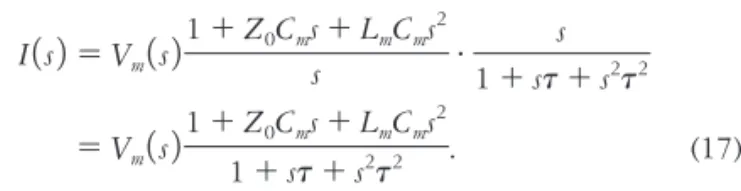
This means that we transform our signal V(t) by the filter func-tion described by the last factor of Eq. (17), and then multiply by the appropriate constants as listed in Eqs. (2) and (16), and we have a time-dependent image of the current I(t). The filter-ing can be done through direct convolution [13] and there are also free software tools for that, downloadable from the Internet [24]. A time-dependent impulse response for the filter function in (17) is found through the inverse Laplace Transform as usual (it involves a Dirac delta function when numerator and denom-inator are of equal order, but Mathematica can handle this—it just means that the original function is copied with no time lag, to form a portion of the convolved function) and then con-volved with the measured field signal, a very quick spreadsheet operation. It is also clear from (17) that the E-field and its mea-sured signal are generally sharper than the source current pro-ducing them, as we’re using a low-pass filter function to recover the current pulse from the field. A view of such a filter function is in Figure 10, calculated for 15 cm and with param-eters calculated for a 6 mm E-field monopole probe as described in [21], with extra capacitance due to the practice of protecting the probe wire with dielectric cap. Network analyzer measure-ments of the E-probe antenna should be done to confirm this model, as we will want a reasonable fit to high frequency.
It is interesting to take the parameters for the small E-probe as described for Fig. 10 and apply them to our examples of calculat-ed realistic fields as in Fig. 8, in order to see what kind of signal is expected for CDM events of that sort. These predicted signals, in normalized form following Eq. (16), are shown in Figure 11.
Fig. 11 is our predicted measurement at 15 cm for the CDM pulse currents for the two devices of Fig. 6. Equal charge results in about 2x difference in peak current (Fig. 6) but about 3x the Vp-p for the dE/dt-like measurement. However, other low-pass filtering of the raw signals pictured in Fig 11 could take place. First is the coaxial cable itself, which must respond to these fast signals, where the first half cycle takes less than 150 psec. If the cable is good, the oscilloscope or pre-amplifier must also be fast or it will smooth out these pulses; good models of scope response are discussed in [17]. But we do want a certain amount of smooth-ing, as shown by the filter function of Fig. 10. It turns out that Fig. 10 is fairly close to the impulse function of a 350 MHz two-pole filter, even one with D < 0.7 as suggested for oscil-loscope in [17]. In this case (note that it applies to a particular probe design and a particular distance from the source, 15 cm), the correct completion of the measurement channel will pro-duce a good current image, with expected current scaling. In this way, the entire measurement channel, plus the effect of the radiation zeros, can be tuned to a particular distance from the dipole to give a current image. With enough low-pass filtering, only an indication of the charge Q will remain, but for the case here, the filter would have to be well below 100 MHz for the two pulses to look nearly the same.
With a tuned measurement channel as described above for current imaging, the last factor in Eq. (17) has, in effect, been
absorbed into the measurement channel to achieve complete pole-zero cancellation. But note that if the measurement channel including probe is not quite right at a particular distance, soft-ware filtering can complete the process to give a current image. For practical situations in the factory or laboratory—anywhere outside controlled conditions in an anechoic chamber, one would think—the true current image may last only the first few nano-seconds at most, before reflections, resonances and other effects intrude. Even so, in the presence of a known current source loca-tion, Eq. (17) inspires us to produce “equivalent small dipole cur-rent source” waveforms from our field measurement data, once we decide between electric and magnetic dipole for the source.
Conclusions
Pulsed radiation has been with us for a long time, but a relatively recent motive to study it in semiconductor manufacturing has been the importance of charged device model ESD and the need to avoid damage to sensitive components. Thus there is renewed incentive to study, measure, and analyze the fields of a small or Hertzian dipole, including at near and intermediate range.
The equations for EM dipole near and far radiation fields were presented in this work for the complex frequency domain with a Laplace Transform analysis of the Hertzian dipole case. Expressions in the s-domain for the pulsed current source are then built up from ordinary circuit analysis, and the result is a pole-zero expression for the field, startling in its simplicity. Sin-gularities and abrupt steps can be removed by refining the pulse expression to capture such real effects as spark rise time. There is easy access to these fields at any distance through the inverse Laplace Transform, and access to the latter is easier than ever through software and free web applets. The concept of using these simple models to recover current pulse waveforms, or at least their main features, from E- and H-field measurements, is also viable once the properties of the measurement instruments are known. The field calculation methods thus lead to simple extraction of filter impulse functions that can be used with con-volution methods (also deployable through free software) to find the time-dependent waveform of the source current at a given distance from the detector. In some cases, an amplifier, hard-ware filter, or well-chosen slow oscilloscope (e.g., 350 MHz) can be part of the measurement channel to achieve much the same filtering, thus producing a current image in hardware.
The zeros of the pole-zero expressions for fields always in-clude the “radiation zeros”, which are essential properties of the dipole fields themselves. Pure numbers like exp(jp(1 6 1/3)) appear to have a deep physical significance, as they are the roots of (1 1 x 1 x2) and include information about all
graduate student’s starting point for serious consideration of ra-diation, good interactive tools for developing insight are help-ful. Now that we find the small pulsed dipole has remarkable significance for observed CDM radiation, as above, we also need simple, accessible tools for busy working engineers to use for comprehending these practical problems, and thus the methods described in this work were developed.
The author always found the use of “jv” in EM-related books to be a bit restrictive, having learned the “secret” of the La-place Transform and complex frequencies as a college sopho-more. He felt free to let jv 5 s on most occasions when reading those books, as the expressions would seem a bit simpler, while also becoming more general. The s-domain expressions in this paper are a good example of that practice, one that brought unusual clarity to the subject under study. The author contin-ues to cross-check as many EM problems as possible with the s-domain approach, using field equations as expressed in this work. Somehow, the “bookkeeping” of the various fields and their r-dependence is more tractable. Consider, for example, the physics examples of Prof. K.T. McDonald of Princeton Univer-sity [28]. If, like the author, you have often searched the Inter-net for information on EM problems, you have undoubtedly encountered Prof. McDonald’s examples and articles, multiple times. Some of his EM examples are admittedly incomplete, i.e., works in progress. Reformulating the EM dipole equations and current sources in Laplace Transform format can be quite revealing, at least when there is a defined beginning at t 5 0. Indeed, it was not a field problem but an incomplete capacitor problem posed by McDonald and solved by both of us in 2008 [29] that convinced the author that more Laplace Transform analysis is needed to understand and solve ESD problems. After all, ESD is a pulse that begins at time zero.
References
[1] S. Ramo, J. Whinnery, and T. Van Duzer, Fields and Waves in Communica-tion Electronics (New York: John Wiley & Sons, 1965).
[2] J.B. Marion, Classical Electromagnetic Radiation (New York: Academic Press, 1965).
[3] J. D. Jackson, Classical Electrodynamics, 3rd Edition (New York: John Wiley and Sons, 1999).
[4] G. Franceschetti and C.H. Papas, “Pulsed Antennas”, IEEE Trans. on Anten-nas and Propagation, Vol. AP-22, No. 5, Sept. 1974, pp. 651–661. [5] H.G. Schantz, “Electromagnetic Energy Around Hertzian Dipoles”, IEEE
Antenna & Prop. Magazine, Vol. 43 (2) April 2001, pp. 50–62.
[6] M.A. Uman, J. Schoene, V. A. Rakov, K. J. Rambo, and G. H. Schnetzer, “Correlated Time Derivatives of Current, Electric Field Intensity, and Magnetic Flux Density for Triggered Lightning at 15 m”, Journal of Geo-physical Research, Vol. 107, No. D13, 2002, pp. 1–11.
[7] JEDEC JESD22-C101-C standard, “Field-Induced Charged-Device Model Test Method for Electrostatic-Discharge-Withstand Thresholds of Micro-electronic Components”, Dec. 2004. See www.jedec.org.
[8] R. Renninger, M-C. Jon, D.L. Lin, T. Diep and T.L. Welsher, “A Field-Induced Charged-Device Model Simulator”, EOS/ESD Symposium Proceed-ings, 1989, pp. 59–71.
[9] J.A. Montoya and T.J. Maloney, “Unifying Factory ESD Measurements and Component ESD Stress Testing”, EOS/ESD Symposium Proceedings, 2005, pp. 229–237.
[10] A. Jahanzeb, K. Wang J. Harrop, J. Brodsky, T. Ban, S. Ward, J. Schichl, K. Burgess, C. Duvvury, “’Real World’ Discharge Event Detection”, 2011 International ESD Workshop, Lake Tahoe, CA, May 2011 (to be published). [11] A. Jahanzeb, K. Wang J. Harrop, J. Brodsky, T. Ban, S. Ward, J. Schichl, K.
Burgess, C. Duvvury, “Capturing Real World ESD Stress with Event Detec-tor”, 2011 EOS/ESD Symposium, Anaheim, CA, Sept. 2011 (to be published). [12] M. Abramowitz and I.A. Stegun, Handbook of Mathematical Functions,
(New York: Dover Publications, 1965).
[13] R.N. Bracewell, The Fourier Transform and Its Applications, (New York: McGraw-Hill, 1965).
[14] R. Levy and S.B. Cohn, “A History of Microwave Filter Research, Design, and Development”, IEEE Trans. on Microwave Theory and Techniques, vol. MTT-32, no. 9, Sept. 1984, pp. 1055–1067. “Richards…had a brilliant career both as an engineer and as a physicist, and was well known for many fine contributions in the fields of physics and applied mathematics.” [15] P.I. Richards. “Transients in Conducting Media”, IRE Trans. on Antennas
and Propagation, April 1958, pp. 178–182.
[16] B. Atwood, Y. Zhou, D. Clarke, T. Weyl, “Effect of Large Device Capacitance on FICDM Peak Current”, EOS/ESD Symposium Proceedings, 2007, pp. 275–82. [17] C. Mittermayer and A. Steininger, “On the Determination of Dynamic Errors for Rise Time Measurement with an Oscilloscope”, IEEE Trans. on Instrumentation and Measurement, Vol. 48, no. 6, Dec. 1999, pp. 1103–07. [18] H.A. Wheeler, “The Radiansphere Around a Small Antenna”, Proceedings
of the IRE, vol. 47, 1959, pp. 1325–1331.
[19] Web resource, http://www.eecircle.com/applets/007/ILaplace.html. [20] P.F. Wilson and M.T. Ma, “Fields Radiated by Electrostatic Discharges,”
IEEE Trans. on Electromagnetic Compatibility, vol. 33, no.1, Feb 1991, pp.10–18. [21] S. Caniggia and F. Maradei, “Numerical Prediction and Measurement of
ESD Radiated Fields by Free-Space Field Sensors”, IEEE Trans. on Electro-magnetic Compatibility, vol. 49, no. 3, Aug. 2007, pp. 494–503.
[22] S. A. Schelkunoff and H. T. Friis, Antennas: Theory and Practice (New York: Wiley, 1952).
[23] C.W. Harrison, “The Radian Effective Half-length of Cylindrical Anten-nas Less Than 1.3 Wavelengths Long”, IEEE Trans. on Antennas and Propa-gation, 1963, AP-11, (6), pp. 657–660.
[24] Web resource, “Excellaneous” Visual Basic macros for Excel, at http:// www.bowdoin.edu/~rdelevie/excellaneous/#downloads.
[25] J.J. Thomson, “On Electrical Oscillations and the effects produced by the motion of an Electrified Sphere”, Proc. London Math. Society, April 8, 1884, pp. 197–218.
[26] J.J. Thomson, J.C. Maxwell, Notes on Recent Researches in Electricity and Mag-netism: intended as a sequel to Prof. Clerk Maxwell’s Treatise on Electricity and Magnetism, 1893, p. 370. Free Google e-Book; http://books.google.com. [27] A. Sommerfeld, Electrodynamics, (New York: Academic Press, 1952)
pp. 154–155.
[28] Web site: http://puhep1.princeton.edu/~mcdonald/examples/.
[29] Web article, Kirk T. McDonald and Timothy J. Maloney, “Leaky Capaci-tors”: http://puhep1.princeton.edu/~mcdonald/examples/leakycap.pdf.
Biography
Timothy J. Maloney received an S.B. degree in physics from the Massachusetts Institute of Technol-ogy in 1971, an M.S. in physics from Cornell University in 1973, and a Ph.D. in electrical engineering from Cornell in 1976, where he was a National Science Foundation Fellow. He was a Postdoctoral Associate at Cornell until 1977, when he joined the Central Research Laboratory of Varian Associates, Palo Alto, CA. At Varian until 1984, he worked on III-V semiconductor photocathodes, solar cells and microwave devices, as well as silicon molecular beam epitaxy and MOS process technology. Since 1984 he has been with Intel Corp., Santa Clara, CA, where he has been concerned with integrated circuit electrostatic discharge (ESD) protection and testing, CMOS latchup, fab process reliability, signal integrity, and system ESD testing, including cable discharge. His papers at the 2008 and 2010 EMC Symposium relate to system ESD tests. He is now a Senior Principal Engineer at Intel. He has received the Intel Achievement Award for his patented ESD protection devices, which have achieved breakthrough ESD performance enhancements for a wide variety of Intel products. He now holds thirty-two patents, with several more pending.
Dr. Maloney received Best Paper Awards for his contributions to the EOS/ESD Symposium in 1986 and 1990, was General Chairman for the 1992 EOS/ESD Symposium, and received the ESD Associa-tion’s Outstanding Contributions Award in 1995. He has taught short courses at UCLA, University of Wisconsin, and UC Berkeley. He is co-author of a book, “Basic ESD and I/O Design” (Wiley, 1998), and

![Fig. 3. from Schantz [5], © 2001, IEEE. Energy density and flow at t = 3 nsec (Fig. 3a) and t = 4 nsec (Fig](https://thumb-us.123doks.com/thumbv2/123dok_us/8195552.2172642/5.958.494.873.74.777/fig-schantz-ieee-energy-density-flow-nsec-fig.webp)
![Fig. 9. Inversion of Eq. (15) to give H f (t), using web applet [19]. Time scale in nanoseconds; expression is normalized to give integral of unity.](https://thumb-us.123doks.com/thumbv2/123dok_us/8195552.2172642/7.958.494.894.649.1051/inversion-applet-scale-nanoseconds-expression-normalized-integral-unity.webp)