Dinh, Tien Ba
Optimal temporal planning using the plangraph framework Original Citation
Dinh, Tien Ba (2007) Optimal temporal planning using the plangraph framework. Doctoral thesis, University of Huddersfield.
This version is available at http://eprints.hud.ac.uk/id/eprint/250/
The University Repository is a digital collection of the research output of the University, available on Open Access. Copyright and Moral Rights for the items on this site are retained by the individual author and/or other copyright owners. Users may access full items free of charge; copies of full text items generally can be reproduced, displayed or performed and given to third parties in any format or medium for personal research or study, educational or notforprofit purposes without prior permission or charge, provided:
• The authors, title and full bibliographic details is credited in any copy; • A hyperlink and/or URL is included for the original metadata page; and • The content is not changed in any way.
For more information, including our policy and submission procedure, please contact the Repository Team at: [email protected].
Tien Ba Dinh
A thesis submitted to the University of Huddersfield
in partial fulfilment of the requirements for
the degree of Doctor of Philosophy
The University of Huddersfield
The past few years have seen a rapid development in AI Planning and Scheduling. Many
algorithms and techniques have been studied and improved to deal with more complex and
difficult planning domains.
One such innovation wasGraphplan, first developed by Blum and Furst in 1995 and soon became one of the best approaches for optimal classical planning systems. Planning
sys-tems that use Graphplan’s plangraph framework can find optimal plans for temporal
plan-ning problems, in which actions have durations. However, these systems have had strict
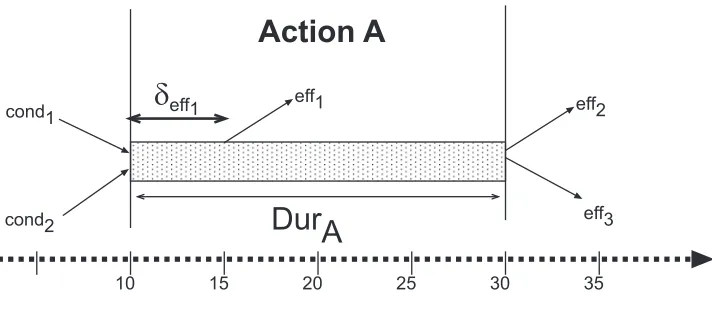
assumptions on the preconditions and effects of actions, for instance, effects happen only
at the end of the execution. In addition, the algorithm used in the solution extraction phase
of these plangraph-based systems does not take full advantage of the information provided
by the expansion phase to prune irrelevant search branches early.
With the ambition to make temporal planning problems more realistic, the thesis proposes
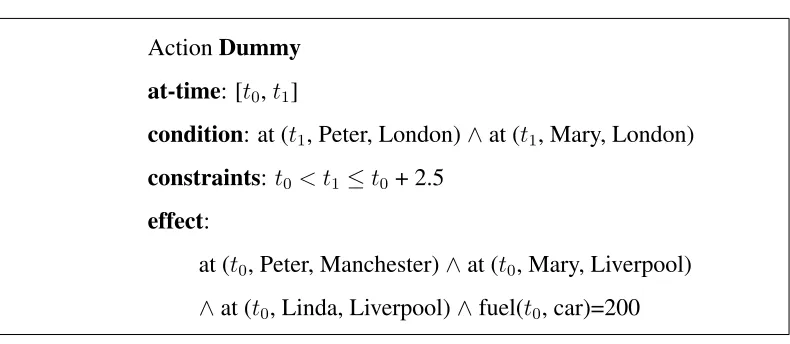
an extension to the Planning Domain Definition Language (PDDL) 2.1 level 3, to allow
actions to have intermediate effects. Our optimal temporal planning system, CPPlanner,
is introduced as the first Graphplan-based optimal planner to handle the richer temporal
domains (i.e. actions can have intermediate effects). Futhermore, the planner applies
“crit-ical paths” as a backbone for the search in the solution extraction phase, so that irrelevant
search branches are pruned early. This improves the performance even in more restricted
temporal planning domains.
In our experimental evaluation, CPPlanner outperforms two leading plangraph-based
opti-mal temporal planning systems, TGP and TPSYS, in almost all test cases. The
state-of-the-art optimal planner CPT and latest temporal planning domains in the international planning
First of all, I would like to thank my supervisors Prof. Barbara Smith and Prof. Lee
McCluskey for all their help, advice, encouragement, and friendship throughout. With
their inspiration, and help, the PhD research became easier and more attractive to me.
I would like to thank Dr. Ian Miguel for his help on ILOG Solver and AI Planning, Dr.
Stephen Cresswell for his help in compiling TGP, and fixing the parser for TPSYS, and Dr.
Diane Kitchin for her advice and enthusiasm.
I would like to thank all members of the ARTFORM research group, who have also helped
me and inspired me.
Many thanks to the staff at the University of Huddersfield, especially the technical and the
administrative staff, for their promptly support on any problems that I have encountered.
I would like to express my gratitude to my best friend, Dr. Damian Jenkinson, for his
kindness and support, especially his offer on accommodation during the writing-up stage.
I am grateful to CoThu, ChuMao, beNa, Vi, Thuy and anhTuan, who are like my family
members in England, for their help, consideration, and encouragement throughout. I will
never forget the beautiful time in Stockport.
I would like to thank Prof. Duong Anh Duc, all of my friends, and staff members at the
Faculty of Information Technology at the University of Natural Sciences, Ho Chi Minh
City, Vietnam for their support and encouragement.
I wish to show my appreciation to my girlfriend Le Hong Van for her love, support and
encouragement throughout.
Finally, and most importantly, my grandmother, parents, brother, and sisters have been
both supportive and encouraging throughout the completion of this thesis, for which I am
List of Figures vii
List of Tables ix
Chapter 1: Introduction 1
1.1 Thesis structure . . . 3
1.2 Contributions . . . 4
Chapter 2: Introduction to Artificial Intelligence Planning 6 2.1 Introduction . . . 6
2.2 Classical planning . . . 9
2.2.1 Introduction . . . 9
2.2.2 Classical planning representations . . . 10
2.2.2.1 Classical representation . . . 10
2.2.3 Introduction to planning approaches . . . 11
2.2.4 State-space planning . . . 12
2.2.4.1 Introduction . . . 12
2.2.4.2 Progressive search . . . 12
2.2.4.3 Regressive search . . . 13
2.2.4.4 STRIPS algorithm . . . 14
2.2.5 Plan-space planning . . . 15
2.2.5.1 Introduction . . . 15
2.2.5.2 Search space . . . 16
2.2.6.2 Description . . . 18
2.2.6.3 Mutual exclusion . . . 18
2.2.6.4 Graphplan planner . . . 20
2.2.7 Constraint Programming in planning . . . 21
2.2.7.1 Introduction . . . 21
2.2.7.2 Constraint Satisfaction Problem . . . 21
2.3 Planning with time and resources . . . 22
2.3.1 Planning with time . . . 22
2.3.1.1 Introduction . . . 22
2.3.1.2 Temporal representation . . . 23
2.3.1.3 Approaches in temporal planning systems . . . 24
2.3.2 Planning with resources . . . 25
2.3.2.1 Introduction . . . 25
2.3.2.2 Approaches . . . 26
2.4 Planning Domain Definition Language (PDDL) . . . 27
2.4.1 Introduction . . . 27
2.4.2 PDDL . . . 28
2.4.3 PDDL 2.1 . . . 34
2.4.4 PDDL 2.2 . . . 40
2.4.5 PDDL 3 . . . 41
2.5 An extension of PDDL2.1 level 3 to handle intermediate effects . . . 43
2.5.1 Introduction . . . 43
2.5.2 Syntax and semantics . . . 44
2.6 Summary . . . 47
3.2 Temporal Planning Systems . . . 49
3.2.1 Graphplan-based temporal planners . . . 49
3.2.1.1 Introduction . . . 49
3.2.1.2 Temporal Graphplan (TGP) . . . 50
3.2.1.3 Temporal Planning System (TPSYS) . . . 52
3.2.1.4 Linear-Programming GraphPlan (LPGP) . . . 54
3.2.2 Partial Order Planners . . . 55
3.2.2.1 Introduction . . . 55
3.2.2.2 parcPLAN . . . 56
3.2.2.3 IxTeT . . . 57
3.2.2.4 Zeno . . . 59
3.2.2.5 Constraint Programming Temporal planner (CPT) . . . . 61
3.2.3 Heuristic Planners . . . 63
3.2.3.1 Introduction . . . 63
3.2.3.2 Sapa . . . 63
3.2.3.3 TP4 . . . 64
3.3 Summary . . . 66
Chapter 4: CPPlanner - An Optimal Temporal Planning System using Crit-ical Paths 68 4.1 Introduction . . . 68
4.1.1 Towards the new extension of the plangraph framework . . . 69
4.2 Action representation . . . 69
4.3 The planning graph . . . 71
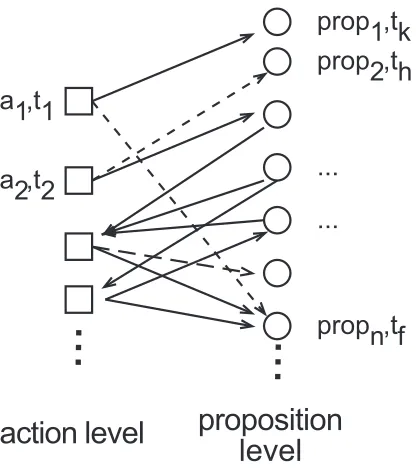
4.4 Graph Expansion . . . 73
4.4.1 The concept . . . 73
4.6 Solution Extraction . . . 84
4.6.1 The concept . . . 84
4.6.2 Critical Path extraction . . . 87
4.6.3 The algorithm description . . . 89
4.7 Summary . . . 92
Chapter 5: Improvements 94 5.1 Introduction . . . 94
5.2 Avoid redundant solution extraction calls . . . 94
5.3 Conflict Directed Backjumping . . . 95
5.3.1 Motivation . . . 95
5.3.2 Improving the search with Conflict-Directed Backjumping . . . 97
5.4 Summary . . . 97
Chapter 6: Experiments and empirical analysis 98 6.1 Introduction . . . 98
6.2 Temporal planning domains used in the experiments . . . 99
6.2.1 Temporal domainlogisticsextracted from the TGP package . . . . 100
6.2.2 Temporal domains extracted from IPC2002 . . . 101
6.2.2.1 Depots . . . 101
6.2.2.2 DriverLog . . . 102
6.2.2.3 Satellite . . . 104
6.2.2.4 Rovers . . . 104
6.2.2.5 ZenoTravel . . . 106
6.2.3 Airport- a temporal domains extracted from the IPC2004 . . . 107
6.2.4 Storage- A temporal planning domain extracted from IPC2006 . . 108
6.3.2 Temporal planning domains from IPC2002 . . . 115
6.3.3 TheAirporttemporal domain extracted from IPC2004 . . . 117
6.3.4 TheStoragetemporal domain extracted from the latest IPC2006 . . 118
6.3.5 Spacecraft - A temporal domain with intermediate effects . . . 120
6.4 Summary of the empirical study and discussion . . . 121
Chapter 7: Conclusion and future work 123 7.1 Introduction . . . 123
7.2 Summary of contributions . . . 123
7.2.1 CPPlanner algorithm . . . 123
7.2.1.1 “Critical paths” . . . 123
7.2.1.2 Extension to the algorithm to handle intermediate effects 124 7.2.2 Extension to PDDL2.1 level 3 . . . 124
7.2.3 CPPlanner - a new optimal planning system for temporal planning domains . . . 125
7.3 Further developments . . . 126
7.3.1 Memoisation . . . 126
7.3.2 Heuristic search . . . 126
7.3.3 Using current Constraint Programming Solvers . . . 127
7.4 ...and finally . . . 128
Bibliography 129 Appendix A: Comparisons a same planner on different operating systems 142 Appendix B: Planning domains and problems used in the experiment 145 B.1 Logistics domain from the TGP package . . . 145
B.2.1 Depot . . . 147
B.2.2 DriverLog . . . 149
B.2.3 Satellite . . . 153
B.2.4 Rovers . . . 155
B.2.5 ZenoTravel . . . 161
B.3 Airport domain extracted from IPC2004 . . . 163
B.4 Domain storage extracted from IPC2006 . . . 174
B.5 Domainspacecraftwith intermediate effects . . . 177
2.1 The abstract view of components in a planning system . . . 7
2.2 Pseudo-code forProgressiveSearch (O, s0, g)extracted from [42]. . . 13
2.3 Pseudo-code forRegressiveSearch (O, s0, g)extracted from [42]. 14 2.4 Pseudo-code forSTRIPS (O, s, g)extracted from [42]. . . 15
2.5 Pseudo-code for plan-space planningPSP (π)extracted from [42]. . . 17
2.6 The overview of a planning graph . . . 19
2.7 A part of gripper domain extracted from planning competition 1998 . . . . 30
2.8 Jug-pouring domain description, extracted from the AI Magazine article [73] 31 2.9 Vehicle domain description, extracted from Fox and Long’s paper [37] . . . 33
2.10 Jug-pouring domain description, extracted from PDDL 2.1 document [37] . 35 2.11 Offloading a box from a truck . . . 36
2.12 Flying from one place to another . . . 37
2.13 A part of bath-filling domain, extracted from PDDL+ [35] . . . 39
2.14 An example of a derived predicate . . . 40
2.15 Turning the spacecraft from the current target to a new target . . . 46
3.1 The causation diagram of the TGP graph expansion phase. Dark lines mean the effects happen later in time (i.e. after action execution). The figure is extracted from TGP paper [88] . . . 51
3.2 The overview of the planning graph of LPGP with duration attached to proposition level and actions are divided into smaller actions. Figure is extracted from the LPGP paper [67] . . . 54
4.1 Action representation . . . 71
4.2 The multiple-level planning graph of the plangraph approach . . . 72
4.3 The Bi-level planning graph . . . 73
4.4 The model of a plangraph-based planning system . . . 74
4.5 The Graph Expansion Diagram . . . 76
4.6 Pseudo-code forGraphExpansion(). . . 79
4.7 Pseudo-code forApplyingPossibleActions(). . . 80
4.8 Action turning of the spacecraft domain. The vibration effects prevent actioncamera chance1but notcamera chance2. . . 82
4.9 The diagram of the solution extraction . . . 85
4.10 Pseudo-code to get a decisive proposition for an action. . . 87
4.11 Pseudo-code to get all possible paths for a certain subgoal. . . 88
4.12 Pseudo-code forCriticalPath candidates extraction (). . . 88
4.13 The planning graph after the expansion phase. Note that for simplicity the full level graph is used for the illustration purpose . . . 90
4.14 Pseudo-code forSolutionExtraction (). . . 91
5.1 An example to illustrate the inefficiency in the backtracking of the solution extraction phase . . . 95
6.1 The numbers of objects in each problem of theLogisticsdomain extracted
from the TGP package. . . 101
6.2 The numbers of objects in each problem of theDriverLogdomain extracted
from IPC2002. . . 103
6.3 The numbers of objects in each problem of theSatellitedomain extracted
from IPC2002. . . 105
6.4 The numbers of objects in each problem of the Rover domain extracted
from IPC2002. . . 106
6.5 The numbers of objects in each problem of the ZenoTravel domain
ex-tracted from IPC2002. . . 107
6.6 The numbers of objects in each problem of theAirport domain extracted
from IPC2004. . . 108
6.7 The numbers of objects in each problem of the Storagedomain extracted
from IPC2006. . . 110
6.8 The numbers of objects in each problem of theSpacecraftdomain . . . 112
6.9 The comparison of different planning systems on the Logistics domain.
Time is in seconds to find an optimal solution. . . 114
6.10 Comparison to TPSYS on IPC2002 temporal planning domains. Time is in
seconds to find an optimal solution. . . 116
6.11 Comparison to CPT on theAirportplanning domain in the IPC2004. Time
is in seconds to find an optimal solution. . . 118
6.12 Comparison to CPT2 on theStorageplanning domain in the latest IPC2006.
Time is in seconds to find an optimal solution. . . 119
A.1 Comparison of CPT on Windows XP and Linux MEMPIS on domain
Air-portextracted from IPC2004. Time is in seconds to find an optimal solution. 142
A.2 Comparison of CPT on Windows XP and Linux MEMPIS on domain
Satel-liteextracted from IPC2004. Time is in seconds to find an optimal solution. 143
INTRODUCTION
It is hard to establish when Artificial Intelligence Planning (AI Planning) was first
in-troduced. It is known that AI Planning was already considered to be a subfield of Artificial
Intelligence in the late 1960s. AI Planning applications can now be found in different fields,
such as autonomous manufacturing, space exploration, and the game industry.
In our daily lives, planning problems are everywhere, e.g. going to school, going
shop-ping etc. Any of us is able to find plans in these situations. However, we have little
knowledge on how our brains work to find the solutions. The mechanism to find a good
plan for a planning problem is still a challenge to scientists nowadays.
One of the very first planning problems considered in AI was the monkey-banana
prob-lem which was proposed by John McCarthy in 1963 [70]. The initial state tells the position
of the monkey, the banana, and the chair. With actions such as walk, move the chair to
underneath the hanging banana, climb etc., the solution is a sequence of actions for the
monkey to get the banana (i.e. the goal state). In this example, John McCarthy introduced
the idea of modelling planning domains into situation calculus by using axioms.
Planning systems and definitions were gradually proposed and developed. However,
each research group developed their own planning system with their own specification
lan-guage for describing a planning domain. This was the situation until 1998, in order to
pre-pare for the first international planning competition, Drew McDermott and other members
of the committee proposed the first Planning Domain Definition Language (PDDL) [72]
to the planning community. Since then, planning systems are compared more easily using
PDDL. PDDL has been developed and extended further to model real-world domains, and
In 1995, Blum and Furst first introduced Graphplan [13] to the planning community.
The algorithm’s innovation is in forming the union of all the reachable states of a current
state together to reduce space complexity, and in finding a solution in a later stage by
backtracking search. This introduction was a big step forward in dealing with planning
problems. Years later, scientists are still working within the plangraph framework to handle
more complex problems, e.g. in temporal planning or planning with resources. Some have
extended the plangraph framework to find an optimal solution for temporal planning, while
others have used the relaxed planning graph as a part of the heuristic function for
state-space search.
However, planning is still a long way from being able to solve realistic problems
ef-ficiently. Planning problems are generally NP-complete [30], even the simple famous
BlocksWorld problems.
At the start of the research described in this thesis, TGP [88] and TPSYS [38] were
the two well-known plangraph-based optimal planning systems for temporal planning
do-mains. These planning system use the plangraph framework to find a plan with minimal
makespan. However, there are several limitations of these two systems, such as a strict
as-sumption on conditions and effects while executing actions. Effects of actions are allowed
only at the end of the action in TGP and only at the beginning or at the end in TPSYS.
Also, the approaches used in the solution extraction phase does not take advantage of all
the information available after the graph expansion phase. This motivated us to develop
CPPlanner. CPPlanner extends PDDL2.1 to allow actions with intermediate effects and
handles them using the plangraph framework. It also uses “critical paths” provided by the
expansion phase to add some actions and propositions to the final plan before the actual
backtracking search takes place. Other improvements are introduced to CPPlanner to speed
1.1 Thesis structure
The thesis is constructed as follows:
• Chapter 2: Introduction to Artificial Intelligence Planning. This chapter introduces
AI Planning. It begins with the definition of what is a planning problem, and a
so-lution to a planning problem. Different types of planning and approaches are
intro-duced. Then, the Planning Domain Definition Language (PDDL) with its extensions
is described briefly. The syntax and semantics of actions with intermediate effects
are proposed in this chapter. This extension allows actions of the current PDDL 2.1
level 3 to have intermediate effects.
• Chapter 3: Temporal Planning Systems. This chapter gives an overview of
well-known temporal planning systems. Each temporal planner is introduced briefly and
its capabilities discussed. The chapter focuses on TGP [88] and TPSYS [38], which
are the two main plangraph-based optimal temporal planning systems. These two
planners will be considered and compared directly to our system in the experimental
study.
• Chapter 4: CPPlanner - An Optimal Temporal Planning System using Critical Paths.
The chapter describes the CPPlanner framework. It begins with the plangraph
frame-work and extends it to deal with temporal domains. Extensions to handle
interme-diate effects are also illustrated. The details of the algorithms for both the graph
expansion phase and solution extraction are described fully. The use of “critical
paths”, which is one of the main contributions, is analysed and shown in detail. A
simple example is also included to illustrate the algorithm.
• Chapter 5: Improvements. This chapter contains the improvements to CPPlanner.
It introduces the timebound in selecting next actions for the search in the solution
to CPPlanner to help the planner jump right back to the origin of the conflict. These
improvements are developed and described in detail.
• Chapter 6: Experiments and empirical analysis. This chapter illustrates the
per-formance and comparison of CPPlanner to TGP and TPSYS on different temporal
domains. The domains are mainly from the planning competitions and the TGP
package. In addition, CPPlanner is compared to the state-of-the-art optimal
tem-poral planning system, CPT in latest temtem-poral planning domains in the last two
in-ternational planning competitions, IPC2004 and IPC2006. This chapter also shows
the comparison of CPPlanner with the earlier version of CPPlanner, called
CPPlan-ner Basic which does not include “critical paths” in the solution extraction phase and
the improvements of chapter 5.
• Chapter 7: Conclusion and future work. This chapter contains the summary of
con-tributions of this thesis. It also incudes the future directions for CPPlanner.
• Appendix A: Comparisons a same planner on different operating systems. The
chap-ter shows the empirical study of the performance of a planning system on different
platforms. It illustrates there is not much difference in running time if planning
sys-tems are compared under the same hardware settings but on different platforms.
• Appendix B. The chapter contains the details of test suites which were used in the
empirical study.
1.2 Contributions
This section introduces and outlines the main contributions of this thesis:
• Introduction of intermediate effects to PDDL2.1 level 3. Because of the complexity
planning, the extension in syntax and semantics of PDDL2.1 is introduced. This
introduction helps to move planning problems towards real-world problems.
• “Critical paths”. This new idea improves the performance of plangraph-based
tem-poral planning systems. The introduction of “critical paths” helps the solution
extrac-tion phase add acextrac-tions and proposiextrac-tions before the actual search takes place. Note
that with actions and propositions being added to the plan early, the search for
so-lutions will be improved even when actions do not have intermediate effects.
Time-bounds and conflict directed-backjumping are also introduced to the backtracking
search of the solution extraction phase to reduce the search space.
• Development of CPPlanner. CPPlanner is developed with the ability to handle
tem-poral planning domains with intermediate effects. The new improvements of the
solution extraction phase are included and tested. The planner shows the efficiency
of the development via experimental results.
• Empirical analysis of CPPlanner and the introduction of a planning domains with
intermediate effects. It contributes to the planning community the comparison of
CPPlanner and other optimal temporal planning systems, TGP and TPSYS, on many
temporal planning problems. The comparison to CPT is also included. Especially, a
new temporal planning domain with actions and intermediate effects are introduced.
INTRODUCTION TO ARTIFICIAL INTELLIGENCE PLANNING
2.1 Introduction
Artificial Intelligence planning (AI planning) has been a sub-field of Artificial Intelligence
since the 1960s [79, 70, 71, 44]. It is a well-known area in Artificial Intelligence that studies
to build algorithms and techniques for planning. AI Planning is applied in many areas in
the real world such as automated data-processing [43, 17], autonomous manufacturing [75]
and [45], space exploration [74, 18, 86, 57], robotics [11, 10, 12, 9], game industry [93],
and large-scale logistics problems [104]. Scientists have studied and developed efficient
algorithms and models to deal with real world problems due to their size and complexity.
An overview of progresses and algorithms in AI Planning can be found in [101, 87, 66].
This chapter will describe briefly the definition of planning problems, types of planning,
approaches and techniques, and the description language used in the International Planning
Competitions: PDDL.
Firstly, it is necessary to define what is a planning problem. Different researchers have
different definitions of planning problems. However, below is the common definition of
what is a planning problem.
Definition 2.1 A planning problem is described as an initial state containing propositions,
a goal state (i.e. a set of propositions called subgoals) to be achieved, and a collection of
actions, in which each has a set of preconditions (which need to be true for the action to
be executed) and a set of effects (which will be true when the action is applied).
will transform the initial state to a state that satisfies all the propositions/subgoals of the
goal state.
In everyday usage, planning is the process of finding a plan for a given initial state and
goal state before actually executing any of them. For example, when we are cooking, we
have a plan which shows a sequence of actions that we will follow. These actions have to
be followed in a predefined order.
initial
state
actions
execution
the world
goal
state
planning
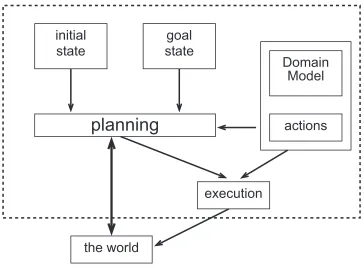
[image:21.595.142.506.264.532.2]Domain
Model
Figure 2.1: The abstract view of components in a planning system
Figure 2.1 shows the general view of components of a planning system. Given a initial
state, a goal state, and a list of available actions, the planning system looks for a sequence
of actions to achieve the goal state. When the plan is executed, the actions are applied to
change from one state to another in the world to achieve the pre-defined goal state. The
initial state, the goal state and actions are defined depending on the type of planning and
With the hope of encouraging researchers to share their planning problems and
algo-rithms, as well as to allow comparisons on performance of different planning systems, the
Planning Domain Description Language (PDDL) was first proposed in 1998 by a
commit-tee led by McDewmott [72], and then extended by Fox and Long in 2002 [34], EdelKamp
and Hoffmann in 2004 [27], and Gerevini and Long in 2006 [40]. The language has been
used as a standard for modelling planning problems. The detail of the language is discussed
later in this chapter.
AI Planning is categorized into different types, such as classical planning, planning
with time and resources, planning under uncertainty, according to the expressivity of the
representation of the planning problem (or the planning language required to describe the
planning problem). The more expressive the planning language is, the bigger the search
space to find a plan becomes. In the scope of this thesis, classical planning and its
ap-proaches are introduced and described briefly. The main focus is on temporal planning (i.e.
planning with time).
However, there are other ways to classify a planning system. It can be classified as a
domain-independent planner, or adomain-dependent planner, in which some hand-coded
knowledge is provided for the domain.
Besides, planning systems might be classified according to the algorithms and
tech-niques used, such as Graphplan-based planners (e.g. IPP [60], STAN [33], TGP [89]), SAT
planners [56, 54], and HTN planners [103, 19, 76] etc.
The next sections introduce classical planning, and planning with time and resources.
In each section, the representation and planning approaches, including algorithms and
2.2 Classical planning
2.2.1 Introduction
Early research in AI Planning was related to automated theorem proving [44]. In these
systems, the initial state, goal state and actions are described in terms of axioms. Resolution
theorem proving was used to produce a proof that a plan exists, and the actual plan found
by applying answer extraction to the proof. However, those systems faced difficulties when
it was required to specify axiomatically not only the changes that an action makes to a state
but also the elements left unchanged. This encouraged the development of the classical
formulation which introduced a simple solution to those types of problems.
Classical planning is a type of planning for restricted state-transition systems. These
restricted systems have the following assumptions:
• The system has a finite set of states.
• The system is fully observable.
• The system is deterministic, i.e. a possible application of an action to a state only
brings it to a single other state.
• The state remains unchanged until another application of an action.
• Actions have no duration.
• Goals are restricted and explicit. It means there are no constraints or conditions on
the goal state.
• The solution is a sequence of linearly ordered finite actions.
2.2.2 Classical planning representations
In AI Planning, it is essential to have a description of the planning problem for planners.
There are different types of representations [42] for classical planning: set-theoretic
rep-resentation,classical representation, andstate-variable representation. These
representa-tions have equivalent expressivity. It means that a planning problem can be represented
equally well in any of those representations. In AI Planning, the classical representation
is the most popular and often used by the community. The section below describes the
classical representation.
2.2.2.1 Classical representation
In classical representation, states are represented as a set of logical atoms. Actions are
represented asoperatorswhich change the truth values of atoms.
Firstly, the first-order language L has finite predicate symbols and constant symbols,
but no function symbols. A state is a set of atoms of L. Because L is finite and has no
function symbol, the set of all possible statesSis finite.
Definition 2.3 An operator is a tripleo= (name(o), precond(o), effect(o)), in which:
• name(o) is the name of the operator. It is an expression in the form of n(x1, ...,xk)
where n is the operator symbol, and is unique; and every xi is a variable symbol
which can appear anywhere ino.
• precond(o) and effect(o) are preconditions and effects of the operator. These
precon-ditions and effects are sets of literals (i.e. atoms and negations of atoms).
• The application of an instance of the operator to a state is described as follows:γ(s,
a) = (s\effect−(a))∪effect+(a).
Definition 2.4 LetLbe a first-order language, aclassical planning domainis a restricted
• S⊆2{allgroundatomsofL}
• A ={all ground instances of operators inO}
• γ(s, a) = (s\effect−(a))∪effect+(a), if ais applicable to the states. The new state
constructed is inSas well.
Definition 2.5 Aclassical planning problemis tripleP= (Σ,s0,g), in which:
• s0is the initial state.
• gis the goal state - a set of literals which need to be achieved.
2.2.3 Introduction to planning approaches
There are many different algorithms and techniques to deal with a wide variety of planning
problems [87]. Some planning systems solve planning problems by searching through a
graph representing the state space [77, 50, 6]. Each node in this space presents a state of
the world. Arcs are state transitions or actions. Therefore, a plan is a path starting from
the initial state, going through intermediate states, and ending at a goal state by applying a
sequence of actions. This is calledstate space planning.
Other planning systems solve planning problems by searching through a space of plans
[82, 8]. This approach is calledplan space planning. Each node in this space is a partially
specified plan. Arcs are plan refinement operations to achieve an open goal or to remove
a possible inconsistency. In this approach, the planning system starts from an initial node
which is an empty plan. The planner, then, is aiming at the final node containing a plan,
which achieves the goal.
The planning graph approach is a synthesis of state space planning and plan space
planning. It introduces a compact and powerful search space, which is called aplanning
graph. Starting from the initial state, also called the first level, the approach builds a next
same level, if two or more states have parts in common, those parts are stored only once.
Hence, the size of the graph is much smaller than the graph in the state space planning.
In addition, there are other approaches which apply Constraint Programming (CP),
Satisfiability (SAT) techniques, or heuristics.
Those approaches can be applied to both classical planning and planning with time
and resources. In the next sections, the classical representation is used in describing the
approaches for classical planning. For planning with time and resources, the planning
systems can use the same approaches but with extensions.
2.2.4 State-space planning
2.2.4.1 Introduction
As described earlier, in state-space planning, each node represents a state of the world. Arcs
are state transitions. The solution plan is a path in the search space. In classical planning,
classical state-space search algorithms are easy to understand. There are two approaches:
progressive andregressive search: starting from the state representing the initial state or
goal state respectively, the planning system searches through the state space to find the
solution path leading to the goal state or initial state respectively. These two approaches
are discussed in more detail in the following sections.
2.2.4.2 Progressive search
Progressive search, also known asforwardsearch, is one of the simplest search algorithms
in AI Planning. Starting from the initial state, the planner searches the state space to find
a solution path leading to the goal state. Figure 2.2 is a general pseudo-code example of a
progressive search algorithm in AI Planning:
In figure 2.2, the algorithm is a depth-first backtracking search. The algorithm might
end up in an infinite search branch if there is a state si with i < kin the sequence s0, s1,
01. ProcedureProgressiveSearch(O,s0,g) 02. s←s0
03. π← {}//an empty plan
04. Loop
05. ifgis a subset of s then returnπas the solution plan and terminate 06. // store the list of all possible actions
07. possActions←a|a∈O and precond(a) is satisfied ins
08. IfpossActions=∅thenreturn failure and backtrack 09. // Try each action in the possible list
10. Foreach aiinpossActionsdo
11. s←γ (s, ai)
12. π←πLai
13. run theloopto continue
14. od{end for}
[image:27.595.155.508.118.427.2]15. End{loop}
Figure 2.2: Pseudo-code forProgressiveSearch (O, s0, g)extracted from [42].
return to this state. In order for the algorithm to be complete, these infinite search branches
must be pruned (i.e. the algorithm must check and return failure at any time it finds a state
which is the same as a state earlier in the listπ).
2.2.4.3 Regressive search
Regressive search, also known asbackwardsearch, is another approach in state-space
plan-ning. The solution plan is extracted from the state space by starting the search from the
goal state, traversing through other states backwards, and ending at the initial state. The
figure 2.3 shows the pseudo-code of the regressive search.
Like the progressive search, the regressive search also keeps a record of the list of state
01. ProcedureRegressiveSearch(O,s0,g) 02. s←g
03. π← {}//an empty plan
04. Loop
05. ifs0is a subset of s then returnπas the solution plan and terminate 06. // store the list of all possible actions
07. possActions←a|a∈O and effect(a)∩s6=∅
08. IfpossActions=∅thenreturn failure and backtrack 09. // Try each action in the possible list
10. Foreach aiinpossActionsdo
11. s←γ−1(s, a
i)
12. π←ai
L π
13. run theloopto continue
14. od{end for}
[image:28.595.151.504.119.428.2]15. End{loop}
Figure 2.3: Pseudo-code forRegressiveSearch (O, s0, g)extracted from [42].
failure whenever it finds a state sj, in which j>k and sj ⊆sk.
2.2.4.4 STRIPS algorithm
In the previous two sections, the progressive and regressive search are introduced.
How-ever, the size of the search space is very big. The STRIPS algorithm [31], which was
developed by Fikes and Nilsson in 1971 at Stanford university, is one of the first attempts
to reduce the search space. The algorithm is very similar to regressive search, but is
differ-ent in the following respects:
• In each recursive call to the STRIPS algorithm, only actions which have a part of their
effects in common with the preconditions of the last chosen action are considered.
01. ProcedureSTRIPS(O,s,g) 02. π← {}// an empty plan
03. Loop
04. ifssatisfies g then returnπ
05. A← {a|ais a ground instance of an operator in O, 06. and a is relevant forg}
07. if A =∅then return failure.
08. choose any actiona∈A nondeterministically. 09. π’←STRIPS(O,s, precond(a))
10. ifπ’ = failure then failure
11. s←γ−1(s,π’) 12. s←γ−1(s,a) 13. π←π.π’.a
[image:29.595.187.485.121.411.2]15. End{loop}
Figure 2.4: Pseudo-code forSTRIPS (O, s, g)extracted from [42].
• If at the current state, an action has all of its preconditions satisfied, STRIPS will
execute the action and not backtrack over this commitment.
2.2.5 Plan-space planning
2.2.5.1 Introduction
This section introduces plan-space planning. In state-space planning, nodes represent states
of the search space, arcs are transitions or actions between states, and a solution plan is a
path of states from the initial state to the goal state. However, in plan-space planning, as
described earlier, nodes arepartially specified plans. Arcs areplan refinement operations
which further complete a partial plan. Starting with an empty plan, the algorithm goes
achieve all the goals.
2.2.5.2 Search space
A solution plan is a sequence of actions which is organised in an order to achieve the goal.
A partial plan can be considered as any subset of actions of this sequence.
A partial plan is gradually refined by adding actions, add ordering constraints for
ac-tions, adding causal links, and variable binding constraints. Ordering constraints tell the
system the relationship between actions, i.e. which one needs to be done before the other.
A causal link is added when a precondition of an action is supported by another action.
Variable binding constraints make sure concerned objects of the relating actions are bound
together.
A plan space is a directed graph in which vertices are partial plans and edges are
re-finement operations. The directed edge from vertexAto vertexBmeans a refinement that
transform partial planAto a successor partial planB. The refinement operation can be one
or more of the followings:
• Adding an action toA.
• Adding an ordering constraint to actions inA.
• Adding a causal link intoA.
• Adding a varible binding constraint toA.
Planning for this approach is a search through this directed graph, starting from the
initial partial plan to the solution plan. For each partial plan, there are subgoals which are
unsupported preconditions. The refinement tries to add things into the partial plan while
01. ProcedurePSP(π)
02. flaws←OpenGoals(π)∪Threats(π) 03. ifflaws=Øthen return(π)
04. select anyflawsφ∈flaws
05. ψ←Resolve(φ,π)
06. ifψ=Øthen return(failure)
07. choose aω∈ψnondeterministically
08. π’←refine(ω,π)
09. return(PSP(π’))
Figure 2.5: Pseudo-code for plan-space planningPSP (π)extracted from [42].
2.2.5.3 Algorithms
A general algorithm for plan-space planning is described as in figure 2.5.
The algorithm starts with a partial plan, and tries to find its flaws, i.e. itsopengoalsand
itsthreats. Then, the algorithm selects one of these flaws and tries to find ways to resolve
it. Next, it will choose a resolver for the flaw and refine the partial plan.
The process of finding flaws consists of finding opengoals and threats. Opengoals are
preconditions which are not supported by a causual link yet. Threats are actions which
cause problems to the causal link of other two actions (i.e. akthreatens the causal link ai
→aj). Finding threats can be done by checking all triple of actions (ai, aj, ak) in the partial
plan.
The process of resolving consists two parts: resolving opengoals and resolving threats.
To resolve an opengoal is to find an action which can provide that proposition (i.e.
open-goal). To resolve the threat ak of the causal link ai → aj is to put a constraint forcing
2.2.6 Planning graph
2.2.6.1 Introduction
In state-space planning, the plan is a sequence of actions, whereas in plan-space planning,
planners synthesize a plan as partially ordered set of actions, i.e. any sequence that meets
the constraints of the partial order is a valid plan. The planning graph approach applies
both. The approach was first introduced by Blum and Furst in 1995 in the Graphplan
planner [13]. The planning graph isdirected layered graph, which is constructed based on
the reachability analysis (Note:see the next section for details of constructing the graph).
The planning graph approach has been analyzed, extended and improved in many
plan-ning systems to speed up the search [22, 13, 38] or deal with more expressive planplan-ning
domains. In addition, it has also been modified as a relaxed planning graph to build up
heuristic functions [80, 23, 49, 14] to guide the search in bigger and more complicated
domains.
2.2.6.2 Description
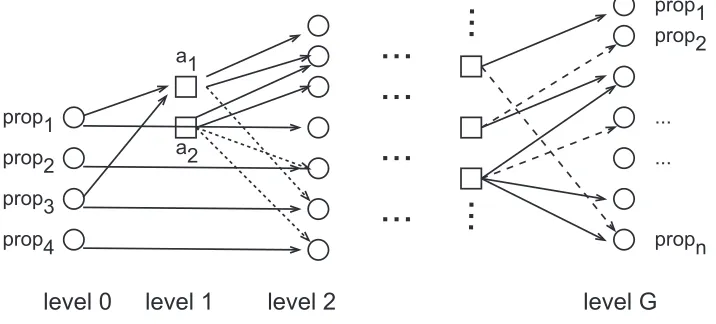
Starting from the initial state in the level 0, the planner will find all the possible actions
includingno-opactions (i.e. actions doing nothing) which have preconditions in level 0 to
construct the level 1. This means that level 2 contains all the propositions which could be
true as a result of applying all possible actions to the initial state. The process repeats to
construct the whole planning graph. Thus, the planning graph is a directed layered graph
which alternates between a level of propositions and a level of actions.
In the planning graph, each proposition level is a union of all possible states of that
level. The figure 2.6 below illustrates an example of a planning graph.
2.2.6.3 Mutual exclusion
With the construction of the planning graph described in the above section, a certain
level 0 level 1 level 2
...
... a1
a2
...
...
...
...
...
...
prop2 prop1
propn
level G
prop1 prop2 prop3 prop4
Figure 2.6: The overview of a planning graph
the algorithm stores states as a union of them, there might be two actions which cannot
hap-pen simultaneously due to a conflict in preconditions or effects. For example, an action may
delete preconditions of another action. Hence, not all the propositions of the proposition
level may be simultaneously true. Therefore, themutual exclusion relations, also called as
mutex relationsormutexes, are introduced to identify whether actions or propositions can
appear simultaneously.
Definition 2.6 Two actions a and b aremutexif:
• [Inference]either action deletes a precondition or an added effect of the other
ac-tions.
• [Competing needs] A precondition of a is logically inconsistent with a precondition
of b in the previous level.
Definition 2.7 Two proposition p and q are mutex if:
• All possible ways to create p are logically inconsistent with all possible ways to
create q.
2.2.6.4 Graphplan planner
The Graphplan planner [13] was introduce by Blum and Furst in 1995. It is an optimal
planner which finds an optimal solution (i.e. using the minimal steps) for classical planning
domains.
Graphplan contains two phases: the graph expansion and the solution extraction. In
the graph expansion, from the initial state, the planner applies possible actions and their
effects to advance the planning graph to the next level. The process is repeated until all
of the propositions of the goal state appear and are pairwise non-mutex. At this time,
the solution extraction is called to look for a solution in the planning graph. In the solution
extraction, starting from the propositions of the goal state, the planner looks for all possible
supporting actions and tries to add them into the plan. The preconditions of these selected
actions are then added. If it leads to a dead-end in the search tree, the planner will backtrack
and try other actions. The process continues to search backwards towards the initial state.
If it reaches the initial state, a solution is found and is optimal. At this time, the algorithm is
terminated. Otherwise, if all possible search branches have been tried, the graph expansion
is called again to advance the planning graph to the next level. If the planning graph has
levelled-off (i.e. the new level is the same as the previous one), there is no solution and the
algorithm stops.
The extension of Graphplan to deal with temporal planning is discussed in detail in
the next chapter. It describes the detail of the algorithms of TGP and TPSYS and the
improvements over Graphplan. Chapter 4 then describes in detail CPPlanner, which uses on
the planning graph to deal with temporal domains in which actions can have intermediate
2.2.7 Constraint Programming in planning
2.2.7.1 Introduction
Constraint programming is a very powerful approach to find an optimal solution. Encoding
the planning problems as CSPs [97, 22, 69, 68, 96] allows to use efficient built-in search
al-gorithms and techniques in Constraint Programming Solvers. Graphplan has been adapted
to use constraint programming [22, 68] and is a typical example to show that planning
problems can be encoded to CSPs and solved using CSP algorithms.
2.2.7.2 Constraint Satisfaction Problem
A constraint satisfaction problem is defined as P = (X, D, C), in which:
• X ={x1, x2, ..., xn}is a finite set of variables.
• D ={D1, D2, ..., Dn}is a set of finite domains for corresponding variables, xi ∈Di.
• C ={c1, c2, ..., cm}is a finite set of constraints.
Definition 2.8 A solutionto a CSP is an assignment of (v1, ..., vn), in which vi ∈Di, to
variables (x1, ..., xn) which satisfy all of the constraints in C.
For example, in Graphplan, the solution extraction process can be encoded as a dynamic
constraint satisfaction problem [22]. In this encoding, variables are propositions which
are looking for supporting actions. Thedomain for each variable consists of all possible
supporting actions of that proposition. The CSP starts with variables of all propositions
in the goal state. Each time new propositions appear which are preconditions of chosen
actions, new variables are created and added to the CSP. The CSP solver tries to look for
a possible assignment to variables. If there is a solution for the CSP problem, it is then
Constraint programming is successfully used for resource allocation and scheduling
problems. In AI Planning, applying constraint programming is still at the early stage.
However, it is a promising approach for AI planning, especially for optimal planning
sys-tems. Besides the above example of encoding the solution extraction of Graphplan into
CSP, there have been a few studies of applying constraint programming into AI Planning,
such as CPlan developed by Peter van Beek [97], Encoding Temporal Planning as CSP by
Mali [69], Generalizing GraphPlan by Formulating Planning as a CSP [68], and Utilizing
Structured Representations and CSPs in Conformant Probabilistic Planning [52].
2.3 Planning with time and resources
In classical planning, actions are assumed to have no duration. The actions can take place
instantaneously. However, this is unrealistic. In addition, resources are also considered in
real world problems. For instance, in order to fly from city A to city B, it will take durAB
time and consume fuelAB. With the ambition to deal with real world problems, temporal
planning and planning with resources have been introduced.
With the introduction of time into planning, actions can take place concurrently as long
as they are not in conflict with one another. Hence, the plan is now a sequence of actions
attached with their starting time. With time and resources, the expressivity of the problem
description increases, and so does the complexity. The search space becomes much bigger
comparing to that of the classical planning. The next sections will show an overview of
planning with time and resources.
2.3.1 Planning with time
2.3.1.1 Introduction
Unlike classical planning, in temporal planning, actions now have duration. This section
2.3.1.2 Temporal representation
According to the description of a temporal planning domain in the book [42], it has:
• constant symbolsare objects in the planning domains, such as cars, places, people.
• variable symbolsare eitherobject variablesthat are typed variables ortemporal
vari-ables.
• relation symbolsare either rigid relation symbolsrepresenting relations that do not
change during time, for example attach(crane, location), orflexible relation symbols
representing relations of the constants that may or may not hold at some instant for a
planning problem, for example at(car1, London).
• constraintsare eithertemporal constraintswhich reside within point algebra
calcu-lus, e.g. t1<t2, orbinding constraintson object variables, which are expressions of
the form x=y, x6=y and x∈D, with D being a set of constant symbols.
The rigid relations and binding constraints are object constraints, which are
time-invariant in this representation scheme.
Thetemporally qualified expressionis an expression in the form: ρ(ζ1,...,ζk)@[ts, te).
in which,ρis a flexible relation,ζiis a constant or object variable, and ts, teare temporal
variables, such that: ∀t∈[ts, te),ρ(ζ1,...,ζk) holds at t.
A temporal databaseis defined asφ = (F, C), in which F is a finite set of temporally
qualified expressions, and C is a finite set of temporal and object constraints.
Atemporal planning operator is a tuple o = (name(o), precond(o), effects(o), const(o),
in which:
• name(o) is in the form of o(x1, ..., xk, ts, te) such that o is the operator symbol, x1, ...,
• precond(o) and effects(o) are temporally qualified expressions.
• const(o) is a conjunction of temporal constraints and object constraints.
An action is an instance of the operator. The action a is applicable to φ=(F, C) iff
precond(a) is supported by F within some consistent constraints.
2.3.1.3 Approaches in temporal planning systems
This section describes a brief introduction to different approaches and techniques in
tem-poral planning, and illustrates temtem-poral planning systems. Chapter 3 will discuss in detail
these temporal planners.
Simple Temporal Constraint Problem (STP) and Temporal Constraint Network Problem
(TCSP), which were introduced by Dechter et al. [21], have been widely used in several
temporal planning systems [15, 51, 18], and many improvements have been introduced
[16].
In temporal state-space planning, planning systems have applied heuristics to guide the
search, such as TLplan [4], and later developments [5, 7, 3], TALplanner [24, 62, 61, 25],
and the HS planner [41].
In plan-space planning, ZENO planner [83] dealt with rich representations with variable
durations and linear constraints. It is one of the earliest planning systems which can deal
with complex planning domains including deadline goals, metric conditions and effects,
and continuous changes.
In the planning graph approach, TGP [89], TPSYS[38], and SAPA [23] deal with
du-rative actions. TGP and the early version of TPSYS extend the Graphplan planner to find
an optimal solution for temporal planning domains. SAPA applies a heuristic search based
on the planning graph.
In HTN planning, several planning systems, such as O-Plan [19], and SHOP2 [78] use
These approaches proved to successfully perform at the International Planning
Com-petition 2002. However, they make restrictive assumptions on actions, such as that actions
only have effects at the beginning or at the end of their execution.
2.3.2 Planning with resources
2.3.2.1 Introduction
Resources are an important part of making planning domains/problems more realistic.
However, since our main topic is working on temporal planning and planning systems,
planning with resources is not discussed in very detail. The section only gives an overview
of planning with resources.
In planning problems, resources can be categorized into two types: consumable
re-sources andreusableresources.
A consumable resource is consumed by an action during its execution. Fuel is a typical
example of a consumable resource. A reusable resource is used by an action during its
exe-cution; the resource is then released and unchanged when the action finishes. For example,
cars, locations are reusable resources.
Reusable resources are constraints on the number of actions which can perform in
par-allel, whereas consumable resources are constraints on whether the action can perform
freely during the lifespan of the plan.
Consumable resources are quantitative resources. These are encoded as a quantity with
a state. The value of this resource is often numeric. The consumption of this resource will
reduced its value accordingly. In some planning domains, there are actions which allow to
restore this resource. For example, an action drive(car, A, B) can consume an amount of
fuel. Another action refuel(car) can restore the fuel level for the car.
Reusable resources are qualitative resources. They are represented by the states of
objects. For example, when a robot arm is empty (or available), it means it is ready for
2.3.2.2 Approaches
There are several approaches to deal with planning domains with resources. In the work
of Srivistava and Kambhampati [94, 95], the authors tried to separate resources from
plan-ning. Resources are then managed and attached into the skeletal plan which is constructed
without resources earlier. The main difficulty of this idea is when the resource constraints
are too tight. In this case, it is very difficult to manage them into the skeletal plan. Because
of this difficulty, the attempt to separate resources from planning has been abandoned.
Many researchers have studied and implemented several planning systems to handle
resources. Penberthy and Weld [83] introduced ZENO planner, Laborie and Ghallab with
IxTeT [63], or Drabble and Tate with O-Plan [26], or Koehler’s work [58, 59] with
intro-duction of resources into the Graphplan framework. ZENO, IxTeT, and O-Plan are among
earliest planners which can handle planning domains with resources. However, due to the
limitation of the approaches they used at that time, their performance was not as good as
the current planning systems with new approaches.
The common idea in those systems is to consider resources as constraints and use
spe-cialized solvers to deal with these constraints. Dealing with resources makes planning
sim-ilar to scheduling. Systems, such as O-Plan and IxTeT, have used scheduling techniques to
solve the planning problems. O-Plan with optimistic and pessimistic resource profile, and
IxTeT identifying the minimum critical set of actions which have resource conflicts.
In ZENO, IxTeT, RealPlan and Koehler’s work, they also consider time as a resource.
ZENO and IxTeT used interval representation for actions and propositions, and applied
constraint programming techniques to manage the relationships between intervals. In
Re-alPlan and Koehler’s work, time is considered as steps, in which each corresponds to a set
2.4 Planning Domain Definition Language (PDDL)
2.4.1 Introduction
The Planning Domain Definition Language (PDDL) was introduced in order to help the
planning community to share planning models, problems and be able to compare their
systems. It became the standard language for the first International Planning Competition in
the community in 1998. Our planning system, CPPlanner, also uses PDDL as the language
for planning domains and problems. This section describes an overview of the language
and its development in the last few years.
Planning Domain Definition Language (PDDL) was first introduced by McDermott in
1998 with the purpose to make a standard planning language for the first International
Planning Competition. Since then, it has been accepted and widely used by the planning
community to share and exchange planning models. PDDL is an action-based planning
definition language, which was mainly inspired from the ideas of STRIPS. In the first
international planning competition in 1998, it was used as the standard definition language
for all participating planners. Before the introduction of PDDL, in the planning community,
each planning system used its own conventions on the input and output data. This caused
difficulty in comparing and sharing planning models. PDDL provides the standards for the
input and output data for planning systems. PDDL encourages scientists to develop and
compare the performance of their systems.
With the ambition to deal with realistic planning problems, PDDL has been extended
with more expressivity to describe more complex and realistic planning domains. In 2002,
it was extended to PDDL 2.1 which is able to model temporal planning domains and
do-mains with resources. In the international planning competition 2004, PDDL was extended
to PDDL 2.2, which added derived predicates and timed initial literals. Recently, Gerevini
and Long [40] extended it further by allowing to express strong and soft constraints on
plan trajectories (i.e. constraints over possible actions in the plan and intermediate states
constraints are ones attached with weights or values which are desired to be satisfied as
“much” as possible. They also proposed strong and soft problem goals (i.e. goals that must
be achieved in any valid plan, and goals that we desire to achieve, but that do not have to be
necessarily achieved). The following sections will introduce PDDL and its development.
2.4.2 PDDL
PDDL uses Lisp-like syntax to describe planning problems. It was built based on the
for-malisms of existing planning systems at that time, such as STRIPS [31], ADL [81], UCPOP
[82]. It is an action-centered language. PDDL separates planning domain descriptions
from problem descriptions. The planning domain description shows the general domain
behaviours via parameterised actions. The problem description contains initial state and
goal state of the problem. A planning problem is a pair of a domain description and a
problem description. Normally, one domain description can be paired with many problem
descriptions to create different planning problems in the same domain.
In the domain description, actions are described at an abstract level. In addition to
preconditions and effects, actions also have parameters which are assigned values when
the actions are applied. The preconditions and effects (i.e. post-conditions) are logical
propositions, objects and logical connectives.
Because PDDL is a general planning language, many planners just support a part of
it. In a domain description, requirements are introduced so that planning systems know
quickly whether they can handle it. Below are the most commonly-used requirements:
:strips
Description consists STRIPS only. :typing
Domains uses types. It is used to declare parameter and object types.
Some or all of the domain description
uses ADL syntax, e.g. actions have quantified and conditional effects, disjunctions and quantifiers in preconditions and goals. :equality
Domain uses "=" predicate as equality
In the original PDDL, the semantics is not formally described for the syntax proposed.
However, the language is widely accepted by the planning community. The language has
the power to express types of objects in planning domains, constrain types of arguments of
predicates, actions with negative preconditions or conditional effects etc. These expressive
abilities were fully described and proposed as ADL. It also attempted to form a standard
syntax for describing hierarchical domains which are used in HTN planners. However,
this attempt of proposing a standard syntax for hierarchical domains was not successfully
explored and was removed in PDDL 2.1. In addition, it also tried to propose a standard
syntax for numeric-valued fluents. However, in the planning competition in 1998 and even
2000, this part of the language is not applied.
Figure 2.7 shows a simple example of a domain description. This domain description
(define (domain gripper-strips) (:predicates (room ?r)
(ball ?b) (gripper ?g) (at-robby ?r) (at ?b ?r) (free ?g)
(carry ?o ?g)) ...
) )
(define (domain jug-pouring)
(:requirements :typing :fluents) (:types jug)
(:functors
(amount ?j -jug) (capacity ?j -jug)
-(fluent number)) (:action empty
:parameters (?jug1 ?jug2 - jug) :precondition (fluent-test
(>= (-(capacity ?jug2) (amount ?jug2)) (amount ?jug1))) :effect (and (change (amount ?jug1) 0)
(change (amount ?jug2)
(+ (amount ?jug1)(amount ?jug2))))) )
The example in the figure 2.8, shows how a planning system can tell from the domain’s
requirements whether or not it can handle the domain. For example, in the requirements of
the domain, the planner is required to handle fluents.
In PDDL, numbers are supported, and numeric quantities can be assigned and updated.
Figure 2.8 is also an example of numeric fluents used in PDDL. In this example, the water
is poured from jug1 to jug2 with the condition that jug2 is big enough to hold the water
from jug1. The effect of this action updates the quantities in each jug by a discrete
quan-tity. PDDL is also tweaked to handle resource consumption without using numeric fluents.
Figure 2.9 shows that the fuel is consumed by the car when it moves from one location to
(define (domain vehicle)
(:requirements :strips :typing)
(:types vehicle location fuel-level) (:predicates
(at ?v - vehicle ?p - location) (fuel ?v - vehicle ?f - fuel-level)
(accessible ?v - vehicle ?p1 ?p2 - location) (next ?f1 ?f2 - fuel-level))
(:action drive
:parameters (?v - vehicle ?from ?to - location ?fbefore ?fafter - fuel-level)
:precondition (and (at ?v ?from) (accessible ?v ?from ?to) (fuel ?v ?fbefore) (next ?fbefore ?fafter)) :effect (and (not (at ?v ?from))
(at ?v ?to)
(not (fuel ?v ?fbefore)) (fuel ?v ?fafter)))
)
Because of the complexity of PDDL, the first International Planning Competition in
1998, there were only 5 participants, in which three planners only supported STRIPS,
and the other two supported STRIPS/ADL. To encourage more participants, in the
sec-ond competition in 2000, the PDDL was restricted. In particular, negative precsec-onditions
were removed; parsing of ADL actions was simplified to avoid unnecessary “nesting”; and
objects were explicitly listed in the problems.
In short, the PDDL is the first planning language which is recognised and widely used
by the community. It helps the community to share planning problems, resources and
compare planning systems’ performance. However, the semantics need to be formally
defined. In addition, in order to encourage more people using PDDL as a standard language
for planning domains and problems, more structure, guidelines and supporting tools need
to be developed and introduced.
2.4.3 PDDL 2.1
PDDL 2.1 [37] was based on the original PDDL with the extension to allow numerical
vari-ables, and concurrent execution of durational actions. This extension was introduced in the
international planning competition in 2002. PDDL 2.1 has 5 levels, in which level 1 is
ADL planning, level 2 adds numerical variables, level 3 introduces discretised durative
ac-tions, and level 4 extends level 3 to allow continuous durative actions under certain restrict
assumptions. Finally, level 5, which is also known as PDDL+, removes the assumptions
and introduces processes and events allowing to model complex discrete and continuous
real-time systems. The higher the level is, the more expressive language is. However,
be-cause planning systems could not handle the complexities of level 4 and 5, only the first 3
levels were used in the planning competition in 2002. The syntax and semantics of the first
3 levels are formally defined in [37]. Level 4 and 5 were defined in [35].
CPPlanner, the system described in this thesis, deals with PDDL 2.1 level 3 with some
(define (domain jug-pouring)
(:requirements :typing :fluents) (:types jug)
(:functions
(amount ?j -jug) (capacity ?j -jug) (:action pour
:parameters (?jug1 ?jug2 - jug)
:precondition (>= (- (capacity ?jug2) (amount ?jug2)) (amount ?jug1)))
:effect (and (assign (amount ?jug1) 0) (change (amount ?jug2)
(increase (amount ?jug1)(amount ?jug2))))) )
Figure 2.10: Jug-pouring domain description, extracted from PDDL 2.1 document [37]
In PDDL 2.1, levels 1 and 2 have some minor modifications to the original PDDL
in order to simplify the parsing and the language. For example, instead of using change
to assign a numeric value to an object, PDDL 2.1 uses assign as direct assignment, and
increase and decrease as relative assignments, which makes the language clearer. The
declaration of functions is modified to allow only numeric-valued functions. PDDL2.1 has
functions in types ofobjects → R, whereas in original PDDL, functions are in types of
objects →object, allowingobjectto be extended by the application of functions to other
objects. With the consideration that numbers do not exist as independent objects in the
world but as attributes of objects, numeric expressions are only allowed as arguments to
predicates or values to action parameters.
![Figure 2.2: Pseudo-code for ProgressiveSearch (O, s0 , g) extracted from [42].](https://thumb-us.123doks.com/thumbv2/123dok_us/378081.1038506/27.595.155.508.118.427/figure-pseudo-code-for-progressivesearch-s-extracted-from.webp)
![Figure 2.3: Pseudo-code for RegressiveSearch (O, s0 , g) extracted from [42].](https://thumb-us.123doks.com/thumbv2/123dok_us/378081.1038506/28.595.151.504.119.428/figure-pseudo-code-regressivesearch-o-s-g-extracted.webp)
![Figure 2.4: Pseudo-code for STRIPS (O, s, g) extracted from [42].](https://thumb-us.123doks.com/thumbv2/123dok_us/378081.1038506/29.595.187.485.121.411/figure-pseudo-code-for-strips-extracted-from.webp)
![Figure 3.3: The IxTeT Planner Architecture, from [63]](https://thumb-us.123doks.com/thumbv2/123dok_us/378081.1038506/73.595.144.505.111.367/figure-the-ixtet-planner-architecture-from.webp)