http://www.scirp.org/journal/jmf
ISSN Online: 2162‐2442
ISSN Print: 2162‐2434
Foreign
Exchange
Derivative
Pricing
with
Stochastic
Correlation
TopilistaNabirye1,PhilipNgare2,JosephMungatu3
1Pan African University, Institute of Basic Science, Technology and Innovation, JKUAT, Nairobi, Kenya 2School of Mathematics, University of Nairobi, Nairobi, Kenya
3Department of Statistics, School of Mathematics, Jomo Kenyatta University of Agriculture and Technology, Nairobi, Kenya
Abstract
Financial markets are known to be far from deterministic but stochastic and hence time dependent correlation tends to suit the markets. We price for European Options by us-ing three dimensional assets under stochastic correlation. The pricus-ing equations under constant correlation and stochastic correlation are derived numerically by using finite difference method called the Crank Nicolson method. We compare the pricing equa-tions when the correlation is stochastic and constant by using real data from emerging financial markets, that is, exchange rates data for Kenya as the domestic currency and South Africa as the foreign currency. Pricing equation for the European option with stochastic correlation performed better than that with constant correlation.
Keywords
Foreign Exchange, European Option, Stochastic Correlation and Option Pricing
1.
Introduction
The long history of option pricing began in 1900 when the French mathematician Louis Bachelier deduced an option pricing formula based on the assumption that stock prices followed a Brownian motion with zero drift [1]. Since 1900, many theories and models have been developed to cater for the behaviour of financial markets. In 1965, Samuelson [2] proposed a popular model for the behaviour of asset prices. In 1973, Black and Scholes [3] provided an equation called the Black-Scholes equation to price derivatives on a single asset in the Black-Scholes model which modified Samuelson model. In 1985, Cox, Ingersoll and Ross [4] extended the Black-Scholes equation to the generalised Black-Scholes equation to price derivatives on multiple assets. Most models used in the pricing of multidimensional derivatives consider constant correlation among their com-ponents but empirical facts suggest that correlation varies over time. Therefore ignoring How to cite this paper: Nabirye, T., Ngare,
P. and Mungatu, J. (2016) Foreign Exchange Derivative Pricing with Stochastic Correla-tion. Journal of Mathematical Finance, 6,
887-899.
http://dx.doi.org/10.4236/jmf.2016.65059
Received: October 7, 2016
Accepted: November 20, 2016 Published: November 23, 2016
Copyright © 2016 by authors and Scientific Research Publishing Inc. This work is licensed under the Creative Commons Attribution International License (CC BY 4.0).
changes in the correlation may introduce significant misleading in the pricing. The sto-chastic correlations have been proposed by different researchers, see for example [5] [6] [7] [8], among others.
In [7], closed-form approximation as well as a measure of the error for the price of two dimensional derivatives under the assumptions of stochastic correlation and constant vol-atility was provided. They provided a simulations-free approximation to the price of Spread Options and Quantos Options under non-constant correlation. They provided a framework for pricing two-dimensional derivatives under time dependent correlation to-gether with a bound for the error and without the need for time-con- suming numerical methods.
A reasonable and appropriate time-dependent correlation function is built so that one can reasonably choose additional parameters to increase the fitting quality on the one hand but also add an economic concept on the other hand [9]. Thus many problems of fi-nance and economics can be treated under dynamic correlation which is much more real-istic than with a constant correlation to model real world phenomena.
In [10], instead of assuming a constant correlation, they developed a strategy for pric-ing the Quanto option under dynamic correlation in a closed formula, includpric-ing the cali-bration to market data. They also compared the pricing and hedging strategy with and without dynamic correlation and studied the effect of dynamic correlation on the option pricing and hedging. [6] dealt with the stochastic modelling of correlation in finance where they illustrated the evidence that the correlation was hardly a deterministic quanti-ty with the analysis of correlation between daily returns time series of S and P Index and Euro/USD exchange rates. They also determined a transition density function of the sto-chastic correlation processes in closed form and computed the price of a quantity adjust-ing option (Quanto).
However, all the literatures we have come across on stochastic correlation dealt with either one dimensional derivative or two dimensional derivatives. In this study, we intend to price European Options by using three dimensional assets under stochastic correlation. The study is divided into four sections, that is, pricing with constant correlation, pricing when the correlation is stochastic, numerical results and conclusion.
2.
Pricing
Equations
for
European
Options
under
Constant
Correlation
Consider the European call C to be a function of S t A t T A t T X T
* , , , , , where
S t is the spot domestic currency price of a unit of foreign exchange at time t,
* ,
A t T is the foreign currency price of a pure discount bond which pays one unit of foreign exchange at time t T , A t T
, is the domestic currency price of a pure dis-count bond which pays one unit of domestic currency at time t T , X is the domestic currency exercise price of an option on foreign currency, t is the initial time and T is the expiration time.
* , , , , ,C C S t A t T A t T X T
subjected to the boundary conditions
, , 0 max 0,
C S t T X S t T X (1)
0, , , , 0
C A t T X T (2)
where Equation (1) is the terminal value of the call option, which has to be greater than zero or the strike value and Equation (2) means that when the spot exchange value is zero, then option to be bought has a zero value.
The second assumption has to do with the dynamics of S, A*, and A. Let 1
dW , dW2,
3
dW denote standardized Wiener processes with unit instantaneous variances and corre-lation matrix
*
* *
*
1
1 d
1
SA SA
SA A A
SA A A
t
where ww
t T, can be a known function of time (t) and the time to maturity of the bond (T). Assume S, A*,A follow the Geometric Brownian Motions
1d d d
S S
S t t t W
S (3)
* *
*
2 *
d
, d , d
A A
A
t T t t T W
A (4)
3d
, d , d
A A
A
t T t t T W
A (5) Basing on the assumption above, we can define new variables dH, dW4, and using Ito’s product rule,
* * * *
*
1 2
* d
d d d d
S A SA S A S A
SA
H t W W
H SA
with a correlation coefficient between them SA*dtd dW W1 2
4d , d , d
H H
H t T t t T W
H (6) and write the correlation matrix of dW4, dW3 as
1
d 1
HA
HA
t
where HAHA
t T, .Applying Ito’s lemma to the function
* , , , , ,
, , , , ,C C S t A t T A t T X T C H t T A t T X T
2 2 2
2 2 2 2
2 2
d d d d
1
2 d
2 H HA H A A
C C C
C t H A
t H A
C C C
H HA A t
H A
H A
(7)
Let θ represent elements involving second derivative and T t then dt d, so Equation (7) becomes:
1
d d d d d
2
C C C
C H A
H A
Let F be a portfolio composed of one option, b units of H, and p units of A, then:
F C bH pA
The dynamics of this portfolio are:
dF dC b H d p Ad Choose b, p such that b C
H , C p A
, then: 1
d d
2 C
F
If the portfolio F uses no wealth, then in equilibrium it should yield a zero return.
C C
F C H A
H A
(8) That is, if F0, then dF 0 which implies that
1 2
C
(9) We look for a function C H A X T
, , ,
that solves Equation (9) and is also subjected to the boundary conditions (1-2). According to [11], the solution to the European call is given by:
*
1 2
, ,
C t S t A t T N d XA t T N d (10) where N(d) is the standard normal distribution with mean 0 and variance 1 and
* 2 1 ln 2 SA T XA d T * 2 2 ln 2 SA T XA d T
2 2 2
0
1
, ,
2 , , , d
T
H A
H A
HA
t T u u t T u u
T
t T u u t T u u t T u u u
3.
Pricing
Equations
for
European
Options
under
Stochastic
Correlation
Consider Equation (6) and (5)
4d
, d , d
H H
H
t T t t T W
H
3d , d , d
A A
A t T t t T W
A
with a correlation coefficient between them
3 4
d dW W dt
where
25
da m dt c 1 dW (11)
a m is the drift term, c 12 is the volatility term and the bound for
correla-tion is 1 1. We assume
4 5 1
dW Wd dt
3 5 2
dW Wd dt
where 1 and 2 are constants.
The correlation matrix become
1 2
1 2
1 1
1
which must be positive definite that
is its determinant is zero or positive. Using Ito’s Lemma, we obtain a three-dimensional stochastic differential of the differential Equations (5), (6) and (11)
2 2 2
2 2 2 2 2 2
2 2 2
2 2 2
1 2
d d d d
1 1 1
2 2 2
d
H A
H A H A
C C C
C H A
H A
C C C C
H A
t H A
C C C
HA H A t
H A H A
(12)
where c 1 2
We assume that, under the risk-neutral measure Q, H and A are geometric Brownian motions with mean r (the risk-free interest rate) and constant volatilities H 0,
0 A
, with respect to Brownian motions W4, W3 satisfying;
4d d , d
H
H r t t T W
H (13)
3d d , d
A
A r t t T W
A (14)
2 2 2 2 2 22 2
2 2 2 2
2 2
1 2
2
4 3 5
1 1 d 2 2 1 d 2
d d d
H A
H A H A
H A
C C C C C C
C rH rA a m H A
t H A H A
C C C C
HA H A t
H A H A
C C C
H W A W W
H A (15)
To obtain the price of the option, following the Black-Scholes analysis, we consider two different options, C H A K T1
, , 1, 1
and C H A K T2
, , 2, 2
on H, A, ;We define a portfolio F by
1 1 2 2 3
FC C H A
where 1, 2 and 3 are units
We assume that F is self-financing. It follows that the dynamics of this portfolio are:
1 1 2 2 3
dFdC dC dHdA
2 2
2 2 2 2
1 1 1 1 1 1
2 2
2 2 2 2
2 2
1 1 1 1
1 2
2
2 2
2 2 2 2
2 2 1 1 2 2
1 2 2
1 1 d 2 2 1 d 2 1 1 2 2 H A
H A H A
H A
C C C C C C
F rH rA a m H A
t H A H A
C C C C
HA H A t
H A H A
C C rH C rA C a m C H C A
t H A H A
2 2 2 2
2 2
2 2 2 2
1 2
2
1 2
2 3 1 2 4
1 2 1 2
1 3 3 1 5
1
d 2
d d d
d d
H A H A
H H H
A A A
C C C C
HA H A t
H A H A
C C
rH t rA t H H H W
H H
C C C C
A A A W W
A A
For the portfolio F to be risk neutral, the factors in front of dW3, dW4 and dW5
need to be zero. This can be achieved by letting 1, 2 and 3 be:
1 1 2 C C
1 2 1
2 2
C C C
C H H
1 2 1
3 2
C C C
C H H
The choices of 1, 2, 3 above make the portfolio risk neutral, so by absence of
1 1 2 1 1 2 1
1 2
2 2 2
1 1 2 1 1 2 1
1 2
2 2 2
d d d d
d
C C C C C C C
t t rH t rA t
C C H H C H H
C C C C C C C
r C C H A t
C C H H C H H
(16)
where 1, 2 refer to the dt terms of dC1 respectively dC2. Simplifying Equation (16), we get:
1 1 2 2
1 2
d d
rC rC
t t
C C
(17)
Clearly the left-hand side of Equation (17) does not depend on C2, and the right- hand
side does not depend on C1, so both sides of the equation do not depend on C1 and C2, so are equal to a function y H A
, , , t
y, which can be considered a premium for correlation risk. This tells us that the price process of a derivative C is a solution of the PDE0
C rC y
(18)
where is the dt term of dC. Writing Equation (18) out fully gives us;
2 2 2
2 2 2 2 2 2
2 2 2
2 2 2
1 2
1 1 1
2 2 2
0
H A
H A H A
C C C C C C
rH rA H A
t H A H A
C HA C H C A rC
H A H A
C
a m y
(19)
Since we are dealing with zero coupon bonds, Equation (19) becomes;
2 2 2
2 2 2 2 2 2
2 2 2
2 2 2
1 2
1 1 1
2 2 2
0
H A
H A H A
C C C C
H A
t H A
C HA C H C A
H A H A
C
a m y
(20)
Equation (20) is valid for any option on foreign exchange with underlying measured in foreign currency but paid in domestic one. Since we only need A to hedge, a solution in-dependent of the exchange rate could be figured out. Rewriting the solution
, ,
,
C H A t V H t and letting T t, we get:
2 2 2
2 2 2 2
1
2 2
1 1
2 H 2 H
V V H V V H a m y V
H
H
(21)
The payoff at expiration time C H T
,
AMaxH T
X, 0, where A is a fixed exchange rate.Crank‐NicolsonMethod
Notice that Equation (21) has three variables and so we employ three indices. Let the time variable be indexed as i, H as j and as k so that our equation is then discretized as:
1 2 2 1 1 1
, , 1, , 1, 1, , 1,
2 2
1 1 1
2 2
, 1 , , 1 , 1 , , 1
2 2 1 1, 1 2 2 1 2 2 2 2 1 2 2 2 1 2
i i i i i i i i
j k j k H j k j k j k j k j k j k
i i i i i i
j k j k j k j k j k j k
i j k H
V V H V V V V V V
H H
V V V V V V
V H
1 1, , 1 1, , , 1
1 , ,
2
i i i i i
j k j k j k j k j k
i i
j k j k
V V V V V
H H
V V
a m y
(22)
Equation (22) can be organized as;
1 2 2 2 2
, 1 1 1 1 1 1
1, , 1, , 1 , , 1
2 2
1 1 1 1 1
1, , , 1 ,
2 2 2 2
,
1, , 1, 2 2 2 4 4 2 2 2 4 i
j k H i i i i i i
j k j k j k j k j k j k
H i i i i
j k j k j k j k
i
j k H i i i
j k j k j k
V H V V V V V V
H
a m y
H
V V V V
H
V H
V V V
H
, 1 , , 1 2
1
1, , , 1 ,
2 4
2 2
i i i
j k j k j k
H i i i i
j k j k j k j k
V V V
a m y
H
V V V V
H Now let
2 2 2 2 12, 2, 2 ,
4 4
H
H H a m y
H
W X Y Z
H H
such that we have the equation given by;
1 1 1 1 1 1 1
, 1, , 1, , 1 , , 1
1 1 1 1
1, , , 1 ,
, 1, , 1, , 1 , , 1
1, , , 1 ,
2 2
2
2 2
2
i i i i i i i
j k j k j k j k j k j k j k
i i i i
j k j k j k j k
i i i i i i i
j k j k j k j k j k j k j k
i i i i
j k j k j k j k
V W V V V X V V V
Y V V V ZV
V W V V V X V V V
Y V V V ZV
(23)
4.
Numerical
Results
Data from the daily closing exchange rates of Kenya and South Africa was used which was got from OANDA
(https://www.oanda.com/solutions-for-business/historical-rates/main.html) starting from 1
and South Africa, the foreign currency. In financial time series there are trends and the trends are nearly impossible to predict and difficult to characterize mathematically. We usually analyze the so-called log-returns, that is, the logged-value of today’s value divid-ed by the one of yesterday. Let pt and pt1 denote the closing exchange rate at the current time (t) and previous day (t1) respectively, log returns or continuously com-pounded returns at any time are given by:
1
log t
t
t p r
p
[image:9.595.194.553.436.557.2] (24)
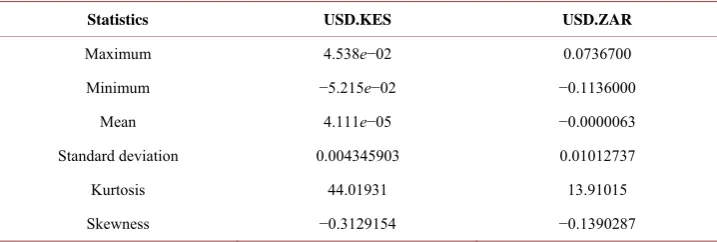
Table 1presents the summary statistics for the daily closing exchange rates returns of
kenya and South Africa. These include the mean, standard deviation, Kurtosis and skew-ness. Kurtosis is significantly greater than three which implies that they are heavily tailed which is characteristic of financial time series data (All series display significant lepto-kurtic behavior as evidenced by the large kurtosis with respect to the Gaussian distribu-tion). All returns series have an observation of 1836. They are all left skewed that is the left tail is longer.
Figure 1 shows the evolution of the daily exchange rates that is for Kenya and South Africa respectively. Both series have trends (which imply that the mean is non constant). Generally, the trend of the Kenya exchange rates data exhibits a decline between 2010 and 2011 and between 2013 and 2014. However, the South Africa exchange rates data exhibit an upward trend in 2012. From a visual analysis, the graph reveals that there is a co-movement of the trends in a similar direction either upward or downward within the period under consideration.
Table 1. Descriptive statistics of returns.
Statistics USD.KES USD.ZAR
Maximum 4.538e−02 0.0736700
Minimum −5.215e−02 −0.1136000
Mean 4.111e−05 −0.0000063
Standard deviation 0.004345903 0.01012737
Kurtosis 44.01931 13.91015
Figure 1.Distribution of the exchange rates.
Daily log returns on exchange rates data are presented in Figure 2 and exhibits no trends. The two graphs reveal the features of financial time series where volatility large clusters and asymmetric are evident.
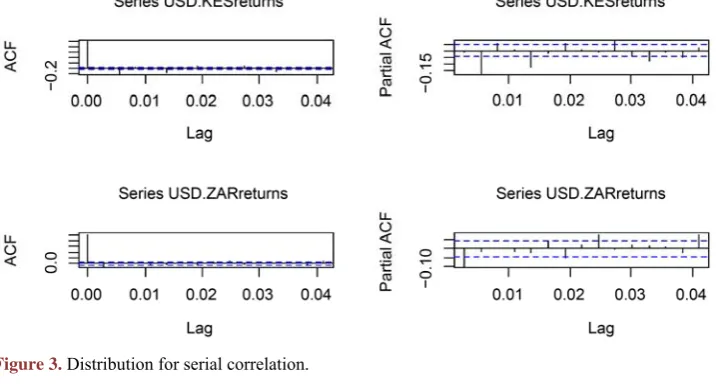
Figure 3 presents the serial correlation of the returns. It can be seen clearly from
Figure 3that returns exhibits no serial correlation. Thus there is no direct dependency
which could be exploited to predict tomorrow’s returns based on today or previous days. The following values of the parameters were used (Table 2):
[image:10.595.196.553.409.574.2]Data was used to compute some parameter such as H, HA and A. And parame-ters a, m and y were just assumed. We were able to assume these parameters after
Figure 3. Distribution for serial correlation. Table 2.Parameters used.
H
HA A a m y
0.01 −0.0027 0.0043 0.001
1 1 2
knowing the interval of the parameters of Cox-Ingersoll-Ross(CIR) process since our correlation dynamics is a CIR process.
The parameters above were used to solve Equation (23) and the one for constant corre-lation. The output is given in the Figures 4-6:
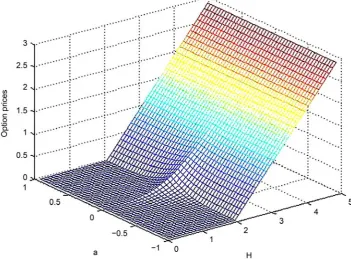
Figure 4 gives the mesh for the prices of the European call when the correlation is constant at maturity time T10.
Figure 5 gives the mesh for the prices of the European call when the correlation is stochastic at maturity time T10.
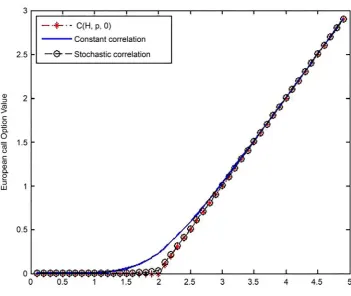
Figure 6shows the comparison of European call option prices for stock prices using
the constant and stochastic correlation where some parameters are determined from the real data and others assumed. From the Figure 6, it can be seen that the graph for the prices with stochastic correlation performs better since it is close to that of the market prices than the one of constant correlation.
5.
Conclusion
Figure 4. Prices for European options under constant correlation.
Figure 6.Values of European call option.
to be the domestic currency and South Africa to be the foreign currency. The data was first tested statistically and graphically before it was used. It was found that returns were heavily tailed and had no serial correlation, which implied that there was no direct de-pendency which could be exploited to predict tomorrows’ returns based on today or pre-vious day. Pricing equation for the European call with stochastic correlation performs better than that with constant correlation because its graph is very close to the graph of the market prices. Further work needs to be done in this area to improve the results such as considering volatility to be stochastic.
Acknowledgements
We thank African Union for financing this research.
References
[1] Merton, R.C. (1973) Theory of Rational Option Pricing. The Bell Journal of Economics and Management Science, 4, 141-183. http://dx.doi.org/10.2307/3003143
[2] Samuelson, P.A. (1965) Proof that Properly Anticipated Prices Fluctuate Randomly. Industri-al Management Review, 6, 41-49.
[3] Black, F. and Scholes, M. (1973) The Pricing of Options and Corporate Liabilities. The Journal of Political Economy, 81, 637-654. http://dx.doi.org/10.1086/260062
[4] Cox, J.C., Ingersoll, J., Jonathan, E. and Ross, S.A. (1985) The Pricing of Options and Cor-porate Liabilities. Econometrica, 53, 363-384. http://dx.doi.org/10.2307/1911241
In-dustry, 6, 1-18.
[7] Alvarez, A., Escobar, M. and Olivares, P. (2011) Pricing Two Dimensional Derivatives under Stochastic Correlation. International Journal of Financial Markets and Derivatives, 6,
265-287.http://dx.doi.org/10.1504/IJFMD.2011.045598
[8] Ma, J. (2009) Pricing Foreign Equity Options with Stochastic Correlation and Volatility. An-nals of Economics and Finance, 10, 303-327.
[9] Grabbe, J.O. (1983) The Pricing of Call and Put Options on Foreign Exchange. Journal of International Money and Finance, 2, 239-253.
http://dx.doi.org/10.1016/S0261-5606(83)80002-3
[10] Teng, L., Ehrhardt, M. and Günther, M. (2014) The Dynamic Correlation Model and Its Ap-plication to the Heston Model. Preprints.
[11] Teng, L., Ehrhardt, M. and Günther, M. (2015) The Pricing of Quanto Options under Dy-namic Correlation. Journal of Computational and Applied Mathematics, 275, 304-310.