2018 International Conference on Computer, Communications and Mechatronics Engineering (CCME 2018) ISBN: 978-1-60595-611-4
An Improved LCMV Beamforming Algorithm in Multi-beam
Bathymetry Sonars
Hong-zhe YAN
1,2, Qing-feng JIANG
1,2and Yu-liang LIU
1,2,*1Key Laboratory of Submarine Geoscience, Second Institute of Oceanography,
State Oceanic Administration, Hangzhou 310012, China
2School of Naval and Architecture and Mechatronics Engineering, Zhejiang Ocean University,
Zhoushan, 316022, China
*Corresponding author
Key words: LCMV, Beamforming algorithm, Multi-beam bathymetry, Sonar.
Abstract. Most of the existing multi-beam bathymetric sonars are based on conventional beamforming algorithms, but it is difficult to break through the Rayleigh limit. In this paper, a linear constrained minimum variance beamforming algorithm is discussed and used in multi-beam sonars. It is shown that the algorithm is of higher main lobe constraints, lower sidelobe level, while the convergence speed was slow. In order to realize in practical application, an improved LCMV beamforming algorithm is introduced to it and its computation and convergence speed were analyzed in detail. Simulation results show that the improved algorithm has faster convergence speed. In the end, the improved algorithm was also used to process the bathymetric data and the corresponding results show that it has higher resolution and good directional ability.
Introduction
With the development of Chinese marine strategy in recent years, higher requirements to exploit abundant natural resources on seabed have been put forward, where the multi-beam sonar is key or especially unique tool. In order to improve the application of multi-beam sonar systems, it’s urgent to improve their depth measurement capability [1]. In multi-beam bathymetric sonars the transmitting transducer array is used to transmit a wide-covering sector sound wave to the sea floor, and the receiving transducer array is used to receive the narrow beam for beamforming [2]. Then the backscattered signals is used to estimate DOA and TOA by signal processing algorithms, where the acoustic velocity formula is used to calculate the water depth and then to obtain the bottom topographic map [3-4]. When using CBF for beamforming, the algorithm often has a high sidelobe level, very easy to create the illusion of “tunnel effect” and “refraction effect”. In addition, CBF algorithms can’t break the Rayleigh limit.
For these problems, MVDR algorithm was proposed to weaken the tunneling effect in reference[5]. In literature [6] LSL algorithm was used to suppress side lobes. However, these methods cannot suppress strong interference effectively in an unknown direction. Therefore an adaptive optimal weight beamforming algorithm is proposed in this paper and its improved frequency-domain analysis is also given in order to overcome time-domain analysis’ defect. Finally, through simulation verification and processing of sea trail data it is verified that the improved algorithm is feasible with higher efficiency.
Linear Constrained Minimum Variance Beamforming Algorithm
LCMV Algorithm Principle
elements, d(t) means desired signal, a(θd)means weigh vector, ij(t) means interference signal and
nk(t) means noise. Then the received signal can be written as Xk(t),
1
( ) ( ) ( ) j ( ) ( ) ( )
k d j ij j
X t ak
d t
ak
i t nk t (1)1 2 1 1 1
1 2 1 2
( ) [ ( ), ( ) ( )] ; ( ) [ ( ), ( ) ( )] ( ) [ ( ), ( ) ( )] ; ( ) [ ( ), ( ) ( )]
T T
k M d k i ij
T T
j j k M
X t x t x t x t a a a a
i t i t i t i t n t n t n t n t
(2)
1
( ) ( ) ( ) ( d) ( ) J ( ij) ( )j ( ) j
x t As t n t a
d t
a
i t n t (3)Then to find the optimal weight vector and the Wiener solution defined with M filters wH=(w1,w2...wm)H,the filter summation output is
( )
H( )
y n
w x t
(4) Here the task is to find the constraint of minimum output power that can minimize noise and interference signal, i.e. it is just to determine the min{wHФzzw} subject to wHA=1[7]. The constraintconditions can be approximately recursive by the Lagrangian multiplier method, so that,
( ) H zz [ H 1] *[ H 1]
L w w
w
w A
A w (5)So substitute wHL w( )zzwA0 into formula(5), we get,
1 1
(
) / (
)
LCMV H
zz zz
w
A
A
A
(6) Theoretical expression (6) is an optimal solution, but it involves correlation matrix inversion which is difficult to realize as to complex seabed time-varying environments, consumption of great time and resources. The estimated optimal solution requires data including noise so we introduce adaptive iterative method into LCMV algorithm. Through the steepest descent adaptive algorithm, we get,( 1) ( ) [ zz ( ) ]
w k w k w k A (7) Here the Lagrangian multiplier must satisfy wHA=1, so we have,
( 1) ( ) ( ) ( ) zz ( ) ( ) w k P k w k
P k
w k F k(8) Substitute (8) into (7) we
(
1)
( ) ( )
( )
zz( )
( )
w k
P k w k
P k
w k
F k
(9) Where,
1 1
( )
(
T)
T; ( )
(
T)
TF k
A A A
A w P k
I
A A A
A
(10)Formula (10) is derived here, and the optimal weight vector of beamforming is obtained. Usually we also need to perform DOA estimation first when calculating the optimal weight vector, but the algorithm applies to the incident angle θ of the received signal of the array in the multi-beam sounding sonar, so it is not considered.
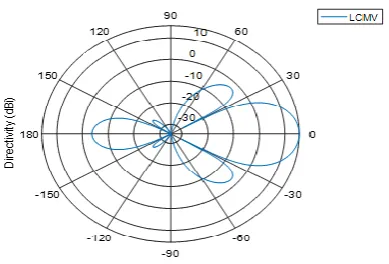
Figure 1.Beam response simulation diagram of LCMV.
Frequency-Domain Adaptive Beam-Forming Algorithm
LCMV beamforming algorithm can be implemented in time-domain. But for a multi-beam bathymetric system, hundreds of filter coefficients may be required to achieve high resolution performance, and the complexity of multiplication increases quadratically with the number of filters. The calculation is large and the convergence speed is slow. The second drawback of time-domain processing is that the large eigenvalue differences usually occur to reduce the adaptive ability and tracking ability. Thus the main reason that affects convergence speed is the ratio of the maximum and minimum eigenvalues of the input signal. The ratio is more smaller, the convergence speed is more faster. In this paper, the time-domain beamforming algorithm is transformed to frequency-domain processing. Then apply it to the multi-beam bathymetric sonar.
Because frequency domain beamforming is essentially based on the operation of the phase, the phase operation in the frequency domain is equivalent to taking the spatial Fourier transform[8]. Then the output vector signal as follow,
[ ]
( )
[ ]
m
m
m
X k s
X k F
X k
(11)
where F is Fourier transform matrix as below,
,
2
( )F a b exp( j ab a b) , 0 k 1 c
(12) Where j 1 is Virtual unit. After frequency domain transformation of the received signal, it is found that only the vicinity of the spatial frequency and the surrounding sequence are related to the desired signal. By designing a FIR band-pass filter, the data near the spatial frequency can be extracted. It can effectively eliminate the interference direction signal and greatly reduce the calculation amount. Band-pass filtering in the frequency domain is equivalent to adding windows. The window center is the spatial frequency of the desired signal, and the spatial frequency corresponds to DOA one-to-one. Due to the DOA of the multi-beam system is known, the interference signal beyond DOA can be eliminated only by extracting the incident angle within a certain range. Then the signal passes through the frequency-domain FIR band-pass filter can be represented as follows,
( )
B m( )
R n
W X
k
(13) Where WB is the band-pass filter’s frequency domain form and the diagonal elements are mostly
0. The array frequency domain output can be expressed as follows,
1
( )
Mm T( ) ( )
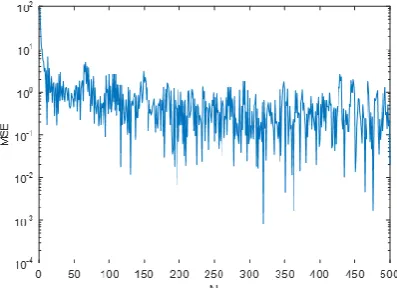
W is the weigh vector of LCMV, Get W by repeating interation.it is the weigh vector of beamforming in frequency-domain (See figure 2).
Figure 2. LCMV algorithm iterations in frequency domain.
For the convergence speed, the frequency domain beamforming algorithm only needs dozen times of iteration to converge to a smaller value. Although for frequency domain conversion the signal needs to be FFT transform. But in FFT, the complex number of addition is onlyMlog2M, The complex multiplication complexity isM/ 2 log 2M
. FFT algorithm is easy to implement in hardware. Therefore, the frequency domain algorithm is suitable for multi-beam bathymetric sonar.
LCMV Algorithm’s Computer Simulation
[image:4.595.299.524.500.652.2]In this section we use matlab software for the simulation tool. The receiver of multi-beam bathymetric sonar is a linear array with array frequency 100kHz. The central frequency of transmission signal is 100kHz. The number of taps is 100 and the relation between spacing and wavelength is 0.5. The interference direction signal is randomly constructed in the range from 0°to 35°, and the noise is Gaussian white noise. It is assumed that the incident angle of the received signal in the array is 100°. The LCMV time-domain algorithm and its frequency-domain algorithm is used to generate the beam pattern as shown in figures (3-4).
Figure 3. Time-domain LCMV. Figure 4. Frequency-domain LCMV.
Sea Trial Data Processing
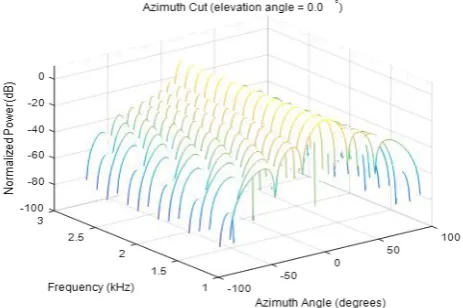
[image:5.595.180.412.247.401.2]The water depth data comes from Zhujiajian sea area about 122.37 east longitude and 29.85 north latitude and the equipment we chose is CARIS multi-beam bathymetric sonar. The Transmitter sends a fan beam whose surface is perpendicular to the track with open angle 60°~ 150°. The receiver array receives echo signal from the sea floor, adds and sums it after delay or phase shift, and forms dozens or hundreds of adjacent beams [9]. The LCMV frequency domain beamforming algorithm is used to process multiple beamforming data. In the range of [-100°, 100°], 127 adjacent narrow beams are generated simultaneously. The three-dimensional beam map using LCMV frequency-domain algorithm is shown in Figure 5. It can be seen from the figure that the beam formation after frequency-domain filtering transformation can rapidly track the real echo signal of the seabed. More signal energy is reserved at the 30-degree central beam and so it has good detection capability for the edge beam.
Figure 5. Using LCMV frequency-domain algorithm to form the three-dimensional beam map.
Summary
In order to overcome the defect of conventional beam forming method, a novel LCMV beam forming algorithm and its frequency domain algorithm are proposed. From simulation results it is shown that the frequency domain beam-forming algorithm has better convergence and beam control function, and it has faster convergence speed so it can be applied to engineering design. Based on data processing results, it is shown that the new beam-forming algorithm has good directional ability.
Acknowledgement
This work was supported by Open Fund Project of China Key Laboratory of Submarine Geoscience (KLSG1802), Science & Technology Project of China Ocean Mineral Resources Research and Development Association (DY135-N1-1-05) and College-Student-Science & Technology- Innovation-Activity-Plan and Xin-Miao Talent Program of Zhejiang Province of China (2018R411038, xj2018038)
References
[1] J.H. Zhao, J.N, Liu. Multi-beam sounding and image data processing [M]. Wuhan: Wuhan University Press, 2008.
[2] S. Agrawal, V. Rana, A.K. Jagannatham. Queuing analysis for multiple-antenna cognitive radio wireless networks with beamforming [J]. IEEE Signal Processing Letters, 2017, 24(3):334-338.
[4] X. Lurton, J. Augustin. A measurement quality factor for swath bathymetry sounders [J]. IEEE Journal of Oceanic Engineering, 2016, 35(4): 852-862.
[5] Y.K. Wei, B.W. Chen, H.S. Li. Tunnel effect elimination in multibeam bathymetry sonar based on MVDR algorithm [J], Hydrographic Surveying and Charting, 2011, 31(1): 28-31.
[6] Alexandrou D. de Moustier C. Adaptive noise canceling applied to sea beam sidelobe interference rejection[J]. IEEE Journal of Oceanic Engineering, 1988(2): 70-76.
[7] T.W. Zhang, S.J. Qin, J.L. Tang. Technical status and development trend of deep-sea multi-beam bathymetry system [J]. Bulletin of Surveying and Mapping, 2018(5): 82-85.
[8] S.X. Liu, Y. Zhang, J.F. Ma, et al. Accuracy assessment of multi-beam echo sounding data[J]. Hydrographic Surveying and Charting, 2016, 36(5): 36-39.