ISSN: 1992-8645 www.jatit.org E-ISSN: 1817-3195
148
ARABIC TEXT TO SPEECH SYNTHESIS USING
QURAN-BASED NATURAL LANGUAGE PROCESSING MODULE
1BANA ALSHARIF, 2RADWAN TAHBOUB, 3LABIB ARAFEH
1Researcher, Deanship of Scientific Research, Palestine Polytechnic University, PS
2Asstt Prof., Department of Computer Engineering, Palestine Polytechnic University, PS
3Assoc. Prof., Department of Computer Engineering, Al-Quds University, PS
E-mail: 1[email protected], 2[email protected], 3[email protected]
ABSTRACT
Natural Language Processing (NLP) Module for Arabic Text to Speech is introduced in this paper. It’s a module from our integrated design for Arabic named as Holy Quran Based- Arabic Text to Speech (HQB-ATTS). HQB-ATTS system is implemented using some Tajweed rules that are used in Standard Arabic. Through this paper, new ideas are adopted and discussed in order to increase the quality of Arabic Text-to-Speech (ATTS). The innovations that have been applied in NLP module are: the use of some of Tajweed rules to build better letter to sound module, the combination of Arabic Prosody with allophone /syllables slots is a new use for a technique supported the linguistic property for Arabic, and the quality evaluation for the NLP module is performed in new method to proof the success for our hypothesis in comparison with other up-to-date approaches. The results show that this HQB-ATTS approach can significantly enhance the quality of the synthesized speech. The evaluation showed that this approach could produce a better synthesized speeches’ quality than comparative ATTS synthesizers.
Keywords: Text to Speech (TTS), Natural Language Processing Module (NLP), Tajweed Rules, Prosody Syllabification, Evaluation.
1.
INTRODUCTIONAlthough significant effort had been done in ATTS in last decades, the produced Arabic synthesis speech is still underestimated. The understanding of the work had been done should help in increasing the quality of this synthesis speech. In more precise terms, a need for an overall study and details ones for ATTS are missed for researchers and need a huge work to introduce it, such that better results can be achieved in ATTS.
Simulating the articulatory of human speech system with hardware machines was started in the 18th century [1]. Passing through the discovery of electricity in the early 20th century, TTS systems were developed by using it and became more natural by allowing software approaches [2]. For Arabic language in specific, it has become an interesting field for few researches through publishing the Speed Assessment Methods Phonetic Alphabet (SAMPA) for Arabic in 1997 [2] [3]. Researches in Arabic TTS were done for the syllables, diphones, di-diphones, phonetics,
phonemes, morphologic and grammar in Arabic. The researchers vary in introducing a completed synthesizer, or specific in NLP module, or in DSP module. All of them aim to improve the quality of the Text-to-Speech (TTS) synthesizer depending on the overall system or partitions. At the
beginning of 21th century, the Arabic TTS became
an important field research [4]. This paper introduces a novel approach for NLP module in the area of the ATTS.
2.
TEXT-TO-SPEECH SYNTHESISTTS is the major framework of producing a voice from text. It is an automatic pipeline starting from the text through grapheme to phoneme (letter-to-sound) transcription of the sentence that ends with utters sounds [1] [3].
149 composed of text analysis stage, Letter-to-Sound (LTS) Module (called Grapheme-to-Phoneme stage) and the prosody generation stage. DSP module, is the next step follows the NLP module that generates the speech. The input for DSP is the symbolic linguistic units in the form of phonemes, which are NLP outputs. DSP can be implemented
using various methods such as Articulatory Synthesis, Concatenating Synthesis and Formant Synthesis [6].
Along with the recent increasing demand on TTS application, many research works have been accomplished in this area. The range of applications for a TTS system varies from simple to complex ones, such as: Aid to handicapped, telecommunication services, language education, man-machine communication, vocal monitoring …etc. [1] [3] [6] [7].
3.
LINGUISTIC PROPERTIES FORARABIC PHONETIC
Linguistics refers to the scientific study of language including form, language meaning, and language in context. The linguistic nature of Arabic sounds must be fully understood in order to implement these features in automatic systems. The scope of this work concentrates on producing high quality TTS synthesizers based on the features included in pronunciation Standard Arabic (SA). SA is chosen for this work because it is the comprehensive class for all Arabic worlds. In addition, some rules in Tajweed (ﺪﯾﻮﺠﺘﻟا) in Quran recitation can be applied in SA as well [8].
The Arabic alphabet consists of 28 letters known as Hijaiyah letters “ﺔﯿﺋﺎﺠﮭﻟا فﺮﺣﻻا”. The Arabic alphabet is written from right to left and there is no upper and lower case. There are twenty-eight Arabic consonant sounds, twenty-six of which are always consonants, but two (/w/: waaw “و”, and /y/:yaa’ “ي”) are semivowels that can be consonant or vowels depending on the context and diacritic. Indeed, the linguistic nature of these Arabic sounds must be understood in
order to implement these features in automat systems. There are six vowels in Arabic (3 short and 3 long). The short vowels are Fatha (َ), Damma(ُ), and Kasrah(ِ). Arabic long vowels are (alef “ا”/a: /, waw “و” /u: /, and yaa“ي” /i: /) [2] [3].
Arabic language is considered as a regular language with relatively few numbers of exceptions. Therefore, the suggested method for some Arabic researches is the rule-based method [9]. Rule-based method is a set of pronunciation rules that are applicable to words in order to determine their pronunciations based on their spelling [1].
Most research follow the theoretical proposals of McCarthy [10], which handles the theoretical challenges of Arabic morphological system poses to traditional linear theories by proposing the separation of the consonantal root and the vocalism. The consonants and vowels are mapped into the CV slots. The substitute of “c” refers to a consonant and the “v” refers to short vowel and the “vv” or “w” to long vowel. They can be written in capital or small English letters. As an example word “ ْﺐَﺘَﻛ” is presented in phonetic transcription as SAMPA assessment is “Katab”, and the CV template is "cv-cv-c". This morphological analysis is used in syllabication [2] [3] [9]. Syllabification templates in TTS conversion are important because it helps in the
implementation of letter-to-phoneme
transcription, and it is essential in enhancing the quality of speech produced by synthesizers [2] [3].
In this research, the mentioned CV slots are applied based on Prosody Science. Al-Khalil Ibn Ahmad Al-Farahidi was the founder of Arabic Prosody Science ((ضوﺮﻌﻟا ﻢﻠﻋ [11]. His “Kitab al-Ayn” was the first dictionary ever written for the Arabic language. In his Al-Ayn book an interesting definition for the smallest phonetic unit, he called it syllable and it is either short (ٮ) or long (-). Arabic prosody which is the science dealing with the patterns of sounds and rhythms in poetry. In Arabic prosody, the meter is based on syllables. The combination of Arabic Prosody with syllables slots is a novel technique in our research.
4.
HOLY QURAN-BASED ARABICTEXT-TO-SPEECH
ISSN: 1992-8645 www.jatit.org E-ISSN: 1817-3195
150 implemented in our research aimed to increase the quality of ATTS Synthesis. HQB-ATTS is divided into two parts, the standard NLP module and the standard DSP module. The input of the HQB-ATTS system is a full diacritic Arabic text, and the output from this system is an Arabic synthesized speech. The implementation of Prosody Syllabification with Tajweed rules, which are inherited in a Quran recitation and based on Arabic allophones, are suggested to enhance the quality of the synthesized speech. The resulted speech naturalness is increased to an expected level as suggested by the work hypothesis
The main objective of this work is to increase the naturalness of the synthesized Arabic speech. Therefore, this approach introduces the Tajweed rules with real Quran recitation in order to increase the quality of ATTS. Tajweed rules cover all the letters in Quran recitation, also they are complete and well-defined [8]. These facts candidate Tajweed rules to be implemented in ATTS. Despite that, the rules in Quran recitation are more than those followed in regular SA, the pronunciation rules “فوﺮﺤﻟا جرﺎﺨﻣ” still the same. The Quran recitation differs from any SA reading
because it has two exclusive rules: “5] ”ﺪﻤﻟا و ﺔﻨﻐﻟا]
[12]. The sanctity of the Holy Quran prohibits the readers from using all the rules in reading classical Arabic text. The desired objective of this work is not to make a Quran synthesizer but to increase the efficiency of ATTS by using Quran recitation. It is also necessary to avoid reading regular Arabic text by using the same melody that is used in the Quran. Thus, the implemented rules from Tajweed are only those compatible with SA. A novel approach, in this research, is to implement the Tajweed rules, which are matched with SA reading in sufficient organization without the need for loops [5]. The rules that are used in Elothmany [2], El-Imam [3]and Al-ghamdi [4] are used and upgraded with additional rules.
The implementation of HQB-ATTS follows the following assumptions:
• “Tajweed rules increase the ability of
speaking Arabic proficiently even not in Quran” [8].
• “The smallest unit in Arabic is Prosody”
[11]
• The suggested segmentation unit for Arabic
based on Arabic linguistic features in this work is allophones. Simply because it is a
single phoneme with features and vowel [4] [5].
Tajweed rules are suggested here to implement LTS model and Arabic Prosody Science ( ﻢﻠﻋ ضوﺮﻌﻟا) in order to perform syllabification in NLP. Prosody Science segmentation is used also in segmenting the syllables while building the database.
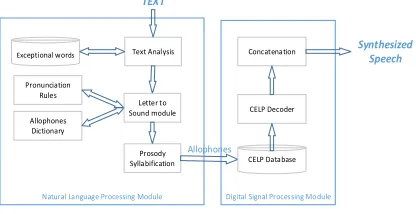
The proposed HQB-ATTS block diagram with its data flow is shown in figure 2. In this approach, the allophonic/syllabic units that are taken from the text are extracted using Quran Tajweed rules. The implementation of LTS module is done by using Tajweed rules to build rule-based system with an exceptions’ table.
Natural Language Processing Module Digital Signal Processing Module
TEXT
Text Analysis
Prosody Syllabification
Exceptional words
Pronunciation Rules Allophones Dictionary
CELP Decoder
CELP Database
Concatenation Synthesized Speech
Letter to Sound module
[image:3.612.321.529.288.395.2]Allophones
Figure 2: Block Diagram For HQB-ATTS
First, the input is Arabic diacritic text, which is analyzed to extract the exception words from it and to replace them with phonemic transcription. Then, Prosody syllabification is performed on the whole sentence. The purpose of syllabification is to be used in LTS module and with Arabic allophones to estimate the allophonic/syllable units. After the Prosody syllabification is completed, searching for these units in the database (audio and CELP databases are built) by selecting syllable waves files should be done. And the final step is concatenating these files to produce the synthesized speech. The database is built by manual segmentation and notation for verses and then by labeling them with their allophonic/syllable names. The CELP database is built by encoding the segments of Quran recitation using CELP.
5.
NATURAL LANGUAGEPROCESSING MODULE
151 module consists of Text Analysis, Prosody Syllabification and letter to sound ruling blocks.
5.1 Text Analysis
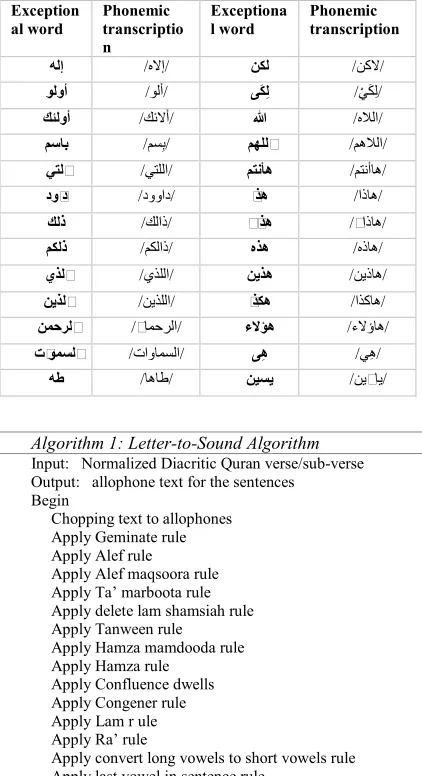
Handling the exceptional words is the concern of this part of the algorithm. The exceptional words are those words that are pronounced in a way that is different from how they are written in regular pronunciation language. Arabic is a regular language that is mostly pronounced as it is written [6]. Using a rule-based system that is mixed with a table for exceptional words is the best combination for Arabic [3]. The search in the table will be sequential and acceptable because of the small size of the table. The algorithm is close to the one for Elothmany [3], but there are some exceptional words that are taken from the Al-Gamidi et al. [4]. The table of the exceptional words is built manually as shown in Table 1.
5.2 Letter-to-Sound Rules
Letter-to-Sound (LTS) phase or Grapheme to phoneme is done by using a set of rules; which are estimated from some linguistics study of Arabic. The advantages for rule-based system are the small memory size that is needed and the
adaptation with new words. Regular
pronunciations for Arabic language make the LTS to be selected to be used in the implementation of ATTS [2] [3]. In this approach, the set of rules are collected from Tajweed rules and then they are reordered.
In HQB-ATTS rule system, the rules are ordered in an optimized way to fit the sentence without loops and to fit the sentence in a matching way with all the cases. The rules are programmed
using Matlab(R2013b) environment. The
[image:4.612.315.526.159.547.2]grapheme to phoneme conversion contains sequential procedure calls without looping. The general algorithm for HQB-ATTS letter-to-sound conversion is shown in algorithm 1. From Arabic Tajweed rules, Arabic linguistics and Al-ghamdi [4], Table 2 is created and it introduces the rules with a description and an example in order to be implemented in algorithm 1.
Table 1: Exceptional Words
Exception
al word Phonemic transcriptio n
Exceptiona
l word Phonemic transcription
ﮫﻟإ /هﻻإ/ ﻦﻜﻟ /ﻦﻛﻻ/
ﻮﻟوأ /ﻮﻟُأ/ ﻰَﻜِﻟ / ْﻲَﻜِﻟ/
ﻚﺌﻟوأ /ﻚﺋﻻُأ/ ﷲ /هﻼﻟا/
ﻢﺳﺎﺑ /ﻢﺴِﺑ/ ﻢﮭﻠﻟا /ﻢھﻼﻟا/
ﻲﺘﻟا /ﻲﺘﻠﻟا/ ﻢﺘﻧﺄھ /ﻢﺘﻧأﺎھ/
دواد /دوواد/ اﺬھ /اذﺎھ/
ﻚﻟذ /ﻚﻟاذ/ ناﺬھ /ناذﺎھ/
ﻢﻜﻟذ /ﻢﻜﻟاذ/ هﺬھ /هذﺎھ/
يﺬﻟا /يﺬﻠﻟا/ ﻦﯾﺬھ /ﻦﯾذﺎھ/
ﻦﯾﺬﻟا /ﻦﯾﺬﻠﻟا/ اﺬ ﻜھ /اﺬﻛﺎھ/
ﻦﻤﺣﺮﻟا /نﺎﻤﺣﺮﻟا/ ءﻻﺆھ /ءﻻؤﺎھ/
تاﻮﻤﺴﻟا /تاوﺎﻤﺴﻟا/ ﻰِھ /ﻲِھ/
ﮫط /ﺎھﺎط/ ﻦﯿﺴﯾ /ﻦﯿﺳﺎﯾ/
Algorithm 1: Letter-to-Sound Algorithm
Input: Normalized Diacritic Quran verse/sub-verse Output: allophone text for the sentences
Begin
Chopping text to allophones Apply Geminate rule Apply Alef rule Apply Alef maqsoora rule Apply Ta’ marboota rule Apply delete lam shamsiah rule Apply Tanween rule
Apply Hamza mamdooda rule Apply Hamza rule
Apply Confluence dwells Apply Congener rule Apply Lam r ule Apply Ra’ rule
Apply convert long vowels to short vowels rule Apply last vowel in sentence rule
End
5.3 Syllabification Process
In this part of the work, a direct Prosody syllabification is done for the complete verse (called a sentence). Syllabification means partitioning the words into units, each unit is called syllable and it is either short or long. In this description the sign (c) is given for the short syllable, and (-) for the long syllable. The
algorithm for Prosody syllabification is
ISSN: 1992-8645 www.jatit.org E-ISSN: 1817-3195
152 patterns: A consonant followed by a long vowel or consonant with a short vowel followed by a consonant.
Input : allophones text for the sentences
Output : String contains the syllables of the phonemes For each Diacritic-Arabic-phonemes
Begin
while not end of sentence read char
If char++ is (a: or u: or i:) or holds “ ْ◌” then cut (char, char++) as long syllable and char++
else cut (char) with its diacritic as short syllable char ++
end if end while End
The syllabification processes for an example: ِﺐِﺋاﺮﱠﻀﻟا ْﻊِﻓاد تﺎﱠﯿِﻟوﺆْﺴَﻣ ْﻦِﻣ اﺬَھ , passes the following steps:
Phonetics: /ha:Da: min mas?u:lijja:ti da:fi?'i d'd'ar’a:?ib/
Phonemes: /ha:/ /Da:/ /min/ /mas/ /?u:/ /lij/ /ja:/ /ti/ /da:/ /fi/ /?’id’/ /d’a/ /ra:/ /?’ib/
Prosody syllabification: - - - - c - c - c - -
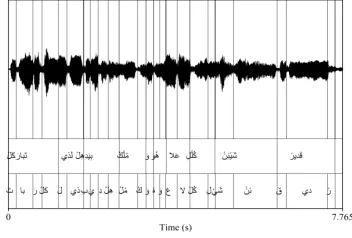
[image:5.612.322.518.382.517.2]Notation depends on Prosody syllabification. Figure 3 illustrate the manual syllabification for a verse “ﺮﯾﺪﻗ ءﻲﺷ ﻞﻛ ﻰﻠﻋ ﻮھو ﻚﻠﻤﻟا هﺪﯿﺑ يﺬﻟا كرﺎﺒﺗ”. For less than 8 seconds, accurate cut for 24 syllables has been done, such that those syllables can be used in coming concatenations.
The novelty in this part of the work is the prosody syllabification. This syllabification is valid for any SA text [15] and it has not been used in ATTS synthesizers. This syllabification is based on Arabic linguistics features and it focuses on Sokoun diacritic ( ْ◌), which shows that Sokoun is a good co-articulation point. This research analyzes Arabic speech from the side of time
domain and pitch contour. The result from this analysis proves that the Sokoun is a suitable co-articulation point that increases the smoothness. The possible syllables from using these techniques are only cv, cw, and cvc. Thus the possible number of syllables for Arabic is
28×4+28×3+28×3×28+28×3 ≈ 2600 syllables (1)
This is bigger than diphones’ number for Arabic, which is about (28+6+6)2 = 1200 diphones [10].
Analyzing the Arabic speech signal considering time domain shows clear correlation point for units where “ ْ◌” exists. From the spectrum and the pitch contour for a word “ ْﻢُﺘْﻠَﺒْﻘَﺘْﺳا”, Figure 4 shows the syllables chopping.
6.
DISCUSSIONThe reason of missing the quality evaluation procedures for NLP Modules is the lack of tangible standardized results. The results from NLP module are symbolic linguistic units in
phonemic or phonetic representations for the texts. These representations can be modeled using any symbols, which increase the distance far from standardization. Usually, using SAMPA (Speech Assessment Methods Phonetic Alphabet) for Arabic with a diacritic text is a good basement in ATTS [12]. Nevertheless, the Letter-to-Sound rules (LTS) phonetics that are used in researches are varied for some basic issues, e.g. Mad Alalif “ا” is aa or a: or AA … etc. Some researches took some features from the text analysis [2] [3]. The output of this track is phonemic text with prosody information, which cannot be easily compared with others [13]
[image:5.612.113.289.482.601.2]Algorithm 2 : Syllabification Algorithm
Figure 3: Prosody Syllabification And Notation For “ﺮﯾﺪَﻗ ٍءﻲﺷ ِّﻞُﻛ ﻰﻠَﻋ َﻮُھ َو ُﻚْﻠُﻤﻟا ِهِﺪَﯿِﺑ يﺬﻟا كرﺎﺒَﺗ”
Figure 4: Time Domain And Spectrum Show The
Sokoun Chopping For “ ْﻢُﺘْﻠْﺒﻘَﺘْﺳا”, The Red Lines Cut
153 The NLP module that is introduced in HQB-ATTS is compared with El-Imam’s research [3] and with ATTSIP [2] that is introduced by Elothmany. In addition, HQB-ATTS letter-to sound rules are compared with Al-ghamdi rules [4]. The comparison is based on the similarity between the works that were done in this research and their approaches. Clearly, in this work, the rules are developed from El-Imam, Al-ghamdi and Elothmany by basing on Tajweed rules. The most common part in NLP module among the HQB-ATTS, El-Imam and Elothmany is the use of SAMPA phonetics with some added symbols from each.
The grapheme to phoneme rules that are presented in El-Imam [3] were: Sukon deletion rules, Elusion rule (like “ﺔﻋﺎﻤﺠﻟا واو ﻒﻟا”), Replacing “ى” with “ا”, Tanween rules, Arabic ligature rules (like “ؤ” and “ئ”), Glottal stop insertion rule (for “ء”), Gemination rules (ةﺪﺸﻟا), Shamsi rule, Long vowel generation rule ( فوﺮﺣ ﺪﻤﻟا), Diphthong generation rules ( (و) ﻰﻠﻋ تﺎﻛﺮﺤﻟا (ي) ﻰﻠﻋو), and Short vowel replacement rule. El-Imam’s rules are included in HQB-ATTS rules with modifications, but “Sukon deletion” is not included because it is an important part in Prosody syllabification. The Elusion rule in Al-Imam’ rules missed the case of the (ﻒﯾﺮﻌﺘﻟا لا) in the begging of the sentence, which is covered in HQB-ATTS. The rest of the rules are included in another order and declaration. Most of assessment sentences that are shown in El-Imam research are tested in HQB-ATTS NLP rules, such as “ ،حﺎﺴْﻤِّﺘﻟا فﺎﻨﺌِﺘﺳا ،ْمِدﺎﺧ ،ﮫَﻄِﺑار”, and all that shows the success of the ruling approach. Errors in El-Imam’s rules weren’t not detailed in his research [3]. Although SA sentences were not focused on El-Imam rules, which produces cuttings in the synthesized speech for the synthesized sentence, HQB-ATTS solves them from Prosody science syllabication. HQB-ATTS was tested on El-Imam tested samples, and this showed the HQB-ATTS’s success.
Al-ghamdi rules [4] had missed the definition of the first “ا” in the sentence, which is defined in HQB-ATTS in this work. Otherwise, Tajweed rules cover the rules in Al-ghamdi’s work.
Although the rules that are used in ATTSIP LTS module is not similar to those that are used in HQB-ATTS, the main difference between them is the disappearance of FOR loops in HQB-ATTS that produce the algorithm as sequential, quick and simple procedures. To determine the time-consumption in both cases, calculating the steps number was done for NLP, in order to transform it
from grapheme to phoneme in some sentences like “ﺐﺋاﺮﻀﻟا ﻊﻓاد تﺎﯿﻟوﺆﺴﻣ ﻦﻣ اﺬھ” using HQB-ATTS and HQB-ATTSIP. After the grapheme to phoneme process, the symbols are compared to check if HQB-ATTS is able to solve the missed features that were in ATTSIP. Manually the rules for ATTSIP, as defined in the work are calculated
HQB-ATTS: ha:Da: min mas?u:li:a:ti da:fi? ‘i d'd'ar’a:? ib/ with 6 steps
ATTSIP: ha: Da: min mas? u:li:a:ti da:fi?'i d'#d'#a#r#a:#?ib with 6 steps
The previous case showed a match between both approaches, but in HQB-ATTS, depending on the Prosody-syllabled Tajweed rules, the approach deletes the rule of magnifying d’ “ض”, a “َ”, r ”ر” and a: “ا” . Here are some examples that show a fail in ATTSIP and a success for
HQB_ATTS:” نﺈﻓ" ,"ةﺮﺧﻵﺎﺑو" ,"ﷲ مار" ,”ةﺮﺧﻻا و
رﺎﻌﺳﻻا". The sentences that are used in ATTSIP are tested with HQB-ATTS and there were no errors.
7.
CONCLUSIONIn this work, the overall architecture and general features of ATTS have been presented with a comprehensive survey. Holy Quran-Based ATTS (HQB-ATTS) approach has been introduced as well that aims at to enhancing the quality of the Arabic synthesized speech. This approach is based on some of the Holy Quran Tajweed rules, which are used in SA speech as
well as on Prosody syllabification in
concatenating allophones/syllables. The
implementation shows that the Tajweed rules have additional rules that help to reach the desired
completeness in grapheme to phoneme
ISSN: 1992-8645 www.jatit.org E-ISSN: 1817-3195
154
TABLE 2:HQB-ATTSRULES
# Rule Description Examples
Input output
1 ةﺪﺸﻟا نﻮﻧﺎﻗ
Geminate rule Geminated consonant will be replaced by same two consonants. The first is un-voweled ( ْ◌) and the second holds the short vowel (diacritic sign) which was on the geminated sign.
ةﻼﱠﺼﻟا
ﺖﱠﯿﺑ ةﻼَﺼْﺼﻟا ﺖَﯿْﯿﺑ
2 (ا) ﻒﻟﻻا نﻮﻧﺎﻗ
Alef Rule If Alef (ا) is at the beginning, and it is followed with Lam ( ْل), then it will be replaced (ا) by ( َأ). Else If Alef (ا) is at the beginning, and it is in a word where the third letter is ( ُ◌), then replace the Alef (ا) by ( ُأ).
Else If Alef (ا) is at the beginning of the sentence, then replace it by (إ)
Else delete (ا)
ءﺎﻤﺴﻟا
اﻮﻋدا
ﻢﺳا ،ﻦﺑا
ﻦﯿﻨﻣﺆﻤْﻟﺎﺑ
ءﺎﻤﺴﻟأ
ﻮﻋدُأ
ﻢﺳإ ،ﻦﺑإ
ﻦﯿﻨﻣﺆﻤْﻠﺑ 3 ةرﻮﺼﻘﻤﻟا ﻒﻟﻻا نﻮﻧﺎﻗ
Alef Maqsoora rule Replace the (ى) by the (ا) ﻰﻣر ﺎﻣر
4 ﺔطﻮﺑﺮﻤﻟا ءﺎﺘﻟا نﻮﻧﺎﻗ
ta’ Marboota rule If (ة) at the end of the sentence, replace it by (ه) Else, replace it by (ت)
ٌﺔﻠﯿﻤﺟ ُﺔﺳرﺪﻤﻟا ُﺖﺳرﺪﻤﻟا ﮫﻠﯿﻤﺟ 5 ﺔﯿﺴﻤﺸﻟا مﻼﻟا فﺬﺤﺑ نﻮﻧﺎﻗ
Delete Lam Shamsiah rule
If ( ْل) followed by ( ،ظ ،ط ،ض ،ص ،ش ،س ،ز ،ر ،ذ ،د ،ث ، ت ل ،ن), then delete it ( ْل)
ءﺎﻤﺴْﻟأ ءﺎﻤﱠﺳأ
6 ﻦﯾﻮﻨﺘﻟا نﻮﻧﺎﻗ
Tanween rule If ( ًا) at the end of the sentence, replace it by (ا) If ( ٍ◌ ٌ◌ ً◌) at the end of the sentence, replace it by ( ْ◌) Else replace it by one similar diacritic and ( ْن)
ًﺎﻤﻜﺣ هﺎﻨﯿﺗآ
ٌﺪﺣأ ًاﻮﻔﻛ
ﺪﺣأ ًاﻮﻔﻛ
ﺎﻤﻜﺣ هﺎﻨﯿﺗآ ْﺪﺣأ ًاﻮﻔﻛ
ْنَﻮﻔﻛ
7 (آ) ةدوﺪﻤﻤﻟا ةﺰﻤﮭﻟا نﻮﻧﺎﻗ
Hamza mamdooda
rule
If (آ) replace it by (اأ) ﺔﯾآ ﺔﯾاأ
8 ةﺰﻤﮭﻟا نﻮﻧﺎﻗ
Hamza rule If (ؤ ،إ ،ئ ،أ) replace it by ( ُء ،ِء ،ِء ،َء) respectively ﺔﻜِﺋﻼﻣ ﺔﻛ ِءﻼﻣ
9 ﻦﯿﻨﻛﺎﺴﻟا ءﺎﻘﺘﻟا نﻮﻧﺎﻗ
Confluence dwells When 2 un-voweld letters come between 2 consecutive words, if the first un-voweled letter is preceded by ( ُ◌ َ◌ ِ◌) , then insert ( ُ◌ ِ◌ َ◌) respectively after the first consonants
ضرَﻷا ْﻦﻤﻟ ضرﻻا ِﻦﻤﻟ
10 ﻦﯿﺴﻧﺎﺠﺘﻤﻟا نﻮﻧﺎﻗ
Congener rule If (د ، ت ،ت ،ذ) followed by (ت ،د ،ط ،ظ), replace the first (د ، ت ،ت ،ذ) by (ت ،د ،ط ،ظ) ﺔﻔﺋﺎط ﺖﻟﺎﻗ اﻮﻤﻠظ ْذإ ﻢﻜﺗﻮﻋد ﺖﺒﯿﺟا
ﻢﻠﻌﺗ ﺪﻗ
اﻮﻤﻠظ ظا ﺔﻔﺋﺎط ﻂﻟﺎﻗ ﻢﻜﺗﻮﻋد ﺪﺒﯿﺟا
ﻢﻠﻌﺗ ﺖﻗ 11 مﻼﻟا نﻮﻧﺎﻗ
Lam rule If (ل) in Allah (or it is preceded by ( ِ◌or ُ◌), then (ل) is magnified. Else, it ﻢﮭﻠﻟا ،ﷲ) in the beginning of the sentence will be soft
ﷲ ﱠنا
Äﺎِﺑ ﺔﻘﻗﺮﻣ ﺔﻤﺨﻔﻣ
12 ءاﺮﻟا نﻮﻧﺎﻗ
Ra’ rule If (ر) is ( ِر) or (( ْر) and preceded by ( ِ◌)), then it is soft, else it is magnified نﻮﻋ ْﺮﻓ ﻢﯾ ْﺮﻣ ﺔﻤﺨﻔﻣ ﺔﻘﻗﺮﻣ 13 ﺔﻠﯾﻮﻄﻟا ﺖﺋاﻮﺼﻟا ﻞﯾﻮﺤﺗ نﻮﻧﺎﻗ
ةﺮﯿﺼﻗ ﻰﻟا
convert long vowels to short vowels
If Mad (ي،و،ا) is followed by ( ْ◌) then replaced it by
( ِ◌ ُ◌ َ◌) respectively ﻞﺟﺮﻟا ﻰﻣر ﺖﯿﺒﻟا ﻲﻓ ﻞﺟﺮﻟا َمر ﺖﯿﺒﻟا ِف
14 ﻲﻓ ﺖﺋﺎﺻ ﺮﺧا فﺬﺣ نﻮﻧﺎﻗ ﺔﻠﻤﺠﻟا
Delete last vowel in sentence
155 The results show that the HQB-ATTS approach, which is implemented using Tajweed-rules as a rule-based system for NLP module, and that
applies the Prosody syllabification for
concatenation in Digital Signal Processing (DSP) module, can significantly enhance the quality of the synthesized speech. This approach is deterministic for Arabic and its linguistics’ properties. The proposed approach was tested on small data samples. The samples are notated and segmented from real Quran recitation that base on Prosody Syllabification. The experiments showed that this approach could produce a better-synthesized speeches’ quality than comparative ATTS.
REFRENCES:
[1] N. B. Al-Saud and H. S. Al-Khalifa, "An Initial Comparative Study of Arabic Speech Synthesis
Engines in iOS and Android," ACM Proc. 14th
International Conference on Information Integration and Web-Based Applications & Services (IIWAS), Bali, Indonesia, 2012, 411-414.
[2] A. I. Elothmany, "Arabic Text-To-Speech Including Prosody (ATTSIP) for Mobile Devices," Master Thesis, 2013.
[3] Y. A. El-Imam , "Phonetization of Arabic: rules and algorithms," Elsevier , Vols. 0885-2308, pp. 339-373, 2003.
[4] M. M. Al-Ghamdi, H. Al-Muhtasib and M. El-Shafie, "Phonetic Rules in Arabic Approach," ﺔﻠﺠﻣ م ،دﻮﻌﺳ ﻚﻠﻤﻟا ﺔﻌﻣﺎﺟ16تﺎﻣﻮﻠﻌﻤﻟا و ﺐﺳﺎﺤﻟا مﻮﻠﻋ ،, 2002. [5] H. Tabbal, W. El Falou and B. Monla, "Analysis
and implementation of a "Quranic" verses delimitation system in audio files using speech recognition techniques," IEEE, 2006, pp. 2979 - 2984.
[6] N. Odeh, "Diphone-Based Arabic Speech Synthesizer for limited Resources Systems," Master Thesis, 2013.
[7] D. Thierry, An Introduction Text-To-Speech Synthesis, Kluwer Academic Publisher, 1997. [8] M. S. Melhis, Quran Recitation's Rule " ﺪﯾﻮﺠﺗ مﺎﻜﺣأ
ناﺮﻘﻟا", Nablus, Palestine: Abdelrrahman Hijjawi, 2007.
[9] A. Chabchoub and a. Cherif, "An Automatic MBROLA Tool for High Quality Arabic Speech Synthesis," International Journal of Computer Applications, vol. 36, 2011.
[10] J. J. McCarthy, "The phonetics and phonology of
Semitic," Cambridge University Press, UMASS, 191-234, 1994.
[11] A. AlFaraheedi, Arabic Language, 11th grade, Palestine, 2005.
[12] N. J. Ibrahim, "Automated Tajweed Checking Rules Engine For Quranic Verse Recitation," Phd thesis, 2010.
[13] M. M. Assaf, "A Prototype of an Arabic Diphone Speech Synthesizer in Festival," Master Thesis, Department of Linguistics and Philology, Uppsala University, 2005.
AUTHORPROFILES:
Bana AlSharif received the master degree in Informatics from Palestine Polytechnic University (PPU), in 2015. She is a research student of Deanship of Scientific Research at PPU. Her interests are in Human Computer Interactive (HCI),
Artificial Intelligent, Graphics.
Labib Arafeh: Associate professor, Department of Computer Engineering, Faculty of Engineering, Al-Quds University, Palestine. His research interests lie in major aspects of computing applications for people, including Essay-Type Auto Grading Systems; development of e-learning systems for practical / experimental courses; He has a Ph.D. in Instrumentation / Pattern Recognition & Intelligent Systems, from University of Manchester Institute of Science and Technology (UMIST), Computer Science from University of Essex, and B.E in Electronics from Bangalore University.
Radwan Tahboub: Assistant professor in Tele-communication and Information Technology.
Chairperson of the of CE