MANUFACTURING RESOURCES CLASSIFICATION BASED
ON FUZZY CLUSTERING ALGORITHM
1XUESONG GUAN, 2GUANGWEI MENG AND 3CHANGLONG ZHAO
1 Department of mechanical science and Engineering, Jilin University, Changchun, China 2 Department of mechanical science and Engineering, Jilin University, Changchun, China 3 Department of mechanical science and Engineering, Changchun University, Changchun, China
E-mail: [email protected], [email protected]
ABSTRACT
Today, for many companies, there are large numbers of manufacturing equipments. To better utilize manufacturing resources, it is necessary to classify the equipments into a few groups. In this paper, the hybrid algorithm of fuzzy clustering algorithm (FCM) and genetic algorithm (GA) is implemented to group manufacturing resources. An application sample is developed and its results are analyzed. The grouping result shows that the hybrid algorithm is reliable and effective.
Keywords: Fuzzy C-Means Clustering; Genetic Algorithm; Manufacturing Resources Classification
1. INTRODUCTION
With the development of technology and the competition in market, the processing capacity of manufacturing company is constantly improved. A product can be produced by different equipments with different costs, qualities and speeds. The quick selection of machining equipments according to different demands is very important for improve the competitiveness of manufacturer. The difference of processing ability between different equipments is more and more fuzzy. Clustering methods organize a set of items into clusters, by this mean the items in a cluster have a high degree of similarity, whereas items belonging to different clusters have a high degree of dissimilarity [1-5].In order to find the suitable equipments in the plentiful existed resources quickly, it is very necessary to group the equipments according to their property. In this paper, the hybrid algorithm of genetic algorithm and the fuzzy c-means clustering (FCM) is used to group the equipments. The GA [5-8] is mainly used to improve the global searching ability of fuzzy clustering algorithm. In this way, the optimum number of groups and classification can be obtained simultaneously.
2. THE CLUSTERING METHOD BASED
ON FCM AND GA
2.1 Fuzzy C-Means Algorithm
Fuzzy c-means clustering algorithm can realize the fuzzy grouping of data, which has been widely used in many fields such as image processing, medical diagnosis, object identification and so on. According to principle of least square, FCM can obtain the data grouping by optimizing the object function with iteration [2]. The object function is shown as following:
2
1 1
c n m
m ij i j
j i
J u x v
= =
=
∑ ∑
−(1)
1
1 1, 2, , 3
c
ij j
u i
=
= =
∑
L(2) Where C is the number of clusters;
}
{
1,
2,....,
,
s
n i
X
=
x x
x
x
∈
R
is data sets,µ
i j is the value of the membership degree of the ith object belonging to the jth cluster, m is fuzzy weight, m=2.2 1
1
1
0 and
ij i j
m c
i j
k i k
u x v i k
x v
x v
−
=
= − > ∀
− −
∑
(3)( )
( )
1 1, 1, 2, ,
n m ij i i j n m ij i
j j c
u x v u = = = =
∑
∀∑
L (4) FCM is a local searching algorithm so it is easyto get in the local optimum and is very sensitive to the initialization. GA is a widely used global optimization algorithm in practice which has a lot of advantages such as universality, fitness for concurrent processing and simplicity. By this mean, a Fuzzy c-means algorithm based on GA not only has the ability of local searching of FCM but also the ability of global searching of GA. In this way, the problem that the FCM is sensitive to initialization can be solved and the velocity of convergence be increased.
2.2 Application Of The Hybrid Algorithm
The hybrid algorithm based on FCM and GA is composed of inner iteration and outer iteration. The outer iteration is used to determine the optimal number of cluster by GA and the inner iteration is used to determine the optimal partition by using FCM clustering based on GA.
In this paper, the equipments are grouped according to the features which can be processed by these equipments such as plane, hole, blind hole, step, slot, blind slot, pocket, cylindrical protrusion, curved surface, and so on. But because of the tolerance requirements, size of feature or parts and other requirements the same feature can not always be processed by the same equipment. So the size of part and processing accuracy are also considered as the attributes of the processing equipments. If there are N processing equipments and s features altogether, processing equipment vector is shown as Eq. 5 and Eq. 6.
(
1,
2,
,
,
,
)
1, 2,
,
i i i is i i
x
x x
x
p a
i
N
=
=
LL
LL
(5)1 equipment i can process feature k
1, 2, , 0 equipment i can not process feature k
1 equipment i can process large-sized parts
0 equipment i only can process small and medium p
ik
i
x k s
p = = = L arts
1 equipment i can be used in finish machining 0 equipment i can not be used in finish machining
i a = (6)
2.3 Inner Iteration
In the inner iteration, by using the hybrid algorithm the optimal classification matrix corresponding to the number of cluster is obtained and the optimal classification is obtained according to maximum membership degree principle. The main questions of the hybrid algorithm include encoding, constructing fitness function, selecting genetic operators, determining parameters and so on.
The objective of fuzzy clustering is to get the minimum objective function (loss function). The objective function of fuzzy clustering
J
m is smaller, the classification is more reasonable and the corresponding fitness function of GA should be bigger. The fitness function is defined as following with the objective functionJ
m :(
)
2
1 1
1 1
, c n
m m
ik ik k i
F U V J
d
ε µ ε
= =
= =
+
∑ ∑
+ (7)The coding method is real coding on cluster center v. A chromosome is composed of c clusters which is shown as
chr
=
v v
1 2L
v
c ,(
1, 2, ,)
i
v i= L c . Because every cluster has s characters so the length of chromosome is
c s
×
. A chromosome is shown as follows:}
{
v
11,
v
12,
K
,
v
1s,
v
21,
v
22,
v
2s,
KK
,
v
c1,
v
c2,
K
,
v
cs.The double-point crossover operator is employed. The combination of the remainder stochastic sampling with replacement and the optimum individual maintaining strategy is used as selection operator.
After on generation, FCM is used to optimize the population, the fuzzy martix U and clustercenters V is revised according to the code of every chromosome, then the new fuzzy matrix is coded as the new chromosome and the value of objective function is recalculated.
2.4 Outer Iteration
characterize the dispersion among the different partitions. The bigger the value of average distance between cluster centers is, the greater the degree of deviation of different partition is. Here, D is used to indicate the average distance between cluster centers, shown as follows:
1
C i j i
v v
D C
=
−
=
∑
(8)The objective of out iteration is the maximum objective function Jm and the minimum average distance between partitions D. The fitness function of outer iteration is defined as:
(
)
(
1
)
'
,
,
m
F U V
J
U V
D
=
+
(9)In outer iteration, the coding method is binary coding on the number of clustering. The genetic operator is the same as the inner iteration. The number of cluster corresponding to each chromosome is calculated and the corresponding optimum partition in obtained by using the inner iteration.
3. IMPLEMENTATION OF THE HYBRID
ALGORITHM
[image:3.612.88.529.510.726.2]The equipment is expressed by pattern vector. The length of the pattern vector is 8. The pattern vector is composed of 0 and 1, if the equipment can process the feature the corresponding value is 1 or 0, if the equipment can process large-size component the corresponding value is 1 or 0, if the equipment can be used in finish processing the corresponding value is 1 or 0. For example, vertical milling machine can process plane and groove, it can not process large-size part and can be used in finish processing, so the vector is 01100001, lathe 2 can process cylinder and taper, plane, groove and hole, and it can not process the large-size part and be used in finish processing, so the vector is 11110000, shown in Figure 2. To check the validity of the proposed algorithm, the pattern vector of the 22 processing equipments is shown in Table 1, and these equipments will be grouped in few groups by using the proposed algorithm.
Figure 1 The Vector Representation of Manufacturing Resources
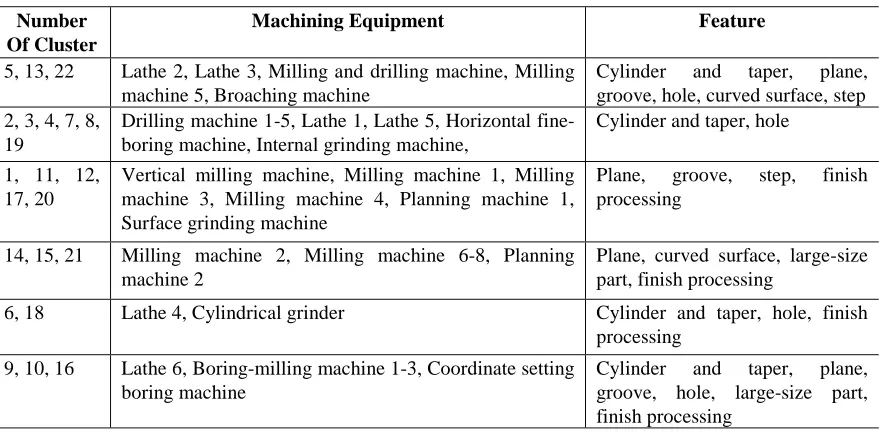
Table 2 Classification Result of Manufacturing Resources
Number Of Cluster
Machining Equipment Feature
5, 13, 22 Lathe 2, Lathe 3, Milling and drilling machine, Milling machine 5, Broaching machine
Cylinder and taper, plane, groove, hole, curved surface, step 2, 3, 4, 7, 8,
19
Drilling machine 1-5, Lathe 1, Lathe 5, Horizontal fine-boring machine, Internal grinding machine,
Cylinder and taper, hole
1, 11, 12, 17, 20
Vertical milling machine, Milling machine 1, Milling machine 3, Milling machine 4, Planning machine 1, Surface grinding machine
Plane, groove, step, finish processing
14, 15, 21 Milling machine 2, Milling machine 6-8, Planning machine 2
Plane, curved surface, large-size part, finish processing
6, 18 Lathe 4, Cylindrical grinder Cylinder and taper, hole, finish processing
9, 10, 16 Lathe 6, Boring-milling machine 1-3, Coordinate setting boring machine
The proposed algorithm was implemented in C++. The population size of the inner iteration and outer iteration are 40 and 20 respectively. The
evolutional generation of the hybrid algorithm is 100, crossover rate and mutation rate are 0.8 and 0.1 respectively.
Table 1 A Set Of Equipments
Number Device Name Features Pattern
Vector
1 Vertical milling machine Plane, groove, finish processing 011000 01 2 Drilling machine 1 Hole 000100 00 3 Drilling machine 3 Hole, large-size part 000100 10 4 Lathe 1 Cylinder and taper, hole 100100 00 5 Lathe 2 Cylinder and taper, plane, groove, hole 111100 00 6 Lathe 4 Cylinder and taper, hole, finish processing 100100 01 7 Drilling machine 4 Hole 000100 00 8 Drilling machine 5 Hole 000100 00 9 Coordinate setting boring
machine
Plane, groove, hole, large-size part, finish processing
011100 11
10 Boring-milling machine 2 Plane, groove, hole, large-size part, finish processing
011100 11
11 Milling machine 1 Plane, groove, finish processing 011000 01 12 Milling machine 3 Plane, groove, step, finish processing 011001 01 13 Milling machine 5 Plane, groove, hole, step, finish processing 011101 01 14 Milling machine 6 Plane, large-size part, finish processing 010000 11 15 Milling machine 7 Plane, large-size part, finish processing 010000 11 16 Boring-milling machine 3 Plane, hole, large-size part, finish processing 010100 11 17 Planning machine 1 Plane, groove 011000 00 18 Cylindrical grinder Cylinder and taper, finish processing 100000 01 19 Internal grinding machine Hole, finish processing 000100 01 20 Surface grinding machine Plane, finish processing 010000 01 21 Planning machine 2 Plane, large-size part, finish processing 010000 11 22 Broaching machine Plane, curved surface, finish processing 010010 01
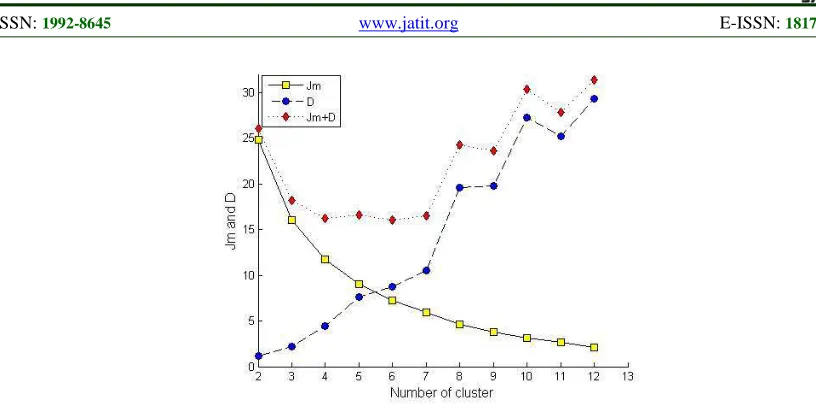
The variation of objective function of fuzzy clustering Jm and the average distance between cluster centers D with respect to the number of cluster is shown in Figure 2. Jm is monotone decreasing and D is monotone increasing as the number of cluster increasing. According to the
Figure 2 Relationship Between Jm, D And The Number Of Cluster
Every manufacturing resource only belongs to one class but every single feature could belong to more than one class. The second group and the fifth group can process cylinder and taper and hole features of small and medium parts, but the equipments in the fifth group can be used in finish processing, so these processing equipments are partitioned in the two different group. The first group and the sixth group can process cylinder and taper, hole, plane and groove features, but the equipments in the sixth group can process these features of large-size part and be used in finish processing, these equipments are partitioned in different groups although they can process the same features. The main content of manufacturability evaluation is to evaluate whether every feature of part has the corresponding processing equipments.
4. RESULTS
In this paper, a hybrid algorithm of genetic algorithm and fuzzy c-means is proposed to group the processing equipments according to the manufacturing and geometric features which can be processed by the equipments. The fuzzy rules employed can cope with the problem of the difference between processing capability of modern processing equipments. An application has been developed to test the algorithm. In the mentioned sample, the mathematical model of algorithm is built, and 22 processing equipments are partitioned to test the algorithm. The result shows that the algorithm is reasonable and effective and it is insensitive to the initial value. In this way, the searching time and searching space of processing equipments are decreased so the manufacturer can select the proper machining equipments according
the requirements. And the manufacturing resources classification is the base of manufacture resources model and manufacturability evaluation. The further work should be focus on how to builde the resources model based on resources classification and integrate the resources model into the manufacturability evaluation system.
REFERENCES
[1] Bezdek, J.C., Keller, J., Krisnapuram, R. and Pal, N. R..Fuzzy models and algorithms for pattern recognition and image processing. Kluwer Academic Publishing, Boston, 1999. [2] Tsdkouras, G. E. and Sarimveis, H.. A new
approach for measuring the validity of the fuzzy c-means algorithm. Advances in Engineering Software, (2004)35(8), pp.567-575.
[3] Francisco de A.T. de Carvalho. Fuzzy c-means clustering methods for symbolic interval data. Pattern Recognition Letters, (2007) 28, pp.423-437.
[4] Lucio, Ippolito, Vincenzo, Loia and Pierluigi, Siano. Extended Fuzzy c-means and genetic algorithms to optimize power flow management in hybrid electric vechicles. Fuzzy Optimization and Decision Making, (2003) 2, pp.359-374. [5] Vigdergauz, S. 4. Genetic algorithm optimization
of the effective Young moduli in a perforated plate. Structural and Multidisciplinary Optimization, (2002)4, pp.106-117.
[7] bdullah,Konakk, David, W. Coit and Alice, E. Smith. Multi-objective optimization using genetic algorithms: A tutorial. Reliability Engineering and System Safety, (2006)91, pp992-1007.