Cluster-based Web Summarization
Yves Petinot and Kathleen McKeown and Kapil Thadani
Department of Computer Science Columbia University 503 Computer Science Building
1214 Amsterdam Avenue New York, New York, 10027
{ypetinot|kathy|kapil}@cs.columbia.edu
Abstract
We propose a novel approach to abstrac-tive Web summarization based on the ob-servation that summaries for similar URLs tend to be similar in both content and structure. We leverage existing URL clus-ters and construct per-cluster word graphs that combine known summaries while ab-stracting out URL-specific attributes. The resulting topology, conditioned on URL features, allows us to cast the summariza-tion problem as a structured learning task using a lowest cost path search as the de-coding step. Early experimental results on a large number of URL clusters show that this approach is able to outperform previ-ously proposed Web summarizers.
1 Introduction
Abstract Web summaries, which describe the top-ics and functionalities of Web pages at anabstract level, play an essential part in the discovery of new sites and services on the Web. Such summaries are intrinsically difficult to obtain using the content of Web pages. As such, the most successful meth-ods for generating them are effectively extractive and based on the identification of likely abstractive content from linking pages. These URL-centric techniques however require a significant amount of redundancy in linking content (Delort et al., 2003).
In this paper, we propose asummary-centric ap-proach to Web summarization based on the ob-servation that summaries for similar URLs exhibit both similar content and structure. This simi-larity is apparent when analyzing summaries from a single ODP category, examples of which are
shown in Table 1. We can see there that sum-maries of semantically related URLs tend to share common concepts and differ mostly at the level of target-specific attributes. Given a previously un-seen URLU, such a cluster could thus be used as a source of potentially relevant terms for that URL’s summary. In particular, these relevant terms in-clude abstract terms, which may not otherwise be observed in the input data. We propose a graph-based summarization framework that can leverage this phenomenon.
2 Proposed Framework
Given a reference cluster C, we represent the space for summary generation as a graph GC =
(VC, EC). This graph is obtained by fusing
train-ing summaries inCinto a word graph. Each sum-marygi is mapped to a path between the shared
source and sink nodes. Each word gij is thus mapped to a nodeNkand each pair of neighboring
words(gij, gij+1)to a directed edge(Nk, Nl).
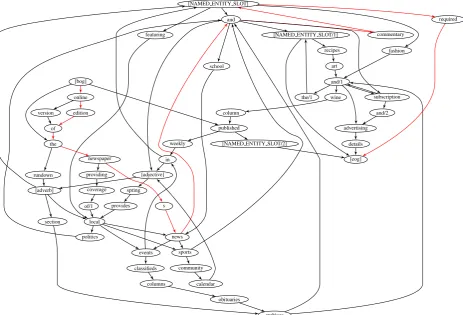
No-tably, we add nodes as needed to guarantee that in-dividual summaries are cycle-free. Figure 1 shows a simple summary graph.
2.1 Node Alignment
During the graph construction, nodes from distinct paths are iteratively combined to elicit the struc-tural and content commonalities between sum-maries in the reference cluster. Following (Fil-ippova, 2010) unambiguous nodes — i.e. nodes whose surface form match exactly and for which only one candidate exists — are always aligned, while ambiguous nodes are aligned to the candi-date node with maximum context overlap. When there is no context overlap, a new node is added to the graph.
URL Abstract Summary
http://www.qgazette.com/ Published weekly for the Queens, New York community. Includes information on politics, religion, dining, seniors, events, archives, classifieds and subscription details.
http://www.queenschronicle.com/ Local Queens NY news classifieds.
http://www.rockawave.com/ Published weekly in Rockaway, featuring local news, sports, community calendar, classified ad section, archives and subscription and advertising details.
http://www.observer.com/ Online version of the newspaper, providing coverage of local politics and media, Real Estate, fashion, and the Arts.
http://www.nytimes.com/ Online edition of the newspaper’s news and commentary. [Registration required]
Table 1: Sample entries form the ODP category /News/Newspapers/Regional/United States/New York. All entries in this category describe sites of news organization located in the New-York area.
2.2 Template Slots
The content of reference summaries is likely to be only partially relevant to a previously unseen URL. In particular, certain paths in the summary graph may contain nodes whose surface form is target-specific. We use the following heuristic to decide on the presence of template slots in a sum-mary:
• Adverbs, adjectives and named entities are treated as slots.
• Any term occurring in at least25%of paths will not be treated as a slot;
Similarly to (Barzilay and Lee, 2003), slot identi-fication is performed prior to alignment.
3 Features
In this section we present the feature sets used to condition the summary graph topology on a tar-get URLU. Two aspects of the graph need to be trained, namely edge costs and slot locations. We introduce features for both.
3.1 Edge Feature Templates
We use the following feature templates to repre-sent the compatibility between U — represented by its text modalities, as listed in Table 2 — and a specific edge in the summary graph.
Edge prior Probability of appearance of edge
eij in reference paths (summaries).
Edge appearance + Modality Frequency of edgeeij in each modality Mk. We consider that
eij appears inMkif its source and sink co-occur
inMk.
Source/Sink prior Probability of Source/Sink nodeNiin reference paths (summaries).
Source/Sink appearance + Modality Indicates whether Source/Sink nodeNioccurs inMk.
Modality + n-gram Compatibility between the edge eij, the modality Mk and the n-gram nl,
where n is in the range[1,3].
3.2 Slot Features
To allow for the use of supervised methods in learning optimal edge costs we need a graph whose structure remains unchanged from one training instance to the next. The fillers of slot locations are thus described using features that are not surface-based:
Semantic Type We only consider fillers com-patible with the host slot.
Modality appearance Frequency of filler can-didate in modalityMk.
Content HTML Context HTML (Style + Structural) context of filler candidate in the con-tent ofU.
4 Learning Model
Using the summary graph topology and the fea-tures defined above we express the abstract Web summarization task as a structured learning prob-lem. Specifically, we seek to obtain edge weights such that the cost of individual reference sum-maries — which, as we saw earlier, are mapped to paths — is minimized. Given a set of features
F, the optimal set of feature weights w∗ is such that:
w∗ = arg min
w
X
g∈R(U)
Costw(g) (1)
Since our core constraint in building the summary graph is that each summary should map to a cycle-free path, identifying the optimal summary given a set of edge weights reduces to solving a lowest cost path problem:
w∗ = arg min
w
X
g∈R(U)
|g|
X
i=1
X
fk∈F
Costfk(egi−1gi)
Modality Feature Types Description
URL content n-gram (n∈[1,3]) n-grams generated from the target page content
n-gram + context n-gram with HTML context (immediately surrounding HTML tag) URL title 1-gram 1-grams generated from the target URL title
URL words 1-gram 1-grams generated from the target URL string (e.g. “nytimes”, “com”) URL anchortext n-gram (n∈[1,3]) n-grams generated from the anchortext for the target URL
Table 2: Modality and features used to represent a target URLU.
In this setting, generation is achieved by running the decoder using the optimal set of edge weights.
4.1 Structured Perceptron
One way to solve this learning problem is to use a structured perceptron algorithm (Collins, 2002) where weightswcontrol the linear contribution of individual features to the aggregate cost of edges.
Costfk(eij) =w
eij
k ·fk (3)
The structured perceptron algorithm is shown in Algorithm 1. At every iteration, decoding is achieved via a search for the shortest path based on the edge costs induced by the current weights
w∗. Following recent work on structured learning (Huang et al., 2012), we do not require this search to be exact, but to guarantee that each iteration results in a valid update. Our decoder thus uses beam search (beam sizeb= 5) combined with an early update procedure, the latter helping in sig-nificantly speeding up model training.
Algorithm 1Structured Perceptron
Require: {ui, gi}n i=1
1: w∗← {0}
2: fori= 1→Tdo
3: forj= 1→ndo
4: g∗←ShortestP athGw∗(ui) 5: w∗←w∗+φ(ui, gi)−φ(ui, g∗
) 6: end for
7: end for
4.2 Slot Filling
During the inference phase, we substitute slot lo-cations with alternate paths, each containing a can-didate filler for the slot. Each of these paths is associated with the slot features discussed ear-lier, however the feature weights of each slot are shared, thus allowing the learning algorithm to converge towards appropriate weights for filler se-lection.
5 Evaluation
We compare the performance of our model against a reimplementation of the two summarization
al-gorithms - content-based and context-based - pro-posed in Delort et al. (2003). We apply our sum-marization algorithms and the baselines to a ran-dom sample of 56 ODP categories comprising at least 50 entries. For each category, we split the set of available summaries into training (90%) and testing (10%), train the summarization algorithms on the training set, and report (macro) average per-formance on the testing set.
ROUGE (Lin, 2004) results comparing both our proposed summarization model and the base-line systems to the ODP ground truth are pro-vided in Table 3. The summary-graph model, both with and without slot-filling, shows signif-icant improvements compared to the baselines in terms of ROUGE-1 and ROUGE-L scores. ROUGE-2 performance, however, is not on par with the baselines. Long-distance sequence sim-ilarity (ROUGE-L) being higher, we believe this could indicate the inability of our model to cap-ture target-specific bi-grams that have little or no support in the training summaries. Allowing the topology of the summary-graph to adapt to its tar-get, for instance by introducing missing edges sup-ported by the input data, should help alleviate this issue. Finally, the performance of the model with slot filling shows slight improvement over the ba-sic model, however we observed that the system frequently fails in extracting slot fillers. Future work will focus on acquiring more filler candi-dates and better features to model them.
6 Previous and Related Work
snip-and
fashion
art
and/2 and/1
spring
community edition
in
coverage
politics
calendar classifieds
weekly
rundown
[eog]
section
sports version
[adverb]
details
provides
online the/1
commentary featuring
local
events
columns
archives
[NAMED ENTITY SLOT/1]
obituaries [adjective]
[bog]
news
subscription school
providing
column
of
recipes
required
[NAMED ENTITY SLOT/2]
s
wine
advertising published
newspaper the
of/1
[NAMED ENTITY SLOT]
Figure 1: Summary graph associated with a subset of /News/Newspapers/Regional/United States/New York. The path for the URLhttp://www.nytimes.comis shown in red
Summarization System ROUGE-1 ROUGE-2 ROUGE-L
Delort - Content 0.07163 0.04492 0.06574 Delort - Context 0.06783 0.03979 0.06197 Summary-graph 0.16222† 0.02775 0.14370†
Summary-graph + slot filling 0.16832† 0.02702 0.14729†
Table 3: Performance of summarization algorithms. † indicates statistically significant improvements (according to a paired t-test withp <0.05) compared to the provided baselines.
pet and how content may be truncated (Clarke et al., 2007). Sun et al. (2005), in particular, lever-aged the ODP hierarchy to mitigate data scarcity for certain URLs, however they did not exploit ODP summaries themselves. Several efforts have focused on producing Web summaries using the content of linking pages as a source of descrip-tive content. Amitay and Paris (2000) assumes full summaries can be readily found on a single page linking to the target site. Delort et al. (2003) makes less stringent assumptions and seeks to combine descriptive content from multiple linking pages. Closer to our work, Berger and Mittal (2000) pro-posed a generative solution embracing the noisi-ness of Web data and trained directly over ODP (URL,summary) pairs. Finally our work relates to T2T generation as we seek to generate
well-formed sentences without resorting to semantic representations of either the input or output con-tents. Graph-based models similar to ours have been used for tasks ranging from string reconstruc-tion (Wan et al., 2009) to sentence fusion and com-pression (Filippova and Strube, 2008; Filippova, 2010).
7 Conclusion and Future Work
References
Einat Amitay and Cecile Paris. 2000. Automatically summarising web sites - is there a way around it? In CIKM 2000, pages 173–179.
Regina Barzilay and Lillian Lee. 2003. Learn-ing to paraphrase: An unsupervised approach us-ing multiple-sequence alignment. InProceedings of NAACL-HLT, 2003, pages 16–23.
A. Berger and V. Mittal. 2000. Ocelot: a system for summarizing web pages. InProceedings of the 23rd Annual International ACM SIGIR Conference on Research and Development in Information Re-trieval (SIGIR’00), pages 144–151.
Charles L.A. Clarke, Eugene Agichtein, Susan Dumais, and Ryen W. White. 2007. The influence of caption features on clickthrough patterns in web search. In Proceedings of the 30th annual international ACM SIGIR conference on Research and development in information retrieva, pages 135–142.
Michael Collins. 2002. Discrimative training meth-ods for hidden markov models: Theory and exper-iments with perceptron algorithms. InProceedings of EMNLP 2002, page ...
Jean-Yves Delort, Bernadette Bouchon-Meunier, and Maria Rifqi. 2003. Enhanced web document sum-marization using hyperlinks. In Hypertext 2003, pages 208–215.
K. Filippova and M. Strube. 2008. Sentence fusion via dependency graph compression. In Proceed-ings of the 2008 Conference on Empirical Meth-ods in Natural Language Processing. Honolulu, Hawaii, Association for Computational Linguistics, page 177–185.
Katja Filippova. 2010. Multi-sentence compression: Finding shortest paths in word graphs. In Proceed-ings of COLING 2010, pages 322–330.
Eric J. Glover, Kostas Tsioutsiouliklis, Steve Lawrence, David M. Pennock, and Gary W. Flake. 2002. Using web structure for classifying and describing web pages. InProceedings of WWW 2002, pages 562–569.
Liang Huang, Suphan Fayong, and Yang Guo. 2012. Structured perceptron with inexact search. In Pro-ceedings of the 2012 Conference of the North Amer-ican Chapter for the Association for Computational Linguistics: Human Language Technologies, pages 142–151.
Chin-Yew Lin. 2004. Rouge: a package for auto-matic evaluation of summaries. InProceedings of the Workshop on Text Summarization Branches Out (WAS 2004), Barcelona, Spain, July 25 - 26.
Jian-Tao Sun, Dou Shen, Hua-Jun Zeng, Qiang Yang, Yuchang Lu, and Zheng Chen. 2005. Web-page summarization using clickthrough data. In SIGIR 2005, pages 194–201.
Stephen Wan, Mark Dras, Robert Dale, and C´ecile Paris. 2009. Improving grammaticality in statisti-cal sentence generation: Introducing a dependency spanning tree algorithm with an argument satisfac-tion model. InProceedings of the 12th Conference of the European Chapter of the ACL, pages 852–860.