A preliminary version of this paper appeared in Advances in Cryptology – CRYPTO ’04, Lecture Notes in Computer Science Vol. ?? , M. Franklin ed., Springer-Verlag, 2004. This is the full version.
The Knowledge-of-Exponent Assumptions and
3-Round Zero-Knowledge Protocols
Mihir Bellare∗ Adriana Palacio†
May 2004
Abstract
Hada and Tanaka [11, 12] showed the existence of 3-round, negligible-error zero-knowledge arguments for NP based on a pair of non-standard assumptions, here called KEA1 and KEA2. In this paper we show that KEA2 is false. This renders vacuous the results of [11, 12]. We recover these results, however, under a suitably modified new assumption called KEA3. What we believe is most interesting is that we show that it is possible to “falsify” assumptions like KEA2 that, due to their nature and quantifier-structure, do not lend themselves easily to “efficient falsification” (Naor [15]).
Contents
1 Introduction 3
2 Preliminaries 5
3 KEA2 is false 6
4 The KEA3 assumption 9
5 Three-round zero knowledge 9
References 14
A Proof of Proposition 2.2 15
B KEA3 implies KEA1 16
1
Introduction
A classical question in the theory of zero knowledge (ZK) [10] is whether there exist 3-round, negligible-error ZK proofs or arguments for NP. The difficulty in answering this question stems from the fact that such protocols would have to be non-black-box simulation ZK [9], and there are few approaches or techniques to this end. A positive answer has, however, been provided, by Hada and Tanaka [11, 12]. Their result (a negligible-error, 3-round ZK argument for NP) requires a pair of non-standard assumptions that we will denote by KEA1 and KEA2.
The assumptions, roughly. Letq be a prime such that 2q+1 is also prime, and letgbe a generator
of the orderqsubgroup ofZ∗
2q+1. Suppose we are given inputq, g, gaand want to output a pair (C, Y) such thatY =Ca. One way to do this is to pick somec∈Zq, letC =gc, and letY = (ga)c. Intuitively,
KEA1 can be viewed as saying that this is the “only” way to produce such a pair. The assumption captures this by saying that any adversary outputting such a pair must “know” an exponent c such that gc =C. The formalization asks that there be an “extractor” that can returnc. Roughly:
KEA1: For any adversaryAthat takes inputq, g, gaand returns (C, Y) withY =Ca, there exists
an “extractor” A¯, which given the same inputs as A returnsc such thatgc=C.
Suppose we are given input q, g, ga, gb, gab and want to output a pair (C, Y) such that Y =Cb. One
way to do this is to pick some c ∈Zq, let C =gc, and let Y = (gb)c. Another way is to pick some
c ∈Zq, let C = (ga)c, and let Y = (gab)c. Intuitively, KEA2 can be viewed as saying that these are
the “only” ways to produce such a pair. The assumption captures this by saying that any adversary outputting such a pair must “know” an exponent c such that either gc = C or (ga)c = C. The formalization asks that there be an “extractor” that can returnc. Roughly:
KEA2: For any adversary A that takes input q, g, ga, gb, gab and returns (C, Y) with Y = Cb,
there exists an “extractor” A¯, which given the same inputs asAreturnscsuch that either
gc =C or (ga)c =C.
As per [11, 12], adversaries and extractors are poly-size families of (deterministic) circuits. See Assumption 3.1 for a formalization of KEA2, and Assumption B.1 for a formalization of KEA1.
History and nomenclature of the assumptions. KEA1 is due to Damg˚ard [7], and is used
by [11, 12] to prove their protocol is ZK. To prove soundness of their protocol, Hada and Tanaka [11, 12] introduce and use KEA2. (In addition, they make the Discrete Logarithm Assumption, DLA.) The preliminary version of their work [11] referred to the assumptions as SDHA1 and SDHA2 (Strong Diffie-Hellman Assumptions 1 and 2), respectively. However, the full version [12] points out that the formalizations in the preliminary version are flawed, and provides corrected versions called non-uniform-DA1 and non-uniform-DA2. The latter are the assumptions considered in this paper, but we use the terminology of Naor [15] which we feel is more reflective of the content of the assumption: “KEA” stands for “Knowledge of ExponentAssumption”, the exponent being the value
c above.
Falsifying KEA2. In this paper we show that KEA2 is false. What is interesting about this —besides
the fact that it renders the results of [11, 12] vacuous— is that we are able to “falsify” an assumption whose nature, as pointed out by Naor [15], does not lend itself easily to “efficient falsification.” Let us explain this issue before expanding more on the result itself.
is not negligible. (For example, a polynomial-time factoring algorithm.) KEA1 and KEA2 are not of this standard format. They involve a more complex quantification: “For every adversary there exists an extractor such that ...”. To show KEA2 is false, we must show there is an adversary for which
there exists no extractor. As we will see later, it is relatively simple to identify an adversary for which
there does not appear to exist an extractor, but how can we actually show that none of the infinite number of possible extractors succeeds?
An analogy. The difficulty of falsifying an assumption with the quantifier format of KEA2 may be
better appreciated via an analogy. The definition of ZK has a similar quantifier format: “For every (cheating) verifier there exists a simulator such that ...”. This makes it hard to show a protocol is not ZK, for, even though we may be able to identify a cheating verifier strategy that appears hard to simulate, it is not clear how we can actually show no simulator exists. (For example, it is hard to imagine how one could find a simulator for the cheating verifier, for Blum’s ZK proof of Hamiltonian Cycle [5], that produces its challenges by hashing the permuted graphs sent by the prover in the first step. But there is to date no proof that such a simulator does not exist). However it has been possible to show protocols are not black-box simulation ZK [9], taking advantage of the fact that the quantification in this definition is different from that of ZK itself. It has also been possible to show conditional results, for example that the parallel version of the Fiat-Shamir [8] protocol is not ZK, unless there is no hash function that, when applied to collapse this protocol, results in a secure signature scheme [16]. Our result too is conditional.
Falsification result. At an intuitive level, the weakness in KEA2 is easy to see, and indeed it is
surprising this was not noted before. Namely, consider an adversary A that on input q, g, ga, gb, gab
picks c1, c2 in some fashion, and outputs (C, Y) where C = gc1(ga)c2 and Y = (gb)c1(gab)c2. Then
Y =Cb but this adversary does not appear to “know”c such that either gc =C or (ga)c = C. The
difficulty, however, as indicated above, is to prove that there does not exist an extractor. We do this by first specifying a particular strategy for choosingc1 andc2 and then showing that if there exists an extractor for the resulting adversary, then this extractor can be used to solve the discrete logarithm problem (DLP). Thus, our result (cf. Theorem 3.2) is that if the DLP is hard then KEA2 is false. Note that if the DLP is easy, then KEA2 is true, for the extractor can simply compute a discrete logarithm of C and output it, and thus the assumption that it is hard is necessary to falsify KEA2.
Remark. We emphasize that we have not found any weaknesses in KEA1, an assumption used not
only in [7, 11, 12] but also elsewhere.
KEA3. Providing a 3-round, negligible-error ZK protocol for NP is a challenging problem that has
attracted considerable research effort. The fact that KEA2 is false means that we “lose” one of the only positive results [11, 12] that we had on this subject. Accordingly, we would like to “recover” it. To this end, we propose a modification of KEA2 that addresses the weakness we found. The new assumption is, roughly, as follows:
KEA3: For any adversary A that takes input q, g, ga, gb, gab and returns (C, Y) with Y = Cb,
there exists an “extractor” A¯, which given the same inputs as A returns c1, c2 such that
gc1(ga)c2 =C.
Before proceeding to use this assumption, we note a relation that we consider interesting, namely, that KEA3 implies KEA1 (cf. Proposition 4.2).1 The relation means that KEA3 is a natural extension of KEA1. It also allows us to simplify result statements, assuming only KEA3 rather than both this assumption and KEA1.
1 KEA2 was not shown by [12] to imply KEA1. Our proof of Proposition 4.2 does extend to establish it, but the
Recovering the ZK result. Let HTP denote the 3-round protocol of Hada and Tanaka, which they claim to be sound (i.e., have negligible error) and ZK. The falsity of KEA2 invalidates their proof of soundness. However, this does not mean that HTP is not sound: perhaps it is and this could be proved under another assumption, such as KEA3. This turns out to be almost, but not quite, true. We identify a small bug in HTP based on which we can present a successful cheating prover strategy, showing that HTP is not sound. This is easily fixed, however, to yield a protocol we call pHTP (patched HTP). This protocol is close enough to HTP that the proof of ZK (based on KEA1) is unchanged. On the other hand, the proof of soundness of HTP provided in [12] extends with very minor modifications to prove soundness of pHTP based on KEA3 and DLA (cf. Theorem 5.3). In summary, assuming KEA3 and DLA, there exists a 3-round, negligible error ZK argument for NP.
Strength of the assumptions. The knowledge-of-exponent assumptions are strong and
non-standard ones, and have been criticized for assuming that one can perform what some people call “reverse engineering” of an adversary. These critiques are certainly valid. Our falsification of KEA2 does not provide information on this aspect of the assumptions, uncovering, rather, other kinds of problems. However, by showing that such assumptions can be falsified, we open the door to further analyses.
We also stress that in recovering the result of [12] on 3-round ZK we have not succeeded in weakening the assumptions on which it is based, for KEA3 certainly remains a strong assumption of the same non-standard nature as KEA1.
Related Work. Since [11, 12] there has been more progress with regard to the design of
non-black-box simulation ZK protocols [1]. However, this work does not provide a 3-round, negligible-error ZK protocol for NP. To date, there have been only two positive results. One is that of [11, 12], broken and recovered in this paper. The other, which builds a proof system rather than an argument, is reported in [14] and further documented in [13]. It also relies on non-standard assumptions, but different from the Knowledge of Exponent type ones. Roughly, they assume the existence of a hash function such that a certain discrete-log-based protocol, that uses this hash function and is related to the non-interactive OT of [3], is a proof of knowledge.
2
Preliminaries
If x is a binary string, then |x| denotes its length, and if n ≥ 1 is an integer, then |n| denotes the length of its binary encoding, meaning the unique integer ` such that 2`−1 ≤ n < 2`. The empty
string is denoted ε. We let N = {1,2,3, . . .} be the set of positive integers. If q is a prime number such that 2q+ 1 is also prime, then we denote by Gq the subgroup of quadratic residues of Z∗2q+1. (Operations are modulo 2q + 1 but we will omit writing “mod 2q+ 1” for simplicity.) Recall this is a cyclic subgroup of order q. If g is a generator of Gq then we let DLogq,g: Gq → Zq denote the
associated discrete logarithm function, meaning DLogq,g(ga) =afor anya∈Z
q. We let
GL = {(q, g) : q,2q+ 1 are primes and g is a generator ofGq}.
For anyn∈Nwe letGLnbe the set of all (q, g)∈GLsuch that the length of the binary representation
of 2q+ 1 isnbits, i.e.,
GLn = {(q, g)∈GL : |2q+ 1|=n}.
Assumptions and problems in [11, 12] involve circuits. A family of circuitsC={Cn}n∈N contains one circuit for each value of n∈N. It is poly-size if there is a polynomialpsuch that the size of Cn is at
Assumption 2.1 [DLA] Let I= {In}n∈N be a family of randomized circuits, and ν: N → [0,1] a function. We associate to anyn∈Nand any (q, g)∈GLn the following experiment:
Experiment ExpdlI (n, q, g)
a←$ Zq; A←ga; ¯a
$
←In(q, g, A) ; Ifa= ¯athen return 1 else return 0
We let
AdvdlI (n, q, g) = PrhExpdlI (n, q, g) = 1i
denote the advantage ofIon inputs n, q, g, the probability being over the random choice ofaand the coins of In, if any. We say that I hassuccess bound ν if
∀n∈N ∀(q, g)∈GLn : AdvdlI (n, q, g)≤ν(n).
We say that the Discrete Logarithm Assumption (DLA) holds if for every poly-size family of circuits I there exists a negligible functionν such thatI has success boundν.
The above formulation of the DLA, which, as we have indicated, follows [12], has some non-standard features that are important for their results. Let us discuss these briefly.
First, we note that the definition of the success bound is not with respect to (q, g) being chosen according to some distribution as is standard, but rather makes the stronger requirement that the advantage of I is small for all (q, g).
Second, we stress that the assumption only requires poly-size families ofdeterministic circuits to have a negligible success bound. However, in their proofs, which aim to contradict the DLA, Hada and Tanaka [11, 12] build adversaries that are poly-size families of randomized circuits, and then argue that these can be converted to related poly-size families of deterministic circuits that do not have a negligible success bound. We will also need to build such randomized adversaries, but, rather than using ad hoc conversion arguments repeated across proofs, we note the following more general Proposition, which simply says that DLA, as per Assumption 2.1, implies that poly-size families of randomized circuits also have a negligible success bound. We will appeal to this in several later places in this paper.
Proposition 2.2 Assume the DLA, and letJ={Jn}n∈Nbe a poly-size family ofrandomized circuits. Then there exists a negligible functionν such thatJhas success boundν.
As is typical in such claims, the proof proceeds by showing that for every n there exists a “good” choice of coins forJn, and by embedding these coins we get a deterministic circuit. For completeness,
we provide the proof in Appendix A.
3
KEA2 is false
We begin by recalling the assumption. Our presentation is slightly different from, but clearly equivalent to, that of [12]: we have merged the two separate conditions of their formalization into one. Recall that they refer to this assumption as “non-uniform-DA2,” and it was referred to, under a different and incorrect formalization, as SDHA2 in [11].
Assumption 3.1 [KEA2] LetA={An}n∈NandA¯ ={A¯n}n∈Nbe families of circuits, andν: N→ [0,1] a function. We associate to any n ∈ N, any (q, g) ∈ GLn, and any A ∈ Gq the following
Experiment Expkea2A,A¯(n, q, g, A)
b←$ Zq; B ←gb; X←Ab
(C, Y)←An(q, g, A, B, X) ;c←A¯n(q, g, A, B, X)
If (Y =Cb AND gc =6 C ANDAc6=C) then return 1 else return 0
We let
Advkea2A,A¯(n, q, g, A) = Pr
h
Expkea2A,A¯(n, q, g, A) = 1
i
denote the advantage ofA relative to A¯ on inputsn, q, g, A. We say thatA¯ is a kea2-extractor forA
with error bound ν if
∀n∈N ∀(q, g)∈GLn ∀A∈Gq : Advkea2A,A¯(n, q, g, A)≤ν(n).
We say that KEA2 holds if for every poly-size family of circuits A there exists a poly-size family of circuits A¯ and a negligible functionν such that A¯ is a kea2-extractor for A with error boundν. We stress again that in the above formulations, following [12], both the adversary and the extractor are families ofdeterministic circuits. One can consider various variants of the assumptions, including an extension to families of randomized ciruits, and we discuss these variants following the theorem below.
Theorem 3.2 If the DLA holds then KEA2 is false.
The basic idea behind the failure of the assumption, as sketched in Section 1, is simple. Consider an adversary given input q, g, A, B, X, where A = ga, B = gb and X = gab. The assumption says
that there are only two ways for the adversary to output a pair C, Y satisfying Y = Cb. One way
is to pick some c, let C = gc and let Y = Bc. The other way is to pick some c, let C = Ac and
let Y = Xc. The assumption thus states that the adversary “knows” c such that either C = gc
(i.e., c = DLogq,g(C)) orC = Ac (i.e., c = DLog
q,A(C)). This ignores the possibility of performing
a linear combination of the two steps above. In other words, an adversary might pick c1, c2, let
C =gc1Ac2 and Y =Bc1Xc2. In this case, Y =Cb but the adversary does not appear to necessarily
know DLogq,g(C) =c1+c2DLogq,g(A) or DLogq,A(C) =c1DLogq,A(g) +c2.
However, going from this intuition to an actual proof that the assumption is false takes some work, for several reasons. The above may be intuition that there exists an adversary for which there would not exist an extractor, but we need to prove that there is no extractor. This cannot be done unconditionally, since certainly if the discrete logarithm problem (DLP) is easy, then in fact there is an extractor: it simply computes DLogq,g(C) and returns it. Accordingly, our strategy will be to present
an adversaryA for which we can prove that if there exists an extractor A¯ then there is a method to efficiently compute the discrete logarithm ofA.
An issue in implementing this is that the natural adversary A arising from the above intuition is randomized, picking c1, c2 at random and forming C, Y as indicated, but our adversaries must be deterministic. We resolve this by designing an adversary that makes certain specific choices of c1, c2. We now proceed to the formal proof.
Proof of Theorem 3.2. Assume to the contrary that KEA2 is true. We show that the DLP is easy.
The outline of the proof is as follows. We first construct an adversaryAfor the KEA2 problem. By assumption, there exists for it an extractor A¯ with negligible error bound. Using A¯, we then present a poly-size family of randomized circuits J = {Jn}n∈N and show that it does not have a negligible success bound. By Proposition 2.2, this contradicts the DLA.
An(q, g, A, B, X)
C ←gA Y ←BX
Return (C, Y)
Jn(q, g, A)
b←$ Zq; B ←gb; X←Ab
c←A¯n(q, g, A, B, X)
C←gA
Ifgc =C then ¯a←(c−1) modq EndIf
IfAc=C then ¯a←(c−1)−1 modq EndIf Return ¯a
Figure 1: Adversary A ={An}n∈N for the KEA2 problem and adversary J={Jn}n∈N for the DLP, for the proof of Theorem 3.2.
extractor for A with error boundν. Using A¯, we define the poly-size family of circuitsJ={Jn}n∈N shown in Figure 1.
Claim 3.3 For alln∈N, all (q, g)∈GLn and all A∈Gq
Prh¯a←$ Jn(q, g, A) : g¯a6=A
i
≤ ν(n).
Note the claim shows much more than we need. Namely,Jdoes not merely have a success bound that is not negligible. In fact, it succeeds with probability almost one.
Proof of Claim 3.3: We let Pr[·] denote the probability in the experiment of executing Jn(q, g, A).
We first write some inequalities leading to the claim and then justify them:
Pr£ga¯ 6=A¤ ≤ Pr [gc 6=C∧Ac6=C] (1)
≤ Advkea2A,A¯(n, q, g, A) (2)
≤ ν(n). (3)
We justify Equation (1) by showing that if gc = C or Ac = C then ga¯ = A. First assume gc = C. Since C =gA, we have gc =gA, whence A=gc−1. Since we set ¯a= (c−1) modq, we haveA=g¯a.
Next assume Ac =C. Since C =gA, we have Ac =gA, whence Ac−1 =g. Now observe that c6= 1, because otherwise Ac =A 6=gA. (Since g is a generator, it is not equal to 1). Since c6= 1 and q is
prime, c−1 has an inverse moduloq which we have denoted by ¯a. Raising both sides of the equation “Ac−1 =g” to the power ¯awe getA=g¯a.
Expkea2A,A¯(n, q, g, A) returns 1 exactly whenY =Cb andgc 6=C andAc 6=C. By construction ofA, we
have C =gAand Y =BX, and thus Y =Cb, so Expkea2
A,A¯(n, q, g, A) returns 1 exactly when g c 6=C
and Ac 6=C. This justifies Equation (2).
Equation (3) is justified by the assumption that A¯ is an extractor forA with error bound ν.
Claim 3.3 implies that J does not have a negligible success bound, which, by Proposition 2.2, shows that the DLP is not hard, contradicting the assumption made in this Theorem. This completes the proof of Theorem 3.2.
Extensions and variants. There are many ways in which the formalization of Assumption 3.1 can
be varied to capture the same basic intuition. However, Theorem 3.2 extends to these variants as well. Let us discuss this briefly.
the assumption is clearly false.) Theorem 3.2 remains true for the resulting assumption, in particular because it is stronger than the original assumption. (Note however that the proof of the theorem would be easier for this stronger assumption.)
Another variant is that adversaries and extractors are uniform, namely standard algorithms, not circuits. (In this case we should certainly allow both to be randomized, and should again give the extractor the coins of the adversary.) Again, it is easy to see that Theorem 3.2 extends to show that the assumption remains false.
4
The KEA3 assumption
The obvious fix to KEA2 is to take into account the possibility of linear combinations by saying this is the only thing the adversary can do. This leads to the following.
Assumption 4.1 [KEA3] LetA={An}n∈NandA¯ ={A¯n}n∈Nbe families of circuits, andν: N→ [0,1] a function. We associate to any n ∈ N, any (q, g) ∈ GLn, and any A ∈ Gq the following
experiment:
Experiment Expkea3A,A¯(n, q, g, A)
b←$ Zq; B ←gb; X←Ab
(C, Y)←An(q, g, A, B, X) ; (c1, c2)←A¯n(q, g, A, B, X)
If (Y =Cb AND gc1Ac2 6=C) then return 1 else return 0
We let
Advkea3A,A¯(n, q, g, A) = Pr
h
Expkea3A,A¯(n, q, g, A) = 1
i
denote the advantage ofA relative to A¯ on inputsn, q, g, A. We say thatA¯ is a kea3-extractor forA
with error bound ν if
∀n∈N ∀(q, g)∈GLn ∀A∈Gq : Advkea3A,A¯(n, q, g, A)≤ν(n).
We say that KEA3 holds if for every poly-size family of circuits A there exists a poly-size family of circuits A¯ and a negligible functionν such that A¯ is a kea3-extractor for A with error boundν. We have formulated this assumption in the style of the formalization of KEA2 of [12] given in Assumption 3.1. Naturally, variants such as discussed above are possible. Namely, we could strengthen the assumption to allow the adversary to be a family of randomized circuits, of course then giving the extractor the adversary’s coins as an additional input. We do not do this because we do not need it for what follows. We could also formulate a uniform-complexity version of the assumption. We do not do this because it does not suffice to prove the results that follow. However, these extensions or variations might be useful in other contexts.
In Appendix B we recall the formalization of KEA1 and prove the following: Proposition 4.2 KEA3 implies KEA1.
This indicates that KEA3 is a natural extension of KEA1.
5
Three-round zero knowledge
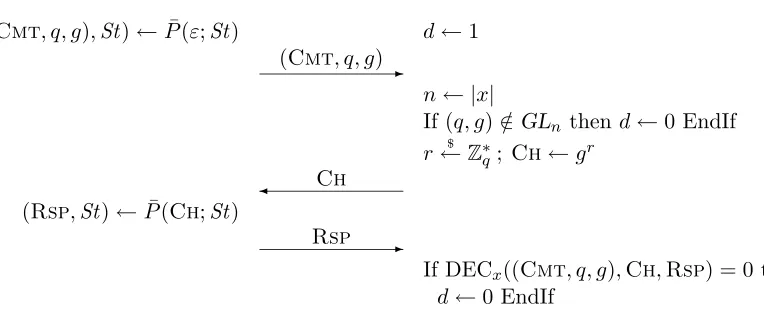
Prover ¯P Verifier ¯V
Initial State St= (x, w, R)
((Cmt, q, g),St)←P¯(ε;St) d←1 (Cmt, q, g)
-n← |x|
If (q, g)∈/GLnthen d←0 EndIf
r←$ Z∗
q; Ch←gr
Ch
¾ (Rsp,St)←P¯(Ch;St)
Rsp
-If DECx((Cmt, q, g),Ch,Rsp) = 0 then
d←0 EndIf
Figure 2: A 3-round argument. The common input is x. Prover ¯P has auxiliary input w and random tape R, and maintains stateSt. Verifier ¯V returns boolean decisiond.
We first consider the protocol of [11, 12], here called HTP. What has been lost is the proof of soundness (i.e., of negligible error). The simplest thing one could hope for is to re-prove soundness of HTP under KEA3 without modifying the protocol. However, we identify a bug in HTP that renders it unsound. This bug has nothing to do with the assumptions on which the proof of soundness was or can be based.
The bug is, however, small and easily fixed. We consider a modified protocol which we call pHTP. We are able to show it is sound (i.e., has negligible error) under KEA3. Since we have modified the protocol we need to re-establish ZK under KEA1 as well, but this is easily done.
Arguments. We begin by recalling some definitions. An argument for an NP language L [6] is a
two-party protocol in which a polynomial-time prover tries to “convince” a polynomial-time verifier that their common input xbelongs toL. (A party is said to be polynomial time if its running time is polynomial in the length of the common input.) In addition to x, the prover has an auxiliary input
a. The protocol is a message exchange at the end of which the verifier outputs a bit indicating its decision to accept or reject. The probability (over the coin tosses of both parties) that the verifier accepts is denoted AccP,aV (x). The formal definition follows.
Definition 5.1 A two-party protocol (P, V), whereP andV are both polynomial time, is anargument
for L with error probability δ :N→[0,1], if the following conditions are satisfied:
Completeness: For allx∈L there existsw∈ {0,1}∗ such thatAccP,w
V (x) = 1.
Soundness: For all probabilistic polynomial-time algorithms Pb, all sufficiently long x /∈ L, and all
a∈ {0,1}∗,AccVP ,ab (x)≤δ(|x|).
We say (P, V) is a negligible-error argument for L if there exists a negligible function δ : N→ [0,1] such that (P, V) is an argument forL with error probability δ.
Canonical protocols. The 3-round protocol proposed by [11, 12], which we call HTP, is based on
(1) The protocol is of the form depicted in Figure 2. The prover is identified with a function ¯P
that given an incoming messageMin (this isεwhen the prover is initiating the protocol) and its current state St, returns an outgoing message Mout and an updated state. The initial state of the prover is (x, w, R), wherexis the common input,wis an auxiliary input andRis a random tape. The prover’s first message is called its commitment. This is a tuple consisting of a string
Cmt, a prime numberq and an element g, where (q, g)∈GL|x|. The verifier selects achallenge
Chuniformly at random from Gq, and, upon receiving a response Rspfrom the prover, applies
a deterministic decision predicate DECx((Cmt, q, g),Ch,Rsp) to compute a boolean decision.
(2) For any x /∈ L and any commitment (Cmt, q, g), where (q, g) ∈ GL|x|, there is at most one challengeCh∈Gq for which there exists a response Rsp∈ {0,1}∗ such that DECx((Cmt, q, g),
Ch,Rsp) = 1. This property is calledstrong soundness.
(3) The protocol is honest-verifier zero knowledge (HVZK),meaning there exists a probabilistic polynomial-time simulator S such that the following two ensembles are computationally in-distinguishable:
{S(x)}x∈L and {View
¯
P ,W(x) ¯
V (x)}x∈L,
whereW is any function that given an input inLreturns a witness to its membership inL, and ViewP ,WV¯¯ (x)(x), is a random variable taking value ¯V’s internal coin tosses and the sequence of messages it receives during an interaction between prover ¯P (with auxiliary input W(x)) and verifier ¯V on common input x.
If ( ¯P ,V¯) is a 3-round argument for an NP-complete language, meeting the three conditions above, then we refer to ( ¯P ,V¯) as a canonical argument. In what follows, we assume that we have such canonical arguments. They can be constructed in various ways. For example, a canonical argument can be constructed by modifying the parallel composition of Blum’s zero-knowledge protocol for the Hamiltonian circuit problem [5], as described in [11, 12].
The Hada-Tanaka protocol. Let ( ¯P ,V¯) be a canonical argument for an NP-complete languageL,
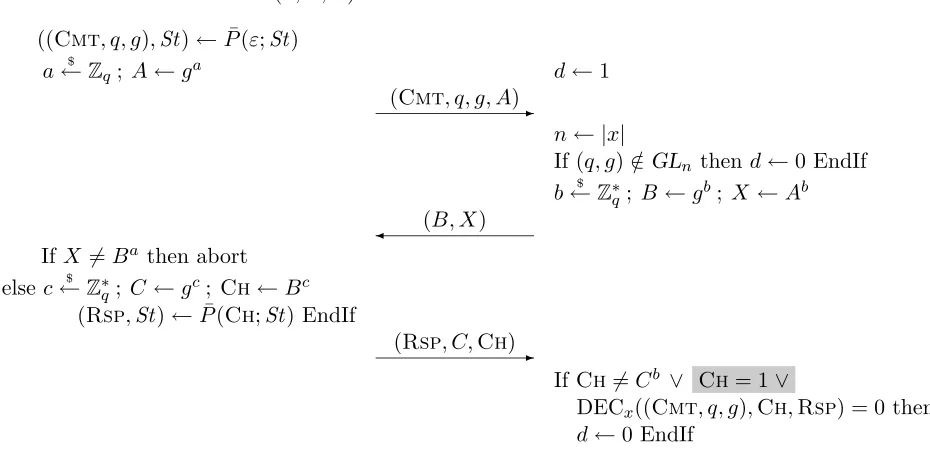
and let DEC be the verifier’s decision predicate. The Hada-Tanaka protocol HTP = (P, V) is described in Figure 3. NoteV’s decision predicate does not include the highlighted portion of its code.
We now observe that the HTP protocol is unsound. More precisely, there exist canonical arguments such that the HTP protocol based on them does not have negligible error. This is true for any canonical argument ( ¯P ,V¯) satisfying the extra condition that for infinitely many x6∈L there exists a commitment (Cmtx, qx, gx) for which there is a responseRspxto challenge 1 that will make the verifier
accept. There are many such canonical arguments. For instance, a canonical argument satisfying this condition results from using an appropriate encoding of group elements in Hada and Tanaka’s modification of the parallel composition of Blum’s zero-knowledge protocol for the Hamiltonian circuit problem.
Proposition 5.2 Let HTP be the Hada-Tanaka protocol based on a canonical argument satisfying the condition stated above. Then there exists a polynomial-time prover for HTP that can make the verifier accept with probability one for infinitely many common inputs not inL.
Proof of Proposition 5.2: Let ( ¯P ,V¯) be the canonical argument and let V be the verifier of the corresponding protocol HTP. Consider a cheating prover Pb that on initial state (x,((Cmtx, qx,
gx),Rspx), ε) selects an exponent a ∈ Zqx uniformly at random, and sends (Cmtx, qx, gx, g
a
x) as its
Prover P Verifiers V, V0
Initial StateSt = (x, w, R) ((Cmt, q, g),St)←P¯(ε;St)
a←$ Zq; A←ga d←1
(Cmt, q, g, A)
-n← |x|
If (q, g)∈/ GLn thend←0 EndIf
b←$ Z∗
q;B ←gb; X ←Ab
(B, X) ¾
IfX 6=Ba then abort
elsec←$ Z∗
q;C ←gc; Ch←Bc
(Rsp,St)←P¯(Ch;St) EndIf
(Rsp, C,Ch)
-If Ch6=Cb ∨ Ch= 1∨
DECx((Cmt, q, g),Ch,Rsp) = 0 then
d←0 EndIf
Figure 3: HTP and pHTP. Verifier V of protocol HTP = (P, V) does not include the highlighted portion. Verifier V0 of protocol pHTP = (P, V0) does.
Otherwise, it sends (Rspx,1,1) as its response toV. By the assumption about protocol ( ¯P ,V¯), for
infinitely many x 6∈ L there exists an auxiliary input y = ((Cmtx, qx, gx),Rspx) ∈ {0,1}∗ such that
AccP ,yVb (x) = 1.
Protocol pHTP. The above attack can be avoided by modifying the verifier to include the
high-lighted portion of the code in Figure 3. We call the resulting verifier V0. The following guarantees that the protocol pHTP = (P, V0) is sound under KEA3, if the DLP is hard.
Theorem 5.3 If KEA3 holds, the DLA holds, and ( ¯P ,V¯) is a canonical 3-round argument for an NP-complete language L, then pHTP = (P, V0) as defined in Figure 3 is a negligible-error argument forL.
Proof of Theorem 5.3. The proof is almost identical to that of [12]. For completeness, however,
we provide it.
Completeness follows directly from the completeness of protocol ( ¯P ,V¯). To prove soundness, we proceed by contradiction. Assume that pHTP is not sound, i.e., there is no negligible function δ such that the soundness condition in Definition 5.1 holds with respect to δ. We show that the DLP is easy under KEA3.
By the assumption that pHTP is not sound and a result of [2], there exists a probabilistic polynomial-time algorithm Pb such that the function
ErrPb(n) = max{AccVP ,ab0 (x) : x∈ {0,1}n∧x6∈L∧a∈ {0,1}∗}2
2We note that this set is finite sincePbis a polynomial-time algorithm andAccP ,ab
is not negligible. Hence there exists a probabilistic polynomial-time algorithm Pb, a polynomialp, and an infinite set S={(x, a) : x∈ {0,1}∗\L ∧ a∈ {0,1}∗}such that for every (x, a)∈S
AccP ,aVb0 (x) > 1/p(|x|), (4) and {x∈ {0,1}∗ : ∃a∈ {0,1}∗ such that (x, a)∈S} is infinite.
Since Pb takes an auxiliary input a, we may assume, without loss of generality, that Pb is deter-ministic. We also assume that, if (Cmt, q0, g0, A0) is Pb’s commitment on inputεwhen the initial state
is (x, a, ε), for some x, a ∈ {0,1}∗ with |x| = n, then (q0, g0) ∈ GL
n. (There exists a prover Pb0 for
which AccPVb00,a(x) = Acc b
P ,a
V0 (x) for every x, a ∈ {0,1}∗ and this assumption holds.) We will use Pb to construct an adversary A for the KEA3 problem. By assumption, there exists for it an extractor
¯
A with negligible error bound. Using A¯ and Pb, we then present a poly-size family of randomized circuits J={Jn}n∈N and show that it does not have a negligible success bound. By Proposition 2.2, this shows that the DLP is not hard.
Let K = {n ∈ N : ∃(x, a) ∈ S such that|x| = n}. We observe that K is an infinite set. For each n ∈ K, fix (x, a) ∈ S such that |x| = n. The poly-size family of circuits A = {An}n∈N is presented in Figure 4. Now, under KEA3, there exists a poly-size family of circuits A¯ = {A¯n}n∈N and a negligible function ν such that A¯ is an extractor for A with error bound ν. For each n∈ K, let a0 = DLogq0,g0(A0), where (Cmt, q0, g0, A0) is Pb’s commitment on input εwhen the initial state is (x, a, ε). Using A¯, we define the poly-size family of circuits J = {Jn}n∈N shown in Figure 4. The proof of the following is in Appendix C.
Claim 5.4 For infinitely manyn∈Nthere exists (q, g)∈GLn such that for everyA∈Gq
Prh¯a←$ Jn(q, g, A) : g¯a=A
i
> 1 p(n)2 −
8
2np(n)−2ν(n).
Claim 5.4 implies that J does not have a negligible success bound, which, by Proposition 2.2, shows that the DLP is not hard, contradicting the assumption made in this Theorem.
Zero knowledge of pHTP. Having modified HTP, we need to revisit the zero knowledge. Hada
and Tanaka proved that if the canonical argument is HVZK (property (3) above) then HTP is zero knowledge under KEA1. However, we observe that pHTP modifies only the verifier, not the prover. Furthermore, only the decision predicate of the verifier is modified, not the messages it sends. This means that the view (i.e., the internal coin tosses and the sequence of messages received during an interaction with a prover P) of verifier V0 of pHTP is identical to that of verifier V of HTP. Thus,
zero knowledge of pHTP follows from zero knowledge of HTP, and in particular is true under the same assumptions, namely KEA1.
Summary. In summary, pHTP is a 3-round protocol that we have shown is a negligible-error argument
for NP assuming DLA and KEA3, and is ZK assuming KEA1. Given Proposition 4.2, this means we have shown that assuming DLA and KEA3 there exists a 3-round negligible-error ZK argument for NP.
Acknowledgments
Proposition 4.2 is due to Shai Halevi and we thank him for permission to include it. We thank the Crypto 2004 referees for their comments on the paper.
An(q, g, A, B, X) // n∈K
St ←(x, a, ε) ; ((Cmt, q0, g0, A0),St)←Pb(ε;St) If q06=q∨g0 =6 g∨A0 6=A then return (1,1)
else ((Rsp, C,Ch),St)←Pb((B, X);St) ; return (C,Ch) EndIf An(q, g, A, B, X) // n6∈K
Return (1,1) Jn(q, g, A) // n∈K
St ←(x, a, ε) ; ((Cmt, q0, g0, A0),St)←Pb(ε;St)
If q06=q∨g0 6=g then return⊥EndIf
b←$ Zq; B ←A·gb; X←Ba
0
((Rsp, C,Ch),St1)←Pb((B, X);St) ; (c1, c2)←A¯n(q, g, A0, B, X)
If DECx((Cmt, q, g),Ch,Rsp) = 0∨Ch6=Bc1Xc2 then return⊥EndIf
b0 ←$ Zq; B0 ←gb
0
; X0 ←B0a0
If B=B0 then ¯a←b0−bmodq; return ¯aEndIf ((Rsp0, C0,Ch0),St0
1)←Pb((B0, X0);St) ; (c01, c02)←A¯n(q, g, A0, B0, X0)
If DECx((Cmt, q, g),Ch0,Rsp0) = 0∨Ch06=B0c
0
1X0c02 then return⊥EndIf
If c1+a0c26≡0 (modq) then ¯
a←(b0c01+b0a0c02−bc1−ba0c2)·(c1+a0c2)−1 modq; return ¯a else return⊥EndIf
Jn(q, g, A) // n6∈K
Return ⊥
Figure 4: Adversary A ={An}n∈N for the KEA3 problem and adversary J={Jn}n∈N for the DLP, for the proof of Theorem 5.3.
References
[1] B. Barak. How to go beyond the black-box simulation barrier. Proceedings of the 42nd Symposium on Foundations of Computer Science, IEEE, 2001.
[2] M. Bellare. A note on negligible functions. Journal of Cryptology, Vol. 15, No. 4, pp. 271–284, June 2002.
[3] M. Bellare and S. Micali. Non-interactive oblivious transfer and applications.Advances in Cryptology – CRYPTO ’89, Lecture Notes in Computer Science Vol. 435, G. Brassard ed., Springer-Verlag, 1989.
[4] M. Bellare and A. Palacio. The Knowledge-of-Exponent assumptions and 3-round zero-knowledge protocols. Advances in Cryptology – CRYPTO ’04, Lecture Notes in Computer Science Vol. ?? , M. Franklin ed., Springer-Verlag, 2004.
[5] M. Blum. How to prove a theorem so no one else can claim it.Proceedings of the International Congress of Mathematicians, pp. 1444–1451, 1986.
[7] I. Damg˚ard. Towards practical public-key cryptosystems provably-secure against chosen-ciphertext at-tacks.Advances in Cryptology – CRYPTO ’91, Lecture Notes in Computer Science Vol. 576, J. Feigenbaum ed., Springer-Verlag, 1991.
[8] A. Fiat and A. Shamir. How to prove yourself: Practical solutions to identification and signature prob-lems.Advances in Cryptology – CRYPTO ’86, Lecture Notes in Computer Science Vol. 263, A. Odlyzko ed., Springer-Verlag, 1986.
[9] O. Goldreich and H. Krawczyk. On the Composition of Zero Knowledge Proof Systems.SIAM J. on Computing, Vol. 25, No. 1, pp. 169–192, 1996.
[10] S. Goldwasser, S. Micali and C. Rackoff. The knowledge complexity of interactive proof systems. SIAM Journal of Computing, Vol. 18, No. 1, pp. 186–208, February 1989.
[11] S. Hada and T. Tanaka. On the existence of 3-round zero-knowledge protocols.Advances in Cryptology – CRYPTO ’98, Lecture Notes in Computer Science Vol. 1462, H. Krawczyk ed., Springer-Verlag, 1998. [Preliminary version of [12].]
[12] S. Hada and T. Tanaka. On the existence of 3-round zero-knowledge protocols. Cryptology ePrint Archive: Report 1999/009, March 1999.http://eprint.iacr.org/1999/009/. [Final version of [11].]
[13] M. Lepinski. On the existence of 3-round zero-knowledge proofs. SM Thesis, MIT, June 2002. http: //theory.lcs.mit.edu/~cis/theses/lepinski-masters.ps.
[14] M. Lepinski and S. Micali. On the existence of 3-round zero-knowledge proof systems. MIT LCS Tech-nical Memo. 616, April 2001. http://www.lcs.mit.edu/publications/pubs/pdf/MIT-LCS-TM-616. pdf.
[15] M. Naor. On cryptographic assumptions and challenges. Invited paper and talk,Advances in Cryptology – CRYPTO ’03, Lecture Notes in Computer Science Vol. 2729, D. Boneh ed., Springer-Verlag, 2003.
[16] K. Sakurai and T. Itoh. On the discrepancy between serial and parallel of zero-knowledge protocols. Advances in Cryptology – CRYPTO ’92, Lecture Notes in Computer Science Vol. 740, E. Brickell ed., Springer-Verlag, 1992.
A
Proof of Proposition 2.2
LetK ={n∈N : GLn6=∅ }. For each n∈K we let (qn, gn)∈GLn be such that
∀(q, g)∈GLn : AdvdlJ(n, q, g)≤AdvdlJ(n, qn, gn). (5)
For n ∈ K, let R(n) denote the set from which Jn draws its coins on inputsn, qn, gn. We say that
r ∈R(n) isn-good if
PrhA←$ Gqn; ¯a←Jn(qn, gn, A;r) : g
¯
a=Ai ≥ Advdl
J(n, qn, gn).
Claim A.1 For eachn∈K there exists ar ∈R(n) such thatr is n-good. Proof: Define X: Gqn×Zqn → {0,1}as follows:
X(A, r) ¯
a←Jn(qn, gn, A;r)
If g¯a=A then return 1 else return 0
Then we have:
X
r∈R(n) 1
|R(n)|·Pr h
A←$ Gqn; ¯a←Jn(qn, gn, A;r) : g
¯
= X
r∈R(n) 1
|R(n)| X
A∈Gqn 1
qn
·X(A, r)
= X
A∈Gqn
1
qn
X
r∈R(n) 1
|R(n)|·X(A, r)
= AdvdlJn(n, qn, gn).
This means that there must exist a r∈R(n) such that PrhA←$ Gqn; ¯a←Jn(qn, gn, A;r) : g
¯
a=Ai ≥ Advdl
Jn(n, qn, gn), which proves the claim.
We now define a poly-size family I = {In}n∈N of (deterministic) circuits, as follows. Let n ∈ N. If
n6∈K then we defineInarbitrarily. If n∈K then Claim A.1 tells us that there exists a string, which
we denote by rn, that isn-good. We then define In as follows:
In(q, g, A)
If q6=qn org6=gn then abort
¯
a←Jn(qn, gn, A;rn)
Return ¯a
Since I is a poly-size family of deterministic circuits, the assumption that the DLP is hard says that there is a negligible function ν such that I has success bound ν. Now putting this together with Equation (5) and Claim A.1 we have
∀n∈K ∀(q, g)∈GLn : AdvdlJ(n, q, g) ≤ AdvdlJ(n, qn, gn) ≤ AdvdlI (n, qn, gn) ≤ ν(n).
This means that Jalso has success boundν, which proves the Proposition.
B
KEA3 implies KEA1
We recall KEA1, following [12], but applying the same simplifications as we did for KEA2 so as to merge their two conditions into one:
Assumption B.1 [KEA1] LetA={An}n∈NandA¯ ={A¯n}n∈Nbe families of circuits, andν: N→ [0,1] a function. We associate to any n ∈ N, any (q, g) ∈ GLn, and any A ∈ Gq the following
experiment:
Experiment Expkea1A,A¯(n, q, g)
b←$ Zq; B ←gb
(C, Y)←An(q, g, B) ; c←A¯n(q, g, B)
If (Y =Cb AND gc 6=C) then return 1 else return 0 We let
Advkea1A,A¯(n, q, g) = Pr
h
Expkea1A,A¯(n, q, g) = 1
i
denote the advantage of A relative to A¯ on inputs n, q, g. We say that A¯ is a kea1-extractor for A
with error bound ν if
∀n∈N ∀(q, g)∈GLn : Advkea1A,A¯(n, q, g)≤ν(n).
Proof of Proposition 4.2: Let A be an adversary (poly-size family of circuits) for KEA1. We need to show there exists a negligible functionν and a poly-size family of circuitsA¯ such thatA¯ is a kea1-extractor for A with error-boundν.
We begin by constructing fromA the following adversaryA0 for KEA3:
AdversaryA0n(q, g, A, B, X)
(C, Y)←An(q, g, B)
Return (C, Y)
We have assumed KEA3. Thus there exists a negligible function ν and an extractor A¯0 such thatA¯0
is a kea3-extractor for A0 with error bound ν. Now we define an extractor A¯ forA as follows: Extractor A¯n(q, g, B)
a←$ Zq; A←ga; X ←Ba
(c1, c2)←A¯0(q, g, A, B, X)
c←c1+ac2 modq Returnc
We claim that A¯ is a kea1-extractor for A with error bound ν. To see this, assume A¯0n(q, g, A, B, X) is successful, meaning gc1Ac2 = C. Then gc =gc1+ac2 = gc1Ac2 = C so A¯
n(q, g, B) is successful as
well.
C
Proof of Claim 5.4
We let Pr[·] denote the probability in the experiment of executingJn(q, g, A). We show that for every
n ∈ K such that n ≥ 4, if (Cmt, q, g, A0) is Pb’s commitment on input ε when the initial state is (x, a, ε), then for every A∈Gq
Pr£ga¯=A¤ > 1 p(n)2 −
8
2np(n) − 2ν(n).
SinceK is infinite and, by our assumption about the output of Pb,q, g are such that (q, g)∈GLn, this
proves the claim.
Fix n∈ K such thatn ≥ 4. Let (Cmt, q, g, A0) be Pb’s commitment on inputε when the initial state is (x, a, ε), and letA∈Gq. We first write some inequalities leading to the claim and then justify
them:
Pr£g¯a=A¤
≥ Pr
[
DECx((Cmt, q, g),Ch,Rsp) = 1∧Ch=Bc1Xc2 ∧B 6=B0∧DECx((Cmt, q, g),Ch0,Rsp0) = 1∧Ch0 =B0c
0
1X0c02 ∧c1+a0c26≡0 (modq)
]
(6)≥ Pr
[
DECx((Cmt, q, g),Ch,Rsp) = 1∧Ch=Bc1Xc2 ∧Ch6= 1∧B6=B0∧DECx((Cmt, q, g),Ch0,Rsp0) = 1∧Ch0 =B0c
0
1X0c02 ∧Ch0 6= 1
]
(7)≥ Pr
[
DECx((Cmt, q, g),Ch,Rsp) = 1∧Ch=CDLogq,g(B)∧Ch6= 1∧B6=B0∧DECx((Cmt, q, g),Ch0,Rsp0) = 1∧Ch0 =C0DLogq,g(B
0)
³
Pr
[
Ch6=Bc1Xc2 ∧Ch=CDLogq,g(B)]
+ Pr[
Ch0 6=B0c01X0c02∧Ch0 =C0DLogq,g(B0)]
´
(8)
≥ ³AccP ,aVb0 (x)
´2
− 1
q−1Acc b
P ,a
V0 (x)−2Advkea3A,A¯(n, q, g, A0) (9)
> 1 p(n)2 −
1
(q−1)p(n) −2ν(n) (10)
≥ 1
p(n)2 − 8
2np(n) −2ν(n). (11)
We justify Equation (6) by showing that if DECx((Cmt, q, g),Ch,Rsp) = 1,Ch=Bc1Xc2, B 6=B0,
DECx((Cmt, q, g),Ch0,Rsp0) = 1, Ch0 =B0c
0
1X0c02 and c1+a0c2 6≡0 (mod q) then g¯a =A. Assume
that the former statement holds. By the strong soundness property of protocol ( ¯P ,V¯), Ch = Ch0, whenceBc1Xc2 =B0c01X0c02. Thus we have
g¯a = g(b0c01+b0a0c02−bc1−ba0c2)·(c1+a0c2)−1modq = ³gb0c01+b0a0c02
´(c1+a0c2)−1
g−b
= ³B0c0
1X0c02
´(c1+a0c2)−1
g−b = (Bc1Xc2)(c1+a0c2)−1g−b
= ³Bc1Ba0c2´(c1+a
0c
2)−1
g−b = ³Bc1+a0c2´(c1+a
0c
2)−1
g−b
= Bg−b = A,
as desired.
To justify Equation (7) we observe that ifCh=Bc1Xc2 and Ch6= 1 thenc
1+a0c2 6≡0 (mod q), and that adding the condition Ch0 6= 1 can only decrease the probability further.
Now Equation (8) is justified as follows.
Pr
[
DECx((Cmt, q, g),Ch,Rsp) = 0∨Ch=6 Bc1Xc2 ∨Ch= 1∨B =B0∨DECx((Cmt, q, g),Ch0,Rsp0) = 0∨Ch0 6=B0c
0
1X0c02 ∨Ch0 = 1
]
≤ Pr
[
DECx((Cmt, q, g),Ch,Rsp) = 0∨Ch6=CDLogq,g(B)∨Ch= 1∨B =B0∨DECx((Cmt, q, g),Ch0,Rsp0) = 0∨Ch06=C0DLogq,g(B
0)
∨Ch0 = 1∨ ³
Ch6=Bc1Xc2 ∧Ch=CDLogq,g(B)
´
∨³Ch0 6=B0c01X0c02 ∧Ch0 =C0DLogq,g(B0)
´
]
≤ Pr
[
DECx((Cmt, q, g),Ch,Rsp) = 0∨Ch6=CDLogq,g(B)∨Ch= 1∨B =B0∨DECx((Cmt, q, g),Ch0,Rsp0) = 0∨Ch06=C0DLogq,g(B
0)
∨Ch0 = 1
]
+Pr
[
Ch6=Bc1Xc2∧Ch=CDLogq,g(B)]
+ Pr[
Ch06=B0c01X0c02∧Ch0=C0DLogq,g(B0)]
.Expkea3A,A¯(n, q, g, A0) returns 1 exactly when Y = CDLogq,g(B) and gc1A0c2 6= C. By construction of
A, we have Y = Ch, and thus Ch = CDLogq,g(B)∧Ch 6= Bc1Xc2 implies that Expkea3
A,A¯(n, q, g, A0)
returns 1. Similarly, Ch0 =CDLogq,g(B0)∧Ch =6 B0c01X0c02 implies that Expkea3
A,A¯(n, q, g, A0) returns 1.
To justify Equation (9) it remains to show that
Pr
[
DECx((Cmt, q, g),Ch,Rsp) = 1∧Ch=CDLogq,g(B)∧Ch6= 1∧B 6=B0∧DECx((Cmt, q, g),Ch0,Rsp0) = 1∧Ch0 =C0DLogq,g(B
0)
≥ ³AccP ,aVb0 (x)
´2
− 1
q−1Acc b
P ,a
V0 (x). (12)
LetRESdenote the event in the experiment of executingJn(q, g, A) whose probability is bounded from
below in Equation (12). Note that the corresponding sample space is Z∗
q×Z∗q. Let ACC denote the
event that in an interaction between Pb (with initial state (x, a, ε)) and V0 (with input x), the latter accepts (i.e., Pr [ACC] =AccP ,ab
V0 (x)). The sample space of the corresponding experiment is Z∗q. We observe that if b∈ACC,b0 ∈ACCand b6=b0 then (b, b0)∈RES. Therefore,
|RES| ≥ |ACC|(|ACC| −1) and
Pr [RES] = |RES|
|Z∗
q×Z∗q|
≥ |ACC| |Z∗
q|
µ |ACC|
|Z∗
q|
− 1
|Z∗
q|
¶
= ³AccP ,aVb0 (x)
´2
− 1
q−1Acc b
P ,a V0 (x). Equation (10) is justified by Equation (4) and the assumption thatA¯ is an extractor forAwith error bound ν.
The assumption that (q, g) ∈GLn implies that |2q+ 1|=n, i.e., 2n−1 ≤2q+ 1<2n, and hence