Adaptive Transmitter Precoding for Time Division
Duplex CDMA in Fading Multipath Channels:
Strategy and Analysis
Daryl Reynolds
Department of Computer Science and Electrical Engineering, West Virginia University, Morgantown, WV 26506-6109, USA
Email: [email protected] Anders Høst-Madsen
Department of Electrical Engineering, University of Hawaii, Honolulu, HI 96822, USA Email: [email protected]
Xiaodong Wang
Department of Electrical Engineering, Columbia University, New York, NY 10027, USA Email: [email protected]
Received 31 January 2002 and in revised form 7 May 2002
The recently developed blind adaptive techniques for multiuser detection in code division multiple access (CDMA) systems offer an attractive compromise of performance and complexity. However, the desire to further reduce complexity at the mobile unit has led to the investigation of techniques that move signal processing from the mobile unit to the base station. In this paper, we investigate transmitter precoding for downlink time division duplex (TDD) code division multiple access (CDMA) communica-tions. In particular, we develop a linear minimum mean square error precoding strategy using blind channel estimation for fading multipath channels that allows for simple matched filtering at the mobile unit and is easy to make adaptive. We also present a performance analysis using tools developed for the analysis of conventional (receiver-based) linear blind multiuser detection in unknown channels. We compare the analytical and simulation results to traditional receiver-based blind multiuser detection. It is seen that transmitter precoding offers a reasonable alternative for TDD-mode CDMA when minimizing computational complex-ity at the mobile unit is a priorcomplex-ity.
Keywords and phrases:multiuser detection, transmitter precoding, wireless communications, blind channel estimation.
1. INTRODUCTION
The demand for capacity and performance in multiple access wireless systems has spurred the development of sophisticated signal processing techniques for signal recep-tion [1, 2]. However, the goal of maintaining low cost and complexity, especially at the mobile unit, is as important as ever. As a result, researchers have recently begun inves-tigating signal processing techniques that move computa-tional complexity from the mobile unit to the base station, where it can be managed more efficiently. Generally speak-ing, these techniques involve some kind of transmitter-based multiuser interference cancellation at the base station (pre-coding) and simple linear processing, for example, matched filtering, at the mobile unit. They are particularly appealing for time division duplex code division multiple access (TDD-CDMA) [3] since the same carrier is used for both uplink
and downlink in different time slots. Hence, the downlink channel can be estimated at the base station using the uplink signals [4].
work, their prefilter is applied to the output of the spread spectrum encoder, rather than applying the filter, first fol-lowed by spreading. It was shown that this approach has in-ferior average performance unless the spreading codes them-selves are allowed to be adaptive.
In this paper, we develop a linear MMSE-based trans-mitter precoding strategy for the CDMA downlink in syn-chronous multipath fading channels. No RAKE receiver is required at the mobile unit, only matched filtering. Since we require channel information to construct optimal precoding filters, we implement blind channel estimation at the base-station, where complexity can be managed more efficiently. We also present a performance analysis using tools devel-oped for the analysis of blind multiuser detection with blind channel estimation [9]. Finally, we develop an adaptive im-plementation that is able to adjust the precoding matrix as users enter and leave the system.
This paper is organized as follows. Section 2 describes the system under consideration. Section 3 develops the trans-mitter precoding strategy for CDMA over synchronous mul-tipath channels. Section 4 presents a performance analysis. Section 5 discusses an adaptive implementation. Section 6 reports simulation results and Section 7 concludes.
2. SYSTEM DESCRIPTIONS
2.1. Uplink signal model and blind channel estimation
We consider aK-user discrete-time synchronous multipath CDMA system with no intersymbol interference (ISI). Such a system is realized either by neglecting the ISI when the mul-tipath delay spread is small compared with the symbol inter-val, or by inserting guard intervals between symbols when the delay spread is large. The path delays are also assumed to be an integral number of chip periods and are known. We first consider the chip-match filtered uplink signal received at the base station which, during theith symbol interval, can be written as
r[i]=
K
k=1
bk[i] L
l=1
sl,kfl,k+n[i], (1)
where Lis the number of resolvable paths, bk[i] is theith symbol for thekth user,sl,kand fl,kare, respectively, the de-layed versions of the spreading waveform (with zero-padding when a guard interval is inserted) and the complex channel fading gain corresponding to thelth path of thekth user, and
n[i] ∼ ᏺc(0, σ2IN) is a complex white Gaussian noise vec-tor. Note thatr[i],n[i]∈CN whereNis the processing gain. Denote
Sk=
s1,k s2,k · · · sL,k
, (2)
fk=
f1,k f2,k · · · fL,k T
. (3)
Then (1) can be written as
r[i]=
K
k=1 Skfk
hk
bk[i] +n[i]=Hb[i] +n[i], (4)
where
H= h1 h2 · · · hK
,
b[i]= b1[i] b2[i] · · · bK[i] T
.
(5)
A block diagram of the uplink system appears in Figure 1. Let the autocorrelation matrix of the received signalr[i] be
Cr=E
r[i]r[i]H =HHH+σ2I
N (6)
=UsΛsUHs +σ2UnUHn, (7) where (7) is the eigendecomposition ofCr. Since the matrix Hhas full column rankK, the matrixHHH in (6) has rank
K. Therefore, in (7),Λscontains theKlargest eigenvalues of Cr;Uscontains the corresponding orthonormal eigenvectors; andUncontains the (N−K) orthonormal eigenvectors that correspond to the smallest eigenvalue,σ2.
Suppose User 1 is the user of interest. Then sinceUH nh1= UH
nS1f1 = 0, we can estimate f1 at the base station in the following way [10, 11, 12, 13]:
ˆ
f1=arg min f=1
UH
nS1f2 (8)
=arg min
f=1f HSH
1UnUHnS1
Q
f (9)
=minimum eigenvector ofQ. (10)
Note that (10) specifiesf1up to a scale and phase ambigu-ity and that, in practice, (10) can be implemented blindly in a batch or sequential adaptive manner. In batch mode, we simply replace the noise subspace parameters in (9) with pa-rameters obtained from the eigendecomposition of the sam-ple autocorrelation matrix of the received signal. In sequen-tial adaptive mode, where we update the channel estimates at each time slot, we may employ a suitable subspace track-ing algorithm and use the sequential Kalman filtertrack-ing tech-nique described in Section 5. Note that a necessary condition for our channel estimate to be unique is thatHhas rankK, which necessitates this matrix to be tall, that is,K≤N.
2.2. Downlink signal model, precoding and receiver
The (downlink) signal transmitted from the base station, during theith symbol interval, can be written as
x[i]=SMb[i], (11) where
S= s1 s2 · · · sK
(12)
r[i]=Hb[i] +n[i] received at base
station +
n[i]
+ Channel
f1
Channel
f2
Channel
fK
. . . Spreader
S1
Spreader
S2
Spreader
SK
. . . .
. .
b1[i]
b2[i]
bK[i] Symbol mapper Symbol mapper
. . . Symbol mapper Differential
encoder Differential
encoder
Differential encoder
b1[n]
b2[n]
bK[n] Mobil
unit 1 Mobil
unit 2 . . . Mobil
unit
K
Figure1: The uplink of aK-user CDMA system.
x[n]=S ˆMb[n] Construct
downlink signal
· · ·
Differential encoding
· · ·
Downlink information bit streams 1,2, . . . , K
Spreaing codes:
S1,S2, . . . ,SK
Construct
ˆ M
Blind adaptive Kalman channel tracker/amplitude
estimator
Us[i],Λs[i] Signal
subspace tracker
r[i]=Hb[i] +n[i]
Channel
f1
Channel
f2
Channel
fK
. . .
n1[n]
n2[n]
nK[n] + + +
r1[n]=H1Mbˆ [n]
r2[n]=H2Mbˆ [n]
rK[n]=HKMbˆ [n] Matched
filtering (S1)
Matched filtering (S2)
Matched filtering (SK) Delay
(symbol period)
Delay (symbol
period)
Delay (symbol
period)
×
×
×
ˆ
b1[n]
ˆ
b2[n]
ˆ
bK[n] Mobile unit 1
Mobile unit 2
Mobile unitK
Figure2: Adaptive precoding transmitter structure at the base station for the downlink signal.
elapsing between uplink and downlink transmissions is suffi -ciently small compared to the coherence time of the channel that the channel impulse response is the same for the uplink and downlink. Then from (2) and (3), the received signal at user 1’s mobile unit can be written as
r1[i]=
S1f1 S2f1 · · · SKf1
H1
Mb[i] +n1[i], (13)
an adaptive implementation is employed. We will see more details in Section 5.
3. TRANSMITTER PRECODING FOR SYNCHRONOUS MULTIPATH CDMA
We seek to choose the precoding matrixMso as to provide the best downlink performance possible when the mobile units are constrained to the use of a matched filter receiver. We choose the MMSE criterion, soMis chosen to minimize
J=E
where we have dropped the time index for clarity. It is easy to see that
The following proposition gives the optimal precoding ma-trix.
Proposition 1. The choice of Mthat minimizesJisM=Ᏼ−1. Proof. Although cumbersome, a direct proof can be con-structed via a complex analog to the proof in [5, Appendix A]. We offer the following simple alternative proof by con-tradiction. Suppose there exists a choice ofM, sayM=M0, that results in a smallerJthanM=Ᏼ−1. Then
Eb−ᏴM0b−v2 < E
v2 . (17) We may evaluate the left-hand side of (17) as
Eb−ᏴM0b−v
Then (17) implies
K−2ERebHᏴM0b +E nelfihas been replaced with the blind estimate ˆfi obtained from (10). Then we may form an initial blind estimate ofM
at the base station as
ˆ
There remain amplitude and phase ambiguities in ˆMthat are addressed in the following sections.
Remarks
We should expect the performance of transmitter-based multiuser detection to be somewhat inferior to traditional receiver-based approaches since the transmitter precoding filter must satisfy more requirements than the detector in a receiver-based approach. More specifically, notice that the objective function in (14) requires that the choice ofM max-imize performance for all userssimultaneously. ChoosingM
to minimize an objective of the form
J=Eb1−sH1r12
=Eb1−sH1
H1Mb[i] +n1[i]
2 (21)
could provide better downlink performance for User 1 than
J of (14) but at the expense of the other users. HenceJis not an acceptable cost function. In this sense, the simultane-ity requirement means that transmitter precoding has fewer degrees of freedom for combatting interference than does MMSE or decorrelating receiver-based multiuser detection.
Notice that choosing the optimal precoding matrix by minimizingJplaces no explicit constraint on average trans-mit power. In fact, it was found in a related work on MMSE precoding [5] that unconstrained optimization with simple power scaling provides superior performance at high signal-to-noise ratio (SNR) to constrained optimization. As a result, we will focus on the former. We will also suppress the power scale factor for simplicity.
4. PERFORMANCE ANALYSIS
In [9, 14, 15, 16, 17], the authors developed analytical tools to investigate the performance of blind and group-blind lin-ear MMSE multiuser detection. In this section, we adapt these tools to the analysis of transmitter precoding with blind channel estimation. In particular, we will derive signal-to-interference-plus-noise ratio (SINR) and bit error rate (BER) expressions that take residual multiple-access interference and channel estimation error into account. In Section 6, we will compare these expressions to simulation results.
is a consistent estimate. The matrixΦis of the form
Φ=diagf1eφ1,f2eφ2, . . . ,fKeφK
, (22)
whereφk,k=1, . . . , K, are phase factors that depend on how the estimation is implemented. With this in mind, we state the following result which is proved in the appendix.
Theorem 1. LetMˆ be given by(20)and letbbe i.i.d. QPSK symbols independent ofM. Thenˆ
√
MMˆΦ−1−Mb−→ᏺ c
0,Cm (23)
in distribution asM−→ ∞with
Cm=Ᏼ−1DᏴ−H, (24) where the diagonal elements of Dare given by
[D]i,i=βi K
k=1 K
l=1
Ᏼ−1Ᏼ−H
k,lsHi SkQ†iSHl si,
βi=σ2hHi UsΛs
Λs−ηIK −2
UH shi,
(25)
while the off-diagonal elements can be ignored with good accu-racy. Here,Q†i denotes the Moore-Penrose generalized inverse [18] of the matrixQi=SHi UnUHnSi.
The SINR at the output of the matched filter for User 1 is given by [9, 14]
SINR= E
sH
1r1[i]|b1[i] 2
EVarsH
1r1[i]|b1[i] .
(26)
Now suppose that the phase and amplitude factors inΦhave been determined. Write the estimated matrix ˆMas ˆMΦ−1= M+∆M, where∆Mis the estimation error. Dropping the time index for clarity, the received signal can then be written as
r1=sH1r1 (27)
=sH 1H1
ˆ
MΦ−1b+sH
1n1 (28)
=sH1H1
Mb+sH1H1
∆Mb+sH1n1 (29)
=sH1H1
[M]:,1b1+
sH1H1
[M]:,2:K[b]2:K +sH
1H1
∆Mb+sH
1n1, (30)
where the notation [M]:,2:K indicates the matrix composed of columns 2 through K of the matrix M. According to Theorem 1, for largeM, the third term in (30) is also Gaus-sian distributed (independent of the other terms) with vari-ance
v21= 1
M
sH1H1
CmHH1s1. (31)
Since M represents an MMSE detector, we can also make the approximate assumption that the residual multiple access interference is Gaussian distributed [19]. We can therefore
calculate the BER via a singleQ-function as
Pb(e)∼=Q
SINR (32)
with
SINR
=
sH 1H1
[M]:,12 K
k=2sH1H1
[M]:,k2+σ2s12+(1/M)
sH1H1
CmHH1s1
.
(33)
Notice that the first term in the denominator of the SINR ex-pression is due to residual multiple-access interference. The second term is the ambient noise, and the third term is due to the channel estimation error.
5. ADAPTIVE IMPLEMENTATION
In this section, we present an adaptive implementation of the transmitter precoding strategy discussed in Section 3 that updates the precoding matrixMat each time slot. This se-quential updating allows the implementation to adapt as the channel changes and as users enter and leave the system. A block diagram of the signal processing at the base station appears in Figure 2. Note that we have suppressed the sig-nal processing necessary for detection of the uplink bits. The uplink signal received at the base station is used in a sig-nal subspace tracker, along with the known spreading codes of all users, to construct channel estimates by solving (39). Recall that since we are assuming TDD mode, the uplink channel estimates also serve as downlink channel estimates that can be used to constructM. As previously mentioned, these channel estimates have amplitude and phase ambigui-ties. Since nearly all cellular CDMA systems employ power control, it is likely that the base station has some knowl-edge of each users’ transmit power. This information, cou-pled with estimates of the received power, can be used to estimate the channel amplitude for each user. More specif-ically, let the diagonal matricesA=diag(α1, α2, . . . , αK) and P=diag(√p1,√p2, . . . ,√pK) contain the unknown channel amplitudes and the known uplink transmit powers, respec-tively. Also define ¯Hsuch thatH=HAP¯ so that the columns of ¯Hhave unit norm.
We propose an estimator based on the following fact.
Proposition 2. The amplitude matrix,A, may be expressed as
A=H¯HUs
Λs−σ2IK −1
UHsHP¯ 2−1/2, (34)
whereUsandΛsare signal subspace components derived from an eigendecomposition of the autocorrelation matrixCr, of the received signal, as in(6)and(7).
Proof. Since
¯
HA2P2H¯H+σ2I
N =UsΛsUsH+σ2UnUHn
=HHH+σ2IN=Cr,
it is easy to see that ¯HA2P2H¯H =U
s(Λs−σ2IN)UHs. It can also be verified using the definition of the Moore-Penrose gener-alized matrix inverse that ( ¯HA2P2H¯H)†=( ¯HH)†A−2P−2H¯†.
Then ¯
HH†A−2P−2H¯†=Us
Λs−σ2IK −1
UHs (36) and, solving forA−2, we have
A−2=H¯HU s
Λs−σ2IK −1
UH
s HP¯ 2 (37)
and the proposition follows.
We may obtain an estimate ˆAof Aby replacing ¯H,Us,
Λs, andσ2 of (34) with their respective estimates obtained from subspace tracking and the solution to (39). The sub-space tracker we have chosen to use for this adaptive imple-mentation is NAHJ-FST (noise averaged Hermitian Jacobi fast subspace tracking) which has complexityO(NK) float-ing operations per user per bit and which performs close to the lower bound for all subspace trackers that are based on the singular value decomposition [20]. The application of NAHJ-FST to the current tracking problem is a straightfor-ward modification of [20] and will not be discussed in detail. The channel phase ambiguity can be circumvented by the use of differential encoding and decoding of the data. After nel and amplitude estimation, the amplitude corrected chan-nel information is then used, along with the known spread-ing codes, to construct the precodspread-ing matrix ˆM. Finally, the downlink information bits are differentially encoded and fil-tered with ˆMbefore spreading and transmission. At the mo-bile unit, matched filtering and differential detection are per-formed to obtain estimates of the downlink information bits.
5.1. Blind sequential adaptive channel estimation
Here, we describe the adaptive channel estimator used in Figure 2. Consider User 1 the user of interest and denote byz[i] the projection of received uplink signalr[i] onto the noise subspace, that is,
z[i]=r[i]−UsUHsr[i]=UnUHnr[i]. (38) Since z[i] lies in the noise subspace, it is orthogonal to any signal in the signal subspace and, in particular, it is orthog-onal toS1f1. Hence,f1is the solution to the following con-strained optimization problem:
min
f1∈CL
Ez[i]HS 1f1
2
=min
f1∈CL
ESH 1z[i]
H f1
2
s.t.f1=1.
(39)
In order to obtain a sequential algorithm to solve the above optimization problem, we write it in the following (trivial) state space form:
f1[i+ 1]=f1[i], state equation, 0=SH1z[i]
H
f1[i], observation equation.
(40)
Denotex[i]= SH1z[i]. Then the standard Kalman filter can
be applied to the above system as
k[i]=Σ[i−1]x[i]x[i]HΣ[i−1]x[i]−1, f1[i]=
f1[i−1]−k[i]
x[i]Hf 1[i−1]
f1[i−1]−k[i]
x[i]Hf1[i−1],
Σ[i]=Σ[i−1]−k[i]x[i]HΣ[i−1].
(41)
with the initial conditionΣ[0]=IL.
5.2. Algorithm summary
We may summarize the adaptive implementation at the base station as follows.
Algorithm 1 (Sequential adaptive transmitter precoding for synchronous multipath CDMA).
(1) Using a suitable signal subspace tracking algorithm, for example, NAHJ-FST, update the signal subspace components Us[i],Λs[i], andσ2[i]at each time slotiusing the uplink sig-nals.
(2) Track the channels{fk}Kk=1as follows: z[i]=r[i]−Us[i]Us[i]Hr[i], x[i]=SHkz[i],
k[i]=Σ[i−1]x[i]x[i]HΣ[i−1]x[i]−1,
fk[i]=
fk[i−1]−k[i]
x[i]Hf k[i−1]
fk[i−1]−k[i]
x[i]Hfk[i−1],
Σ[i]=Σ[i−1]−k[i]x[i]HΣ[i−1].
(42)
(3) Calculate the channel amplitudes via(34)using the channel estimates, the signal subspace parameters, the known spreading codes, and the known transmit powers.
(4) Using(15)and the information from steps (1), (2), and (3), calculateᏴand setM=Ᏼ−1.
(5) Differentially encode the downlink bit streams for each user to formb[i].
(6) Transmit the precoded downlink signalx[i]=SMb[i].
(7) Perform matched filtering and differential detection at the mobile units.
6. SIMULATION RESULTS
6.1. Analytical performance versus simulated performance
Here, we compare the BER expression in (33) to simula-tion results. We will also compare the analytical and simu-lated performance to conventional receiver-based subspace blind MMSE multiuser detection. The simulated system is a QPSK modulated synchronous multipath CDMA system as described in Section 2, that is,
bk[i]∈ !1 +
j
√
2 , 1√−j
2 ,
−1 +√ j
2 ,
−1√−j
2 "
35 30 25 20 15 10 5 0
SNR (dB) 10−6
10−5
10−4
10−3
10−2
10−1
100
BER
Simulation:min Simulation:max Theory:min
Theory:max rx-mud:min rx-mud:max
N=15;K=10;L=4;M=2000
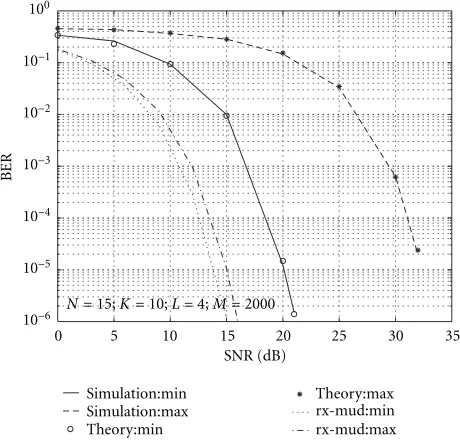
Figure 3: Comparison of analytical and simulated performance results for transmitter precoding. Also presented for comparison, is the analytical performance of (receiver-based) subspace blind MMSE multiuser detection. The number of signal samples used to construct the precoders and detectors is 2000.
The spreading codes for each user arem-sequences of length 15 and their shifted versions. The number of users in the system is 10. The number of paths, induced by each user’s channel, isL=4. Each path delay is an integral number of chip periodsTc, chosen with equal probability from the set
{0, Tc,2Tc, . . . ,(N −1)Tc}. The fading gain for each users’ channel is generated from a complex Gaussian distribution. The channel parameters are fixed for all simulations. Blind channel estimation is performed on the uplink signals using (10), where the exact noise subspace is replaced by an esti-mated noise subspace obtained from an eigendecomposition of the received signal, as in [9]. The frame length used for es-timating the channel (and the precoding filter) is eitherM=
200 orM=2000, as noted on the figures. As mentioned pre-viously, there is an amplitude and phase ambiguity inherent in (10). For now, they are assumed known. These ambiguities are resolved in the adaptive implementation discussed next.
Figure 3 illustrates the best and worst BER performance among the 10 users using (32) for the analytical performance of transmitter precoding, and [9, equation (98)] for the ana-lytical performance of receiver-based subspace blind MMSE multiuser detection (denoted rx-mud:min and rx-mud:max in the figure). The SNR is defined as Eb/(2σ2). Notice that there is a very good match between the simulated and analyt-ical performance results for transmitter precoding. The viously mentioned performance penalty of transmitter pre-coding relative to receiver-based multiuser detection is also evident. The number of signal samples used to estimate the channels and, hence,Mis 2000.
The simulation parameters for Figure 4 are identical to those for Figure 3 except that the number of signal samples
35 30 25 20 15 10 5 0
SNR (dB) 10−6
10−5
10−4
10−3
10−2
10−1
100
BER
Simulation:min Simulation:max Theory:min
Theory:max rx-mud:min rx-mud:max
N=15;K=10;L=4;M=200
Figure 4: Comparison of analytical and simulated performance results for transmitter precoding. Also presented for comparison, is the analytical performance of (receiver-based) subspace blind MMSE multiuser detection. The number of signal samples used to construct the precoders and detectors is 200.
used to estimateMand the receiver-based multiuser detec-tor has been reduced from 2000 to 200. Although the perfor-mance of subspace blind MMSE multiuser detection is still superior, the error floor that appears, its performance does not appear in the performance of transmitter precoding. It is clear that an error floor must exist for both techniques since the detector and precoder are estimated from noisy received signals, but this result suggests that the performance of trans-mitter precoding may degrade more gracefully than that of subspace blind MMSE multiuser detection when the num-ber of signal samples available diminishes.
Figure 5 contains plots of the analytical and simulated SINR versus the number of signal samples used to construct the precoder matrix for the best performing user. The ana-lytical values are obtained from the SINR expression in (33). The simulated values are taken from
SINRk= E
zk[i]|bk[i] 2
EVarzk[i]|bk[i] ,
(44)
where the expectations are replaced with time averaging and where zk[i] is the decision statistics for userk at time slot
i. This figure also contains an indication of the theoretical SINR when perfect channel information is available, that is, forM= ∞. As was the case with the BER plots, there is good agreement between the simulated and theoretical results.
6.2. Performance of adaptation implementation
1000 900 800 700 600 500 400 300 200 100 0
Number of samples (M) 4
5 6 7 8 9 10 11
SNR
(dB)
Best user:theory Best user:simulation Theory:M=∞ N=15,K=10, SNR=18 dB
Figure5: Analytical and simulated SINR results for transmitter pre-coding. The SNR is fixed at 18 dB.
3000 2500 2000 1500 1000 500
0 10−1
100
101
102
7 users 10 users 4 users
Processing gain=15, SNR=18 dB, forgetting factor=.99725
Figure6: Adaptation performance of adaptive transmitter precod-ing.
multipath CDMA system used in the previous simulation results, except that the modulation used is BPSK instead of QPSK. The channel is kept constant during all simulations and the SNR is fixed at 18 dB.
Figure 6 contains a plot of the average SINR for the first four users versus the time index. Since we are using diff eren-tial detection, the decision statistic for detecting bitiof user
kis
zk[i]=Re
sHkrk[i−1] H
sHkrk[i] (45)
and the SINR is defined here as
SINR= E
zk[i]|dk∗[i−1]dk[i] 2
EVarzk[i]|dk∗[i−1]dk[i] ,
(46)
30 25
20 15 10 5
0
SNR (dB) 10−6
10−5
10−4
10−3
10−2
10−1
100
BER
Best user
Best user, perfectly known channel Worst user
Worst user, perfectly known channel
N=15;K=10
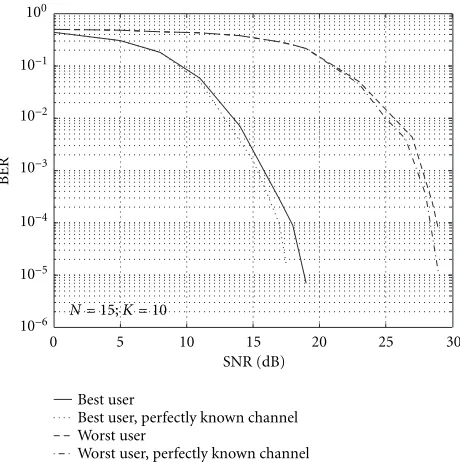
Figure7: Steady-state performance of adaptive transmitter precod-ing.
where thedk[i] represents theith differentially coded bit for userk. For these simulations, the expectation is replaced with time averaging. During the first 1000 time slots, there are 7 users in the system. At time slot 1001, 3 users are added to the system and at iteration 2001 and 6 users are removed from the system. We see that the adaptive system rapidly ad-justs (within 500 time slots) when users leave and enter the system.
Figure 7 contains plots of the BER versus SNR. The sys-tem has been allowed 500 received signal samples to reach steady state before errors are accumulated. For compari-son, this figure also contains plots generated with perfect knowledge of the channel. It is tempting to compare this figure to Figures 3 and 4, but it must be noted that the blind adaptive implementation uses BPSK instead of QPSK and differential encoding/decoding rather than coherent detection.
7. CONCLUSIONS
and leave the system. Future work will address asynchronous multipath channels and cases where the uplink and down-link channels are not identical, but only statistically highly correlated.
APPENDIX
In this appendix, we prove Theorem 1. We begin with the following lemma.
Lemma A.1 (see [9, Corollary 1]). Letf1be the true channel of user 1 and letfˆ1be the channel estimate given by(10). Then there exists a phase factorejφsuch that
√
in distribution asM→ ∞with
β1=σ2hH1UsΛs sian distribution with meanµ, Hermitian covariance matrix C, and symmetric covariance matrixC.¯
Proof of Theorem 1. Let ∆M denote the differential of the function ˆM[14, 21]. Then
Now each ∆fk is asymptotically circularly Gaussian dis-tributed by Lemma A.1. It follows that the same holds for
∆M, and since bis independent of ˆM, this is also true for
∆Mb, and the theorem follows. It remains to calculateCm. To this end notice that
∆Ᏼ=
Here, we have
M[D]i, j
We can disregard cross-correlation between different channel estimates and, therefore, we have [X]i, j≈0 fori=j, and for
i=j, we have, by Lemma A.1,
ME∆fi∆fiH =βifi−2Q†i. (A.9)
If we substitute (A.9) into (A.8) and compensate for the am-plitude and phase factors, then (A.6) is equal to (24) and the proof is complete.
ACKNOWLEDGMENT
This work was supported in part by National Science Foun-dation (NSF) Grant CAREER CCR-9875314.
REFERENCES
[1] S. Verd ´u, Multiuser Detection, Cambridge University Press, Cambridge, UK, 1998.
[2] M. L. Honig and H. V. Poor, “Adaptive interference sup-pression,” inWireless Communications: Signal Processing Per-spectives, H. V. Poor and G. W. Wornell, Eds., pp. 64–128, Prentice-Hall, Upper Saddle River, NJ, USA, 1998.
[3] G. J. R. Povey and M. Nakagawa, “A review of time division duplex-CDMA techniques,” inProc. IEEE 5th International Symposium on Spread Spectrum Techniques and Applications (ISSSTA ’98), pp. 630–633, Sun City, South Africa, September 1998.
[4] M. Meurer, P. W. Baier, T. Weber, Y. Lu, and A. Papathanas-siou, “Joint transmission: advantageous downlink concept for CDMA mobile radio systems using time division duplexing,”
Electronics Letters, vol. 36, no. 10, pp. 900–901, 2000. [5] B. R. Vojˇci´c and W. M. Jang, “Transmitter precoding in
syn-chronous multiuser communications,” IEEE Trans. Commu-nications, vol. 46, no. 10, pp. 1346–1355, 1998.
[6] R. Esmailzadeh, E. Sourour, and M. Nakagawa, “Prerake diversity combining in time-division duplex CDMA mobile communications,” IEEE Trans. Vehicular Technology, vol. 48, no. 3, pp. 795–801, 1999.
time division duplex CDMA,” inProc. 2001 Conf. on 3G Mo-bile Communication Technologies, pp. 257–261, London, UK, March 2001.
[8] M. Brandt-Pearce and A. Dharap, “Transmitter-based mul-tiuser interference rejection for the down-link of a wireless CDMA system in a multipath environment,”IEEE Journal on Selected Areas in Communications, vol. 18, no. 3, pp. 407–417, 2000.
[9] A. Høst-Madsen and X. Wang, “Performance of blind mul-tiuser detectors with blind channel estimation,” preprint, http://ee.tamu.edu/∼wangx/perf.html.
[10] S. E. Bensley and B. Aazhang, “Subspace-based channel esti-mation for code division multiple access communication sys-tems,”IEEE Trans. Communications, vol. 44, no. 8, pp. 1009– 1020, 1996.
[11] H. Liu and G. Xu, “A subspace method for signal waveform es-timation in synchronous CDMA systems,”IEEE Trans. Com-munications, vol. 44, no. 10, pp. 1346–1354, 1996.
[12] M. Torlak and G. Xu, “Blind multiuser channel estimation in asynchronous CDMA systems,”IEEE Trans. Signal Processing, vol. 45, no. 1, pp. 137–147, 1997.
[13] X. Wang and H. V. Poor, “Blind equalization and multiuser detection in dispersive CDMA channels,” IEEE Trans. Com-munications, vol. 46, no. 1, pp. 91–103, 1998.
[14] A. Høst-Madsen and X. Wang, “Performance of blind and group-blind multiuser detection,”IEEE Transactions on Infor-mation Theory, vol. 48, no. 7, pp. 1849–1872, 2002.
[15] A. Høst-Madsen and X. Wang, “Performance of blind and group-blind multiuser detectors,” inProc. 38th Annual Aller-ton Conference on Communications, Computing and Control, pp. 4–6, Monticello, Ill, USA, October 2000.
[16] A. Høst-Madsen and X. Wang, “Performance analysis of subspace-based blind and group-blind multiuser detection,” inProc. 10th International Symposium on Information The-ory and Its Applications (ISITA ’00), Honolulu, Hawaii, USA, November 2000.
[17] A. Høst-Madsen and X. Wang, “Performance of subspace-based multiuser detection,” inProc. 2001 IEEE International Symposium on Information Theory (ISIT ’01), Washington, DC, USA, June 2001.
[18] R. A. Horn and C. R. Johnson, Matrix Analysis, Cambridge University Press, Cambridge, UK, 1985.
[19] H. V. Poor and S. Verd ´u, “Probability of error in MMSE mul-tiuser detection,” IEEE Transactions on Information Theory, vol. 43, no. 3, pp. 858–871, 1997.
[20] D. Reynolds and X. Wang, “Adaptive group-blind multiuser detection based on a new subspace tracking algorithm,”IEEE Trans. Communications, vol. 49, no. 7, pp. 1135–1141, 2001. [21] G. S. Rogers, Matrix Derivatives, vol. 2 of Lecture Notes in
Statistics, Marcel Dekker, New York, USA, 1980.
Daryl Reynoldsreceived the B.S. degree in electrical engineering from the University of Colorado, Boulder in 1993. He received the M.S. and Ph.D. degrees in electrical engi-neering from Texas A&M University, Col-lege Station, TX in 1998 and 2002, respec-tively. In August 2002, he joined the De-partment of Computer Science and Electri-cal Engineering at West Virginia University as an Assistant Professor. Dr. Reynolds’
re-search interests fall in the general area of multiuser communication theory and statistical signal processing.
Anders Høst-Madsen was born in Den-mark in 1966. He received the M.S. degree in electrical engineering in 1990 and the Ph.D. degree in mathematics in 1993, both from the Technical University of Denmark. From 1993 to 1996, he was with Dantec Measurement Technology A/S, Denmark, from 1996 to 1998, he was an Assistant Pro-fessor at Kwangju Institute of Science and Technology, Korea, and from 1998 to 2000,
an Assistant Professor at Department of Electrical and Computer Engineering, University of Calgary, Canada, and a staffScientist at
TRLabs,Calgary. In 2001, he joined Department of Electrical Engi-neering, University of Hawaii, as an Assistant Professor. He has also been a visitor at Department of Mathematics, University of Califor-nia, Berkeley, through 1992. His research interests are in statistical signal processing and wireless communications, including multi-user detection, equalization, and ad hoc networks.
Xiaodong Wang received the B.S. degree in electrical engineering and applied math-ematics (with the highest honor) from Shanghai Jiao Tong University, Shanghai, China, in 1992; the M.S. degree in electri-cal and computer engineering from Purdue University in 1995; and the Ph.D. degree in electrical engineering from Princeton Uni-versity in 1998. From July 1998 to Decem-ber 2001, he was an Assistant Professor in