Volume 2007, Article ID 12597,14pages doi:10.1155/2007/12597
Research Article
Towards Scalable MAC Design for High-Speed Wireless LANs
Yuan Yuan,1William A. Arbaugh,1and Songwu Lu2
1Department of Computer Science, University of Maryland, College Park, MD 20742, USA 2Computer Science Department, University of California, Los Angeles, CA 90095, USA
Received 29 July 2006; Revised 30 November 2006; Accepted 26 April 2007
Recommended by Huaiyu Dai
The growing popularity of wireless LANs has spurred rapid evolution in physical-layer technologies and wide deployment in di-verse environments. The ability of protocols in wireless data networks to cater to a large number of users, equipped with high-speed wireless devices, becomes ever critical. In this paper, we propose a token-coordinated random access MAC (TMAC) framework that scales to various population sizes and a wide range of high physical-layer rates. TMAC takes a two-tier design approach, em-ployingcentralized, coarse-grained channel regulation,anddistributed, fine-grained random access.The higher tier organizes stations into multiple token groups and permits only the stations in one group to contend for the channel at a time. This token mechanism effectively controls the maximum intensity of channel contention and gracefully scales to diverse population sizes. At the lower tier, we propose an adaptive channel sharing model working with the distributed random access, which largely reduces protocol over-head and exploits rate diversity among stations. Results from analysis and extensive simulations demonstrate that TMAC achieves a scalable network throughput as user size increases from 15 to over 300. At the same time, TMAC improves the overall throughput of wireless LANs by approximately 100% at link capacity of 216 Mb/s, as compared with the widely adopted DCF scheme.
Copyright © 2007 Yuan Yuan et al. This is an open access article distributed under the Creative Commons Attribution License, which permits unrestricted use, distribution, and reproduction in any medium, provided the original work is properly cited.
1. INTRODUCTION
Scalability has been a key design requirement for both the wired Internet and wireless networks. In the context of medium access control (MAC) protocol, a desirable wireless MAC solution should scale to both different physical-layer rates (from 1 second to 100 seconds of Mbps) and various user populations (from 1 second to 100 seconds of active users), in order to keep pace with technology advances at the physical layer and meet the deployment requirements in practice. In recent years, researchers have proposed numer-ous wireless MAC solutions (to be discussed inSection 7). However, the issue of designing a scalable framework for wireless MAC has not been adequately addressed. In this pa-per, we present our Token-coordinated random access MAC (TMAC) scheme, a scalable MAC framework for wireless LANs.
TMAC is motivated by two technology and deployment trends. First, the next-generation wireless data networks (e.g., IEEE 802.11n [1]) promise to deliver much higher data rates in the order of 100 seconds of Mbps [2], through ad-vanced antennas, enhanced modulation, and transmission techniques. This requires MAC-layer solutions to develop in
pace with high-capacity physical layers. However, the widely
adopted IEEE 802.11 MAC [3], using distributed
it is essential to design a wireless MAC scheme that effectively tackles the scalability issues in the following three aspects:
(i) user population, that generally leads to excessive colli-sions and prolonged backoffs,
(ii)physical-layer capacity, that requires the MAC-layer throughput scales up in proportion to the increases in physical-layer rate,
(iii)protocol overhead, that results in high signaling over-head due to various interframe spacings, acknowledge-ments (ACK), and optional RTS/CTS messages.
TMAC tackles these three scalability issues and provides an efficient hierarchical channel access framework by com-bining the best features of both reservation-based [9,10] and contention-based [3,11] MAC paradigms. At the higher tier, TMAC regulates channel access via a central token coordi-nator, residing at the AP, by organizing contending stations into multiple token groups. Each token group accommodates a small number of stations (say, less than 25). At any given time, TMAC grants only one group the right to contend for channel access, thus controlling the maximum intensity of contention while offering scalable network throughput. At the lower tier, TMAC incorporates an adaptive channel shar-ing model, which grants a station a temporal share depend-ing on its current channel quality. Within the granted chan-nel share, MAC-layer batch transmissions or physical-layer concatenation [8] can be incorporated to reduce the signal-ing overhead. Effectively, TMAC enables adaptive channel sharing, as opposed to the fixed static sharing notion in terms of either equal throughput [3] or identical temporal share [5], to achieve better capacity scalability and protocol over-head scalability.
The extensive analysis and simulation study have con-firmed the effectiveness of the TMAC design. We analytically show the scalable performance of TMAC and the gain of the adaptive channel sharing model over the existing schemes [3,5]. Simulation results demonstrate that TMAC achieves a scalable network throughput and high efficiency of chan-nel utilization, under different population sizes and diverse transmission rates. Specifically, as the active user population grows from 15 to over 300, TMAC experiences less than 6% throughput degradation, while the network throughput in DCF decreases approximately by 50%. Furthermore, the ef-fective TMAC throughput reaches more than 100 Mb/s at link capacity of 216 Mb/s, whereas the optimal throughput is below 30 Mb/s in DCF and about 54 Mb/s using the op-portunistic auto rate (OAR),1 a well-known scheme for en-hancing DCF.
The rest of the paper is organized as follows. The next section identifies underlying scalability issues and limitations
of the legacy MAC solutions.Section 3presents the TMAC
design. InSection 4, we analytically study the scalability of TMAC, which is further evaluated through extensive simula-tions inSection 5. We discuss design alternatives inSection 6.
1OAR proposed to conduct multiple back-to-back transmissions upon winning the channel access for achieving temporal fair share among con-tending nodes.
Section 7outlines the related work. We conclude the paper in
Section 8.
2. CHALLENGES IN SCALABLE WIRELESS MAC DESIGN
In this section, we identify three major scalability issues in wireless MAC and analyze limitations of current MAC so-lutions [2,4]. We focus on high-capacity, packet-switched wireless LANs, operating at the infrastructure mode. Within a wireless cell, all packet transmissions between stations pass through the central AP. The wireless channel is shared among uplink (from a station to the AP) and downlink (from the AP to a station), and used for transmitting both data and control messages. APs connected to the wired may have connection directly to the wired Internet (e.g., in WLANs). Different APs may use the same frequency channel due to insufficient num-ber of channels or dense deployment, and so forth.
2.1. Scalability issues
We consider the scalability issues in wireless MAC protocols along the following three dimensions.
Capacity scalability
Advances in physical-layer technologies have greatly im-proved the link capacity in wireless LANs. The initial 1 ∼ 11 Mbps data rates specified in 802.11b standard [3] have been elevated to 54 Mb/s in 802.11a/g [4], and to 100 sec-onds of Mb/s in 802.11n [1]. Therefore, MAC-layer through-put must scale up accordingly. Furthermore, MAC designs need to exploit the multirate capability offered by the phys-ical layer for leveraging channel dynamics and multiuser di-versity.
User population scalability
Another important consideration is to scale to the number of contending stations. The user population may range from a few in an office, to tens or hundreds in a classroom or a conference room, and thousands in public places like Dis-ney Theme Parks [12]. As the number of active users grows, MAC designs should control contentions and collisions over the shared wireless channel and deliver stable performance.
Protocol overhead scalability
The third aspect in scalable wireless MAC design is to min-imize the protocol overhead as the population size and the physical-layer capacity increase. Specifically, the fraction of channel time consumed by signaling messages per packet, due to backoff, interframe spacings, and handshakes, must remain relatively small.
2.2. Limitations of current MAC solutions
In general, both CSMA/CA [3] and polling-based MAC
2.2.1. CSMA/CA-based MAC
Our analysis and simulations show that DCF MAC, based on CSMA/CA mechanism, does not scale to high physical-layer capacity or various user populations. We plot the theoreti-cal throughput attained by DCF MAC with different packet sizes inFigure 1(a).2 Note that DCF MAC delivers at most 40 Mb/s throughput without RTS/CTS at 216 Mb/s, which further degrades to 30 Mb/s when the RTS/CTS option is on. Such unscalable performance is due to two factors. First, as the link capacity increases, the signaling overhead ratio grows disproportionately since the time of transmitting data pack-ets reduces considerably. Second, the current MAC adopts a static channel sharing model that only considers transmis-sion demands of stations. The channel is monopolized by low-rate stations. Hence the network throughout is largely reduced.Figure 1(b)shows results from both analysis3 and simulation experiments conducted inns-2. The users trans-mit UDP payloads at 54 Mb/s. The network throughput ob-tained with DCF reduces by approximately 50% as the user population reaches 300. The significant throughput degra-dation is mainly caused by dramatically intensified collisions and increasingly enlarged contention window (CW).
2.2.2. Polling-based MAC
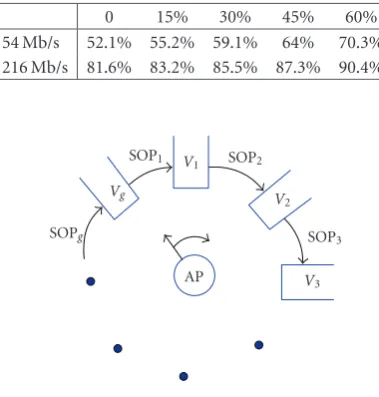
Polling-based MAC schemes [3,7,14] generally do not pos-sess capacity and protocol overhead scalability due to the ex-cessive polling overhead. To illustrate the percentage of over-head, we analyze the polling mode (PCF) in 802.11b. In PCF, AP sends the polling packet to initiate the data transmission from wireless stations. A station can only transmit after re-ceiving the polling packet. Idle stations respond to the polling message with NULL frame, which is a data frame without any payload.Table 1lists the protocol overhead as the frac-tion of idle stafrac-tions increases.4 The overhead ratio reaches 52.1% even when all stations are active at the physical-layer rate of 54 Mb/s, and continue to grow considerably as more idle stations present. Furthermore, as the link capacity in-creases to 216 Mb/s, over 80% of channel time is spent on signaling messages.
3. TMAC DESIGN
In this section, we present the two-tier design of TMAC framework, which incorporates centralized, coarse-grained regulation at the higher tier and distributed, fine-grained channel access at the lower tier. Token-coordinated channel regulation provides coarse-grained coordination for
bound-2Table 4lists the values of DIFS, SIFS, ACK, MAC header, physical-layer preamble and header according to the specifications in [2,4].
3We employ analytical model proposed in [13] to compute throughput, which matches the simulation results.
4The details of the analysis are listed in the technique report [15]. We com-puted the results using the parameter listed inTable 4.
Physical-layer data rate (Mb/s)
6 36 66 96 126 156 186 216
0 10 20 30 40 50 60
1500 bytes 1000 bytes 500 bytes 150 bytes
802.11 MAC without RTS/CTS 802.11 MAC with RTS/CTS
Thr
o
ug
hput
p
erfor
manc
e
(Mb/s)
(a) Throughput at different physical-layer data rates
15 45 75 105 135 165 195 225 255 285 315 10
13 16 19 22 25
Thr
o
ug
hput
p
erfor
manc
e
(Mb/s)
Simulation result without RTS/CTS Simulation result with RTS/CTS Analysis result with RTS/CTS Analysis result without RTS/CTS
Number of stations
(b) Network throughout at various user populations
Figure 1: Legacy MAC throughput at different user populations and physical-layer data rates.
Table1: Polling overhead versus percentage of idle stations.
0 15% 30% 45% 60%
54 Mb/s 52.1% 55.2% 59.1% 64% 70.3% 216 Mb/s 81.6% 83.2% 85.5% 87.3% 90.4%
Vg
V1
V2
V3 AP
SOPg
SOP1 SOP2
SOP3
Figure2: Token distribution model in TMAC.
3.1. Token-coordinated channel regulation
TMAC employs a simple token mechanism in regulating channel access at the coarse-time scale (e.g., in the order of 30 ∼ 100 milliseconds). The goal is to significantly re-duce the intensity of channel contention incurred by a large population of active stations. The base design of the token mechanism is motivated by the observation that polling-based MAC works more efficiently under heavy network load [7, 16], while random contention algorithms better serve bursty data traffic under low load conditions [13,17]. The higher-tier design, therefore, applies a polling model to mul-tiplex traffic loads of stations within the token group.
Figure 2schematically illustrates the token mechanism in TMAC. An AP maintains a set of associated stations,
S = {s1,s2,. . .,sn}, and organizes them into g number of disjoint token groups, denoted asV1,V2,. . .,Vg. Apparently,
g
i=1Vi=S, andVj∩Vj = ∅(1≤i,j≤gandi /= j). Each token group, assigned a unique Token Group ID (TGID), ac-commodates a small number of stations,NVi, andNVi ≤NV,
whereNVis a predefined upperbound. The AP regularly dis-tributes a token to an eligible group, within which the sta-tions contend for channel access via the enhanced random channel procedure in the lower tier. The period during which a given token group Vk obtains service is calledtoken
ser-vice period, denoted by TSPk, and the transition period be-tween two consecutive token groups is theswitch-over period. The token service time for a token groupVk is derived us-ing: TSPk =(NVk/NV)TSP, (1≤k ≤g), where TSP
repre-sents the maximum token service time. Upon the timeouts of TSPk, the AP grants channel access to the next token group
Vk+1.
To switch between token groups, the higher-tier design constructs a token distribution packet (TDP), and broadcasts it to all stations. The format of TDP, shown in Figure 3, is compliant with the management frame defined in 802.11b.
Group member IDs <1200 (optional) Rf Tf
CWt
g TGID Timestamp Frame
control Duration DA SA BSSID Sequence
control Frame
body FCS
MAC header
Octets: 2 2 6 6 6 2 0∼1023 4
8
Octets: 1 1 1 1 1
Figure3: Frame format of token distribution packet.
In each TDP, a timestamp is incorporated for time synchro-nization,g denotes the total number of token groups, and the token is allocated to the token group specified by the TGID field. Within the token group, contending stations use CWt in random backoff. TheRf andTf fields provide two design parameters employed by the lower tier. The optional field of group member IDs is used to perform membership management of token groups, which can be MAC addresses, or dynamic addresses [18] in order to reduce the address-ing overhead. The length of TDP ranges from 40 to 60 bytes (NV = 20, each ID uses 1 byte), taking less than 100 mi-croseconds at 6 Mb/s rate. To reduce the token loss, TDP is typically transmitted at the lowest rate.
We need to address three concrete issues to make the above token operations work in practice, including member-ship management of token groups, policy of scheduling the access group, and handling transient conditions (e.g., when TDP is lost).
3.1.1. Membership management of token groups
When a station joins the network, TMAC assigns it to an el-igible group, then piggybacks TGID of the token group in the association response packet [3], along with a local ID [18] generated for the station. The station records the TGID and the local ID received from the AP. Once a station sends a deassociation message, the AP simply deletes the station from its token group. The groups are reorganized if neces-sary. For performing membership management, the AP gen-erates a TDP carrying the optional field that lists IDs of cur-rent members in the token group. Upon receiving the TDP with the ID field, each station with a matched TGID purges its local TGID. The station, whose ID appears in the ID field, extracts the TGID value from the TDP and updates its local TGID.
Function 1:On stationsjoining the network
ifg==0then
create the token groupV1with TGID1
V1=s, set the update bit ofV1
else
search forVi, s.t.,NVi< Nv,
ifViexiststhen
Vi=Vi∪s, set the update bit ofVi else
randomly select a token groupVi
SplitVievenly into two token groups,Vi,Vg+1
Vi=Vi∪s
set the update bit ofViandVg+1,g=g+ 1
end if end if
Function 2:On stations,s∈Vi,leaving the network
Vi=Vi−s
ifNVi==0then
deleteVi, reclaim TGIDi,g=g−1 end if
ifNVi< Nv/4 then
search forVj, s.t.,NVj< Nv/2,
ifVjexiststhen
Vj=Vj∪Vi
deleteVi, reclaim TGIDi
set the update bit ofVj,g=g−1 end if
end if
Algorithm1: Group membership management functions.
3.1.2. Scheduling token groups
Scheduling token groups deal with the issues of setting the duration of TSP and the sequence of the token distribution.
The TSP is chosen to strike a balance between the system throughput and the delay. In principle, the size of the TSP should allow for every station in a token group to transmit once for a period of its temporal shareTi.Tiis defined in the lower-tier design and typically in the order of several mil-liseconds. The network throughput performance improves whenTiincreases [19]. However, increasingTienlarges the token circulation period,g ∗TSP, thus affecting the delay performance. Consequently, TSP is a tunable parameter in practice, depending on the actual requirements of through-put/delay. The simulation results ofSection 6provide more insights of selecting a proper TSP.
To determine the scheduling sequence of token groups, TMAC uses a simple round-robin scheduler to cyclicly dis-tribute the token among groups. It treats all the token groups with identical priority.
3.1.3. Handling transient conditions
Transient conditions include the variation in the number of active stations, loss of token messages, and stations with ab-normal behaviors.
The number of active stations at an AP may fluctu-ate significantly due to bursty traffic load, roaming, and
power-saving schemes [16, 20]. TMAC exploits a
token-based scheme to limit the intensity of spatial contention and collisions. However, potential channel wastage may be in-curred due to underutilization of the allocated TSP when the number of active stations sharply changes. TMAC takes a simple approach to adjust the TSP boundary. The AP an-nounces the new TGID for the next group after deferring for
a time period TIFS = (DIFS +m∗CWt∗σ), where CWt
is the largest CW in the current token group,mis the maxi-mum backoffstage, andσis the minislot time unit (i.e., 9 mi-croseconds in 802.11a). The lower-tier operation in TMAC
ensures that TIFS is the maximum possible backoff time.
In addition, if a station stays in the idle status longer than the defined idle threshold, the AP assumes that it enters the power-saving mode, records it in the idle station list, and per-forms the corresponding management function for a leaving station. When new traffic arrives, the idle station executes the routine defined in the second transient condition to acquire a valid TGID, and then returns to the network.
Under the second transient condition, a station may lose its transmission opportunity in a recent token service pe-riod or fail to update its membership due to TDP loss. In this scenario, there are two cases. First, if the lost TDP mes-sage informs group splitting, the station belonging to the newly generated group, continues to join TSP matches its original TGID. The AP, upon detecting this behavior, uni-casts the station with the valid TGID to notify its new mem-bership. Second, if the lost TDP message announces group merging, the merged stations may not be able to contend for the channel without the recently assigned TGID. To re-trieve the valid TGID, each merged station sends out reasso-ciation/reauthentication messages after timeouts ofg∗TSP. We next consider the station with abnormal behaviors, that is, the station transmits during the TSP that it does not belong to. Upon detecting the abnormal activities, the AP first reassigns it to a token group if the station is in the idle station list. Next, a valid TGID is sent to the station to com-pensate the potentially missed TDP. If the station continues the behavior, the AP can exclude the station by transmitting it a deassociation message.
3.2. Adaptive distributed channel access
The lower-tier design addresses the issues of capacity scala-bility and protocol overhead scalascala-bility in high-speed wire-less LANs with an adaptive service model (ASM). The pro-posed ASM largely reduces channel access overhead and of-fers differentiated services that can beadaptively tuned to leverage high rates of stations. The following three subsec-tions describe the contention mechanism, the adaptive chan-nel sharing model, and the implementation of the model.
3.2.1. Channel contention mechanism
sensing an idle channel. A random backoff value is then chosen from (0, CWt). Once the associated backoff timer expires, RTS/CTS handshake takes place, followed by DATA transmissions for a time duration specified by ASM. Each station is allowed to transmitoncewithin a given token ser-vice period to ensure the validity of ASM among stations across token groups. Furthermore, assuming most of stations within the group are active, AP can estimate the optimal value of CWtbased on the size of the token group, which will be carried in the CWtfield of TDP messages. CWtis derived based on the results of [13]:
CWt= ζ 2
1 +pΣm−1 i=0 (2p)i
, (1)
wherep=1−(1−ζ)n−1and the optimal transmission proba-bilityζcan be explicitly computed usingζ=1/(NV·Tc∗/2), andTc∗=(RTS+DIFS+δ)/σ.mdenotes the maximum back-offstage, which has marginal effect on system throughput with RTS/CTS turned on [13], andmis set to 2 in TMAC.
3.2.2. Adaptive service model
The adaptive sharing model adopted by TMAC extracts the multiuser diversity by granting the users under good channel condition proportionally longer transmission durations. In contrast, the state-of-the-art wireless MACs do not adjust the time share to the perceived channel quality, granting stations with either identical throughput share [3] or equal temporal share [5,14,22], under idealized conditions. Consequently, the overall network throughput is significantly reduced since these MAC schemes ignore the channel conditions when specifying the channel sharing model. ASM works as follows. The truncated function (2) is exploited to define the service timeTASMfor stationi, which transmits at the rate ofriupon winning the channel contention:
TASM(ri)=
⎧ ⎪ ⎨ ⎪ ⎩
r
i
Rf
Tf ri≥Rf,
Tf ri< Rf.
(2)
The model differentiates these two classes of stations, high-rate and low-rate stations, by defining the reference pa-rameters, namely, the reference transmission rateRf and the reference time durationTf. Stations with transmission rates higher than or equal toRf are categorized as high-rate sta-tions, thus grantedproportional temporal share in that the access time is roughly proportional to the current data rate. For low-rate stations, each of them is providedequal temporal sharein terms of identical channel access timeTf. Thus, ASM awards high-rate stations with a proportional longer time share and provides low-rate stations equal channel shares. In addition, the current DCF and OAR MAC become the spe-cific instantiations of ASM by tuning the reference parame-ters.
3.2.3. Implementation via adaptive batch transmission and block ACK
To realize ASM, AP regularly advertises the two reference pa-rametersRf andTf within a TDP. Upon receiving TDP,
sta-tions in the matched token group extract theRf andTf pa-rameters, and contend for the channel access. Once a station succeeds in contention, adaptive batch transmission allows for the station to transmit multiple concatenated packets for a period equal to the time share computed by ASM. The adaptive batch transmission can be implemented at either the MAC layer as proposed in OAR [5] or the physical layer as in MAD [8]. To further reduce protocol overhead at the MAC layer, we exploit the block ACK technique to acknowledge
Af number of back-to-back transmitted packets in a single Block-ACK message, instead of per-packet ACK in the 802.11 MAC. The reference parameterAfis negotiated between two communicating stations within the received-based rate adap-tation mechanism [23] by utilizing RTS/CTS handshake.
4. PERFORMANCE ANALYSIS
In this section, we analyze the scalable performance ob-tained by TMAC in high-speed wireless LANs, under various user populations. We first characterize the overall network throughput performance in TMAC, then analytically com-pare the gain achieved by ASM with existing schemes. Also, we provide analysis on the three key aspects of scalability in TMAC.
4.1. Network throughput
To derive the network throughput in TMAC, let us consider a generic network model where allnstations are randomly located in a service areaΩcentered around AP, and stations in the token groups always have backlogged queues of pack-ets at lengthL. Without loss of generality, we assume each
token group accommodatesNV number of active stations,
and there are totalggroups. We ignore the token distribution overhead, which is negligible compared to the TSP duration. Thus, the expected throughputSTMACcan be derived based on the results from [13,24],
STMAC= PtrPsE[P]
1−Ptrσ+PtrPsTs+Ptr1−PsTc,
Ptr=1−(1−ζ)NV,
Ps= NVζ(1−ζ) NV−1
1−(1−ζ)NV .
(3)
E[P] is the expected payload size;Tcis the average time the channel is sensed busy by stations due to collisions;Ts denotes the duration of busy channel in successful transmis-sions. σ is the slot time andζ represents the transmission probability at each station in the steady status. The value of
Table2: Comparison of TMAC, DCF, and OAR.
Analysis Simulation
S(Mb/s) Ts(μs) E[P] (bits) S(Mb/s) Sf (Mb/s) DCF MAC 18.41 404.90 8192 18.79 20.24 OAR MAC 31.50 781.24 20760 32.11 26.52 TMACRf=108 38.46 2119.42 83039 38.92 39.31
TMACRf=54 41.64 1763.27 75093 42.13 42.59
TMACRf=24 46.31 1341.61 62587 46.85 47.37
MAC layer, the values of E[P],Tc, andTs are expressed as
withTPH,TMH being the overhead of physical-layer header and MAC-layer header, respectively.δis the propagation de-lay.
Next, based on the above derivations and results in [5,13], we compare the network throughput obtained with TMAC, DCF, OAR. The parameters used to generate the nu-merical results are chosen as follows:nis 15;gis 1, andLis 1 K;Tf is set to 2 milliseconds; the series of possible rates are 24, 36, 54, 108, and 216 in Mb/s, among which a station uses each rate with equal probability; other parameters are listed in Table 4. The results from numerical analysis and simu-lation experiments are shown inTable 2as theRf
parame-ter in ASM of TMAC varies. Note that TMAC, withRf set
to 108 Mb/s, improves the transmission efficiency, measured withSf = E[P]/Ts, by 22% over OAR. On further reduc-ingRf, the high-rate stations are granted with the
propor-tional higher temporal share. Therefore, TMAC withRf =
24 Mb/s achieves 48% improvement in network throughput over OAR, and 84% over DCF. Such throughput improve-ments demonstrate the effectiveness of ASM by leveraging high data rates perceived by multiple stations.
4.2. Adaptive channel sharing
Here, we analyze the expected throughput of ASM, exploited in the lower tier of TMAC, as compared with those of the equal temporal share model proposed in OAR [5] and of the equal throughput model adopted in DCF [3].
LetφASM
i , φOARi be the fractions of time that station i transmits at rateriin a time durationT using the scheme of ASM and OAR, respectively, where 0≤φi≤1. During the intervalT,ndenotes the number of stations in the equal tem-poral sharing policy, andnis the number of stations
trans-mitting within the adaptive service model, clearlyn ≥ n. Then, we have the following equality:
n
Therefore, the expected throughput achieved in ASM is given bySASM=
n
i=1riφASMi . We obtain the following result, using the above notations.
Proposition 1. SASM,SOAR, and SDCF are the total expected
throughput attained by ASM, OAR, and DCF, respectively. One has
SASM≥SOAR≥SOAR. (6)
Proof. From the concept of equal temporal share, we have
φOAR
i = φOARj , (1 ≤i,j ≤ n). The expected throughput in equal temporal share is derived as
SOAR=
Thus, by relations (5) and Chebyshev’s sum inequality, we can have the following result:
SOAR≤n1
We analytically study the scalability properties achieved by TMAC, while we show that the legacy solutions do not pos-sess such appealing features.
4.3.1. Scaling to user population
It is easy to show that TMAC scales to the user populations. From the throughput characterization of (3), we observe that the throughput of TMAC is only dependent on the token group sizeNV, instead of the total number of usersn. There-fore, the network throughput in TMAC scales with respect to the total number of stationsn.
To demonstrate the scalability constraints of the legacy MAC, we examine the DCF with RTS/CTS handshakes. Note that DCF can be viewed as a special case of TMAC, in which allnstations stay in the same group, thusNV =n. We mea-sure two variables ofζandTw.ζis the transmission proba-bility of a station at a randomly chosen time slot and can be approximated by 2/(CW+ 1).TW denotes the time wasted on the channel due to collisions per successful packet trans-mission, and can be computed by
TW =TDIFS+TRTS+δ
1−(1−ζ)n
nζ(1−ζ)n−1−1
, (9)
Table3: Analysis results forζandTWin DCF.
n 15 45 105 150 210 300
ζ 0.0316 0.0177 0.0110 0.0090 0.0075 0.0063
TW(μs) 21.80 43.24 72.78 92.75 119.61 163.34
Table4: PHY/MAC parameters used in the simulations.
SIFS 16μs DIFS 34μs
Slot time 9μs PIFS 25μs
ACK size 14 bytes MAC header 34 bytes Peak datarate (11a) 54 Mb/s Basic datarate (11a) 6 Mb/s Peak datarate (11n) 216 Mb/s Basic datarate (11n) 24 Mb/s PLCP preamble 16μs PLCP header length 24 bytes
As the number of stations increases, the values ofζ and
TWin the DCF are listed inTable 3and the network through-put is shown in Figure 1(b). Although ζ decreases as the user size expands because of the enlarged CW in exponen-tial backoff, the channel time wasted in collisions, measured by TW, increases almost linearly with n. The considerable wastage of channel time on collisions leads to approximately 50% network throughput degradation as the user size reaches 300, as shown by simulations.
4.3.2. Scaling of protocol overhead and physical-layer capacity
Within a token group, we examine the protocol overhead at the lower tier as compared to DCF. At a given data rater, the protocol overheadTodenotes the time duration of executing the protocol procedures in successfully transmitting aE[P ]-bytes packet, which is given by
TDCF
o =Top+Tidle+Tcol,
TASM o =T
DCF o
Bf +T EX o .
(10)
TidleandTcolrepresent the amount of idle time and the time wasted on collisions for each successful packet transmis-sion, respectively.Topspecifies in DCF the protocol overhead spent on every packet, which is equal to (TRTS+TCTS+TDIFS+ 3TSIFS+TACK+TPH+TMH).ToEXdenotes the per-packet over-head of the adaptive batch transmission in ASM, which is calculated by (2TSIFS+TACK+TPH+TMH).Bf is the number of packets transmitted inTASMinterval andBf =TASM/TEX. From (10), we note that the protocol overhead in ASM is re-duced by the factor ofBf as compared with DCF, andBf is a monotonically increasing function of data rater. Therefore, TMAC effectively controls its protocol overhead and scales to the channel capacity increase, while DCF suffers from fixed per-packet overhead, throttling the scalability of its network throughput. Moreover,TEX
o is the fixed overhead in TMAC,
incurred by physical-layer preambles, interframe spacings, and protocol headers. It is the major constraint to further improve the throughput in the MAC layer.
4.3.3. Scaling to physical-layer capacity
To demonstrate the scalability achieved by TMAC with
re-spect to the channel capacity R, we rewrite the network
throughput as the function ofR, and obtain
SDCF= L R·TDCF
o +L·R,
STMAC= TDCF L
o /TASM+ 1
R·TEX o +L
·R. (11)
Note thatTASM is typically chosen in the order of sev-eral milliseconds, thus havingTASMToDCF. Now, the lim-iting factor of network throughput isL/(R·TDCF
o ) in DCF,
andL/(R·TEX
o ) in ASM. SinceToEX ToDCFandToEXis in the order of hundreds of microseconds (e.g.,TEX
o =136
mi-croseconds in 802.11a/n), ASM achieves much better scala-bility asRincreases, while the throughput obtained in DCF is restrained by the increasingly enlarged overhead ratio. In addition, the study shows transmitting packets at larger size
L can greatly improve network throughput. Therefore, the
technique of packet aggregation at the MAC layer and pay-load concatenation at the physical layer is promising in next-generation high-speed wireless LANs.
5. SIMULATION
We conduct extensive simulation experiments to evaluate scalability performance, channel efficiency, and sharing fea-tures achieved by TMAC in wireless LANs. Five environment parameters are varied in the simulations to study TMAC’s performance, including user population, physical-layer rate, traffic type, channel fading model, and fluctuations in the number of action stations. Two design parameters,Tf and
Af, are investigated to quantify their effects (Rf has been examined in the previous section). We also plot the per-formance of the legacy MACs, 802.11 DCF and OAR, in
demonstrating their scaling constraints. We use TMACDCF
and TMACOARto denote TMAC employing DCF or OAR in
the lower tier, which are both specific cases of TMAC. The simulation experiments are conducted inns-2 with
the extensions of Ricean channel fading model [25] and
the receive-based rate adaptation mechanism [23]. Table 4
lists the parameters used in the simulations based on IEEE 802.11b/a [3,4] and the leading proposal for 802.11n [2]. The transmission power and radio sensitivities of various data rates are configured according to the manufacturer spec-ifications [26] and 802.11n proposal [2]. The following pa-rameters are used, unless explicitly specified. Each token group has 15 stations.Tf allows 2 milliseconds batch trans-missions at MAC layer. Each block ACK is sent for every two packets (i.e.,Af =2). Any packet loss triggers retransmission of two packets. Token is announced approximately every 35 milliseconds to regulate channel access. Each station gener-ates constant-bit-rate traffic, with the packet size set to 1 Kb.
5.1. Scaling to user population
15 45 75 105 135 165 195 225 255 285 315 10
15 20 25 30 35 40
TMACASM TMACOAR
DCF MAC OAR MAC Number of stations
Thr
o
ug
hput
(Mb/s)
(a) Network throughput at 54 Mb/s link capacity
Number of stations
Thr
o
ug
hput
(Mb/s)
15 45 75 105 135 165 195 225 255 285 315
TMACASM TMACOAR
DCF MAC OAR MAC 10
20 30 40 50 60 70 80 90
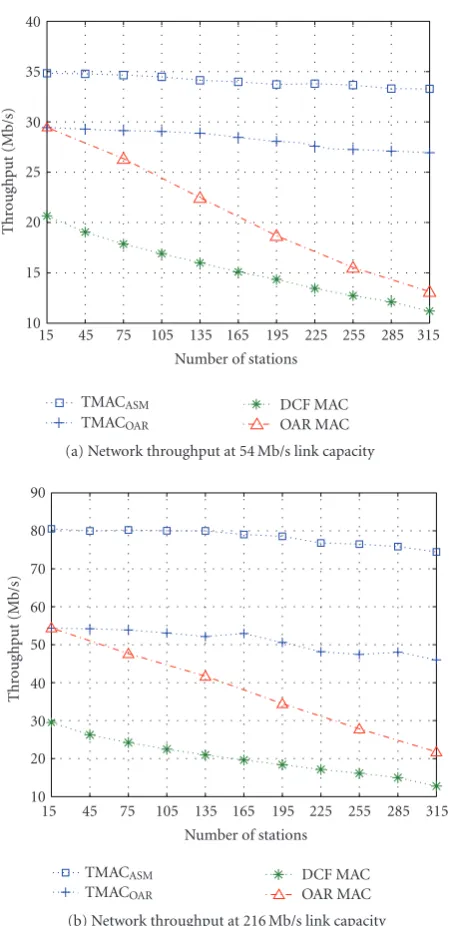
(b) Network throughput at 216 Mb/s link capacity Figure4: Network throughput versus the number of stations.
5.1.1. Network throughput
Figure 4shows that both TMACASMand TMACOARachieve scalable throughput, experiencing less than 6% throughput degradation, as the population size varies from 15 to 315. In contrast, the network throughput obtained with DCF and OAR does not scale: the throughput of DCF decreases by 45.9% and 56.7% at the rates of 54 Mb/s and 216 Mb/s, re-spectively, and the throughput in OAR degrades 52.3% and 60%, in the same cases. The scalable performance achieved in TMAC demonstrates the effectiveness of the token mech-anism in controlling the contention intensity as user
pop-ulation expands. Moveover, TMACASM consistently
outper-forms TMACOARby 21% at 54 Mb/s data rate, and 42.8% at
Table5: Average delay (s) at 216 Mb/s.
Num. 15 45 75 135 165 225 285
DCF MAC 0.165 0.570 0.927 1.961 3.435 4.539 5.710 TMACDCF 0.163 0.822 1.039 1.654 2.400 2.590 2.870
TMACASM 0.053 0.169 0.359 0.620 0.760 0.829 1.037
Physical-layer rate (Mb/s)
6 36 66 96 126 156 186 216
0 10 20 30 40 50 60 70 80
TMACASM(Tf =2 ms) TMACASM(Tf =1 ms)
DCF MAC OAR MAC
Thr
o
ug
hput
p
erfor
manc
e
(Mb/s)
Figure5: Network throughput versus physical-layer data rates.
216 Mb/s data rate, which reveals the advantage of ASM in supporting high-speed physical layer.
5.1.2. Average delay
Table 5 lists the average delay of three protocols, DCF,
TMACDCF, and TMACASMin the simulation scenario
iden-tical to the one used inFigure 4(b). The table shows that the average delay in TMAC increases much slower than that in DCF, as the user population grows. In specific, the average delay in DCF increases from 0.165 second to 5.71 seconds as the number of stations increases form 15 to 285. TMACDCF, adopting token mechanism in the higher tier, reduces the av-erage by up to 39%, while TMACASMachieves approximately 70% average delay reduction over various population sizes. The results demonstrate that the token mechanism can effi -ciently allocate channel share among a large number of sta-tions, thus reducing the average delay. Moveover, ASM im-proves channel efficiency and further decreases the average delay.
5.2. Scaling to different physical-layer rates
TMACASM, withTf set to 1 millisecond and 2 milliseconds, achieves up to 20% and 42% throughput improvement over OAR, respectively. This reveals that TMAC effectively can control protocol overhead at MAC layer especially within the high-capacity physical layer. Our study further reveals that the overhead incurred by the physical-layer preamble and header is the limiting factor for further improving the throughput achieved by TMAC.
5.3. Interacting with TCP
In this experiment, we examine the throughput scalability and the fair sharing feature in TMAC when stations, exploit-ing the rate of 54 Mb/s, carry out a large file transfer usexploit-ing TCP Reno. The sharing feature is measured by Jain’s fair-ness index [27], which is defined as (ni=1xi)2/(nni=1x2i).
where Si is the throughput of station i. Figure 6plots the network throughput and labels the fairness index obtained
with DCF, OAR, and TMACASMin various user sizes. TMAC
demonstrates scalable performance working with TCP. Note that both OAR and DCF experience less than 10% through-put degradation in this case. However, as indicated by the fairness index, both protocols lead to severe unfairness in channel sharing among FTP flows as user size grows. Such unfairness occurs because in DCF and OAR, more than 50% of FTP flows experience service starvation during the simu-lation run, and 10% flows contribute to more than 90% of the network throughput, as the number of users grows over 75. On the other hand, TMAC, employing the token mecha-nism, preserves the fair sharing feature while attaining scal-able throughput performance at various user sizes.
5.4. Ricean fading channel
We now vary channel fading model and study its effects on TMAC with the physical layer specified by 802.11a. Ricean
fading channel is adopted in the experiment with K = 2,
whereK is the ratio between the deterministic signal power and the variance of the multipath factor [25]. Stations are distributed uniformly over 400 m×400 m territory (AP is in the center) and move at the speed of 2.5 m/s. The parame-terRf is set at rate of 18 Mb/s.Figure 7shows the network throughput of different MAC schemes. These results again demonstrate the scalable throughput achieved by TMACASM
and TMACOARas the number of users grows. TMACASM
con-sistently outperforms TMACOARby 32% by offering adaptive service share to stations in dynamic channel conditions. In contrast, OAR and DCF experience 72.7% and 68% through-put reduction, respectively, as the user population increases from 15 to 255.
5.5. Active station variation and token losses
We examine the effect of variations in the number of active stations caused and of token losses. During the 100-second
Thr
Figure6: Network throughput in TCP experiments.
0
Figure7: Network throughput in Ricean fading channel.
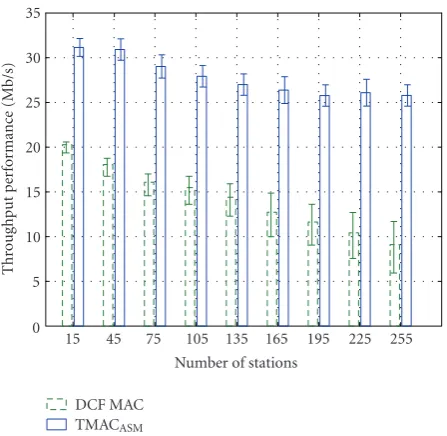
simulation, 50% stations periodically enter 10-second sleep mode after 10-second transmission. Receiving errors are manually introduced, which causes loss of the token mes-sage in nearly 20% of active stations. The average of
net-work throughput in TMAC and DCF is plotted inFigure 8
0 5 10 15 20 25 30 35
15 45 75 105 135 165 195 225 255 Number of stations
DCF MAC TMACASM
Thr
o
ug
hput
p
erfor
manc
e
(Mb/s)
Figure8: Network throughput versus the number of stations.
fact that the throughput degrade by up to 18% in the same case. Several factors that contribute to the throughput reduc-tion in TMAC include the wastage of TSP, the overhead of membership management and the cost of token loss.
5.6. Design parametersAf andTf
We now evaluate the impacts of the design parameters Tf andAf. We adopt scenarios similar to the caseA, and fix the number of users as 50. The reference transmission duration
Tf varies withAf set to 1, whereTf of 0 millisecond grants one packet transmission as in the legacy MAC. Next, to quan-tify the effect of the block ACK size, we tuneAf from 1 to 6, with 3 millisecondsTf.
Table 7presents the network throughput obtained with
TMAC as the design parameters ofTf andAf vary. When
Tf changes from 0 millisecond to 5 milliseconds, the aggre-gate throughput improves by 63.7% at 54 Mb/s data rate, and 127% with 216 Mb/s rate. Tuning the parameterAf can fur-ther improve the throughput to more than 100 Mb/s. The improvements show that the overhead caused by per-packet
contention and acknowledgement has been effectively
re-duced in TMAC.
5.7. Exploiting rate diversity
In the final set of experiments, we demonstrate that TMAC can adaptively leverage multirate capability at each station to further improve the aggregate throughput. We use the fair-ness index defined inSection 5.3. We consider the simula-tion setting of eight stasimula-tions in one token group. Each stasimula-tion
carries a UDP flow to fully saturate the network. There are four transmission rate options, 24 Mb/s, 54 Mb/s, 108 Mb/s, and 216 Mb/s. Each pair of stations randomly chooses one of the four rates. The results are obtained from averaging over 5 simulation runs.
Table 6 enumerates the aggregate throughput and the fairness index for flows transmitting at the same rate, us-ing the 802.11 MAC, and TMAC with differentRf settings. TMAC enables high-rate stations to increasingly exploit their good channel conditions by granting the high-rate nodes more time share than the low-rate stations. This is realized by reducing a single parameterRf. TMAC acquires 65%, 87%, 111% and 133% overall throughput gains compared with the legacy MAC as adjustingRf to 216 Mb/s, 108 Mb/s, 54 Mb/s, and 24 Mb/s, respectively.
Moreover, The fairness index for TMAC design is close to 1 in every case, which indicates the effectiveness of the adap-tive sharing scheme. The fairness index of DCF MAC is 0.624 in temporal units. DCF results in such a severe bias because it neglects the heterogeneity in channel quality experienced by stations and offers them equal throughput share. In sum-mary, by lowering the access priority of low-rate stations that are nevertheless not in good channel conditions, TMAC pro-vides more transmission opportunities for high-rate stations perceiving good channels. This feature is important for high-speed wireless LANs and mesh networks to mitigate the se-vere aggregate throughput degradation incurred by low-rate stations. The lower channel sharing portion by a low-rate sta-tion also motivates it to move to a better spot or to improve its reception quality. In either case, the system throughput is improved.
6. DISCUSSIONS
In this section, we first discuss alternative designs to ad-dress the scaling issues in high-speed wireless LANs. We then present a few issues relevant to TMAC. We will discuss the prior work related to TMAC in detail inSection 7.
TMAC employs a centralized solution to improve user experiences and provide three scaling properties, namely user population scaling, physical-layer capacity scaling, and protocol overhead scaling. The design parameters used in TMAC can be customized for various scenarios, which is es-pecially useful for wireless Internet service providers (ISP) to improve the service quality. One alternative scheme for sup-porting large user sizes is to use the distributed method to tune CW. Such a method enables each node to estimate the perceived contention level and thereafter choose the suitable CW (e.g., AOB [28], Idle Sense [24]). Specifically, the slot utilization, or the number of idle time slots, is measured and serves as the input to derive CW in DCF MAC.
Table6: Throughput (Mb/s) and fairness index.
MAC type 802.11MAC TMAC (Rf =216 Mb/s) TMAC (Rf =108 Mb/s) TMAC (Rf =54 Mb/s) TMAC (Rf =24 Mb/s)
24 Mb/s flows 6.649 4.251 1.922 1.198 0.910
54 Mb/s flows 6.544 8.572 11.282 5.004 4.695
108 Mb/s flows 6.655 12.660 15.489 20.933 10.649
216 M/bs flows 6.542 17.795 20.986 28.811 45.136
All flows 26.490 43.278 49.679 55.946 61.390
Fairness index 0.6246 0.9297 0.9341 0.9692 0.9372
Table7: Network throughput (Mbits/s) versusTf andAf.
Tf 0 ms 1 ms 2 ms 3 ms 4 ms 5 ms
54 Mb/s 20.40 25.33 28.91 32.10 32.93 33.40 216 Mb/s 35.16 70.70 76.19 78.35 79.31 79.88
Af 1 2 3 4 5 6
216 Mb/s 78.35 93.92 95.91 97.29 98.94 101.72
largely adopts the existing schemes proposed in IEEE 802.11e [14]. In 802.11e, several access categories are defined to of-fer differentiated services in supporting various applications. Each access category uses different settings of the deferring time period, CW, and the transmission duration. The new MAC protocol inevitably poses challenges to the distributed schemes based on modeling DCF, the simpler version of 802.11e. Second, the distributed scheme mainly considers tuning CW to match the contention intensity. The scaling issues of protocol overhead and physical-layer capacity are not explicitly addressed. Moreover, the distributed scheme requires each node to constantly measure contention condi-tion for adjusting CW. The design incurs extra management complexity at APs due to lack of the control of user behav-iors.
The problem with the distributed scheme of CW tuning may be solvable in high-speed wireless LANs, but it is clear that a straightforward approach using the centralized control prevents several difficulties. TMAC can support access cat-egories by announcing the corresponding parameters, such as CW, in the token messages. More sophisticated sched-ulers (e.g., weighted round robin) can be adopted to arrange the token groups in order to meet the quality-of-service (QoS) requirements of various applications. The adaptive service model enables packet aggregation and differentiates the time share allocated to the high-rate and low-rate sta-tions to leverage data-rate diversities. In addition, most com-putation complexity in TMAC occurs at APs, while client de-vices only require minor changes to handle received tokens. The design parameters offers wireless ISPs extra flexibility to control system performance and fairness model. The two-tier design adopted by TMAC extracts benefits of the random access and the polling mechanism, hence provides a highly adaptable solution for the next generation, high-speed wire-less LANs.
We now discuss several issues relevant to the TMAC de-sign.
(a) Backward compatibility
TMAC so far mainly focuses on operating in the infrastruc-ture mode. Since the fine-grained channel access is still based on CSMA/CA, TMAC can coexist with stations using the cur-rent 802.11 MAC. AP still uses the token distribution and reference parameter set to coordinate channel access among stations supporting TMAC. However, the overall MAC per-formance will degrade as a larger number of regular stations contend for channel access.
(b) Handling misbehaving stations
Misbehaving stations expose them by acquiring more chan-nel share than its fair share during its batch transmission or contending for channel access when it does not possess the current TGID. We can mitigate these misbehaving stations by monitoring and policing them via central AP. Specifically, the AP can keep track the channel time each station received, and calculates its fair share based on the collected information of the station transmission rate and other reference parameter settings. When the AP detects an overly aggressive station, say, access time beyond certain threshold, it temporarily re-vokes channel access right of the station. This can be realized via the reauthentication mechanism provided by the current 802.11 MAC management plane.
(c) Power saving
TMAC supports power saving and also works with the power saving mechanism (PSM) defined in 802.11. In TMAC, time is divided into token service periods, and every node in the network is synchronized by periodic token transmissions. So every node will wake up at beginning each token service pe-riod at about the same time to receive token messages. The node that does not belong to the current token group can save energy by going into doze mode. In doze mode, a node consumes much less energy compared to normal mode, but cannot send or receive packets. Within the token service pe-riod, PSM can be applied to allow a node to enter the doze mode only when there is no need for exchanging data in the prevailing token period.
7. RELATED WORK
early ALOHA and slotted ALOHA protocols [6], to the more recent 802.11 DCF [3], MACA [21], MACAW [11]. These proposals, however, all face the fundamental problem that their throughput drops to almost zero as the channel load increases beyond certain critical point [29]. This issue leads to the first theoretical study of network performance as the user population varies [29]. The study further stimulates the recent work [16,17,20,24,28,30] on dynamically tuning the backoffprocedure to reduce excessive collisions within large user populations. However, backofftuning generally requires detailed knowledge of the network topology and traffic demand, which are not readily available in practice. TMAC differs from the above work in that it addresses the scalability issues in a two-tier framework. The framework incorporates a higher-tier channel regulation on top of the contention-based access method to gracefully allocate chan-nel resource within different user populations. In the mean-time, TMAC offers capacity and protocol overhead scalabil-ity through an adaptive sharing model. Collectively, TMAC controls the maximum intensity of resource contention and delivers scalable throughput for various user sizes with min-imal overhead.
A number of enhanced schemes for DCF have been pro-posed to improve its throughput fairness model [3] in wire-less LANs. Equal temporal share model [5,31] and through-put propositional share model [22] generally grant each node the same share in terms of channel time to improve the network throughput. In 802.11e and 802.11n, access cate-gories are introduced to provide applications different pri-orities in using the wireless medium. In TMAC, the exist-ing models can be applied to the lower-tier design directly. To offer the flexibility of switching the service model, we ex-ploit the adaptive service model, which allows administra-tors to adjust the time share for each station based on both user demands and the perceived channel quality. To further reduce the protocol overhead, TMAC renovates the block
ACK technique proposed in 802.11e [14] by removing the
tedious setup and tear-down procedures, and introduces an adjustable parameter for controlling the block size. More im-portantly, TMAC is designed for a different goal—it is to tackle the three scalability issues in next-generation wireless data networks.
Reservation-based channel access methods typically ex-ploit the polling model [7,10] and dynamic TDMA schemes in granting channel access right to each station. IBM Token Ring [32] adopts the polling model in the context of wired network by allowing a token to circulate around the ring net-work. Its counterpart in wireless network includes PCF [3] and its variants [14]. The solutions of HiperLAN/2 [9,33] are based on dynamic TDMA and transmit packets within the reserved time slots. All these proposals use reservation-based mechanisms in fine-time-interval channel access for each individual station. In contrast, the polling model ap-plied in TMAC achieves coarse-grained resource allocation for a group of stations to multiplex bursty traffic loads for efficient channel usage.
Some recent work has addressed certain aspect of the scalable MAC design. The work by [34] recognized the
im-pact of scalability in MAC protocol design, but did not pro-vide concrete solutions. Commercial products [12,35] have appeared in the market that claimed scalable throughput in the presence of about 30 users for their 802.11b APs. ADCA [19], our previous work, is proposed to reduce the protocol overhead as the physical-layer rate increases. The
method of tuning CW based on idle slots [24] have been
explored to manage channel resource and fairness for large user sizes. Multiple-channel [36] and cognitive radios [37] offer the promise of spectrum agility to increase the available resources by trading offthe hardware complexity and cost. Inserting an overlay layer [38] or using multiple MAC lay-ers [39,40] has been exploited to increase network efficiency. However, an effective MAC framework that is able to tackle all three key scalability issues has not yet been adequately ad-dressed.
8. CONCLUSION
Today wireless technologies are going through similar de-velopment and deployment cycles that wired Ethernet has been through in the past three decades—driving the speed to orders of magnitude higher, keeping low protocol over-head, and expanding deployment in more diversified envi-ronments. To cater to these trends, we propose a new scalable MAC solution within a novel two-tier framework, which em-ploys coarse-time-scale regulation and fine-time-scale ran-dom access. The extensive analysis and simulations have con-firmed scalability of TMAC. The higher-tier scheduler of TMAC that arbitrates token groups can be enhanced to pro-vide sustained QoS for various delay- and loss-sensitive ap-plications, which is our immediate future work.
REFERENCES
[1] IEEE 802.11n: Wireless LAN MAC and PHY Specifications: Enhancements for Higher Throughput, 2005.
[2] IEEE 802.11n: Sync Proposal Technical Specification, doc. IEEE 802.11-04/0889r6., May 2005.
[3] B. O’Hara and A. Petrick,IEEE 802.11 Handbook: A Designer’s Companion, IEEE Press, Piscataway, NJ, USA, 1999.
[4] IEEE Std 802.11a-1999—part 11: Wireless LAN Medium Ac-cess Control (MAC) and Physical Layer (PHY).
[5] B. Sadeghi, V. Kanodia, A. Sabharwal, and E. Knightly, “Op-portunistic media access for multirate ad hoc networks,” in
Proceedings of the 8th Annual International Conference on Mo-bile Computing and Networking (MOBICOM ’02), pp. 24–35, Atlanta, Ga, USA, September 2002.
[6] L. Kleinrock and F. A. Tobagi, “Packet switching in radio channels—part I: carrier sense multiple-access modes and their throughput-delay characteristics,”IEEE Transactions on Communications, vol. 23, no. 12, pp. 1400–1416, 1975. [7] F. A. Tobagi and L. Kleinrock, “Packet switching in radio
channels—part III: polling and (dynamic) split-channel reser-vation multiple access,”IEEE Transactions on Communications, vol. 24, no. 8, pp. 832–845, 1976.
[9] Hiperlan/2 EN 300 652 V1.2.1(1998-07), Function Specifica-tion, ETSI.
[10] H. Levy and M. Sidi, “Polling systems: applications, model-ing, and optimization,”IEEE Transactions on Communications, vol. 38, no. 10, pp. 1750–1760, 1990.
[11] V. Bharghavan, A. Demers, S. Shenker, and L. Zhang, “MACAW: a media access protocol for wireless LAN’s,” in Pro-ceedings of the Conference on Communications Architectures, Protocols and Applications (SIGCOMM ’94), pp. 212–225, Lon-don, UK, August-September 1994.
[12] http://www.computerworld.com/mobiletopics/mobile/story/ 0,10801,65816,00.html.
[13] G. Bianchi, “Performance analysis of the IEEE 802.11 dis-tributed coordination function,”IEEE Journal on Selected Ar-eas in Communications, vol. 18, no. 3, pp. 535–547, 2000. [14] IEEE Std 802.11e/D8.0—part 11: Wireless LAN Medium
Ac-cess Control (MAC) and Physical Layer (PHY).
[15] W. Arbaugh and Y. Yuan, “Scalable and efficient MAC for next-generation wireless data networks,” Tech. Rep., Com-puter Science Department, University of Maryland, College Park, Md, USA, 2005.
[16] Y. Kwon, Y. Fang, and H. Latchman, “A novel MAC protocol with fast collision resolution for wireless LANs,” inProceedings of the 22nd Annual Joint Conference on the IEEE Computer and Communications Societies (INFOCOM ’03), vol. 2, pp. 853– 862, San Francisco, Calif, USA, March-April 2003.
[17] H. Kim and J. C. Hou, “Improving protocol capacity with model-based frame scheduling in IEEE 802.11-operated WLANs,” in Proceedings of the 9th Annual International Conference on Mobile Computing and Networking (MOBI-COM ’03), pp. 190–204, San Diego, Calif, USA, September 2003.
[18] V. Bharghavan, “A dynamic addressing scheme for wireless media access,” inProceedings of IEEE International Conference on Communications (ICC ’95), vol. 2, pp. 756–760, Seattle, Wash, USA, June 1995.
[19] Y. Yuan, D. Gu, W. Arbaugh, and J. Zhang, “High-performance MAC for high-capacity wireless LANs,” inProceedings of the 13th International Conference on Computer Communications and Networks (ICCCN ’04), pp. 167–172, Chicago, Ill, USA, October 2004.
[20] F. Cali, M. Conti, and E. Gregori, “IEEE 802.11 protocol: de-sign and performance evaluation of an adaptive backoff mech-anism,” IEEE Journal on Selected Areas in Communications, vol. 18, no. 9, pp. 1774–1786, 2000.
[21] P. Karn, “MACA: a new channel access method for packet radio,” in Proceedings of the ARRL/CRRL Amateur Radio 9th Computer Networking Conference, pp. 134–140, Ontario, Canada, September 1990.
[22] D. Tse, “Multiuser diversity in wireless networks: smart scheduling, dumb antennas and epidemic communication,” inProceedings of the IMA Wireless Networks Workshop, August 2001.
[23] G. Holland, N. Vaidya, and P. Bahl, “A rate-adaptive MAC pro-tocol for multi-hop wireless networks,” inProceedings of the 7th Annual International Conference on Mobile Computing and Networking (MOBICOM ’01), pp. 236–250, Rome, Italy, July 2001.
[24] M. Heusse, F. Rousseau, R. Guillier, and A. Duda, “Idle sense: an optimal access method for high throughput and fairness in rate diverse wireless LANs,” inProceedings of the Confer-ence on Applications, Technologies, Architectures, and Protocols for Computer Communications (SIGCOMM ’05), pp. 121–132, Philadelphia, Pa, USA, August 2005.
[25] T. S. Rapport,Wireless Communications: Principles and Prac-tice, Prentice Hall, Upper Saddle River, NJ, USA, 2nd edition, 2005.
[26] Cisco Aironet Adapter,http://www.cisco.com/en/US/products/ hw/wireless/ps4555/products data sheet09186a00801ebc29 .html.
[27] D.-M. Chiu and R. Jain, “Analysis of the increase and decrease algorithms for congestion avoidance in computer networks,”
Computer Networks and ISDN Systems, vol. 17, no. 1, pp. 1– 14, 1989.
[28] L. Bononi, M. Conti, and E. Gregori, “Runtime optimization of IEEE 802.11 wireless LANs performance,”IEEE Transactions on Parallel and Distributed Systems, vol. 15, no. 1, pp. 66–80, 2004.
[29] F. A. Tobagi and L. Kleinrock, “Packet switching in radio channels—part IV: stability considarations and dynamic con-trol in carrier sense multiple access,” IEEE Transactions on Communications, vol. 25, no. 10, pp. 1103–1119, 1977. [30] F. Cali, M. Conti, and E. Gregori, “Dynamic tuning of the IEEE
802.11 protocol to achieve a theoretical throughput limit,”
IEEE/ACM Transactions on Networking, vol. 8, no. 6, pp. 785– 799, 2000.
[31] G. Tan and J. Guttag, “Time-based fairness improves perfor-mance in multi-rate WLANs,” inProceedings of the USENIX Annual Technical Conference, pp. 269–282, Boston, Mass, USA, June-July 2004.
[32] IEEE 802.5: Defines the MAC layer for Token-Ring Networks. [33] I. Cidon and M. Sidi, “Distributed assignment algorithms for multihop packet radio networks,”IEEE Transactions on Com-puters, vol. 38, no. 10, pp. 1353–1361, 1989.
[34] R. Karrer, A. Sabharwal, and E. Knightly, “Enabling large-scale wireless broadband: the case for TAPs,” inProceedings of the 2nd Workshop on Hot Topics in Networks (HotNets-II ’03), Cambridge, Mass, USA, November 2004.
[35] Scalable Network Technologies, http://scalable-networks .com/.
[36] N. Vaidya and J. So, “A multi-channel MAC protocol for ad hoc wireless networks,” Tech. Rep., Department of Electrical and Computer Engeneering, University of Illinois, Urbana-Champaign, Ill, USA, January 2003.
[37] C. Doerr, M. Neufeld, J. Fifield, T. Weingart, D. C. Sicker, and D. Grunwald, “MultiMAC—an adaptive MAC framework for dynamic radio networking,” inProceedings of the 1st IEEE In-ternational Symposium on New Frontiers in Dynamic Spectrum Access Networks (DySPAN ’05), pp. 548–555, Baltimore, Md, USA, November 2005.
[38] A. Rao and I. Stoica, “An overlay MAC layer for 802.11 net-works,” inProceedings of the 3rd International Conference on Mobile Systems, Applications, and Services (MobiSys ’05), pp. 135–148, Seattle, Wash, USA, June 2005.
[39] A. Farago, A. D. Myers, V. R. Syrotiuk, and G. V. Zaruba, “Meta-MAC protocols: automatic combination of MAC pro-tocols to optimize performance for unknown conditions,”
IEEE Journal on Selected Areas in Communications, vol. 18, no. 9, pp. 1670–1681, 2000.