R E S E A R C H
Open Access
Regularization of an initial inverse problem
for a biharmonic equation
Hua Quoc Nam Danh
1,2, Donal O’Regan
3, Van Au Vo
4, Binh Thanh Tran
5and Can Huu Nguyen
6**Correspondence: [email protected] 6Applied Analysis Research Group,
Faculty of Mathematics and Statistics, Ton Duc Thang University, Ho Chi Minh City, Vietnam Full list of author information is available at the end of the article
Abstract
In this paper, we consider the problem of finding the initial distribution for the linear inhomogeneous biharmonic equation. The problem is severely ill-posed in the sense of Hadamard. In order to obtain a stable numerical solution, we propose two regularization methods to solve the problem. We show rigourously, with error estimates provided, that the corresponding regularized solutions converge to the true solution strongly inL2uniformly with respect to the space coordinate under somea prioriassumptions on the solution. Finally, in order to increase the significance of the study, numerical results are presented and discussed illustrating the theoretical findings in terms of accuracy and stability.
MSC: 35K99; 47J06; 47H10; 35K05
Keywords: Backward problem; Biharmonic equation; Polyharmonic problem; Regularization method; Error estimate
1 Introduction
In this paper, we consider the non-homogeneous biharmonic equation
⎧ ⎪ ⎪ ⎪ ⎪ ⎪ ⎨ ⎪ ⎪ ⎪ ⎪ ⎪ ⎩
2u=∂4u
∂y4 + 2 ∂ 4u
∂y2∂x2 +∂ 4u
∂x4 =ρ(y,x), inQL:= (0,L)×Ω, u(y,x) =u(y,x) = 0, onΣL:= (0,L)×∂Ω,
u(L,x) =g(x), ∂∂uyu(L,x) = 0, inΩ,
u(L,x) =h(x), ∂u
∂y (L,x) = 0, inΩ,
(1.1)
whereΩ⊂Rd,d≥1 is an open bounded domain with a smooth boundary∂Ω, and the linear source functionρ∈L∞(0,L;L2(Ω)). In practice, the datag,h∈L2(Ω) are noisy and are represented by the observation datagα,hα∈L2(Ω) satisfying
gα–g
L2(Ω)≤α, hα–hL2(Ω)≤α; (1.2)
hereα> 0 is a small positive number representing the level of noise.
There are many papers on different methods for approximating solutions to boundary value problems for elliptic partial differential equations and most are centered on second order equations where maximum principles are used to obtain asymptotic estimates for the error [1–5,7,8,11,13–15,17–19]. The theory for elliptic equations of order greater
than two is less developed [8] (note that such equations arise in physics and in engineering design and they also appear naturally in many areas of mathematics, including conformal geometry, and nonlinear elasticity [1,4,5]).
The prototypical example of a higher-order elliptic operator, well known from the the-ory of elasticity, is the biharmonic2=() =∇4, and a more general example is the polyharmonic operatorp= (...)
ptimes
,p> 2. The biharmonic equation arises in many
engineering applications such as the deformation of thin plates, the motion of fluids, free boundary problems, nonlinear elasticity and for historical details we refer the reader to [2,3,7,14] (for a more elaborate history of the biharmonic problem and the relation with elasticity from an engineering point of view we refer the reader to the survey of Meleshko [11]).
In 1928, Covrant et al. [6] posed a difference analog for the first boundary value problem for the homogeneous biharmonic equation
Lu=
∂2u
∂y2 + ∂2u
∂x2 2
= 0 (1.3)
and proved that the approximate solutions converge to the exact solution as the mesh is refined (however, no estimates for the error were given). In [10], the authors obtained necessary and sufficient conditions for existence of a solution for the biharmonic equation (1.3) in a rectangular domain [0,π]×[0,L] in the spaceL2(0,π). In [9] using a nonlocal
boundary value problem method, convergence of regularized approximation with a priori parameter choice was proven, provided data noise level tends to zero (however, the authors did not investigate error estimates). The method of nonlocal boundary value problems for second order elliptic equations was used by several authors (see [13,15,17–19]). There are many papers on the linear homogeneous case for the biharmonic equation, but, how-ever, very little is known on regularization theory and numerical simulation for the linear inhomogeneous case. Our main aim in this paper is to discuss regularized solutions for problem (1.1). Using the Fourier truncation method introduced in [16], we propose the regularized solution and give an error estimate.
The paper is organized as follows. In Sect.2, the formulation of the problem and its ill-posed property are given. In Sect.3, stability estimates are proved under a priori condi-tions on the solution. Numerical results are presented and discussed in Sect.4and, finally, conclusions are summarized in Sect.5.
2 Preliminaries
2.1 Notations and assumptions
We begin this section by introducing some notations and assumptions that are needed for our analysis in the next sections.
Definition 2.1 Without loss of generality, we assume that –has the eigenvalues λm
(m∈N∗):
0 <λ1≤λ2≤λ3≤ · · · ∞, (2.1)
Definition 2.2(Hilbert scale space, see [12]) The Hilbert scale spaceHp, (p> 0) defined
by
Hp:=
f ∈L2(Ω) :
∞
m=1
λ2mpf,ξm(x)
2
L2(Ω)≤ ∞
, (2.2)
is equipped with the norm defined by
f2Hp=
∞
m=1
λ2mpf,ξm(x)
L2(Ω)
2
≤ ∞. (2.3)
For a Hilbert spaceX, we denote byLp(0,L;X) (respectively,C([0,L];X)) the Banach space
of measurable (respectively, continuous) functionsf : [0,L]→X, such that
fLp(0,L;X)=
L
0
f(y)pXdy
1/p
<∞, 1≤p<∞,
fL∞(0,L;X)=ess sup 0≤y≤L
f(y)X<∞, p=∞,
respectively,
fC([0,L];X)= sup 0≤y≤L
f(y)X<∞.
Throughout this paper, the functionρis perturbed so as to contain errors in the form of noisyρα∈L∞(0,L;L2(Ω)) satisfying
ρα–ρL∞
(0,L;L2(Ω))≤α. (2.4)
2.2 Mild solution and ill-posed of problem (1.1)
The solution to problem (1.1) can be represented in the form of an expansion in the or-thogonal series
u(y,x) =
∞
m=1
um(y)ξm(x), withum(y) =
u(y,x),ξm(x)
L2(Ω). (2.5)
By considering that the series (2.5) converges and allows a term by term differentiation (the required number of times), we construct a formal solution to the problem. We obtain the problems
⎧ ⎪ ⎪ ⎨ ⎪ ⎪ ⎩
u(4)m(y) – 2λmum(y) +λm2um(y) =ρm(y), y∈(0,L), um(L) =gm, um(L) = 0,
um(L) –λmum(L) =hm, um(L) –λmum(L) = 0.
(2.6)
Heregm,hmandρm(y) are Fourier coefficients of the expansion according to the
orthonor-mal basis{ξm(x)}m∈N∗of the functionsg(x),h(x) andρ(y,x), respectively:
g(x) =
∞
m=1
gmξm(x), h(x) =
∞
m=1
ρ(y,x) =
∞
m=1
ρm(y)ξm(x).
By direct calculation, the solution to problem (2.6) has the form
um(y) =coshλm(L–y)
Substituting the result into (2.5), we obtain the formal solution to problem (1.1).
Next, we give an example which shows that the solution of problem (1.1) does not de-pend continuously on the final data.
and it follows that
Hence, we deduce that
ujL∞(0,L;L2(Ω))=ess sup
Thus our problem is ill-posed in the Hadamard sense in theL2(Ω)-norm.
3 Regularization and error estimate
In order to obtain stable numerical solutions, we propose two regularization methods to solve the problem. As was shown in the previous section, for the linear biharmonic problem (1.1), its solution (true solution) can be represented as an integral equation which contains some instability terms. Indeed, we find that the four functions
cosh(λmz),sinh(λmz), z> 0,
in (2.7) are unbounded, as functions of the variablem, fory∈(0,L). Consequently, small errors in high frequency components can blow up and completely destroy the solution fory∈(0,L). A natural idea to stabilize the problem is to eliminate all high frequencies (truncation method) or to replace them by a bounded approximation (quasi-boundary value method). We introduce two bounded operators as follows:
where
Iγ(α)
L,m =
1 +γ(α)λme√λmL–1, ∀m∈N∗,
andγ(α) > 0is the parameter regularization which satisfies
lim
α→0+γ(α) = 0. (3.2)
• Forf ∈C([0,L];L2(Ω)), we define
BMαf(y,x) =
m∈T† α
f(y,x),ξm(x)
L2(Ω)ξm(x), (3.3)
where
T† α:=
m∈N∗|λm≤Mα
,
andMα> 0is the parameter regularization which satisfies
lim
α→0+Mα= +∞. (3.4)
3.1 The main results
3.1.1 Result for quasi-boundary value method
Let us consider the following well-posed problem:
⎧ ⎪ ⎪ ⎪ ⎪ ⎪ ⎨ ⎪ ⎪ ⎪ ⎪ ⎪ ⎩
2uγ(α)=Qγ(α)ρα(y,x), inQ
L,
uγ(α)=uγ(α)= 0, onΣ
L,
uγ(α)(L,x) =Qγ(α)gα(x), ∂uα
∂y(L,x) = 0, inΩ,
uγ(α)(L,x) =Qγ(α)hα(x), ∂uγ(α)
∂y (L,x) = 0, inΩ.
(3.5)
Theorem 3.1((QBV) method) Assume that the exact solution u of (1.1)satisfies
uL∞(0,L;Hp+1(Ω))≤E1, (3.6)
where p,E1are positive constants.Chooseγ(α)∈(0, 1)such that ⎧
⎨ ⎩
limα→0+γ(α) = 0,
limα→0+ α
γ(α)=finite.
(3.7)
Then the estimate
uγ(α)(y,·) –u(y,·)L2(Ω)≤
C(λ1,L) log( L
γ(α))
α γ(α)+E1
(3.8)
holds.
Remark3.1 From condition (3.7), if we chooseγ(α) =αkfor somek∈(0, 1), then the error
estimate in (3.8) is of orderlogα1–k
(L αk)
3.1.2 Result for truncation method
Next, we propose a second regularized solutionuαsolving the following problem:
⎧ ⎪ ⎪ ⎪ ⎪ ⎪ ⎨ ⎪ ⎪ ⎪ ⎪ ⎪ ⎩
2uα=BMαρα(y,x), inQL,
uα=uα= 0, onΣ
L,
uα(L,x) =BMαgα(x), ∂uα
∂y(L,x) = 0, inΩ,
uα(L,x) =BMαhα(x), ∂uα
∂y (L,x) = 0, inΩ.
(3.9)
Theorem 3.2 ((TR)method).Suppose that the problem(1.1)has a solution u satisfying
uL∞(0,L;Hp(Ω))≤E2, (3.10)
for some known constant E2> 0.Assume that we can choose Mα> 0such that
⎧ ⎨ ⎩
limα→0+Mα= +∞,
limα→0+αeL
√
Mα= 0.
(3.11)
Then
uα
(y,·) –u(y,·)L2(Ω)≤Ce
√
MαLα+ E2
Mαp
. (3.12)
Remark3.2 Let us chooseMα=L12log2(α–), for some∈(0, 1). Then the hypothesis
lim α→0+αe
L√Mα= 0,
is fulfilled and (3.12) is of order
max
α1–; 1
log2p(α–)
, p∈N∗. (3.13)
Theorem 3.3(EstimateHp) Let us choose M
α> 0such thatlimα→0+Mα=∞and
lim α→0+αM
p
αe
√
MαL<∞. (3.14)
Assume further that the problem (1.1) has a unique exact solution u satisfying u ∈ L∞(0,L;Hp+q),for p,q> 0.Then,for all y∈[0,L],we have
uα(y,·) –u(y,·)Hp(Ω) ≤C(λ1,L)Mpαe
√
MαLα+M–q
α uL∞(0,L;Hp+q(Ω)). (3.15)
Remark3.3 Let anyχ∈(0, 1). We choose
Mα=
log2(α–χ)
Then condition (3.14) is satisfied asα→0+and the right-hand side of (3.15) is of order
max
log2pα–χα1–χ; 1
log2q(α–χ)
, p,q> 0. (3.16)
3.2 Proof of Theorem3.1
Problem (3.5) can be rewritten as the following integral equation:
uγ(α)(y,x) =
∞
m=1
coshγ(α)λm(L–y)
gmα ξm(x)
+
∞
m=1
(L–y)sinhγ(α)(√λm(L–y))
2√λm
hα
m
ξm(x)
+
∞
m=1
L
y
(σ–y)coshγ(α)(√λ
m(σ–y))
2λm
ρmα(σ)dσ
ξm(x)
+
∞
m=1
L
y
sinhγ(α)(√λm(σ–y))
2λm
√ λm
ρmα(σ)dσ
ξm(x), (3.17)
where we define the operators forz> 0
coshγ(α)(λ
mz) :=I
γ(α)
L,m cosh(
λmz), (3.18)
sinhγ(α)(λmz) :=ILγ,m(α)sinh(λmz), (3.19)
and
gα
m=
gα(x),ξ
m(x)
L2(Ω), hαm=
hα(x),ξ
m(x)
L2(Ω),
ρmα(σ) =ρα(x,σ),ξm(x)
L2(Ω).
First, we shall prove some inequalities which will be used in the main part of our proof. The following lemma is proved directly (we omit the proof ).
Lemma 3.1 For z≥0,we have
(a) cosh(λmz)≤e√λmz, (3.20a)
(b) sinh(λmz)≤e
√
λmz. (3.20b)
We need the following lemma.
Lemma 3.2 For z∈[0,L].The following estimates hold
(a) coshγ(α)(λ
mz)≤
L
γ(α)log(γ(Lα))
z L
, (3.21a)
(b) sinhγ(α)(λmz)≤
L
γ(α)log( L
γ(α)) z
L
Proof (a) We have
On other hand, it is easy to see that
f(ν) = 1
It follows from (3.22) that
1
The proof of (b) is similar. This completes the proof of the lemma.
We are now in a position to prove the theorem.
Proof of Theorem3.1 Using the triangle inequality, we have
uγ(α)(y,·) –u(y,·)
We observe that
We first estimate the termA"α. Combining with (2.7) and (3.17) we obtain
From Parseval’s relation we obtain
"Aα2= 4
Using (3.21a) we have
Aα1= 4
where we have used the elementary inequalityez≥z, forz> 0 which leads to
L
and thus it follows that
It follows from (3.21b) that
Aα2= 4
Using Hölder’s inequality, (3.21a) and (2.4), one has
Aα3= 4
Thus from (2.4) and (3.21b), by the Hölder inequality, we have
Combining (3.28)–(3.32) yields
"Aα= C(λ1,L) log(γ(Lα))
α
γ(α), (3.33)
whereC(λ1,L) is a positive constant that depends onλ1,Lbut it is independent ofyand
m. Next we have
Qγ(α)u(y,x) –u(y,x) =
∞
m=1
Iγ(α)
L,m um(y) –um(y) ξm(x).
It follows from Parseval’s relation that
"Bα2=Qγ(α)u(y,·) –u(y,·)2
L2(Ω)=
∞
m=1 Iγ(α)
L,m um(y) –um(y)
2
=
∞
m=1
1 –ILγ,m(α)2um(y)2
=
∞
m=1
γ(α)√λme
√
λmL
1 +γ(α)√λme√λmL
2um(y)2
=
∞
m=1
γ2(α) 1
γ(α)√λm+e–
√
λmL
2λmum(y)
2
.
Using inequality (3.23), we get
"Bα2≤γ 2(α)
λ1+21 p
L
γ(α)log( L
γ(α)) 2∞
m=1
λ2(1+m p)um(y)2
≤γ2(α) λ1+21 p
L
γ(α)log(γL(α))
2
u2L∞(0,L;Hp+1(Ω))
≤
C(λ1,L)E1 log(γL(α))
2
, (3.34)
forC(λ1,L) a positive constant which depends onLandλ1. Hence, we get
"Bα≤C(λ1,L)E1
log(γL(α)) . (3.35)
Combining (3.25), (3.33) and (3.35), we deduce that
uγ(α)(y,·) –u(y,·)
L2(Ω)≤
C(λ1,L) log(γL(α))
α γ(α)+
C(λ1,L)E1
log(γL(α)) , (3.36)
which leads to (3.8). The proof of Theorem3.1is completed.
3.3 Proof of Theorem3.2
Lemma 3.3 For z≥0andλm≤Mα,we have
The solution of the regularized problem (3.9) is given by
uα(y,x) =
By the triangle inequality, one has
uα(y,·) –u(y,·)L2(Ω)
It is straightforward to see that
Observe that, from (2.7) and (3.2), we get
+
It follows from (3.37b) and (1.2) that
J2α≤4
3, applying Hölder’s inequality and using (3.37a) coupled with (2.4) we have
≤L
Similarly, from (3.37b), (2.4) and Hölder’s inequality, we deduce that
Jα
Combining (3.42)–(3.46), we conclude that
"Jα≤C(λ 1,L)e
√
MαLα. (3.47)
Also we have
"Kα2=
Combining (3.39), (3.47) and (3.48), we get
uα(y,·) –u(y,·)
3.4 Proof of Theorem3.3
Proof Using the triangle inequality, we deduce that
uα
(y,·) –u(y,·)Hp(Ω)
≤uα(y,·) –BMαu(y,·)
Hp(Ω)+u(y,·) –BMαu(y,·)Hp(Ω). (3.50)
From (3.41), we have
uα
(y,·) –BMαu(y,·)2
Hp(Ω)
≤4
m∈T†α
λ2mpcoshλm(L–y)
gmα–gm2
+ 4
m∈T† α
λ2mp(L–y)sinh( √
λm(L–y))
2√λm
hαm–hm
2
+ 4
m∈T†α λ2mp
L
y
(σ–y)cosh(√λm(σ–y))
2λm
ρmα(σ) –ρm(σ)
dσ 2
+ 4
m∈T†α λ2mp
L
y
sinh(√λm(σ–y))
2λm
√ λm
ρmα(σ) –ρm(σ)
dσ 2
. (3.51)
Using similar arguments to obtaining (3.47), we deduce that
uα(y,·) –BMαu(y,·)
Hp(Ω)≤C(λ1,L)Mpαe
√
MαLα. (3.52)
Similarly, we infer from (3.48) that
u(y,·) –BMαu(y,·)
Hp(Ω)
=
m∈N∗\T† α
λ2mpu(y,x),ξm(x)
L2(Ω)
2
≤M–2αq
m∈N∗\T†α
λ2mp+2qu(y,x),ξm(x)
L2(Ω)
2
≤M–2αqu2L∞(0,L;Hp+q(Ω)). (3.53)
Combining (3.50), (3.52) and (3.53), we get
uα(y,·) –u(y,·)Hp(Ω) ≤C(λ1,L)Mpαe
√
MαLα+M–q
α uL∞(0,L;Hp+q(Ω)), (3.54)
leading as a result to (3.15).
4 Numerical results
(0,π), and the problem has the following form:
2u= –sin(x)–2sin(x)cosh(y– 1)y2+ 2sin(x)cosh(y– 1)2
+ 4sin(x)cosh(y– 1)y+ 4sin(x)y2– 6sin(x)cosh(y– 1)
– 8sin(x)y–y2+ 4sin(x) + 2cosh(y– 1) + 2y– 1, (4.1)
subject to the conditions given by
⎧ ⎪ ⎪ ⎪ ⎪ ⎪ ⎨ ⎪ ⎪ ⎪ ⎪ ⎪ ⎩
u(y, 0) =u(y, 0) = 0, y∈(0, 1),
u(y,π) =u(y,π) = 0, y∈(0, 1),
u(1,x) = –sin(x), ∂u
∂yu(1,x) = 0, x∈(0,π),
u(1,x) = 2sin(x), ∂∂yu(1,x) = 0, x∈(0,π).
(4.2)
The eigenvalues and eigenvectors of the operator –depend on the specified boundary conditions. For the Dirichlet boundary conditions, the eigenvalues areλm=m2and the
corresponding eigenelements ξm(x) =
# 2
πsin(mx) which form an orthonormal basis in
L2(0,π).
Then we have the exact solution
u(y,x) =(y– 1)2–cosh(y– 1) sin(x). (4.3)
Next, we generate the final measurement data with noise by
⎧ ⎨ ⎩
gα(x) =αrand(size(g)) –sin(x),
hα(x) =αrand(size(h)) + 2sin(x). (4.4)
For the discretization, a uniform grid of mesh points (xi,yj) is used to discretize the space and time intervals fori= 1,Nx+ 1,j= 1,Ny+ 1,
x= π
Nx, y=
1
Ny, xi=
(i– 1)π
Nx , yj=
(j– 1)π
Ny .
The inner product inL2(0,π) can be approximated by the 1-D composite Simpson rule of
numerical integration as
π
0
f(x)dx≈ π
3(Nx+ 1)
(Nx+1)/2
k=1
f(x2k–2) + 4f(x2k–1) +f(x2k)), (4.5)
wherexk=Nkx+1π ,x0= 0,xNx+1=π.
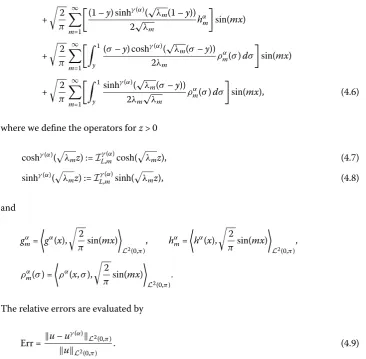
The regularized solution of the problem (4.1)–(4.2) is as follows:
uγ(α)(y,x)
=
$
2
π
∞
m=1
coshγ(α)λ
m(1 –y)
gα
+
$
2
π
∞
m=1
(1 –y)sinhγ(α)(√λm(1 –y))
2√λm
hαm
sin(mx)
+
$
2
π
∞
m=1
1
y
(σ–y)coshγ(α)(√λm(σ–y))
2λm
ρmα(σ)dσ
sin(mx)
+
$
2
π
∞
m=1
1
y
sinhγ(α)(√λ
m(σ–y))
2λm
√ λm
ρmα(σ)dσ
sin(mx), (4.6)
where we define the operators forz> 0
coshγ(α)(λmz) :=ILγ,(mα)cosh(λmz), (4.7)
sinhγ(α)(λmz) :=ILγ,m(α)sinh(λmz), (4.8)
and
gα
m=
%
gα(x), $
2
πsin(mx) &
L2(0,π)
, hα
m=
%
hα(x), $
2
πsin(mx) &
L2(0,π)
,
ρmα(σ) =
%
ρα(x,σ),
$
2
πsin(mx) &
L2(0,π)
.
The relative errors are evaluated by
Err =u–u γ(α)
L2(0,π)
uL2(0,π)
. (4.9)
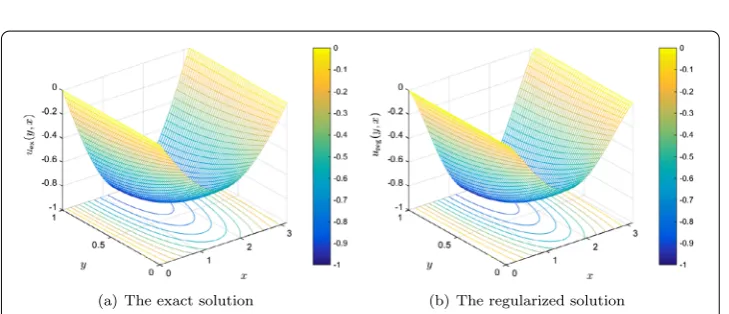
Here, we present graphs illustrating the numerical example, which we are considering. Table1shows that the smallerα, the smaller the error between the exact solution and the regularized solution, and the errors are acceptable. Specifically, in Fig.1, we can see the evaluation results aty= 0.1 andy= 0.3. Moreover, we also show 3D graphs of the exact and regularized solutions throughout the domain (0, 1)×(0,π) in Fig.2. Seen from that point of view, the result of the method of correction is effective.
5 Conclusions
Problem (1.1) was solved using two regularization methods based on problems (3.1) and (3.2). Convergence and stability estimates, as the noise level tends to zero, are formu-lated and proved. Numerical examples support the theoretical findings of the paper. In future work we hope to consider extending the current study to nonlinear sources to allow for an even wider range of physical applications in for example nonlinear elastic-ity.
Table 1 The errors between the exact solution and the regularized solution aty= 0.1 andy= 0.3 for
α∈ {0.1; 0.01; 0.001}
Errors α= 10–1 α= 10–2 α= 10–3
Err(y= 0.1) 0.0575122776 0.0335725277 0.0267921267
Figure 1The exact and regularized solutions aty= 0.1 (a) andy= 0.3 (b) forα∈ {10–1, 10–2, 10–3}
Figure 23D graphs of the exact and regularized solutions
Acknowledgements
Not applicable.
Funding
Not applicable.
Availability of data and materials
Not applicable.
Competing interests
The authors declare that they have no competing interest.
Authors’ contributions
The authors declare that the study was realized in collaboration with the same responsibility. All authors read and approved the final manuscript.
Author details
1Department of Research Management, Thu Dau Mot University, Binh Duong, Vietnam.2Department of Mathematics
and Computer Science, VNUHCM—University of Science, HoChiMinh City, Vietnam. 3School of Mathematics, Statistics
and Applied Mathematics, National University of Ireland, Galway, Ireland. 4Faculty of General Sciences, Can Tho University
of Technology, Can Tho City, Viet Nam.5Institute of Research and Development, Duy Tan University, Da Nang, Vietnam. 6Applied Analysis Research Group, Faculty of Mathematics and Statistics, Ton Duc Thang University, Ho Chi Minh City,
Vietnam.
Publisher’s Note
Springer Nature remains neutral with regard to jurisdictional claims in published maps and institutional affiliations.
References
1. Antman, S.: Nonlinear Problems of Elasticity, 2nd edn. Applied Mathematical Sciences, vol. 107. Springer, New York (2005)
2. Berchio, E., Gazzola, F., Mitidieri, E.: Positivity preserving property for a class of biharmonic elliptic problems. J. Differ. Equ.229, 1–23 (2006)
3. Berchio, E., Gazzola, F., Weth, T.: Critical growth biharmonic elliptic problems under Steklov type boundary conditions. Adv. Differ. Equ.12, 381–406 (2007)
4. Chang, A.S.Y.: Conformal invariants and partial differential equations. Bull. Am. Math. Soc.42, 365–393 (2005) 5. Ciarlet, P.: Mathematical Elasticity. Studies in Mathematics and Its Applications, vol. 27. North-Holland, Amsterdam
(1997)
6. Courant, R., Friedrichs, K., Lewy, H.: Über die partiellen Differenzengleichungen der mathematischen Physik. Math. Ann.100(1), 32–74 (1928)
7. Gazzola, F.: On the moments of solutions to linear parabolic equations involving the biharmonic operator. Discrete Contin. Dyn. Syst.33, 3583–3597 (2013)
8. Gazzola, F., Grunau, H.C., Sweers, G.: Polyharmonic Boundary Value Problems: A Monograph on Positivity Preserving and Nonlinear Higher Order Elliptic Equations in Bounded Domains. Springer, Berlin (2010)
9. Kal’menov, T., Iskakova, U.: On a boundary value problem for the biharmonic equation. In: AIP Conf. Proc., vol. 1676 (2015)
10. Kal’menov, T., Iskakova, U.: On an ill-posed problem for a biharmonic equation. Filomat31(4), 1051–1056 (2017) 11. Meleshko, V.V.: Selected topics in the history of the two-dimensional biharmonic problem. Appl. Mech. Rev.56,
33–85 (2003)
12. Nair, M.T., Pereverzev, S.V., Tautenhahn, U.: Regularization in Hilbert scales under general smoothing conditions. Inverse Probl.21(6), 1851–1869 (2005)
13. Nguyen, H.T., Kirane, M., Quoc, N.D.H., Vo, V.A.: Approximation of an inverse initial problem for a biparabolic equation. Mediterr. J. Math.15, 18 (2018)
14. Sweers, G.: A survey on boundary conditions for the biharmonic. Complex Var. Elliptic Equ.54, 79–93 (2009) 15. Tuan, N.H., Lesnic, D., Viet, T.Q., Au, V.V.: Regularization of the semilinear sideways heat equation. IMA J. Appl. Math.,
84(2), 258–291 (2019)
16. Tuan, N.H., Quan, P.H.: Some extended results on a nonlinear ill-posed heat equation and remarks on a general case of nonlinear terms. Nonlinear Anal., Real World Appl.12(6), 2973–2984 (2011)
17. Tuan, N.H., Thang, L.D., Khoa, V.A.: A modified integral equation method of the nonlinear elliptic equation with globally and locally Lipschitz source. Appl. Math. Comput.265, 245–265 (2015)
18. Tuan, N.H., Thang, L.D., Khoa, V.A., Tran, T.: On an inverse boundary value problem of a nonlinear elliptic equation in three dimensions. J. Math. Anal. Appl.426, 1232–1261 (2015)