University of South Carolina
Scholar Commons
Theses and Dissertations
12-14-2015
Optical Spectroscopy and Chemometrics for
Discrimination of Dyed Textile Fibers and
Magnetic Audio Tapes
Nathan C. Fuenffinger
University of South Carolina - Columbia
Follow this and additional works at:https://scholarcommons.sc.edu/etd
Part of theChemistry Commons
This Open Access Dissertation is brought to you by Scholar Commons. It has been accepted for inclusion in Theses and Dissertations by an authorized administrator of Scholar Commons. For more information, please [email protected].
Recommended Citation
OPTICAL SPECTROSCOPY AND CHEMOMETRICS FOR DISCRIMINATIONS OF
DYED TEXTILE FIBERS AND MAGNETIC AUDIO TAPES
by
Nathan C. Fuenffinger
Bachelor of Science Gannon University, 2009
Master of Science University of Kentucky, 2012
Submitted in Partial Fulfillment of the Requirements
For the Degree of Doctor of Philosophy in
Chemistry
College of Arts and Sciences
University of South Carolina
2015
Accepted by:
Stephen L. Morgan, Major Professor
S. Michael Angel, Committee Chair
Michael L. Myrick, Committee Member
Brian T. Habing, Committee Member
ii
iii
DEDICATION
iv
ACKNOWLEDGEMENTS
First and foremost, I would like to thank my mother, Terri, my father, Curtis Sr.,
and my brother, Curtis Jr., for their endless support. Next, I would like to offer my
gratitude to my advisor, Dr. Morgan, for giving me the resources and the freedom to
work on projects that I enjoy doing and allow me to develop my skillset. Additionally, I
would like to thank my dissertation committee, Dr. Angel, Dr. Myrick, and Dr. Habing
for their oversight and advice throughout this process. Finally, I am grateful for my high
school chemistry teacher, Miss Carla Andrews, for laying the groundwork in the field
v
ABSTRACT
This dissertation focuses on the application of both novel and standard
chemometric approaches toward societal problems of interest in the areas of forensic
science and cultural heritage preservation.
M
icrospectrophotometry (MSP), a technique enabling measurements ofabsorption of electromagnetic radiation by microscopic materials in the ultraviolet-visible
(UV-Vis) region, is widely used by forensic examiners for comparisons of metameric
textile fibers. These comparisons are often hindered, however, by the raw or normalized
spectra showing little detail or having few points of comparison. Derivative
preprocessing can enhance structure in some instances. We have demonstrated through
the use of multivariate statistics that derivatives are an effective tool for discriminating
dyed textile fibers. The Fiber Spectra Comparison Tool developed in this work is an
easy-to-use program designed for comparing multiple fibers simultaneously.
Microspectrofluorimetry (MSF) is another useful technique, often used as a
follow-up method to MSP, for studying fibers that absorb and emit in the UV-Vis region.
Results found after applying MSP and MSF to the same set of fibers suggest that the
discrimination power of MSP measurements are slightly higher than those obtained from
MSF for most colors and fiber-types. In some instances, MSP and MSF provide
complimentary information which can be taken advantage of by fusing the
measurements. A low-level (i.e., data level) fusion strategy has been developed which
vi
The ability to transfer multivariate classification models between laboratories
having differing instruments has also been investigated in this work. Such efforts could
save time and resources in forensic analyses and help identify variability between
examiners. A set of 12 blue acrylic fibers was analyzed by MSP at three academic
institutions and two certified forensic laboratories. Using a six-step preprocessing
procedure combined with quadratic discriminant analysis, a transferrable classification
model was developed which, when tested, produced a classification accuracy of 93.2%.
This percentage was only slightly lower than the 96.3% accuracy resulting from
intra-laboratory models. This outcome speaks to the consistency of results obtained on the
same samples in different laboratories.
Multivariate classification strategies similar to those applied to colored fibers
have also proven useful for determining the playability of magnetic audio tapes, a popular
recording medium from the 1950s to the 1990s. Attempting to play degraded tapes during
the digitization process can cause damage to the playback instrument, and to the tapes
themselves, often leading to significant downtime for museums and archives. A reliable
and non-destructive technique for determining the playability of a tape without ever
actually playing the tape would be beneficial. This work has shown that with attenuated
total reflectance Fourier transform infrared spectroscopy and machine learning
algorithms, playability of quarter-inch magnetic audio tapes can be determined with
greater than 90% accuracy. This finding led to the creation of the Magnetic Audio Tape
Spectra Analysis program, a user-friendly software program allowing tape custodians to
vii
TABLE OF CONTENTS
DEDICATION ... iii
ACKNOWLEDGEMENTS ... iv
ABSTRACT ...v
LIST OF TABLES ... viii
LIST OF FIGURES ...x
CHAPTER 1:COMPARISON OF MULTIVARIATE PREPROCESSING TECHNIQUES FOR THE FORENSIC DISCRIMINATION OF COTTON FIBERS BY UV-VISIBLE MICROSPECTROPHOTOMETRY ...1
CHAPTER 2:CLASSIFICATION STRATEGIES FOR FUSING UV-VISIBLE ABSORBANCE AND FLUORESCENCE MEASUREMENTS FROM TEXTILE FIBERS...35
CHAPTER 3:MULTIVARIATE CLASSIFICATION MODEL TRANSFER OF UV-VISIBLE DATA FROM ACRYLIC FIBERS WITHOUT STANDARDS ...70
CHAPTER 4:SUPERVISED MACHINE LEARNING IN PLAYABILITY DETERMINATIONS OF POLYESTER-URETHANE MAGNETIC AUDIO TAPES ...101
CHAPTER 5:MATSA:AUSER-FRIENDLY SOFTWARE PROGRAM FOR MAGNETIC AUDIO TAPE SPECTRA ANALYSIS ...138
viii
LIST OF TABLES
Table 1.1 Groups of studied fibers categorized by dye and color ...19
Table 1.2 Confusion matrix for discrimination of yellow reactive dyed fibers ...20
Table 1.3 Performance of PCA-LDA models following different preprocessing
techniques ...21
Table 1.4 Correctly classified spectra in each fiber dye class and color based
category, with the number of principal components used for each model in parentheses, following different preprocessing techniques ...22
Table 2.1 Confusion matrices displaying results of leave-one-out cross-validation for five yellow acrylic samples (10 replicate spectra each). ...56
Table 2.2 Numbers of correctly classified spectra for all fiber types and colors ...57
Table 2.3 Correct classification percentages and number of principal components used from each instrumental technique for all fiber types and colors ...58
Table 2.4 Confusion matrices of percentages based on 100 iterations of 10-fold cross-validation for low-level fusion, intermediate-level fusion, and high- level fusion on nine purple cotton fibers. Percentages equaling zero are omitted. ...59
Table 3.1 Cationic dye composition of 12 blue acrylic fibers examined. ‘Y’ indicates presence of dye ...91
Table 3.2 Comparison of classification accuracies between laboratories by method...92
Table 3.3 Confusion matrix resulting from QDA on test set composed of combined laboratory data. Percentages of correctly classified spectra are in bold.
Percentages equaling zero are omitted ...93
Table 3.4 Classification accuracies resulting from LDA, QDA, and SMV-DA models trained using datasets from four laboratories and tested on a fifth
laboratory’s dataset ...94
Table 4.1 Peak assignments for infrared absorbance spectrum of magnetic tape.
ix
Table 4.2 Naïve Bayes classification parameters ...126
Table 4.3 Sensitivity and fall-out of calibration, stratified 10-fold cross-validation, and external testing with equal cost of misclassifications between classes ..127
Table 4.4 Sensitivity and fall-out of calibration, stratified 10-fold cross-validation, and external texting with higher cost of falsely classifying a non-playable tape as playable ...128
x
LIST OF FIGURES
Figure 1.1 Gaussian shaped absorbance spectra and associated Amax and Amin
locations ...23
Figure 1.2 Absorbance spectra of three cotton fibers containing A) direct blue 86 and direct direct yellow 106, B) vat black 25, vat brown 81 and vat
yellow 33, and C) reactive yellow 206. ...24
Figure 1.3 Absorbance spectra of six reactive dyed yellow cotton fibers (10
replicates each) ...25
Figure 1.4 Averaged absorbance spectra for three of six yellow reactive dyed cotton fiber samples. ...26
Figure 1.5 Scree plot obtained following PCA on first derivative spectra of six
yellow reactive dyed cotton fibers. ...27
Figure 1.6 PCA scores plot for six reactive dyed yellow cotton fibers after first
derivative preprocessing. ...28
Figure 1.7 Absorbance spectra (10 replicates each) of samples RY03 and RY04 after a) no preprocessing, b) autoscaling, c) normalization, d) SNV, e) baseline correction, f) baseline correction plus normalization, g) first derivative, h) first derivative plus normalization, i) first derivative plus SNV, and j)
second derivative. ...29
Figure 1.8 PCA scores plot resulting from absorbance spectra (10 replicates each) of samples RY03 and RY04 after a) no preprocessing, b) autoscaling, c) normalization, d) SNV, e) baseline correction, f) baseline correction plus normalization, g) first derivative, h) first derivative plus normalization, i) first derivative plus SNV, and j) second derivative.. ...31
Figure 1.9 Fiber spectra comparison tool graphical user interface ...33
Figure 1.10 Calculated feature-by-feature t-statistics for raw (left) and preprocessed (right) data ...34
Figure 2.1 Schematic of low-level fusion process ...60
xi
Figure 2.3 Schematic of high-level fusion process ...62
Figure 2.4 Canonical variate scores plot resulting from raw (left) and first derivative (right) spectra of five yellow acrylic fibers ...63
Figure 2.5 Raw (left) and first derivative UV-Vis absorbance spectra for two yellow yellow acrylic samples (10 replicate spectra for each sample) ...64
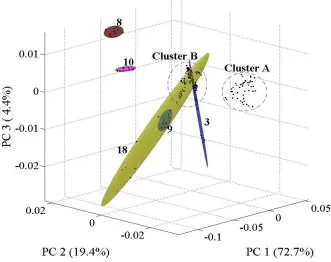
Figure 2.6 PCA scores plot of 39 brown polyester fibers with 95% elliptical
confidence regions around clustered samples removed ...65
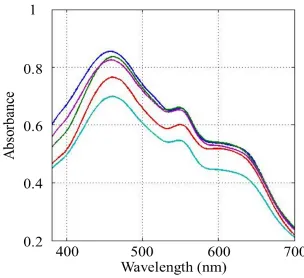
Figure 2.7 Averaged UV-Vis absorbance spectra for five brown polyester samples in Cluster B ...66
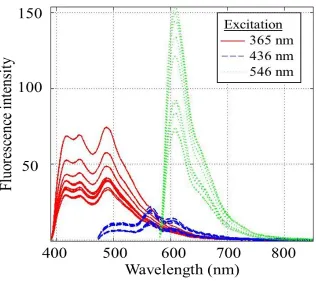
Figure 2.8 Replicate fluorescence spectra of brown polyester sample at three excitation wavelengths. Excitation at 405 nm not shown due to amount of overlap with 436 nm excitation ...67
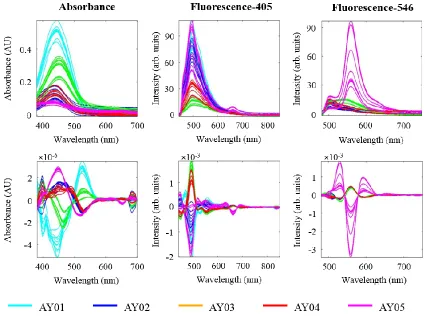
Figure 2.9 Visible absorbance and fluorescence (405 and 546 nm excitations) spectra of five yellow acrylic fibers before (top) and after (bottom) second
derivative preprocessing followed by mean centering. ...68
Figure 2.10 PCA scores plots resulting from absorbance (top left), fluorescence with 405 nm excitation (top right), fluorescence with 546 nm excitation (bottom left), and fusion of all three techniques (bottom right) for nine Purplce cotton fibers. ...69
Figure 3.1 Schematic of the methodology used for the classification of combined
laboratory datasets ...95
Figure 3.2 Microscopic images of 12 blue acrylic fibers under 40× magnification ...96
Figure 3.3 Mean absorbance spectra of 12 blue acrylic fibers collected at five
laboratories ...97
Figure 3.4 PCA scores plot of 12 blue acrylic samples (10 replicates each) collected at laboratory three ...98
Figure 3.5 Decision boundaries used to separate samples 086 and 112 generated by QDA (solid line), LDA using pooled-covariance from all 12 samples (dashed line), and LDA with sample 099 excluded from pooled-
covariance (dotted line). Class means are indicated by ‘X’ ...99
Figure 3.6 Classification error of LDA resulting from transfer of classification models to five laboratories. Each ‘o’ label involves that method of
xii
Figure 4.1 Absorbance spectra from magnetic tape samples (a) before preprocessing and (b) after preprocessing with Savitzky-Golay smoothing followed by standard normal variate transform and mean centering ...130
Figure 4.2 Partial least squares discriminant analysis scores plot for playable and
non-playable magnetic tape samples ...131
Figure 4.3 Partial least squares discriminant analysis loadings plot for the first three latent variables ...132
Figure 4.4 Average classification error of calibration and stratified 10-fold cross- validation models by number of latent variables used in partial least
squares discriminant analysis ...133
Figure 4.5 Three layer feed-forward artificial neural network ...134
Figure 4.6 Artificial neural network performance progress of training, validation, and test data. Best validation performance is indicated by intersecting
dashed lines ...135
Figure 4.7 Log posterior probabilities of magnetic tapes included in the calibration (left) and test (right) sets belonging to playable non-playable classes as determined by naïve Bayes classification. Blue and red markers indicate class determined by playability testing. Magenta markers indicate region of signficant overlap of classes ...136
Figure 4.8 Decision tree used to classify playable (P) and non-playable (NP) magnetic tapes using scores from 11 latent variables selected by partial least squares discriminant analysis ...137
Figure 5.1 MATSA program title window (left) and main user interface (right) ...159
Figure 5.2 MATSA spectral plot window showing examples of magnetic audio tape raw absorbance spectra (left) and spectra preprocessed using
interpolation, Savitzky-Golay smoothing, standard normal variate
transform, and mean centering (right) ...160
Figure 5.3 MATSA scores (left) and loadings (right) plots resulting from feature
Extraction by principal component analysis ...161
Figure 5.4 MATSA displays of validation accuracy with newly selected algorithms (left) and validation results for all algorithms based on the number of
xiii
Figure 5.5 MATSA displays showing samples to be predicted in the space of the first two latent variables with linear boundary separating playable tapes from non-playable tapes (left) and playability predictions for each sample in tabular form (right) ...163
Figure 5.6 MATSA three-dimensional plots showing decision planes resulting from linear discriminant analysis on the principal component scores with an equal cost of misclassifying tapes (left) and with a higher cost of falsely classifying non-playable tapes as playable (right) ...165
Figure 5.7 Dendrogram showing two clusters from hierarchical cluster analysis using Ward’s linkage on the average ATR FT-IR absorbance spectra from 41 tapes in an assorted collection listed by brand and model number ...166
Figure 5.8 Average spectra of two clusters resulting from hierarchical cluster
xiv
“The three great essentials to achieve anything worthwhile are, first, hard work; second, stick-to-itiveness; third, common sense.”
1
CHAPTER 1
COMPARISON OF MULTIVARIATE PREPROCESSING TECHNIQUES
FOR THE FORENSIC DISCRIMINATION OF COTTON FIBERS BY
UV-VISIBLE MICROSPECTROPHOTOMETRY
ABSTRACT
Color plays a critical role when analyzing natural fibers such as cotton in forensic
investigations. Ultraviolet-visible microspectrophotometry is a non-destructive technique
capable of providing objective color measurements on fibers in the form of absorption or
transmission spectra. Forensic fiber examinations are often hindered, however, by spectra
with little detail or points of comparison. In this work, samples of reactive, direct, and vat
dyed cotton fibers were analyzed and spectra were preprocessed using multiple methods
including baseline correction, normalization, and derivatives. Principal component
analysis followed by linear discriminant analysis was employed to discriminate the cotton
samples.
Direct dyed fibers exhibited almost featureless and low absorbing spectra
compared to those of reactive and vat dyed fibers. As a result, classification accuracies
for direct dyed fibers were lower than those calculated for reactive and vat dyed fibers.
The results of this study show that derivative spectra can significantly enhance structure
2
exhibited by direct dyed cotton fibers. No single method was best for all classes of fibers
in the study, and the shapes and intensities of the curves are important when determining
if derivative calculations are auspicious.
1. INTRODUCTION
Cotton is the most abundant fiber in the world with an estimated 25 million tons
produced annually.1 Much of that amount is used in clothing manufacturing.2 The
likelihood of recovering cotton fibers from a crime scene is the highest of any fiber type,
as population studies have shown cotton to be the most common textile fiber found on
indoor3,4 and outdoor surfaces5, as well as human head hair.6 Certain types of cotton
fibers, such as indigo dyed and colorless cotton, are found in such abundance that they
are often considered of little significance for use by forensic analysts.
Cotton fibers can be categorized based on the method in which they were dyed.
Fibers dyed using reactive dyes make up the majority of all cotton fibers, and their
dominance over direct and vat dyed fibers is expected to continue due to the excellent
wetfastness properties of reactive dyed fibers and the range of brilliant colors which can
be made using these dyes.7 Although the strength of the covalent bonding between
reactive dyes and the fiber allows for some superior properties, these forces also make
removing the dye from the fiber very challenging in cases where one wishes to use
chromatographic methods of analysis. Direct dyed fibers seemingly account for only
about 10% of all colored cotton fibers8, and vat dyed fibers share a similar percentage.
Due to the decreasing popularity of direct and vat dyes, the evidentiary value of fibers
3
Color-based techniques such as thin layer chromatography, Raman spectroscopy,
and ultraviolet-visible (UV-Vis) microspectrophotometry (MSP) are popular methods
used to analyze cotton fibers due to the lack of other defining characteristics in most
natural fibers.9-11 UV-Vis MSP provides a simple, non-destructive method for analyzing
fibers in situ. The technique is often beneficial for excluding fibers which are
indistinguishable by other approaches such as comparison light microscopy and
fluorescent light microscopy.12
The traditional method used to compare two fibers by UV-Vis MSP might have a
forensic examiner overlaying representative absorption or transmission spectra and
comparing them based on the locations and shapes of the peaks. Spectral preprocessing
techniques can be performed on UV-Vis data to potentially present the data in a more
useful way. For example, differentiation has been used for many years in analytical
chemistry for various applications described elsewhere.13,14 The use of derivatives has
only been used sparingly in forensics, however, for analyzing textile fibers15-18 and fiber
dyes.19,20
The aim of this work is to investigate the extent to which the ability to
discriminate cotton fibers is influenced by various multivariate preprocessing techniques.
Feature extraction by principal component analysis (PCA) will be used for the purpose of
reducing complex datasets down to the most significant variables which may not be
readily visible by examining the spectra. Classification accuracies will be obtained using
linear discriminant analysis (LDA), a technique which has been used in conjunction with
UV-Vis MSP in previous studies to discriminate colored textile fibers of cotton, acrylic,
4
2. EXPERIMENTAL
2.1Materials
Cotton fibers were collected from fabric obtained from a textile-related
manufacturer in the southeast United States. Dyeing of the fabric was performed at the
North Carolina State School of Textiles pilot facility (Raleigh, NC). A total of 121 cotton
fiber samples known to have been dyed using direct, reactive, or vat dyes were analyzed.
The fibers were then placed into the groups in Table 1.1 based on their observed color for
subsequent analysis by UV-Vis MSP.
Procedures from the Scientific Working Group on Materials Analysis
(SWGMAT) were followed for fiber analysis by UV-Vis MSP.23 Single fibers were
positioned on quartz slides (CRAIC Technologies, Altadena, CA, and Esco Products Inc.,
Oak Ridge, NJ) using micro tweezers. Each fiber was mounted using spectral grade
glycerin (Spectrum Chemical Mfg. Corp., Gardena, CA) and quartz cover slips.
2.2Instrumentation
UV-Vis spectra were obtained using a Quantum Detection Instrument (QDI) 1000
microspectrophotometer (CRAIC Technologies, San Dimas, CA). Data was processed
using GRAMS/AI version 700 software (Thermo Galactic, Salem, NH). The
microspectrophotometer was operated in transmission mode using a xenon light source.
A 15× collecting objective was used to focus the source light onto an area within the
diameter of the fiber samples, and replicate spectra were taken along the length of the
same fiber. Spectra were obtained by taking an average of 100 scans across a spectral
region of 200-850 nm with a bandwidth of 10 nm. Integration time for the charge coupled
5
2.3Data Analysis
Data was saved as comma separated variable (CSV) files and analyzed using
Fiber Spectrum Explorer, an in-house program written in MATLAB version 8.1 (The
Mathworks, Inc., Natick, MA). By convention, each dataset explored consisted of a
matrix with n (number of samples) rows and p (number of variables) columns. For
discrimination by multivariate analysis, wavelength ranges for all spectra were truncated
to a wavelength range of 380 to 700 nm. The spectra were then preprocessed using the
methods described below.
2.3.1Baseline Correction
It is common to have offsetting baselines from spectrum to spectrum in UV-Vis
measurements. Numerous methods are available for correcting offsetting baselines in
spectroscopy. Although there are more elaborate techniques for estimating the baseline of
a spectrum, the method used here involves a simple rescaling of each spectrum by
assuming the lowest non-zero intensity across a spectrum is in a region where there is
zero signal. That intensity is then subtracted from all other points in that spectrum. For
the purpose of discrimination, this method seemingly works at least as well as some
polynomial fitting algorithms.
2.3.2Normalization
Normalization to unit area is achieved by dividing each observation, X, in the ith
row and jth column, by the sum of the absolute value of all elements in that row, also
6 𝑋𝑖𝑗,𝑛𝑜𝑟𝑚=
𝑋𝑖𝑗 ∑𝑛 |𝑋𝑖𝑗|
𝑗=1 (1)
The result is the total area under the curve of each resulting vector being set equal to one.
Normalization to unit area is used to account for scaling differences arising from
variations in concentration, amount, and sample size as well as instrumental intensity
variations caused by changes in fiber thickness.
2.3.3Standard Normal Variate
The standard normal variate (SNV) transformation is a method of preprocessing
similar to that of the normalization technique described previously and is calculated using
Equation 2, where 𝑋𝑖𝑗,𝑆𝑁𝑉 is the SNV transformed point.25
𝑋𝑖𝑗,𝑆𝑁𝑉= 𝑋𝑖𝑗− 𝑋𝑖
𝑠𝑖 (2)
The sample mean spectrum, 𝑋𝑖, used in SNV calculations is not used in normalization to
unit area, however, and can instead be thought of as being set to zero. In addition,
normalization uses a scaling factor (1-norm for the calculation used in this study) in place
of the standard deviation, 𝑠𝑖, of the sample-spectrum.
2.3.4Autoscale
Autoscaling is a method of preprocessing which involves subtracting the column
mean from each element of each column and dividing that result by the standard
deviation of the column, 𝑠𝑗.
𝑋𝑖𝑗,𝑎𝑢𝑡𝑜 =
𝑋𝑖𝑗− 𝑋𝑗
𝑠𝑗
7
This results in the variance of all columns being equal to one. Because all values are
given equal weighting, small variations in the data are emphasized. When using data with
a low signal to noise ratio, however, noise and signal are treated equally, and this
approach becomes less useful.
2.3.5Derivatives
First derivatives (FDs) are an effective tool for correcting baseline offsets. By using a
normalization technique such as a normalization to unit area or SNV following a FD
calculation, a slope correction can also be gained. FD spectra of data recorded using
evenly spaced intervals along the x-axis can be obtained by calculating the difference
between two features, n and n + 1, where y is signal intensity and 𝜆 is wavelength.
𝜕𝑦 𝜕𝜆 =
𝑦𝑛+1− 𝑦𝑛
𝜆𝑛+1− 𝜆𝑛 (4)
The sharpest features in UV-Vis absorbance spectra are caused by noise in the measured
signal. This results in a decrease in the signal-to-noise ratio when the FD is calculated.
Noise enhancement by derivative spectroscopy is often dealt with by spectral smoothing
before differentiation. For all FD spectra in this study, a line was fitted to a 23 point
moving window using a least-squares approximation.
A second approach to dealing with the increasing noise amplification that is
associated with calculating derivatives is to use the gap-segment method. Unlike the FD
calculations collected by taking the difference of values over two adjacent points, the
second derivative (SD) calculations were made by calculating the derivative over a
number of variables (i.e., segments). The user can then define the number of variables
gap-8
segment combination is to try multiple combinations on one or more datasets, and select
the one which gives the best results. From this process, a gap size of 31 points and a
segment size of 35 points were used for all SD calculations in this study.
2.3.6Feature extraction and classification
After preprocessing, all sets of spectra were subjected to PCA. PCA is a technique
used to reduce the dimensionality of large data sets.26 In PCA, the original correlated
variables (wavelengths) are reduced to a new set of uncorrelated variables, or principal
components (PCs). PCs are linear combinations of the original variables and are arranged
in such a way that the first PC accounts for the largest variation in the data set, and the
amount of variance captured decreases with each successive PC. Selection of the number
of relevant PCs to be used in the models was chosen via scree plots which display the
percent variance captured by each PC. The greatest number of PCs before the captured
variance begins to level off was selected for use in LDA.
After the appropriate number of PCs are selected, LDA, a supervised
classification technique, was used to maximize the separation between groups in the
reduced PC space. This is carried out by projecting the data into the space of the
canonical variates. These axes differ from those in PCA in that they account for the
within-group and between-group variances after the groups are specified by the user.
Classification accuracies of each PCA-LDA model were determined internally using
leave-one-out cross-validation. In this cross-validation technique, LDA is performed on
the data set with one sample omitted thus becoming the training set. An attempt is then
made to allocate the omitted sample back into the training set. This process is repeated
9
each ‘unknown’ spectrum to the group of which the Mahalanobis distance27 is the
shortest.
3. RESULTS AND DISCUSSION
3.1 Comparing preprocessing methods for fiber analysis
The impact of using multiple forms of preprocessed UV-Vis spectra for fiber
discrimination with PCA-LDA was investigated. Though there is no hard-and-fast rule
for classifying cotton fibers based on the class of the dye, the classes themselves may
have characteristic changes in absorbance (∆A) across each spectrum as calculated using
Equation 5. Amax and Amin are the respective maximum and minimum absorbance values
in a spectrum as seen in Figure 1.1. For Gaussian-shaped curves, such as the ones
encountered in UV-Vis MSP, this calculation can serve as an indicator of the evenness of
the features across the spectra.
∆𝐴 = 𝐴𝑚𝑎𝑥 − 𝐴𝑚𝑖𝑛 (5)
Most direct dyed fibers in this study (80.8%) had values for ∆A between 0.005
and 0.020. The ∆A values for vat dyed fibers were mainly (85.7%) within a range of
0.020 and 0.130. Cotton fibers dyed using reactive dyes showed a broad range of ∆A
values. However, 89.2% of these fibers had a ∆A between 0.020 and 0.456. This suggests
that the majority of reactive dyed fibers show equal or greater absorption than vat dyed
fibers. UV-Vis spectra of fibers consistent with this trend are shown in Figure 1.2.
Multivariate statistical methods were used to compare each fiber sample to other
fibers of both the same color and dye class. A group of six yellow fibers dyed using
UV-10
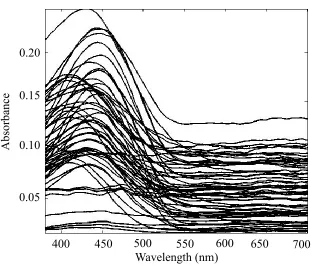
Vis absorbance spectra obtained for this group of fibers are shown in Figure 1.3. The
hues for these fibers were obtained using one to three dyes, the typical range for all fibers
in this study. From a visual examination of the absorbance spectra of this set of six fibers,
it was concluded that three of the fibers could easily be discriminated. As seen in Figure
1.4, the broad peaks in the averaged raw absorbance spectra of the three remaining fibers
demonstrate the challenge associated with fiber comparisons based on unprocessed
spectra. It should be noted that none of the samples in this group which appeared to have
very similar absorbance spectra shared any of the same dyes.
After all UV-Vis absorbance spectra had been preprocessed using the techniques
described in the previous section, PCA was performed to reduce the dimensionality of the
data. A requirement for LDA calculations is to have more samples than variables. If this
is not the case, inversion of the within-groups sum of squares and cross-products matrix
cannot occur. Selection of an appropriate number of PCs to include in the LDA model is
important for achieving the best separation between classes. When too many PCs are
included, the resulting classification model may generalize poorly. Overfitting is avoided
or reduced by using a Scree plot such as the one in Figure 1.5. This plot shows the
percent variance captured by each PC after performing PCA on FD spectra of the six
yellow reactive dyed fibers. Four PCs, containing 91.7% of the total variance in the data,
were chosen as the number used as input for LDA, since the variance appears to be
relatively flat for all PCs greater than four.
Table 1.2 shows the confusion matrix resulting from leave-one-out
cross-validation on the PC-LDA model of the six yellow reactive dyed fibers after FD
11
60) was obtained for the group of six yellow reactive dyed fibers after FD preprocessing.
As was already shown, samples RY03 and RY05 have very similar absorbance spectra.
The PCA scores plot in Figure 1.6 shows that even after FD preprocessing, there is still
significant overlap of the 95% confidence ellipses calculated for the two groups of fibers.
No preprocessing method used in this study allowed for complete discrimination of
samples RY03 and RY05.
The positive effect that each preprocessing method has on UV-Vis absorbance
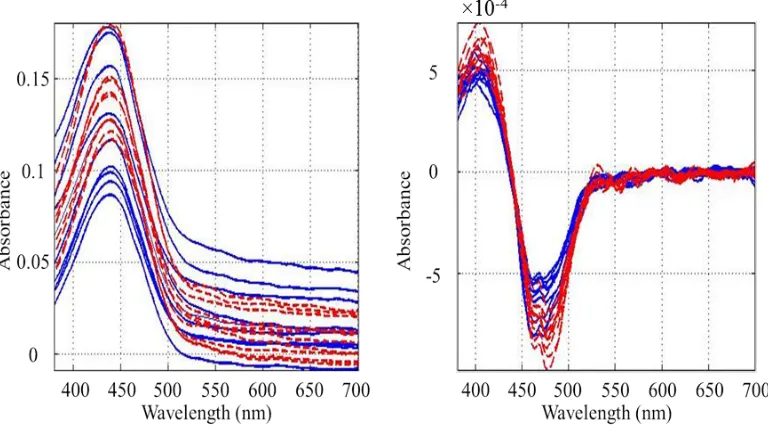
spectra is perhaps best shown using samples RY03 and RY04 (Figure 1.7). These fibers
gave very similar raw spectra, but were easily distinguishable after several types of
preprocessing. Feature by feature t-tests were used to measure the difference between the
group means at each observation point. The largest t-statistic value and the wavelength at
which it occurs are indicated following each preprocessing technique. As seen by the
t-statistic values from the raw and autoscaled spectra, autoscaling provided no
improvement in separating the two groups. In general, the changes in classification
accuracies for all groups before and after autoscaling were insignificant. Separation of the
two groups of fibers was achieved to the greatest extent by calculating SDs. This is not
surprising, as SDs correct for both baseline offsets and changes in slope. The PCA scores
plots in Figure 1.8 are consistent with the t-statistic values for each preprocessing
technique. The greatest separation between the two groups of fibers was gained using FD
(Figures 1.8g, 1.8h, and 1.8i), SD (Figure 1.8j), and SNV preprocessing techniques
(Figure 1.8d).
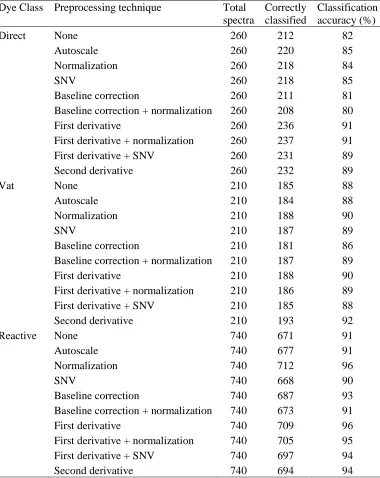
Classification accuracies of PCA-LDA, obtained after numerous methods of
12
Methods involving FD and SD calculations show increased classification accuracies of
direct dyed cotton fibers by as much as 11%. This gap in discrimination ability is
lessened for vat dyed fibers and is non-existent in the analysis of reactive dyed fibers.
Normalized spectra are slightly more discriminating, in the case of reactive dyed fibers,
than FD spectra. Because, in general, these fibers had larger changes in absorbance
relative to those of direct dyed fibers, this suggests there may be some cutoff value of ∆A
at which calculating derivatives provides no further benefit over using other methods of
preprocessing. The baseline correction method used in this study was found to have no
real advantage over the other preprocessing techniques used, and therefore is not
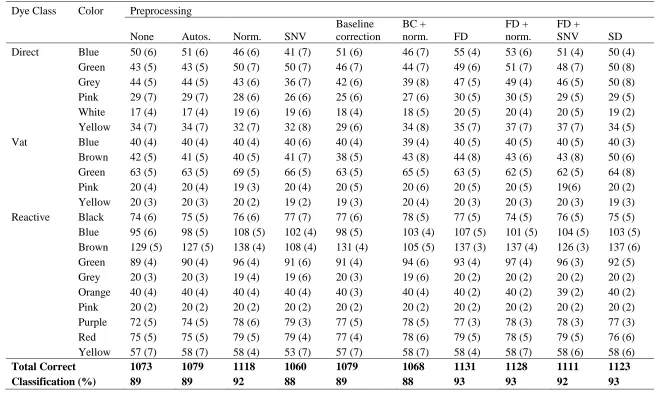
recommended. Classification accuracies for the entire dataset are shown in Table 1.4. All
FD and SD preprocessing methods used in this study, in addition to normalization, can be
considered effective methods for discriminating cotton fibers.
3.2 Fiber Spectra Comparison Tool
Using MATLAB, a Fiber Spectra Comparison Tool (FISCOTO) was developed
which would allow an examiner to view absorbance spectra of textile fibers and calculate
the previously described two sample single feature t-statistics. The design of the interface
makes the program convenient for rapidly skimming through spectra of numerous
questioned and known fibers and selecting out those fibers which require a more
thorough comparison. The user-friendly interface for the FISCOTO application is
displayed in Figure 1.9.
Spectra from multiple fibers may be loaded into FISCOTO as .CSV files.
FISCOTO uses the .CSV filenames and number of classes specified by the user to
13
Select fibers to compare list box on the left-hand side of the main user interface.
Although the user can opt to select multiple fibers to compare, a t-test for the equality of
the means is only performed when two samples are selected. The maximum t-statistic for
all features is made available for the user on the main interface. The t-statistics for all
features can be found by accessing the View t-test option located on the top right portion
of the main window.
To show an example of the single feature t-tests in FISCOTO, the same two
vat-dyed blue cotton fibers selected in Figure 1.9 will be used. After clicking the View t-test
button, the two plots in Figure 1.10 are shown. Here, the calculated t-statistics for each
feature of the raw data and data processed using Savitzky-Golay smoothing, the FD, and
standard normal variate transformation are shown in black. The horizontal green
threshold line denotes the critical value (tcrit) of Student's t at the 0.05 level of
significance, and 9 degrees of freedom (df) (due to 10 samples in each group). When the
black line is above the green line for any comparison of means at a single feature value,
the null hypothesis of equal means can be rejected at the 95% level of confidence. The
plots of calculated t-values across the feature domain also have red lines at tcalc = ~4.3,
representing a conservative choice for a threshold value. The most significant difference
between groups in the processed data is seen near 416 nm. This corresponds to the large
separation shown at that wavelength shown on the After processing panel in Figure 1.9.
In addition to hypothesis testing, this software allows users to remove undesired
features and visualize raw or processed data. FISCOTO currently makes available 12
separate methods of processing including those used in this work prior to multivariate
14
it was performed is listed in the box in the bottom right corner of the interface. This
serves as a reminder to the user as to how the data has been manipulated. The box will fill
in automatically when previously saved data is loaded back into theprogram. The Reset
option located by the Summary box undoes all performed preprocessing steps and
restores the original data.
4. CONCLUSION
Performing PCA-LDA on derivative spectra can improve discrimination of cotton
fibers over other methods of spectral preprocessing. Significant increases in
discrimination of fibers with mostly flat spectra with small changes in absorbance are
possible using derivative spectra. Direct dyed cotton fibers are one class of fibers that
would seemingly benefit significantly from utilizing derivative spectra, since these fibers
had distinctively low ∆A values. It should be noted that the effect of smoothing the
spectra using a Savitzky-Golay polynomial28 prior to calculating the FD was examined.
Although Savitzky-Golay polynomial smoothing may be advantageous for visual
examinations, increases in classification accuracies were not gained by using a
higher-order polynomial smooth rather than a linear smooth.
As was stated by Wiggins et al.19, there is a risk of FD spectra misclassifying
matching fibers with large variations in absorbance. This resulted in classification
accuracies of FD spectra being slightly lower in the analysis of reactive dyed cotton
fibers when compared to the normalized spectra. Still, the high classification accuracies
(greater than 90%) achieved using all methods of preprocessing are significant due to the
difficulty of extracting these dyes for analysis by other techniques such as thin-layer
15
best for all types of spectra, a convenient software application with many preprocessing
options available, called FISCOTO, was developed for rapid comparisons of fiber
spectra. The program is freely available and can be attained by sending a request to the
author.
ACKNOWLEDGMENTS
This project was supported by Award No. 2010-DN-BX-K245 from the National
Institute of Justice, Office of Justice Programs, U.S. Department of Justice. Portions of
this work were presented at the Pittsburgh Conference on Analytical Chemistry and
Applied Spectroscopy (Pittcon) on March 6, 2014 in Chicago, IL. The co-authorship of
Jessica M. McCutcheon, John V. Goodpaster, Edward G. Bartick, and Stephen L.
Morgan is also acknowledged. The opinions, findings, and conclusions or
recommendations expressed in this presentation are those of the author(s) and do not
16 REFERENCES
1. van Dam, J. In Environmental benefits of natural fibre production and use,
Proceedings of the Symposium on Natural Fibres, Rome, Italy, 2008; pp 3-17.
2. Biermann, T.; Grieve, M. A Computerized Data Base of Mail Order Garments: a Contribution Toward Estimating the Frequency of Fibre Types Found in Clothing. Part 2: the Content of the Data Bank and its Statistical Evaluation, Forensic Sci. Int.
1996, 77, 75-71.
3. Cantrell, S.; Roux, C.; Maynard, P.; Robertson, J. A Textile Fibre Survey as an Aid to the Interpretation of Fibre Evidence in the Sydney Region, For. Sci. Int.2001, 123, 48-53.
4. Watt, R.; Roux, C.; Robertson, J. The Population of Coloured Textile Fibres in Domestic Washing Machines, Sci. Justice2005, 45, 75-83.
5. Grieve, M.; Biermann, T. The Population of Coloured Textile Fibres on Outdoor Surfaces, Sci. Justice1997, 37, 231-239.
6. Palmer, R.; Oliver, S. The Population of Coloured Fibres in Human Head Hair, Sci. Justice2004, 44, 83-88.
7. Christie, R. Colour Chemistry; Royal Society of Chemistry: Cambridge, U.K., 2001.
8. Wiggins, K. Thin Layer Chromatographic Analysis for Fibre Dyes. In Forensic Examination of Fibres, 2nd ed.; Robertson, J.; Grieve, M., Eds.; Taylor and Francis: London, U.K., 1999, pp 291-310.
9. Adolf, F.; Dunlop, J. Microspectroctrophotometry/Colour Measurement. In Forensic Examination of Fibres, 2nd ed.; Robertson, J.; Grieve, M., Eds.; Taylor and Francis: London, U.K., 1999, pp 251-289.
10.Goodpaster, J.; Liszewski, E. Forensic Analysis of Dyed Textile Fibers, Anal. Bioanal. Chem.2009, 394, 2009-2018.
11.Massonnet, G.; Buzzini, P.; Monard, F.; Jochem, G.; Fido, L.; Bell, S.; Stauber, M.; Coyle, T.; Roux, C.; Hemmings, J.; Leijenhorst, H.; Van Zanten, Z.; Wiggins, K.; Smith, C.; Chabli, S.; Sauneuf, T.; Rosengarten, A.; Meile, C.; Ketterer, S.; Blumer, A. Raman Spectroscopy and Microspectrophotometry of Reactive Dyes on Cotton Fibres: Analysis and Detection Limits, For. Sci. Int.2012, 222, 200-207.
17
13.Bosch Ojeda, C.; Sanchez Rojas, F. Recent Applications of Derivative
Ultraviolet/Visible Absorption Spectrophotometry: 2009-2011 a Review, Microchem. J.2013, 106, 1-16.
14.Karpinska, J. Derivative Spectrophotometry – Recent Applications and Directions of Developments, Talanta2004, 64, 801-822.
15.Coyle, T.; Larkin, A.; Smith, K.; Mayo, S.; Chan, A.; Hunt, N. Fibre Mapping – a Case Study, Sci. Justice2004, 44, 179-186.
16.Grieve, M.; Biermann, T.; Schaub, K. The Individuality of Fibres Used to Provide Forensic Evidence – Not all Blue Polyesters are the Same, Sci. Justice2005, 45, 13-28.
17.Grieve, M.; Biermann, T.; Schaub, K. The Use of Indigo Derivatives to Dye Denim Material, Sci. Justice2006, 46, 15-24.
18.Wiggins, K.; Palmer, R.; Hutchinson, W.; Drummond, P. An Investigation into the Use of Calculating the First Derivative of Absorbance Spectra as a Tool for Forensic Fibre Analysis, Sci. Justice2007, 47, 9-18.
19.Almeida, V.; Vargas, A.; Garcia, J.; Lenzi, E.; Oliveira, C.; Nozaki, J. Simultaneous Determination of the Textile Dyes in Industrial Effluents by the First-Order
Derivative Spectrophotometry, Anal. Sci.2009, 25, 487-492.
20.Bridge, T.; Wardman, R.; Fell, A. Novel Digital Methods for the Qualitative
Characterization of Some Acid Dyes Applied to Wool and Nylon, Analyst1985, 110, 1307-1312.
21.Morgan, S.; Niewland, A.; Mubarak, C.; Hendrix, J.; Enlow, E.; Vasser, B. In
Forensic Discrimination of Dyed Textile Fibres Using UV-VIS and Fluorescence Microspectrophotometry, Proceedings of the 12th Meeting of the European Fibres Group, Prague, Czech Republic, 2004.
22.Morgan, S.; Hall, S.; Hendrix, J.; Bartick, E. In Pattern Recognition Methods for Classification of Trace Evidence Textile Fibers from UV/Visible and Fluorescence Spectra, Proceedings of the National Institute of Justice Trace Evidence Symposium, Kansas City, Missouri, 2011.
23.SWGMAT Forensic Fiber Examination Guidelines.
http://www.swgmat.org/Forensic%20Fiber%20Examination%20Guidelines.pdf (accessed May 5, 2014).
18
25.Barnes, R.; Dhanoa, M.; Lister, S. Standard Normal Variate Transformation and De-trending of Near-Infrared Diffuse Reflectance Spectra, Appl. Spectrosc.1989, 43, 772-777.
26.Gemperline, P. Principal Component Analysis, 2nd ed.; Gemperline, P., Ed.; Taylor & Francis: Florida, 2006, pp 69-104.
27.Mahalanobis, P. On the Generalized Distance in Statistics, Proc. Nat. Instit. Sci. India
1936, 2, 49-55.
19
Table 1.1 Groups of studied fibers categorized by dye and color.
Subclass Color Spectra
examined Subclass Color
Spectra examined
Direct Blue 60 Reactive Black 80
Green 60 Blue 110
Grey 50 Brown 150
Pink 30 Green 100
White 20 Grey 20
Yellow 40 Orange 40
Vat Blue 40 Pink 20
Brown 60 Purple 80
Green 70 Red 80
Pink 20 Yellow 60
20
Table 1.2 Confusion matrix for discrimination of yellow reactive dyed fibers.
Actual
Predicted RY01 RY02 RY03 RY04 RY05 RY06
RY01 10 0 0 0 0 0
RY02 0 10 0 0 0 0
RY03 0 0 8 0 0 0
RY04 0 0 0 10 0 0
RY05 0 0 2 0 10 0
21
Table 1.3 Performance of PCA-LDA models following different preprocessing
techniques.
Dye Class Preprocessing technique Total
spectra
Correctly classified
Classification accuracy (%)
Direct None 260 212 82
Autoscale 260 220 85
Normalization 260 218 84
SNV 260 218 85
Baseline correction 260 211 81
Baseline correction + normalization 260 208 80
First derivative 260 236 91
First derivative + normalization 260 237 91
First derivative + SNV 260 231 89
Second derivative 260 232 89
Vat None 210 185 88
Autoscale 210 184 88
Normalization 210 188 90
SNV 210 187 89
Baseline correction 210 181 86
Baseline correction + normalization 210 187 89
First derivative 210 188 90
First derivative + normalization 210 186 89
First derivative + SNV 210 185 88
Second derivative 210 193 92
Reactive None 740 671 91
Autoscale 740 677 91
Normalization 740 712 96
SNV 740 668 90
Baseline correction 740 687 93
Baseline correction + normalization 740 673 91
First derivative 740 709 96
First derivative + normalization 740 705 95
First derivative + SNV 740 697 94
22
Table 1.4 Correctly classified spectra in each fiber dye class and color based category, with the number of principal components used
for each model in parentheses, following different preprocessing techniques.
Dye Class Color Preprocessing
None Autos. Norm. SNV
Baseline correction
BC +
norm. FD
FD + norm.
FD +
SNV SD
Direct Blue 50 (6) 51 (6) 46 (6) 41 (7) 51 (6) 46 (7) 55 (4) 53 (6) 51 (4) 50 (4)
Green 43 (5) 43 (5) 50 (7) 50 (7) 46 (7) 44 (7) 49 (6) 51 (7) 48 (7) 50 (8)
Grey 44 (5) 44 (5) 43 (6) 36 (7) 42 (6) 39 (8) 47 (5) 49 (4) 46 (5) 50 (8)
Pink 29 (7) 29 (7) 28 (6) 26 (6) 25 (6) 27 (6) 30 (5) 30 (5) 29 (5) 29 (5)
White 17 (4) 17 (4) 19 (6) 19 (6) 18 (4) 18 (5) 20 (5) 20 (4) 20 (5) 19 (2)
Yellow 34 (7) 34 (7) 32 (7) 32 (8) 29 (6) 34 (8) 35 (7) 37 (7) 37 (7) 34 (5)
Vat Blue 40 (4) 40 (4) 40 (4) 40 (6) 40 (4) 39 (4) 40 (5) 40 (5) 40 (5) 40 (3)
Brown 42 (5) 41 (5) 40 (5) 41 (7) 38 (5) 43 (8) 44 (8) 43 (6) 43 (8) 50 (6)
Green 63 (5) 63 (5) 69 (5) 66 (5) 63 (5) 65 (5) 63 (5) 62 (5) 62 (5) 64 (8)
Pink 20 (4) 20 (4) 19 (3) 20 (4) 20 (5) 20 (6) 20 (5) 20 (5) 19(6) 20 (2)
Yellow 20 (3) 20 (3) 20 (2) 19 (2) 19 (3) 20 (4) 20 (3) 20 (3) 20 (3) 19 (3)
Reactive Black 74 (6) 75 (5) 76 (6) 77 (7) 77 (6) 78 (5) 77 (5) 74 (5) 76 (5) 75 (5)
Blue 95 (6) 98 (5) 108 (5) 102 (4) 98 (5) 103 (4) 107 (5) 101 (5) 104 (5) 103 (5)
Brown 129 (5) 127 (5) 138 (4) 108 (4) 131 (4) 105 (5) 137 (3) 137 (4) 126 (3) 137 (6)
Green 89 (4) 90 (4) 96 (4) 91 (6) 91 (4) 94 (6) 93 (4) 97 (4) 96 (3) 92 (5)
Grey 20 (3) 20 (3) 19 (4) 19 (6) 20 (3) 19 (6) 20 (2) 20 (2) 20 (2) 20 (2)
Orange 40 (4) 40 (4) 40 (4) 40 (4) 40 (3) 40 (4) 40 (2) 40 (2) 39 (2) 40 (2)
Pink 20 (2) 20 (2) 20 (2) 20 (2) 20 (2) 20 (2) 20 (2) 20 (2) 20 (2) 20 (2)
Purple 72 (5) 74 (5) 78 (6) 79 (3) 77 (5) 78 (5) 77 (3) 78 (3) 78 (3) 77 (3)
Red 75 (5) 75 (5) 79 (5) 79 (4) 77 (4) 78 (6) 79 (5) 78 (5) 79 (5) 76 (6)
Yellow 57 (7) 58 (7) 58 (4) 53 (7) 57 (7) 58 (7) 58 (4) 58 (7) 58 (6) 58 (6)
Total Correct 1073 1079 1118 1060 1079 1068 1131 1128 1111 1123
23 0.05
0.1 0.15 0.2
Amax - Amin
400 450 500 550 600 650 700
Wavelength (nm)
Absor
ba
nc
e
24
Figure 1.2 Absorbance spectra of three cotton fibers containing A) direct blue 86 and
direct direct yellow 106, B) vat black 25, vat brown 81 and vat yellow 33, and C) reactive yellow 206.
400 450 500 550 600 650 700
0.06 0.08 0.1 0.12
Wavelength (nm)
Absor
ba
nc
e
C
B
25
Figure 1.3 Absorbance spectra of six reactive dyed yellow cotton fibers (10 replicates
each).
400 450 500 550 600 650 700
0.05 0.20
0.15
0.10
Wavelength (nm)
Absor
ba
nc
26
Figure 1.4 Averaged absorbance spectra for three of six yellow reactive dyed cotton fiber
samples.
0.16
0.12
0.05
0.04
400 450 500 550 600 650 700
Wavelength (nm)
Absor
ba
nc
e
27
Figure 1.5 Scree plot obtained following PCA on first derivative spectra of six yellow
reactive dyed cotton fibers.
2 4 6 8 10
0 5 10 15 20
Principal Component Number
V
aria
nc
e (%
28
Figure 1.6 PCA scores plot for six reactive dyed yellow cotton fibers after first derivative
preprocessing.
RY01
RY04
RY06 RY02 RY05
RY03
PC2 (13.8%)
P
C
3 (2.5
%
)
5 0
-5 -10
-4 -2 0 2 -1
29
(a) (b)
(c) (d)
(e) (f)
Figure 1.7 Absorbance spectra (10 replicates each) of samples RY03 and RY04 after a)
no preprocessing, b) autoscaling, c) normalization, d) SNV, e) baseline correction, f) baseline correction plus normalization, g) first derivative, h) first derivative plus normalization, i) first derivative plus SNV, and j) second derivative.
Wavelength (nm) A b so rb an ce
400 450 500 550 600 650 700 0.05
0.1 0.15 0.2 0.25
t-statistic = 1.4 (382 nm)
400 450 500 550 600 650 700 0.5 1 1.5 2 Wavelength (nm) A b so rb an ce
t-statistic = 1.4 (382 nm)
x10-3
t-statistic = 11.5 (502 nm)
400 450 500 550 600 650 700 0.5 1 1.5 2 A b so rb an ce Wavelength (nm) A b so rb an ce
400 450 500 550 600 650 700 -0.05
0 0.02 0.04 0.06
t-statistic = 22.0 (416 nm)
Wavelength (nm)
400 450 500 550 600 650 700 0
1 2 3
x10-3
t-statistic = 11.0 (496 nm)
Wavelength (nm) A b so rb an ce
t-statistic = 8.7 (515 nm)
30
(g) (h)
(i) (j)
Figure 1.7 Absorbance spectra (10 replicates each) of samples RY03 and RY04 after a)
no preprocessing, b) autoscaling, c) normalization, d) SNV, e) baseline correction, f) baseline correction plus normalization, g) first derivative, h) first derivative plus normalization, i) first derivative plus SNV, and j) second derivative.
x10-3 -4 -2 0 2 A b so rb an ce
400 450 500 550 600 700 Wavelength (nm)
t-statistic = 10.8 (522 nm)
650
400 450 500 550 600 650 700 -0.05 0.05 0 A b so rb an ce Wavelength (nm) t-statistic = 21.6 (504 nm)
450 500 550 600 650 x10-6 -5 0 5 A b so rb an ce Wavelength (nm) t-statistic = 25.2 (490 nm) x10-3
2
0
-2
-4
t-statistic = 13.7 (504 nm)
A b so rb an ce
31
(a) (b)
(c) (d)
(e) (f)
Figure 1.8 PCA scores plot resulting from absorbance spectra (10 replicates each) of
samples RY03 and RY04 after a) no preprocessing, b) autoscaling, c) normalization, d) SNV, e) baseline correction, f) baseline correction plus normalization, g) first derivative, h) first derivative plus normalization, i) first derivative plus SNV, and j) second
derivative.
PC 1 (98.2%)
-1 -0.5 0 0.5 1 1.5 -1.5 P C 2 ( 1 .6 %) -0.25 -0.2 -0.15 -0.1 -0.05 0 0.05 0.1 0.15 0.2 P C 2 ( 1 .2 %)
PC 1 (98.7%)
-10 0 10 20
-20 -3 -2 -1 0 1 2 3
PC 1 (97.6%)
PC 2 ( 1 .9 %) 0.01 0.005 0 -0.005 -0.01 -0.015 -8 -6 -4 -2 0 2 4 6 8 10 x10
-4
x10-4 -1.5 -1 -0.5 0 0.5 1 -3 -2 -1 0 1 2 3 4 P C 2 ( 3 2 .8 %)
PC 1 (52.9%)
PC 1 (90.8%)
P C 2 ( 5 .8 %) -0.06 -0.04 -0.02 0 0.02 0.04 0.06 0.08
-0.6 -0.4 -0.2 0 0.2
x10-3 x10-3 -4 -3 -2 -1 0 1 2 3 4 P C 2 ( 3 4 .2 %) PC1 (55.9%)
32
(g) (h)
(i) (j)
Figure 1.8 PCA scores plot resulting from absorbance spectra (10 replicates each) of
samples RY04 and RY05 after a) no preprocessing, b) autoscaling, c) normalization, d) SNV, e) baseline correction, f) baseline correction plus normalization, g) first derivative, h) first derivative plus normalization, i) first derivative plus SNV, and j) second
derivative.
PC 1 (44.4%)
-2 -1.5 -1 -0.5 0 0.5 1 -1 -0.5 0 0.5 1 P C 2 ( 2 9 .0 %) x10-3 x10⁻³
-0.01 -0.005 0 0.005 0.01 -5
-0 -5 x10
-3 P C 2 ( 1 1 .4 %)
PC 1 (56.0%)
0 0.1
0.05
-0.05
-0.1
-0.2 -0.1 0 0.1 0.2
P C 2 ( 8 .4 %)
PC 1 (56.9%) PC 1 (52.9%)
33
34
Figure 1.10 Calculated feature-by-feature t-statistics for raw (left) and processed (right)
35
CHAPTER 2
CLASSIFICATION STRATEGIES FOR FUSING UV-VISIBLE
ABSORBANCE AND FLUORESCENCE MEASUREMENTS FROM
TEXTILE FIBERS
ABSTRACT
A recent emphasis in forensic science has been placed on the development of
statistical methods for improving the interpretability of trace evidence analyses.
Determining which non-destructive analytical methods will have the highest
discrimination power for trace evidence examinations is significant to forensic
laboratories to save time and assets. Knowing which analytical techniques provide
complimentary information on the evidence is also useful for ensuring that the data
collected is utilized in the optimum manner.
This study compares the discrimination ability of ultraviolet-visible (UV-Vis)
microspectrophotometry (MSP) and microspectrofluorimetry (MSF), two common
techniques used by forensic analysts to study textile fibers. Fusion of MSP and MSF data
was also evaluated. Low-, intermediate-, and high-level data fusion strategies were
employed in discriminations of over 400 dyed textile fiber samples of cotton, acrylic,
nylon 6,6, and polyester, resulting in correct classification rates of 97.8%, 94.6%, and
93.8%, respectively. Comparatively, classification rates of 89.5%, 87.7% and 87.6%
resulted from quadratic discriminant analysis models built from isolated absorbance
36
measurements with 546 nm excitation, respectively. The results suggest that data fusion
is useful for providing additional discriminatory information on textile fibers when
compared to single technique data evaluations.
1. INTRODUCTION
Textile fibers are a frequently encountered form of class evidencein forensic
investigations of incidents involving personal contact.1,2 Cotton is the most abundant
natural source of fibers in the world3, and nylon, polyester, and acrylic fibers are three of
the most common classes of synthetic fibers likely to be encountered in forensic
investigations.4 As a whole, these fibers are found as trace evidence in more than 80% of
all criminal cases pertaining to textile fibers.5
Initial fiber analysis is often carried out using forms of microscopy. Polarized
light microscopy is beneficial towards determining the polymer class (especially for
synthetic fibers), and stereomicroscopy enables an examiner to document the physical
characteristics of a fiber such as diameter, color, and luster.6,7 If the studied fibers,
however, are a metameric match, they may not be excluded as originating from the same
source. In cases such as these, further analyses can be carried out using optical
spectroscopy techniques.
Ultraviolet-visible (UV-Vis) microspectrophotometry (MSP) is a widely accepted
technique for discriminating fibers based on color.8 Color is often the most discriminating
characteristic of dyed fibers and is the only distinctive feature of many natural fibers such
as cottons due to a lack of variation in morphology.8,9 To visualize and interpret the vast
amount of data that can be collected using one or more spectroscopic techniques,
37
Data fusion is a chemometric approach which merges data from multiple sources
with the expectation that a better interpretation can be gained from the combined data in
comparison to any single sensor. Data fusion has been examined for multiple applications
in analytical chemistry and has been heavily used in the food and drink realm.10-16 A
fused data process falls into one of three categories: low-level fusion (LLF),
intermediate-level fusion (ILF), and high-level fusion (HLF). The fusion level is
determined by the stage of data processing at which fusion is carried out. LLF involves
merging the raw or preprocessed data signals of each set of input data.10,11,17 Similarly,
ILF also involves fusion at the data-level but occurs after feature selection or feature
extraction is employed.18 For this reason, ILF is also known as feature-level fusion. In
HLF, a separate model is built for each set of input data, and the responses of each model
are then “fused” together to create one final response.19
With relative ease, fusible data can be provided by modern MSP instruments
capable of collecting transmittance, absorbance, reflectance, and fluorescence
information from fibers. Though most fiber comparisons are carried out by a simple
examination of UV-Vis transmittance or absorbance spectra, microspectrofluorimetry
(MSF) is a tool often used following MSP to provide additional discriminatory
information. This is especially true in cases where the absorbance and transmittance
spectra resulting from multiple fibers appear to match. In addition to the dye components,
dye-bath additives, and the garment material may contribute to a fiber’s fluorescence
spectrum.8
This study investigates various strategies for the fusion of UV-Vis absorbance and
38
ability to discriminate these fibers was examined using multivariate classification
techniques in the form of quadratic discriminant analysis (QDA) or naïve Bayes
classification (NBC). Multivariate approaches make it possible to extract as much
information as possible from the data, and have been applied previously to color-based
discriminations of textile fibers.20,21 Lastly, the classification accuracies from fused
UV-Vis MSP and MSF data were compared to the results found using single modality.
2. EXPERIMENTAL
2.1 Materials
A total of 482 dyed textile fibers collected from various manufacturers were
examined in the study. All fibers were classified as belonging to one of four classes,
acrylic (at least 85% acrylonitrile), cotton, nylon 6,6, and polyester, based on their
polymer component. The fibers were further placed in subgroups based on perceived
color of source material to reduce the number of overall comparisons. Single fibers were
then removed from the source using razor blades and centered on quartz microscope
slides (CRAIC Technologies, Altadena, CA, and Esco Products Inc., Oak Ridge, NJ)
using micro tweezers. Spectral grade glycerin (Spectrum Chemical Mfg. Corp., Gardena,
CA) and quartz coverslips were used to mount the fibers on the slides for analysis by
MSP and MSF.
2.2 Instrumentation
UV-Vis absorbance and fluorescence spectra were acquired using a CRAIC
Technologies Quantum Detection Instrument (QDI) 1000 MSP. Data acquisition was
carried out using GRAMS/AI 7.0 (Thermo Galactic, Salem, NH). For absorbance
39
integration time for the charge coupled device (CCD) detector of ~4 ms. Fluorescence
was carried out using a mercury light source with a CCD integration time of ~200 ms.
Fluorescence spectra were acquired after 365, 405, 436, and 546 nm excitations. All
absorbance and fluorescence spectra were calculated by performing an average of 100
scans over a range of 200-850 nm with a 10 nm bandwidth.
2.3 Data Analysis
All data was analyzed using MATLAB version 8.3 (The Mathworks, Inc., Natick,
MA) and the statistics toolbox. The ‘classify’ function with discriminant types ‘quadratic’
and ‘diagquadratic’ was used to perform QDA and NBC, respectively.
2.3.1 Preprocessing
All absorbance spectra were truncated to the region of 380 to 700 nm. Truncation
of fluorescence spectra was based on the excitation cube used. The lower wavelength
cutoff was 390, 444, 470, 581 nm for 365, 405, 436, 546 nm excitation, respectively, with
an upper wavelength cutoff of 850 nm.
Further preprocessing to be performed on the datasets was dependent on whether
the preprocessed data would be analyzed individually or as part of a fused data
classification model. Preprocessing of the absorbance data to be analyzed individually
was carried out by first calculating the first derivative of each spectrum. Noise reduction
was accomplished using a Savitzky-Golay22 numerical algorithm with a second order
polynomial and nine point moving window. The first derivative is followed by a standard
normal variate transformation. Fluorescence data to be analyzed individually was
40
final preprocessing step for the individual absorbance and fluorescence datasets is mean
centering, a technique which scales each feature to a mean of zero.
Fused absorbance and fluorescence datasets were preprocessed using the second
derivative. The second derivative spectra were calculated using the gap-segment method.
In the gap-segment technique, derivatives are calculated over a number of variables (i.e.,
segments) as opposed to adjacent points. The gap, also defined by the user, is the number
of variables between the segments. Different types of spectra from multiple datasets were
examined using various gap-segment combinations. A gap size of 31 points and segment
size of 35 points were chosen as the parameters to be used based on the resulting
absorbance and fluorescence spectra which appeared to strike a balance between feature
retention and spectral smoothing. As with the single sensor data, the datasets which
would ultimately be fused are also mean centered.
2.3.2 Classification
2.3.2.1 Single Modality
Preprocessed absorbance and fluorescence spectra were subjected to principal
component analysis (PCA). Using PCA, new sets of uncorrelated variables (PCs) are
generated for each dataset.23 The number of PCs from each set of data to be used for
QDA was selected by plotting the variance captured by each PC (i.e., scree plots). QDA
is similar to the popularly used discriminant method, linear discriminant analysis,
developed by R. A. Fisher in 1936.24 In QDA, however, a separate variance/covariance
matrix is calculated for each group as opposed to the pooled variance/covariance matrix
used in LDA. The result of using stratified covariance matrices is a quadratic decision
41
total number of classification attempts which were performed correctly) were determined
using leave-one-out cross-validation.
2.3.2.2 Low-level Fusion
A schematic of the LLF process is shown in Figure 2.1. To avoid increased
complexity, only fluorescence measurements collected at two excitation wavelengths
(405 and 546 nm) were used in the fused data models. The original data collected
utilizing MSP and MSF was viewed as three separate n×p matrices, where n is the
number of samples and p is the number of measured wavelengths. Before fusion, p is
equal to 940, 1193, and 790 for absorbance, fluorescence-405, and fluorescence-546,
respectively. After all data has been preprocessed as described previously, the three
matrices are horizontally concatenated, generating a single matrix with n rows and 2923
(940 + 1193 + 790) columns.
In LLF, no feature extraction or selection techniques were carried out prior to
classification. Discrimination of the fiber samples in LLF was carried out utilizing the
naïve Bayes method of classification which uses probabilistic responses. The naïve Bayes
approach assumes that the features for a given class are independent (i.e., the covariance
matrices are diagonal ones). Though this assumption is generally not valid, the technique
remains a popular one due the surprisingly good results that are often obtained on
real-world datasets.25 The substantial bias generated by assuming the features of a class are
independent is usually countered by savings in variance. Classification accuracies for
fused data models were determined using 100 iterations of stratified 10-fold