Purdue e-Pubs
Open Access Dissertations Theses and Dissertations
January 2016
Methods to Improve Applicability and Efficiency of
Distributed Data-Centric Compute Frameworks
Karthik Shashank Kambatla
Purdue University
Follow this and additional works at:https://docs.lib.purdue.edu/open_access_dissertations
This document has been made available through Purdue e-Pubs, a service of the Purdue University Libraries. Please contact [email protected] for additional information.
Recommended Citation
Kambatla, Karthik Shashank, "Methods to Improve Applicability and Efficiency of Distributed Data-Centric Compute Frameworks" (2016).Open Access Dissertations. 1379.
PURDUE UNIVERSITY GRADUATE SCHOOL Thesis/Dissertation Acceptance This is to certify that the thesis/dissertation prepared
By Entitled
For the degree of
Is approved by the final examining committee:
To the best of my knowledge and as understood by the student in the Thesis/Dissertation Agreement, Publication Delay, and Certification Disclaimer (Graduate School Form 32), this thesis/dissertation adheres to the provisions of Purdue University’s “Policy of Integrity in Research” and the use of copyright material.
Approved by Major Professor(s):
Approved by:
Head of the Departmental Graduate Program Date
Karthik Shashank Kambatla
METHODS TO IMPROVE APPLICABILITY AND PERFORMANCE OF DISTRIBUTED DATA-CENTRIC COMPUTE FRAMEWORKS
Doctor of Philosophy
Prof. Ananth Y Grama Prof. Aniket Kate
Chair
Prof. Dongyan Xu
Prof. Sonia Fahmy
Prof. Mathias Payer
Prof. Ananth Y Grama
DATA-CENTRIC COMPUTE FRAMEWORKS
A Dissertation Submitted to the Faculty
of
Purdue University by
Karthik Shashank Kambatla
In Partial Fulfillment of the Requirements for the Degree
of
Doctor of Philosophy
December 2016 Purdue University West Lafayette, Indiana
ACKNOWLEDGMENTS
PhinallyDone! I am thrilled and grateful to be able to write these two words. The last 9 years have been challenging. Four years ago, I took the opportunity to work full time at Cloudera on the next generation of big-data software, but my dream of a doctorate in computer science continued to entice me. Today, I am so glad I kept chipping at it over the years. That said, I could not have accomplished my PhD without the unyielding support and help of all the people I wish to thank here. Enumerating their contributions and recounting the warm stories could run longer than the dissertation itself. I will resist the temptation of putting all of that on paper and restrict my write up to expressing my gratitude for their support.
I will begin by thanking my advisor, Prof. Ananth Grama. Besides being one of the smartest people I have met and an inspiring source of technical expertise, he has always had a great way of bonding with his students. I very much appreciate the confidence he placed in me and the freedom he extended which allowed me to pursue and complete my PhD while I worked full time as a software engineer. I have grown and blossomed into an independent professional under his mentorship.
My most sincere thanks go next to Prof. Suresh Jagannathan for advising me on the sig-nificance of formalism, and also to my graduate committee including Professors Dongyan Xu, Sonia Fahmy, Mathias Payer, and Aniket Kate for their insightful comments.
Working at Cloudera on Apache Hadoop has exposed me to production Hadoop clus-ters and the associated real-world problems which motivated my research. Discussing these challenges with the Hadoop developer community and their valuable feedback on my pro-posed solutions has been immensely helpful. Special thanks to Vamsee Yarlagadda, Inigo Goiri, Jason Lowe, Nathan Roberts, Bikas Saha, Ganesh Ananthanarayanan for their di-rect involvement and feedback. My colleagues at Cloudera – Haibo Chen, Ray Chiang, Yufei Gu, Robert Kanter, Daniel Templeton, bc Wong – epitomize teamwork, and their
cooperation allowed me time for research and publications. I thank Matthew LaMantia and Santhosh Srinivasan for their advice on achieving a good balance between work and research. And of course, Amr Awadallah for being a role model as someone who finished his PhD while working full time.
I am thankful for the opportunity to work with some of the brightest and most helpful graduate students – Abhinav Pathak, Himabindu Pucha, Jayaram KR, Luke Ziarek, Mu-ralikrishna Ramanathan, KC Sivaramakrishnan, and many others. Their critical insights, and the numerous discussions and debates we had have fueled my work. Special thanks to Naresh Rapolu for being a wonderful research partner and for leading me through the logistics of putting together my dissertation. I also very much appreciate the help from Venkata Gandikota (GV) for handling paperwork for me at the University while I was ge-ographically away for work.
I am very grateful to my dear friends and fellow students at Purdue – Ajay Kalangi, Aravindakshan Parthasarathy, Padma Koutha, Prashant Rajan, Raghava Budhiraju, Ravi Annapragada, Shweta Chopra, Srikar Bhagavatula, and Venkata Gandikota – for being my family at Purdue. The fun times together, their support, the interest they showed in my well-being, the times we hung out and worked together, and their own dedication toward academic and professional excellence were all critical for me to thrive during my stay at Purdue. I am also very thankful to the cricket fraternity at Purdue, especially the members of Purdue University Cricket Club and Purdue Village Cricket Club for their camaraderie. Playing my favorite sport with them was a great way to unwind.
I am indebted to my best friend and confidante, Laxmi Pandit, for always being avail-able and supportive. Her company, encouragement and emotional support were instrumen-tal to my success in graduate school.
Finally, I owe this dissertation to my family and their unconditional love and support. The interest my parents – Ramani and Sridhar Kambatla – took in my education and the strong sense of integrity and work ethic they have instilled in me has moulded me into the person I am today. When I was a child, my father had recommended that I become a doctor (a.k.a physician) so as to positively impact many lives. Today, I am proud to say that I
had the privilege of having my father and mother attend my PhD defense and watch me graduate as a Doctor in in my chosen field. I realize this is just the beginning, and look forward to upholding everything that the privileged prefixDr. embodies.
TABLE OF CONTENTS Page LIST OF TABLES . . . x LIST OF FIGURES . . . xi GLOSSARY . . . xiii ABSTRACT . . . xiv 1 INTRODUCTION . . . 1
1.1 Limited Applicability of Data-Centric Models . . . 2
1.2 Need for Efficient Cluster Resource Usage . . . 4
1.3 Problem Statement . . . 5
1.4 Contributions . . . 5
2 BACKGROUND ON DISTRIBUTED STORAGE AND COMPUTE FRAME-WORKS . . . 9
2.1 Storage Systems . . . 9
2.1.1 Resource Efficiency of Storage Systems . . . 11
2.2 Distributed Compute Frameworks . . . 12
2.2.1 Batch Processing . . . 13
2.2.2 Bulk Synchronous Parallel Processing . . . 14
2.2.3 Event Processing . . . 15
2.2.4 Cluster Scheduling . . . 17
3 ASYNCHRONOUS ALGORITHMS IN MAPREDUCE . . . 18
3.1 Motivation for Partial Synchronization. . . 20
3.2 Proposed Semantic Extensions . . . 23
3.2.1 Semantics for Iterative MapReduce . . . 23
3.2.2 Proposed API . . . 25
Page
3.3 Evaluation . . . 28
3.3.1 PageRank . . . 28
3.3.2 Single Source Shortest Path . . . 36
3.3.3 K-Means . . . 39
3.4 Discussion and Related Work . . . 41
3.4.1 Applicability of Partial Synchronization Techniques . . . 41
3.4.2 Related Work . . . 43
3.5 Conclusion . . . 44
4 EFFICIENT LARGE-SCALE GRAPH ANALYSIS IN MAPREDUCE . . . . 46
4.1 Background and Related Work . . . 48
4.1.1 Suitability of Data-Centric Models to Graph Analysis . . . 49
4.1.2 Graph Similarity . . . 50
4.2 Graph Similarity Using Data-Centric Models . . . 51
4.2.1 Diffusion-Based Algorithms for Graph Similarity . . . 51
4.2.2 Network Similarity Decomposition (NSD) . . . 53
4.2.3 NSD for Data-Centric Models . . . 55
4.2.4 Graph Similarity in MapReduce . . . 57
4.3 Mat-VecDesign and Implementation . . . 59
4.3.1 Optimizing a SingleMat-Vec . . . 60
4.3.2 OptimizingMat-VecIterations: The Inner/Outer Case . . . 69
4.4 Evaluation: Results on Computing Similarity . . . 71
4.5 Conclusion . . . 74
5 TRANS-MR: DATA-CENTRIC PROGRAMMING BEYOND DATA PARAL-LELISM . . . 75
5.1 TransMR Programming Model. . . 76
5.1.1 Operational Semantics . . . 78
5.2 Design of TransMR Framework . . . 79
Page
5.2.2 Fault Tolerance Model and its Implications on CAP . . . 81
5.2.3 Prototype Implementation . . . 81
5.3 Evaluation . . . 82
5.3.1 Boruvka’s Minimum Spanning Tree (MST) . . . 82
5.3.2 Preflow Push-Relabel . . . 84
5.4 Discussion and Related Work . . . 86
5.4.1 Applicability of TransMR . . . 86
5.4.2 Related Work . . . 87
5.5 Conclusion . . . 88
6 UBIS: UTILIZATION-AWARE CLUSTER SCHEDULING . . . 89
6.1 Motivation for Utilization-Aware Scheduling . . . 92
6.1.1 Job-Level Resource Wastage . . . 92
6.1.2 Workflow-Level Resource Wastage . . . 94
6.2 Problem Statement . . . 95
6.3 UBIS Design . . . 97
6.3.1 Identifying the Opportunity . . . 97
6.3.2 Scheduling Opportunistic Containers . . . 98
6.3.3 Avoiding Adverse Effects of Opportunistic Containers . . . 99
6.3.4 Promotions and Opt-Out Provisions . . . 100
6.3.5 Honoring Fairness . . . 102
6.3.6 Scalability . . . 104
6.4 Evaluation . . . 104
6.4.1 UBIS Implementation in YARN . . . 105
6.4.2 Sensitivity Analysis . . . 107
6.4.3 Results from a Realistic Deployment . . . 112
6.5 Related Work . . . 118
6.6 Conclusion . . . 119
Page
7.1 Motivation: One Size Does Not Fit All . . . 123
7.2 Signature-Based Approach to Classify Applications . . . 125
7.3 Evaluation . . . 128
7.4 Conclusion . . . 131
8 CONCLUSIONS . . . 132
8.1 Conclusion . . . 132
8.2 Avenues for Future Work . . . 132
REFERENCES . . . 134
LIST OF TABLES
Table Page
3.1 Measurement testbed and software. . . 28
3.2 Input graph properties . . . 31
4.1 Sample naivemat-vecoperation in MapReduce . . . 59
4.2 Measurement testbeds and software . . . 60
4.3 Input graph properties . . . 71
6.1 Workload for sensitivity analysis . . . 107
LIST OF FIGURES
Figure Page
1.1 Cluster utilization at Yahoo! . . . 4
2.1 MapReduce dataflow. . . 14
3.1 Syntax for iterative relaxed MapReduce . . . 23
3.2 Semantics for iterative relaxed MapReduce . . . 24
3.3 Construction ofgmapfromlmapandlreduce . . . 27
3.4 In-link distribution of Stanford web graph . . . 32
3.5 In-link distribution of synthetic graph . . . 32
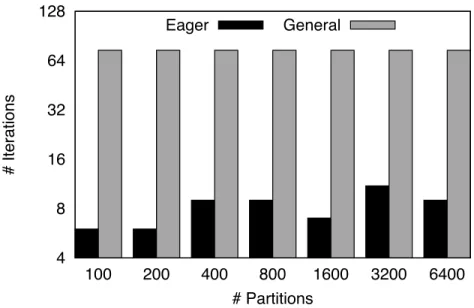
3.6 PageRank: iterations to converge for Stanford web graph . . . 34
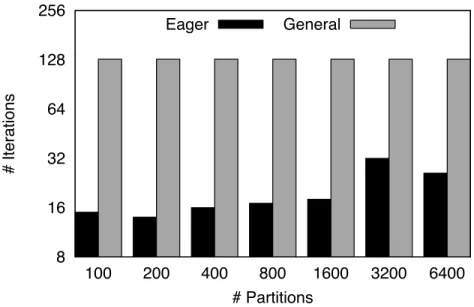
3.7 PageRank: iterations to converge for synthetic graph . . . 34
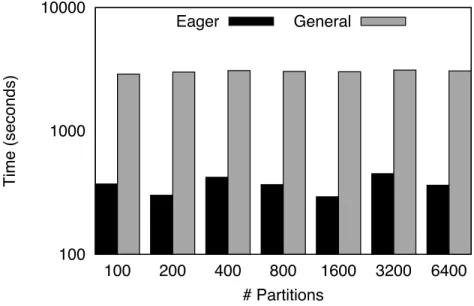
3.8 PageRank: time to converge for Stanford web graph . . . 35
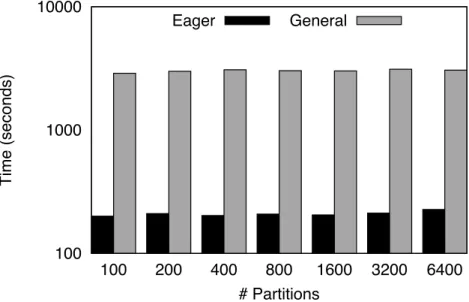
3.9 PageRank: time to converge for synthetic graph . . . 36
3.10 Single Source Shortest Path: iterations to converge . . . 38
3.11 Single Source Shortest Path: time to converge . . . 38
3.12 K-Means: iterations to converge . . . 40
3.13 K-Means: time to converge . . . 41
4.1 Similarity as a diffusive process . . . 52
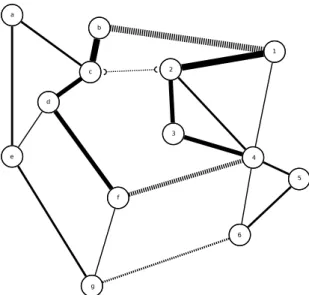
4.2 Example graph for illustrating themat-vec“mechanics” inMapReduce . . 58
4.3 Resource utilization for naivemat-vec . . . 62
4.4 Percentage of time spent in each MapReduce stage . . . 64
4.5 Partitionedmat-vecperformance. . . 66
4.6 Performance of differentmat-vecimplementations . . . 67
4.7 Strong scalability ofmat-vecimplementations . . . 68
4.8 Weak scalability ofmat-vecimplementations . . . 68
Figure Page
4.10 Effect ofmat-vecimplementation on graph similarity . . . 72
4.11 Graph similarity durations for UK web graph . . . 73
5.1 System architecture of TransMR . . . 77
5.2 Syntax for TransMR operational semantics . . . 78
5.3 Operational semantics for TransMR . . . 79
5.4 Performance of Boruvka’s minimal spanning tree . . . 83
5.5 Performance of preflow push-relabel. . . 84
6.1 Memory usage for commonly used Hadoop examples . . . 93
6.2 Task schedule and execution for a job . . . 101
6.3 Effect ofTallocon opportunistic allocations and preemptions . . . 108
6.4 Percentage of preemptions at different values ofTpreempt . . . 110
6.5 Effect of task duration on opportunistic allocations and preemptions . . . . 111
6.6 Improvement in makespan . . . 114
6.7 Deterioration of task runtimes . . . 114
6.8 Individual job durations . . . 115
6.9 UBIS robustness . . . 117
7.1 Effect of number of maps ongrepperformance . . . 124
7.2 Overview of the optimization process . . . 125
7.3 Design of RS maximizer . . . 128
GLOSSARY DAG Directed Acyclic Graph
HPC High-Performance Computing SLO Service-Level Objective
ABSTRACT
Kambatla, Karthik Shashank PhD, Purdue University, December 2016. Methods to Im-prove Applicability and Efficiency of Distributed Data-Centric Compute Frameworks. Major Professor: Ananth Y. Grama.
The success of modern applications depends on the insights they collect from their data repositories. Data repositories for such applications currently exceed exabytes and are rapidly increasing in size, as they collect data from varied sources – web applications, mobile phones, sensors and other connected devices. Distributed storage and data-centric compute frameworks have been invented to store and analyze these large datasets. This dis-sertation focuses on extending the applicability and improving the efficiency of distributed data-centric compute frameworks.
While data-centric models like MapReduce allow applications to process large datasets on thousands of nodes, the lack of inter-task communication and high synchronization costs limit their applicability to data-parallel computations. In this dissertation, we (1) en-able inter-task communication through transactional execution of tasks over shared address space, and (2) lower the synchronization costs through relaxed synchronization techniques. These improvements extend the applicability of MapReduce and allow applications to ex-ploit amorphous data parallelism and algorithmic asynchrony. We demonstrate this by im-proving the scalability and performance, by an order of magnitude, of many unstructured graph applications.
The simplicity of data-centric models, that hides the complexity of distributed execution from end-users, is one of the main reasons for their widespread adoption and success. How-ever, this makes it harder for end-users to efficiently utilize and share cluster resources. In this dissertation, we devise UBIS, a utilization-aware cluster scheduler, to improve cluster utilization and job throughput. UBIS demonstrates improvements of up to30%for
repre-sentative workloads. We also outline methods to automatically tune per-job configuration knobs for optimal performance.
1. INTRODUCTION
Modern web and mobile applications serve millions of users. Hardware advances in the form of advanced networking and cheap storage, coupled with software enhancements in distributed data storage engines have allowed these applications to collect yotta-scale datasets. These datasets are growing at rapid rates as they collect data from varied and dis-tributed sources like web applications, social networks, mobile phones, sensors and other internet-connected devices.
Extracting information and intelligence from these large-scale datasets is quintessential to the success of modern applications. Recent conservative studies estimate that enter-prise server systems in the world have processed 9.57⇥1021 bytes of data in 2008 [1].
This number is expected to have doubled every two years from that point. As an example, Walmart servers handle more than one million customer transactions every hour, and this information is inserted into databases that store more than2.5petabytes of data. The Large
Hadron Collider at CERN [2] will produce roughly 15petabytes of data annually. Every
minute,100hours of video are uploaded on to YouTube and upwards of135,000hours are
watched [3]. Roughly46million mobile applications were downloaded in 2012, each
ap-plication collecting more data. Twitter [4] serves more than550million active users, who
produce9,100 tweets every second. In other domains, Boeing jet engines can produce10
terabytes of operational information for every 30minutes of operation. This corresponds
to a few hundred terabytes of data for a single Atlantic crossing, which, if multiplied by the25,000 flights each day, highlights the data footprint of sensor and machine-produced
information. These examples provide a tiny glimpse into the rapidly expanding ecosys-tem of diverse sources of massive datasets currently in existence. Data can be structured (e.g., financial, electronic medical records, government statistics), semi-structured (e.g., text, tweets, emails), unstructured (e.g., audio and video), and real-time (e.g., network
traces, generic monitoring logs). All of these applications share the potential for providing invaluable insights, if organized and analyzed appropriately.
The need for large-scale data analysis has led to the rise of several data-centric pro-gramming models like MapReduce [5], Spark [6], and Dryad [7]. The datasets are typ-ically stored in a distributed storage system that partitions the data across cluster nodes. Data-centric models process these partitions parallely to exploit data parallelism: a job comprises multiple tasks with each task processing a block of data. Many data-analysis algorithms – transformations, computing statistics, etc. – are embarrassingly data parallel and lend themselves to these data-centric models.
Larger datasets and increasing number of users and workloads sharing a cluster requires efficient cluster management. Generic cluster schedulers like YARN [8] and Mesos [9] enable efficient sharing of cluster resources; YARN schedules resources to applications (potentially running different frameworks – e.g. MapReduce and Spark) based on organi-zational policies, while Mesos is a two-level scheduler assigning resources to frameworks which they could in turn assign to their jobs.
1.1 Limited Applicability of Data-Centric Models
A majority of data-centric applications (like data analytics) have a data- parallel, uni-form access profile. While the existing data-centric programming models accommodate such applications, they are not readily applicable to unstructured applications that do not lend themselves naturally to data- parallel formulations. Furthermore, even in cases where they can be captured by data-centric models, the domain-specific optimizations do not carry over. Common examples of these include sparse unstructured graph operations (as encoun-tered in diverse domains including social networks, financial transactions, data and graph mining, and scientific datasets), discrete optimization and state-space search techniques (in business process optimization, planning), and discrete event modeling. There is a need for programming model enhancements to exploit all the parallelism available in these applica-tions. For these applications, there are two major unresolved questions: (i) can the existing
data-centric models effectively support such applications in a scalable manner? and (ii) what enhancements to the data-centric models would significantly enhance their perfor-mance and scalability without compromising desirable attributes of programmability and fault tolerance?
Past research on unstructured applications was targeted to traditional high-performance computing (HPC) systems. Unlike these traditional systems, modern data centers use com-modity hardware with higher frequency of hardware failures and the software running on these systems is expected to be fault-tolerant. Storage systems adopt replication to tol-erate faults, and data-centric computations persist intermediate output to the underlying distributed storage systems. If a computation (task) fails due to hardware failures or oth-erwise, the computation is simply re-executed from the last persisted intermediate output. Due to these differences, traditional formulations of unstructured application are either sub-optimal or outright do not apply.
Many unstructured applications are iterative in nature with inter-process communica-tion/synchronization between iterations. Persisting intermediate data to distributed storage for this inter-process communication is expensive. To reduce this synchronization over-head, applications have to exploit any asynchrony inherent to the algorithms. In fact, many graph processing and machine learning algorithms are known to benefit from leveraging this algorithmic asynchrony [10–12]. Realizing this asynchrony at scale preserving the simplicity of the data-centric programming models is challenging.
Fault-tolerance through deterministic replay, as adopted by data-centric models, does not work in the presence of side-effects (e.g., writes to persistent storage or communication over the network) or non-deterministic operations (e.g., using a random number genera-tor). Consider amaptask writing to the underlying distributed file system. If this instance is replayed (in case of a fault), the re-execution is oblivious of the previous write and hence rewrites the data. Both of these writes are, however, visible to external processes leading to non-deterministic behavior. For this reason, side-effects are not well-supported within the MapReduce framework. Data-sharing through side-effects on shared address space (e.g., a shared disk-resident key-value store) enables speculative- and task- parallelism in
appli-Fig. 1.1: Resource allocation and utilization in a production Hadoop cluster at Yahoo!
cations [13]. Not supporting side-effects disallows inter-process communication outside of strict synchronization barriers, which are again expensive as discussed earlier.
1.2 Need for Efficient Cluster Resource Usage
Projections suggest that data growth will largely out-pace foreseeable improvements in the cost and density of storage technologies, the available computational power for pro-cessing it, and the associated energy footprint [14, 15]. For example, between 2002 and 2009 data traffic grew56-fold, compared to a corresponding16-fold increase in computing
power (largely tracking Moore’s law). While hardware enhancements are required to bridge the gap, it is important for the software solutions to make efficient use of resources. Fur-thermore, organizations are looking to gain insights from their data faster for competitive advantage.
Figure 1.1 captures the cpu and memory utilization at Yahoo! in one of their pro-duction clusters over a week. Cluster resources allocated to jobs, the solid line labeled allocation, varies over time between40%and100%and the cluster’s full allocation is
sel-dom sustained. This is likely because of sub-optimal capacity planning – job submission optimized for best packing. The actual cpu and memory usage, captured by the dotted lines, is consistently under 50% even when the cluster is fully allocated. The execution
them. They rely on application-frameworks and end-users to specify application-specific details like resource requirements and other performance-critical configuration parameters. While determining the ideal amount of resources for a computation is hard, figuring out the configuration parameters requires understanding the internals of these execution engines. End-users are often ill-equipped to determine these values, and end up picking defaults or providing highly conservative estimates. Such deployments lead to severe under-utilization of resources and sub-optimal application performance.
1.3 Problem Statement
This dissertation aims to extend the applicability and improve the efficiency of dis-tributed data-centric compute frameworks. Specifically, we formulate the following prob-lems, present hypotheses and validate them.
• By relaxing the synchronization requirements in data-centric models, unstructured
applications can exploit available algorithmic asynchrony for improved performance.
• Large-scale graph analysis can be more efficient by using 1-D block partitioning of
their adjacency matrices due to reduced communication costs.
• Enabling speculative execution by supporting side-effects in data-centric models
al-lows unstructured applications to exploit amorphous data parallelism.
• Opportunistic allocation of cluster resources based on actual resource utilization on
individual nodes can lead to improved utilization and job throughput.
• A job’s configuration can be optimized by profiling its resource usage and comparing
to well-studied jobs with similar resource usage profiles.
1.4 Contributions
The main contributions of this dissertation are (1) enhanced semantics of data-centric models like MapReduce to support relaxed synchronization and transactional execution,
and (2) efficient use of resources through optimal configuration tuning and utilization-aware scheduling. More specifically, our contributions include:
• Relaxed synchronization in MapReduce for asynchronous algorithms
Chapter 3 presents our work on realizing algorithmic asynchrony in data-centric models. We motivate the need to extend MapReduce and other data-centric mod-els with constructs for asynchrony. We investigate the notion of partial synchro-nizations in iterative MapReduce applications to overcome global synchronization overheads along with locality-enhancing techniques. Map tasks execute local com-putations with (relatively) frequent local synchronizations, with less frequent global synchronizations. We propose an easy-to-use API that hides the local and global syn-chronizations from the developer. This approach yields significant performance gains in distributed environments, even though their serial operation counts are higher. We demonstrate these performance gains on asynchronous algorithms for diverse appli-cations, includingPageRank,Shortest Path, andK-Means.
• Optimized approaches for large-scale graph analysis in MapReduce
In chapter 4, we present optimized approaches for the most common graph kernel – iterative matrix-vector multiplication – on MapReduce. We comprehensively profile execution costs (CPU utilization, communication overhead, and I/O) of graph kernels in MapReduce. We identify that 1-D block partitioning of the adjacency matrices offers best computation to communication trade-off. We propose the use of 1-D block partitioning along with asynchronous iterations to reduce communications, and inner-outer iterations to reduce global synchronizations to optimize iterative matrix-vector multiplications. To demonstrate the associated scalability and performance improvements, we compute graph similarity on billion node graphs.
• Realizing amorphous data parallelism in data-centric models
Chapter 5 presents an augmented programming model for transactional execution of tasks to realize amorphous data parallelism. More specifically, we (i) motivate
the need for inter-task communication in MapReduce and other data-centric models, (ii) identify distributed key-value stores to be a good candidate for data sharing, (iii) define semantics for a novel programming model, TransMR (Transactional MapRe-duce), which addresses inconsistencies between execution and storage layers during faults. We demonstrate the broader application scope and performance improvements enabled by data-sharing across computations through a prototype implementation of the proposed semantics to support applications hitherto infeasible in MapReduce – Boruvka’s minimal spanning tree and Preflow-Push Relabel algorithms.
• Utilization-aware cluster scheduling for improved job throughput
In chapter 6, we focus on the problem of scheduling jobs in distributed execution environments to improve resource utilization. Cluster schedulers like YARN and Mesos base their scheduling decisions on resource requirements provided by end users. It is hard for end-users to predict the exact amount of resources required for a task/ job, especially since resource utilization can vary significantly over time and across tasks. In practice, users pick highly conservative estimates of peak utilization across all tasks of a job to ensure job completion, leading to resource fragmentation and severe under utilization in production clusters. We present UBIS, a utilization-aware approach to cluster scheduling, to address this resource fragmentation and to improve cluster utilization and job throughput. UBIS considers actual usage of run-ning tasks and schedules opportunistic work on under-utilized nodes. UBIS monitors resource usage on these nodes and preempts opportunistic containers in the event this over-subscription becomes untenable. In doing so, UBIS effectively utilizes wasted resources, while minimizing adverse effects on regularly scheduled tasks. Our imple-mentation of UBIS on YARN demonstrates improvements of up to30%in makespan
for a representative workload and25%in individual job durations.
• Automatic tuning of MapReduce jobs for optimal performance
Chapter 7 discusses our approach to automatically tune MapReduce jobs for opti-mal performance. Data-centric models like MapReduce and Spark are general
pur-pose and expur-pose hundreds of configuration knobs for applications to tune for per-formance. We motivate the importance of optimally provisioning a MapReduce job, and demonstrates that existing approaches can result in far from optimal provision-ing.Tuning these knobs requires a deep understanding of the underlying execution framework. We present a preliminary approach that improves MapReduce provi-sioning by analyzing and comparing resource consumption of the application at hand with a database of resource consumption signatures of other applications.
2. BACKGROUND ON DISTRIBUTED STORAGE AND COMPUTE
FRAMEWORKS
As mentioned in Chapter 1, storing and analyzing yotta-scale datasets on modern datacen-ters required a complete re-evaluation of the software stack. Distributed software running in these datacenters must tolerate hardware failures, scale with the amount of data, and be able to elastically leverage additional resources as and when they are provided. While stor-age systems must evolve to host these large-scale datasets, data-processing systems need to efficiently process data on these datastores. These systems are still evolving to bridge the increasing gap between the growth of data and computing power [14].
This section provides the necessary background on current state of the art in distributed storage, cluster schedulers, and data-centric models.
2.1 Storage Systems
The amount of data and the advances in hardware require storage platforms to be dis-tributed, scalable, elastic and fault-tolerant. In addition to these highly-desirable features, applications have their respective demands of the underlying storage. Client-facing applica-tions demand high-availability, even in the presence of node failures or network partiapplica-tions. Depending on the required amounts of fault-tolerance and availability, current storage sys-tems appropriately replicate data across multiple machines within and across datacenters. Replication involves the overhead of preserving consistency across the replicas; this over-head increases with the number of replicas. Even though archival systems are efficient for storing large amounts of data, random access or the need to preserve metadata requires more sophisticated storage models. Datasets are often unstructured and do not fit the strict relational model. This has motivated NoSQL distributed datastores — multi-column key-value stores.
An ideal storage platform supports efficient data accesses in the presence of failures (node failures and network partitions), high-availability, and offers a consistent view of data to its clients. However, Brewer, through his famous CAP theorem [16], showed that such an ideal system can not exist, as it is impossible to guarantee consistency along with high-availability in the presence of partitions. Consequently, distributed storage systems are forced to relax at least one of these constraints.
Most cloud applications that do not directly interface with the client, typically, do not need high-availability; all back-end processes fall under this category of applications. By sacrificing high-availability, the storage platforms that serve these kinds of applications promise strong consistency in the presence of node failures and network partitions. The Google File System (GFS) [17] is a highly-scalable and consistent distributed file system. Google’s Bigtable [18] and Megastore [19] are key-value stores that replicate data within and across data-centers respectively. Google’s storage systems use Chubby [20] locking service to synchronize accesses to shared resources. The open-source equivalents of these systems, HDFS [21] 1 and HBase [22] use Zookeeper [23] for consistency; Zookeeper uses the Zab protocol [24] to propagate the incremental state updates from primary node to backup nodes. These storage systems tolerate node/ disk failures through duplication mechanisms – replication, coding (e.g. erasure coding)etc.
Client-facing applications typically relax consistency guarantees to realize high-availability and performance requirements. While the strong consistency model guarantees that all clients see the same data, weaker consistency models relax this requirement. The weakest model of no consistency, where each replica has a different version of the data without any reconciliation, is less useful. Eventual consistency promises that all replicas would eventually reach a consistent state; note that reconciliation of the different states across replicas can take arbitrarily long depending on the work load, node-failures, and network partitions. Eventual consistency is sufficient for applications dealing with non-1Recently, HDFS added redundancy in the master through a pair of Active-Standby masters. If the Active
master fails, the Standby takes over the role of master. However, there is a failover period during which the system is unusable.
sensitive information. For instance Amazon uses Dynamo [25] for its shopping cart, and Facebook stores user information (posts, messages and pictures) in Cassandra [26].
Not all applications requiring high-availability can afford eventual consistency; popular examples include storage of electronic medical records and bank accounts. Inconsistencies in such sensitive information can lead to severe problems. Recent efforts have proposed alternate consistency models. PNUTS [27] proposes per-record consistency, where all replicas apply updates to a row in the same order. Though this is a stronger guarantee than eventual consistency, it does not fully support serializability. COPS [28], scalable causal consistency model, enforces causal dependencies between keys across the entire cluster; all operations on the datastore are ordered and hence inconsistencies due to out-of-order execution are avoided. Microsoft’s Windows Azure Storage (WAS) [29] promises a highly-available storage service with strong consistency within a storage stamp; a storage stamp can host only a limited amount of data (100 TB). WAS achieves all three charac-teristics within a storage stamp by decoupling the nodes that promise high availability in the presence of partitions from those that guarantee strong consistency. This decoupling is achieved by adopting a two-layered model where the lower layer addresses network partitioning and the upper layer ensures consistency. Decoupling of nodes and the use of two-layers, however, entail performance overheads associated with higher number of replicas and inter-layer communication. Birman et al. [30] propose a consistency model for soft-state replication that does not require durability. They achieve order-based consis-tency through in-memory logging of updates, resulting in strongly consistent model albeit with weak durability. They argue that the unavoidable delays the CAP theorem prescribes stem from the durability aspect of C in CAP; hence, by relaxing the durability guarantees, they achieve strong consistency.
2.1.1 Resource Efficiency of Storage Systems
The performance and resource-usage of above-mentioned distributed storage platforms are as important as the features of high-availability, consistency and tolerance to
parti-tions. The increasing gap between data size and compute power makes a case for improved resource-usage. While users tend to ignore slow- or ill- performing applications, increased resource-usage can lead to prohibitive energy cost.
Recent research efforts have attempted to improve the performance and resource-usage of these storage platforms. Techniques such as erasure-coding help reduce the size of the data transferred to replicas and stored. Even though erasure-coding adds a coding/decod-ing cost, the space reduction reduces network latency and disk space. In fact, Google’s next generation file system Colossus uses Reed-Solomon encoding to reduce its storage footprint. The advent of SSDs also greatly reduces the disk access latencies, but comes with a different failure model — the wear-leveling in flash storage devices requires check-ing for storage errors through checksums. Erasure-codcheck-ing techniques would automatically correct disk errors as well. Network usage within a datacenter can be improved using tech-niques like TCP Nice [31] and Dr. Multicast [32]. TCP Nice improves network usage by using spare bandwidth for asynchronous, background communication to avoid inter-fering regular demand traffic. Dr. Multicast enables IP-multicast in datacenters to reduce the sender/receiver latencies. By mapping traditional IP-multicast operations to either use UDP-multisend or send to traditional IP-multicast address, Dr. Multicast makes multi-cast in datacenters manageable by limiting the number of IP-multimulti-cast groups. With user-clouds spanning multiple datacenters, there is a need for similar or better techniques for inter-datacenter communication.
2.2 Distributed Compute Frameworks
Applications differ in the kind of input, data access patterns and the kind of parallelism they exhibit. Applications with online (streaming) input process each input/request indi-vidually incurring significant latency costs, while those with large datasets as inputs can batch I/O and avoid these latencies. Client-facing applications (e.g., querying) randomly access the underlying storage, while back-end processes that run on entire datasets have a more sequential access pattern. While most web-applications exhibit data-parallelism,
sci-entific applications often exhibit task parallelism. Even among data-parallel applications, some use iterative algorithms with each iteration operating on the same data. Different ap-plications require different data-processing techniques and optimizations. However, all the models used for big-data analytics in datacenters need to be fault-tolerant, scale with data, and elastically utilize additional resources.
Typical analytics applications are data-parallel, involving computations on independent data-items. This data-parallelism can be extracted using the simple SPMD technique; the single operation is applied to each individual data-item potentially in parallel. The data can be distributed across different compute nodes to be operated on concurrently. Here, we consider three different models, depending on the kind of input.
2.2.1 Batch Processing
Batch-processing applies to processing large datasets, where (I/O) operations on multi-ple data-items can be batched for efficiency. In the context of big-data analytics, Google’s MapReduce [5] is the first major data-processing paradigm. Dean and Ghemawat pro-posed MapReduce to facilitate development of highly-scalable, fault-tolerant, large-scale distributed applications. The MapReduce runtime system divests programmers of low-level details of scheduling, load balancing, and fault tolerance. The map phase of a MapReduce job takes as input a list of key-value pairs, <key, value>:list, and applies a
programmer-specified (map) function, independently, on each pair in the list. The output of the map phase is a list of keys and their associated value lists –<key, value:list>:list, referred to as
intermediate data. The reduce phase of the MapReduce job takes this intermediate data as input, and applies another programmer-specified (reduce) function on each pair of key and value list. The MapReduce runtime supports fault-tolerance through a deterministic replay mechanism, where a failed map/reduce task is simply re-executed. Figure 2.1 captures the flow of data in a typical MapReduce job.
The MapReduce programming model and its open-source version Hadoop [34] have been widely adopted in the big-data analytics community for their simplicity and
ease-of-Fig. 2.1: MapReduce Dataflow. Source: [33]
programming. A number of research efforts have targeted improving both the systems and applications aspects of MapReduce. The MapReduce programming model has been vali-dated on diverse application domains like data-analytics and data-mining. Pig [35] offers a high-level SQL like language for easier analysis of large-scale data, while HadoopDB [36] builds a distributed database by using Hadoop for (storage and analysis) distribution over single-node databases. While MapReduce restricts the data-flow to map and reduce phases in favor of simplicity, Dryad [7] supports a more general data-flow model expressed as di-rected acyclic graphs for more advanced developers. To extend the applicability of MapRe-duce, MapReduce Online [37] supports online aggregation and continuous queries.
2.2.2 Bulk Synchronous Parallel Processing
Even though MapReduce applies to broad classes of batch-processing applications, it may not be the optimal paradigm in every case. For instance, iterative algorithms (e.g., graph algorithms) operate on the same input (e.g., graph) in each iteration. Having to
reload data in every iteration from distributed storage is expensive and unnecessary. In these cases, bulk-synchronous parallel processing (BSP) [38] of the data works well. In the BSP model, computation proceeds in supersteps (iterations); in each iteration, concurrent computations are executed in parallel on participating nodes (cluster-nodes), followed by a global synchronization step where tasks communicate if necessary. Each computation operates on the data local to that node, the input can be cached at various levels and does not need reloading.
Adopting this BSP model, Google proposed Pregel [39] for iterative graph algorithms. Pregel holds the entire graph in memory distributed across nodes, thus avoiding disk-access latencies. The primary overhead is the communication at the end of each superstep, which is essential to application semantics. The open source implementations of Pregel — Java-based implementations GoldenOrb [40], Apache Giraph [41], and the Erlang-Java-based im-plementation Phoebus [42] — are being increasingly used in analyzing social networks (LinkedIn, Facebook, etc.) and other scientific applications.
Pregel and related models store entire graphs in memory for improved performance. This is likely not feasible in the future, given the anticipated growth in data. Conse-quently, techniques for efficiently caching and processing graphs need to be developed. One approach loads smaller partitions into memory, and performs local communications in memory itself. This requires effective partitioning techniques; most existing partitioning techniques can not be readily used for large-scale data in a distributed setting on graphs with specific characteristics (for e.g., power law).
2.2.3 Event Processing
Event-driven applications require continuous and timely processing of events; the tight latency constraints disallow batching events together for efficiency. Event-driven cations typically involve processing, monitoring, and notification of events. These appli-cations, involving complex event processing, read as input a stream of events and either (i) independently process individual data items (stream-processing) or (ii) detect complex
event patterns (e.g., credit-card fraud detection). While operations on data are indepen-dent in stream-processing applications, detecting complex events requires maintaining a state corresponding to past events; i.e., stream-processing is context-free whereas complex event detection is context-sensitive. Prior research (Aurora [43], Borealis [44], Publish/-Subscribe systems [45]) addresses both stream-processing and complex event detection in depth, albeit for different input rates and hardware.
Stream-processing systems operate on continuous data streams: e.g., click streams on web pages, user request/query streams, monitoring events, notifications, etc. The impor-tance of stream-processing systems increases as more modern applications impose tighter time constraints on a particular event’s propagation along the pipeline. For instance, Google, Facebook and other advertising companies analyze user-data (e.g., wall post or status change) to display specific ads corresponding to the user’s search query. As they aim reduce the time it takes for ads related to the particular event to be displayed, more data would go through the stream-processing pipelines.
The progress of stream-processing systems, in the cloud (datacenters), has been rel-atively slow. Efforts [37] have gone into supporting streaming-inputs in batch-oriented systems like MapReduce, but as expected, suffer from high latencies. Though several con-cepts used in previous stream-processing systems like Borealis [44] and IBM’s System S [46] still hold, they lack support for elasticity and hence do not readily lend themselves to the utility computing model of the cloud. Furthermore, the cost model of the cloud is very different from the fixed-size distributed clusters these systems were proposed for. Recently, systems like Apache Storm [47] have been designed particularly for use in data-centers to operate on big-data. However, these systems have limited support for elasticity and dynamic load-balancing. In addition to this, the fault-tolerance mechanisms used by all the above-mentioned systems require dedicated backup nodes leading to significant re-source costs in the cloud.
2.2.4 Cluster Scheduling
Need for sharing a large cluster. As discussed earlier, large-scale datasets often require large clusters. Since moving data is expensive and has security implications, all com-putations that analyze these datasets run on the same cluster; the computation fragments accessing data on a particular node run as close to that node as possible. In addition to data locality, multiple tenants sharing a large cluster leads to better utilization as each tenant could use any unused resources in addition to their share of the cluster.
On a shared cluster, multiple users run different workloads; these workloads differ not only in the data-centric model (e.g. MapReduce vs Spark) but also in the size of datasets they access and the access patterns themselves. Further, a cluster could be shared along two different dimensions – frameworks and organizational boundaries.
Mesos [9] is a two-level scheduler that allows sharing cluster resources among frame-works. Based on resource availability and configured policies, the scheduler makes re-source offers to interested frameworks. The frameworks have the option of accepting or rejecting resources in these offers. Mesos uses locking avoid conflicts due to multiple frameworks attempting to use the same resources simultaneously.
Omega [48] is also a two-level scheduler primarily aimed at allowing second-level schedulers of different complexities, so some frameworks could adopt more involved scheduling algorithms without affecting the scheduling latencies of other frameworks. Omega adopts optimistic concurrency controlto resolve conflicts among multiple frame-works.
YARN [8] is a one-level cluster scheduler where individual applications, not frame-works, request the exact resources their constituent tasks need. YARN considers resource availability and locality requirements of applications to allocate resources to these appli-cations. Applications could choose to rescind these resources and wait longer for better resources. Through hierarchical queues, YARN lends itself to sharing resources along or-ganizational boundaries; each queue could represent an organization entity.
3. ASYNCHRONOUS ALGORITHMS IN MAPREDUCE
Asynchronous algorithms have been shown to enhance the scalability of a variety of algo-rithms in parallel environments. In particular, a number of unstructured graph problems have been shown to utilize asynchrony effectively to trade-off serial operation counts with communication costs. The increased communication costs in distributed settings further motivates the use of asynchronous algorithms. However, implementing asynchronous al-gorithms within traditional distributed computing frameworks presents challenges. These challenges, their solutions, and resulting performance gains form the focus of this work.
With a view to supporting large-scale distributed applications in unreliable wide-area environments, Dean and Ghemawat proposed the MapReduce [5] programming model based on maps and reduces. The inherent simplicity of this programming model, com-bined with underlying system support for scheduling, fault tolerance, and application de-velopment, make MapReduce an attractive platform for diverse data-intensive applications. Indeed, MapReduce has been used effectively in a wide variety of data processing applica-tions.
A majority of the applications currently executing in the MapReduce framework have a data-parallel, uniform access profile, which makes them ideally suited to map and re-duce abstractions. Recent research interest, however, has focused on more unstructured applications that do not lend themselves naturally to data-parallel formulations. Common examples of these include sparse unstructured graph operations (as encountered in diverse domains including social networks, financial transactions, and scientific datasets), discrete optimization and state-space search techniques (in business process optimization, plan-ning), and discrete event modeling. For these applications, there are two major unresolved questions: (i) can the existing MapReduce framework effectively support such applications in a scalable manner? and (ii) what enhancements to the MapReduce framework would
significantly enhance its performance and scalability without compromising desirable at-tributes of programmability and fault tolerance?
This chapter primarily focuses on the second question – namely, it seeks to extend the MapReduce semantics to support specific classes of unstructured applications on large-scale distributed environments. Recognizing that one of the key bottlenecks in supporting such applications is the global synchronization between themapandreducephases, it in-troduces notions of partial synchronization and eager scheduling. The underlying insight is that for an important class of applications, algorithms exist that do not need global syn-chronization for correctness. Specifically, while global synsyn-chronizations optimize serial operation counts, violating these synchronizations merely increases operation counts with-out impacting correctness of the algorithm. Common examples of such algorithms include, computation of eigenvectors (pageranks) through (asynchronous) power methods, branch-and-bound based discrete optimization with lazy bound updates, computing all-pairs short-est paths in sparse graphs, constraint labeling and other heuristic state-space search algo-rithms. For such algorithms, a global synchronization can be replaced by concurrent partial synchronizations. However, these partial synchronizations must be augmented with suit-able locality enhancing techniques to minimize their adverse effect on operation counts. These locality enhancing techniques typically take the form of min-cut graph partitioning and aggregation in graph analyses, periodic quality equalization in branch-and-bound, and other such operations that are well known in the parallel processing community. Replacing global synchronizations with partial synchronizations also allows us to schedule subsequent mapsin an eager fashion. This has the important effect of smoothing load imbalances as-sociated with typical applications.
Our work, captured in this chapter, combines partial synchronizations, locality en-hancement, and eager scheduling, along with algorithmic asynchrony to deliver distributed performance improvements of upto 800% (and beyond in some cases). Importantly, our proposed enhancements to programming semantics do not impact application programma-bility. We demonstrate all of our results on an Amazon EC2 8-node cluster, which involves real-world cloud latencies, in the context ofPageRank, clustering (K-Means), andShortest
Pathimplementations. These applications are selected because of their ubiquitous interac-tion patterns, and are representative of a broad set of applicainterac-tion classes.
We make the following specific contributions —
• Motivate the use of MapReduce for implementing asynchronous algorithms in a dis-tributed setting.
• Propose partial synchronization and an associated API to alleviate the overhead due to the expensive global synchronization between map and reduce phases. Global synchronizations limit asynchrony.
• Demonstrate the use of partial synchronization and eager scheduling in combination
with coarse-grained, locality enhancing techniques.
• Evaluate the applicability and performance improvements due to the aforementioned
techniques on a variety of applications –PageRank,Shortest Path, andK-Means. The rest of the chapter is organized as follows: Section 4.1 provides specific problem and motivates the problem; Section 3.2.2 provides an API to realize partial synchroniza-tions; Section 5.3 discusses our implementations of our proposed API,PageRank,Shortest PathandK-Meansclustering in the context of the API and analyze the performance gains of our approach.
3.1 Motivation for Partial Synchronization
The primary design motivation for the functional MapReduce abstractions is to allow programmers to express simple concurrent computations, while hiding the cumbersome details of parallelization, fault-tolerance, data distribution, and load balancing in a single library [5]. The simplicity of the API makes programming relatively easy. Most applica-tions require iteraapplica-tions of MapReduce jobs. Once thereducephase terminates, the next set ofmaptasks can be scheduled. As may be expected, for many applications, the dominant overhead in the program is associated with the global synchronizations between the map
andreducephases. When executed in wide-area distributed environments, these synchro-nizations often incur substantial latencies associated with underlying network and storage infrastructure.
To alleviate the overhead of global synchronization, we propose partial synchroniza-tions (synchronization only across a subset ofmaps) that takes significantly less time, de-pending on where the maps execute. We observe that in many parallel algorithms, frequent partial synchronizations can be used to reduce the number of global synchronizations. The resulting algorithm(s) may be suboptimal in serial operation counts, but are be more effi-cient and scalable in a MapReduce framework. A particularly relevant class of algorithms where such tradeoffs are possible are iterative techniques applied to unstructured problems (where the underlying data access patterns are unstructured). This broad class of algorithms underlies applications ranging fromPageRankto sparse solvers in scientific computing ap-plications, and clustering algorithms. Our proposed API incorporates a two-level scheme to realize partial synchronization in MapReduce, described in detail in section 3.2.2.
We illustrate the concept using a simple example – consider PageRank computations over a network, where the rank of a node is determined by the rank of its neighbors. In the traditional MapReduce formulation, during each iteration, mapinvolves each node push-ing itsPageRankto all its out-links andreduceaccumulates all neighbors’ contributions to computePageRankfor the corresponding node. These iterations continue until the PageR-anks converge. An alternate formulation would partition the graph; each map task now corresponds to the local PageRank computation of all nodes within the sub-graph (parti-tion). For each of the internal nodes (nodes that have no edges leaving the partition), a partial reduction accurately computes the rank (assuming the neighbors’ ranks were accu-rate to begin with). On the other hand, boundary nodes (nodes that have edges leading to other partitions) require a global reduction to account for remote neighbors. It follows therefore that if the ranks of the boundary nodes were accurate, ranks of internal nodes can be computed simply through local iterations. Thus follows a two-level scheme, wherein partitions (maps) iterate on local data to convergence and then perform a global reduction. It is easy to see that this two-level scheme increases the serial operation count. Moreover,
it increases the total number of synchronizations (partial + global) compared to the tra-ditional formulation. However, and perhaps most importantly, it reduces the number of global reductions. Since this is the major overhead, the program has significantly better performance and scalability.
Indeed optimizations such as these have been explored in the context of traditional HPC platforms as well with some success. However, the difference in overhead between a partial and global synchronization in relation to the intervening useful computation is not as large for HPC platforms. Consequently, the performance improvement from algorith-mic asynchrony is significantly amplified on distributed platforms. It also follows thereby that performance improvements from MapReduce deployments on wide-area platforms, as compared to single processor executions are not expected to be significant unless the prob-lem is scaled significantly to amortize overheads. However, MapReduce formulations are motivated primarily by the distributed nature of underlying data and sources, as opposed to the need for parallel speedup. For this reason, performance comparisons must be with respect to traditional MapReduce formulations, as opposed to speedup and efficiency mea-sures more often used in the parallel programming community. While our development efforts and validation results are in the context of PageRank, K-Means andShortest Path algorithms, concepts of partial reductions combined with locality enhancing techniques and eagermapscheduling apply to broad classes of iterative asynchronous algorithms.
We seek to answer the following key questions relating to the application scope and performance of MapReduce in the context of applications that tolerate algorithmic chrony: (i) what are suitable abstractions (MapReduce extensions) for distributed asyn-chronous algorithms? (ii) for an application class of interest, can the performance benefits of localization, partial synchronization, and eager scheduling ofmaps overcome the sub-optimality in terms of serial operation counts, and (iii) can this framework be used to deliver scalable and high performance over wide-area distributed systems?
v✏V alue (3.1) p✏P rocessors = {P1, ..., Pm} (3.2) ⌃✏LocalStore = {⌃1, ...,⌃m} (3.3) ✏GlobalStore = { } (3.4) ✏⌃ = L !Z (3.5) ✏ = L !Z (3.6) f ✏F n : : = x.e (3.7) l ✏List : : = [v1, ..., vn] (3.8) e✏P : : = f (3.9) | Apply(I, < e, fm, fr, l >) (3.10)
Fig. 3.1: Syntax for iterative relaxed MapReduce
3.2 Proposed Semantic Extensions
As mentioned earlier, numerous applications use MapReduce iteratively. Hence, im-proving the performance of iterative MapReduce is very important, specifically because of the high overhead due to synchronization and starting/stopping of MapReduce jobs (input and output data handling).
In this section, we present the semantics and API that we propose for iterative MapRe-duce to alleviate synchronization overheads, preserving the programming simplicity.
3.2.1 Semantics for Iterative MapReduce
Figure 5.2 describes the formal syntax of our proposed language. Lists form an inter-esting value in our language as MapReduce operates on lists and not on its elements. Any operation on an element of the list has to be defined in terms of an abstraction, so that our MapReduce constructs can evaluate them on the elements to compute new lists. We define
L, G, and I as the local, global, and iterative versions of MapReduce; one invoked from another. These operators evaluate on a tuple<condition, map function, reduce function,
¯
l, =) (¯l) (LOCAL-LOOKUP)
¯
l, =) (¯l) (GLOBAL-LOOKUP)
Apply(I, < e, fm, fr, l >) =)gIe fm fr ¯l (APPLY-ITER) while(condg)Gcondlfm fr¯lg, =)g¯l0g, 0
Icondg fm fr ¯lg, =)g¯l0g, 0
(ITER-MAPRED)
ch¯lg, , ⌘¯¯l, ,l 0 whilecondmap(Lfm fr) ¯¯l,l =)l¯¯ll
0 , 0agg¯¯ll0, , ⌘¯l0 g, , 0 foldfr ¯l0g, =)g¯lg00, 0 Gcond fmfr¯lg, , =)g¯lg00, 0, 0 (MAPRED-GLOBAL) mapfm ¯ll, =)l¯l00l, 00 foldfr¯ll00, =)l¯ll0, 0 Lfm fr ¯ll, =)l¯l0l, 0 (MAPRED-LOCAL) ch¯lg ⌘¯¯ll⌘{¯ll|¯ll⇢¯lg & \¯ll,l¯l✏¯¯ll¯ll = };8¯li, i[¯li 7! (¯l)] (CHUNKIFY) agg¯¯ll⌘¯lg ⌘ [¯ll✏¯¯lll¯l;8¯li, [¯l7!¯li] (AGGREGATE)
Fig. 3.2: Semantics for iterative relaxed MapReduce
list>. Programs in the language are defined as applications of our iterative MapReduce
applied to functions and an input list.
To capture salient behavior of the system, we assume a set of processors and a set of associated stores. We define look up functions, (local) and (global). We also define two different evaluation rules for MapReduce — =)g for the evaluation rules that change
the global state, and =)lto describe the evaluations that change the local state.
Figure 5.3 describes the semantics. A typical program in the language is an application of IterMapReduce( I) to a tuple consisting of a termination condition, map and reduce functions and the list of data. The computation rules[Apply-Iter] evaluate to running global IterMapReduce. I, the iterative MapReduce takescond, map,reduceand a list to operate on. Thecond function operates on the global heap until the termination condition is met. Iterative MapReduce calls global MapReduce iteratively till this condition is met.
[Mapred-Global] describes the behavior of global MapReduce. This operation uses an-other condition to determine the termination of the local MapReduce and operates on data
local to the MapReduce it gets associated with. The main feature is to have a mechanism of synchronization across the local and global stores. This is achieved by our Chunkify andAggregatefunctions. Chunkify(ch) partitions the global list into sequence of multiple lists each made available to the local MapReduce and copies these chunks to the respective local stores. Aggregatetakes care of aggregating the data from the multiple local MapRe-duce computations and copies the changes to global store. During the evaluation of global MapReduce, we first Chunkify the data. We then have the required values in the local store. We subsequently apply the standardmap, to a curried version of local MapReduce — (L fm fr) — and the local list, iteratively until it terminates. Only the local store is
modified during this stage. At the end of these iterations, we need to synchronize globally, requiring us to copy data back to the global store, this task performed by the Aggregate function.
[Mapred-Local] controls the behavior of local MapReduce. This is very close in struc-ture to the original MapReduce model, with the main difference being that it operates lo-cally, with no global store changes, as explained in the semantics.
The semantics usewhile,map, andfold constructs (bold faced in the semantics) which carry their usual functional definitions. From a systems perspective, map/fold functions process the data given to them in parallel, and collect the output.
In addition to the inputs to the regular MapReduce, our iterative version requires a termination condition. Such a termination condition has to be thought of even for iter-ating over traditional MapReduce. Also, our iterative MapReduce reduces to traditional MapReduce if the local condition is set to one iteration. Our semantics do not increase programming complexity.
3.2.2 Proposed API
In this section, we present our API for the proposed partial synchronization and discuss its effectiveness, built on the rigorous semantics for iterative MapReduce. As mentioned earlier, our API for iterative MapReduce comprises a two-level scheme – local and global
mapandreduce. We refer to the regular MapReduce with global synchronizations as global MapReduce. Aglobal maptakes a partition as input, and involves invocation oflocal map andlocal reducefunctions iteratively on the partition. Thelocal reduceoperation applies the specified reduction function to only those key-value pairs emanating fromlocal map functions. Since partial synchronization suffices, local map operations corresponding to the next iteration can be eagerly scheduled. Thelocal mapandlocal reduceoperations can use a thread-pool to extract further parallelism.
Often, thelocalandglobal map/reduceoperations are functionally the same and differ only in the data they are applied on. Given a regular MapReduce implementation, it is fairly straight-forward to generate the local mapand local reducefunctions from the se-mantics, thus not increasing the programming complexity. In the traditional MapReduce API, the user providesmapandreducefunctions along with the functions to split and for-mat the input data. To generate the local map andlocal reduce functions, the user must provide functions for termination of global and local MapReduce iterations, and functions to convert data into the formats required by thelocal mapandlocal reducefunctions.
However, to accommodate greater flexibility, we propose use of four functions —gmap, greduce,lmapandlreduce;gmapinvokinglmapandlreducefunctions as described in sec-tion 5.3. Funcsec-tionsEmit()andEmitIntermediate()support data-flow in traditional MapRe-duce. We introduce their local equivalents — EmitLocal()and EmitLocalIntermediate(). Function lreduce operates on the data emitted through EmitLocalIntermediate(). At the end of local iterations, the output throughEmitLocal()is sent to theglobal reduce; other-wise, local map receives it as input. Section 5.3 describes our implemenation of the API and our implementations of PageRank, Shortest Path, and K-Means using the proposed API; demonstrating its ease of use and effectiveness in improving the performance of ap-plications using asynchronous algorithms.
gmap(xs : X list) {
while(no-local-convergence-intimated) {
lmap(x); // emits lkey, lval
lreduce(); }
for each value in lreduce-output{
EmitIntermediate(key, value); }
}
Fig. 3.3: Construction ofgmapfromlmapandlreduce
3.2.3 API Implementation
As in regular MapReduce, our execution also involves map and reduce phases; each phase executing tasks one one each machine. Each map/reduce task involves the appli-cation of gmap/greduce functions to corresponding data. Within the gmap function we executelocal MapReduceiterations.
Figure 3.3 describes our construction ofgmapfrom the user-defined functions —lmap andlreduce. The argument to gmap is a<key, value>list(xs), on which thelocal
MapRe-duce operates. lmap takes an element of xs as input, and emits its output by invoking EmitLocalIntermediate(). lreduce operates on this local intermediate data. A hashtable is used to store the intermediate and final results of thelocal MapReduce. Upon local con-vergence,gmap outputs the contents of this hashtable. greduce acts as the normalglobal reduce on gmap’s output. Such an implementation allows the use of other optimizations like Combiners in conjunction.
The rest of the section describes benchmark applications, their nominal and eager (par-tial synchronization with eager scheduling) implementations, and corresponding
perfor-Table 3.1: Measurement testbed and software Amazon EC2 4 64 bit EC2 Compute Units 8 Large Instances 7.5 GB RAM, 2 x 420 GB storage Software Hadoop 0.20.1, Java 1.6
Heap space 4 GB per slave
mance gains. We discussPageRankin detail to illustrate our approach; Shortest Pathand K-Meansare discussed briefly in the interest of space.
3.3 Evaluation
In this section, we describe our implementation of the API and the performance benefits from the proposed techniques of locality-enhanced partitioning, partial synchronization, and eager scheduling. We consider three applications — PageRank, Shortest Path, and K-Meansto compare general MapReduce implementations with their modified implemen-tations. While we present results for only three applications, our approach is applicable to a broad set of applications that admit asynchronous algorithms. These applications include — all-pairs Shortest Path, network flow and coding, neural-nets, linear and non-linear solvers, and constraint matching.
Our experiments were run on an 8-node Amazon EC2 cluster of large instances. This reflects the characteristics of a typical cloud environment. Also, it allows us to monitor the utilization and execution of map and reduce tasks. Table 3.1 presents the physical resources, software, and restrictions on the cluster.
3.3.1 PageRank
The PageRank of a node is the scaled sum of the PageRanks of all of its neighbors, given by the following expression:
P Rd= (1 ) + ⇤
X
(s,d)✏E
where is the damping factor,s.pagerank ands.out links correspond to thePageRank
and the out-degree of the source node, respectively.
The asynchronous PageRank algorithm involves an iterative two step method. In the first step, the PageRank of each node is sent to all its out-links. In the second step, the PageRanks received at each node are aggregated to compute the new PageRank. The PageRankschange in each iteration, and eventually converge to the final PageRanks. For nominal as well as eager implementations, we use a graph represented as adjacency lists as input. All nodes have an initialPageRank of1. We define convergence by a bound on the
norm of difference (infinite norm of10 5 in our case).
GeneralPageRank
The general MapReduce implementation of PageRank iterates over a map task that emits thePageRanksof all the source nodes to the corresponding destinations in the graph, and areducetask that accumulatesPageRankcontributions from various sources to a single destination. In the actual implementation, the map function emits tuples of the type < dn, pn >, where dn is the destination-node, and pn is the PageRank contributed to this
destination node by the source. Thereducetask operates on a destination node, gathering the PageRanks from the incoming source nodes and computes a new PageRank. After every iteration, the nodes have renewed PageRanks which propagate through the graph in subsequent iterations until they converge. One can observe that a small change in the PageRankof a single node is broadcast to all the nodes in the graph in successive iterations of MapReduce, incurring a potentially significant cost.
Our baseline for performance comparison is a MapReduce implementation for which maps operate on complete partitions, as opposed to single node adjacency lists. We use this as a baseline because the performance of this formulation was noted to be on par or better than the adjacency-list formulation. For this reason, our baseline provides a more competitive implementation.

![Fig. 2.1: MapReduce Dataflow. Source: [33]](https://thumb-us.123doks.com/thumbv2/123dok_us/1372000.2683719/31.918.178.803.124.454/fig-mapreduce-dataflow-source.webp)