8
International Journal of Pharmaceutical Sciences and Drug Research
2015; 7(1): 08-12
Research Article
CODEN (USA): IJPSPP
ISSN: 0975-248X
Formulation Development of Aqueous Injection of Poorly Soluble Drug
Using Mixed Hydrotropic Solubilization Concept and Its Evaluation
R. K. Maheshwari
*, S. Jawade, A. Fouzdar
Industrial Pharmacy Research Lab, Department of Pharmacy, Shri G.S. Institute of Technology and Science, 23, Park Road, Indore– 452003, Madhya Pradesh, India
ABSTRACT
Furosemide is a high ceiling diuretic that exhibits antihypertensive activity and also used in treatment of edema associated with congestive heart failure, liver cirrhosis, renal disease, including nephrotic syndrome. It is practically insoluble in water. The effect of hydrotropes such as urea, sodium citrate, sodium benzoate, sodium acetate and blends on the solubility of furosemide was investigated. The enhancement in the solubility of furosemide was up to 200.46 fold in 40% sodium benzoate solution, 14.81 fold in 40% urea solution, 11.85 fold in 40% sodium citrate solution and 9.35 fold in 40% sodium acetate solution compared to its solubility in distilled water. The solubility of drug was raised up to 357.87 fold in blend BUC (containing sodium benzoate, urea and sodium citrate in the ratio of 13.3:13.3:13.3) which was about 1.35 times more than the solubility in the blend BU (containing sodium benzoate and urea in the ratio of 20:20). This proved a synergistic enhancement in solubility of a poorly water soluble drug due to mixed hydrotropy. Combination of hydrotropic agents giving synergistic solvent action can minimize the amount of hydrotropic agents employed, minimizing the chances of their individual toxicities. Aqueous injection of furosemide, using the mixed hydrotropic solubilization technique, was developed. The developed formulation was studied for physical and chemical stability. The prepared formulation was unaffected in respect of color stability. There was no color change or precipitate was found in the developed formulation. In the freeze thaw study there was no precipitation and no turbidity in the developed parenteral formulation at the end of the testing. Chemical stability showed that there was no appreciable loss of furosemide in the formulation stored for 30 days at different temperatures. So it can be assumed that the formulation will have sufficient chemical stability at room temperature.
Keywords: Mixed hydrotropy, solubilization, furosemide, aqueous injection, urea, sodium acetate, sodium
benzoate, synergistic enhancement.
INTRODUCTION
Hydrotropy is the term originally put forward by
Neuburg [1] to describe the increase in the solubility of a
*Corresponding author: Dr. R. K. Maheshwari,
Industrial Pharmacy Research Lab, Department of Pharmacy, Shri G.S. Institute of Technology and Science, 23, Park Road, Indore– 452003, Madhya
Pradesh, India; E-mail: [email protected]
Received: 30 August, 2014; Accepted: 21 October, 2014
solute by the addition of fairly high concentrations of alkali metal salts of various organic acids. Various hydrotropic agents have been used to enhance the
aqueous solubility of a large number of drugs. [2-18]
Maheshwari and his associates have analyzed a large number of poorly water-soluble drugs by titrimetric
and spectrophotometric analysis. [2-18]
Int. J. Pharm. Sci. Drug Res. January-February, 2015, Vol 7, Issue 1 (08-12)
drugs precluding the use of organic solvents [5-18] for
example salicylic acid, ketoprofen, aceclofenac, tinidazole, cefixime and hydrochlorthiazide .
Mixed hydrotropic solubilization technique is the phenomenon to increase the solubility of poorly soluble drugs by the addition of more than one hydrotropic
agent. [15] Hydrotropic agents used in combination may
enhance the solubility of poorly soluble drugs by miraculous synergistic solvent effect in addition to the additive effect. Utilization of this technique in the formulation made of water insoluble drugs can also reduce the concentrations of the individual hydrotropic agents. [16]
The aim of the present research study was to explore the possibility of employing mixed hydrotropic solubilization technique in the formulation of aqueous parenteral formulation of a poorly water soluble drug and to reduce the concentrations of individual solubilizers to minimize the toxic effects of solubilizers.
In present investigation furosemide, an
antihypertensive high ceiling diuretic was selected as a model drug and it was tried to formulate its aqueous formulations for parenteral and oral use by employing combination of physiologically compatible hydrotropic agents. The formulation was also studied for chemical and physical stability studies.
MATERIALS AND METHODS Materials
The gift sample of furosemide was provided by M/s IPCA Laboratories Ltd. Ratlam (M.P.). All other chemicals and solvents used were of analytical grade.
Instrument
A Shimadzu UV/V is recording spectrophotometer (Model-UV1700) with 1 cm matched silica cells was employed for spectrophotometric analysis.
Determination of equilibrium solubility
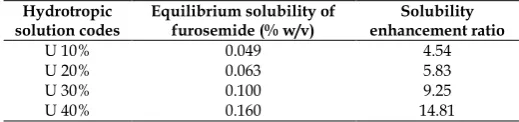
Aqueous solutions of hydrotropic agents (sodium benzoate, urea, sodium citrate, sodium acetate) of known concentrations (10%, 20%, 30%, and 40%) were prepared in distilled water. Sufficient excess amount of furosemide was added to screw capped amber colored glass vials containing fixed volumes (10 ml) of the hydrotropic solutions separately. The vials were shaken mechanically for 12 hours at room temperature in orbital flask shaker (Khera Instruments Pvt. Ltd., Delhi, India). The solutions were allowed to equilibrate for next 24 hours and then centrifuged for 5 minutes at 2000 rpm using a centrifuge (Remi Instruments Limited, Mumbai, India). The supernatants of each vial were filtered through Whatman filter paper # 41. An aliquot of each filtrate was diluted suitably with distilled water and the resulting solutions were analyzed on UV/Visible spectrophotometer (Shimadzu 1700) at 333 nm against respective reagent blank solutions. The solubilities were determined using the regression equations. The solubility of drug in various hydrotropic solutions and the solubility enhancement ratios are presented in Table 1to Table 4.
Solubility enhancement ratio = Solubility in particular hydrotropic solution/ solubility in distilled water
Table 1: Equilibrium solubility data of furosemide and solubility enhancement ratio in sodium benzoate solutions of varying concentrations
Hydrotropic
solution codes Equilibrium solubility of furosemide (% w/v) enhancement ratio Solubility
B 10% 0.256 23.70
B20% 0.591 54.70
B 30% 1.138 105.37
B 40% 2.165 200.46
(Where B = sodium benzoate)
Table 2: Equilibrium solubility data of furosemide and solubility enhancement ratio in urea solutions of varying concentrations
Hydrotropic
solution codes Equilibrium solubility of furosemide (% w/v) enhancement ratio Solubility
U 10% 0.049 4.54
U 20% 0.063 5.83
U 30% 0.100 9.25
U 40% 0.160 14.81
(Where U = Urea)
Table 3: Equilibrium solubility data of furosemide and solubility enhancement ratio in sodium citrate solutions of varying concentrations
Hydrotropic
solution codes Equilibrium solubility of furosemide (% w/v) enhancement ratio Solubility
C 10% 0.015 1.38
C 20% 0.034 3.14
C 30% 0.060 5.55
C 40% 0.128 11.85
(Where C = sodium citrate)
Table 4: Equilibrium solubility data of furosemide and solubility enhancement ratio in sodium acetate solutions of varying concentrations
Hydrotropic
solution codes Equilibrium solubility of furosemide (%w/v) enhancement ratio Solubility
A 10% 0.013 1.20
A 20% 0.024 2.22
A 30% 0.053 4.81
A 40% 0.101 9.35
(Where A = sodium acetate)
Determination of equilibrium solubility of
furosemide in aqueous blends (solutions) of hydrotropic agents
Different aqueous blends (solutions) of hydrotropic agents were made as per the compositions mentioned in Table 6 and Table 7.
For the preparation of the hydrotropic blends, required amounts of hydrotropes were weighed and transferred to the volumetric flask. Distilled water was added and the flask was shaken vigorously to ensure the complete dissolution of hydrotropic agents. Finally, the volume was made up to the mark with distilled water. Then the solutions were filtered using Whatman filter paper # 41 and used for solubilization studies.
Int. J. Pharm. Sci. Drug Res. January-February, 2015, Vol 7, Issue 1 (08-12)
equilibrate for next 24 hours and then centrifuged for 5 minutes using a centrifuge (Remi Instruments Limited, Mumbai, India). The supernatants of each vial were filtered through Whatman filter paper # 41. An aliquot of each filtrate was diluted suitably with distilled water and the resulting solutions were analyzed on UV/ Visible spectrophotometer (Shimadzu 1700) at 333 nm against respective reagent blank solutions. The observations are recorded in Table 5-7.
Table 6: Equilibrium solubility data of furosemide in blends of three hydrotropic agents
Blend codes
Hydrotropes (%w/v) Equilibrium solubility
(%w/v)
Solubility enhanceme nt ratio B U SC SA
BUC 13.3 13.3 13.3 - 3.865 357.87
BUA 13.3 13.3 - 13.3 1.875 173.61
BCA 13.3 - 13.3 13.3 0.412 38.14
UCA - 13.3 13.3 13.3 1.108 102.59
(Where B = sodium benzoate, U = urea, C = sodium citrate, A = sodium acetate)
Table 7: Equilibrium solubility data of furosemide in blends of four hydrotropic agents
Blend codes
Hydrotropes (%w/v) Equilibrium solubility
(% w/v)
Solubility enhanceme nt ratio
B U C A
BUCA1 10 10 10 10 1.847 171.08
BUCA2 20 10 5 5 5.275 488.42
BUCA3 10 20 5 5 3.555 329.16
BUCA4 10 5 20 5 2.047 189.53
BUCA5 10 5 5 20 1.508 139.62
(Where B = sodium benzoate, U = urea, C = sodium citrate, A = sodium acetate)
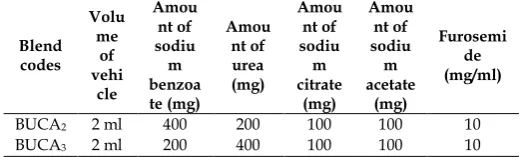
Table 8: Selection of hydrotropic blend for aqueous injection formulation Blend codes Volu me of vehi cle Amou nt of sodiu m benzoa te (mg) Amou nt of urea (mg) Amou nt of sodiu m citrate (mg) Amou nt of sodiu m acetate (mg) Furosemi de (mg/ml)
BUCA2 2 ml 400 200 100 100 10
BUCA3 2 ml 200 400 100 100 10
(Where B represents sodium benzoate, U represents urea, C represents sodium citrate and A represents sodium acetate.)
Selection of hydrotropic blend to formulate the injections
On the basis of the results obtained from solubility
determination studies, blends BUCA2and BUCA3 were
selected. To develop 2 ml of furosemide injection, the amounts of hydrotropic agents that will be
administered through each blend was determined as shown in the Table 8. Though the total concentration of hydrotropic blend was 40% in each case and maximum
solubility was obtained in the blend BUCA2, but
considering an exhaustive literature survey, it was decided to solubilizer furosemide using the
hydrotropic blend BUCA3 for developing its aqueous
injection (10 mg/ml).
Optimized formula
Table 9: Composition of aqueous injection formulation of furosemide
S.
No. Product code Ingredients Prescribed formula Working formula
1.
FBUCA3
Furosemide 20 mg 1 g
2. Sodium benzoate 200 mg 10 g
3. Urea 400 mg 20 g
4. Sodium citrate 100 mg 5 g
5. Sodium acetate 100 mg 5 g
6. Sodium bisulphite 0.1 % 0.1 %
7. Water for injection Total volume 2 ml q.s. 100 ml q.s.
Formulation of injection dosage form
Initially, the appropriately weighed amount of hydrotropic agents (mentioned in Table 9) were transferred to the 100 ml volumetric flask containing 60 ml of the water for injection purged with nitrogen gas. The flask was shaken to dissolve the hydrotropic agents. Finally, the volume was made up to the mark with same water for injection. To prepare the aqueous drug solution the calculated quantity of furosemide was transferred to the 100 ml volumetric flask and 80 ml of the prepared hydrotropic blend was added to it. The flask was sonicated to dissolve the drug. After complete dissolution of the drug, sodium bisulphate 0.1 g was added to preclude the chances of oxidation. The flask was shaken to dissolve the added antioxidant. Other excipients like chelating agents, buffering agents were not included in the formulation since they might upset the basic solubility enhancement ratio. Finally, the volume was made up to the mark with the same hydrotropic blend. Flask was shaken to get the homogenous solution. After the preparation of the solution, it was filtered through membrane filter 0.22µm (Millipore, Sartorius Germany).
Treatment of packaging material
Amber colored glass vials were first washed three times with distilled water. Finally, these were washed with distilled water, already passed through 0.45µm membrane filter. All these vials were dried in an oven and sterilized by dry heating in an oven at 160°C for 2 hours in inverted position. Rubber closures and aluminum seals used for plugging the vials were first washed several times with distilled water and then autoclaved (Khera Instruments Pvt. Ltd., Delhi, India) at 15 lbs pressure (121°C) for 20 minutes and finally dried in oven.
Preparation of aseptic area
The walls and floor of aseptic room were thoroughly washed with filtered tap water followed by 5% phenol
Table 5: Equilibrium solubility data of furosemide in blends of two hydrotropic agents
Blend codes
Hydrotropes (%w/v) Equilibrium solubility
(% w/v)
Solubility enhancement
ratio B U C A
BU 20 20 - - 2.846 263.50
BC 20 - 20 - 2.730 253.61
BA 20 - - 20 2.414 223.50
UC - 20 20 - 0.921 85.27
UA - 20 - 20 0.669 61.94
CA - - 20 20 0.078 7.22
Int. J. Pharm. Sci. Drug Res. January-February, 2015, Vol 7, Issue 1 (08-12)
solution. The laminar airflow bench (Khera Instruments Pvt. Ltd., Delhi, India) was scrubbed with 70% isopropyl alcohol and the HEPA filter and UV light were switched on an hour before the filling of injection into the vials.
Aseptic Filtration
Membrane filter 0.22µm (Millipore, Sartorius Germany) was used for the filtration. The membrane filtration assembly fitted with the membrane filter was sterilized previously in the autoclave (Khera Instruments Pvt. Ltd., Delhi, India) at 121°C and 15 lbs pressure for 20 minutes.
Final flushing with nitrogen gas
The sterile vials were pre- and post- flushed with sterile nitrogen gas, filled with 2 ml volumes of sterile
aqueous solution of furosemide, stoppered
immediately and sealed with sterile aluminum caps.
Stability Studies
Physical stability testing
The sealed vials of the prepared formulation were visually inspected every 15 days for 45 days against black and white backgrounds to see the changes occurring, if any, in physical appearance of aqueous injection like color, clarity, precipitation, etc. These studies were carried out under room temperature in dark (R.T.D.) and other temperatures (at 40°C/75% RH and 55°C).
Freeze Thaw Cycling (FTC)
This method was designed to simulate storage and temperature conditions and to induce any anticipated precipitation and check it in a much shorter time. The vials were kept alternately at 40± 1°C and 4±1°C for 24 hour each, and shaken every day for 5 minutes on a touch type vortex mixer. Two vials of formulation were taken, one of which was kept at 40±1°C and the other at 4±1°C for first day, followed by subsequent temperature cycling and shaking as described. After 7-7 such cycles at 4±1°C and 40±1°C (alternately), the vials were observed to check turbidity and precipitation, if any.
Chemical stability testing
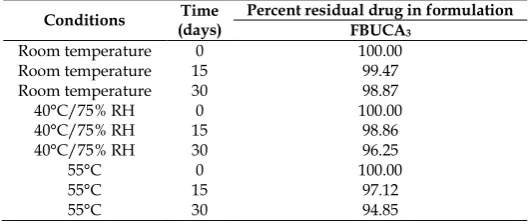
Furosemide formulation was further subjected to chemical stability testing at room temperature, 40°C/75% RH (as per ICH guideline), and at 55°C for a period of one month. The samples were analyzed by the HPLC method initially and at fifteen days intervals up to one month to calculate the residual drug content. The initial drug content for the formulation was taken as 100%.
Dilution profiles of aqueous injection formulation
The effect of dilution with intravenous fluids (normal saline solution and 5% dextrose solution) was studied on the prepared formulation shown in Table 10.
Test dilutions of furosemide aqueous formulation in different vehicles of different concentrations, were prepared in thoroughly cleaned and dried volumetric flasks with normal saline and 5% dextrose solution. Dilutions were made in duplicate at room temperature. The prepared dilutions (1:1 to 1:100) were examined
visually for the presence of visible precipitate or microcrystals using a sample of intravenous fluid for comparison.
Table 10: Precipitation of furosemide in developed formulation after dilution with normal saline and 5% dextrose solution
Diluti on
Time (hour)
Normal saline 5% Dextrose solution 0.5 1 2 3 6 8 24 0.5 1 2 3 6 8 24
1:1 - - - -
1:2 - - - -
1:5 - - - -
1:10 - - - -
1:20 - - - -
1:30 - - - -
1:40 - - - -
1:50 - - - -
1:100 - - - -
Table 11: Physical stability data for furosemide injection FBUCA3
Conditions (days) Time Colour Physical parameters Clarity Precipitation
RTD 0 Colourless solution Clear precipitation No
RTD 15 Colourless solution Clear precipitation No
RTD 30 Colourless solution Clear precipitation No
40°C/75%
RH 0 Colourless solution Clear precipitation No
40°C/75%
RH 15 Colourless solution Clear precipitation No
40°C/75%
RH 30 Colourless solution Clear precipitation No
55°C 0 Colourless solution Clear precipitation No
55°C 15 Colourless solution Clear precipitation No
55°C 30 Colourless solution Clear precipitation No
Table 12: Chemical stability data for furosemide injection FBUCA3
Conditions Time (days)
Percent residual drug in formulation FBUCA3
Room temperature 0 100.00
Room temperature 15 99.47
Room temperature 30 98.87
40°C/75% RH 0 100.00
40°C/75% RH 15 98.86
40°C/75% RH 30 96.25
55°C 0 100.00
55°C 15 97.12
55°C 30 94.85
RESULTS AND DISCUSSION
The solubility determination of furosemide was carried out in distilled water, hydrotropic solutions (40% urea, 40% sodium citrate, 40% sodium acetate, 40% sodium
benzoate) and solutions containing different
concentrations of hydrotropic agents (urea, sodium benzoate, sodium acetate and sodium citrate). The results of solubility studies are presented in Table 1-7. It seems from the results that the aqueous solubility of furosemide was increased more than 488.42 times in hydrotropic blend BUCA2, 329. 16 times in hydrotropic
blend BUCA3 and up to 200.46 fold in 40% sodium
Int. J. Pharm. Sci. Drug Res. January-February, 2015, Vol 7, Issue 1 (08-12)
sodium acetate solution. It is concluded that the solubility of furosemide increases synergistically by mixed hydrotropy. In order to reduce the concentration of sodium benzoate we had used the formulation
BUCA3. To find out the influence of pH on solubility of
furosemide, the solubility of furosemide was determined in the buffer solution of pH 8.0, 8.4 and 9.0. The results indicated that the enhancement in solubility of the drug was not entirely due to pH effect but mostly due to hydrotropic solubilization phenomenon.
The results of physical stability study (Table 11) showed that the prepared formulation was unaffected in respect of color stability. No visual color change or precipitate was revealed in the developed formulation. The results of freeze thaw study showed that there was no precipitation and no turbidity in the developed parenteral formulation at the end of the testing.
The results of chemical stability study (Table 12) showed that there was no appreciable loss of furosemide in the formulation stored for 30 days at different temperatures. So it can be assumed that the formulation will have sufficient chemical stability at room temperature.
In conclusion, the findings of this study suggest that a stable aqueous injection of furosemide has been developed. This study further opens the chance of preparing such injection for many other poorly water soluble drugs, using the concept of mixed-hydrotropy. In this way, the toxicity issues related to the hydrotropic solubilizers used were minimized as the individual concentration of solubilizers in blend was reduced. The proposed techniques would be economic, convenient and safe. Thus, this study opens the chance of preparing aqueous formulations of poorly–water soluble drugs, employing the mixed- hydrotropy technique.
REFERENCES
1. Neuberg C. Hydrotropy. Biochem Z. 1961; 76:107-109.
2. Maheshwari RK. Simultaneous spectrophotometric
estimation of norfloxacin and tinidazole in two component tablet formulations. Asian J Chem. 2006; 18:1481.
3. Maheshwari RK. Novel application of hydrotropic
solubilization in the spectrophotometric analysis of piroxicam in solid dosage form. Indian Drugs 2006; 43: 683.
4. Maheshwari RK. Novel application of hydrotropic
solubilization in the spectrophotometric analysis of tinidazole in dosage form. Asian J Chem. 2006; 18: 640.
5. Maheshwari RK. A novel application of hydrotropic
solubilization in the analysis of bulk samples of ketoprofen and salicylic acid. Asian J Chem. 2006; 18:393.
6. Maheshwari RK. Mixed hydrotropy in spectrophotometric
analysis of aceclofenac. Indian Pharmacist 2007; 6:67-9.
7. Maheshwari RK. Spectrophotometric determination of
cefixime in tablets by hydrotropic solubilization
phenomenon. The Indian Pharmacist 2005; IV: 63.
8. Maheshwari RK. Application of hydrotropic solubilization
phenomenon in spectrophotometric estimation of norfloxacin in tablets. Indian J Pharm Edu Res. 2006; 40: 237.
9. Maheshwari RK. New application of hydrotropic
solubilization in the spectrophotometric estimation of ketoprofen in tablet dosage form. Pharma Rev. 2005; 3: 123.
10. Maheshwari RK. A novel application of hydrotropic
solubilization in the spectrophotometric estimation of frusemide in tablets. Pharma Rev. 2006; 4: 148.
11. Maheshwari RK, Chaturvedi SC, Jain NK. Novel application
of hydrotropic solubilizing additives in the estimation of aspirin in bulk sample and tablets. Int J Pharm Exc. 2005; 4: 84.
12. Maheshwari RK, Chaturvedi SC, Jain NK. Novel
spectrophotometric estimation of some poorly water soluble drugs using hydrotropic solubilizing agents. Indian J Pharm Sci. 2006; 68:195.
13. Maheshwari RK, Chaturvedi SC, Jain NK. Novel application
of hydrotropic solubilization in the quantitative analysis of some NSAIDs and their solid dosage forms. Indian J Pharm Sci. 2007; 69:101.
14. Maheshwari RK, Chaturvedi SC, Jain NK. Application of
hydrotropic solubilization phenomenon in
spectrophotometric analysis of hydrochlorothiazide tablets. Indian Drugs 2005; 42:541.
15. Maheshwari RK, Chaturvedi SC, Jain NK. Application of
hydrotropy in spectrophotometric determination of pharmaceutical dosage forms. Indian Drugs 2005; 42:760.
16. Maheshwari RK. Mixed hydrotropy in spectrophotometric
analysis of poorly water- soluble drug. Indian Pharmacist 2007; 6:66–7.
17. Maheshwari RK, Indurkhya Arpana. Formulation and
evaluation of aceclofenac injection made by mixed hydrotropic solubilization technique. Iran J Pharm Res. 2010 summer; 9(3): 233-242.
18. Maheshwari RK, Prasad S, Pandey P, Wanare G. Novel
Spectrophotometric Analysis of Piroxicam Tablets Using Ibuprofen Sodium as Hydrotropic Solubilizing Agents. International Journal of Pharmaceutical Sciences and Drug Research 2010; 2(3):210-212.