CASE REPORT OPEN ACCESS
Formulation development and evaluation of diclofenac
sodium injection using benzyl alcohol (co-solvent), mixed
solvency concept
Yasir Mehmood
ABSTRACT
Introduction: Mixed solvency is a concept of solubilization of the material. For producing new formulation, especially in the form of injection it is essential to solubilize the active pharmaceutical ingredients (API) in the solvent and that must be stable throughout the shelf life. Aqueous solubility of raw materials is important for injection formulation, but in some cases if the drug is not soluble in water, oil can be used for drug solubility. In this present investigation, mixed-solvency approach has been applied for the enhancement of aqueous solubility of poorly water-soluble drugs, diclofenac sodium (selected as a model drug). Those drugs that poorly soluble in aqueous media are required fractioned oil to enhance its solubility. In most of the cases to make raw materials soluble in water, solubilizing agent in high concentration (co-solvent and surfactant) are use for drug solubility. But due to high concentration of co-solvent and use of oil can make more painful to inject. In the present study, we formulated the diclofenac sodium injection without using high concentrations of propylene glycol as co-solvent which is used in conventional formulation. Benzyl alcohol is used as preservative in conventional formulation and in this formulation benzyl alcohol uses as co-solvent for diclofenac sodium in aqueous medium and due to this, injection is less painful
Yasir Mehmood
Affiliations: Faculty of Pharmacy University of Central Pun-jab, Lahore, Pakistan.
Corresponding Author: Yasir Mehmood, Faculty of Pharma-cy, University of Central Punjab, Lahore, Pakistan; Ph: +92-301-7795575; EMail: [email protected]
Received: 12 June 2015 Accepted: 05 August 2015 Published: 12 December 2015
then propylene glycol based injection. At the end, we studied the stability, toxicity, pyrogenicity and isotonicity of the formulated injection. Conclusion: From the various formulation studied, it was found that benzyl alcohol (6– 7% v/v) is good and save solubilizing agent for preparation of injection dosage form of diclofenac sodium. This mixed solvency shall prove definitely a boon for pharmaceutical industries for the development of dosage form of poorly water soluble drugs.
Keywords: Mixed solvency, Diclofenac Sodium, Benzyl alcohol
How to cite this article
Mehmood Y. Formulation development and evaluation of diclofenac sodium injection using benzyl alcohol (co-solvent), mixed solvency concept. Edorium J Drug Res 2015;1:1–8.
Article ID: 100001D07YM2015
*********
doi:10.5348/D07-2015-1-OA-1
INTRODUCTION
Formulation has numerous benefits in drug discovery and development. It enables efficacy, toxicity, and pharmacokinetic (PK) studies. Formulation can improve oral bioavailability, shorten onset of a therapeutic effect, enhance stability of drugs, and reduce dosing frequency. More consistent dosing can be achieved by reducing food effect through formulation [1]. A drug molecule has to be water soluble to be readily delivered to the cellular
membrane while retaining its hydrophobic properties and water insolubility can postpone or completely derail–important new drug formulation [2]. So, there is a much needed reformulation of currently marketed products and can be significantly affected by these type of issues. Maheshwari R. K. gives the concept of mixed solvency [3]. According to his opinion that all the substances solids, liquids and gases possess solubilizing ability and hence aqueous solutions, containing different dissolved substances can also enhance the solubility of poorly water-soluble drugs [4]. An intramuscular (IM) medication is given by needle into the muscle. It can be a solution, oil, or suspension. Drugs in aqueous solution are rapidly absorbed. However, very slow constant absorption can be obtained if the drug is administered in oil or suspended in other repository vehicles. Solubility may also be enhanced by altering the pH and using co-solvents but excess amount of these agents may have adverse effects. The vehicle should contain a minimum amount and low concentration of the co-solvent to reduce viscosity and toxicity effects. Polyethylene glycol 600, polyethylene glycol 800, and polyethylene glycol 400 used as co-solvent. Mixed solvency is the phenomenon to increase the solubility of poorly soluble drugs, using blends of solubilizing agents [5]. This technique gives the idea that additive or synergistic enhancement effect on solubility of poorly soluble drugs. By using this method in the formulation of different dosage forms made of insoluble drugs soluble and can reduce the concentration of solubilizing agents that are use in the formulation for its solubility in different solvent and minimize the side effects. In most of the conventional formulation of injection of diclofenac sodium propylene glycol is use as solubilizing agent [6]. The concentration of propylene glycol is used 25–30% [7] Urea (M.P. 130–135ºC) dissolves diclofenac sodium (M.P. 283ºC). This shows that melted urea act as solvent for diclofenac sodium. In supercritical fluid technology liquefied carbon dioxide acts as solvent for many insoluble substances [8]. These indicate that all substances possess some solvent character. All weaker solvents can be made strong solvent by proper selection of co-solvent. Mixed hydrotropy is another type of co-solvency [3]. Hydrotropic agents also increase the solubility of poorly water-soluble drugs [9]. Hydrotropy or mixed hydrotropy also used to enhance the aqueous solubility of poorly soluble drugs [10]. The present research is to explore the application of mixed solvency technique in the injection formulation of poorly water-soluble drug [11]. The formulation was also studied for physical and chemical stability. Diclofenac sodium is pain killer and indicated for the treatment of relative humidity rheumatoid arthritis, osteoarthritis, ankylosing spondylitis, tendinitis, bursitis and acute gout. It is also indicated in the relief of mild to moderate pain and the treatment of primary dysmenorrhea [12].
MATERIALS AND METHODS
The gift sample of diclofenac sodium was provided by Ameer pharmaceuticals Pvt. Limited, Lahore, Pakistan. Benzyl alcohol, sodium hydroxide and sodium metabisulphite were purchased from local market. All other chemicals and solvents used were of analytical grade. Other material and instruments include Spectrophotometer (UV-1800, Shimadzu, Japan), FTIR (Agilent 4500 Series Portable FTIR Spectrometer), limulus amebocyte lysate reagent, sterility media, NaOH, glass ampoules, rabbit, pyrogen meter (panomax PX/ PTA-461 china), stability chamber (Darwin Chambers - PH030), HPLC (DYNAMIC UV1) and pH meter (Hanna pH meter model HI 9025C).
Solubility studies
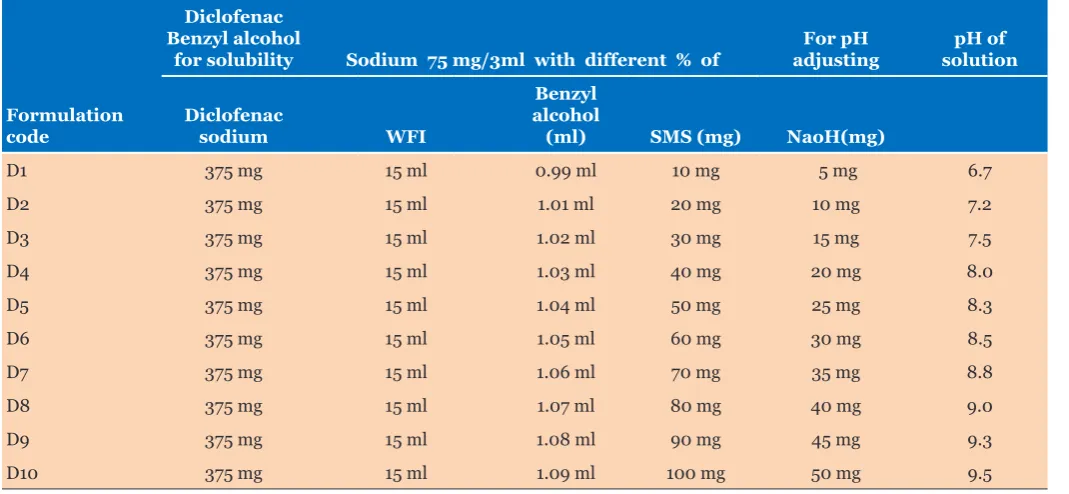
Solubility studies of diclofenac sodium were performed in aqueous with different concentration of benzyl alcohol; solution containing different concentration of solubilizing agent (benzyl alcohol). Various concentration of mixed blends were prepared for solubilization of diclofenac sodium (Table 1). Solubility of diclofenac sodium in water using different concentration of benzyl alcohol was determined by stirrer mixing method. For adjusting the required pH SMS and NaOH were added. Different solution were prepared and observed by naked eye for its solubility. Filter all the good solution with 0.2 micron filter paper and about 3 ml of each solution was taken in a ampoule separately. Ampoules were properly sealed by the machine. They were kept in orbital flask shaker maintained at 25ºC for 12 hr. The solution was then allowed to equilibrate for 24 hr (undisturbed). After this, the ampoules were kept in stability chamber at 40ºC and relative humidity 70% for six weeks. The supernatant was suitably diluted with ethanol and analyzed using UV/Visible spectrophotometer (Shimadzu) at 277 nm against respective reagent blanks.
Procedure for preparation of solution
Add water for injection about 70% of the batch size having 60°C temperature in a glass beaker and kept glass beaker on the magnetic stirrier device. Provide continuous nitrogen purging for about 10 minutes. Processing continues under nitrogen purging. Now add gradually weighed quantity of diclofenac sodium to the WFI and mixing was allowed for several minutes. The solution
was then filtered with 0.45 μ filter paper and made up to
until all the SMS and NaOH was dissolved. The pH was then adjusted near to 8.0. The resultant diclofenac sodium
solutions were sterilized by filtration with 0.22 μm filters
or sterilized by the autoclave 121°C for 15 minutes now fill and sealed it in transparent glass ampoules. The prepared solution was evaluated for various physical and chemical parameters. For each parameter, average values of two samples were considered until all the SMS and NaOH was dissolved (Tables 2, 3).
Evaluation of formulation batches
Physical appearance: Prepared solution of Diclofenac sodium injection was visually observed with naked eye for their physical appearance or its solubility at initially and after 6 weeks of time interval.
pH measurement: The pH of the prepared formulations was measured using pH meter at 25±1ºC.
Particulate matter: The particulate matter in the formulation can be determined by the visual inspection by naked eye under direct light beam.
Assay content for diclofenac sodium
Analysis method for diclofenic sodium injection
Each ampoule (3 ml) contains diclofenac sodium 75 mg.
Sample Preparation: Transfer 2 ml of solution equivalent to 50 mg of diclofenac sodium to a 100 ml volumetric flask. Dilute it to volume with the methanol. Dilute 1 ml of solution to 50 ml with the methanol.
Standard Preparation: Transfer 50 mg of diclofenac sodium to a 100 ml volumetric flask. Dilute it to volume with the methanol. Dilute 1 ml of solution to 50 ml with the methanol. Measure the absorbance of both sample and standard solution at ultraviolet-visible spectrophotometer at 277 nm.
Calculations
Observations
(a) Absorbance of sample solution = A (b) Absorbance of standard solution = B (c) Record the reading.
Calculations
A
B
x 100 = cLimit: 90–110%
RESULTS AND DISCUSSION
Physical appearance
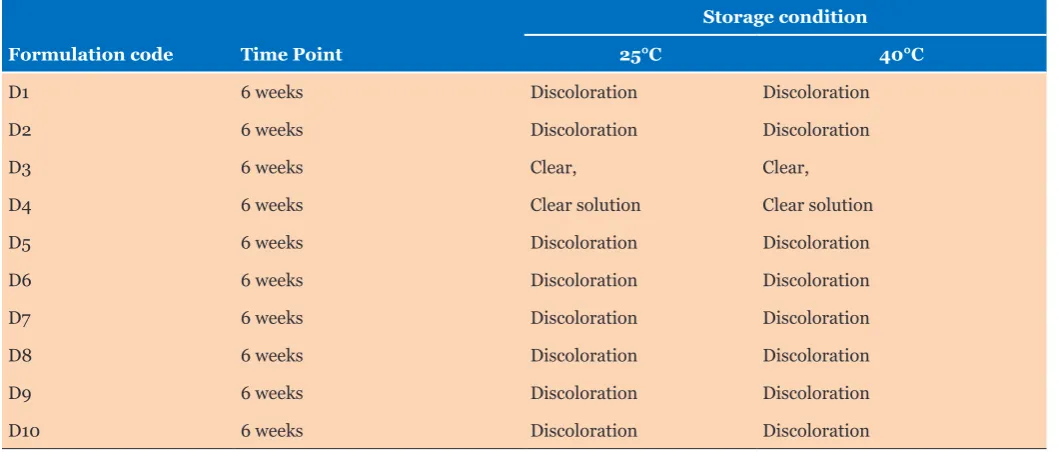
Physical appearance (transparency, color, precipitation, etc.) of prepared formulations or solution was studied. Batch D3 and D4 appeared colorless and
clear initially as well as after six week of interval at 25°C/60% relative humidity and 40°C/75% relative humidity (Table 4).
pH Measurement
The pH of all the formulations was set initially in the range of 7.5–8.1. The pH of the prepared solution initially and after six weeks of interval was measured which are given in Table 5.
Accelerated Stability Studies
When the product is developed, it was subjected to getting a result, because after some time its physical properties, chemical proprieties and even its biological availability may be changed. The prepared formulations were subjected to 2–8 C, 25C, 40C and 55C with 70% relative humidity to observe the stability of medicament in developed formulations Table 6. Samples were withdrawn after 7, 14, 21 and 28 days and analyzed spectrophotometrically at 277 nm after suitable dilution with ethanol to determine content of drug. The initial composition in the formulation was taken as 100% (Tables 7, 8).
Effect of sunlight on drug degradation
One set of colorless vials containing the formulations were exposed to sunlight to estimate the effect of light on the stability of formulations. Other set of colorless vials containing formulation were wrapped with aluminium foil (controlled) and stored in dark. Both sets of vials were stored at room temperature. One vial of each formulation and each set was withdrawn every seventh day up to 28 days, suitably diluted with ethanol and observes at 277 nm under ultraviolet/visible spectrophotometer (Shimadzu) to determine the drug remained. The initial drug content of formulations was taken as 100% for the study (Figure 1, 2).
Effect of atmospheric oxygen on stability To assess the effect of oxygen, the injection (3 ml) was filled in 5 ml and 20 ml vials. The air in 20 ml capacity ampoules was not displaced before sealing, whereas the air present in the 5 ml capacity vials was replaced by flushing with nitrogen and sealed. Samples from both sets of vials were withdrawn periodically at seventh-day intervals and the drug content was estimated
CONCLUSION
Figure 1: FTIR of raw material diclofenac sodium.
Figure 2: Chromatogram of diclofenac sodium injection.
Table 1: Different formulations of diclofenac sodium solution
Formulation code
Diclofenac Benzyl alcohol
for solubility Sodium 75 mg/3ml with different % of adjustingFor pH solutionpH of
Diclofenac
sodium WFI
Benzyl alcohol
(ml) SMS (mg) NaoH(mg)
D1 375 mg 15 ml 0.99 ml 10 mg 5 mg 6.7
D2 375 mg 15 ml 1.01 ml 20 mg 10 mg 7.2
D3 375 mg 15 ml 1.02 ml 30 mg 15 mg 7.5
D4 375 mg 15 ml 1.03 ml 40 mg 20 mg 8.0
D5 375 mg 15 ml 1.04 ml 50 mg 25 mg 8.3
D6 375 mg 15 ml 1.05 ml 60 mg 30 mg 8.5
D7 375 mg 15 ml 1.06 ml 70 mg 35 mg 8.8
D8 375 mg 15 ml 1.07 ml 80 mg 40 mg 9.0
D9 375 mg 15 ml 1.08 ml 90 mg 45 mg 9.3
Table 2 : Formulation of injection
Raw Material Unit Quantity
Diclofenac Sodium mg 75.00
Benzyl Alcohol ml 0.2
Sodium Metabisulphite mg 9.08
Sodium Hydroxide mg 3.80
Water for Injection q.s to make 3 ml
Table 3: Observation for physical appearance
Formulation code Time Point
Storage condition
25°C 40°C
D1 Initial Discoloration Discoloration
D2 Initial Discoloration Discoloration
D3 Initial Clear, Clear,
D4 Initial Clear solution Clear solution
D5 Initial Clear Clear
D6 Initial Discoloration Discoloration
D7 Initial Discoloration Discoloration
D8 Initial Discoloration Discoloration
D9 Initial Discoloration Discoloration
D10 Initial Discoloration Discoloration
Table 4: Observation for physical appearance
Formulation code Time Point
Storage condition
25°C 40°C
D1 6 weeks Discoloration Discoloration
D2 6 weeks Discoloration Discoloration
D3 6 weeks Clear, Clear,
D4 6 weeks Clear solution Clear solution
D5 6 weeks Discoloration Discoloration
D6 6 weeks Discoloration Discoloration
D7 6 weeks Discoloration Discoloration
D8 6 weeks Discoloration Discoloration
D9 6 weeks Discoloration Discoloration
Edorium J Drug Res 2015;1:1–8.
www.edoriumjournalofdrugresearch.com Mehmood
6
Table 5: Results of pH measurement
Formulation code Time Point
Storage condition
25°C 40°C
D1 6 weeks 7.45 7.56
D2 6 weeks 7.56 7.56
D3 6 weeks 7.59 7.86
D4 6 weeks 8.16 8.26
D5 6 weeks 7.56 8.56
D6 6 weeks 7.96 7.50
D7 6 weeks 8.56 7.56
D8 6 weeks 7.06 7.86
D9 6 weeks 8.16 7.86
D10 6 weeks 8.56 8.06
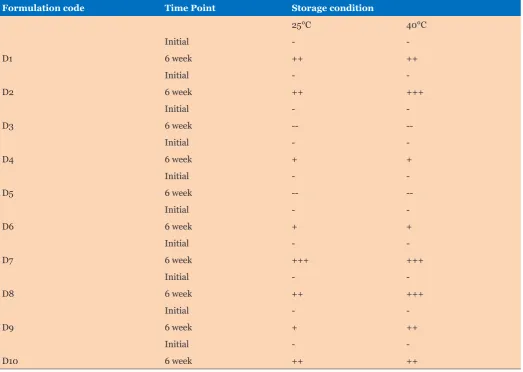
Table 6: Results of particle matter
Formulation code Time Point Storage condition
D1
25°C 40°C
Initial -
-6 week ++ ++
D2
Initial -
-6 week ++ +++
D3
Initial -
-6 week --
--D4
Initial -
-6 week + +
D5
Initial -
-6 week --
--D6
Initial -
-6 week + +
D7
Initial -
-6 week +++ +++
D8
Initial -
-6 week ++ +++
D9
Initial -
-6 week + ++
D10
Initial -
-6 week ++ ++
Key: (-) = Absent (+) = Very few colloidal particulates, fibers or filling artifacts (++) = Evidence of physical instability under light
the concept of mixed-solvency approach. The amount of individual solubilizer required to increase the measurable solubility shall be very high which sometimes shows the toxicity. Therefore, the use of benzyl alcohol which is physiologically compatible often acts synergistically to improve the solubility and reduce the risk of toxicity.
Thus it can be concluded that, with the carefully designed experimental technique, solubility of poorly water-soluble drug can be improved by using the “mixed solvency” approach. The application of the mixed solvency approach in the development of formulations shall prove to be a boon for pharmaceutical industries because the quantity of water soluble solubilizers can be
selected at safe level (well below their toxic levels) for a modest increase in solubility of a water-insoluble drug.
*********
Acknowledgements
I am thankful to Ameer Pharmaceutical Pvt. Ltd (Pakistan) for providing the gift sample of diclofenac sodium. I am also thankful to UCP research Center (Lahore) and A&A Pharma Company (Lahore) for providing me the facilities for research.
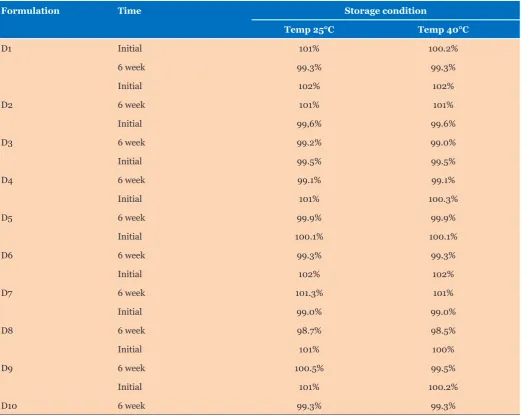
Table 7: Results of assay content of diclofenac sodium
Formulation Time Storage condition
Temp 25°C Temp 40°C
D1 Initial 101% 100.2%
6 week 99.3% 99.3%
D2
Initial 102% 102%
6 week 101% 101%
D3
Initial 99,6% 99.6%
6 week 99.2% 99.0%
D4
Initial 99.5% 99.5%
6 week 99.1% 99.1%
D5
Initial 101% 100.3%
6 week 99.9% 99.9%
D6
Initial 100.1% 100.1%
6 week 99.3% 99.3%
D7
Initial 102% 102%
6 week 101.3% 101%
D8
Initial 99.0% 99.0%
6 week 98.7% 98.5%
D9
Initial 101% 100%
6 week 100.5% 99.5%
D10
Initial 101% 100.2%
6 week 99.3% 99.3%
Table 8: Result of microbiology testing of only successful formulations
Formulation Sterility result Endotoxin limit Pyrogen (BP2013)
D3 No growth 3.45 EU/ML Complies
Author Contributions
Yasir Mehmood – Substantial contributions to conception and design, Acquisition of data, Analysis and interpretation of data, Drafting the article, Revising it critically for important intellectual content, Final approval of the version to be published
Guarantor
The corresponding author is the guarantor of submission.
Conflict of Interest
Authors declare no conflict of interest.
Copyright
© 2015 Yasir Mehmood. This article is distributed under the terms of Creative Commons Attribution License which permits unrestricted use, distribution and reproduction in any medium provided the original author(s) and original publisher are properly credited. Please see the copyright policy on the journal website for more information.
REFERENCES
1. Desai NP. Compositions and methods of delivery of pharmacological agents. US Patent US 9012518 B2. 2013. [Availabel at: https://www.google.com/ patents/US9012518]
2. Torchilin VP. Targeted polymeric micelles for delivery of poorly soluble drugs. Cell Mol Life Sci 2004 Oct;61(19-20):2549–59.
3. Maheshwari RK. Mixed-Solvency - A novel concept for solubilization of poorly water soluble drugs. Delving Journal 2009;50(1):39–43.
4. Maheshwari RK. “Mixed-solvency approach” - Boon for solubilization of poorly water-soluble drugs. Asian Journal of Pharmaceutics 2010;4(1):60–3.
5. Maheshwari R. Shilpkar R. Formulation development and evaluation of injection of poorly soluble drug using mixed solvency concept. International Journal of Pharma and Biosciences 2012;3:179–89.
6. Yalkowsky SH, Rubino JT. Solubilization by cosolvents I: organic solutes in propylene glycol-water mixtures. J Pharm Sci 1985 Apr;74(4):416–21.
7. Strickley RG. Solubilizing excipients in oral and injectable formulations. Pharm Res 2004 Feb;21(2):201–30.
8. Woods HM. Materials processing in supercritical carbon dioxide: surfactants, polymers and biomaterials. Journal of Materials Chemistry 2004;14(11):1663–78.
9. Chen H, Khemtong C, Yang X, Chang X, Gao J. Nanonization strategies for poorly water-soluble drugs. Drug Discov Today 2011 Apr;16(7-8):354–60. 10. Jain P. Solubility enhancement techniques with special
emphasis on hydrotrophy. International Journal of Pharma Proffessional’s Research 2010;1:34–45. 11. Agrawal A, Maheshwari RK. Formulation development
and evaluation of in situ nasal gel of poorly water soluble drug using mixed solvency concept. Asian Journal of Pharmaceutics. 2011;5(3)131–40.
12. Mehmood Y. Combination of Allopurinol’and Sustained Release Diclofenac Sodium for Treatment of Gout. International Journal of Science and Research (IJSR) 2014;3(5).
Access full text article on