IJSRR, 8(2) April. – June., 2019 Page 1736
Research article Available online www.ijsrr.org
ISSN: 2279–0543
International Journal of Scientific Research and Reviews
Energy Efficient Data Gathering Technique for Wireless Sensor
Networks
S. Pasupathy
Associate Professor Department of Computer Science and Engineering, Annamalai University, Annamalainagar, Tamilnadu, India
Email: [email protected]
ABSTRACT
Wireless sensor network have recently emerged as an important computing platform. The primary focus endeavors to conserve energy and to measure the network lifetime in the process of gathering data in a Wireless Sensor Network. The theory passes the role of sensor nodes in acquiring data and routing the sense from the source to the destination. An Energy Efficient Cluster-Chain based Protocol (ECCP) is proposed to maximize the network lifetime and reduce the energy consumption and communication overhead in wireless sensor network. ECCP organizes sensor nodes into clusters and constructs a chain among the sensor nodes within cluster so that each sensor node receives from a previous neighbor and transmits to a next neighbor. Furthermore, ECCP improves the data transmission mechanism from the cluster heads to the base station via constructing a chain among the cluster heads. A simulation result shows that ECCP outperforms in terms of network lifetime, balancing energy consumption among sensor nodes and network throughput.
KEYWORDS: WSN (wireless sensor network), Energy Efficient Cluster-Chain based Protocol (ECCP), Sensors.
*Corresponding author:
Dr. S. Pasupathy
Associate Professor
Department of Computer Science and Engineering, Annamalai University,
IJSRR, 8(2) April. – June., 2019 Page 1737
I INTRODUCTION
A.
Introduction
Wireless networking has seen a thriving development in recent years. Wireless networking refers to technology that enables two or more computers to communicate using standard network protocols, but without network cabling. Wireless networks are generally implemented and administered using radio communication. The exchange of information can be communicated and broadcasted to various different locations.
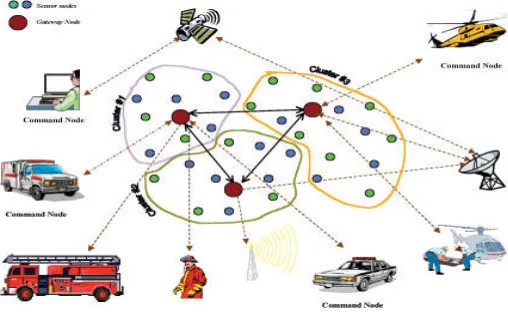
Sensor is a detector or converter which measures the physical quantity and converts it into signal which can be observed by an electronic device. They are used to measure the changes to physical environment like pressure, humidity and changes to the health of person like blood pressure, stress and heartbeat. Wireless sensor network (WSN) refers to a group of spatially dispersed and dedicated sensors for monitoring and recording the physical conditions of the environment and organizing the collected data at a central location as shown in Fig. 1 Sensor network consist of many different type of sensors such as magnetic, thermal, visual, infrared and radar which are able to monitor different types of environmental conditions such as temperature, pressure, humidity, vehicular movement, pollution levels, lighting condition, noise level, power-line voltage, vibration, wind and chemical concentration.
Wireless sensor network is consists of large number of sensor nodes and one or more Base Stations. The nodes in the network are connected via wireless communication channels. Each node has capability to sense data, process the data and send it to rest of the nodes or to Base Station. These networks are limited by the node battery lifetime.
Figure 1. Example of Wireless Sensor Network
IJSRR, 8(2) April. – June., 2019 Page 1738
transmit to base station. The process power source is been used from the power unit that is from a battery.
B.
Importance and significance
Wireless Sensor Network is a collection of sensor nodes deployed in an ad hoc fashion. Being battery powered and deployed in remote areas they have limited energy resource and hence limited lifetime. The other constraints are limited memory, processing power, bandwidth and large latencies. Due to these limitations data aggregation is an important consideration for sensor networks. The idea is to combine the data coming from different sources and route it further after eliminating redundancy. Data gathering can be used for a wide variety of monitoring and research applications like inventory maintenance, healthcare, military, object recognition and tracking, research and study of biological and environmental phenomenon. The performance of the application depends on the ability to extract data from the network. The main constraint of sensor nodes is their low battery energies which limits the network lifetime and has an impact on the quality of the network. Thus, the network lifetime of a wireless sensor network is defined as the time of the first node failure in the network. Therefore, energy efficiency in the design of routing protocols for sensor networks is important. Hence, there is a need for data gathering mechanism which improves the network lifetime by minimizing the communication thus consuming less energy.
Wireless sensor networking is an exciting new technology that allows for true ad-hoc mesh networking of tiny little sensor devices. This technology is made possible by new advances in low-powered computing as well as the miniaturization of popular sensor components. It is a technology that extends the internet beyond the PC to the physical world, allowing computers to sense and monitor physical assets and the world around them. This technology is likely to be a “disruptive technology” by changing the way people work and live. A WSN system incorporates a gateway that provides wireless connectivity back to the wired world and distributed nodes. Some of the available standards include 2.4 GHz radios based on either IEEE 802.15.4 or IEEE 802.11 (Wi-Fi) standards or proprietary radios, which are usually in the large of 900 MHz.
II RELATED WORKS
IJSRR, 8(2) April. – June., 2019 Page 1739
Wendi Rabiner Heinzelman and Anantha Chandrakasan, LEACH-Centralized uses a centralized clustering algorithm. In the setup phase, the base station receives all the information about each node regarding its location and energy status. The base station runs local algorithm for the formation of cluster heads and clusters and broadcasts a message that contains the cluster head ID for each node. The steady state phase of LEACH-C is identical to that of the LEACH protocol.2
W. R. Heinzelman and et al., In LEACH with fixed clusters (LEACH-F) was proposed. LEACH-F is based on clusters that are formed once in the first setup phase by the base station and then fixed. The cluster head position rotates among the sensor nodes within the cluster. LEACH-F uses the same centralized cluster formation algorithm as LEACH-C. The fixed clusters in LEACH-F do not allow new nodes to be added to the system and do not adjust their behavior based on nodes' death.3
S. Lindsey and C. Raghavendra, has presented as PEGASIS is an improvement of the LEACH protocol. The main idea in PEGASIS is to form a chain among sensor nodes so that each node receives from and transmits to a close neighbor. The gathered data move from node to node, get fused and eventually a designated node transmits them to the base station. In PEGASIS, the chain construction is done in a greedy fashion with the assumption that all the nodes have global knowledge of the network. PEGASIS outperforms LEACH by eliminating the overhead of dynamic cluster formation, minimizing the distance non-leader nodes must transmit, limiting the number of transmissions and receiving among all nodes and using only one transmission to the base station per round.4
A. Manjeshwar and D.P. Agrawal, has presented TEEN is a routing protocol for time critical applications to respond to changes in the sensed attributes such as temperature. After the clusters are formed, the cluster head broadcasts two thresholds to the nodes. These are hard and soft thresholds for the sensed attributes. The hard threshold aims at reducing the number of transmissions by allowing the nodes to transmit only when the sensed attribute is in the range of interest. The soft threshold will further reduce the number of transmissions if there is little or no change in the value of sensed attribute. One can adjusts both hard and soft threshold values in order to control the number of packet transmissions. The advantage of this scheme is its suitability for time critical applications and also the fact that it significantly reduces the number of transmission.5
IJSRR, 8(2) April. – June., 2019 Page 1740
the network topology or size. The protocol incurs low overhead in terms of processing cycles and exchanged messages. It also achieves fairly uniform cluster head distribution.6
H.Y. Lee, K.O. Lee, H.L. Lee and A. Kusdaryono, has proposed a Cluster Based Energy Efficient Routing Protocol (CBERP) for wireless sensor networks. CBERP divides sensor nodes to clusters and selects the cluster heads as LEACH-C. However, CBERP advances the cluster head selection mechanism by utilizing a number of candidate nodes to reduce the overhead. After selecting the cluster heads, it forms a chain of the cluster heads and transmits data to the base station through the chain.7
F. Tang, I. You , S. Guo, M. Guo and Y Ma, has proposed a Chain-Cluster based Mixed routing (CCM) algorithm for wireless sensor networks , which divides a wireless sensor network to a few chains and a cluster. CCM algorithm is run in two stages. In the first stage, sensor nodes in each chain transmit data to their own chain head using the chain based routing. In the second phase, all the chain heads form a cluster and send the data, which are fused from their own chains, to a voted cluster head. Finally, the cluster head further fuses data and transmits them to the remote base station.8
III PROPOSED WORK
A.
Existing System
Hierarchical clustering algorithm is Energy efficient clustering protocols. Energy efficient hierarchical clustering algorithm for wireless sensor is providing reducing energy consumption. Operation will occur in LEACH.
LEACH divided into two rounds: -
Set up phase - cluster heads are selected and clusters are organized Steady state phase-data are transmitted to base station
Hierarchical clustering algorithm is bottom up and top down approach, bottom up approach Pairs of clusters are merged as one moves up the hierarchy and Top down approach performed recursively. LEACH protocol is energy efficient but the expected number of clusters is pre-defined. LEACH is that it does not guarantee good cluster head distribution and assumes uniform energy consumption for cluster heads
B.
Proposed System
IJSRR, 8(2) April. – June., 2019 Page 1741
do exist, still an attempt canters to explore the use of a cluster chain based routing pattern and evaluate its performance through simulation.
An Energy Efficient Cluster-Chain based Protocol (ECCP) is proposed to maximize the network lifetime and reduce the energy consumption and communication overhead in wireless sensor network. The operation of the ECCP protocol is organized into rounds. Each round of this protocol consists of the following phases.
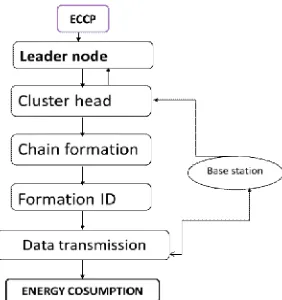
ECCP- Energy Efficient Cluster-Chain based Protocol. The ECCP is nodes to minimize the energy consumption and maximize the network lifetime of wireless sensor networks. In the cluster the all nodes elect a cluster head and data’s are been transmitted from nodes to the cluster head. Base station elects a header node between the cluster head. Chain based data transmission mechanism for sending data packets from the cluster heads to the base station.
Figure 2. Block diagram of ECCP model
C.
Clustering Phase
(a) Cluster Head Election
In ECCP, each node maintains about itself and neighbor’s information in the form of a table. Every node broadcast a message containing the information about the location using GPS receiver and residual energy using non persistent carrier-sense multiple access (CSMA) MAC protocol within the range r as shown in figure 2. Every node can receive the messages from all nodes in range r. Each node computes the distance from all neighbors and updates the neighborhood table.
Every node after receiving the message, each node computes its weight using the Eq.
= ∗ 1
,
RE i = residual energy of node i
Dist2(vi ,vj) = distance between node i to node j
IJSRR, 8(2) April. – June., 2019 Page 1742
CHSVi Weighti
if CHSV > CHSVi of all its neighbour nodes in the range r.node i is been elected as the cluster head
(CH).
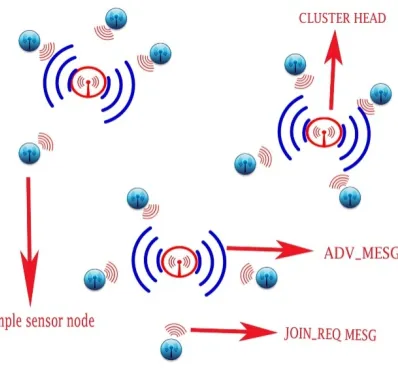
Each node broadcast its weight using the non-persistent CSMA MAC protocol within a radio range r and the node with highest weight among its neighbors is selected as the cluster head.
Figure 3 Cluster Head election
(b)
Formation of Cluster
Figure 4 Cluster Head election
IJSRR, 8(2) April. – June., 2019 Page 1743
each node selects the cluster head to which it is nearer to and then its sends a join-request message (JOIN_REQ MESG) as shown in figure 4. In this join-req message it contains node’s ID and the cluster head’s ID which is sent back to chosen cluster head using CSMA MAC protocol.
D.
Chaining Phase
(a).Chain Formation within Clusters
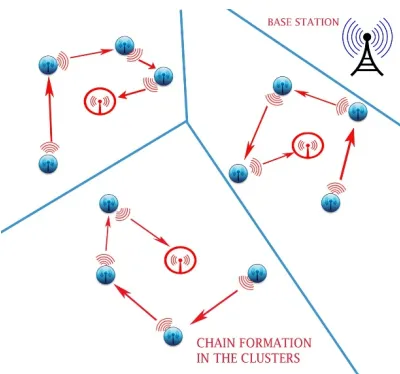
Figure 5. Chain formations among clusters
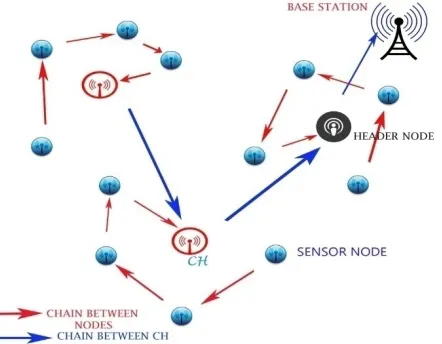
After the formation of the clusters, the path has to design for the data transmission between all nodes to base station. As according to the last phase the highest weight node state changes into cluster head from simple node, shown in the above figure 5. The cluster head creates a chain between the sensor nodes within the cluster. The chain is formed between sensor nodes from last node to nearest node to the cluster head in the each cluster. The cluster head creates the TDMA schedule, which specifies the time slots allocated for each sensor node in cluster. After that, cluster head sends the chain of sensor nodes and TDMA schedule to sensor nodes within its cluster.
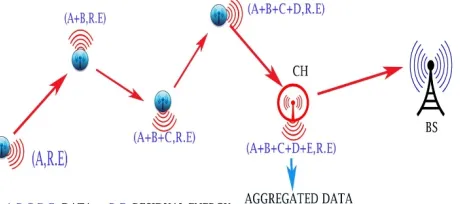
Each sensor node receives data from a previous neighbor, aggregates its data with the one received from the previous neighbor and transmits aggregated data to next neighbor.
(b). Chain Formation among Cluster Heads
As the chain is been formed between all sensor nodes and aggregated data are transmitted to cluster head with the TDMA schedule. In this the stage, all cluster head sends the location information to base station.
With the information of cluster head, the base station creates the chain of all cluster head and then sends to every cluster heads.
Sends the (Location i) to the Base station
IJSRR, 8(2) April. – June., 2019 Page 1744
Base station sets the path between all cluster head for data transmission.
In ECCP, the base station applies the GREEDY algorithm used in PEGASIS to make the chain among the cluster heads. The chain is formed in between all cluster head from the last head to nearest head to Base station. The nearest node is been elected as an HEADER within all cluster head as shown in figure 6. The aggregated data is been transmitted in chain through all cluster head to the header node, which again sends that data to the Base station.
As by transfer of all data to the base station through this chain between the cluster head can reduce the energy consumption.
Figure 6: Chain formation within Cluster heads
E.
Data transmission
Data transmission phase is divided into several frames and sensor nodes transmit and receive the data at the each frame. For gathering data in each frame, sensor nodes in each cluster transmit their data to their own cluster head using the chain based routing. The last node in the chain transmits its data next neighbour in the chain it continuous till the nearest node to the cluster head.
IJSRR, 8(2) April. – June., 2019 Page 1745
Each sensor node receives data from previous neighbour, aggregates with its own data, and transmits to the next neighbour in the chain. The data are transmitted in an alternative way until all data are transmitted to the cluster head node. Once the cluster heads receive data from previous neighbours in the latest frame of a round, data transmission among cluster heads are begun as shown in figure 7.
In this stage, Header node generates a token and then transmits it to the end cluster head node in the chain of cluster heads. Only the cluster head that has the token can transmit data. Each cluster head aggregates its neighbour’s data with its own data and transmits aggregated data and token to the next neighbour in the chain of cluster heads. Finally, the aggregated data are delivered to the base station by the leader node in the chain of cluster heads that has the shortest distance to the base station as shown in figure 8.
Figure 8: Data Transmission in ECCP
(a). Data Transmission in ECCP
If any sensor node dies in cluster, the cluster head sends a message to the base station and informs it that the sensors should hold the clustering phase at the beginning of the upcoming round. After that, the base station sends specific synchronization pulses to all nodes. When each node receives a pulse, it prepares itself to perform clustering phase.
F.
Energy consumption
Energy is been consumed by sensor nodes while transmitting the data between itself and to the cluster heads. And cluster head also drain much energy while transmitting the data with other cluster head and with the header node.
IJSRR, 8(2) April. – June., 2019 Page 1746
sensor nodes within cluster. In order to balance the energy consumption among all sensor nodes in the network, the cluster head’s role should be rotated among the sensor nodes to prevent their exhaustion. ECCP uses the residual energy for cluster’s rotation so that sensor node with highest residual energy in the cluster is selected as cluster head for next round.
In the latest frame of a round; sensor node sends data to the next neighbour; also it
sends its residual energy.
Based on the collected information, the sensor node compares its energy levels with the
energy level of previous neighbour and selects highest energy level and sends the information and aggregated data to the next neighbour.
Once, the data are received by cluster head, the node with highest residual energy is selected as cluster head for next round.
IV PERFORMANCE EVALUATION METRICS
1. Create Simulator Object
Create event scheduler
set ns [new Simulator]
2. Tracing
Insert immediately after scheduler!
Trace packets on all links
set nf [open out.nam w]
$ns trace-all $nf
$ns NAM trace-all $nf
3. Create Network
Two nodes, One link
Nodes
set n0 [$ns node]
set n1 [$ns node]
Links and queuing
$ns duplex-link $n0 $n1 1Mb 10ms RED
$ns duplex-link $n0 $n1 <bandwidth><delay><queue_type>
<queue_type>: Drop Tail, RED, etc.
4. Network Dynamics
IJSRR, 8(2) April. – June., 2019 Page 1747
Hooks in routing module to reflect routing changes
$ns rtmodel-at <time> up|down $n0 $n1
For example:
$ns rtmodel-at 1.0 down $n0 $n1 $ns rtmodel-at 2.0 up $n0 $n1
5. Creating UDP Connection
set udp [new Agent/UDP]
set null [new Agent/Null]
$ns attach-agent $n0 $udp
$ns attach-agent $n1 $null
$ns connect $udp $null
6. Creating Traffic (On Top of UDP)
CBR
set cbr [new Application/Traffic/CBR]
$cbr set packet Size_ 500
$cbr set interval_ 0.005
$cbr attach-agent $udp
FTP
set ftp [new Application/FTP]
$ftp attach-agent $tcp
Telnet
set telnet [new Application/Telnet]
$telnet attach-agent $tcp
V RESULTS AND DISCUSSIONS
IJSRR, 8(2) April. – June., 2019 Page 1748
Figure 9: Every nodes view
Figure 10: Clustering phase
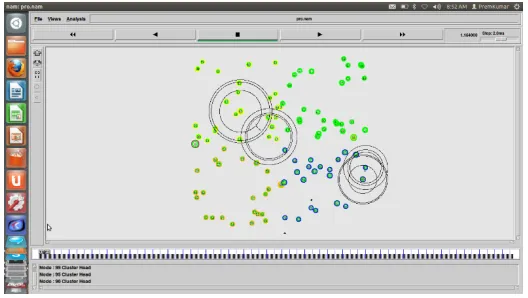
The figures (3.3) and (3.4) explain the manner in which the phases are selected for the next level of the data transfer pattern.
IJSRR, 8(2) April. – June., 2019 Page 1749
Figure 12: Data Transmission
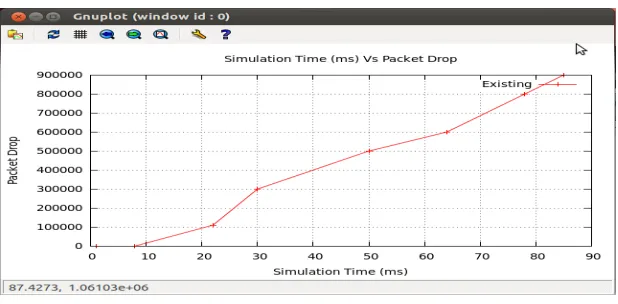
The figure (3.5) and (3.6) gives the performances indices of the network between the sensor nodes.
Figure 13: Network lifetime
Figure 14: Load balancing
IJSRR, 8(2) April. – June., 2019 Page 1750
Figure 15: Energy consumption & Communication overhead
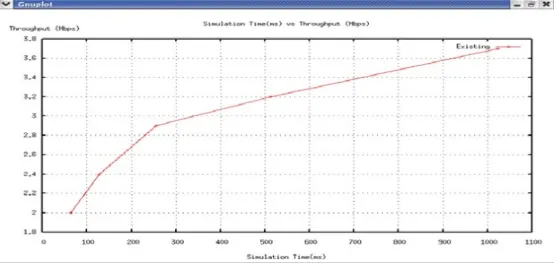
Figure 16: Throughput
VI CONCLUSION
Here, ECCP is been proposed, a novel Energy Efficient Cluster-Chain based Protocol for wireless sensor network that aims at maximizing the network lifetime and balancing the energy consumption among sensor nodes. ECCP organizes sensor nodes into clusters by using multiple metrics and constructs a chain among the sensor nodes within cluster so that each sensor node receives from a previous neighbour and transmits to a next neighbour. ECCP also adopts chain based data transmission mechanism for sending data packets from the cluster heads to the base station. By chaining the nodes in each cluster and using a separate chain for the cluster heads, ECCP offers the advantage of small transmit distances for most of the nodes and thus helps them to be operational for a longer period of time by conserving their limited energy. The simulation results show that ECCP is more efficient in terms of network lifetime, stability period, instability period, balancing energy consumption among sensor nodes, energy consumption and the amount of data received at base station than other protocols.
REFERENCES
IJSRR, 8(2) April. – June., 2019 Page 1751
2. W. Heinzelman, A. Chandrakasan and H. Balakrishnan. An application-specific protocol architecture for wireless microsensor networks. IEEE Transactions on Wireless Communications, 2002; 1(4): 660–670.
3. F. Bajaber and I. Awan. Energy efficient clustering protocol to enhance lifetime of wireless sensor network. Journal of Ambient Intelligence and Humanized Computing, 2010; 1(4): 239-248.
4. S. Lindsey and C. Raghavendra,. PEGASIS: power-efficient gathering in sensor information systems. IEEE Aerospace Conference Proceedings, 2002; 3: 1125–1130.
5. O. Younis and S. Fahmy. HEED: A hybrid, energy-efficient, distributed clustering approach for ad hoc sensor networks. IEEE Transaction Mobile Computing, 2004; 3(4) :366–379. 6. F. Tang, I.You , S. Guo, M. Guo and Y. Ma. A chain-cluster based routing algorithm for
wireless sensor networks. Journal of Intelligent Manufacturing, Published Online, 2010 7. B. Zarei, M. Zeynali and V.Majid Nezhad, Novel Cluster Based Routing Protocol in Wireless
Sensor Networks. IJCSI International Journal of Computer Science Issues, 2010; 7(4.1): 32-36.
8. A. Ezzati, S. Benalla, A. Beni Hssane and M. Lahcen Hasnaoui. Advanced Low Energy Adaptive Clustering Hierarchy. International Journal on Computer Science and Engineering, 2010; 02(07): 2491-2497.
9. G. Rashed, H. Kabir and E. Ullah. WEP: An Energy Efficient Protocol for Cluster based Heterogeneous Wireless Sensor. International Journal of Distributed and Parallel Systems (IJDPS), 2011; 2(2): 54-60.
10.G. Chen, Ch. Li, M. Ye, J. W. An unequal cluster-based routing protocol in wireless sensor networks. Wireless Networks, 2009; 1(2): 193-207.