A new DSATUR-based algorithm for exact vértex coloring
Pablo San Segundo*
Centro de Automática y Robótica (CAR), José Abascal 2, 28006, Madrid, Spain
A R T I C L E I N F O A B S T R A C T
This paper describes a new exact algorithm PASS for the vértex coloring problem based on the well Keywords- known DSATUR algorithm. At each step DSATUR maximizes saturation degree to select a new candidate Color vértex to color, breaking ties by máximum degree w.r.t. uncolored vértices. Later Sewell introduced a Graph new tiebreaking strategy, which evaluated available colors for each vértex explicitly. PASS differs from Exact Sewell in that it restricts its application to a particular set of vértices. Overall performance is improved DSATUR when the new strategy is applied selectively instead of at every step. The paper also reports systematic
experiments over 1500 random graphs and a subset of the DIMACS color benchmark.
1. Introduction
For a given undirected graph G=(V,E) the vértex coloring problem (VCP) requires to assign a color to every vértex so that adjacent vértices are all colored differently and the total number of colors employed is minimized. The origins of the vértex color-ing problem (VCP) can be traced back to a letter written to Sir Willian Hamilton by the renowned mathematician Augustus de Morgan in 1852, where the famous Four Color Theorem has its roots.
VCP is a well known and deeply studied NP-hard problem in graph theory [1], which has attracted the attention of many researchers for its implications in computational theory. More-over, many real world applications in a wide variety of engineer-ing fields have also been found, such as register allocation [2], scheduling [3-5], air traffic [6], etc., which suggest the impor-tance of efficient algorithms in practice.
Let n and m be the cardinalities of the vértex set V and edge set E, respectively. deg(v) is the degree of a given vértex v, i.e. the number of adjacent vértices (alias neighbors). A(G) denotes the degree of the graph, the máximum degree of any of its vértices. A vértex v is said to be dominated by vértex w if the neighbor set of w is a superset of the neighbor set of v.
Subsets of V where all vértices are pairwise non-adjacent are called independent sets. Any k coloring of G partitions V in disjoint k independent sets named color classes. A dique in G is any subgraph with all its vértices pairwise adjacent. cu(G) denotes the máximum dique in G, the clique with the largest possible size. The chromatic number of a graph x(G) is the mínimum number of colors required to color G, i.e. the size of its optimum coloring.
*Tel.: +34 913 363 061; fax: +34 913 363 010. E-mail address: [email protected]
A partid coloring of a graph II(íi), íi<= V, is and admissible assign-ment of colors to vértices in U. Given a partial coloring n , c(II) is the total number of colors used in the partition and c ^ e l l ) denotes the color label assigned to v. p(v) refers to the chromatic degree of a vértex (alias its saturation degree), the number of adjacent vértices which have been assigned different colors.
Compared with other related problems such as the máximum clique or the máximum independent set, VCP is considerably more challenging; for example, it is possible to compute máximum clique exactly in graphs with some hundreds of vértices whereas fast exact coloring of a random graph with 80 vértices and 0.5 edge density already requires efficient algorithms and a powerful CPU. In fact, exact methods for VCP usually suffer from the same problem: it is easy to find a good admissible coloring c{G), but proving that no c(G)-l admissible coloring exists becomes very difficult.
The hardness of exact VCP computation has given rise to many efficient heuristics and metaheuristics for the domain. Initial approaches favored greedy constructive algorithms, which color each vértex exactly once given a heuristic rule to compute the next color label based on the current partial coloring. Fast but usually sensible to some initial criteria (e.g. vértex ordering) the most important examples are the simple greedy sequential (SEQJ and the máximum chromatic degree heuristic DSATUR [7].
Constructive algorithms, which produce color classes sequen-tially have also attracted attention, such as the recursive largest first (RLF [5]) algorithm or MAXIS [9], an improved variant of [8], which is known to perform well over difficult random graphs. Worth mentioning is also the iterated greedy algorithm IG [9], which iterates over suboptimal colorings by reordering a subset of color classes following certain criteria at each step.
Classical metaheuristics applied to VCP start from an initial incorrect color partition and gradually attempt to remove con-flicts at each step. Many evolutionary algorithms are based on
tabú search, simulated annealing or some form of hybridation. In view of the exponential character of exact coloring, real Ufe problems usually resort to these methods.
The first proposed algorithm, TABUCOL [10], employed tabú search. In [11] a simulated annealing algorithm was proposed, which compared different neighborhoods; later the Impasse Class Neighborhood (ICN) described in [12] became for a long time the most effective approach to VCP. Algorithm MIPS-CLR [13] com-bines the Tabú Search technique with the ICN to produce a very effective algorithm. Hybrid algorithms integrating local search and diversification via crossover, as in [14] or [15], showed that diversification was able to improve the performance of local search. Of the more recent algorithms we point out [16], in a similar vein as MIPS-CLR, and MMT [17]. The latter is based on ICN and a crossover operator, which is an adaptation of the Greedy Partitioning Crossover proposed in [15].
The inherent difficulty of VCP makes exact algorithms rather scarce compared with approximate coloring methods. We give a brief overview of the leading algorithms.
Integer programming models for VCP have recently attracted much attention because of the improvement of general purpose ILP solvers. The first known ILP model for VCP is the so called descriptive model (VCP-DES), which for exact k-coloring can be defined as
(I) xik+xjk<\ V(¿j)e£,Vfc
(II) E*/< = 1 Vi xiik6{0,l} O)
k
VCP-DES uses nk Boolean variables, which represent all possible color assignments to vértices. Constraints of type I model that no two adjacent vértices can have the same color and constraints of type II do not allow different color labels in any vértex.
This model has been used in literature, mainly for its simpli-city. Recently, Méndez-Díaz and Zabala [19,20] showed a way to exploit it in a branch and cut scheme by refining VCP-DES with further inequalities to remove symmetries - possibly the most relevant drawback of such models for any ILP solver - and thus obtain a stronger continuous relaxation.
A set cover ILP model (VCP-SC) was first employed successfully using column generation by Mehrotra and Trick [21] in a branch and price algorithm. VCP-SC can be formalized as follows: Minimize Y^Xs 5 s.t.
Y^ x
s>\ Viel/
5 e {s:i e S] xs 6(0,1} (2)where the basic Boolean variables xs represent (maximal) inde-pendent sets. A valué of xs to 1 indicates that the set is given a label (color) in the VCP-SC solution; in case a 0 is assigned to xs that (color) set will not correspond to the mínimum coloring. Constraints establish that all vértices have to be covered by at least one independent set.
Branch and price algorithms, which exploit VCP-SC are cur-rently the best way to attack exact VCP for large structured graphs and a number of improvements have recently appeared, such as [22-24].
Worth mentioning is an additional ILP set packing model for VCP, which has recently been exploited in [25], performing similarly to VCP-SC in the reported tests. To end this overview we refer the reader to [18] for a detailed survey on both approximate and exact methods.
Color heuristics embedded in a complete enumeration scheme lead also to exact algorithms. Of these, branch and bound DSATUR [7], later improved by Sewell [26] is undoubtedly the best known
and has been a standard defacto for many years (see Section 2 for a more detailed analysis of these algorithms).
DSATUR is a simple and efficient algorithm, which has been known to perform surprisingly well over random graphs. Out-performed by recent branch and price algorithms on the more difficult graphs it is still frequently employed both stand-alone or as part of more sophisticated algorithms to quickly compute initial upper bounds or to 'wrap up' on small subproblems (c.f. many of the algorithms described in [12]). This makes research on DSATUR-based solvers, in the opinión of the authors, still very important in practice.
This paper describes a new DSATUR-based algorithm. It is structured from here in 5 parts. Section 2 reviews existing related algorithms. Section 3 describes the new algorithm while Section 4 provides a case study. Section 5 reports experiments and finally Section 6 is the conclusions section.
2. DSATUR review
The general outline of sequential vértex coloring algorithms is to color each vértex in turn until there are no more left. The simplest form is the greedy coloring heuristic known as SEQ. Let V be the set of vértices to be colored and let K = {v-[,.. .,vn) be any strict ordering of V. SEQ(V, K) can then be described as follows: SEQ(\Z,K)
for v : = V\ to vn
assign the smallest possible color to v endfor
Different definitions of K give rise to different heuristics (e.g. [27,28] are examples of a fixed strategy). DSATUR computes K dynamically at each step choosing the vértex with máximum saturation degree w.r.t. the current partial coloring. In case of ties, the vértex with máximum degree over the set of (as yet) uncolored vértices is selected. A further tie is broken lexicographically.
An implicit enumeration of vértices combined with any of the vértex selection rules used in GREEDY produce exact color algorithms. A direct implementation, however, would lead to many spurious subproblems being analyzed. Brown [29] was the first to reduce complexity by enumerating only tight colora-tions in the graph.
Definition. A coloring c(G)of a given graph G is tight given a strict
ordering of its vértices V\,...,vn if
c(vi+-¡) <colors(¡) + l V¡ = 1,.. . , n - l colors(í) = maXjC^j) l < s < ¡ , c(vi) = l
Brélaz [7] used the Brown enumeration to implement exact DSATUR. Throughout the text, terms in capital letters will refer to both the heuristic rule and the exact algorithm. Subscript 'h' will be added when an explicit reference to the rule is required.
DSATUR recursively enumerates all tight partial colorings which, in turn, become new subproblems. For any partial k-coloring at a given step, a vértex is chosen using DSATURh and
assigned either one of the k colors already used, or color fc+1 if none are available. This gives a máximum branching factor of fe+1 (colors) at any point in the search tree.
Leaf nodes are admissible colorings. When a leaf node is reached, the size of the coloring is compared with the current minimal coloring. If the latter is minored, the champion is unseated and the leaf node determines a new upper bound (UB) for the chromatic number. UB is used at any step to prune the search tree when the
size of the current pardal coloring k is greater or equal to UB. This makes DSATUR a branch and bound algorithm.
Applying DSATURh produces an initial partial coloring, which corresponds to a clique. The size of this initial clique is used implicitly as lower bound (LB) during search, determining an end condition when UB=LB. Note that once LB has been fixed it does not change during the whole procedure whereas UB gradually decreases. This is an important disadvantage compared with exact ILP methods, where LB also rises dynamically by solving the continuous relaxation problem.
A number of improvements to the original DSATUR algorithm were suggested by Sewell [26]. Apart from an initial reordering of vértices, Sewell proposed a new tie breaking strategy and reported a reduction in the number of subproblems searched under some restrictions. We will refer to this new tiebreak as the Sewell rule. It can be described informally as follows:
SEWELL RULE
Selectfrom the set of vértices tied at máximum saturation degree the one with the máximum number of common available colors in the neighborhood of uncolored vértices.
Compared with DSATURh, this heuristic rule is more informed
since it explicitly takes into account the structure of the graph together with the number of available colors when branching. Note that DSATURh only estimates future color availability using degree and runs in 0(n2) whereas SEWELLh runs in 0(n3) in the worst case. Apart from the additional overhead, SEWELLh is known to obtain,
on average, worse admissible colorings than DSATURh at the early stages of the search. To overeóme this problem, Sewell further proposed to compute a priori upper and lower bounds, which are also fed into the search algorithm. Reported experiments with a very tight UB seemed to outperform DSATUR in a benchmark of random graphs and a small set of real-world graphs. In spite of this, the SEWELL rule has not met many followers in recent years.
3. A new tiebreaking strategy
This paper proposes a new tiebreaking strategy for DSATUR, which is much less expensive to compute than SEWELL but has a similar pruning effect. It will be referred to as the PASS rule (in reference to the corresponding author's family ñame).
Let G=(V,E) be a given graph to be colored of size n. Let II be the / partial fe-coloring (c(II) = fc,|II =/) obtained by DSATUR at the current step and let íi = {V;+1,ví+2.- • -.iM be the set of
remaining uncolored vértices. For any pair of adjacent vértices in U we define function same : V2 ->naturals; such that
(4) (0 (t/,,t/2)fÉ £(U)
*"ne(v,,t/2)= j \F(v,)nF(v2)\ (v,,v2)eE(U)
where F(v¡) is the set of admissible color labels for vértex v¡. DSATUR initially applies DSATURh to select vértices in U with
máximum saturation degree. Let T e U be the set of such candi-date vértices:
T = maXiiPuiVi)) VteU (5)
SEWELLh will then select a vértex vseT, which minimizes the number of available colors in the set U\{vs} in child subproblems. In practice, this is implemented by maximizing the number of common available colors in the uncolored neighborhood:
/ vsd = max„s e T \ y ^ same(vs,v) veU (6)
The new PASS rule introduces a further variation: it seleets the new candidate from T in a similar manner as Sewell but restriets its application to candidate vértices in T only:
( •• m a x „s e T \ y ^ same(vs,v) v e r
\vj-v
s (7) /Further ties are broken lexicographically in all cases. SEWELLh minimizes the number of subproblems by system-atically reducing available colors in subproblems at deeper levéis of the search tree. By restricting this idea to the set of tied vértices in T, PASS employs a different strategy. It aims at reducing color domains of vértices, which are already known to have the least number of available colors, and so therefore more likely to require a new color in deeper levéis of the search. Note that, at each step, all candidate vértices in T are, by definition, those with máximum saturation degree (and therefore have the least number of free colors). This fact justifies the PASS strategy.
However, consistent application of PASS does not improve the overall performance because in the initial steps of the search there are many vértices in T (w.r.t. to íi) and the desired effect is not obtained. It is much better to selectively apply PASS in steps where the number of available colors of candidate vértices in T is below a certain parameter ¡i, which is computed dynamically. PASS performs better when ¡i is evaluated at each step in the following way:
fj. = c(n)-pn(v eT) fi>0 (8) The first term in (8), c(II), is the number of assigned colors in the current partial coloring. The second term, the saturation degree (related to II) of every candidate vértex, represents the number of colors in c(II) not available for every vértex in T (note that the particular colors can differ for each vértex). Therefore the difference between both terms is a direct measure of color availability. When PASS is applied in steps where candidate vértices have low valúes of ¡i, it is more likely that vértices in T in future subproblems will require a new color. A step where ¡i=Q indicates that every vértex in T requires an extra color fe=c(|II|) + l and so the part of the search tree, which hangs from the current node is very likely to be pruned.
The current implementation of PASS uses DSATURh tiebreak
rule in all steps where ¡i exceeds a given threshold TH fixed at the beginning of the search (typically TH=3; Section 5.1 explains the choice). In steps where ¡i < TH the PASS rule is applied. We note that ¡i is the same for all candidate vértices and so has to be computed just once per step, an important practical advantage of (8). For TH=0, PASS is equivalent to DSATUR. Pseudocode for PASS is given in full.
PASS(l/,;Q.Cmax,rH)
U is the current set of uncolored vértices; II is the current partial coloring; Cmax is the size of minimal coloring; TH is a fixed threshold.
C„ = 0;
/
Initial valúes: G = (V,E); U : = V; TI : = TH: =3
Returns: Cmax:=x{G)
Step 1. Select vértex veU with máximum saturation degree. Let T be the set of tied vértices. If \i=c(II) - p(v e T) < TH break ties using PASSh (7) else break ties using DSATURh (5).
Step 2. if (U=4>) then let Cmax : =c(i7) and return
Step 3. Select c(v) with the lowest possible color used in II. If none are available assign c(v):=c(II) + l
Step 4. if c(v) > Cmax return.
Step 5. PASS(n + (v,c(v)), U-{v}, Cmax, TH)
4. A case study
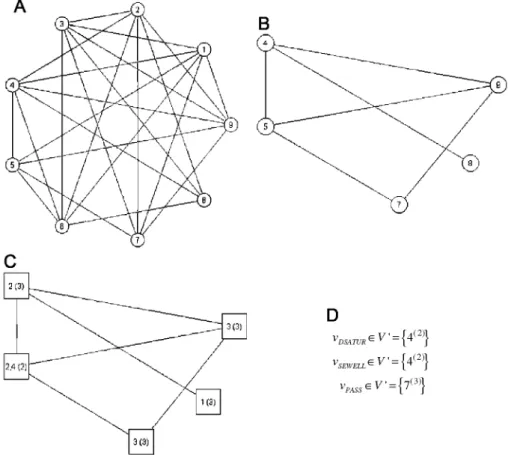
Graph G depicted in Fig. 1(A) has been chosen to compare the performance of DSATUR, SEWELL, and new PASS.
Notation i/p will be used to describe the search trees. It summarizes two facts: (1) vértex v has been assigned color k ((v,k)eTl in the current step) and (2) further tight enumerations with c(v)eF are still possible. Subscripts or superscripts may be missing when unnecessary in the context. F is the set of remain-ing available colors for v (as in (4)) and each color constitutes a branching point in the search. Note that fe^Falways holds.
= { f % \ f £ l „fc») ,Vn-\¥ "Fn } refers to the current path, the vértex ordering reflecting the choices taken by the heuristic at each branching point. Every vértex v¡eP with F¡ # <p is a subproblem at the ¡th level in the tree. For a given P, c(II) = m and | n | = d hold. When d=n a leaf node has been reached and c(II=G) is an admissible coloring for VCP.
The behavior of the three algorithms is compared after the first minimal coloring has been established by DSATUR (i.e. the initial branch of the search tree is assumed the same in all three cases). This allows a cleaner comparison while not losing generality since SEWELL is known to produce, on average, a worse initial coloring than DSATUR as explained in [26].
The first minimal coloring obtained by DSATUR is a 5-coloring (Cmax = 5). While traversing the first branch, DSATUR finds a 3-clique formed by vértices {l9),3?),6?)}. The remaining
unco-lored vértices all tie in saturation degree ( p = 2 ) so vértex 2 is chosen lexicographically to generated the child subproblem and
assigned available color 1. The procedure continúes in a similar way until all vértices are colored (at leaf node I) having traversed
(1) o(2) c( 3 ) 0( 1 ) Q( 4 ) A<2) n-(4)¿y-) cW v 7( 3 )w q p j i Sinre C Q( 5 ) ^ Í 5 ) 'DÍ 5 ) >/Í 5 ) >sí , f , ) ) - 5 1 n l- e L n
p a t h PL - {\í4>y-,í4>yuí4>y¿.í4],um,-,í5]^{5],,{5],^í4>]S
it is possible to remove this color from the corresponding F sets so
(1) , ( 2 ) R(3) , ( 1 ) fi(4) A(2) n-(4) 7( 3 ) Q( 5 )
that PL is simplified to {1 "3\±G/f>2'. {<!>}' {<!>}' {<!>}' W ' { < ! > } ' { < ! > } ' { < ! > } ' { < ! > } ' { < ! > } A}¿) cyt> 7 W n P ) i with only one branching point at vértex 2. All three algorithms backtrack to this vértex, label it with color 4 and update F sets and saturation degrees in the remaining uncolored vértices accord-ingly so that at the new step PL + 1 ={lW,3^)),6f¿,2f¿,8{1),4{2),
5{2.4}.7{3}.9(3}} with remaining uncolored vértices íi={4.5.7.8.9}. Induced subgraph G = G(U,E(U)) is depicted in Fig. 1(B). Saturation degrees for each vértex in U are p(4)=3, p(5)=2, p(7)=3, p(8)=3, p(9)=3 with máximum saturation degree set r={4,7,8,9} (see Fig. 1(C)).
The next step turns out critical for the performance of the different algorithms. To establish a clear comparison we denote by HDSATUR, HSEWELL and HPASs the set of valúes obtained by the
corresponding rules over vértices in T.
DSATUR uses máximum degree in G to break ties. At present AG = degc-(4,5,9) = 3, degc-(7) = 2 and degc-(8) = 1 (see Fig. 1(B))
so HDS/ITUR={3,2,1,3} and the first vértex in T (vértex 4) is chosen
with color assignment c(4) = 2.
In the case of SEWELL and PASS, ties are broken using Eqs. (6) and (7), respectively. SEWELL rule for vértex 4 considers common available colors in adjacent vértices in G, (e.g. HSEWELL(4) = \ since vértex 4 shares just color 2 with neighbor vértex 5), which results in HS£WEU={1,1,0,1} and the same
lexicographical choice as DSATUR.
PASS applies the same criteria as SEWELL, but evaluates only neighbor vértices with máximum chromatic degree (the T set). In particular, vértex 4 shares no available color now (vértex 5 does not belong to T) so HP/iss={0,1,0,l}and this time vértex 7 is
selected with color label 3.
{4(2)}
e V = {4(2)} v. = |7(3)j
Fig. 1. A color example. (A) A simple graph. (B) Induced graph G = G({4,5,7,8,9}) by uncolored vértices after first backtrack (C) Available colors and saturation degree (in brackets) for each vértex in G' (see B). (D) Candidate vértices selected from by DSATUR, SWELL and new PASS. In brackets color assignments for each vértex.
P. San Segundo / Computen & Operations Research • lili III III 5
It is clear that, on average, PASS will be less expensive to compute than SEWELL (| T| < U\), but the key factor is that it has captured structure better. SEWELL selects vértex 4 on the basis of removing color 2 option from vértex 5{2,4} in child subproblems,
but p(5) is not maximal and color 4 will still be available to continué the search. PASS picks vértex 7 to remove color 3 from the singleton F set in 9{3} thus producing a cut in the new
subproblem.
This is confirmed in the next step. In the child subproblem generated by SEWELL a 4 coloring is still possible and all uncolored vértices íi={5{4},7{3},8{1},9{3}} have non-empty F sets,
so it cannot be pruned.
Fig. 1(D) shows the different choices made by all three algorithms at step C. As usual, color assignments appear as superscripts in brackets. The total number of steps needed to complete the search for DSATUR, SEWELL and PASS was 14, 13 and 12, respectively.
5. Experiments
This section reports a number of experiments on random Gnp
graphs and a subset of the DIMACS color benchmark.
Gnp graphs are random graphs generated by including each
possible edge independently with probability p for a given a list of n vértices. The density of such graph is approximately p and has been used extensively to test algorithms for VCP as they are hard known to be difficult to color. For the report we have generated a bench-mark of 1500 random graph instances of varying sizes and densities (RB). Specifically RB includes 50 Gnp graphs for sizes n={60,70,75}
and densities ranging from 0.1 up to 0.9 at 0.1 intervals. 50 instances of G80p with p={0.1,0.2,0.3} complete the collection.
The DIMACS benchmark is currently the standard set for experi-menting algorithms for VCP and other NP-hard problems (c.f. [30]; instances are publicly available at ftp://dimacs.rutgers.edu/pub/chal lenge/graph/). The benchmark set includes a number of artificial graphs (queen, latin_square, Insertion, etc.), random graphs (DSJC, standard G„iP graphs), geometric random graphs (DSJR and r) and
graphs derived from real word problems amongst others (c.f. http:// mat.gsia.cmu.edu/COLOR03/ for a description of each family). The subset used in the report comprises 102 graphs (mainly the subset used in [22]) so as to establish a comparison with leading branch and price algorithm MMT-BP.
Some instances from the DIMACS benchmark can be prepro-cessed in order to reduce their size. This is done by removing vértices while preserving chromatic degree by applying recur-sively the following two rules: 1. Any dominated vértex can be removed from the graph. 2. Any vértex v such that deg(v) < LB (where LB refers to, as usual, a lower bound on %(G)) can be removed from the graph (c.f. [20,25]). Whenever possible, graphs have been preprocessed prior to the start of the search. We note that this simplification attempt is useless on the random RB benchmark.
Section 5.1 analyses the basic properties of PASSh w.r.t.
DSATURh and SEWELLh while Section 5.2 compares PASS with
existing algorithms in literature. 5.1. Analysis of the new heuristic rule
The new algorithm employs PASSh rule for tie breaks when
parameter ¡i is below a certain threshold TH and DSATUR rule otherwise. Important issues are how to determine empirically TH, the ratio of steps where PASSh is applied (w.r.t. DSATURh) and
how well it captures structure (w.r.t. SEWELLh).
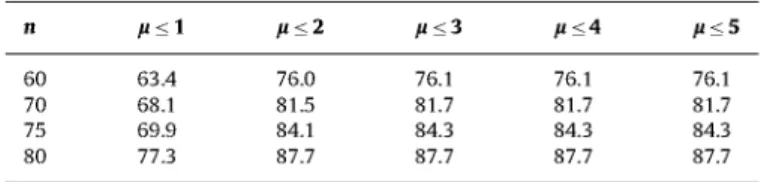
Table 1 reports the percentage of steps where PASSh was fired
instead of DSATURh when running PASS over our benchmark set
Table 1
Percentage of steps where PASSh was fired for varying thresholds of parameter m using the RB benchmark. Table entries are averaged for each row accordingly (500 graphs for n¼60, 70 and 7 5 ; 150 for n¼80).
n 60 70 75 80 / ! < 1 63.4 68.1 69.9 77.3 / i < 2 76.0 81.5 84.1 87.7 / i < 3 76.1 81.7 84.3 87.7 / i < 4 76.1 81.7 84.3 87.7 / i < 5 76.1 81.7 84.3 87.7 Table 2
Number of steps taken by PASS and SEWELL using a subset of the RB benchmark. Each entry is averaged over 50 instances.
n p 70 70 70 70 70 70 70 70 70 0.1 0.2 0.3 0.4 0.5 0.6 0.7 0.8 0.9 PASS 110 992 126,827 925,802 2,861,863 4,345,015 7,421,229 1,439,024 57,024 SEWELL 200 2056 134,562 1,090,343 3,513,657 4,610,283 7,128,713 1,795,241 113,820 n p 75 75 75 75 75 75 75 75 75 0.1 0.2 0.3 0.4 0.5 0.6 0.7 0.8 0.9 PASS 433 7370 136,937 4,058,103 20,408,727 41,117,085 44,881,962 10,621,766 1,261,113 SEWELL 501 9223 208,925 4,134,748 19,473,294 30,571,612 32,458,948 10,420,784 1,386,572
RB using thresholds TH for parameter m ranging from 1 to 5. Values of TH greater than three have almost no effect in PASS and have an additional overhead so TH has been fixed to 3 in the rest of experiments.
Intuitively, TH captures color availability in maximum satu-rated vertices. Table 1 shows that the sizes of available color sets during search in RB graphs are no greater than 3, and that the percentage of steps where mrT H , for a fixed TH, varies more or less linearly with size.
Table 2 presents results about informedness of PASSh w.r.t. SEWELLh. PASS is only significantly less informed for the harder problems of size 75 (notably p¼0.6, 0.7) but is even more informed than SEWELL in the simpler ones. Since the overhead introduced by SEWELL is linear w.r.t. PASS, this validates the new heuristic.
5.2. Comparison with existing algorithms in literature
In this section we compare results obtained by PASS with leading ILP and DSATUR-based algorithms.
In general, exact ILP algorithms for VCP should be able to reduce the gap between LB and UB better than any DSATUR variant since they are able to produce tighter LBs by solving the continuous relaxation problem at each step of the branching scheme. In DSATUR-based algorithms, the lower bound computed at the beginning of the search or determined by the initial clique stays fixed in the remainder of the search.
In practice, however, reducing the LB–UB gap is important specifically if it helps to prove optimality. When it is not possible to conclude optimality within a certain time limit, LBs have an undeniable theoretical interest but do not help to produce admissible colorings (they might help to construct maximal cliques). For this reason the comparison between PASS and ILP-based algorithms has been ILP-based on either achieving optimality or tighter UBs; reported data on improving LBs, as in [20] or [24] has not been considered in this report.
Our main reference algorithm is MMT-BP [22], a leading column generation algorithm enhanced by an efficient metaheur-istic procedure MMT described in [17]. MMT-BP uses MMT during initialization to improve the performance of the branching Please cite this article as: San Segundo P. A new DSATUR-based algorithm for exact vertex coloring. Computers and Operations Research (2011), doi:10.1016/j.cor.2011.10.008
P. San Segundo / Computers & Operations Research ] (]]]]) ]]]–]]]
scheme both by obtaining an initial feasible solution (an UB) as well as a starting pool of columns for the VCP-SC set cover model described in (2). We note that DSATUR is one of the algorithms used in MMT.
Results for the branch and cut approach employed in BC-Col by Me´ ndez-Dı´az and Zabala [19], are also reported. During initializa-tion, BC-Col computes a maximal clique (LB) with a greedy algorithm and then runs DSATUR for 5 s to obtain an initial UB.
As reference DSATUR [7] we have selected the Michael Trick implementation available at http://mat.gsia.cmu.edu/COLOR/sol vers/trick.c, which is commonly used for comparison purposes. We have also implemented an efficient SEWELL variant based on PASS. All three algorithms (DSATUR, SEWELL and PASS) have the same initialization stage: an exact leading maximum clique algorithm BB-MCP described in [31] is run for 5 s to obtain an initial LB (although in the majority of cases it finds an optimal clique in the first second). Vertices in this initial clique are then placed first and the remaining vertices are ordered by non-increasing degree prior to the start of the search.
Tests for the DSATUR variants were run on an I7-CPU [email protected] GHz with 6 GB of RAM (Windows O.S., Visual Studio– O2). To allow an approximate (but meaningful) comparison on
time results reported elsewhere, benchmark program dfmax is publicly available at URL ftp://dimacs.rutgers.edu/pub/dsj/clique/ dfmax.c. Computing times obtained on different machines are calibrated w.r.t. the performance obtained on this program over a benchmark set of random instances. We are aware of the limita-tions of this (typical) procedure, but there is simply no other option when it is not possible to run all implementations in the same machine.
User times for dfmax in our machine were 0.031, 0.234, 1.419 and 5.336 s for r200.5, r300.5, r400.5 and r500.5, respectively.
Neither MMT-BP nor BC-Col was publicly available. Color expert Enrico Malaguti complied with tests for MMT-BP over our random benchmark set RB. The machine he used was a [email protected] GHz with 2 GB RAM (Windows O. S.). Reported machine user times were 2.0 and 7.0 s for r400.5 and r500.5, respectively, and less than a second for r300.5 and r200.5. The averaged user time ratio for r400.5 and r500.5 between both machines is 1.332 in favor of our computer.
The original tests for BC-Col where run on a Sun ULTRA workstation @ 140 MHz with 288 MB of RAM, which took 24 s to compute r500.5, as reported in [22]. No other comparison results are available and the authors did not supply further information on our request. Based on r500.5, the user time ratio is 4.497 in favor of our computer. In [22] a similar comparison was established; we note, in both cases, the approximate nature of the ratio.
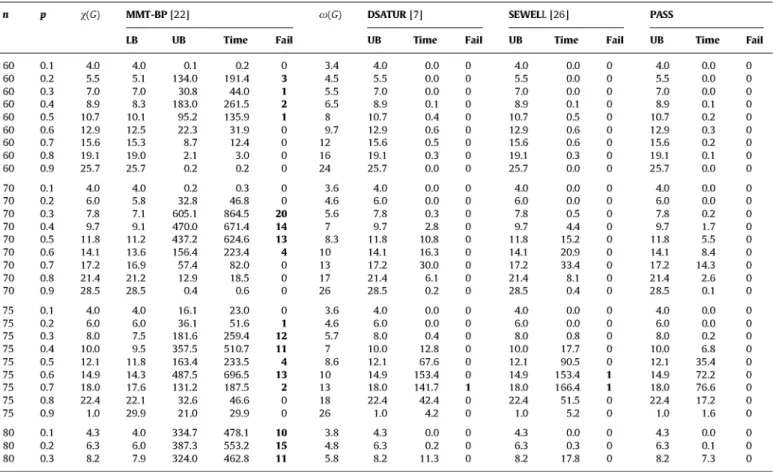
Table 3 reports tests over our random benchmark RB for the Gn,p graph family. MMT-BP was run with a time limit of 1800 s; in
the other three algorithms the limit was fixed at 1200 s (the calibrated time limit 1800/1.332¼1351 s has been rounded in favor of MMT-BP). Times for MMT-BP shown in Table 3 (and reported by Malaguti specifically for this research) have been calibrated using the 1.332 ratio.
For each row entry in the table, 50 graphs were computed and results averaged (including entries for columns w(G),o(G)). Col-umn Fail is the number of graphs where optimality was not proved inside the time limit. Maximum clique column o(G) is the LB of all DSATUR variants (as found by BB-MCP) and has been
Table 3
Performance over random benchmark RB. Times are averaged over 50 instances for each row and measured in seconds. Column Fail is the number of cases when the algorithm was unable to determine an optimum coloring. Time limit was fixed at 1800 s for MMT-BP and 1200 s for the rest to account for the different machines.
n 60 60 60 60 60 60 60 60 60 70 70 70 70 70 70 70 70 70 75 75 75 75 75 75 75 75 75 80 80 80 P 0.1 0.2 0.3 0.4 0.5 0.6 0.7 0.8 0.9 0.1 0.2 0.3 0.4 0.5 0.6 0.7 0.8 0.9 0.1 0.2 0.3 0.4 0.5 0.6 0.7 0.8 0.9 0.1 0.2 0.3 X(G) 4.0 5.5 7.0 8.9 10.7 12.9 15.6 19.1 25.7 4.0 6.0 7.8 9.7 11.8 14.1 17.2 21.4 28.5 4.0 6.0 8.0 10.0 12.1 14.9 18.0 22.4 1.0 4.3 6.3 8.2 MMT-BP [22] LB 4.0 5.1 7.0 8.3 10.1 12.5 15.3 19.0 25.7 4.0 5.8 7.1 9.1 11.2 13.6 16.9 21.2 28.5 4.0 6.0 7.5 9.5 11.8 14.3 17.6 22.1 29.9 4.0 6.0 7.9 P l e a s e c i t e t h i s a r t i c l e a s : UB 0.1 134.0 30.8 183.0 95.2 22.3 8.7 2.1 0.2 0.2 32.8 605.1 470.0 437.2 156.4 57.4 12.9 0.4 16.1 36.1 181.6 357.5 163.4 487.5 131.2 32.6 21.0 334.7 387.3 324.0 Time 0.2 191.4 44.0 261.5 135.9 31.9 12.4 3.0 0.2 0.3 46.8 864.5 671.4 624.6 223.4 82.0 18.5 0.6 23.0 51.6 259.4 510.7 233.5 696.5 187.5 46.6 29.9 478.1 553.2 462.8 S a n S e g u n d o P . A Fail 0 3 1 2 1 0 0 0 0 0 0 20 14 13 4 0 0 0 0 1 12 11 4 13 2 0 0 10 15 11 n e w R e s e a r c h ( 2 0 1 1 ) , d o i :1 0 . 1 0 1 6 / j . c o r . 2 0 1 1 . 1 0 . 0 0 8 CÜ(G) 3.4 4.5 5.5 6.5 8 9.7 12 16 24 3.6 4.6 5.6 7 8.3 10 13 17 26 3.6 4.6 5.7 7 8.6 10 13 18 26 3.8 4.8 5.8 DSATUR UB 4.0 5.5 7.0 8.9 10.7 12.9 15.6 19.1 25.7 4.0 6.0 7.8 9.7 11.8 14.1 17.2 21.4 28.5 4.0 6.0 8.0 10.0 12.1 14.9 18.0 22.4 1.0 4.3 6.3 8.2 [7] Time 0.0 0.0 0.0 0.1 0.4 0.6 0.5 0.3 0.0 0.0 0.0 0.3 2.8 10.8 16.3 30.0 6.1 0.2 0.0 0.0 0.4 12.8 67.6 153.4 141.7 42.4 4.2 0.0 0.2 11.3 DSATUR-based algorithm Fail 0 0 0 0 0 0 0 0 0 0 0 0 0 0 0 0 0 0 0 0 0 0 0 0 1 0 0 0 0 0 SEWELL UB 4.0 5.5 7.0 8.9 10.7 12.9 15.6 19.1 25.7 4.0 6.0 7.8 9.7 11.8 14.1 17.2 21.4 28.5 4.0 6.0 8.0 10.0 12.1 14.9 18.0 22.4 1.0 4.3 6.3 8.2
for exact vértex
[26] Time 0.0 0.0 0.0 0.1 0.5 0.6 0.6 0.3 0.0 0.0 0.0 0.5 4.4 15.2 20.9 33.4 8.1 0.4 0.0 0.0 0.8 17.7 90.5 153.4 166.4 51.5 5.2 0.0 0.3 17.8 Fail 0 0 0 0 0 0 0 0 0 0 0 0 0 0 0 0 0 0 0 0 0 0 0 1 1 0 0 0 0 0 PASS UB 4.0 5.5 7.0 8.9 10.7 12.9 15.6 19.1 25.7 4.0 6.0 7.8 9.7 11.8 14.1 17.2 21.4 28.5 4.0 6.0 8.0 10.0 12.1 14.9 18.0 22.4 1.0 4.3 6.3 8.2 Time 0.0 0.0 0.0 0.1 0.2 0.3 0.2 0.1 0.0 0.0 0.0 0.2 1.7 5.5 8.4 14.3 2.6 0.1 0.0 0.0 0.2 6.8 35.4 72.2 76.6 17.2 1.6 0.0 0.1 7.3 Fail 0 0 0 0 0 0 0 0 0 0 0 0 0 0 0 0 0 0 0 0 0 0 0 0 0 0 0 0 0 0 c o l o r i n g . C o m p u t e r s a n d O p e r a t i o n s 6
P. San Segundo / Computers & Operations Research l lili l l l - l l l 7
Table 4
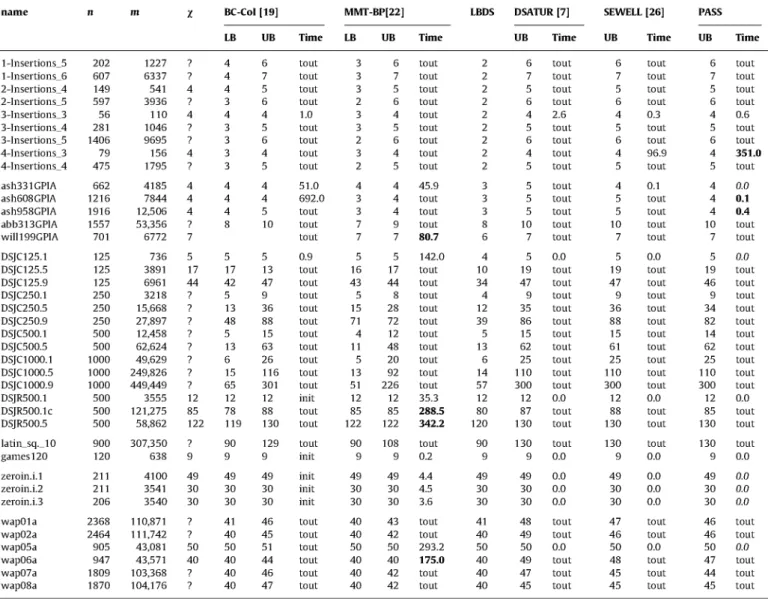
Comparison between PASS and other exact algorithms over a subset of the DIMACS color benchmark. Bold face time entries for MMT-BP and PASS indícate that an optimum coloring was found by one of them but not the other. Cursive time entries indícate that optimality was proved at least 5 times faster w.r.t. each other. Reported times for BC-Col and MMT-BP are taken directly from the indicated sources and have not been calibrated. We estímate the 4.49 and 1.33 ratios in favor of our computer for BC-Col and MMT-BP, respectively. User times are measured in seconds.
ñ a m e n tn / BC-Col [19] MMT-BP[22] LBDS DSATUR [7] SEWELL [26] PASS
LB UB Time LB UB Time UB Time UB Time UB Time queen8_8 queen8_12 queen9_9 queenl0_10 queenl1_11 queenl2_12 queenl3_13 queenl4_14 queenl5_15 queenl6_16 qg.order30 qg.order40 qg.order60 myciel6 myciel7 miles250 miles500 miles750 miles1000 milesl500 anna huck jean david fpsol2.i.l fpsol2.i.2 fpsol2.i.3 inithx.i.l inithx.i.2 inithx.i.3 mug88_l mug88_25 mugl00_l mugl00_25 mulsol.i.l mulsol.i.2 mulsol.i.3 mulsol.i.4 mulsol.i.5 schooll schooll_nsh le450_5c le450_5d le450_15a le450_15b le450_15c le450_15d le450_25a le450_25b 1-Fulllns_4 1-Fulllns_5 2-FullIns_3 2-FullIns_4 2-FullIns_5 3-FullIns_3 3-FullIns_4 3-FullIns_5 4-FullIns_3 4-FullIns_4 4-FullIns_5 5-FullIns_3 5-FullIns_4 l-Insertions_4 64 96 81 100 121 144 169 196 225 256 900 1600 3600 95 191 128 128 128 128 128 138 74 80 87 496 451 425 864 645 621 88 88 100 100 197 188 184 185 186 385 352 450 450 450 450 450 450 450 450 93 282 52 212 852 80 405 2030 114 690 4146 154 1085 67 728 1368 2112 2940 3960 5192 6656 8372 10,360 12,640 26,100 62,400 212,400 755 2360 387 1170 2113 3216 5198 493 301 254 406 11,654 8691 8688 18,707 13,979 13,969 146 146 166 166 3925 3885 3916 3946 3973 19,095 14,612 9803 9757 8168 8169 16,680 16,750 8260 8263 593 3247 201 1621 12,201 346 3524 33,571 541 6650 77,305 792 11,395 232 9 12 10 11 11 12 13 14 15 16 30 40 60 7 8 8 20 31 42 73 11 11 10 11 65 30 30 54 31 31 4 4 4 4 49 31 31 31 31 14 14 5 5 15 15 15 15 25 25 5 6 5 6 7 6 7 8 7 8 ? 8 ? 5 9 12 9 10 11 12 13 14 15 16 30 40 60 5 5 8 20 31 42 73 11 11 10 11 65 30 30 54 31 31 3 3 3 3 49 31 31 31 31 14 14 5 5 15 15 15 15 25 25 5 4 5 5 5 6 6 6 7 7 6 8 8 5 9 12 11 12 14 15 16 17 18 20 30 42 63 7 8 8 20 31 42 73 11 11 10 11 65 30 30 54 31 31 4 4 4 4 49 31 31 31 31 14 14 5 10 17 17 24 23 25 25 5 6 5 6 7 6 7 8 7 8 9 8 9 5 3.0 init tout tout tout tout tout tout tout tout init tout tout tout tout init init init 0.2 0.1 init init init init 0.6 1.2 1.1 init init init 11.0 184.0 60.0 60.0 init init init init init init init init tout tout tout tout tout init init 0.1 tout 0.1 tout tout 0.1 tout tout 3.0 tout tout 2.0 tout 2.0 9 12 10 11 11 12 13 14 15 16 30 40 60 4 5 8 20 31 42 73 11 11 10 11 65 30 30 54 31 31 4 4 4 4 49 31 31 31 31 14 14 5 5 15 15 15 15 25 25 4 4 5 5 5 6 6 5 7 7 6 8 8 3 9 12 10 11 11 13 14 15 16 17 30 40 60 7 8 8 20 31 42 73 11 11 10 11 65 30 30 54 31 31 4 4 4 4 49 31 31 31 31 14 14 5 5 15 15 15 15 25 25 5 6 5 6 7 6 7 8 7 8 9 8 9 5 3.6 0.2 36.6 686.9 1865.7 tout tout tout tout tout 0.2 2.9 3.8 tout tout 5.0 3.7 0.2 0.2 0.1 3.6 0.2 0.2 0.2 10.6 11.2 10.0 21.0 9.2 9.9 9.6 10.6 14.4 12.0 0.2 4.7 0.2 0.2 6.0 0.4 17.0 0.1 0.2 0.4 0.2 3.1 3.8 0.1 0.1 tout tout 2.9 tout tout 2.9 tout tout 3.4 tout tout 4.6 tout tout 8 12 9 10 11 12 13 14 15 16 30 40 60 2 2 8 20 31 42 73 11 11 10 11 65 30 30 54 31 31 3 3 3 3 49 31 31 31 31 14 14 5 5 15 15 15 15 25 25 3 3 4 4 4 5 5 5 6 6 6 7 7 2 9 12 10 12 13 14 15 17 18 19 30 41 63 7 8 8 20 31 42 73 11 11 10 11 65 30 30 54 31 31 4 4 4 4 49 31 31 31 31 14 14 5 5 17 16 24 23 25 25 5 6 5 6 7 6 7 8 7 8 9 8 9 5 8.3 0.0 tout tout tout tout tout tout tout tout 0.6 tout tout tout tout 0.0 0.0 0.0 0.0 0.0 0.0 0.0 0.0 0.0 0.0 0.0 0.0 0.0 0.0 0.0 77.1 295.0 786.0 978.0 0.0 0.0 0.0 0.0 0.0 0.0 0.6 0.0 1060.0 tout tout tout tout 0.0 0.0 tout tout 84.6 tout tout tout tout tout tout tout tout tout tout tout 9 12 10 12 13 14 16 17 18 19 30 40 60 7 8 8 20 31 42 73 11 11 10 11 65 30 30 54 31 31 4 4 4 4 49 31 31 31 31 14 14 5 11 18 16 22 23 25 25 5 6 5 6 7 6 7 8 7 8 9 8 9 5 3.4 0.0 tout tout tout tout tout tout tout tout 0.1 0.5 66.1 tout tout 0.0 0.0 0.0 0.0 0.0 0.0 0.0 0.0 0.0 0.0 0.0 0.0 0.0 0.0 0.0 120.0 215.0 tout tout 0.0 0.0 0.0 0.0 0.0 0.1 0.5 73.6 tout tout tout tout tout 0.0 0.0 tout tout 79.0 tout tout tout tout tout tout tout tout tout tout tout 9 12 10 12 13 14 15 16 18 19 30 40 61 7 8 8 20 31 42 73 11 11 10 11 65 30 30 54 31 31 4 4 4 4 49 31 31 31 31 14 14 5 5 16 16 22 23 25 25 5 6 5 6 7 6 7 8 7 8 9 8 9 5 3.0 0.0 466.0 tout tout tout tout tout tout tout 0.0 0.2 tout tout tout 0.0 0.0 0.0 0.0 0.0 0.0 0.0 0.0 0.0 0.0 0.0 0.0 0.0 0.0 0.0 324.0 191.0 tout tout 0.0 0.0 0.0 0.0 0.0 0.1 0.4 0.0 98.1 tout tout tout tout 0.0 0.0 0.2 tout 0.0 tout tout tout tout tout tout tout tout tout tout 240.0
Please cite this article a s : San Segundo P. A n e w DSATUR-based algorithm for exact vertex coloring. C o m p u t e r s a n d Operations Research (2011), doi:10.1016/j.cor.2011.10.008
P. San Segundo / Computers & Operations Research ] (]]]]) ]]]–]]] Table 4 (continued) ñ a m e l-Insertions_5 l-Insertions_6 2-Insertions_4 2-Insertions_5 3-Insertions_3 3-Insertions_4 3-Insertions_5 4-Insertions_3 4-Insertions_4 ash331GPIA ash608GPIA ash958GPIA abb313GPIA WÜ1199GPIA DSJC125.1 DSJC125.5 DSJC125.9 DSJC250.1 DSJC250.5 DSJC250.9 DSJC500.1 DSJC500.5 DSJC1000.1 DSJC1000.5 DSJC1000.9 DSJR500.1 DSJR500.1c DSJR500.5 latin_sq._10 gamesl20 zeroin.i.l zeroin.i.2 zeroin.i.3 wapOla wap02a wap05a wap06a wap07a wap08a n m 202 607 149 597 56 281 1406 79 475 662 1216 1916 1557 701 125 125 125 250 250 250 500 500 1000 1000 1000 500 500 500 900 120 211 211 206 2368 2464 905 947 1809 1870 1227 6337 541 3936 110 1046 9695 156 1795 4185 7844 12,506 53,356 6772 736 3891 6961 3218 15,668 27,897 12,458 62,624 49,629 249,826 449,449 3555 121,275 58,862 307,350 638 4100 3541 3540 110,871 111,742 43,081 43,571 103,368 104,176 X ? ? 4 ? 4 ? ? 4 ? 4 4 4 ? 7 5 17 44 ? ? ? ? ? ? ? ? 12 85 122 ? 9 49 30 30 ? ? 50 40 ? ? BC-Co LB 4 4 4 3 4 3 3 3 3 4 4 4 8 5 17 42 5 13 48 5 13 6 15 65 12 78 119 90 9 49 30 30 41 40 50 40 40 40 [19] UB 6 7 5 6 4 5 6 4 5 4 4 5 10 5 13 47 9 36 88 15 63 26 116 301 12 88 130 129 9 49 30 30 46 45 51 44 46 47 Time tout tout tout tout 1.0 tout tout tout tout 51.0 692.0 tout tout tout 0.9 tout tout tout tout tout tout tout tout tout tout init tout tout tout init init init init tout tout tout tout tout tout MMT-BP[22] LB 3 3 3 2 3 3 2 3 2 4 3 3 7 7 5 16 43 5 15 71 4 11 5 13 51 12 85 122 90 9 49 30 30 40 40 50 40 40 40 UB 6 7 5 6 4 5 6 4 5 4 4 4 9 7 5 17 44 8 28 72 12 48 20 92 226 12 85 122 108 9 49 30 30 43 42 50 40 42 42 Time tout tout tout tout tout tout tout tout tout 45.9 tout tout tout 80.7 142.0 tout tout tout tout tout tout tout tout tout tout 35.3 288.5 342.2 tout 0.2 4.4 4.5 3.6 tout tout 293.2 175.0 tout tout LBDS 2 2 2 2 2 2 2 2 2 3 3 3 8 6 4 10 34 4 12 39 5 13 6 14 57 12 80 120 90 9 49 30 30 41 40 50 40 40 40 DSATUR [7] UB 6 7 5 6 4 5 6 4 5 5 5 5 10 7 5 19 47 9 35 86 15 62 25 110 300 12 87 130 130 9 49 30 30 48 49 50 49 47 45 Time tout tout tout tout 2.6 tout tout tout tout tout tout tout tout tout 0.0 tout tout tout tout tout tout tout tout tout tout 0.0 tout tout tout 0.0 0.0 0.0 0.0 tout tout 0.0 tout tout tout SEWELL [26] UB Time 6 7 5 6 4 5 6 4 5 4 5 5 10 7 5 19 47 9 36 88 15 61 25 110 300 12 88 130 130 9 49 30 30 47 46 50 48 45 45 tout tout tout tout 0.3 tout tout 96.9 tout 0.1 tout tout tout tout 0.0 tout tout tout tout tout tout tout tout tout tout 0.0 tout tout tout 0.0 0.0 0.0 0.0 tout tout 0.0 tout tout tout PASS UB 6 7 5 6 4 5 6 4 5 4 4 4 10 7 5 19 46 9 34 82 14 62 25 110 300 12 85 130 130 9 49 30 30 46 46 50 47 44 45 Time tout tout tout tout 0.6 tout tout 351.0 tout 0.0 0.1 0.4 tout tout 0.0 tout tout tout tout tout tout tout tout tout tout 0.0 tout tout tout 0.0 0.0 0.0 0.0 tout tout 0.0 tout tout tout
placed immediately to the left of them for clarity. Time entries average user times in seconds.
In this scenario, PASS clearly outperforms the other algo-rithms, proving optimality faster in the majority of cases (and never performing worse). The ratio of improvement in time w.r.t. DSATUR and SEWELL rises in moderately difficult instances to nearly triple (e.g. (60,0.7) or (70, 0.8)) and decreases with the more difficult ones to around double (e.g. (75, 0.5)). This can be explained by the fact that there are fewer vertices tied at maximum saturation degree in the former case so PASSh is more
effective. On the easier less dense instances, we report similar performances in all three algorithms up to a tenth of a second. Out of the 1500 instances in RB, SEWELL failed in two (rows (75, 0.6), (75, 0.7)) and DSATUR in one ((75, 0.6)). PASS was the only algorithm to finish the full set inside the limit.
Interestingly, leading branch and price MMT-BP was totally outperformed in RB, even by the older DSATUR variants, which points at a structural weakness of the set cover VCP-SC model (2). Specifically, it performed worse on the a priori easier less dense graphs (e.g. (70, 0.3), (80, 0.1–0.3)). This fact has not been mentioned explicitly in existing literature to our knowledge, probably because a systematic test on random graphs has been somewhat lacking in recent branch and price reports, (i.e.[18,23,24]) and constitutes, in the opinion of the author, an additional contribution of this research.
Further evidence of a possible structural weakness was con-firmed by tests carried out by VCP expert Stefano Gualandi (complying to our request) over a subset of RB fed to the branch and price algorithm described in [23]. Reported times did not essentially improve MMT-BP, so they have not been included in the report. Of interest is the fact that in the original column generation algorithm LPCOLOR [21], the same trend appeared but in a smaller scale. The reduced computing power at the time could only handle a small subset of random graphs.
Column generation techniques applied to VCP require to solve, at each step, a maximum weighted stable set slave problem (MWSS), which is NP-hard in the general case (c.f. [21] or [18] for a detailed explanation) so effective procedures to solve MWSS become critical in overall performance. As density decreases, the slave problem at each step of the branching scheme is also harder. This would explain why MMT-BP fails to compute optimality for instances of size 80 in 36 cases out of 150, whereas DSATUR based algorithms solve the whole subset without difficulty.
Table 4 reports comparisons between the four previous algo-rithms and branch-and-cut BC-Col. Most column headers have the same interpretation as in Table 3. LBDS entries (column 10) refer
to the lower bound obtained during the initial stage of all three DSATUR variants which, in the majority of cases, is a maximum clique. To emphasize the comparison between PASS and MMT-BP, bold face time entries for both algorithms indicate that an Please cite this article as: San Segundo P. A new DSATUR-based algorithm for exact vertex coloring. Computers and Operations Research (2011), doi:10.1016/j.cor.2011.10.008
P. San Segundo / Computen & Operations Research • lili III III 9 o p t i m u m w a s found by o n e a n d n o t t h e o t h e r . Cursive t i m e
e n t r i e s indicate t h a t optimality w a s p r o v e d a t least five t i m e s faster w.r.t. e a c h o t h e r .
Time limits for BC-Col a n d MMT-BP w e r e fixed a t 7 2 0 0 a n d 2 4 0 0 s e c o n d s respectively, s o 1 5 0 0 s w a s c h o s e n a s t i m e limit for all DSATUR variants t o a c c o u n t for t h e difference in m a c h i n e t i m e s . W e n o t e t h a t t i m e limits b a s e d o n available dfmax d a t a s h o u l d b e a p p r o x i m a t e l y 1 6 0 0 a n d 1 8 0 0 s, respectively, s o again t h e r o u n d i n g in t h e t e s t s is in favor of t h e p r e v i o u s existing a l g o r i t h m s .
BC-Col a n d MMT-BP e n t r i e s i n t h e t a b l e w e r e t a k e n directly from t h e original sources ([19,22] respectively) a n d h a v e n o t b e e n calibrated in Table 4. This s e e m e d preferable t o correcting t i m e s b a s e d o n t h e available w e a k evidence, a n d w a s t h e s a m e policy a d o p t e d in [ 2 2 ] w.r.t. BC-Col u s e r t i m e s . The difference in m a c h i n e s is, h o w e v e r , explicitly m e n t i o n e d w h e n n e e d e d in t h e c o m p a r a t i v e analysis.
W i t h t h e exception of qg.order60, r a n d o m g r a p h DJSC500.5, school1 a n d t h e mug family, PASS is clearly superior t o t h e o t h e r t w o DSATUR variants, finding faster a n d / o r b e t t e r UBs in m a n y cases. This validates t h e n e w tie-breaking s t r a t e g y for large s t r u c t u r e d DIMACS g r a p h s .
Also PASS h a s i m p r o v e d performance of DSATUR-based algo-r i t h m s w.algo-r.t. BC-Col c o m p a algo-r e d t o algo-r e p o algo-r t e d algo-results in [ 2 2 ]: t h e r e a r e m a n y i n s t a n c e s w h e r e t h e UB found by PASS is tighter (e.g. 5 cases in t h e queen family, 4 i n t h e le450, ash958GPIA, 8 in t h e DSJC r a n d o m family, etc.). BC-Col, o n t h e o t h e r h a n d , finds b e t t e r b o u n d s in 5 cases.
Column g e n e r a t i o n b a s e d MMT-BP o u t p e r f o r m s PASS in large DIMACS g r a p h s . There a r e 1 4 cases w h e r e MMT-BP finds a n o p t i m u m coloring w h e r e a s PASS c a n n o t p r o v e optimality. M o r e -over i n t h e queen, le450, DSJC a n d w a p families MMT-BP also c a p t u r e s s t r u c t u r e b e t t e r a n d t e n d s t o find b e t t e r b o u n d s .
On t h e o t h e r h a n d , c o m p a r i n g w i t h t h e r e p o r t e d results in [ 2 2 ] t h e difference b e t w e e n UBs is n o w tighter o n average. Further-m o r e , PASS finds a n o p t i Further-m u Further-m coloring i n 6 cases w h e r e MMT-BP e x c e e d s t h e t i m e limit. W e also n o t e t h a t w h e n PASS is a b l e t o p r o v e optimality, it is usually faster t h a n MMT-BP, since t h e latter is m u c h m o r e c o m p l e x a n d r e q u i r e s h a r d i n s t a n c e s for c o l u m n g e n e r a t i o n o v e r h e a d t o pay off. Specifically, it t a k e s PASS m o r e t h a n 5 t i m e s less t h a n its c o u n t e r p a r t ( m a c h i n e differences a c c o u n t e d for) t o c o m p u t e c h r o m a t i c d e g r e e i n m o r e t h a n 3 0 cases. In t h e opinion of t h e a u t h o r , t h i s m a k e s it a very useful tool in practice (notice t h a t DSATUR is also u s e d b o t h i n BC-Col a n d MMT-BP d u r i n g initialization, s o PASS could b e u s e d t o i m p r o v e t h i s stage in b o t h cases).
6 . C o n c l u s i o n s
This p a p e r describes a n e w exact coloring a l g o r i t h m (PASS) b a s e d o n t h e well k n o w n DSATUR a l g o r i t h m of Bre´laz a n d a later i m p r o v e m e n t p r o p o s e d by Sewell. PASS i n t r o d u c e s a n e w t i e b -reaking strategy, w h i c h c a n b e c o m p u t e d m u c h faster t h a n Sewell b e c a u s e it is restricted t o a s u b s e t of vertices. Reported results s h o w t h a t it is n o less informed o n a v e r a g e a n d i m p r o v e s overall performance w h e n selectively applied i n s t e p s w h e r e t h e n u m b e r of available colors for m a x i m a l s a t u r a t e d vertices is b e l o w a given t h r e s h o l d .
Today DSATUR-based a l g o r i t h m s a r e still very m u c h e m p l o y e d in practice b e c a u s e of their simplicity a n d efficiency. In m a n y cases t h e y a r e also applied a t s o m e s t a g e in m e t a h e u r i s t i c s or in t h e m o r e c o m p l e x exact a l g o r i t h m s . Moreover, r e p o r t e d results reveal t h a t PASS clearly o u t p e r f o r m s a leading c o l u m n g e n e r a t i o n a l g o r i t h m in a b e n c h m a r k of 1 5 0 0 r a n d o m g r a p h s . In t h e opinion of t h e a u t h o r s t h e a b o v e r e a s o n s m a k e PASS a very useful tool for exact VCP in real-life applications.
A c k n o w l e d g m e n t s
This work is funded by the Spanish Ministry of Science and Technology (ARABOT: DPI 2010-21247-C02-01) and supervised by CACSA whose kindness w e gratefully acknowledge. We also w a n t to thank Enrico Malaguti and Stefano Gualandi for running t w o leading branch and price solvers on our random benchmark RB.
R e f e r e n c e s
[1] Garey. M, Johnson D. Computers and intractability: a guide to the theory of NP completeness. San Francisco, California: Freeman; 1979.
[2] Chow Fred C, John L. Hennessy. The priority-based coloring approach to register allocation. ACM Trans. Program. Lang. Syst. 1990;12(4):501–36. [3] Zufferey N, Amstutz P, Giaccari. P. Graph coloring approaches for a satellite
range scheduling problem. Journal of Scheduling 2008;11(4):263–77. [4] Gamache M, Hertz A, Ouellet. JO. A graph coloring model for a feasibility
problem in monthly crew scheduling with preferential bidding. Computers & Operations Research 2007;34(8):2384–95.
[5] Leighton. FT, Graph A. Coloring algorithm for large scheduling problems. Journal of Research of the National Bureau of Standards 1979;84(6):489–506. [6] Barnier N, Brisset Graph P. Coloring for air traffic flow management. In: Proceedings of the CPAIOR’02 fourth international workshop on integration of AI and OR techniques in constraint programming for combinatorial optimisation problems. Le Croisic, France; 2002. p. 133–47.
[7] Bre´laz D. New methods to color the vertices of a graph. Communications of the ACM 1979;22(4):251–6.
[8] Bolloba´s B., Thomason A. Random graphs of small order. Random graphs ’83. Annals of discrete mathematics, vol. 28, Section 6. North-Holland Publishing Co.; 1985. p. 47–97.
[9] Culberson J. Iterated greedy graph coloring and the difficulty landscape. Technical Report 92-07. Department of Computing Science, The University of Alberta, Edmonton, Alberta, Canada; 1992.
[10] Hertz A, de Werra D. Using tabu search techniques for graph coloring. Computing 1987;39(4):345–51.
[11] Johnson DD, Aragon CR, McGeoch LA, Schevon C. Optimization by simulated annealing: an experimental evaluation; part II, graph coloring and number partitioning. Operations Research 1991;39:378–406.
[12] Morgenstern CA. Distributed coloration neighborhood search. In: Johnson DS, Trick MA, editors. Cliques, coloring, and satisfiability: 2nd DIMACS. Imple-mentation Challenge, 1993. DIMACS series in discrete mathematics and theoretical computer science. American Mathematical Society; 1996. p. 335–58.
[13] Funabiki N, Higashino T. A minimal-state processing search algorithm for graph coloring problems. IEICE Transactions on Fundamentals 2000;E83-A:1420–30.
[14] Fleurent C, Ferland J. Object-oriented implementation of heuristics search methods for graph coloring, maximum clique, and satisfiability. DIMACS series in discrete mathematics and theoretical computer science. American Mathematical Society, vol. 2 6 ; 1996. p. 619–52.
[15] Galinier P, Hao JK. Hybrid evolutionary algorithms for graph coloring. Journal of Combinatorial Optimization 1999;3:379–97.
[16] Blo¨ chliger I, Zufferey. N. A reactive tabu search using partial solutions for the graph coloring problem. Computers & Operations Research 2008;35:960–75. [17] Malaguti E, Monaci M, Toth. P, Metaheuristic A. Approach for the vertex
coloring problem. Informs Journal of Computing 2008;20(2):302–16. [18] Malaguti E, Toth. P. A survey on vertex coloring problems. International
Transactions in Operational Research 2010;17(1):1–34.
[19] Mendez-Diaz I, Zabala. P. A branch-and-cut algorithm for graph coloring. Discrete Applied Mathematics 2006;154(5):826–47.
[20] Me´ndez-Dı´az I, Zabala P, Cutting Plane A. Algorithm for graph coloring. Discrete Applied Mathematics 2008;156:159–79.
[21] Mehrotra A, Trick. MA. A column generation approach for graph coloring. INFORMS Journal on Computing 1996;8(4):344–54.
[22] Malaguti E, Monaci M, Toth P. An exact approach for the Vertex Coloring Problem. Discrete Optimization 2011;8(2):174–90.
[23] Gualandi S, Malucelli F. Exact solution of graph coloring problems via constraint programming and column generation. Technical report. Optimiza-tion Online; 2010.
[24] Held S, Sewell EC, Cook W. Safe lower bounds for graph coloring. Accepted for IPCO; 2011.
[25] Hansen P, Labbe´ M, Schindl. D. Set covering and packing formulations of graph coloring: algorithms and first polyhedral results. Discrete Optimization 2009;6:135–47.
[26] Sewell E. An improved algorithm for exact graph coloring. In: Trick MA, Johnson DS, editors. Cliques, coloring, and satisfiability. Proceedings of the second DIMACS implementation challenge, vol. 26. American Mathematical Society; 1996. p. 359–73.
[27] Matula. DW, Marble. G, Issacson. JD. Graph coloring algorithms. In: Read RC, editor. Graph theory and computing. New York: Academic Press; 1972.
Please cite this article a s : San Segundo P. A n e w DSATUR-based algorithm for exact vertex coloring. C o m p u t e r s a n d Operations Research (2011), doi:10.1016/j.cor.2011.10.008
10 P.San Segundo/Computers &
[28] Welsh DJA, Powell. MB. An upper bound for the chromatic number of a graph and its application to timetabling problems. The Computer Journal 1967;10(1):85–6.
[29] Brown JR. Chromatic scheduling and the chromatic number problem. Management Science 1972;19(4):456–63 Application Series, Part 1. [30] Johnson DS, Trick MA., editors. Cliques, coloring, and satisfiability: 2nd
DIMACS implementation challenge, 1993. DIMACS series in discrete
Operations Research ] (]]]]) ]]]–]]]
mathematics and theoretical computer science. American Mathematical Society; 1996.
[31] San Segundo P, Rodriguez-Losada D, Jimenez A. An exact bit-parallel algo-rithm for the maximum clique problem. Computers & Operations Research 2011;38(2):571–81.
Please c i t e t h i s article a s : San S e g u n d o P. A n e w DSATUR-based a l g o r i t h m for e x a c t v e r t e x coloring. C o m p u t e r s a n d O p e r a t i o n s Research ( 2 0 1 1 ) , doi:10.1016/j.cor.2011.10.008