4148 FORMULATION AND EVALUATION OF DOMPERIDONE SUSTAINED RELEASE PELLETS USING DIFFERENT POLYMERS AND DIFFERENT
TECHNIQUES
Gampa Vijaya Kumar*1, V. V. Basava Rao2
1Professor and Head, Dept. of Pharmacy, KGR Institute of Technology and Management, Rampally, Keesara, Rangareddy, Telangana, India
2Dean, Department of Pharmacy, Osmania University, Hyderabad, Telangana India.
*Corresponding author E-mail:[email protected]
ARTICLE INFO ABSTRACT
Key Words
Pellets, Extrusion– Spheronization,
Domperidone, Sodium Lauryl Sulfate.
Gastroesophageal reflux is very common in youth. If conservative procedures fail to relieve it, the use of a potent antiemetic agent that facilitates gastric motility and emptying, such as Domperidone, is vindicated. Domperidone is a synthetic benzimidazole compound that acts as a dopamine D2 receptor antagonist. Its localization outside the blood-brain barrier and antiemetic properties has made it a useful adjunct in therapy for Parkinson’s disease. There has been rehabilitated curiosity in antidopaminergic prokinetic agents since the abandonment of cisapride, a 5-HT4 agonist, from the market. Domperidone is also as a prokinetic negotiator for treatment of upper gastrointestinal motility disorders. It continues to be an attractive alternative to metoclopramide because it has fewer neurological side effects. Patients receiving Domperidone or other prokinetic agents for diabetic gastropathy or gastroparesis should also be managing diet, lifestyle, and other medications to optimize gastric motility. The aim of the investigation is to improve the dissolution behavior of Domperidone, a dopamine antagonist. Extrusion– spheronization technique, a possible approach for ensuring maximum dissolution and uniform pellet size almost spherical so as to achieve the smooth gastric transit of drug have been estimated. Pellets were prepared utilizing Extrusion–spheronization technique and all the process parameters such as excipient ratio, stirring speed, temperature, and effect of aggregating agent on the pellets formulation have been optimized. The addition of an aggregating agent (isopropyl alcohol) improved the uniform pellets formation and the method was reproducible. Formulated pellets showed clear and highly improved in vitro dissolution behavior, probably due to Critical micelles concentration of surfactant (Sodium Lauryl Sulfate). The pellets drug was stable at room temperature, 25°C/60% RH, 30°C/65% RH and 40°C/75% RH as per ICH guidelines, after 3 months.
INTRODUCTION:
Matrix systems: Matrix system is formulated in such manner as to make the contained drug available over an extended period following administration. A typical
controlled release system is designed to provide constant or nearly constant drug levels in plasma with reduced fluctuations via slow release over an extended period of
An Elsevier Indexed Journal ISSN-2230-7346
4149
time. In practical terms, an oral controlled release should allow a reduction in dosing frequency as compared to when the same drug is presented as a conventional dosage form.
Pellets: Pellets or microencapsulated crystals filled in capsules or compressed into fast disintegrating tablets are multiple unit dosage forms, which offer several advantages over single unit dosage forms, such as independence of gastric emptying rate, increase in bioavailability, reduction in side effects, and possibility of combining incompatible drugs in a single unit Pellets offer a high degree of flexibility in the design and development of oral dosage forms. They can be divided into desired dose strengths without formulation or process changes and also can be blended to deliver incompatible bioactive agents simultaneously and/or to provide different release profiles at the same or different sites in the gastrointestinal tract. In addition, pellets, taken orally, disperse freely in the GI tract, maximize drug absorption, minimize local irritation of the mucosa by certain irritant drugs, and reduce inter and intra patient variability.
Pellets are spherical agglomerated powders and can be prepared by various processes thus mechanism of pellets formations and not alike. Pelletization techniques widely used in pharmaceutical industries are direct pelletization, extrusion spheronization, and layering. Direct pelletization technique using fluidized bed equipment has many advantages such as one-unit process, no starting material required,and short processing time. The layering technique is the process in which drug in powder,solution, or suspension form is layered onto seed materials. Layering can be carried out in either conventional or fluidized bed equipment. The latter offers much advantage such as one unit process, higher yields, higher reproducibility, and good control over process parameters. Therefore, the fluidized bed process is of interest and gains popularity in pellet manufacturer.
Pelletization Techniques: Historically, the term pellet has been used by a number of
industries to describe avariety of agglomerates produced from diverse raw materials, using different pieces of manufacturing equipment. These agglomerates include fertilizers, animal feed, iron ore,and pharmaceutical dosage units and thus do not only differ in composition but also encompass different sizes and shapes. As a result, pellets meant different things for different industries. In the pharmaceutical industry, pellets can be defined as small, free flowing,spherical particulates manufactured by the agglomeration of fine powders or granules of drug substances and excipients using appropriate processing equipment. The term also has been used to describe small rods with aspect ratios of close to unity. Although pellets have been used in the pharmaceutical industries for more than 4 decades, it has only been since the late 1970s, with the advent of controlled release technology, that the advantage of pellets over single – unit dosage forms have been realized. Pellets offer a high degree of flexibility in the design and development of oral dosage forms. They can be divided into desired dose strengths without formulation or process changes and also can be blended to deliver incompatible bioactive agents simultaneously and /or to provide different release profiles at the same or different sites in the GT tract. Given enormous advantages of multiparticulate systems over single-unit oral dosage forms, extensive research has focused recently on refining and optimizing existing pelletization techniques as well as on the development of novel manufacturing approaches that use innovative formulations and processing equipment.
Pellets provide a solid dosage form with several advantages. Their size and shape,particularly if this is spherical, provide: reproducible packing to allow high speed subdivision of bulk by volume, a free flowing system and a minimum surface area to volume ration and no sharp corners, which allows the application of polymer coating for controlled drug release.
List of pelletization techniques:
A. Powder layering technique
4150
C. Extrusion- spheronization technique D. Balling / spherical agglomeration E. Spray congealing / drying
F. Cryopelletization G. Melt spheronization
Powder Layering: Steps involved in this technique are
I. Sifting/milling
II. Loading of non pareil seeds III. Drug coating
IV. Drying V. Sizing
VI. Functional coating VII. Sizing
VIII. Encapsulation
Converting powders to pellets can be achieved by a variety of techniques. Layering a suspension or solution of drug onto a seed material can result in pellets that are uniform in size distribution and generally possess very good surface morphology. These characteristics are especially desirable when the pellets will subsequently be coated for some type of controlled release.
Experimental Methods
Preparation of Buffers and Reagents
Sodium hydroxide solution, 0.2 M: 8.0 g of sodium hydroxide was dissolved in distilled water and diluted to1000 ml with distilled water.
Potassium dihydrogen phosphate solution, 0.2 M: 27.218 g of potassium dihydrogen phosphate was dissolved in distilled water and diluted to 1000 ml.
Hydrochloric acid solution, 0.1 N: 8.5 ml of concentrated hydrochloric acid was diluted with distilled water and volume was made up to 1000 ml with distilled water. pH (1.2) was adjusted with dilute hydrochloric acid.
Phosphate buffer solution, pH 6.8: 250 ml of 0.2 M potassium dihydrogen phosphate was placed in a 1000 ml volumetric flask, 112 ml of 0.2 M sodium hydroxide was added and then volume was adjusted with distilled water up to 1000 ml. pH was adjusted to 6.8 with dilute sodium hydroxide.
Analytical Methods: Preparation of Domperidone standard Stock solution in phosphate buffer solution, pH 6.8: A standard stock solution of Domperidone was
prepared by dissolving accurately weighed 100 mg of venlafaxine HCl with little quantity of phosphate buffer solution, pH 6.8 in a 100 ml volumetric flask .The volume was made up to 100 ml with phosphate buffer solution, pH 6.8 to obtain a stock solution of 1000mg/ml
Preparation of stock solution of Domperidone: Accurately weighed 20 mg of Domperidone was dissolved in little quantity of distilled water and volume was adjusted to 100 ml with the same to prepare standard solution.
Procedure: From the stock solution, aliquots of 1, 2, 3, 4, 5, 6, 7, 8 ml were transferred to 100 ml volumetric flasks and final volume was made to 100 ml with 0.01N HCl. Absorbance values of these solutions were measured against blank (0.01N HCl) at 205.5nm using Shimadzu-1700 UV spectrophotometer.
Quantification of Drug: Accurately weighed 20 mg of Domperidone was dissolved in little quantity of distilled water and volume was adjusted to 100 ml with the same to prepare standard solution. From the above solution, aliquots of 5 ml were transferred to 100 ml volumetric flasks and final volume was made to 100 ml with 0.01N HCl. Absorbance values of these solutions were measured against blank (0.01N HCl) at 236nm using Shimadzu-1700 UV spectrophotometer.
Compatibility testing of drug with polymer
The proper design and formulation of a dosage form requires consideration of the physical, chemical and biological characteristics of all drug substances and excipients to be used in the fabricating the product. Each polymer used in the formulations was blended with the drug levels that are realistic with respect to the final dosage form. Each polymer was thoroughly blended with drug to increase drug- polymer molecular contacts to accelerate the reactions if possible. Physical
Properties of Domperidone
4151
and it was introduced in to a measuring cylinder. The volume occupied by the powder was measured which gave bulk volume. The bulk densities (BD) of powder blends were determined using the following formula.
Bulk density = Total weight of powder / Total volume of powder
Tapped bulk density (TBD)
An accurately weighed powder blend from each formula was lightly shaken to break any agglomerates formed and it was introduced into a measuring cylinder. The measuring cylinder was tapped until no further change in volume was noted which gave the tapped volume. The tapped bulk densities (TBD) of powder blends were determined using the following formula.
TBD= Total weight of powder / Total volume of tapped powder.
Angle of repose
The angle of repose was determined by the funnel method. The accurately weighed powder was taken in a funnel. The height of the funnel was adjusted in such a way that the tip of the funnel just touched the apex of the heap of the powder. The powder was allowed to flow through the funnel freely onto the surface
FORMULATION DEVELOPMENT Domperidone Sustained Release Pellets:
Extruder-spheronizer technique was used for preparation pellets. Pelletization techniques were optimized with respect to the proportion of diluents, spheronization speed, spheronization residence time (dwell time) and concentration of surfactant .Pellets were prepared using Domperidone with microcrystalline cellulose as diluents, povidone and Iso-propyl alcohol solution as binder. The material previously passed through 80 # was mixed thoroughly and kneaded using povidone solution quantity sufficient to obtain mass of right consistency. Extrudates collected into the tray were spheroinized at optimized speed of 1400 rpm for 4-6 minutes this treatment led to the formation of multiple layers of drug particle around and non pareil seed resulting in the production of pellets and were dried at 40ºC for 3 hours in tray dryer 1. Dry pellets
were passed through 16 # and fraction retained on 32 # was collected for auxiliary characterization. Evaluation of powder blend and pellets
The formulated powder blend were evaluated for compatibility, particle size shape analysis using Malvern particlesizer (MS 2000)3, angle repose4, hausner’s ratio,compressibility index, bulk density, true density and Granule density3.
Extrusion and spheronization: Steps involved in this technique are
I. Sifting/milling II. Mixing/binding III. Extrusion IV. Spheronization V. Drying
VI. Sizing VII. Coating VIII. Sizing IX. Encapsulation
This is a multistep process involving dry mixing, wet granulation, extrusion,spheronization, drying and screening. The first step is dry mixing of the drug and excipients in suitable mixers followed by wet granulation, in which the powder is converted in to a plastic mass that can be easily extruded. The extruded strands are transferred into an Spheronizer, where they are instantaneously broken into short cylindrical rods on contact with the rotating friction plate and pushed outward and up the stationary wall of the processing chamber by centrifugal force. Finally, owing to gravity,the particles fall back to the friction plate, and the cycle is repeated until the desired sphericity is achieved.
4152
coating. Extrusion – spheronization is a multistep process involving a number of unit operations and equipment. However, the most critical pieces of processing equipment that, in effect, dictate the outcome of overall process are the extruders and Spheronizer. A variety of extruders, which differ in design features and operational principles are currently on the market and can be classified as screw-fed extruders, gravity-fed extruders, and ram extruders.
Screw-fed extruders have screws that rotate along the horizontal axis and hence transport the material horizontally; they may be axial or radial screw extruders. Axial extruders, which have a die plate that is positioned axially, consist of a feeding zone, a compression zone, and an extrusion zone. The product temperature is controlled during extrusion by jacketed barrels. In radial extruders, the transport zone is short, and the material is extruded radically through screens mounted around the horizontal axis of the screws. Gravity-fed extruders include the rotary cylinder and rotary gear extruders, which differ primarily in the design of the two counter-rotating cylinders. In the rotary-cylinders extruder, one of the two counter-rotating cylinders is hollow and perforated, whereas the other cylinder is solid and cats as a pressure roller. In the so-called rotary-gear extruder,there are two hollow counter-rotating gear cylinders with counter bored holes. In ram extruders, a piston displaces and forces the material through a die at the end. Ram extruders are preferred during formulation development they are designed to allow for measurement of the rheological properties of formulation.
In-vitro Dissolution studies
The release of drug from the developed formulations in the environment of gastrointestinal tract was determined using the USP XXIII dissolution apparatus II (Electro lab TDT – 08L). Capsules containing pellets in beaker containing 900 ml of dissolution media maintained at 37 ± 0.5°C and 100 rpm.For cumulative release studies, dissolution media consisted of buffer solution of 0.1 HCl for one hour.Aliquot samples of 10 ml were withdrawn every 5minutes each time with
the same amount of fresh medium. Correction factors for each aliquot were considered in calculation of release profile. Absorbance of sample after proper dilution was measured at 285 nm using U.V. spectrophotometer (Shimadzu) against blank.Concentration of drug was determined from the standard plots of the drug in buffer and the percentage drug release was calculated at each sampling time.
Evaluation of Sustained Release Pellets Percentage Friability
The friability test gives an indication of Pellets ability to resist chipping and abrasion on handling during packaging and shipping. Usually for conventional pellets friability value of 1.0% or less is desirable. If the tablet weight is ≥ 650 mg pellets were taken and initial weight was noted. The pellets were rotate in the Roche friabilator for 100 revolutions at 25 rpm.
Particle size distribution: This practice was done for the pellets obtained after functional coating to check average size of the pellets. 100 gms of the pellets are shifted in to sieve shaker where a series of sieves was placed (16 #, 22 #, 25 # and 30 #). The machine was run for 5 minutes, all the meshes were taken out and retained granules were collected by respective mesh and the % retention of pellets by that mesh was calculated. Average particle size was determined.
Stability studies
Formulation were stored at various temperature viz.25°C/60% RH, 30°C/65% RH and 40°C/75% RH as per ICH guidelines and various physicochemical parameter (appearance, percentage drug content and release profile) were monitored periodically for 3 months.
RESULT AND DISCUSSION
Preformulation parameters
Odourless, white or almost white crystalline powder
Melting point
4153
range of 1850C to 1890C. The reported melting point range for Domperidone is 183.50C to 1840C. Hence, experimental
values are in good agreement with official values.
Analytical methods: λ max Determination
The absorption maximum for Domperidone was found to be 228nm
Preparation of standard graph of Domperidone
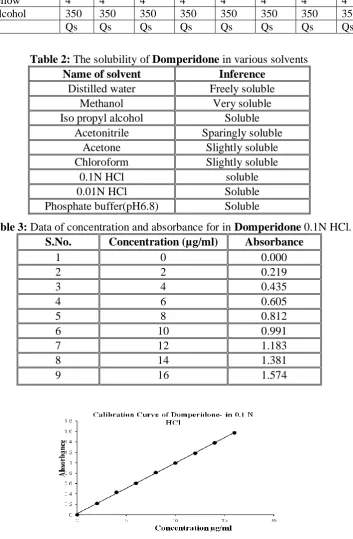
UV absorption spectrum of Domperidone in 0.1N HCl shows λ max at 228nm. Absorbances obtained for various concentrations of Domperidone in 0.1N HCl are given in table no 6.2. The graph of absorbance vs concentration for Domperidone was found to be linear in the concentration range of 2-16 μg /ml. The drug obeys Beer- Lambert’s law in the range of 2-16 μg /ml.
Preparation of standard graph of
Domperidonein pH 6.8 Phosphate buffer.
UV absorption spectrum of Domperidone in pH 6.8 Phosphate buffer shows λ max at 206nm. Absorbances obtained for various concentrations of Domperidone in pH 6.8 phosphate buffer are given in table no.6.3. The graph of absorbance vs concentration for Domperidone was found to be linear in the concentration range of 2-16 μg /ml. The drug obeys Beer- Lambert’s law in the range of 2-16 μg /ml.
Characterization of powder blend
The powder blends were prepared by mixing of various ingredients mentioned in table and used for characterization of various flow properties of powder.
Bulk Density (BD)
The powder blends of formulations have the bulk density ranged between Sustained Release Formulations-0.439±0.0005 to 0.526±0.005 gm/ml
Tapped bulk density (TBD)
The powder blends of formulations have the tapped bulk density ranged between Sustained Release Formulations
0.867±0.0005 to 0.898±0.001 g/ml. These
values indicate good packing characteristics and the powder was not bulky.
Carr’s Compressibility Index: The carr’s index for all the both formulations was found to 12-18%indicating that the powders have a excellent compressibility.
Hausner’s Ratio:
The hausner ratio for all the both formulations was found to be <1.25, indicating good flow properties.
Angle of repose:The flow properties of granules were analyzed by determining angle of repose which was found to be between Sustained Release Formulations- 20.07 to 22.1,excellent flow property.
Evaluation of Sustained Release Pellets
The pellets were evaluated for in process quality control tests. The following tests were performed for sustained release pellets.
Content of active ingredients (assay): The amount of active ingredient(s)present in drug coated pellets was determined. 421mg of pellets were weighed accurately;pellets were placed in 100 ml volumetric flask. The volume was made up to 100 ml using phosphate buffer solution, pH 6.8. The volumetric flask was placed in sonicator for 10 minutes. (Stock solution)1 ml solution from the stock solution was pippeted in to a 100 ml volumetric flask. Volume was made up to 100 ml with phosphate buffer solution, pH 6.8. Out of this, 1 ml was pippeted in to a test tube and 9 ml of phosphate buffer solution, pH 6.8. Was added. Absorbance was measured at 226 nm using UV spectrophotometer. Percentage of drug present in the sample was calculated.
4155 Table 1: Formulations of SR pellets of Domperidone
Ingradients F1 F2 F3 F4 F5 F6 F7 F8 F9
Domperidone 160 160 160 160 160 160 160 160 160
Povidone 60 60 60 60 60 60 60 60 60
Starch 60 60 60 60 60 60 60 60 60
Sodium Lauryl Sulfate 20 40 80
Eudragit Rspo 20 40
Eudragit rs100 20 40
Eudragit rl 100 20 40
Quinoline Yellow 4 4 4 4 4 4 4 4 4
Isopropyle Alcohol 350 350 350 350 350 350 350 350 350
MCC Qs Qs Qs Qs Qs Qs Qs Qs Qs
Table 2: The solubility of Domperidone in various solvents
Name of solvent Inference
Distilled water Freely soluble
Methanol Very soluble
Iso propyl alcohol Soluble Acetonitrile Sparingly soluble
Acetone Slightly soluble Chloroform Slightly soluble
0.1N HCl soluble
0.01N HCl Soluble
Phosphate buffer(pH6.8) Soluble
Table 3: Data of concentration and absorbance for in Domperidone 0.1N HCl.
S.No. Concentration (µg/ml) Absorbance
1 0 0.000
2 2 0.219
3 4 0.435
4 6 0.605
5 8 0.812
6 10 0.991
7 12 1.183
8 14 1.381
9 16 1.574
4156 Table 4: Data of concentration and absorbance for Domperidone pH6.8 phosphate buffer:
Table 5: Pre formulation studies of Domperidone
Formulation code
Angle of Repose (θ)
Bulk Density(g/ml)
Tapped Bulk Density(g/ml)
Carr’s Index (%)
Hausner’s Ratio
F1 22.90 0.459 0.534 14.04 1.16
F2 24.38 0.479 0.548 12.59 1.14
F3 20.35 0.464 0.528 12.22 1.14
F4 23.14 0.480 0.564 13.30 1.15
F5 23.90 0.439 0.514 12.83 1.13
F6 21.20 0.449 0.521 13.82 1.16
F7 22.34 0.465 0.523 14.02 1.17
F8 23.01 0.453 0.517 13.92 1.15
F9 22.87 0.526 0.527 14.23 1.14
Table 6: Weight Distribution of Pellets
Table 7: Friability of Domperidone Peleets
S. No. Concentration (µg/ml)
Absorbance
1 0 0.000
2 2 0.197
3 4 0.395
4 6 0.583
5 8 0.772
6 10 0.954
7 12 1.151
8 14 1.345
9 16 1.527
Sieve No.
F1 F2 F3 F4 F5 F6 F7 F8 F9
Nomina mesh aperture size,(µm)
Nomina mesh aperture size,(µm)
Nomina mesh aperture size,(µm)
Nomina mesh aperture size,(µm)
Nomina mesh aperture size,(µm)
Nomina mesh aperture size,(µm)
Nomina mesh aperture size,(µm
Nomina mesh aperture size,(µm)
Nomina mesh aperture size,(µm)
Pan - - - -
16 1000 1000 1000 1000 1000 1000 1000 1000 1000
20 710 820 910 750 740 720 780 740 760
25 600 620 580 600 540 560 620 640 580
30 500 450 480 520 450 480 520 540 540
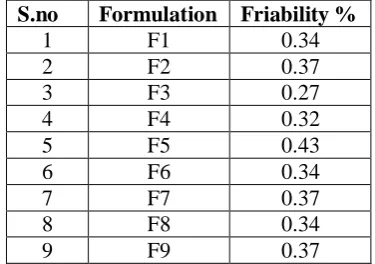
S.no Formulation Friability %
1 F1 0.34
2 F2 0.37
3 F3 0.27
4 F4 0.32
5 F5 0.43
6 F6 0.34
7 F7 0.37
8 F8 0.34
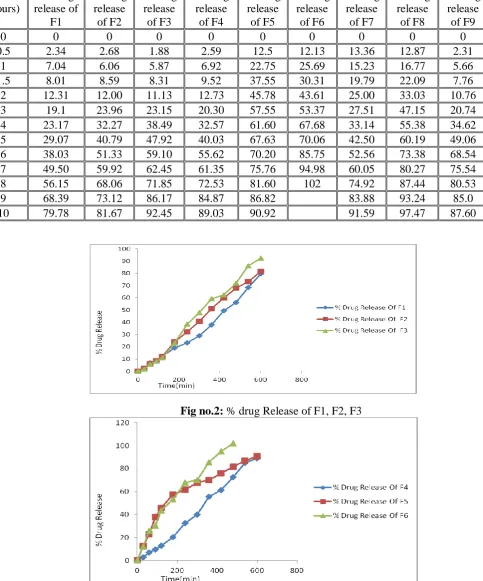
4157 Table 8: Dissolution data of SR pellets of Domperidone
Time (hours)
% Drug release of
F1
% Drug release
of F2
% Drug release
of F3
% Drug release
of F4
% Drug release
of F5
% Drug release
of F6
% Drug release
of F7
% Drug release
of F8
% Drug release
of F9
0 0 0 0 0 0 0 0 0 0
0.5 2.34 2.68 1.88 2.59 12.5 12.13 13.36 12.87 2.31
1 7.04 6.06 5.87 6.92 22.75 25.69 15.23 16.77 5.66
1.5 8.01 8.59 8.31 9.52 37.55 30.31 19.79 22.09 7.76
2 12.31 12.00 11.13 12.73 45.78 43.61 25.00 33.03 10.76 3 19.1 23.96 23.15 20.30 57.55 53.37 27.51 47.15 20.74 4 23.17 32.27 38.49 32.57 61.60 67.68 33.14 55.38 34.62 5 29.07 40.79 47.92 40.03 67.63 70.06 42.50 60.19 49.06 6 38.03 51.33 59.10 55.62 70.20 85.75 52.56 73.38 68.54 7 49.50 59.92 62.45 61.35 75.76 94.98 60.05 80.27 75.54
8 56.15 68.06 71.85 72.53 81.60 102 74.92 87.44 80.53
9 68.39 73.12 86.17 84.87 86.82 83.88 93.24 85.0
10 79.78 81.67 92.45 89.03 90.92 91.59 97.47 87.60
Fig no.2: % drug Release of F1, F2, F3
4158 Fig no.4: % drug Release of F7, F8, F9
A graph was plotted taking average particle size on X – axis and percent weight undersize on Y – axis.
Effect of agitational intensity: It is necessary to check that the effect of agitational intensity on the drug release. To study the effect of agitational intensity (rpm) of the dissolution medium, studies were conducted as stated below.
Percent Friability: Percentage friability of all the formulations was found between 0.284±0.008 to 0.454±0.054%. This indicated good handling property of the prepared SR tablet. Various sustained release Pellets were formulated with Eudragit polymers and microcrystalline cellulose was used as diluents. The drug release data of dissolution studies of formulation f8 containing eudragit L100 is shown concentration levels were found to be 97.47% respectively.
SUMMARY:
Pellets offer a high degree of flexibility in the design and development of oral dosage forms. They can be divided into desired dose strengths without formulation or process changes and also can be blended to deliver incompatible bioactive agents simultaneously and/or to provide different release profiles at the same or different release profiles at the same or different sites in the gastrointestinal tract. In addition, pellets,taken orally, disperse freely in the GI tract, maximize drug absorption, minimize local irritation of the mucosae by certain irritant drugs, and reduce inter and intra
4158
diffusion and non- fickian release. The formula optimized and it was selected for stability studies as per ICH guidelines. Based on the stability data the company (Micro Labs Ltd) may launch the product to trade.
CONCLUSION
The conclusions drawn from the present investigation were given below: Suitable analytical method based on UV-Visible spectrophotometer was developed for Domperidone max of 228 nm, 206nm
were identified in 0.1N HCl and pH 6.8 Phosphate buffer. Manfactuning of tablets by Wet granulation method was established. The tablets were evaluated for pharmacopoeial and non-pharmacopoeial (industry specified) tests. Based on the results, F-8 were identified as better formulation amongst all formulations. Pellets of the formulation F-8 passed all official and unofficial quality control tests.
In vitro release profiles of optimized formulations of Domperidone tablets (F-8), was found to be similar to that of theoretical drug release profile. The conclusions arrived in this thesis indicated that the formulations of Domperidone sustained release developed in this investigation was found to be satisfactory based on in vitro release studies. Thus the objectives envisaged in this research were arrived. The bioavailability of the drug can also be improved with this sustained drug delivery system which increases efficacy, compliance and better clinical usefulness of patients.
BIBLIOGRAPHY
1. G. Pellets., A general overview in pharmaceutical technology, Marcel Dekker Inc New York., 1989, 1-10, 62-89, 123-141,145-164
2. Chowdary KPR, Kamala RG. Sustained release of nifedipine from mucoadhesive tablets of its solid dispersion in HPMC and HPC. Ind Drugs 2002;39:225-29.
3. Paradkar AR, Maheshwari M, Chauhan B. Sustained release matrix of metformin hydrochloride and glyceryl behenate. Ind Drugs 2004
41:350-55.
4. Www.Healthofchildren.Com/Topic/ Antidepressant.Html#B#Ixzz 25grjj2w1.
5. Aniley Wade And Paul J. Weller. Hand Book Of Pharmaceutical Excipients 2nd Edition. The Pharmaceutical Press, London. 1994. Pages. 219-222.
6. Raymond C. Rowe, Paul J. Sheskey And Sian C. Owen. Hand Book Of Pharmaceutical Excipients, 2006. Pages. 526-531.
7. Owen, S., Rowe, R., Sheskey, P., Pharmaceutical Excipients, 245,267,389.
8. Parikh, M., Handbook Of Pharmaceutical Excipients . 81.121-124
9. Arthur H, Kibbe, Hand Book Of Pharmaceutical Exicipiets, American Pharmaceutical Association, 3rd
Edition, 2000
10.Http/ Www.Wikipedia.Com /Potato Starch.Html
11.Preformulation Libermann Ha, Lachman . (Editors). Preformulation Testing: Pharmaceutical Dosage Forms- Tablets. New York: Marcel Dekker Inc; 1980. P. 1-8.
12.Sarfarz K.Niazi. Hand Book Of Pharmaceutical Manufacturing Formulation, 2004, Volume 1, Pages. 26-27.
13.A Martin, P. Bustamante And A. Cun, Lippincott Williams And Wilkins, Baltimore. Micromeritics, In Physical Pharmacy-Physical Chemical Principles In The Pharmaceutical Sciences, 4th Edition. 2002, Pages.423-452.
14.Subramanyam CVS, Text Book of
Physical Pharmaceutics. 2nd Ed. New Delhi; Vallabh Prakashan; 2001.
15.Sarfarz K.Niazi. Hand Book Of Pharmaceutical Manufacturing Formulation, 2004, Volume 1,Pages.26-27.
4159
Formulation And In Vitro Evaluation. AAPS Pharmascitech. 2003;4(4):E61.
17.Hadjiioannou Tp, Christian Gd, Koupparis Ma. Quantitative Calculations In Pharmaceutical Practice And Research. Vch Publishers Inc, New York, Ny, Pp. 1993;345-348.
18.Bourne Dw. Pharmacokinetics. In: Banker Gs, Rhodes Ct. Eds. Modern Pharmaceutics. 4th Ed. Marcel Dekker, New York, Ny, Pp. 2002;67-92.
19.Peppas Na .Analysis Of Fickian And Non-Fickian Drug Release From Polymers. Pharm Acta Helv. 1985;60:110-111.
20.Leon lachman – The theory and practic of industrial pharmacy. Michael E Alton - Pharmaceutics The science of dosage form design. 21.Brahmankar – Text Book of
Biopharmaceutics& Pharmacokinetics.
22.Yie.W.Chein - Controlled & Novel Drug Delivery, CBS publishers. 23.Painter,P& Coleman ,M – “
Fundamental of Polymer science”. 24.Shayne Cox Gad. Pharmaceutical
manufacturing handbook, production and processes. North Carolina: Wiley-Interscience; 2008.
25.Text book of Sustained release dosage form by Y.S.Robinson, Decker Series. Ansel’s Pharmaceutical Dosage forms and Drug delivery Systems