
Title: NEW INSIGHTS IN THE FIELD OF FAST DISSOLVING TABLETS Author: Shivangi Shukla*, Dinesh Kumar Mishra, Dinesh Kumar Jain Keyword: Disintegration, Dissolution, Modified tablets, Novel drug delivery system (NDDS).Page No: 213-226Abstract: Recent a
14
0
0
Full text
(2) Shukla S. et al., Jour. Harmo. Res. Pharm., 2015, 4(3), 213-226. or disintegrate rapidly in the saliva usually less than one minute. 2, 3 These are also known as “Fast-dissolving”, “Mouth-dissolving”,” Rapid dissolve”, “Quick-disintegration”, “Orally disintegrating”, “Rapimelt”, “Fast-melt”, “Oro dispersible”, “Melt-in-mouth”, “Quick dissolving”, “Porous tablets” and “Effervescent drug absorption system”. All FDT approved by the Food and Drug Administration (FDA) are classified as orally disintegrating tablets. 4, 5 The most common approach in the development of FDT is use of superdisintegrants like cross linked carboxy methyl cellulose (crosscarmellose), sodium starch glycolate (primogel, explotab), poly-vinyl-pyrollidone (polyplasdone) etc, which provides fast disintegration of tablet after placing on tongue and release the drug in saliva. 6, 7 The bioavailability of some bioactives might be increased due to absorption of drug in oral cavity and may be due to pregastric absorption of saliva containing dispersed drugs that pass down into the stomach. More ever, the amount of drug that is subjected to first pass metabolism is reduced as compared to standard tablet. FDT which may release these drugs in the mouth are very promising for the delivery of high molecular weight protein and peptide. 5, 6 General scheme of FDT is shown in Figure 1. Placed on tongue. Instantaneous disintegration. Rapid drug dispersion/dissolution in saliva (Pregastric Absorption). Avoid first pass metabolism. Increased bioavailability (faster onset of action) Figure No.1 - General scheme of FDT. Fast Dissolving Tablet: A FDT is a tablet that dissolves or disintegrates in the oral cavity without requirement of water as well as chewing. The active ingredient is then swallowed by the patient’s saliva along with the soluble and insoluble excipients. 8, 9 These are also called melt-in-mouth tablets; repi melts, porous tablets, orodispersible, quick dissolving or rapid disintegrating tablets. 10 Distinctive Characteristics of FDT: 8,10 • Easy administration for uncooperative patients who are mentally or physically disabled. • No need of water. • Fast disintegration and dissolution of the dosage form. • Mask unacceptable taste of the drugs and also provides a pleasant mouth feel. • Cost effective. Merits of FDT: 11, 12 • Fast onset of action with improved bioavailability. • Useful for such patients who cannot easily swallow the dosage forms and also for pediatric, geriatric and mentally retard patients. • Better patient compliance. • Accuracy of dose. • Provides pleasant mouth feel that helps to change the perception of medication. • Improved clinical performance through a decline of unwanted side effects. • Rapid drug therapy intervention is possible. • Specific packaging is not required. Demerits of FDT: 13, 14 • They are more susceptible to degradation by humidity and temperature. • Hygroscopic in nature and must be kept in dry place. • Drug with relatively large doses are difficult to formulate into FDT. • Chances of unpleasant taste and/or grittiness in mouth if not formulated properly. Criteria for Excipients Selection of FDT: 15, 16 • Ability to disintegrate quickly.. www.johronline.com. 214 | P a g e.
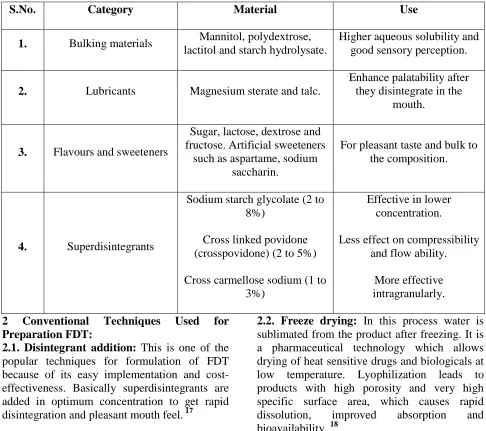
(3) Shukla S. et al., Jour. Harmo. Res. Pharm., 2015, 4(3), 213-226. • • • •. Individual properties should not affect the FDT. No interaction with drug as well as other excipients. No interference with the efficacy and organoleptic properties of the product. While selecting binder (Individual or combination of different binders) care must be taken in context of final integrity and stability of the product.. •. Their melting point should be in the range of 30-35ºC. Excipients for Formulation of FDT: Excipients plays major role in the balancing of the properties of the actives in fast-melting tablets. This necessitates thorough understanding of the chemistry of these excipients to prevent interaction with the actives. Determination of the cost of these ingredients is another issue that needs to be addressed by formulators. 10 Different types of excipients are shown in (Table no. 1). Table no. 1 - Excipients for FDT 10. S.No.. Category. Material. Use. 1.. Bulking materials. Mannitol, polydextrose, lactitol and starch hydrolysate.. Higher aqueous solubility and good sensory perception.. 2.. Lubricants. Magnesium sterate and talc.. Enhance palatability after they disintegrate in the mouth.. Flavours and sweeteners. Sugar, lactose, dextrose and fructose. Artificial sweeteners such as aspartame, sodium saccharin.. For pleasant taste and bulk to the composition.. Sodium starch glycolate (2 to 8%). Effective in lower concentration.. Cross linked povidone (crosspovidone) (2 to 5%). Less effect on compressibility and flow ability.. Cross carmellose sodium (1 to 3%). More effective intragranularly.. 3.. 4.. Superdisintegrants. 2 Conventional Techniques Used for Preparation FDT: 2.1. Disintegrant addition: This is one of the popular techniques for formulation of FDT because of its easy implementation and costeffectiveness. Basically superdisintegrants are added in optimum concentration to get rapid disintegration and pleasant mouth feel. 17. 2.2. Freeze drying: In this process water is sublimated from the product after freezing. It is a pharmaceutical technology which allows drying of heat sensitive drugs and biologicals at low temperature. Lyophilization leads to products with high porosity and very high specific surface area, which causes rapid dissolution, improved absorption and 18 bioavailability.. www.johronline.com. 215 | P a g e.
(4) Shukla S. et al., Jour. Harmo. Res. Pharm., 2015, 4(3), 213-226. 2.3. Moulding: In moulding powder blend is moistened with a hydro alcoholic solvent then moulded into tablets under pressure lower than that used in conventional tablet compression. Moulded tablets are usually prepared by use of water-soluble ingredients that cause tablets to dissolve completely and rapidly. 19 2.4. Sublimation: Low porosity of the tablets causes slow dissolution of the compressed tablet even after addition of highly water-soluble components. Inert readily volatilize solid ingredients such as urea, ammonium carbonate, ammonium bicarbonate, camphor are added with other tablet ingredients and this mixture is compressed into tablets. The volatile materials are then removed via sublimation, which generates highly porous structures for rapid dissolution. 19, 20 Different steps involved in the sublimation technique are shown in (Figure 2). Drug + volatilizing agent + other excipients. Compressed tablet (Sublimation). Pores developed on sublimation of volatilizing agent Figure No. 2: Sublimation technique 2.5. Spray-Drying: This technique can produce fine powders with high porosity which dissolves rapidly. The preparations are usually incorporated by hydrolyzed and non hydrolyzed gelatine as supporting agents, mannitol as bulking agent, sodium starch glycolate or crosscarmellose sodium as disintegrating and citric acid as an acidic material. Tablets formulated from the spray dried powder disintegrate within 20 seconds in an aqueous medium. 2.6. Mass-Extrusion: It involves softening of active blend with solvent mixture of water soluble polyethylene glycol, methanol and expulsion of softened mass through the extruder or syringe to get a cylinder of the product into. even segments using heated blade to form tablets. The dried cylinder can also be used to coat granules of bitter taste drugs and thereby masking of their bitter taste. 2.7. Direct Compression: It is one of the easiest ways to formulate tablets. Conventional equipments, commonly available excipients and limited number of processing steps are involved in direct compression. High doses can also be accommodated and final weight of tablet can easily exceed that of other production methods. 17, 21. 3. Need and Development of FDT: The need of non-invasive type dosage forms persists due to poor patient’s acceptance and compliance with existing delivery systems, limited market size for drug companies and drug uses, also high cost of disease management. Factors that necessitate the need of FDT are discussed below: 3.1. Patient factors: FDT well suited for patients who are not convenient to swallow conventional tablets or capsules with a glass of water. Generally it includes geriatric patients mainly suffering from conditions like hand tremors and dysphasia. Pediatric patients who are unable to swallow because of their central nervous system and internal muscles are not developed completely. Travelling patients suffering from motion sickness and diarrhoea that do not have easy access to water and patients with persistent nausea for a long period of time are unable to swallow are well supported by FDT. 22 3.2. Effectiveness factor: Fast onset of action and increased bioavailability are better claimed by these formulations. Dispersion in saliva in oral cavity causes pre-gastric absorption from some formulations in those cases where drug dissolves quickly. Any pre-gastric absorption avoids first pass metabolism and can be a great advantage in drugs that undergo hepatic metabolism. Safety profiles may be improved for drugs that produce significant amounts of. www.johronline.com. 216 | P a g e.
(5) Shukla S. et al., Jour. Harmo. Res. Pharm., 2015, 4(3), 213-226. toxic metabolites mediated by first-pass liver metabolism and gastric metabolism. 23 3.3. Manufacturing and marketing factors: Entry of new dosage form gives a platform for manufacturer to extend market exclusivity, unique product differentiation, value-added product line extension, and extend patent protection. This leads to increased revenue, while also targeting underserved and undertreated patient populations. 7, 22 4. Challenges in the Formulation of FDT: 4.1. Mechanical strength and disintegration time: FDT are designed to obtain disintegration time usually less than a minute and maintaining a good mechanical strength. It is usually observed that up on increasing the mechanical strength it delays the disintegration time. Many FDT are fragile and there are many chances that such fragile tablet will break during packing, transport or handling by the patient. 20, 21 4.2. Taste masking: Administration of an oral drug delivery system having bitter taste and acceptable level of palatability has always been challenge in developing a formulation for paediatric and geriatric purpose. So effective taste masking of the bitter drugs must be done so that the taste of the drug is not felt in the oral cavity.22 4.3. Aqueous solubility: Great challenges are faced with water soluble drugs because they may form eutectic mixtures, which result in freezing point depression and may form glassy solid that may be collapsed upon drying because of loss of supporting structure during the sublimation process. It can be prevented by using various matrix-forming excipients such as mannitol that imparts crystallinity and gives rigidity to the amorphous composite. 23 4.4. Hygroscopicity: Physical integrity of various formulations under normal conditions of temperature and humidity is greatly affected as they are hygroscopic. That’s why; they need protection from humidity. which demands a specialized product packaging. 24 4.5. Mouth feel: It is desirable that FDT should not disintegrate into larger particles in the oral cavity. They should leave minimal or no residue in mouth. To improve the mouth feel flavours and cooling agents like menthol are added. 21, 22 4.6. Amount of drug: Amount of drug to be incorporated is also very challenging factor while formulating FDT. In case of lyophilized dosage forms, the drug dose must be less than 400 mg for insoluble drugs and less than 60 mg for soluble drugs.25 4.7. Cost: The technology used for FDT should be acceptable in terms of cost of the final product. Methods like Zydis and Orasolv that require special technologies and specific packaging increase the cost to a remarkable extent. 24, 26 4.8. Size of tablet: Size of tablet is a critical factor for handling as well as for administration. Hence it should be considered in the formulation of FDT.27 4.9. Sensitivity to environmental conditions: FDT should be less sensitive to environment conditions such as humidity and temperature as most of the materials used in formulation of FDT subjected to dissolve in minimum quantity of water. 19, 28 5. Patented Technologies for FDT: • Zydis technology • Lyoc technology • Quick solv technology • Nanocrystal technology • Flashtab technology • Orasolv technology • Durasolv technology • WOW tab technology • Dispersible tablet technology • Pharma burst technology • Frosta technology • Oraquick technology • Ziplets/advatab technology. • Nanocrystal technology • Shearform technology. www.johronline.com. 217 | P a g e.
(6) Shukla S. et al., Jour. Harmo. Res. Pharm., 2015, 4(3), 213-226. • Ceform technology • Humidity treatment technology • Sintering 5.1. Zydis technology: It was the first marketed new technology, a unique freeze dried/ lyophilizing tablet in which drug is physically entrapped or dissolved within the matrix of fast dissolving carrier material. When zydis units are placed in mouth, the freeze-dried structure disintegrates instantaneously without need of water. The zydis matrix is composed of polymers such as gelatine, dextran or alginates to achieve number of objectives. To obtain crystallinity, elegance and hardness, saccharine such as mannitol or sorbitol are incorporated. Protectants such as glycine used to prevent the shrinkage of zydis units during freeze-drying process or long-term storage. 5, 28 5.2. Orasolv technology: Orasolv was Cima's first FDT dosage form in which active medicament is taste masked. It also contains effervescent disintegrating agent. Tablets are generally made by direct compression technique at low compression force in order to minimize oral dissolution time. For this reason, Cima developed a special handling and packaging system for Orasolv. Conventional blenders and tablet machine are used to produce the tablets. 29 5.3. Durasolv technology: Patented technology of CIMA lab's secondgeneration FDT tablet formulation, produced in a fashion similar to Orasolv. It requires low amounts of active ingredients and the tablets consist of drug, filler and a lubricant. This technique is not compatible with large doses of active ingredients, because the formulation is subjected to such high pressures on compaction. 30. 5.4. Flash dose technology: This technique was patented by FUISZ. Nurofen meltlet a new form of Ibuprofen as melt in mouth tablets application and rapidly releases the active agent for local and/or systemic absorption.25, 31. 5.5. Nano crystal technology: For mouth dissolving tablets, Élan’s proprietary NanoCrystal technology can enable formulation and improve compound activity and final product characteristics. Decreasing particle size increases the surface area, which leads to an increase in dissolution rate. This can be accomplished predictably and efficiently using NanoCrystal technology. NanoCrystal particles are small particles of drug substance, typically less than 1000 nm in diameter, which are produced by milling the drug substance using a proprietary wet milling technique. NanoCrystal colloidal dispersions of drug substance are combined with water-soluble ingredients, filled into blisters and lyophilized. 32 5.6. Shearform technology: This technology is based on preparation of floss that is also known as shearform matrix which is prepared by subjecting a feedstock containing a sugar carrier by flash heat processing. In this process, the sugar is simultaneously subjected to centrifugal force and temperature gradient, which increases the temperature of the mass to create an internal, flow condition, which permits part of it to move with respect of the mass. 26, 33 5.7. Ceform technology: In Ceform technology, microspheres containing active pharmaceutical ingredient are prepared. The process involves placing a dry powder, containing substantially pure drug material or a special blend of drug materials plus other pharmaceutical compounds, and excipients into a precision engineered and rapidly-spinning machine. 34 5.8. Pharmaburst technology: SPI Pharma, New castle, patented this technology. It utilizes the co processed excipients to develop ODT, which dissolves within 30-40 second. It involves drug dry blending, flavour, and lubricant followed by compression into tablets. Compressed tablets have sufficient strength so they can be packed in blister packs and bottles. 32, 35. www.johronline.com. 218 | P a g e.
(7) Shukla S. et al., Jour. Harmo. Res. Pharm., 2015, 4(3), 213-226. 5.9. Frosta technology: This was patented by Akina which utilizes the concept of formulating plastic granules and co processing at low pressure to produce strong tablets with high porosity. The process consists of mixing of porous plastic material with water penetration enhancer and followed by granulation with binder. 23, 36 5.10. Ziplet technology: In ziplet technology water insoluble drug(s) as coated micro particles are used. The addition of suitable amount of water soluble inorganic excipients combination with disintegrants are impart an excellent physical resistance to the FDT and simultaneously maintained optimal disintegration. The use of water soluble inorganic excipients offer better enhancement of disintegration in comparison to the most commonly used water soluble sugars or salts. 37 5.11. Wow tab Technology: Wow tab technology means without water is patented by Yamanouchi Pharmaceutical Co. In this technique, combination of low mouldability saccharides (rapid dissolution) and high mouldability saccharides (good binding property e.g. Maltose, oligosaccharides) are used to obtain an adequate hardness and rapidly melting strong tablet. 24, 38 5.12. Flash tab technology: In this tablet consists of an active ingredient prepared in the form of microcrystals. Drug microcrystals may be prepared by using the conventional techniques like coacervation, micro encapsulation, simple pan coating methods and extrusion spheronisation. 39 5.13. Oraquick technology: The Oraquick FDT formulation utilizes a patented taste masking technology. It does not utilize any solvents, and therefore leads to mouther and more efficient production. Its. lower heat of production makes Oraquick appropriate for heat-sensitive drugs.25, 40 5.14. Quick–Dis technology: The novel intra-oral drug delivery system, trademarked as Quick-Dis that is Lavipharm’s proprietary patented technology. It is a thin, flexible, and quick-dissolving film which is placed on the top or the floor of the tongue. 41 5.15. Sintering: When thermal energy is applied to a powder compact, the compact is denstified and the average grain size increases. The basic phenomena occurring during this process is called sintering or densification and grain growth. Tablet strength can be improved by sintering the tablet components at high temperatures and then resolidification at lower temperatures. 26, 42 6. Possible Mechanism of Action of FDT: The tablet breaks to primary particles by one or more of the mechanisms listed below: 1. Capillary action (Wicking) 2. Heat of wetting 3. Swelling 4. Due to release of gases 5. Enzymatic action 6. Due to deformation. 7. Due to disintegrating particle/particle repulsive forces. 6.1. Capillary action (Wicking) Capillary action mechanism in which disintegration is always considered as first step. When tablet is placed into suitable aqueous medium, the medium penetrates into the tablet which replaces the air adsorbed on the particles. This may weakens the intermolecular bond which breaks the tablet into fine particles (Figure 3). Water uptake by tablet depends upon hydrophilicity of the drug/excipient and 32, 43 on tabletting conditions.. www.johronline.com. 219 | P a g e.
(8) Shukla S. et al., Jour. Harmo. Res. Pharm., 2015, 4(3), 213-226. Figure No.: 3 Capillary action (Wicking) and Swelling mechanism acid or tartaric acid. The tablet gets 6.2. Swelling disintegrated due to generation of pressure It is considered as widely accepted mechanism within the tablet. This effervescent mixture is of action for tablet disintegration (Figure 3). used when there is need of formulation of very Tablet with high porosity shows poor rapidly dissolving tablets or FDT. Since these disintegration due to lack of adequate swelling disintegrants are very sensitive to small changes force while sufficient swelling force is exerted in humidity level and temperature, strict control in the tablet with low porosity. It is important to of environment is needed during manufacturing note that if the packing fraction is very high, of the tablets. The effervescent blend is either fluid is unable to penetrate in the tablet and 44 added immediately prior to compression or can disintegration gets slow. be added in to two separate fraction of 6.3. Due to release of gases Carbon dioxide is released due to interaction formulation (Figure 4). 37 between bicarbonate and carbonate with citric. Figure No.: 4 Release of gases www.johronline.com. 220 | P a g e.
(9) Shukla S. et al., Jour. Harmo. Res. Pharm., 2015, 4(3), 213-226. 6.4. Enzymatic reaction Enzymes present in the body act as disintegrates and destroy the binding action of binder which ultimately helps in disintegration. 38, 45 6.5. Due to deformation During tablet compression, disintegrated particles get deformed and these deformed particles get into their normal structure when they come in contact with aqueous media or water. Occasionally, the swelling capacity of starch was improved when granules were extensively deformed during compression. This increase in size of the deformed particles produces a breakup of the tablet. This may be a mechanism of starch and has only recently begun to be studied. 46 Process is shown in (Figure 5).. Figure No.: 5. Deformation and Repulsion Mechanism for Tablet Disintegration 6.6. Due to disintegrating particle/particle repulsive forces Another mechanism of disintegration attempts to explain the swelling of tablet made with non swellable disintegrates. Guyot- Hermann has proposed a particle repulsion theory based on the observation that non-swelling particle also cause disintegration of tablets. The electric. repulsive forces between particles are the mechanism of disintegration and water is required for it. Researchers found that repulsion is secondary to wicking. 47 Process is shown in (Figure 5). 7. Evaluation Parameters for Fast Dissolving Tablet 7.1. General appearance: The general appearance of a tablet, its visual identity and overall “elegance” is essential for consumer acceptance. It includes tablets size, shape, colour, presence or absence of an odour, taste, surface texture, physical flaws and consistency and legibility of any identifying marking 16,48 7.2. Tablet thickness: Tablet thickness is an important characteristic in reproducing appearance and also in counting by using filling equipment. Ten tablets are taken and their thickness is recorded using micrometer. 33, 39 7.3. Taste or mouth feel: Healthy human volunteers can be used for evaluation of mouth feel of the tablet. One tablet is evaluated for its mouth feel. A panel of 5 members evaluates the mouth feel by time intensity method. Sample equivalent to 40 mg is to be held in mouth for 10 seconds and the opinion is rated by giving different score values. (0: good, 1: tasteless, 2: slightly bitter, 3: bitter, 4: awful). 35, 42 7.4 Preformulation studies for FDT: 7.4.1. Angle of repose: The angle of repose can be determined using funnel method. The opening end of funnel is closed with thumb until drug is poured. The 5 gm of powder is poured into funnel that can be raised vertically until a maximum cone height (h) is obtained. Radius of the heap (r) is to be measured and the angle of repose (Ɵ) is calculated using the formula: 37. www.johronline.com. Tan Ɵ = h/ r Therefore, Ɵ = Tan-1 h/r Where Ɵ = Angle of repose. 221 | P a g e.
(10) Shukla S. et al., Jour. Harmo. Res. Pharm., 2015, 4(3), 213-226. 7.4.2. Bulk density (Db): It is the ratio of total mass of powder to the bulk volume of powder. It is measured by pouring the weight powder (passed through standard sieve # 20) into a measuring cylinder and initial weight is noted. This initial volume is called the bulk volume. From this the bulk density is calculated according to the formula mentioned below: 39 Db = M/ Vb Where, M is the mass of powder Vb is the bulk volume of the powder 7.4.3. Tapped density (Dt): It is the ratio of total mass of the powder to the tapped volume of the powder. Volume is measured by tapping the powder and the tapped volume is to be noted if the difference between these two volumes is less than 2%. If it is more than 2%, tapping is continued and tapped volume is noted. It is expressed in g/ml and is given by: 40 Dt = M / Vt Where, M is the mass of powder Vt is the tapped volume of the powder. 7.4.4. Carr’s index (Or) % compressibility: It indicates powder flow properties. It is expressed in percentage and shown in Table. 2. I = (Dt – Db)/ Dt x100 Dt is the tapped density of the powder Db is the bulk density of the powder Table no. 2 - Relationship between % compressibility and flow ability 5-10 Excellent 12-16 Good 18-21 Fair Passable 23-25 Poor 33-38 Very Poor <40 Very Very Poor. 7.4.5. Hausner’s ratio: Hausner’s ratio is an indirect index of ease of powder flow. It is calculated by the following formula: Hausner’s ratio = nt/nd Where, nt = tapped density nd = bulk density. Lower Hausner’s ratio (<1.25) indicates better flow properties than higher ones (>1.25). 7.4.6. Weight variation: Uniformity of weight is generally determined by Pharmacopeial procedure. Twenty tablets are selected and their weight is calculated individually and collectively on a digital weighing balance. The average weight of one tablet is determined from the collective weight. Then weight variation is calculated. 49 7.4.7. Tablet hardness: Tablet hardness is defined as the force required for breaking the tablet. It affects the resistance of the tablet to chip, abrasion or breakage under condition of storage transformation and handling before usage. Hardness tester is used to determine the hardness of the tablet.46, 50 7.4.8. Friability: Friability test is done to assess the effect of friction and shocks, which may often cause tablet to chip, cap or break. Roche friabilator is subjected to observe the combined effect of abrasion and shock by utilizing a plastic chamber. Tablets are dropped at a distance of 6 inches that revolves at 25 rpm. Pre weighed sample of tablets is placed in the friabilator, which is operated for 100 revolutions. Tablets are dusted and reweighed.49 F = Wt initial–Wt final / Wt initial x 100. 7.4.9. Wetting time: Wetting time is closely related to the internal structure of the tablet and hydrophilicity of the excipient. According to the following equation. www.johronline.com. 222 | P a g e.
(11) Shukla S. et al., Jour. Harmo. Res. Pharm., 2015, 4(3), 213-226. proposed by Washburn E.W (1921), the water penetration rate into the powder bed is proportional to the pore radius and is affected by the hydrophilicity of the powders. 51 dl/dt = r cos q/ (4hl) Where l is the length of penetration, r is the capillary radius is the surface tension, h is the liquid viscosity, t is the time, and q is the contact angle. 7.4.10. Dissolution test: Randomly six tablets are selected to drug release studies using USP dissolution apparatus. Dissolution media volume (900 ml) is used and a temperature of 37±0.5ºC is maintained. Samples are collected, filtered and suitably diluted. Finally drug assay is carried out using UV spectrophotometer or HPLC. 52 7.4.11. Thickness variation: Ten tablets from each formulation are to be taken randomly and their thickness is measured with a digital screw gauge micrometer. The mean SD values are calculated. 7.4.12. Disintegration time: Six tablets are usually taken to carry out this test using the specified apparatus. Distilled water is used as disintegration media and the time taken for complete disintegration of the tablet with no palatable mass remaining in the apparatus is measured. 7.4.13. In-Vitro dispersion time: It is determined by taking measuring cylinder (10 ml) in which distilled water (6 ml) is added and tablet is dropped. Time needed for complete dispersion is noted. 7.4.14. Uniformity of dispersion: Two randomly selected tablets are placed in water (100 ml) and stirred for two minutes. The dispersion is then passed through 22 meshes. The test is passed if no tablet residue remains on the screen. 7.4.15. Moisture uptake studies: It should be conducted to have an insight into the stability of the formulation, as several excipients used are hygroscopic. Ten tablets from each formulation. are usually kept in desiccators containing calcium chloride at 37ºC for 24 h. Then tablets are weighed and exposed to 75% RH at room temperature for two weeks. The required humidity (75% RH) is obtained by placing saturated sodium chloride solution at the bottom of the desiccators for three days. One tablet (without superdisintegrant) is kept as control to monitor the moisture uptake due to other excipients. Tablets are reweighed and the increase in weight is recorded. 52, 53 8. Conclusion: FDT possess the potential to overcome the drawbacks of conventional tablets like swallowing issue especially with paediatric, geriatric, and psychiatric patients. They have proven better patient compliance and safety along with improved biopharmaceutical properties. The potential for such dosage forms is promising because of the availability of new technologies combined with strong market acceptance and patient demand. 9. Future Prospects: The upcoming time of FDT lies in the formulation of FDT with controlled release behaviour. Despite enormous progress in the technologies, formulation of hydrophobic drugs still poses great challenges especially in large doses drugs. Drugs having low dose shows less difficulty but increase in dose lead to decline in fast disintegration potential. If FDT would be capable to deliver drugs with short half-lives for 12-24 hours, then it would be a quantum improvement in the FDT technology. Additionally, the ability to formulate drugs with high doses will lead to another important technological advancement. There are several biopharmaceutical advantages such as improved efficiency over conventional dosage forms for fast disintegrating tablets. The safety and efficacy profile of drugs in fast dissolving tablet is same like their conventional tablet dosage form. Based on conventional techniques, new techniques are developed like Zydis, Wow Tab, orosolv, durasolv, flashtab, flashdose technology and many more, which leads to. www.johronline.com. 223 | P a g e.
(12) Shukla S. et al., Jour. Harmo. Res. Pharm., 2015, 4(3), 213-226. getting a patent and new market strategy for FDT. 10. References: 1. Kuchekar BS, Bhise SB, Arungam V. Design of fast dissolving tablets. Ind J Pharm Edu 2005; 35:150. 2. Kumar S, Garg K. Fast dissolving tablets current status and new market opportunities recent advances in manufacturing technologies and future prospect. Int J Pharm Pharm Sci 2014; 6(7):22-35. 3. Nautiyal U, Singh S, Singh R. Fast dissolving tablets as a novel boon a review. J Pharm Chem Bio Sci 2014; 2(1):5-26. 4. Sreenivas SA, Dandagi PM, Gadad AP. Orodispersible tablet new fanged drug delivery system a review. Ind J Pharm Edu Res 2005; 39(4):177-181. 5. Pandey NS, Gupta MM, Chauhan S. A brief discussion on fast dissolving tablets a recent technology. Am J Pharm Tech Res 2013; 3(1):28-52. 6. Gohel M, Patel M, Agrawal R. Formulation design and optimization of mouth dissolve tablets of nimesulide using vacuum drying technique. Am Pharm Sci Tech 2004; 5(3):36-40. 7. Panigrahi R, Behera S, Panda C. A review on fast dissolving tablets. Web med central 2010; 1(11):1-15. 8. Yadav G, Kapoor A, Bhargava S. Fast dissolving tablets recent: a review. Int J Pharm Sci 2012; 3(3):728-736. 9. Allen LV, Wang B. Particulate support matrix for making a rapidly dissolving tablet 1997, US Patent 5 595761. 10. Abha, kaur LV. Fast dissolving tablet as a novel vital concept a review. Int J Pharm Res Bio Sci 2015; 4(1):308-319. 11. Modi A, Tayade P. Enhancement of dissolution profile by Solid dispersion (kneading) technique. Am Pharm Sci Tech 2006; 7(3):68. 12. Kumar P, Pasupathi A, Bhowmik D. Formulation and evaluation of fast dissolving tablets of rupatadine fumarate. fast dissoiving tablet. Der Pharmacia Let 2009; 1(2): 151-163. 13. Kumari S, Chander H, Bhatt B. Formulation and evaluation of fast dissolving tablet of Ramipril. Pelagia Res Lib 2011; 2(6):153160. 14. Chang R, Guo X, Burnside BA. Fast dissolving tablets Pharm Tech 2000; 24(6):52-58. 15. Sehgal P, Gupta R, Chaturvedi A. Fast dissolving tablets a new venture in drug delivery. Am J Pharma Tech Res 2012; 2(4):253-81. 16. Reddy LH, Ghosh BR. Fast dissolving drug delivery systems a review of the literature. Ind J Pharma Sci 2002; 64(4):331-336. 17. Bhowmik D, Chiranjib B, Chandira RM. Fast dissolving tablet an overview. J Chem. Pharma Res 2009; 1(1):163-77. 18. Debjit B, Chiranjib B. Fast dissolving tablet an overview. J Chem Pharma Res 2009; 1(1): 163-177. 19. Kumar S, Shiv K. Fast dissolving tablets recent trends and new market opportunities. Indo Am J Pharma Res 2014; 4(7):213-286. 20. Velmurugan S, Vinushitha S. Oral disintegrating tablets an overview. Int J Chem Pharma Sci 2010; 1(2): 1-12. 21. Sharma D, Kumar D, Singh M. Fast disintegrating tablet a new era in novel drug delivery system and new market opprotunities. J Drug Deliv Therap 2012; 2(3):74-86. 22. Seager H. Drug delivery products and the zydis fast-dissolving dosage form. J pharm Pharmacol 1998; 50:375-382. 23. Pather SI, Khankari Rk. OraSolv and duraSolv efficient technologies for the production of orally disintegrating tablets. Drugs Pharma Sci 2003; 126:203-16. 24. Divate S, Kunchu K. Fast disintegrating tablets an emerging trend. Int J Pharma Sci Revi Res 2011; 6(2): 18-22. 25. Gupta A, Mishra AM, Gupta V. Recent trends of fast dissolving tablet an Overview. www.johronline.com. 224 | P a g e.
(13) Shukla S. et al., Jour. Harmo. Res. Pharm., 2015, 4(3), 213-226. of formulation technology. Int J Pharma Bio Arch 2010; 1(1):59-65. 26. Siddiqui M.D, Garg G, Sharma PK. A short review on a novel approach in oral fast dissolving drug delivery system and their patents. Adv Bio Res 2011; 5(6):291-303. 27. Hirani J, Rathod DA, Vadalia KR. Orally disintegrating tablets a review. Trop J Pharma Res 2009; 8(2):161-172. 28. Kalia A, Khurana S, Bedi N. Formulation and evaluation of mouth dissolving tablets of Oxcarbazepin., Int J Pharma Pharma Sci 2009; 1(1):12-23. 29. Kulkarni U, Durgad SA, Patil BS. Formulation and evaluation of pimozide fast dissolving tablets by solid dispersion technique. Int J Pharma Sci 2010; 2(3):724727. 30. Patil BS, Hariprasanna RC. Formulation and development of fast dissolving meloxicam tablets by solid dispersion technique for the effective treatment of dental pain. Int J current pharma Res 2010; 2(3):82-85. 31. Omaima AS, Mohammed AH, Nagia AM. Formulation and optimization of mouth dissolve tablets containing rofecoxib solid dispersion, Am Pharm Sci Tech 2006; 7(2): 55. 32. Ratnaparkhi MP, Mohanta GP, Upadhyay L. Review on fast dissolving tablet. J Pharma Res 2009; 2(1):5-12. 33. Sahoo S, Mishra B, Biswal PK. Fast dissolving tablet as a pot drug delivery system. Drug Inv Today 2010; 2(2):130133. 34. Bhise K, Shaikh, S, Bora D. Taste mask design and evaluation of an oral formulation using ion exchange resin as drug carrier. Am Pharma Sci Tech 2008; 9(2):557-562. 35. Manivannan R. Oral disintegrating tablets a future compaction. Int J Pharma Res 2009; 1(10):1-10. 36. Taksande JB, Murade SS, Trivedi RV, Umekar MJ. Formulation and characterization of lornoxicam fast dissolving tablet using natural. superdisintegrants. Int J Res Pharma Bio Sci 2013: 4(2):459-464. 37. Venkateswarlu BS, Margret CR. Formulation development and evaluation of fast dissolving tablets of carvedilol. The Pharma Res 2010; 3:203-220. 38. Bandari S, Mittapalli RK, Gannu R, Rao YM. Orodispersible tablets an overview. Asian J Pharm, 2008; 2(2):11-28. 39. Bhagawati ST, Hiremath SN, Sreenivas SA. Comparative evaluation of disintegrants by formulating Cefixime dispersible tablets. Ind J Pharm Edu Res 2005; 39(4):194-197. 40. Bhattacharya S, Pal TP. A review on fast dissolving tablet technology. Pharmatutor Edu Lab 2011; 3(2):44-59. 41. Chaulang G, Patil K, Ghodke D. Preparation and characterization of solid dispersion tablet of furosemide with crospovidone. Res J Pharm Tech 2008; 1(4):386-389. 42. Agrawal VA, Rajurkar RM. Fast disintegrating tablet as a new drug delivery system a review. Int Res J Pharma 2011; 2(1):1-8. 43. Reddy D, Pillay V, Choonara Y, Du Toit LC. Rapidly disintegrating or mucosal drug delivery technologies. Pharma Devlop Technology.2009; 14(6):588-601. 44. Lachman L, Liberman H, Kanig J. The theory and practice of industrial pharmacy, 3rd edition, Varghese Publishing House, Mumbai.1987:297. 45. Siddiqui N, Garg G, Sharma KP. A short review on a novel approach in oral fast dissolving drug delivery System and their Patents. Adv Bio Res 2011; 5(6):291-303. 46. Thakre A, Bhople A, Bari M. Formulation and development of oral fast dissolving tablet of etoricoxib. Der Pharmacia Let 2012; 4(4):1169-82. 47. Kaur H. Processing technologies for pharmaceutical tablet a review. Int Res J Pharm 2012; 3(7):20-4. 48. Kaur T, Gill B, Kumar S, Gupta GD. Mouth dissolving tablet a novel approach to drug. www.johronline.com. 225 | P a g e.
(14) Shukla S. et al., Jour. Harmo. Res. Pharm., 2015, 4(3), 213-226. delivery. Int J Curr Pharm Res.2013; 3(1):1-7. 49. Hisakadzu S, Yunxia B. Preparation evaluation and optimization of rapidly disintegrating tablets. Powder Technol. 2002; 122:188-198. 50. Bhasin R.K, Bhasin N, Ghosh P. Advances in formulation of orally disintegrating dosage forms a review article. Indo Glob J Pharma Sci 2011; 1(4):328-353. 51. Johnson JR, Wang LH, Gordon MS, Chowhan ZT. Effect of formulation. solubility and hygroscopicity on disintegrating efficiency in tablets prepared by wet granulation. J Pharma Sci 1991; 80:469–71. 52. Jeong SH, Takaishi Y, Park K. Material properties for making fast dissolving tablets by a compression method. J Mater Chem 2008; 18(2):3527-3535. 53. Deshpanday KB, Ganesh NS, Orodispersible tablets an overview of formulation and technology. Int J Pharma Bio Sci 2011; 3(2):726-735.. www.johronline.com. 226 | P a g e.
(15)
Figure

Related documents
‘Treatment averages for each compartment followed by the upper case letter are not significantly different (130.05).. increasing nitrogen concentration following
Acute MI stage (Figure 6 A1-A5): 48 hours after reperfused MI, the infarcted region appeared almost isointense on T1WI, but hyperintense to a larger extent at the lateral and
42 To assess the mechanism(s) of solute release from calcein-HPPH liposomes upon phototriggering, we evaluated 1) amounts of liposome- encapsulated calcein and HPPH per µ
They observed that the overall heat transfer coefficient increase with inner coil tube Dean Number for constant flow rate in annulus region.. Jayakumar
The results showed that treatments of high concentrations of bacterial cells and their free cells had a significant effect on the mortality of all treated ootheca for four times
Instead of a single military revolution embodied by linear infantry tactics, there were multiple revolutions (one could even call them evolutions) in how armies fought: an
By linking one knowledge object, a combination of the granules map and key, with a second knowledge object, a combination of the assets a textual explanation using map keys and a
The clocked RS flip flop consists of a neither basic NOR flip flop and two AND gates. Figure 10 shows the RS flip flop designed from conventional irreversible
