Merugu et al. World Journal of Pharmaceutical and Life Sciences
METHOD DEVELOPMENT AND VALIDATION OF DRUG COMBINATION IN A
FORMULATION OF ISONIAZID, RIFAMPICIN AND PIPERINE BY RP-HPLC
METHOD
Merugu Manasa*1 and Mahesh Pothu2
1
Pulla Reddy Institute of Pharmacy, Hyderabad, Telangana, India.
2
Sai Life Sciences Limited, Hyderabad, Telangana, India.
Article Received on 10/04/2017 Article Revised on 29/04/2017 Article Accepted on 20/05/2017
INTRODUCTION
Analytical chemistry may be derived as the science and art of determining the composition of material in terms of the elements of compounds contained. By means of analytical techniques both qualitative analysis (the presence or absence of one or more elements) and quantitative analysis (how much amount is present) can be done. Pharmaceutical analysis may be defined as the application of analytical procedures used to determine the purity, safety and quality of drugs and chemicals. It includes both qualitative and quantitative analysis of drugs and pharmaceutical substances start from bulk drugs to the finished dosage form.[1]
High Performance Liquid Chromatography (HPLC)[2]
HPLC was introduced commercially in 1969 and since then it has undergone extensive modifications and innovation which lead to its emergence as the foremost analytical tool for quantitative analysis. HPLC is a type of liquid chromatography that employs a liquid mobile phase and a very finely divided stationary phase. In order to obtain a satisfactory flow rate liquid must be pressurized to a few thousands of pounds per square inch.
For the present study, the drugs Isoniazid, Rifampicin
HPLC method was considered the choice of estimation, since this method is the most powerful of all chromatographic and other separative methods. The HPLC method has enabled analytical chemist to attain great success in solving his analytical problems. The HPLC is the method of choice in the field of analytical chemistry, since this method is precise, accurate and linear.
Isoniazid (Laniazid, Nydrazid), also known as isonicotinylhydrazine (INH), is an organic compound that is the first-line medication in prevention and treatment of tuberculosis.[3] Rifampicin or rifampin is a bactericidal antibiotic drug of the rifamycin group. It is a semisynthetic compound derived from Amycolatopsis rifamycinica.[4] Piperine is the alkaloid responsible for the pungency of black pepper and long pepper, along with chavicine (an isomer of piperine). It has also been used in some forms of Traditional medicine and as an insecticide.[5]
METHODOLOGY
Preparation of Reagents[6]
Preparation of 0.1N Orthophosphoric Acid Buffer
Mix of 6.7 ml of phosphoric acid with 50.0 ml of a 4 percent solution of dilute sodium hydroxide solution and dilute to 1000.0 ml with HPLC grade water and PH is
World Journal of Pharmaceutical and Life Sciences
WJPLSwww.wjpls.org SJIF Impact Factor: 4.223
*Corresponding Author: Merugu Manasa
Pulla Reddy Institute of Pharmacy, Hyderabad, Telangana, India.
ABSTRACT
A simple, isocratic reverse phase high pressure liquid chromatographic method has been validation and method development of new drug combination. The method was carried out on an Waters xterra reverse phase C 18 (250 mm x 4.6 mm I.D; particle size 5 μm) column with a mobile phase consisting of methanol and ortho phosphoric acid (pH was adjusted to 2.2 by using hydrochloric acid) in the ratio of 40:60 at a flow rate 1.0 mL/min. Detection was carried out at λ 282 nm. The retention times of Isoniazid , Rifampicin and Piperine were found to be 2.513, 3.625 and 5.316 min respectively. The developed method was validated in terms of accuracy, precision, limit of detection/quantitation, linearity and robustness. The proposed method is highly sensitive, precise, accurate and easy to perform and successfully applied for the estimation of these drugs in bulk and capsule dosage form.
Preparation of Mobile Phase
A Combination of Methanol (50%) and 0.1N Orthophosphoric Acid buffer (PH2.2) (50%) was mixed and degassed in ultrasonic water bath for 5 minutes finally filtered through 0.45µ membrane filter. This prepared solution was used as mobile phase.
Diluent
HPLC grade water was used as diluent.
Standard Stock Solution Preparation
Weighed and transferred 200mg of Rifampicin working standard 300mg of Isoniazid working standard and 10mg of Piperine working standard into 100 mL volumetric flask, added 50 mL of diluent and sonicate to dissolve and dilute to volume with diluent.
Preparation of Standard Solution
Weighed and transferred 200mg of Rifampicin working standard 300mg of Isoniazid working standard and 10mg of Piperine working standard into 100 mL volumetric flask, added 50 mL of diluent and sonicate to dissolve and dilute to volume with diluent. From this solution 5ml was taken into a 25ml volumetric flask and made up to the mark with diluent.
Preparation of Sample Solution
Finely grind preweighed 20 tablets. Transfer grinded sample quantitatively equivalent to 200mg of Rifampicin 300mg of Isoniazid and 10mg of Piperine into 100mL volumetric flask, added 20mL of diluent, sonicate to dissolve for 20 minutes and diluted to volume with diluent. Further filter the solution through filter paper.
Selection of Chromatographic Methods
The proper selection of methods depends upon the nature of the sample (ionic or ionisable or neutral molecule) its molecular weight and stability. The drugs selected are polar, ionic and Reversed phase chromatography can be used because of its simplicity and suitability.
Optimized Method
Chromatographic Conditions
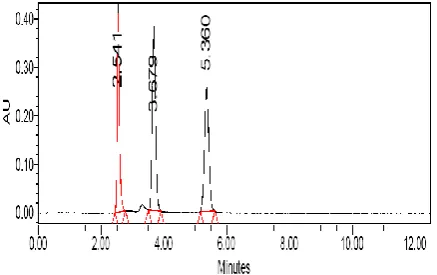
Mobile Phase: 0.1N OPA:Methanol (60:40), Column Temperature: 30oC, Flow Rate: 1mL/min, λmax: 282.1 nm, Injection Volume: 10µL, Run Time: 7 min and Detector: Waters 2998 Photo Diode Array detector. Inference: Sharp peaks at 2.541min (INH) and 3.679min (RFP) and 5.360min (PIP) were eluted and they were well separated at lower concentration. Mode of Operation: Isocratic. Stationary Phase:Waters xterra C18 column (250 mm x 4.6 mm I.D;particle size 5 μm).
Validation of Developed RP-HPLC Method[6]
As per the International Conference on Harmonization (ICH) guidelines the method validation parameters such as specificity, linearity, precision, accuracy, limit of detection/quantitation and robustness were optimized,
System Suitability
The standard I solution was injected one time and standard II solution was injected 5 times.
Acceptence Criteria
Tailing factor for the peaks due to Isoniazid, Rifampicin and Piperine in Standard solution Should not be more than 2. Theoretical plates for the Isoniazid, Rifampicin and Piperine peaks in Standard solution Should not be less than 2500.
Accuracy
The accuracy of the method shall be demonstrated through determination on samples in three concentrations from 50% (300.0µg/mL for INH; 200.0µg/mL for RFP; 10.0µg/mL for PIP), 100% (600.0µg/mL for INH; 400.0µg/mL for RFP; 20.0µg/mL for PIP), and 150% (900.0µg/mL for INH; 600.0µg/mL for RFP; 30.0µg/ml fog PIP), (Three replicates from 100% and six replicates from 50% & 100%) of the theoretical concentrations employed as per the usual procedure and the chromatograms were recorded.
Acceptance Criteria
The % Recovery for each level should be between 97.0 to 103.0%.
Precision
Weighed and transferred 200mg of Rifampicin working standard 300mg of Isoniazid working standard and 10mg of Piperine working standard into 100 mL volumetric flask, added 50 mL of diluent and sonicate to dissolve and dilute to volume with diluents. The sample solution was injected for six times and measured the area for all six injections in HPLC.
Acceptance Criteria
The % RSD for the area of six standard injections results should not be more than 2%.
Limit of Detection (LOD)
From the above preparation 1ml of solution is transferred to 10ml of volumetric flask and the volume made with the diluent.
Limit of Quantitation (LOQ)
From the above preparation 0.5ml of solution is transferred to 10ml of volumetric flask and the volume made with the diluent.
Linearity
Injected each level into the chromatographic system and measured the peak area. Ploted a graph of peak area versus concentration (on X-axis concentration and on Y-axis Peak area) and calculated the correlation coefficient.
Acceptance Criteria
Specificity
The blank, placebo, standard I and standard II solutions were injected. Blank, placebo and standard I were injected one time and the standard II was injected 5 times.
Robustness
As part of the Robustness, deliberate change in the Flow rate, Temperature Variation were made to evaluate the impact on the method.
Sample solution was injected and analysed using the varied flow rates (1±0.2) along with method flow rate and sample solution was injected and analysed using the varied temperatures (350C±5).
ASSAY
Sample and standard was injected into the chromatographic system and measured the areas for INH, RFP and PIP peaks and calculated the % Assay by using the formulae.
Calculation: (For Isoniazid, Rifampicin and Piperine)
Where:
AT = average area of sample. WT = Weight of sample taken in mg.
AS = average area of standard. DS = Dilution factor of standard solution.
WS = Weight of working standard taken in mg. DT = Dilution factor of sample solution.
P= Percentage purity of working standard. LC = label claim of INH, RFP and PIP
RESULTS AND DISCUSSION
Optimized method
It was performed on Waters xterra C18 (250 mm x 4.6 mm I.D; particle size 5 μm) with a mobile phase composition of 0.1N OPA: Methanol in the ratio of 60:40 at a flow rate of 1 mL/min. 10 µL of sample was injected and the analytes are monitored at 282.1 nm. The run time was 7 min.
Fig 1: Typical Chromatogram of INH, RFP and PIP.
ASSAY: The % assay can be calculated by using the formula,
Potency of INH: 99.1% Potency of RFP: 99.7% Potency of PIP: 99.1%
Table 1: Assay results.
System suitability
Table 2: System suitability parameters.
Accuracy
The mean percentage recoveries for INH, RFP and PIP were found to be 100%, 99% and 99% respectively. The high percentage recovery indicates that the proposed method was highly accurate.
Precision
Table 4: Precision results for PIP.
Table 5: Precision results for RFP.
The % RSD values of INH, RFP and PIP were found to be 0.6, 0.4 and 0.4 respectively. The low % RSD values (below 2) indicates that the method was Precise.
Limit of Detection (LOD)
The LOD values for INH, RFP and PIP were 7.129, 23.763 and 36.276 respectively.
Limit of Quantitation (LOQ)
The limit of detection and limit of quantitation were performed and the results indicates the sensitivity of the method.
Linearity
Fig 2: Calibration curve of INH.
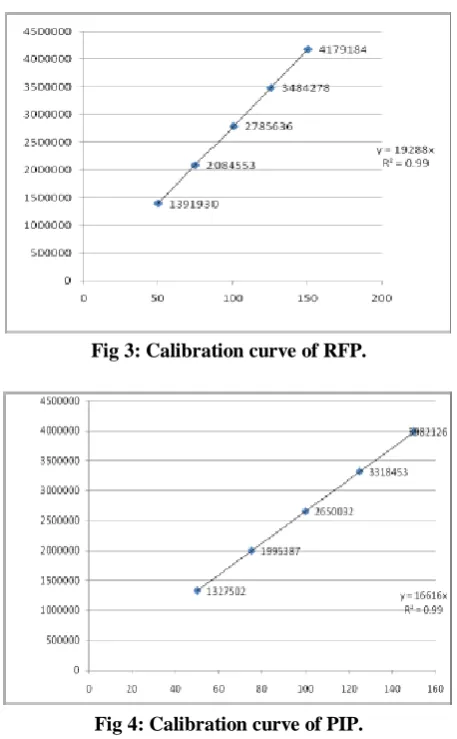
Fig 3: Calibration curve of RFP.
Fig 4: Calibration curve of PIP.
Table 6: Regression equation of linearity plots and coefficient of correlation.
From the above data it was observed that Quantitative linearity was obeyed in the concentration range of 300-900, 200-600 and 10-30 μg/mL of INH, RFP and PIP respectively. The regression equations of concentration over their peak areas were found to be Y = 16616x (R2 = 0.999), Y = 19288x (R2 = 0.9990) and Y = 16616x (R2 = 0.99) for INH RFP and PIP respectively where Y is the peak area and x is concentration of drugs (μg/mL).
Robustness
Table 7: pH of buffer and buffer concentration.
Table 8: Robustness for INH.
Table 9: Robustness for RFP.
From the above data it was found the asymmetric factor was less than 2.0 and theoretical plates were more than 2000 for INH, RFP and PIP peaks, which illustrates the good robustness of the developed method.
Specificity
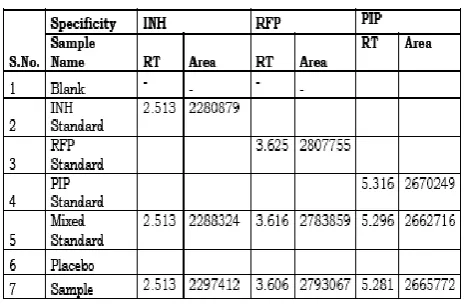
Specificity is the method performed for checking the excipients and solvent effect on the developed method by injecting them seperately.
Table 10: Results for specificity.
CONCLUSION
The developed HPLC method was applied for simultaneous estimation of Isoniazid, Rifampicin and Piperine in Pharmaceutical dosage forms. No interfering peaks were found in the chromatogram indicating that excipients used in capsule formulations didn’t interfere with the estimation of the drugs by the proposed HPLC method. Thus, it concludes a simple, sensitive, precise
validated for the simultaneous estimation of Isoniazid, Rifampicin and Piperine in bulk and pharmaceutical dosage form.
BIBLIOGRAPHY
1. Rashmin, An Introduction to Analytical Method Development for Pharmaceutical formulations. Indoglobal Journal of Pharmaceutical Sciences, 2012; 2(2): 191-196.
2. Malvia R, Bansal V, Pal O.P and Sharma P.K. A Review of High Performance Liquid Chromatography. Journal of Global Pharma technology, 2010.
3. Ping-Fei Fang et al., Simultaneous determination of Isoniazid, Rifampicin, Levofloxacin in mouse tissues and plasma by high performance liquid chromatography – tandem mass spectrometry Journal of Chromatography B, 15 August 2010; 878(24): 2286-2291.
4. M.Y Khuhawar et al., Liquid chromatographic determination of Isoniazid, Pyrazinamide and Rifampicin from pharmaceutical preparations and blood Journal of Chromatography B, 25 January 2002; 766(2): 357-363.
5. Sunil Bajad et al., Liquid chromatographic method for determination of Piperine in rat plasma: application to pharmacokinetics, Journal of Chromatography B, 5 September 2002; 776(2): 245-249.
6. ICH, Validation of Analytical Procedures: Methodology, ICH – Q2B, International Conference on Harmonization, 1996; 1-3.