HOME BIAS AND NETWORK EFFECT
OF INDONESIAN MIGRANT
WORKERS ON MALAYSIA’S
EXTERNAL TRADE
Fariastuti Djafar1*, Mohd Khairul Hisyam Hassan1
1Department of Economics, Faculty of Economics and Business, Universiti Malaysia Sarawak, Malaysia
Abstract
Limited studies on the effect of immigrant workers on trade have been carried out in Asia even though some Asian countries have become important labour sending or labour receiving countries. This study attempts to fill the gap by examining the effect of Indonesian migrant workers on the external trade of Malaysia. Three objectives are proposed. The first objective is to examine the long-run relationship between Indonesian migrant workers, and export and import, respectively. This is followed by examining the causality between Indonesian migrant workers and Malaysia’s external trade, as well as the extent to which Indonesian migrant workers affect Malaysia’s external trade in the third objective. The secondary data are analysed utilizing the Vector Autoregressive (VAR) framework. The findings show that Indonesian migrant workers do not have any significant effect on Malaysia’s import, thus indicating the insignificance of the home bias effect. The outcomes also reveal a negative and significant effect of Indonesian migrant workers on exports implying the absence of a network effect. This could be due to several factors, such as similarities in culture between Malaysia and Indonesia, low-skilled immigrant workers, the immigrants working in non-tradable sectors, the import substitution policy in Indonesia, and Indonesia not being the main trading partner of Malaysia.
Key words
Import; Export; Migrant Workers; Indonesia; Malaysia
INTRODUCTION
the effect of trade on migrant workers is whether the country wants to import labour intensive products or the labour itself, which, consequently, will encourage or discourage workers to migrate to host countries (Carbough, 2007). Meanwhile, the main issue relating to the effect of migrant workers on trade is the mechanism concerning how migrant workers influence the external trade of their host countries. Some of the previous studies have mixed these two different issues; hence, generating a rather different conclusion (Gaston & Nelson, 2013).
This study focuses on the effect of Indonesian migrant workers on Malaysia’s external trade. Previous studies on this issue tended to concentrate on developed countries as the host country to migrant workers. Although some countries in Asia, such as the United Arab Emirates, Saudi Arabia, South Korea, Japan, Singapore and Malaysia, have become important host countries for migrant workers from the other Asian countries, studies on Asian host countries are limited. Studies mainly concentrate on the role of Asian migrant workers in trade in developed countries, such as Australia (Lung, 2008), New Zealand (Qian, 2008) and Germany (Akkoyunlu, 2009), rather than in host countries in Asia.
This study will contribute to the studies on immigrant workers and the external trade relationship with particular reference to the effect of immigrant workers on the external trade in South East Asian countries. Among these countries, Malaysia, as the study site, is the top receiving migrant country while Indonesia is the top sending migrant country with Malaysia as its main destination country. Indonesia is the closest neighbouring country to Malaysia, with which it shares a land border. Hence, leading to low costs and rapid mobility between the countries.
Three objectives are proposed in this study. The first objective is to examine the long-run relationship between Indonesian migrant workers and Malaysia’s external trade, followed by examining the causality between these two variables in the second objective, and the extent to which the immigrant workers affect trade in the third objective. The paper is presented as follows. The next two sections present an overview of social and economic conditions in Indonesia and Malaysia, followed by the literature review. The fourth section explains the methodology, while the fifth section describes the empirical results and discussions. The last section presents the conclusions.
OVERVIEW OF SOCIAL AND ECONOMIC CONDITIONS IN INDONESIA AND MALAYSIA
Malaysia has a better economic condition compared to Indonesia, while Indonesia is a large country in terms of territory and demography. In 2010, Malaysia’s per capita income (USD 8,418) was almost three times higher than that of Indonesia (USD 2,981) (International Monetary Fund, 2012). In contrast, Malaysia’s territory (329,847 km2) is
2010 (28.3 millions), which is only around 12% of the population size of Indonesia (237.6 millions). In Indonesia, approximately 8.3 million people are unemployed, as opposed to 0.4 million in Malaysia (Asian Development Bank, 2012). A strong domestic demand and the huge market in Indonesia have now made this country attractive to foreign investors including those from Malaysia. Several Palm Oil companies and Malaysian banks operate in Indonesia.
Malaysia’s economic structure is mainly dependent upon the industry and service sectors which were around 90% of the total output in 2010 (Table 1). Malaysia is rapidly becoming a modernized country, as indicated by the increasing share of employment in the “others” category including construction, trade and the other service sectors from 56% in 1995 to 69% in 2010. The share of the agricultural and manufacturing sectors in the total employment of Malaysia has declined steadily from approximately 43% in 1995 to about 31% in 2010.
TABLE 1. STRUCTURE OF OUTPUT AND EMPLOYMENT IN MALAYSIA, 1995-2010 Output (%) 1995 2000 2005 2010
Agriculture 12.7 8.3 8.4 10.5
Industry 40.5 46.8 46.9 41.5
Services 46.8 44.9 44.7 48.0
Employment (%)
Agriculture 20.0 16.7 14.6 14.2 Manufacturing 23.3 23.5 19.8 16.7
Mining 0.4 0.3 0.4 0.5
Others 56.3 59.5 65.2 68.6
Source: Asian Development Bank, 2012
China, Singapore, Japan and the USA are the main trading partners with Malaysia (Table 2), while Indonesia is the sixth largest importing country to Malaysia. The share of manufactured products in Malaysia’s total exports (68%) is the largest, followed by the share of oil and gas (12%), and palm oil (9%). Malaysia’s imports are mainly intermediate goods (67%), which are used as inputs for further production and generate labour demand. The contribution of consumption goods to total imports is approximately 7% (Economic Planning Unit, 2012).
TABLE 2. MAIN TRADING PARTNERS OF MALAYSIA, 2011
Major Trading Partners (Export) Major Trading Partners (Import)* China (18 %) Singapore (21 %)
Singapore (13 %) China (14 %) Japan (11 %) Japan (10 %)
United States (US) (9 %) United States (US) (8 %) Source: Economic Planning Unit, 2012
The trade balance between Malaysia and Indonesia is mainly a surplus for Malaysia (Figure 1). Between 1999 and 2011, Malaysia’s export value to Indonesia was consistently greater than its import value except in 2007 and 2008. Mineral fuels and machinery have a greater share in Malaysia’s total exports to Indonesia compared to the other export commodities. The largest imported product to Malaysia from Indonesia in 2009 was manufactured products (23%) followed by mineral fuels (19%), and animal and vegetable oils (17%) (Table 3). The share of animal and vegetable oil to the total imports in 2009 dropped sharply compared to the share of this product in 2005 (30%), and was replaced by the increasing share of other products, such as food products (13%) and manufactured goods (23%).
FIG 1. TRADE BALANCE BETWEEN MALAYSIA AND INDONESIA, 1999-2011
Source: Asian Development Bank, 2012
TABLE 3. MAIN IMPORT AND EXPORT COMMODITIES, MALAYSIA-INDONESIA, 2005 & 2009
Commodity Import from Indonesia (%) Export to Indonesia (%)
2005 2009 2005 2009
Food 8.41 12.64 6.07 5.35
Beverages and Tobacco 1.11 1.13 2.13 2.61
Crude Materials, Inedible 1.48 2.21 1.55 2.17 Mineral Fuels, Lubricants, etc. 20.75 19.37 22.95 25.59 Animal and Vegetable Oils and Fats 30.49 17.34 0.91 1.41
Chemicals 6.56 7.67 19.61 17.80
Manufactured Goods 19.76 22.92 12.63 16.49
Machinery and Transport Equipment 9.50 13.75 28.74 24.11 Miscellaneous Manufactured Articles 1.77 2.48 3.33 3.56 Miscellaneous Trans. and Commod. 0.16 0.49 2.07 0.92
Total 100.00 100.00 100.00 100.00
Not only does Malaysia trade with Indonesia, but it also receives labour from Indonesia. The high demand for low-paid workers in Malaysia matches the high supply of low-skilled workers from Indonesia. These workers are willing to work in Malaysia because of the low wages and the difficulty in finding jobs in Indonesia. The stronger value of the Malaysian ringgit over the Indonesian Rupiah has encouraged Indonesians to seek employment in Malaysia. The jobs considered as being low-paid jobs by the Malaysians are considered as relatively better paid jobs by the Indonesian migrant workers. Indonesian migrant workers dominate all sectors in Malaysia except in manufacturing and services. The largest number of Indonesian migrant workers is in the plantation sector (85%) followed by construction (70%), maids (70%) and agriculture (53%) (Table 4).
TABLE 4: FOREIGN WORKERS BY SECTOR AND COUNTRY OF ORIGIN, 2012.
Maid Construction Manufacturing Services* Plantation Agriculture** Total (%)
Indonesia 69.88 70.16 20.08 16.73 84.54 53.46 47.53
Nepal 0.05 2.41 41.58 22.39 1.47 8.74 19.41
Bangladesh 0.03 11.92 12.22 7.70 4.14 5.46 8.43
Myanmar 0.06 5.82 15.74 9.47 0.75 3.60 8.21
Others 29.98 9.69 10.38 43.70 9.11 28.74 16.41 Total (%) 100.00 100.00 100.00 100.00 100.00 100.00 100.00 Total Foreign
Worker 142,744 228,560 609,589 140,340 319,858 144,778 1,585,869 Source: Department of Immigration, 2012.
Notes: * other than maid ** other than plantation
LITERATURE REVIEW
Two mechanisms are usually utilized to explain the effect of immigration on trade, namely, the “home bias effect” and the “network effect”. The “home bias effect”, or “transplanted home-bias effect” (White, 2007), or “preference effect” (Gould, 1994) refers to the immigrant preference to consume products from their home countries (Gould, 1994; White, 2007). Meanwhile, the “network effect” (White, 2007), or “information effect” (Wagner et al, 2002) refers to the information about the home country supplied by the immigrants, which reduces the transaction costs in conducting trade between the home and host countries of the immigrants (Wagner et al, 2002; White, 2007).
different taste between immigrants and natives. On the other hand, Aleksynska and Peri (2012), in their study on Organisation for Economic Co-operation and Development(OECD)countries, state that immigrant workers have a strong positive network effect on the exports of the host country.
Many factors may influence the immigration and trade relationship, such as remittance, the level of skill of immigrant workers, and the income per capita of the home country. Parsons (2005) argues that exports from the host country to the home country may also increase due to remittance, which will increase the income of families in the home country, which may create a preference for the products from the host country. This is demonstrated in the way Mexican immigrants in the United States (US) share their experiences in the US with their families in their home country (Parsons, 2005).
The levels of skill of immigrants may have different effects on the external trade of their host countries. The study by Hijzen and Wright (2010) on immigrant workers in the United Kingdom (UK) shows that the relationship between skilled immigrants and imports is complementary while between unskilled immigrants and imports it is one of substitution. This is due to the imports containing large quantities of goods produced by low-skilled workers. Thus, a large number of low-skilled immigrant workers in the host country may reduce the import of these products.
The income in the home country of immigrant workers may affect the elasticity of import and export to immigration. White (2007) in his study on the US, reveals that the immigrants from low-income countries will have a greater effect on imports than on exports due to the home bias effect. Qian (2008) also shows that imports in New Zealand are more influenced by immigrants from low-income countries than immigrants from high-income countries. Similarly, Piperakis (2011) reports that low-skilled immigrants and immigrants from low-income countries positively affect imports and exports, while skilled immigrants and immigrants from high-income countries do not have any significant effect on trade in the EU-15 countries.
The long duration of immigrant workers in the host country may reduce the preference effect of the home country’s product and lead to an import substitution policy. Imports from the home country will decline because immigrants will slowly adjust to the conditions in the host country, for instance, by consuming local products (Bratti et al., 2012; Qian, 2008). Moreover, in the long-run, both the home and host countries may adopt an import substitution policy, which will reduce the imports in these countries (Tai, 2009).
DATA AND METHODOLOGY
This study uses two models, namely, export (EXP) and import (IMP). Exports and imports are functions of Indonesian Migrant Workers (IMW). The export and import data are based on unpublished data from the Department of Statistics (2011) and are measured in Malaysian ringgit, while the data on Indonesian migrant workers are based on unpublished data on the number of work visas issued by the Department of Immigration (2012). The quarterly data from 1999 to 2009 were employed. All the variables were transformed into the natural logarithmic form.
The two models are as follows:
EXP = f (IMW) (1)
IMP = f (IMW) (2)
EXP and IMP, respectively, denote Malaysia’s exports to Indonesia and Malaysia’s imports from Indonesia, while IMW denotes Indonesian migrant workers. IMW is an independent variable in both models, while EXP and IMP are dependent variables in each of the models.
This study used a Vector Autoregressive (VAR) framework. The Kwiatkwoski, Phillips, Schmidt and Shin (KPSS) test was carried out to detect the order of integration for each variable in the model (Kwiatkowski et al, 1992). The null hypothesis in the KPSS is mean stationary against the alternative hypothesis of a unit root. The long-run relationship between the variables in the model was tested by utilising the Johansen and Juselius cointegration test (Johansen & Juselius, 1990). Furthermore, the Error Correction Term (ECT) and Wald tests were used to test the long-run and the short-run causality between variables, respectively. The Schwarz Information Criterion (SIC) was used to select the optimal lag length.
FINDINGS AND DISCUSSION
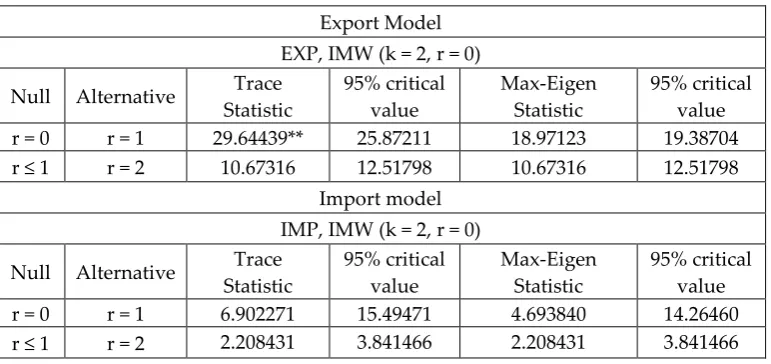
and Juselius test. The results of the cointegration test are presented in Table 6. Both the Trace and Max-Eigenvalues of the cointegration test reject the null hypothesis of r=0 at the 5% level for the export model. This implies that export and Indonesian migrant workers have a long-run relationship, while the import model does not have a long-run relationship.
TABLE 5: THE RESULTS OF THE KPSS UNIT ROOT TEST
Variable
Level 1st Difference
Intercept Trend and
Intercept Intercept
Trend and Intercept IMW 0.676126** 0.209946** 0.542352** 0.123628 EXP 0.785150* 0.112516 0.125703 0.102264 IMP 0.727607** 0.163041** 0.10779 0.110125 Notes: Asterisks (*) and (**) denote significant at the 1 and 5 % levels, respectively.
TABLE 6. THE RESULTS OF THE JOHANSEN-JUSELIUS COINTEGRATION TEST
Export Model EXP, IMW (k = 2, r = 0)
Null Alternative Trace Statistic 95% critical value Max-Eigen Statistic 95% critical value r = 0 r = 1 29.64439** 25.87211 18.97123 19.38704 r ≤ 1 r = 2 10.67316 12.51798 10.67316 12.51798
Import model IMP, IMW (k = 2, r = 0)
Null Alternative Trace Statistic 95% critical value Max-Eigen Statistic 95% critical value r = 0 r = 1 6.902271 15.49471 4.693840 14.26460 r ≤ 1 r = 2 2.208431 3.841466 2.208431 3.841466 Notes: Asterisk (**) denotes significant at the 5 per cent level.
TABLE 7. THE RESULTS OF THE VECTOR ERROR CORRECTION MODEL Sort-run Long-run
Dependent Variables ∆EXP ∆IMW ECT
p-value Coefficient t-ratio
∆EXP 0.8605 -0.392516 [-3.66487]*
∆IMW 0.5334 -0.365335 [-4.27121]*
Dependent Variables ∆IMP ∆IMW p-value
∆IMP 0.7863
∆IMW 0.1901
Notes: Asterisk (*) denotes significant at the 1 per cent level.
The results of normalized equation:
Table 7 presents the results of the Vector Error Correction Model (VECM). The Wald test results show that neither model has any short-run causality. The results of the ECT imply that both the EXP and IMW equations are significant, which indicates that in the long-run, exports and Indonesian migrant workers have bi-directional causality. Exports may cause IMW, while IMW may cause exports. Moreover, the results of the normalized equation for the export model reveal that Indonesian migrant workers have a negative effect on exports. An increase in the number of Indonesian migrant workers will be followed by a decrease in Malaysia’s exports to Indonesia.
Some arguments are proposed in explaining the negative effect of Indonesian migrant workers on Malaysia’s exports to Indonesia. It is clear that the network effect in business does not play any significant role in Malaysia’s exports to Indonesia since the effect of Indonesian migrant workers on the exports is negative instead of positive, as confirmed by previous studies on developed countries (for instance, Parsons, 2005; Bratti et al., 2012; Aleksynska & Peri, 2012). The role of network in trade is weak when the home and host countries of immigrant workers have cultural similarities (Aleksynska and Peri, 2012). This is the case of Malaysia and Indonesia having a similar language and culture, and Islam as the major religion. Moreover, Indonesian migrant workers are mostly skilled workers. These low-skilled immigrant workers are least likely to have the ability to create business networks (Aleksynska & Peri, 2012).
Moreover, Indonesian migrant workers mainly engage in non-tradable sectors, such as construction, household services and the other services (Table 4). Many Indonesian migrant workers are employed in plantations and the other sub-sectors in agriculture, which are important to Malaysia’s total exports. These export commodities are the least likely to have an impact on Indonesia since Indonesia is not Malaysia’s main trading partner. Malaysia’s export commodities to Indonesia are mainly capital-intensive products, such as mineral fuels and lubricants, and machinery and transport equipment (Table 3). Increasing Indonesian migrant workers in Malaysia may imply that Malaysia has increased its demand for low-skilled labour in a labour-intensive industry for export mainly to their main trading partners, which is not Indonesia. Another possibility is that the Indonesian government may apply an import substitution policy, which reduces Malaysia’s exports to Indonesia.
staying in Malaysia for a long time. This is similar to the findings of Qian (2008) in New Zealand inasmuch as immigrants who have been staying in this country for a long time have adjusted to the local culture. This does not necessarily mean that immigrant workers who do not have any significant effect on imports are not able to consume their home country products at all. This is indicated by the increase in imported foods from Indonesia from 2005 to 2009 (Table 3). Many Malaysians also buy various products from Indonesia via shopping tourism rather than via formal international trade.
CONCLUSION
This study has three objectives. The long-run relationship between Indonesian migrant workers and trade, and the causality between these two variables have been examined in the first and second objectives, respectively. The findings in this study show that Indonesian migrant workers and Malaysia’s exports to Indonesia have a long-run and bi-directional causality relationship; however, this is not the case for the relationship between Indonesian migrant workers and Malaysia’s imports from Indonesia.
The third objective examines the extent to which Indonesian migrant workers influence Malaysia’s external trade. Indonesian migrant workers have a significantly negative instead of positive effect on Malaysia’s exports. This reveals that the network effect does not significantly exist among Indonesian migrant workers in Malaysia. This finding might be due to the similarities in culture between Malaysia and Indonesia, low-skilled Indonesian migrant workers, the immigrants engaging in non-tradable sectors, the import substitution policy in Indonesia, and Indonesia not being Malaysia’s main trading partner. Meanwhile Indonesian migrant workers do not have any significant effect on imports due to the similarities in culture between Indonesia and Malaysia, and the adjustment process of Indonesian migrant workers to the local culture.
This study concludes that Indonesian migrant workers in Malaysia are not an important factor in determining Malaysia’s external trade with Indonesia. Indonesian migrant workers seem to be crucial for Malaysia’s exports to its main trade partners, such as China, Singapore, Japan and the US. Indonesian migrant workers, who are generally low-paid workers, have contributed to the export products of Malaysia to the world market being more competitive.
ACKNOWLEDGEMENT
REFERENCES
Akkoyunlu, S. (2009). Trade, aid, remittances and migration, KOF Swiss Economic Institute Working Papers No. 299, Zürich.
Aleksynska, M. & Peri, G. (2012). Isolating the network of immigrants on trade, Institute for the Study of Labor (IZA) Working Paper No.6941, Bonn.
Asian Development Bank. (2012). Key indicators for Asia and the Pacific, Retrieved from www.adb.org/statistics.
Bratti, M., Benedictis, L. D. & Santoni, G. (2012). On the pro-trade effects of immigrants, Institute the Study of Labor (IZA), Working Paper No.6628, Bonn.
Carbough, R. J. (2007). Is international trade a substitute for migration? Global Economy Journal, 7(3), 1-13.
Department of Immigration, Malaysia. (2012). Foreign workers by countries and sectors.
Department of Statistics, Malaysia. (2011). Data on external trade of Malaysia by countries 1999-2009.
Department of Statistics, Malaysia. (2012). Yearbook of statistics.
Dunlevy, J. A. & Hutchinson, W. K. (2001). The pro-trade effects of immigration on American exports during the period 1870 to 1910, Vandablit University Working Paper No.1-W25, Vandablit.
Economic Planning Unit. (2012). The Malaysian economy in figures 2012. Retrieved from http://www.epu.gov.my/meif2012
Gaston, N. & Nelson, D. R. (2013). Bridging trade theory and labour econometrics: The effects of international migration, Journal of Economic Surveys, 27(1), 98-139.
Gould, D. M. (1994). Immigrant links to the home country: empirical implications for U.S. bilateral trade flows, The Review of Economics and Statistics, 76(2), 302-316.
Hijzen, A. & Wright, P. W. (2010). Migration, trade and wages, Journal of Population Economics 23(4), 1189-1211.
International Monetary Fund. (2012). World economic outlook database (WEO). Retrieved from http://www.imf.org/external/data.htm.
Kwiatkowski, D., Phillips, P. C. B., Schmidt, P. & Shin, Y. (1992). Testing the null hypothesis of stationarity against the alternative of a unit root; how sure are we that economic time series have a unit root?, Journal of Econometrics, 54(1-3), 159-178.
Lung, M. N. (2008). The impact of international migration on international trade: An empirical study of Australian migrant intake from Asian countries. PhD Thesis. Victoria University, Melbourne, Australia.
Parsons, C. (2005). Quantifying the trade-migration nexus of the enlarge EU. A comedy or errors of much ado about nothing? Sussex Centre for Migration Research Migration, Working Paper No. 27, Sussex.
Piperakis, A. S. (2011). The impact of immigration on EU-15 trade, The International Trade Journal, 25(5), 558-580.
Qian, M. (2008). The Economic relationship between trade and immigration in New Zealand. Integration of immigrants programme, Massey University Albany, University of Waikato, Working Paper No. 1, Waikato.
Tai, S. H. T. (2009). Market structure and the link between migration and trade, Review of World Economics, 145, 225-249.
Wagner, D., Head, K. & Reis, J. C. (2002). Immigration and the trade of provinces, Scottish Journal of Political Economy, 49(5), 507-525.