Privacy Law
Volume 17
Issue 1
Journal of Computer & Information Law - Fall
1998
Article 2
Fall 1998
Patenting Computer Science: Are Computer
Instruction Writings Patentable?, 17 J. Marshall J.
Computer & Info. L. 5 (1998)
Allen B. Wagner
Follow this and additional works at:
http://repository.jmls.edu/jitpl
Part of the
Computer Law Commons
,
Intellectual Property Law Commons
,
Internet Law
Commons
,
Privacy Law Commons
, and the
Science and Technology Law Commons
http://repository.jmls.edu/jitpl/vol17/iss1/2
This Symposium is brought to you for free and open access by The John Marshall Institutional Repository. It has been accepted for inclusion in The John Marshall Journal of Information Technology & Privacy Law by an authorized administrator of The John Marshall Institutional Repository.
Recommended Citation
ARE COMPUTER INSTRUCTION
WRITINGS PATENTABLE?
by
ALLENB.
WAGNERtI. INTRODUCTION
This paper opposes the IBM/PTO' proposal to patent (as an article of manufacture) computer instruction fixed on computer readable media (so called media or Beauregard claims). The juridical issue raised is whether patents are limited to the utilitarian embodiment of inventions (the instructed machine) or may be extended to include mere symbolic expression (the machine instruction) fixed in a tangible medium.
We argue (a) patenting symbolic expression breaches the intellectual property premise prohibiting property interests in mere abstract ideas, by avoiding both copyright merger and patent preemption doctrines, and (b) contrary to the PTO analysis, patents and copyrights are mutually exclusive statutory interests with no overlap in "abstract expression" subject matter.
On the practical side, we contend media claims provide an unjust enrichment and competitive advantage to computer manufacturers over software companies by allowing (a) a second compensation demand for an already licensed use (i.e., two payments for one invention embodi-ment), and (b) hardware industry dominance over independent software
development.
t © 1998 Oracle Corp. and Allen B. Wagner, all rights reserved, by Allen Wagner, Associate General Counsel, with the dedicated support and assistance of Special Counsel Katja DeGroot. We express our deep appreciation and commend this writing to the many members and friends at KIPO, JPO, EU, EPO, UKPTO and PTO, who selflessly contrib-uted their time, inspiration and questions to our understanding. The views expressed herein are not necessarily those of Oracle Corp.
In examining the media claim issue, we noticed it was the progeny of a deeper continuing uncertainty over the patentability of computer sci-ence ingenuity in general. Seeking to understand the former, we were drawn into considering the latter and offer our observations and com-mentary on it, which now comprises the major portion of this paper. Spe-cifically, using the Cartesian division of reality into objective and subjective realms, we demonstrate how (a) natural science ingenuity lies in the abstract solution to objective problems, thus having measurable physical impact which is used to determine patentability, while (b) com-puter science ingenuity lies in the abstract solution to abstract problems, having no causal impact upon the objective realm.
We offer the Cartesian divide perspective to understand the continu-ing juridical confusion over the application of patent law to computer sci-ence advancements. We note the critical issue raised is physical novelty, which serves to assure the fundamental premises of our intellectual property jurisprudence (i.e., that there be nothing taken from the public domain and that there be no property interest in mere ideas). We sug-gest novel utility in the objective realm as a reasonable alternative stan-dard for patenting computer science ingenuity, while maintaining the same premises.
As part of our explanation we note novel utility would resolve the United States Supreme Court decisions (a) placing mere mechanization of mathematical algorithms in the public domain, and (b) equating natu-ral science principles with mathematical algorithms. The question raised is whether computer science ingenuity is to be given parity to nat-ural science ingenuity in patenting as well as preemption; novel utility is viewed as a means to do so.
Part II, Intellectual Property Fundamentals: Can an Idea be
Owned?, reviews the fundamentals, introduces a Cartesian perspective
and concludes there is no property interest over mere abstract ideas or scientific principles; though abstract expressions of ideas are copyright-able and utilitarian embodiment of inventive conceptions are patentcopyright-able. Part III, The Abstract Nature of Computer Science, explores the ab-stractions of computer science by reviewing the Turing machine, the the-ory of algorithms and the difference between digital and analog computation, and by comparing computer science ingenuity (abstract lutions to abstract problems) with natural science ingenuity (abstract so-lutions to concrete problems).
algo-rithms analogous to scientific principles in patentability as well as pre-emption? A fundamental question arises in this discussion; that is, will the ingenuity of a computer scientist be given parity with the ingenuity of a natural scientist?
Part V, Are Computer Programs on Media Patentable?, offers our ar-guments on the issue we initially set out to discuss.
Finally, Part VI, Concluding Comments, offers our closing remarks.
II. INTELLECTUAL PROPERTY FUNDAMENTALS: CAN AN IDEA BE OWNED?
The institution of property has interested social philosophers in part, at least, because it raises issues ofjustice.... [Bjecause it discrim-inates between rights and fortune, it invites moral criticism and the demand for justification.
Many of the classical accounts of the origin and function of private property have taken for granted that in nature all things were held 'in common. This phrase, however, is ambiguous, for it often meant not a system regulating the use of goods by general agreement but a condi-tion where, there being no rules, everything was res nullius (a thing belonging to no one) and the concept 'property' was consequently irrele-vant. How, then, it was asked, would men come to appropriate the land and its fruits? How could such appropriation be justified? What would be rational grounds for claiming exclusive possession?2
A. OuR COMMON LAW HERITAGE
Property is the de jure right to exclude others from use of its subject matter.3 Under the common law only tangible stuff was the subject of property; that is, you could exclude others from using your stuff but had no right to interfere with the use of other people's stuff. Thus, the subject
matter and possessory interest of common law property were congruent
and there were no exclusive rights associated with intangible ideas. Eve-ryone had the positive right to make, use or sell his/her discoveries or inventions.4 However, this right passed to the public when one
permit-2. THE ENCYCLOPEDIA OF PHILOSOPHY, 6 PROPERTY 491 (Macmillan, reprint ed. 1972). 3. See Cal. Civ. Code § 654 (West 1982). Ownership of a thing is the right of one or more persons to possess and use it to the exclusion of others. Id. In this Code, the thing of which there may be ownership is called property. Id.
4. Bauer v. ODonnell, 229 U.S. 1, 10 (1912).
ted the idea's public use.5
A common law inventor could secret a new idea to maintain a de
facto exclusivity; but another who lawfully came upon it possessed the
same positive right and ability to dedicate it to the public. Thus, every-one had the right to possess and practice their ideas and no every-one had the negative right to exclude use by others.6 This common law heritage con-tinues today as the trade secret law (state law) alternative to the federal patent system.7
Common law copyright was likewise limited to the tangible medium in which an expression was fixed, i.e., transferring the medium contain-ing one copy transferred the right to unlimited reproduction because there was no separate intangible subject matter property.8
B. INTELLECTUAL PROPERTY'S CARTESIAN DICHOTOMY
Modern intellectual property rewards the creative fruit of intellec-tual curiosity with a separate (subject matter) property status; however, its possessory interest remains physical. There are two fundamental ju-ridical premises applicable to this new intellectual property. First, noth-ing may be removed from the public domain; that is, an inventor or author may only get a property interest in what s/he contributes to the public domain. This is generally satisfied by the novelty (subjective and objective) requirement. Second, preemption of scientific principle or ab-stract idea is prohibited; that is, all abab-stract ideas and scientific princi-ples, as a portion of the storehouse of knowledge, remain available to the intellect and industry of us all.
So, (i) property remains the de jure right to exclude use of the subject by others, but now (ii) the subject may be tangible (for stuff you own) or intangible (to interfere with stuff owned by another); however, (iii) the
possessory interest is always and only over objective stuff and may not
5. See Wilson v. Rousseau, 45 U.S. (4 How.) 646, 674 (1846).
At common law, the better opinion, probably, is, that the right of property of the inventor to his invention or discovery passed from him as soon as it went into public use with his consent; it was then regarded as having been dedicated to the public, as common property, and subject to the common use and enjoyment of all.
Id.
6. See Gaylor v. Wilder, 51 U.S. (10 How.) 477, 494 (1850). "Now the monopoly
granted to the patentee is for one entire thing; it is the exclusive right of making, using, and vending to others to be used, the improvement he has invented, and for which the patent is granted. The monopoly did not exist at common law. . .." Id. at 494.
7. See generally Kewanee Oil Co. v. Bicron Corp., 416 U.S. 479 (1984); Sinclair v. Aquarius Electronics Inc., 42 Cal. App. 3d 216, 223-25 (1974).
8. See Pushman v. N.Y. Graphic Soc., Inc., 39 N.E.2d 249 (1942). See also 17 U.S.C.
preempt principle or idea and may not remove anything from the public domain.
Rene Descarte's division of reality into subjective (mental, intangi-ble) and objective (physical, tangiintangi-ble) realms (the Cartesian divide) pro-vides a useful context for examining intellectual property whose subject matter is abstract (mental conception or expression) but whose
posses-sory interest applies only to others stuff.
C. PATENTS
Patents provide an intellectual property right; that is, a patentee may exclude others from making or using embodiments (objective realm) of an inventive conception (subjective realm). Embodiment is an objec-tive manifestation, that is, to invest with a physical body.9 Patents pre-clude the embodiment of inventive conceptions by others. That is, while the subject of patent protection is an abstract inventive idea, patent's
possessory interest is limited to its tangible embodiment by others. The
patentee's common law right to possess and practice the invention with his/her own stuff remains intact, subject to any prior patent of another. Patents provide only a negative right to interfere with the use of others' stuff when embodying a patented invention. They provide no pos-sessory interest or right over any disembodied conception.
This limitation can be seen (i) in the patent statute subject matter provision: machines, articles and compositions are all tangible objects, and processes or methods have always been confined to the manipulation or transformation of objects,'0 (ii) in the statute's exclusionary right pro-vision: allowing a patentee to prevent embodiment or use by others,1 1 and (iii) in the judicial decisions prohibiting patents on (a) a mere ab-stract idea (i.e., patentable conception must comprise a useful (objective) implementation of the idea),12 or (b) a fundamental principle or mathe-matical algorithm (i.e., patents are limited to a useful application of prin-ciple or algorithm).13 Thus, a patent's possessory interest covers the
9. WEBSTER'S NEW INT'L DICTIONARY 739 (3d ed.1993).
10. 35 U.S.C. § 101 (1984); see In re Schrader, 22 F.3d 290, 293-95 (Fed. Cir. 1994)
(process patentable if the series of steps transform or manipulate data or signals represent-ing or constitutrepresent-ing physical activity or objects); but see Gottschalk v. Benson, 409 U.S. 63,
71 (1972) (the contrary is not yet foreclosed).
11. 35 U.S.C. § 271(a) (1984) (prohibiting the unauthorized making, using or selling of
a patented invention). See generally 5 DONALD CHISUM, CHISUM ON PATENTS §§ 16.01-16.02
(1997).
12. See Rubber-Tip Pencil Co. v. Howard, 87 U.S. 498, 507 (1874) ("An idea of itself is not patentable, but a new device by which it may be made practically useful is.").
13. See LeRoy v. Tatham, 55 U.S. 156, 175 (1852) ("A principle, in the abstract, is a
objective embodiment, by others, of the invented conception, but may not preempt abstraction or preclude use of any principle or algorithm.
However, since patents are limited to useful inventions and the
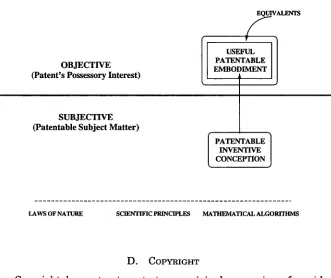
dis-tinction between subjective conception and objective embodiment is so bright a line, patents enjoy (i) dominion over embodiments using equivalent elements, so long as all elements of the invented conception are present (as claimed or by equivalence),14 as well as (ii) dominion over subsequent independent development. FIGURE 1 DISPLAYS THIS
CARTE-SIAN VIEW.
Figure 1: PATENTS
OBJECTIVE (Patent's Possessory Interest)
SUBJECTIVE (Patentable Subject Matter)
LAWS OF NATURE SCIENTIFIC PRINCIPLES MATHEMATICAL ALGORITHMS
D. COPYRIGHT
Copyright by contrast protects an original expression of an idea when fixed in a tangible medium.'5 Expression is symbolic representa-tion;16 that is, a token is being given a meaning beyond its physical
na-14. See Warner-Jenkinson Co. Inc. v. Hilton Davis, 117 S. Ct. 1040 (1997). 15. See 17 U.S.C. § 102(a) (1984).
16. 17 U.S.C. § 101 (1984) (defining literary works as those expressed in words,
num-bers, or other verbal or numerical symbols or indicia). See also WEBSTER'S NEW INT'L
ture. That additional meaning is abstract. So, both an idea and its expression are abstractions (which are why they're often difficult to dis-tinguish). Thus, while the subject of copyright protection is abstract ex-pression (independent of the physical medium), its possessory interest is limited to the medium in which the symbols are fixed.
To preclude preemption of ideas, the copyright statute expressly ex-cludes any idea, procedure, process, system, and method of operation,
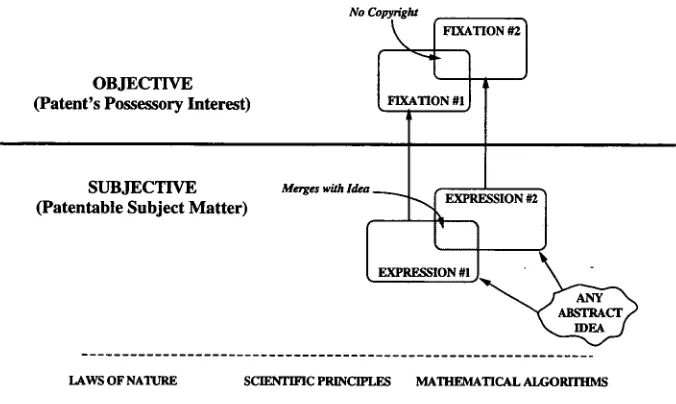
con-cept, principle, or discovery from copyright protection.17 So ideas must be distinguished from their expression. But since the distinction be-tween idea and expression is not a bright line, where alternative expres-sion is prevented, expresexpres-sion merges into idea and copyright is denied.'8
Thus, copyright is certain only if alternative expression is certain. FIGURE 2 DISPLAYS THIS CARTESIAN VIEW.
Figure 2: COPYRIGHT
OBJECTIVE
(Patent's Possessory Interest)
SUBJECTIVE
(Patentable Subject Matter)
LAWS OF NAIURE SCIENTIFIC PRINCIPLES MATHEMATICAL ALGORITHMS
So at this time, in this Cartesian culture, while the subject of prop-erty may be an abstract expression or conception; ideas, principles and
17. 17 U.S.C. § 102 (b) (1984). See also Baker v. Seldon, 101 U.S. 99 (1879) (copyright subsists in a work's expression and not the underlying ideas).
18. This merger doctrine is reflected in 17 U.S.C. §102(a) (1984) (codifying Baker v.
Seldon, 101 U.S. 99 (1879) (excluding "any idea, procedure, process, system, method of
mathematical algorithms remain outside property's possessory interest, available to the intellect and industry of all, beyond anyone's ownership.
III. THE ABSTRACT NATURE OF COMPUTER SCIENCE [Flundamentally, computer science is a science of abstraction-creating the right model for a problem and devising the appropriate
mechaniz-able techniques to solve it.
Every other science deals with the universe as it is. The physicist's job, for example, is to understand how the world works, not to invent a world in which physical laws would be simpler or more pleasant to fol-low. Computer scientists, on the other hand, must create abstractions of real-world problems that can be represented and manipulated inside a [digital process] computer.' 9
From the beginning, some declared computer science a literary art, while others proclaimed it a technical science, but under either view computer science regards modeling the use and operation of a digital pro-cess computing device.
Modeling computing devices has been with us since invention of the abacus 5,000 years ago in Babalonia. More recent useful devices include the slide rule (1614), Pascal's digital adding machine (1642), Jacquard's loom (1804), Babbage's analytical engine (1834), Scheutz's working dif-ference engine (1853), the punched card tabulator (1890), Bush's differ-ential analyzer (1930), Philbrick's Polyphemus (the first fully electronic analog computer, 1938), and the Atanasoff-Berry's electronic digital com-puter (1942).20 Each device uses some technique of modeling a logical
problem for mechanized computation.
The modem electronic digital computer2' represents a distinctive paradigm shift in the nature and role of such devices. Digital computers use a two-digit binary number system to compute functions and decide
19. A.V. AHo & J.D. ULLMAN, FOUNDATIONS OF COMPUTER SCIENCE 1 (1992).
20. See generally TmE-LIFE BOOKS, UNDERSTANDING COMPUTERS, ILLUSTRATED CHRO-NOLOGY AND INDEX, FIFTY CENTURIES OF COMPUTING (1985).
21. See ANTHONY RALSTON & EDWIN D. REILLY, ENCYCLOPEDIA OF COMPUTER SCIENCE
434 (3d ed. 1993), stating:
A digital computer is a machine that will accept data and information presented to
it in its required form, carry out arithmetic and logical operations on this raw material, and then supply the required results in an acceptable form .... The sequence of the operations required to produce the desired output must be accu-rately determined and specified by people known as system designers (or analysts)
and programmers .... The main characteristics of the computer are that it is
automatic, general purpose, electronic, and digital.
predicates. To understand the elegant simplicity and distinct nature of digital computing we briefly review the Turing machine and the theory of algorithms, then compare digital to analog computing and, finally, we distinguish the computer science abstract logical model from its comput-ing algorithm and compare computer science comput-ingenuity to natural sci-ence ingenuity.
A. THE TURING MACHINE AND THE DIGITAL COMPUTER
Alan M. Turing (1912-54)22 was a brilliant British logician and mathematician whose contribution to computation would be difficult to overstate. In 1935 his interest and attention focused upon mathematical logic and in 1937 he published his celebrated paper introducing the con-cept of a Turing machine.
A Turing machine ... consists of (1) a control unit which can assume any one of a finite number of possible states; (2) a tape, marked off into discrete squares, each of which can store a single symbol, taken from a finite set of possible symbols; and (3) a read-write head, which moves along the tape and transmits information to and from the control unit (figure omitted).
The Basic Model: A Turing machine computes via a sequence of discrete steps. Its behavior at a given time is completely determined by the symbol currently being scanned by the read-write head, and by the in-ternal state of the control unit. On a given step, it will write a symbol on the tape, move along the tape one square to the left or right, and enter a new internal state. The new symbol is permitted to be the same as the current symbol; similarly, it is permissible to stay on the same tape square on a given step and/or to reenter the same state. Certain symbol state situations may cause the machine to halt...
The program of a Turing machine defines its action for the various state-symbol combinations that are possible....
... As is often the case, the algorithm is best thought of as an exercise
in symbol manipulation rather than as arithmetic.2 3
Since it is not an actual machine or device, it might better be called a Turing program or concept. It is an abstract mathematical notion of how problems can be solved in a binary number system; that is, a system of only two symbols, zero and one. A square on the tape being read may be a "1," a "0," or blank. In combination with the control unit's internal state (one of a finite number of states), the symbol read on the tape deter-mines (i) whether the machine writes a zero or a one, (ii) whether it shifts left or right, and (iii) what will be the next state of the control unit. The total number of available discrete operations is the product of
ble control unit states times tape states; although the machine only writes a zero or a one and only moves one space right or left. An incredi-bly simple set of operations.
In practical effect an electronic digital process computer is a Turing machine, that is, it manipulates binary numbers, changing zeros to ones and ones to zeros. However, an electronic computer performs billions of such operations every second; and by breaking complex computation down into a finite set of such simple symbol manipulations, the modern electronic computer provides incredible computation ability.
B. THE THEORY OF ALGORITHMS:
COMPUTING FUNCTIONS & DECIDING PREDICATES
A computer program is an algorithm for manipulating binary number digits. An algorithm is a precisely stated set of steps to solve a computation.
In the theory of computation, one is mainly concerned with algorithms that are used either for computing functions or for deciding predicates. A function f with domain D and range R is a definite correspondence by which there is associated with each element x of the domain D (referred to as the "argument") a single element f(x) of the range R (called the "value"). The function f is said to be computable (in the intuitive sense) if there exists an algorithm that, for any given x in D, provides us with the value fx) ....
A predicate P with domain D is a property of the elements of D that each particular element of D either has or does not have. If x in D has the property P, we say that P(x) is true; otherwise we say that P(x) is false. The predicate P is said to be decidable (in the intuitive sense) if there exists an algorithm that, for any given x in D, provides us with a definite answer to the question of whether or not P(x) is true .... The computability of functions and the decidability of predicates are very closely related notions because we can associate with each predi-cate P a function f with a range {0, 11 such that, for all x in the common domain D of P and f, ffx) = 0 if P(x) is true and fRx) = 1 if P(x) is false. Clearly, P is decidable if and only if x is computable .... 24
So, a computer program provides a precise set of instruction for de-termining which manipulation (from a finite set) to conduct for each step of the process. The instruction is always in the same form, that is, if (a),
do (x).
The Church-Turing thesis states, any computation solvable by a pre-cisely stated set of instruction (i.e., an algorithm) can be run on a Turing machine (or digital process computer).
C. DISTINGUISHING DIGITAL AND ANALOG COMPUTING
A computer may be either digital or analog. The two types do have some principles in common, but they employ different types of data rep-resentations and are, in general, suited to different kinds of work. Digi-tal computers are so called because they work with numbers in the form of separate discrete digits. More precisely, they work with information that is in digital or character form, including alphabetic and other sym-bols as well as numbers.
In a digital machine, the data, whether numbers, letters, or other sym-bols, is represented in digital form. An analog computer, on the other hand, may be said to deal with a[n analogy] of the problem, in which the variables are represented by continuous physical quantities such as an-gular position and voltage .... Using familiar devices, we could say that a slide rule is an analog device because numbers are represented by linear length. The abacus, on the other hand, is a digital device, because movable counters are used for calculating.
Digital computers differ from analog computers much as counting dif-fers in principle from measuring. Both type of machine employ electric currents, or signals, but in the analog system, a number is represented by the magnitude (e.g., voltage) of a signal, whereas, in a digital com-puter, it is not the magnitude of signals that is important, but rather the number of them, or their presence or absence in particular posi-tions. Analog computers tend to be special-purpose machines2 5 designed for some specific scientific or technical application .... In commercial and administrative data processing and for mathematical computation, we are concerned almost exclusively with digital computers.2 6
The input to an analog computer is a direct and continuous measure-ment of a scientific principle's impact upon an objective physical circum-stance. The analog computer creates an electronic analogy to the changing physical phenomena. This functional relationship between physical phenomena and the operation of an analog computer is critical to our discussion, because it distinguishes a digital from an analog com-puter; that is, the difference between direct measurement of value and counting or manipulating symbols.
Digital computation is symbol manipulation, it has no causal rela-tionship to objective phenomena or scientific principles. Digital com-puters change symbolic zeros and ones by flipping the state of a circuit on/off. Thus, while analog computing is directly and functionally
depen-25. See In re Alappat, 33 F.3d 1526 (Fed. Cir. 1994). When the Court of Appeals for the
Federal Circuit suggests a programmed general purpose digital computer is a special pose computer for the functionality of the program instruction it cannot mean special pur-pose computer as used to describe an analog computer, for digital computing does not
become analog computing by mere programming. Id. at 1545.
dent upon application of scientific principle to physical phenomena, the operation of a digital process computer is completely independent of both.
D. ABSTRACT MODELS, ALGORITHMS AND INGENUITY
Computer science creates an abstract logical model of a practical problem expressible as an algorithm to calculate functions and deter-mine predicates. A two-digit binary number system is used to map the algorithm's symbol manipulation (across the Cartesian divide) to the on! off operation of electronic circuit processing. The logical model itself is a
symbolic allegory distinct from the physical process of a computer
execut-ing instructions; that is, no physical analog exists between the logical model and what occurs within the computing device. Unlike natural sci-ence, where inventive conception is confined to the objective application of scientific principles, an instructed computer (as such) does not mani-fest the conceived logical model or the practical use of the calculation result. Indeed, all the usefulness of computer science ingenuity lies hid-den in the subjective meaning of the symbols and simply doesn't occur until the computed result is applied to the context of the question solved. A natural scientist applies physical science to physical phenomena; that is, s/he conceives solutions to concrete (objective) problems. The computer scientist assigns meanings to symbols (the abstract model) and develops the steps (algorithm) of a symbol manipulating process; that is, s/he conceives solutions to abstract problems.
The significant differences between natural science and computer science are: (i) process computation is an abstract principle that does not occur in nature, (ii) process computation is independent of the physical form or mechanism used (i.e., symbol manipulation is as accurately ac-complished with beer cans and ping pong balls as with CPUs and memo-ries); and (iii) natural science principles are several and immutable, while computer science is premised upon a single mutable principle-the
flexible algorithm of instruction.
IV. COMPUTER SCIENCE AND INTELLECTUAL PROPERTY LAW A. THE IssuE RESTATED
Computer science provides a gateway to the Information Age, but it also vexes the intellectual property system of our Industrial Revolution. Patents were established to protect the utilitarian application of natural science to industrial technology. Copyrights evolved to protect non-utili-tarian (literary/aesthetic) symbolic expressions. Yet, computer science has both utilitarian and symbolic aspects.
Natural science ingenuity lies in the selection and application of sci-entific principles to natural phenomena. The physical changes produced are measured for novelty; ingenuity in selection is evaluated against what is obvious to an artisan; and if new, useful and non-obvious, a pat-ent is available.
Computer science ingenuity lies in modeling a practical question into a process computation dichotomy and in writing a script of instruc-tion. The logical model is allegorical and distinct from the encoded pro-cess or its mechanization, that is, there is no physical analog between the logical model and what occurs or exists within a computing device. So, computer science ingenuity does not cause change to physical phenom-ena, since no causal relationship crosses the Cartesian divide.
As the review below will show, this computer science and natural science difference raises several new patent issues, including:
1. Is encoded machine instruction patentable, per se; and if not, is an instructed machine patentable?
2. Since utility does not occur until a computation result is applied to a practical problem, is encoded instruction or instructed machine pat-entable apart from the context of its use?
3. Assuming a useful context, is computer science ingenuity suffi-cient or is physical novelty always necessary; that is, is computer science merely a permissible but irrelevant adjunct to natural science ingenuity? 4. May the context or practical use be mere information processing? 5. Do our property law premises (i.e., nothing removed from the public domain, no property in mere abstract ideas and possessory inter-ests limited to physical stuff) limit the available interinter-ests?
At the end of the day, the question is, will the ingenuity of a com-puter scientist be given parity with natural science ingenuity, and if so, how may our property law premises be maintained?
B. COPYRIGHT DISAMBIGUATION
Copy-right Amendment resolved this issue by recognizing the expressive nature of the program, assuring it copyright protection.2 7
But those re-lying on copyrighted expression eventually found they had inadequate protection,28 for computer science ingenuity lay in the logical model, not its expressed instruction and copyright provides no interest over subse-quent independent development.
C. PATENT'S EARLY CONTEXT
As suggested by a (Vice President of IBM) member of the President's Commission on the Patent System, a 1966 Commission report, "To
Pro-mote The Progress of... Useful Arts" In An Age of Exploding Technology,
recommended the patent statute be amended to provide:
A series of instructions which control or condition the operation of a data processing machine, generally referred to as a 'program,' shall not be patentable regardless of whether the program is claimed as: (a) an
article, (b) a process described in terms of the operations performed by a
machine pursuant to a program, or (c) one or more machine configura-tions established by a program.
The amendment was never enacted, notwithstanding repeated at-tempts; however, with such an introduction a struggle over patentability was predicable.
D. THE UNITED STATES SUPREME COURT COMPUTER SCIENCE DECISIONS
1. Benson-Liberates Mechanized Process Computing
Quoting the 1966 Presidential Commission Report, the 1972 United States Supreme Court Gottschalk v. Benson decision held a method for converting binary-coded decimal numerals into pure binary numerals in a general purpose digital computer, was an unpatentable preemption of a mathematical algorithm.29 The claimed process was not limited to any
27. THE FINAL REPORT OF THE NATIONAL COMMISSION ON NEW TECHNOLOGICAL USES OF
COPYRIGHTED WORKS (1978) [hereinafter CONTU] (concluding copyright is the appropriate mechanism for protecting computer software). The Computer Software Copyright Act of 1980 (Act of Dec. 12, 1980, Pub. L. 96-517, § 10, 94 Stat. 3015) incorporated CONTU by amending 17 U.S.C. § 101 (1984) to include a definition of computer program, and by ad-ding 17 U.S.C. § 117 (1984), the right to make interim copies. The copyright statute al-ready allowed literary works (17 U.S.C. § 102(a) (1984)) defined as verbal or numerical
symbols or indicia, regardless of the nature of the material objects (17 U.S.C. § 101 (1984)). See H.R. Rep. No. 1476, 94th Cong. 2d Sess. 54 (1976). See also The Computer Software
Copyright Act of 1980, Act of Dec. 12, 1980, Pub. L. 96-517, § 10, 94 Stat. 3015, and the accompanying House Report, H.R. Rep. No. 96-1307, Part 2, 96th Cong., 2d Sess. (1980) p.19, (applying the 1976 Act to computer programs).
28. See, e.g., Lotus Dev. Corp. v. Borland Int'l Inc., 116 S. Ct. 804 (1996) (menu com-mand hierarchy non-copyrightable method of operation).
art or technology, apparatus or machinery, or particular end use, and purported to cover any use of the method in any general purpose digital computer.3 0
The Court recited several precedents holding (i) scientific truths, mathematical expressions, mere ideas and natural phenomena were un-patentable;3 1 and (ii) transformation and reduction of an article "to a
dif-ferent state or thing," is the clue to patentability of a process claim that does not include particular machines.32 Yet the Court tempered the lat-ter (but not the former) cases by concluding:
It is argued that a process patent must either be tied to a particular machine or apparatus or must operate to change articles or materials to a "different state or thing." We do not hold that no process patent could ever qualify if it did not meet the requirements of our prior prece-dents .... What we come down to in a nutshell is the following.
It is conceded that one may not patent an idea. But in practical effect that would be the result if the formula for converting BCD numerals to
pure binary numbers were permitted in this case. The mathematical formula involved here has no substantial practical application except in connection with a digital computer, which means that if the judgment below is affirmed, the patent would wholly pre-empt the mathematical formula and in practical effect would be a patent on the algorithm
itself.3 3
2. Benson & Mechanized Process Computation
Benson included only process claims to an abstract algorithm
(although one claim did include shift registers),3 4 but does it apply to a
machine programmed with an algorithm?
Benson's preclusion of patenting mathematical algorithms seems
reasonably premised. Consider removing just one mathematical formula from all others. The probability any problem would be denied reasonable solution seems small. Indeed, perhaps several formulas could be re-moved without denying solution to any problem; but how many before probabilities intersect and new practical uses are denied process comput-ing? Addressing this very issue the Court held every known or unknown process computing algorithm is analogous to a principle of natural sci-ence, patentable only in non-preemptive practical uses. Thus, the Court placed all computing algorithms into the storehouse of knowledge avail-able to the intellect and industry of all.
30. Id. at 64. 31. Id. at 67-69.
32. Id. at 69-72 (emphasis added). 33. Id. at 71-72.
But if an algoiithm provides faster computer processing, shouldn't its computer embodiment be patentable as an improved computing machine, or would that constitute preemption? Some argue computing is advanced by an algorithm no less than when a new circuit design is pat-ented. However, the principles of operating a computer are unchanged by the algorithm being processed, that is, there is no change in physical processing speed, efficiency or function, only a change in the computa-tional steps taken to determine a value. Furthermore, circuit designs do not preempt principle or algorithm. Such patents protect only an in-vented circuit, stated in terms of the physical laws applied to its electric components, not as an abstract calculating logic or all other circuit use of it. By contrast, a digital computer patented in terms of an algorithm would prevent use by all computer architectures (known or later devel-oped), in all computer languages, for all utilities, that is, it preempts computer use of the algorithm.
Theoretically there are endless ways to a mathematical value, one algorithm is only one way; but it is a specific way, demonstrating a com-putational truth in abstract relationship. Since much of objective reality may be logically modeled by computing truths, patenting an algorithm based upon its application to one objective circumstance unjustly removes it from the public domain, if doing so denies use to other circum-stances. An algorithm may conveniently express a truth of an invention, but it is not the substance of the invention until the context of its
practi-cal use is revealed; and that is the most an inventor can be said to
provide.
The algorithm concern expressed in Benson was focused upon a com-puter program. However, as Justice Douglas acknowledged, the only
practical use of such algorithms is in a mechanical computing device;
and, patenting that mere mechanized performance of an algorithm was the objectionable preemption. So, merely programming a computing de-vice and calling it a novel patentable machine3 5 seems patently
inconsis-35. Some suggest In re Alappat, 33 F.3d 1526 (Fed. Cir. 1994), stands precisely for that, however, the facts in Alappat belie that claim. While some of the court's language is
ambiguous; see, e.g.:
[C]laim 15 would read on a general purpose computer programmed to carry out the claimed invention .... We have held that such programming creates a new machine, because a general purpose computer in effect becomes a special purpose computer once it is programmed to perform particular functions pursuant to in-structions from program software.
Id. at 1545.
[Tihe proper inquiry... is to see whether the claimed subject matter as a whole is a disembodied mathematical concept ... which.., represents nothing more than a "law of nature," "natural phenomenon," or "abstract idea."
Id. at 1544.
tent with Benson, the only Supreme Court decision dealing with actual preemption. Mere mechanization is preemptive, the programmed device needs a practical use limitation.
3. Computer Science Embodiment and Utility3 6
If the physical embodiment of an algorithm in a computing device is unpatentable without a utility limitation, the algorithm preemption con-cern in patent law may be analogized to the preemption of idea concon-cern in copyright law.37 As we saw, both an idea and its copyrightable expres-sion are subjective abstractions in the Cartesian divide and their distinc-tion is often difficult; so copyright's doctrine of merger requires the availability of alternative expression to assure ideas are not preempted. Likewise, an unpatentable mechanized algorithm and its patentable
practical use are both objective and their distinction may be difficult, so
patenting could be premised on the nature and availability of alternative
practical uses.
not provide) is mere embodiment of an algorithm in a computing device with no limitation to a practical use; admittedly, the above language can be read to suggest Claim 15 covers a mere programmed computer, as such, even when not designed for use as a rasterizer, but then it would appear inconsistent with Benson, the only Supreme Court decision factually dealing with preemption.
36. The utility requirement of patent law arises from the "useful Arts" limitation of the Constitution. U.S. CONST., art. 1, § 8, cl. 8, provides Congress the power: "To promote the progress of science and useful arts, by securing for limited times to authors and inventors the exclusive right to their respective writings and discoveries." Id. The prevailing view of this balanced provision is that science pertains to authors/writings, while useful arts pertain to inventors/discoveries. See Karl B. Lutz, Patents and Science, 32 J. PAT OFF. Soc'y 83 (1950); Giles S. Rich, The Principles of Patentability, 42 J. PAT OFF. Soc'y 75,
76-80 (1960). The useful Arts had a unitary meaning including: "... .the so-called industrial, mechanical and manual arts of the 18th century, which of course stemmed back to the useful arts of antiquity insofar as knowledge thereof had been handed down or rediscovered." Id. See also Robert I. Coulter, The Field of the Statutory Useful Arts, 34 J.
PAT OFF. Soc'y 487, 496 (1952).
However, the term was intended to specifically broaden the limited British statutory phrase new manufactures, to assure new processes were included. See Karl B. Lutz, Patents
and Science, 32 J. PAT OFF. Soc'y 83, 86 (1950):
The British Statute of Monopolies (1623) permitted patents for "new manufactures" only .... [B]y the year 1787 it was being recognized even in Great Britain that the phrase "new manufactures" was an unduly limited object for a patent system, since it seemed to exclude new processes. [Which was] resolved in the United States Constitution by broadening the field from "new manufactures"
to "useful arts" ....
Id.
While practical use meant any technical application of scientific principle, utility was significant only in its absence; digital process computing, however, may seek utility as a means to confine a patent's scope to prevent preemption.
37. See Parker v. Flook, 437 U.S. 584, 589 (1978) (Stevens, J.) (3 dissentions)
So long as practical use meant the application of a scientific princi-ple, physical embodiment and novelty were assured, and utility was sig-nificant only in its absence (i.e., any use suffices for natural science ingenuity). Physical novelty assures the premises of our intellectual property (i.e., nothing removed from the public domain and no property in mere abstract ideas).
Computer science ingenuity however does not assure physical nov-elty or embodiment; and indeed, as Benson shows, mere embodiment of an algorithm is preemptive, absent a practical use limitation. So for computer science ingenuity, utility is a limitation (not just as a thresh-old, as in natural science). If an instructed computer is preemptive, a
practical use limitation confines a patent and resolves the preemption
concern. And, by limiting patentable computer science ingenuity to a new use of an algorithm, the absence of physical novelty is resolved. Thus, requiring computer embodiment and a novel utility assures the premises of our intellectual property, even though the ingenuity is abstract.
4. Flook-Rejects Computer Science Ingenuity
The Court's 1978 Flook decision held a method for updating alarm limit values for the catalytic conversion of any hydrocarbon was unpat-entable where the only novel feature was the mathematical algorithm used to calculate the values.38 While calculating updated alarm limits was a new step, the Court held all known or unknown mathematical al-gorithms were in the public domain and as such were to be ignored. So
Flook required natural science ingenuity and rejected conventional
post-solution activity even though limited to the physical realm and to a spe-cific (albeit broad) range of end use (thus, it was not preemptive).
Flook would refuse every patent premised on computer science
inge-nuity; that is, it demands traditional physical novelty Also, Flook estab-lished the inadequacy of mere post-solution activity; that is, the use must be a more traditional useful art, not mere information processing.
5. Diehr-An Uncertain Revelation
In Diehr3 9 (1981) the Court again analogized mathematical algo-rithms to unpatentable scientific principles.40 Diehr held an old process for curing rubber which included measuring mold temperature but now
38. Id. at 584.
39. Diamond v. Diehr, 450 U.S. 175 (1981) (Rehnquist, J. ) (4 dissentions).
using a prior known mathematical formula to compute the precise time to open the mold, was traditional patentable subject matter deserving examination.
Diehr distinguished Flook, by noting Flook claimed an algorithm's
use in the abstract without limitation to the objective elements of a pat-entable process, whereas Diehr was so limited. However, by stating, "[ilt is now commonplace that an application of a law of nature or mathemati-cal formula to a known structure or process may well be deserving of patent protection"4 1 and holding, "the 'novelty' of any element or step in a process, or even of the process itself, is of no relevance in determining statutory subject matter."4 2
Diehr cast considerable doubt on Flook's requirement for the
physi-cal novelty of natural science. Yet Diehr favorably cited Flook for the inadequacy of insignificant post-solution activity. So while a use may be old and absent physical invention, it apparently requires more of a tradi-tional useful art than mere insignificant post-solution activity.
To restate, Flook asked if computerizing an old hydrocarbon cata-lytic conversion process with a new formula might be patentable if un-preemptive, and was told no, computer science ingenuity was irrelevant. Three years later, Diehr asked if computerizing a traditional rubber cur-ing process with an old formula might be patentable and was told yes, if stated as a traditional physical process. In Flook, said Diehr, the process was too abstract, lacking sufficient physicality.
6. Are Mathematical Algorithms Analogous to Scientific Principles? In Benson the Supreme Court analogized mathematical algorithms to scientific principles for purposes of preemption and placed them in the public domain, but it has yet to articulate their relationship or the im-pact of their differences.
Scientific principles act only within and directly upon the objective realm. They are known only by their measured and consistent impact upon physical phenomena. Since objectively determined, they are not
subjectively mutable and ingenuity is limited to conception of their objec-tive application.
Process computing, by contrast, does not occur in nature.43 It acts only upon the subjective meanings assigned to tokens, is confined only by its logic or numeric system and is subjectively mutable; indeed, computer science ingenuity is limited to abstract models and has no physical
im-41. Id. (emphasis added). 42. Id. at 188 (emphasis added).
pact until a computing device executes an algorithm of instruction and applies the result to some other useful context.
Application of a scientific principle to a physical structure or process is well known in patent law; it produces an objective measurable event, used to judge novelty and obviousness. Applying a new algorithm, how-ever, may change computation process to enhance speed or provide new
and useful information without changing physical structure, process or result.44 By analogizing mathematical algorithms to scientific principles
did the Court intend parity in patentability as well as preemption?
Flook assumed the formula was novel but the process was old45 and held:
The process itself, not merely the mathematical algorithm, must be new and useful. Indeed, the novelty of the mathematical algorithm is not a determining factor at all. Whether the algorithm was in fact known or unknown at the time of the claimed invention, as one of the "basic tools of scientific and technological work" [citing Benson], it is treated as though it were a familiar part of the prior art.4 6
Flook rejects computer science ingenuity as a basis for patentability.
Not surprisingly, it expressly limits patents to the application of scien-tific principles and requires more than mere post-solution activity.
In Diehr both the formula and process were old and novelty was lim-ited to continuous temperature measurement and computing cure time.47 While limited to determining patentable subject matter where a scientific principle was present but unchanged, Diehr held:
[Wihen a claim containing a mathematical formula implements or ap-plies that formula in a structure or process which, when considered as a whole, is performing a function which the patent laws were designed to protect (e.g., transforming or reducing an article to a different state or thing), then the claim satisfies the requirements of § 101.4 8
The example given by the Court was the traditional application of natural science, however, Diehr suggested physical novelty was irrele-vant: "The "novelty" of any element or step in a process, or even of the
process itself, is of no relevance in determining whether the subject
mat-ter of the claim falls within the § 101 categories of possibly patentable
44. The cases are divisible by the question ofphysicality. Some (e.g., In re Arrhythmia, 958 F.2d 1053 (Fed. Cir. 1992)) find a patentable process or machine incidentally applying a mathematical algorithm. Others reject patentability for lack of any material embodiment (e.g., In re Meyer, 688 F.2d 789 (C.C.P.A. 1982); In re Grams, 888 F.2d 835 (Fed. Cir. 1989);
In re Warmerdam, 33 F.3d 1354 (Fed. Cir. 1994)) (representing no more than mere
manipu-lation of ideas). But what if there is embodiment without any change in scientific principle?
45. Parker, 437 U.S. at 588. 46. Id. at 591-92.
subject matter."49 So, for a claim limited to a function that the patent
laws were designed to protect the Flook requirement of physical novelty
appears to be overruled, sub silentio, by Diehr.
Diehr did continue an uncertain shadow of Flook by citing it as
pre-cedent precluding patents where (a) there is insubstantial post-solution
activity or (b) a formula is merely limited to a particular technological environment. So, practical use is significant to the patentability of
com-puter science ingenuity. If application to a traditional useful art is re-quired, but physical novelty is not, then computer science ingenuity in hastening a known structure or process to a known result, may be pat-entable; but patentability of computer science ingenuity in enhancing in-significant post-solution activity (such as displaying manipulated information on a computer screen, as in today's Information Age) would remain speculative.
Yet, if the premises of intellectual property are assured, there is no apparent reason to deny the recognition and reward of patenting to com-puter science ingenuity. As discussed, requiring mechanization and a novel use limitation assures those premises, allowing the analogy be-tween natural science principles and computer science algorithms in both preemption and patentability; if application of computer science is viewed as a useful art and the Flook shadow removed.
E. THE COURT OF CUSTOMS AND PATENT APPEALS AND COURT OF
APPEALS FOR THE FEDERAL CIRCUIT
ALGORITHM-CENTRIC CASES
The Court of Customs and Patent Appeals (CCPA) and its successor the Court of Appeals for the Federal Circuit (CAFC) decisions followed the Supreme Court's algorithm-centric analysis.
(a) In 1978 pre-Flook, Freeman50 held patentable a process and
machine, computer implemented typesetting system, using a
conven-tional typesetter but not stating a mathematical algorithm. The court asked two questions: does the claim recite an algorithm, and if so, is it wholly preempted?
(b) In 1979 Bradley5' held patentable a computing machine switch-ing system for multi-programmed operation usswitch-ing firmware microcode including a mathematical algorithm that was not part of the claimed in-vention. The court distinguished how a computer works (claimed) from what it does with real world data (not claimed), and was sustained on appeal by a four to four vote of the Supreme Court.
49. Id. at 188-89 (emphasis added).
50. In re Freeman, 573 F.2d 1237 (C.C.P.A. 1978).
51. In re Bradley, 600 F.2d 807 (C.C.P.A. 1979), affd sub nom. Diamond, 450 U.S. 381
(c) In 1980 Walter52 held unpatentable the process and machine com-putational unscrambling of reflected seismic waves, comprising a mathe-matical exercise in the abstract with no substance apart from the
calculations involved.53 Following Flook, mere improved calculation was insufficient for patenting; i.e., there must be a new and useful structure or end. The court changed the Freeman test to ask if an algorithm is applied to structural physical elements or limits process steps; or is merely solved, even if post-solution activity or a preamble field of use limitation is present.
(d) In 1982 Taner54 held patentable an improved process of seismic exploration using simulated seismic wavefronts to determine subsurface formations that included a calculation. Seismic signals were viewed as
physical apparitions and the algorithm was used to transform the physi-cal signals.
(e) In 1982 Abele5 5 held the process and machine for calculation and display (by gray scale shading) of data values in a field, unpatentable where applied to any data (notwithstanding the display step) and patent-able when limited to X-ray attenuation data, since the latter required specific (process) steps beyond mere data gathering. It was a
conven-tional CAT scan process and addition of an algorithm did not render a
statutory process non-statutory. The court modified the Freeman-Walter test to ask only if a claim with an algorithm is otherwise statutory; i.e., applied in any manner to physical elements or process steps and limited by more than a field of use or non-essential post-solution activity.
(M In 1982 Meyer5 6 held unpatentable a process and machine used to test for probable malfunctions in any complex system; the literally de-scribed algorithm was preemptive, where not applied to physical ele-ments or their process steps.
(g) In 1989 Grams5 7 held unpatentable a process to test complex sys-tems; where the literally described algorithm was preempted and the only physical step was gathering data.
(h) Also in 1989 Iwahashi58 held patentable a machine used to
calcu-late auto-correlation coefficients for use in pattern recognition; a com-puter combination of means interrelated by an algorithm operation, where at least one element was a specific component (ROM) did not claim every means, so it was not viewed as a process.
52. In re Walter, 618 F.2d 758 (C.C.P.A. 1980). 53. Id. at 769.
(i) In 1992 Arrhythmia5 9 held patentable a process and machine for analyzing electrocardiograph signals to determine heart activity; using a computer operation to convert input signals to different output signals, a physical thing was transformed; even though all the mathematical pro-cedures were previously known in the abstract.
(j) In 1994 Schrader6 o held unpatentable a process for competitively bidding on a plurality of related items; the literal algorithm was pre-empted where bids were not physical, mere manipulation of data consti-tutes no physical change, effect or result; but the court acknowledged patentability where physicality is involved.6 1
The algorithm was a well known optimization procedure.
There were others, but the above case law fairly represents the fun-damental principles and approaches taken by the intermediate appellate court under the Supreme Court decisions, until 1994.
F. THE 1994 COURT OF APPEALS FOR THE FEDERAL CIRCUIT SHIFT TO A NON-ALGORITHM PERSPECTIVE
After twenty-two years of algorithm-centric analyses, 1994 was a watershed year for a shift in the CAFC perspective on computer science
patentability:
(a) First, a divided in banc Alappat6 2 held an instructed general
pur-pose computer effectively becomes a special purpur-pose computer for per-forming the instructed functions,63 which may support patentability, and questioned the validity of any algorithm-centric consideration of pat-entability beyond a claim for a mere disembodied mathematical
concept.6 4
59. In re Arrhythmia, 958 F.2d 1053 (Fed. Cir. 1992). 60. In re Schrader, 22 F.3d 290 (Fed. Cir. 1994).
61. Id. at 293-95 (acknowledging a computer process is patentable if the series of steps transform or manipulate data or signals representing or constituting physical activity or
objects).
62. In re Alappat, 33 F.3d 1526 (Fed. Cir. 1994). 63. Id. at 1526, 1545 (1994), where the court stated:
We have held that . . . a general purpose computer in effect becomes a special purpose computer once it is programmed to perform particular functions pursuant to instructions from program software.... Consequently, a computer operating pursuant to software may represent patentable subject matter, provided, of course, that the claimed subject matter meets all of the other requirements of Title 35 ....
Id. (emphasis in original).
64. Id. at 1544.
(b) Second, Warmerdam6 5 held unpatentable an abstract process for generating a data structure representing the shape of physical objects as hierarchies of bubbles, but held patentable a claim to any machine con-taining in its memory any data representing an object in one of the de-scribed prior art bubble hierarchies. After accounting for the mathematical algorithm issue, the court concluded the concern of its originators was over abstract ideas and could be satisfied by a physicality requirement; thus, a mere manipulation of mathematical constructs or abstract ideas (i.e., no physical transformation or reduction) in a process was unpatentable, while the machine was physical and definite (enough). The data structure was held abstract like the process.
c) Third, in Lowry6 6 the court held patentable a computer memory
article containing a specific data structure; after finding data structures
impose a physical organization on the data . .. are specific electrical or magnetic structural elements in a memory ... [and] are physical entities that provide increased efficiency in computer operation, the court quoted its pre-Benson Bernhart6 7 holding that programming a computer physi-cally changes its memory elements, and held the PTO failed to show the data structure lack[ed] a new and unobvious functional relationship with
the memory.68 The court also held the printed matter doctrine is limited
claimed subject matter as a whole is a disembodied mathematical concept ... which in essence represents nothing more than a "law of nature," "natural phe-nomenon," or "abstract idea."
Id.
65. In re Warmerdam, 33 F.3d 1354 (Fed. Cir. 1994). 66. In re Lowry, 32 F.3d 1579 (Fed. Cir. 1994).
67. In re Bernhart, 417 F.2d 1395, 1400 (C.C.P.A. 1969). "[Ihf a machine is program-med in a certain new and unobvious way, it is physically different than the machine with-out that program: its memory elements are differently arranged." Id.
68. In Lowry, the court apparently misconstrued computer science by suggesting there may be a new and non-obvious functional relationship between physical memory and a
logi-cal data structure. But no functional relationship ever crosses the Cartesian divide. In re Lowry, 32 F.3d 1579 (Fed. Cir. 1994). Computer science uses an arbitrary, abstract (and quite simple) mathematical concept (developed by Alan Turing) and a mechanical device that conveniently allows a mapped correlation between physical process and mathematical computation. This correlation of process and computation occurs at the interface of the divide but never crosses it. No causal relationship (ergo, no functional relationship) ever crosses the Cartesian divide.
Further, computer science rests upon a consistent and unchanging functional relation-ship between physical memory and the digital signals stored upon it; significantly, physical organization or location of data symbols is totally irrelevant to the computation and to its hidden practical use meaning. So, computer science ingenuity is unavailable and un-recognizable, until that contextual meaning is made known and binds to the process as its utility limitation.
in-to human activity.
(d) Fourth, in Trovato6 9 the court reviewed the algorithm-centric two step test of Freeman-Walter-Abele and the abstract idea manipula-tion test of Warmerdam, to hold unpatentable the process and machine claims of a logical system for calculating the shortest distance between two points in physical space; absent any described specific physical pro-cess or apparatus, the court held it a manipulation of abstract ideas.
However, on July 25, 1995 an en banc court issued a per curiam order
vacating its judgment, setting aside the PTO decision and remanding
Trovato for further consideration in light of Alappat and the pending
PTO Guidelines for computer inventions.70
G. TRANSITION OBSERVATION
Since Benson, we've sought to understand how a process algorithm relates to its computer implementation and application to a function the
patent laws were designed to protect. But such efforts often only renewed
uncertainty in (i) whether computer mechanization alone is sufficient to cover all uses, (ii) where between abstract algorithm and practical use, patentability attaches, and (iii) which practical uses were sufficient, which too much?7 1
Media claims for computer instruction fixed on a computer readable
medium (our target theme) regards patenting expression versus
embodi-ment; which is a question beyond the mathematical algorithm
preemp-tion issue or computer science versus natural science ingenuity raised by the process and machine patents discussed above. However, the media
novative, but its patent application is an attempt to establish ownership over use of an abstract logical construct.
69. In re Trovato, 42 F.3d 1376 (Fed. Cir. 1994). 70. In re Trovato, 60 F.3d 807 (Fed. Cir. 1995).
71. What is a function the patent laws were designed to protect? See Alappat, 33 F.3d
at 1550-68; Chief Judge Archer (in dissent) suggests the majority's opinion will lead to a proliferation of mathematical patents couched in terms of special purpose machines that will be easy to obtain because there is no prior art to judge them:
One might invent or discover a new and useful product or process that includes as an element therein digital electronics performing mathematics .... One might invent or discover a mode of operation of a digital electronic device, capable ulti-mately of being used to perform mathematics .... Or, one might discover a partic-ular mathematic operation and claim the use of digital electronics to perform the mathematical operation .... This last category, however, is at best newly discov-ered mathematics which is not being 'implement[ed] or applie[d] ... in a structure or process which, when considered as a whole,' [Diehr citation] (emphasis added), represents an invention or discovery of a machine or process(as in the case of Diehr) for which one may obtain a patent pursuant to § 101.
Id.