VOLUME NO.5(2015),ISSUE NO.04(APRIL) ISSN 2231-5756
A Monthly Double-Blind Peer Reviewed (Refereed/Juried) Open Access International e-Journal - Included in the International Serial Directories
Indexed & Listed at:
Ulrich's Periodicals Directory ©, ProQuest, U.S.A., EBSCO Publishing, U.S.A., Cabell’s Directories of Publishing Opportunities, U.S.A., Open J-Gage, India [link of the same is duly available at Inflibnet of University Grants Commission (U.G.C.)],
Index Copernicus Publishers Panel, Poland with IC Value of 5.09 & number of libraries all around the world.
Circulated all over the world & Google has verified that scholars of more than 4064 Cities in 176 countries/territories are visiting our journal on regular basis. Ground Floor, Building No. 1041-C-1, Devi Bhawan Bazar, JAGADHRI – 135 003, Yamunanagar, Haryana, INDIA
VOLUME NO.5(2015),ISSUE NO.04(APRIL) ISSN 2231-5756
CONTENTS
Sr.
No.
TITLE & NAME OF THE AUTHOR (S)
Page
No.
1
.
ROBUST FACE IDENTIFICATION USING MOVIE
SUGANYA.C, SIVASANKARI.A & SANGEETHA LAKSHMI.G
1
2
.
IMPACT OF ECONOMIC AND NON ECONOMIC VARIABLES ON CORPORATE GOVERNANCE COMPLIANCE
AND DISCLOSURE PRACTICES OF LISTED AND UNLISTED DEFENCE PUBLIC SECTOR ENTERPRISES IN INDIA
DR. U. PADMAVATHI
4
3
.
IMPACT OF YOGA ON SCHOOL STUDENTS PERFORMANCE: A STUDY
DR. C. ANURADHA, DR. J. ANURADHA & DR. S. GOPALSAMY
12
4
.
A STUDY ON MUTUAL FUND INVESTMENT PERSPECTIVES IN INDIA
S. CHAKRAVARTHI, DR. M SARADADEVI & N.SAIBABU
16
5
.
ADVANCED ESSENTIALS BASED ON AGRICULTURE USING SOLAR TRACTOR WITH WIRELESS SENSOR
NETWORKS
K.DEEPASHREE, G.SANGEETHALAKSHMI & A.SIVASANKARI
19
6
.
AN INVESTIGATION INTO THE DETERMINANTS OF SERVICE QUALITY IN COMMERCIAL BANKS
M. RAMESH, DR. G. VAMSHI & C. SIVARAMI REDDY
24
7
.
THE IMPACT OF ATM SERVICES IN CANARA BANK IN MYSORE CITY
GEETHA S & DR. C S RAMANARAYANAN
28
8
.
A CASE STUDY ON CORPORATE SOCIAL RESPONSIBILITY OF JINDAL STEEL WORK'S LTD, BELLARI
(KARNATAKA)
VENKATESHA K & DR. RAMESH.OLEKAR
32
9
.
A STUDY OF LIQUIDITY AND PROFITABILITY ANALYSIS OF AN INDUSTRIAL UNIT IN ODISHA
JAYASHREE JETHY, SUPRAVA SAHU & MALAY K MOHANTY
37
10
.
TRAINING AND MANAGEMENT DEVELOPMENT FOR PROMOTABILITY IN GHANAIAN ORGANIZATIONS
IDDIRISU ANDANI MU-AZU
41
11
.
CROWD FUNDING AS INVESTMENT TOOL: DISCOVERING SOMETHING ADDITIONAL
REKHA SHARMA & NEHA THAKUR
44
12
.
CHILD SEXUAL ABUSE AND EXPLOITATION: ROLE OF JUDICIARY
DR. MANPREET KAUR
48
13
.
GREEN MARKETING AND MNCs: GO GREEN PROCESS IN INDIA
SEEMA BANGAR
50
14
.
A STUDY STRESS MANAGEMENT AMONG TRAFFIC CONSTABLES WITH SPECIAL REFERENCE TO MYSURU
CITY
DR. A.C.PRAMILA
54
15
.
MARKETING STRATEGIES OF PHARMACEUTICAL COMPANIES IN INDIA: A COMPARATIVE STUDY OF LUPIN
AND RANBAXY
RUCHI MANTRI, ANKIT LADDHA & PRACHI RATHI
56
16
.
GREEN MARKETING: EVOLUTION, REASONS, ADVANTAGES AND CHALLENGES
MANJU KAMBOJ & RENU BALA
58
17
.
IMPORTANCE OF RECORDS MANAGEMENT IN AN ORGANIZATION
DR. JUSTINA I. EZENWAFOR
63
18
.
FACTORS RELATED TO JOB SATISFACTION OF ACADEMIC STAFF IN SRI LANKA INSTITUTE OF ADVANCED
TECHNOLOGICAL EDUCATION (SLIATE)
S.ANTONY
67
19
.
WORKING CAPITAL ANALYSIS WITH SPECIAL REFERENCE TO SESHASAYEE PAPER AND BOARDS LIMITED,
ERODE
M.ANAND SHANKAR RAJA & SHENBAGAM KANNAPPAN
72
20
.
IMPACT OF ENVIRONMENTAL AWARENESS ON YOUNG FEMALE CONSUMER ATTITUDES IN SELECTION
AND PURCHASE OF ECO-FRIENDLY APPARELS IN SELECTED CITIES OF UTTATAKHAND
JUBILEE GOYAL
77
VOLUME NO.5(2015),ISSUE NO.04(APRIL) ISSN 2231-5756
INTERNATIONAL JOURNAL OF RESEARCH IN COMMERCE, IT & MANAGEMENT
A Monthly Double-Blind Peer Reviewed (Refereed/Juried) Open Access International e-Journal - Included in the International Serial Directories
http://ijrcm.org.in/
iii
CHIEF PATRON
PROF. K. K. AGGARWAL
Chairman, Malaviya National Institute of Technology, Jaipur
(An institute of National Importance & fully funded by Ministry of Human Resource Development, Government of India)
Chancellor, K. R. Mangalam University, Gurgaon
Chancellor, Lingaya’s University, Faridabad
Founder Vice-Chancellor (1998-2008), Guru Gobind Singh Indraprastha University, Delhi
Ex. Pro Vice-Chancellor, Guru Jambheshwar University, Hisar
FOUNDER PATRON
LATE SH. RAM BHAJAN AGGARWAL
Former State Minister for Home & Tourism, Government of Haryana
Former Vice-President, Dadri Education Society, Charkhi Dadri
Former President, Chinar Syntex Ltd. (Textile Mills), Bhiwani
CO-ORDINATOR
AMITA
Faculty, Government M. S., Mohali
ADVISORS
PROF. M. S. SENAM RAJU
Director A. C. D., School of Management Studies, I.G.N.O.U., New Delhi
PROF. M. N. SHARMA
Chairman, M.B.A., Haryana College of Technology & Management, Kaithal
PROF. S. L. MAHANDRU
Principal (Retd.), Maharaja Agrasen College, Jagadhri
EDITOR
PROF. R. K. SHARMA
Professor, Bharti Vidyapeeth University Institute of Management & Research, New Delhi
CO-EDITOR
DR. BHAVET
Faculty, Shree Ram Institute of Business & Management, Urjani
EDITORIAL ADVISORY BOARD
DR. RAJESH MODI
Faculty, Yanbu Industrial College, Kingdom of Saudi Arabia
PROF. SANJIV MITTAL
University School of Management Studies, Guru Gobind Singh I. P. University, Delhi
PROF. ANIL K. SAINI
Chairperson (CRC), Guru Gobind Singh I. P. University, Delhi
DR. SAMBHAVNA
VOLUME NO.5(2015),ISSUE NO.04(APRIL) ISSN 2231-5756
DR. MOHENDER KUMAR GUPTA
Associate Professor, P. J. L. N. Government College, Faridabad
DR. SHIVAKUMAR DEENE
Asst. Professor, Dept. of Commerce, School of Business Studies, Central University of Karnataka, Gulbarga
ASSOCIATE EDITORS
PROF. NAWAB ALI KHAN
Department of Commerce, Aligarh Muslim University, Aligarh, U.P.
PROF. ABHAY BANSAL
Head, Department of Information Technology, Amity School of Engineering & Technology, Amity
University, Noida
PROF. A. SURYANARAYANA
Department of Business Management, Osmania University, Hyderabad
DR. SAMBHAV GARG
Faculty, Shree Ram Institute of Business & Management, Urjani
PROF. V. SELVAM
SSL, VIT University, Vellore
DR. PARDEEP AHLAWAT
Associate Professor, Institute of Management Studies & Research, Maharshi Dayanand University, Rohtak
DR. S. TABASSUM SULTANA
Associate Professor, Department of Business Management, Matrusri Institute of P.G. Studies, Hyderabad
SURJEET SINGH
Asst. Professor, Department of Computer Science, G. M. N. (P.G.) College, Ambala Cantt.
TECHNICAL ADVISOR
AMITA
Faculty, Government M. S., Mohali
FINANCIAL ADVISORS
DICKIN GOYAL
Advocate & Tax Adviser, Panchkula
NEENA
Investment Consultant, Chambaghat, Solan, Himachal Pradesh
LEGAL ADVISORS
JITENDER S. CHAHAL
Advocate, Punjab & Haryana High Court, Chandigarh U.T.
CHANDER BHUSHAN SHARMA
Advocate & Consultant, District Courts, Yamunanagar at Jagadhri
VOLUME NO.5(2015),ISSUE NO.04(APRIL) ISSN 2231-5756
INTERNATIONAL JOURNAL OF RESEARCH IN COMMERCE, IT & MANAGEMENT
A Monthly Double-Blind Peer Reviewed (Refereed/Juried) Open Access International e-Journal - Included in the International Serial Directories
http://ijrcm.org.in/
v
CALL FOR MANUSCRIPTS
We invite unpublished novel, original, empirical and high quality research work pertaining to recent developments & practices in the areas of Computer Science & Applications; Commerce; Business; Finance; Marketing; Human Resource Management; General Management; Banking; Economics; Tourism Administration & Management; Education; Law; Library & Information Science; Defence & Strategic Studies; Electronic Science; Corporate Governance; Industrial Relations; and emerging paradigms in allied subjects like Accounting; Accounting Information Systems; Accounting Theory & Practice; Auditing; Behavioral Accounting; Behavioral Economics; Corporate Finance; Cost Accounting; Econometrics; Economic Development; Economic History; Financial Institutions & Markets; Financial Services; Fiscal Policy; Government & Non Profit Accounting; Industrial Organization; International Economics & Trade; International Finance; Macro Economics; Micro Economics; Rural Economics; Co-operation; Demography: Development Planning; Development Studies; Applied Economics; Development Economics; Business Economics; Monetary Policy; Public Policy Economics; Real Estate; Regional Economics; Political Science; Continuing Education; Labour Welfare; Philosophy; Psychology; Sociology; Tax Accounting; Advertising & Promotion Management; Management Information Systems (MIS); Business Law; Public Responsibility & Ethics; Communication; Direct Marketing; E-Commerce; Global Business; Health Care Administration; Labour Relations & Human Resource Management; Marketing Research; Marketing Theory & Applications; Non-Profit Organizations; Office Administration/Management; Operations Research/Statistics; Organizational Behavior & Theory; Organizational Development; Production/Operations; International Relations; Human Rights & Duties; Public Administration; Population Studies; Purchasing/Materials Management; Retailing; Sales/Selling; Services; Small Business Entrepreneurship; Strategic Management Policy; Technology/Innovation; Tourism & Hospitality; Transportation Distribution; Algorithms; Artificial Intelligence; Compilers & Translation; Computer Aided Design (CAD); Computer Aided Manufacturing; Computer Graphics; Computer Organization & Architecture; Database Structures & Systems; Discrete Structures; Internet; Management Information Systems; Modeling & Simulation; Neural Systems/Neural Networks; Numerical Analysis/Scientific Computing; Object Oriented Programming; Operating Systems; Programming Languages; Robotics; Symbolic & Formal Logic; Web Design and emerging paradigms in allied subjects.
Anybody can submit the soft copy of unpublished novel; original; empirical and high quality research work/manuscriptanytime in M.S. Word format
after preparing the same as per our GUIDELINES FOR SUBMISSION; at our email address i.e. [email protected] or online by clicking the link online submission as given on our website (FOR ONLINE SUBMISSION, CLICK HERE).
GUIDELINES FOR SUBMISSION OF MANUSCRIPT
1. COVERING LETTER FOR SUBMISSION:
DATED: _____________
THE EDITOR
IJRCM
Subject: SUBMISSION OF MANUSCRIPT IN THE AREA OF .
(e.g. Finance/Marketing/HRM/General Management/Economics/Psychology/Law/Computer/IT/Education/Engineering/Mathematics/other, please specify)
DEAR SIR/MADAM
Please find my submission of manuscript entitled ‘___________________________________________’ for possible publication in your journals.
I hereby affirm that the contents of this manuscript are original. Furthermore, it has neither been published elsewhere in any language fully or partly, nor is it under review for publication elsewhere.
I affirm that all the authors have seen and agreed to the submitted version of the manuscript and their inclusion of names as co-authors.
Also, if my/our manuscript is accepted, I/We agree to comply with the formalities as given on the website of the journal & you are free to publish our contribution in any of your journals.
NAME OF CORRESPONDING AUTHOR :
Designation : Institution/College/University with full address & Pin Code : Residential address with Pin Code : Mobile Number (s) with country ISD code : WhatsApp or Viber is active on your above noted Mobile Number (Yes/No) : Landline Number (s) with country ISD code : E-mail Address : Alternate E-mail Address : Nationality :
NOTES:
a) The whole manuscript is required to be in ONE MS WORD FILE only (pdf. version is liable to be rejected without any consideration), which will start from the covering letter, inside the manuscript.
b) The sender is required to mention the following in the SUBJECT COLUMN of the mail:
New Manuscript for Review in the area of (Finance/Marketing/HRM/General Management/Economics/Psychology/Law/Computer/IT/
Engineering/Mathematics/other, please specify)
c) There is no need to give any text in the body of mail, except the cases where the author wishes to give any specific message w.r.t. to the manuscript. d) The total size of the file containing the manuscript is required to be below 500 KB.
e) Abstract alone will not be considered for review, and the author is required to submit the complete manuscript in the first instance.
f) The journal gives acknowledgement w.r.t. the receipt of every email and in case of non-receipt of acknowledgment from the journal, w.r.t. the submission of manuscript, within two days of submission, the corresponding author is required to demand for the same by sending separate mail to the journal.
g) The author (s) name or details should not appear anywhere on the body of the manuscript, except the covering letter and cover page of the manuscript, in the manner as mentioned in the guidelines.
2. MANUSCRIPT TITLE: The title of the paper should be in a 12 point Calibri Font. It should be bold typed, centered and fully capitalised.
3. AUTHOR NAME (S) & AFFILIATIONS: The author (s) full name, designation, affiliation (s), address, mobile/landline numbers, and email/alternate email address should be in italic & 11-point Calibri Font. It must be centered underneath the title.
VOLUME NO.5(2015),ISSUE NO.04(APRIL) ISSN 2231-5756
5. ABSTRACT: Abstract should be in fully italicized text, not exceeding 250 words. The abstract must be informative and explain the background, aims, methods, results & conclusion in a single para. Abbreviations must be mentioned in full.
6. JEL CODE: Provide the appropriate Journal of Economic Literature Classification System code (s). JEL codes are available at www.aeaweb.org/econlit/jelCodes.php
7. KEYWORDS: JEL Code must be followed by a list of keywords, subject to the maximum of five. These should be arranged in alphabetic order separated by commas and full
stops at the end.
8. MANUSCRIPT: Manuscript must be in BRITISH ENGLISH prepared on a standard A4 size PORTRAIT SETTING PAPER. It must be prepared on a single space and single column with 1” margin set for top, bottom, left and right. It should be typed in 8 point Calibri Font with page numbers at the bottom and centre of every page. It should be free from grammatical, spelling and punctuation errors and must be thoroughly edited.
9. HEADINGS: All the headings should be in a 10 point Calibri Font. These must be bold-faced, aligned left and fully capitalised. Leave a blank line before each heading. 10. SUB-HEADINGS: All the sub-headings should be in a 8 point Calibri Font. These must be bold-faced, aligned left and fully capitalised.
11. MAIN TEXT: The main text should follow the following sequence:
INTRODUCTION REVIEW OF LITERATURE NEED/IMPORTANCE OF THE STUDY STATEMENT OF THE PROBLEM OBJECTIVES
HYPOTHESES
RESEARCH METHODOLOGY RESULTS & DISCUSSION FINDINGS
RECOMMENDATIONS/SUGGESTIONS CONCLUSIONS
LIMITATIONS
SCOPE FOR FURTHER RESEARCH REFERENCES
APPENDIX/ANNEXURE
It should be in a 8 point Calibri Font, single spaced and justified. The manuscript should preferably not exceed 5000 WORDS.
12. FIGURES & TABLES: These should be simple, crystal clear, centered, separately numbered & self explained, and titles must be above the table/figure. Sources of data should be mentioned below the table/figure. It should be ensured that the tables/figures are referred to from the main text.
13. EQUATIONS/FORMULAE: These should be consecutively numbered in parentheses, horizontally centered with equation/formulae number placed at the right. The equation editor provided with standard versions of Microsoft Word should be utilized. If any other equation editor is utilized, author must confirm that these equations may be viewed and edited in versions of Microsoft Office that do not have the editor.
14. ACRONYMS: These should not be used in the abstract. The use of acronyms is elsewhere is acceptable. Acronyms should be defined on first use in each section: Reserve
Bank of India (RBI). Acronyms should be redefined on first use in subsequent sections.
15. REFERENCES: The list of all references should be alphabetically arranged. The author (s) should mention only the actually utilised references in the preparation of manuscript and they are supposed to follow Harvard Style of Referencing. Also check to make sure that everything that you are including in the reference section is cited in the paper. The author (s) are supposed to follow the references as per the following:
•
All works cited in the text (including sources for tables and figures) should be listed alphabetically.•
Use (ed.) for one editor, and (ed.s) for multiple editors.•
When listing two or more works by one author, use --- (20xx), such as after Kohl (1997), use --- (2001), etc, in chronologically ascending order.•
Indicate (opening and closing) page numbers for articles in journals and for chapters in books.•
The title of books and journals should be in italics. Double quotation marks are used for titles of journal articles, book chapters, dissertations, reports, working papers, unpublished material, etc.•
For titles in a language other than English, provide an English translation in parentheses.•
Headers, footers, endnotes and footnotes may not be used in the document, but in short succinct notes making a specific point, may be placed in number orders following the references.PLEASE USE THE FOLLOWING FOR STYLE AND PUNCTUATION IN REFERENCES: BOOKS
•
Bowersox, Donald J., Closs, David J., (1996), "Logistical Management." Tata McGraw, Hill, New Delhi.•
Hunker, H.L. and A.J. Wright (1963), "Factors of Industrial Location in Ohio" Ohio State University, Nigeria.CONTRIBUTIONS TO BOOKS
•
Sharma T., Kwatra, G. (2008) Effectiveness of Social Advertising: A Study of Selected Campaigns, Corporate Social Responsibility, Edited by David Crowther & Nicholas Capaldi, Ashgate Research Companion to Corporate Social Responsibility, Chapter 15, pp 287-303.JOURNAL AND OTHER ARTICLES
•
Schemenner, R.W., Huber, J.C. and Cook, R.L. (1987), "Geographic Differences and the Location of New Manufacturing Facilities," Journal of Urban Economics, Vol. 21, No. 1, pp. 83-104.CONFERENCE PAPERS
•
Garg, Sambhav (2011): "Business Ethics" Paper presented at the Annual International Conference for the All India Management Association, New Delhi, India, 19–23UNPUBLISHED DISSERTATIONS
•
Kumar S. (2011): "Customer Value: A Comparative Study of Rural and Urban Customers," Thesis, Kurukshetra University, Kurukshetra.ONLINE RESOURCES
•
Always indicate the date that the source was accessed, as online resources are frequently updated or removed.WEBSITES
VOLUME NO.5(2015),ISSUE NO.04(APRIL)
INTERNATIONAL JOURNAL OF
A Monthly Double-Blind Peer Reviewed (Refereed
ADVANCED ESSENTIALS BASED ON AGRICULTURE
DEPARTMENT OF COMPUT
DEPARTMENT OF COMPUT
DEPARTMENT OF COMPUT
This paper presents an overview on agriculture using wireless sensor with solar tractor. Using wireless sensor, here we disc
Protection, and Manure so on. The farmer cultivates his field level by level to the growth of plant life, and farmer’s waste lot of money for workers, and also wasting the time for yielding. Agriculture is the science of art practice of refining the soil, crops, and raise farm nature
marketing of the resulting products. Agriculture is the basic need for animals, plants, fungi, and other life food, fiber, b and enhance human life. For plants, this usually requires some o
mixture of grassland-based and landless systems. And important task the farmers lands are enclosed by power supply to protect plants from animals elephant, forest cow, and tiger. The tractor avoidance system gives an alarm and messages to the farmer and agriculture department
KEYWORDS
Precision Agriculture, Environmental Monitoring, Process Control, Wireless Sensor Networks.
1. INTRODUCTION
he service demand for irrigation from pumping is based on more than a few factors including the growth of the sector, croppin armed forces, and water management practice. The rights of pump
The basic need of an Indian cultivation is agriculture 75% sides are bounded by water, and 25% sides are bounded by land. By yield land very easy with less amount of time, with wireless sensor network we gather the day to day data
plays an important role. Mechanical sensor and wireless network allow local and real role to cultivate. In some country they discover this type of robotics for research.
1.1. REQUIREMENT OF WIRELESS SENSOR AND TRACTOR
Sensor and Telecommunication technology has quickly developed. Using Grass property and labor
and is affecting towards interoperable and also self-reliant sensor webs. Most new tractors equipment is sold with factory installed (GNSS) global navigation satellite system take delivery of a range of sensors.WSN system have need of a centralized control unit with us
control elements and most vital – the sensors.
2. RELATED TO WIRELESS SENSOR NETWORK MODULES
Based on soil characteristics, plant resources, crop protection, some other diseases
necessary action taken like spraying, cropping, yielding, spraying chemicals to plants depends on farmer land. How many acres sensor and done the process.
T
INTERNATIONAL JOURNAL OF RESEARCH IN COMMERCE, IT
Refereed/Juried) Open Access International e-Journal - Included in the International Serial Directories
http://ijrcm.org.in/
BASED ON AGRICULTURE USING SOLAR TRACTOR WITH WIRELESS SE
NETWORKS
K.DEEPASHREE
RESEARCH SCHOLAR
DEPARTMENT OF COMPUTER SCIENCE
D.K.M COLLEGE FOR WOMEN
VELLORE
G.SANGEETHALAKSHMI
ASST. PROFESSOR
DEPARTMENT OF COMPUTER SCIENCE
D.K.M COLLEGE FOR WOMEN
VELLORE
A.SIVASANKARI
HEAD
DEPARTMENT OF COMPUTER SCIENCE
D.K.M COLLEGE FOR WOMEN
VELLORE
ABSTRACT
This paper presents an overview on agriculture using wireless sensor with solar tractor. Using wireless sensor, here we disc
ivates his field level by level to the growth of plant life, and farmer’s waste lot of money for workers, and also wasting the time for yielding. Agriculture is the science of art practice of refining the soil, crops, and raise farm nature and in varying d
marketing of the resulting products. Agriculture is the basic need for animals, plants, fungi, and other life food, fiber, b
and enhance human life. For plants, this usually requires some outward show of irrigation, although there is method of dry land farming. Livestock are raised in a based and landless systems. And important task the farmers lands are enclosed by power supply to protect plants from animals nt, forest cow, and tiger. The tractor avoidance system gives an alarm and messages to the farmer and agriculture department
Precision Agriculture, Environmental Monitoring, Process Control, Wireless Sensor Networks.
he service demand for irrigation from pumping is based on more than a few factors including the growth of the sector, croppin armed forces, and water management practice. The rights of pump-sets and the average hours of operation of pump
The basic need of an Indian cultivation is agriculture 75% sides are bounded by water, and 25% sides are bounded by land. By
yield land very easy with less amount of time, with wireless sensor network we gather the day to day data factor like soil, weather situation, and others. Farmer plays an important role. Mechanical sensor and wireless network allow local and real-time observation and monitoring. Now a days, robotics plays an important
scover this type of robotics for research.
1.1. REQUIREMENT OF WIRELESS SENSOR AND TRACTOR
Sensor and Telecommunication technology has quickly developed. Using Grass property and labor-intensive downloading to develop wireless on
reliant sensor webs. Most new tractors equipment is sold with factory installed (GNSS) global navigation satellite system take delivery of a range of sensors.WSN system have need of a centralized control unit with use interface, Communication gateways and routers,
FIG. 1: WSN ARCHITECTURE
2. RELATED TO WIRELESS SENSOR NETWORK MODULES
Based on soil characteristics, plant resources, crop protection, some other diseases and pest attacks are inform through the farmer with WSN. Using tractor, the necessary action taken like spraying, cropping, yielding, spraying chemicals to plants depends on farmer land. How many acres
ISSN 2231-5756
, IT & MANAGEMENT
Included in the International Serial Directories
19
WITH WIRELESS SENSOR
This paper presents an overview on agriculture using wireless sensor with solar tractor. Using wireless sensor, here we discuss about Soil Monitoring, Animal’s ivates his field level by level to the growth of plant life, and farmer’s waste lot of money for workers, and also and in varying degrees the preparation and marketing of the resulting products. Agriculture is the basic need for animals, plants, fungi, and other life food, fiber, bio fuel and other goods used to sustain utward show of irrigation, although there is method of dry land farming. Livestock are raised in a based and landless systems. And important task the farmers lands are enclosed by power supply to protect plants from animals like nt, forest cow, and tiger. The tractor avoidance system gives an alarm and messages to the farmer and agriculture department to protect the plants.
he service demand for irrigation from pumping is based on more than a few factors including the growth of the sector, cropping patterns, other irrigation urs of operation of pump-sets. India is an agriculture country. The basic need of an Indian cultivation is agriculture 75% sides are bounded by water, and 25% sides are bounded by land. By using solar tractor they factor like soil, weather situation, and others. Farmer time observation and monitoring. Now a days, robotics plays an important
intensive downloading to develop wireless on-line sensors reliant sensor webs. Most new tractors equipment is sold with factory installed (GNSS) global navigation e interface, Communication gateways and routers,
VOLUME NO.5(2015),ISSUE NO.04(APRIL) ISSN 2231-5756
The different factors related to task are
• Soil monitoring
• Plant protections
• Insect protections
• Animal protections
• Fertilizers
• Tractor Guidance system
• Irrigations
• Harvestings
2.1. SOIL MONITORING
Wireless sensor helps the farmer depending on soil characteristics. A huge quantity of fertilizer is used to cultivate crop depends from one place to another, can estimate by using Wireless Sensor Network. WSNs have become an important tool in soil monitoring. The relatively low cost of the devices allows the installation of a dense population of nodes that can adequately represent the variability present in the environment.
They can give danger measurement information, like for example alerting farmers at the onset of frost damage and providing better microclimate awareness. It help farmer to reduce time consumption and yield cost more toward farmer. The tractor using sensor update the data’s day to day activity.
2.2. PLANT PROTECTIONS
Using WSN, The affected seed disease which is caused can be easily monitored through sensed or detected (removed). Plant monitoring also called phytomonitoring, is easier using wireless sensor network. For example, with the help of a WSN the owner of producer can manage the operation of the vineyard more efficiently and automatically. After sensing, the unnecessary seeds are removed. This method of checking the plant protection improves the growth of plant. So, the farmer can be yield more cost.
2.3. INSECT PROTECTIONS
The agriculture can spoil more, with and without Insects. The insects can cause some disease to plants and it spoils the growth of plants. A system provides a valuable framework for farmers and pest control officials to analyses the relation between population dynamics of the fruit fly and meteorological actions. Based on the analysis insect pest risk assessment and decision supporting system can be made as an aid to programs against to control, by using the sensor tractor to spraying chemicals to avoid the insects causing diseases.
2.4. ANIMAL PROTECTIONS
Farmers have large acres to cultivate the plants. Animals are entered ,destroy his field. It causes more loss to farmer. Animal welfare is an issue of great importance in modern food production systems.
Because animal behavior provides consistent information about animal’s health and benefit, modern research has expected at manipulative, monitor systems capable of measuring acres to prevent power supply through current wires, but it causes the death of animals.
2.5. FERTILIZERS
The progress has been made in the use of proximal remote measurements with handheld &tractor mounted sensors for nutrient management inerrable farming. The green pollution, high nitrate concentration collects in the safe to eat parts of these green vegetables, particularly if extreme nitrogen fertilizer has been applied. These crops are harmful to human health; thus developing a suitable approach for the agricultural application of nitrogen fertilizer is essential. Organic, inorganic, and liquid fertilizers were utilized in this study to investigate their effect on nitrate concentrations and lettuce growth.
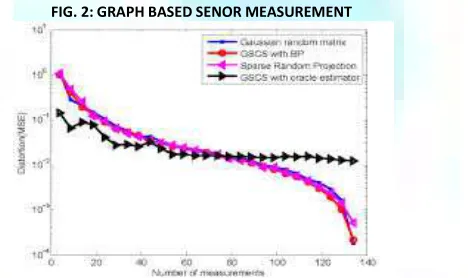
FIG. 2: GRAPH BASED SENOR MEASUREMENT
It helps to growth of plant health and good culture to soil, destroy the insects. Because of these farmers earned more profit.
2.6. TRACTOR GUIDANCE SYSTEM
Using tractor guidance system upload Soil Type Data, Plant culture, Sheltered Machine mechanism, spraying the Chemical, manure is record in the database with sensor network. The data collection, monitoring and analyze material application to the crops allows for higher yields and lesser cost, with a smaller amount force to the surroundings.
Each area receives only what is required for its particular space, and the appropriate time and duration. Depends upon the climate condition summer to winter (6 months) and winter to summer(6 months) variations are saved into it. Farmers obtain a safety measure through messages with help of Bluetooth.
2.7. IRRIGATION
The potential of sensor technology for irrigated agriculture has been studied since standard 80’s. Sol Chip is an energy-harvesting company that has developed maintenance frees Everlasting Solar Battery. The battery can deliver energy from the duration of low-power devices.
Sol Chip’s technology provides a platform for disruptive applications such as precision agriculture and Internet of Things (IoT). Sol Chip’s innovative technology is designed to enable autonomous operation of devices and systems powered by a Plug n’ Play solar energy sources. Since then rapid development of communication technologies has been replaced with wired soil conditions monitoring systems with wireless sensor. The wireless techniques make system faster to deploy and provide flexibility. While challenges were founded in cost of sensors, Depending on staff experience in electric supply.
2.8. HARVESTING
The leading and largest event in energy harvesting and storage technologies, Sol Chip are launched its product and demonstrated the use of its technology in multiple market segments including RFID, IoT (Internet of things), agriculture, security industrial wireless sensors. In sensor, there are several methods,
• A moisture sensor,
• A Ground Speed Sensor,
• A Cut With Sensor,
• An Elevation Speed Sensor And
• A DGPS (Differential global positioning system).
Other grain field sensors are
VOLUME NO.5(2015),ISSUE NO.04(APRIL) ISSN 2231-5756
INTERNATIONAL JOURNAL OF RESEARCH IN COMMERCE, IT & MANAGEMENT
A Monthly Double-Blind Peer Reviewed (Refereed/Juried) Open Access International e-Journal - Included in the International Serial Directories
http://ijrcm.org.in/
21
• Flow Measurements
• Impact Sensors and Indirect Methods
The result is that from now on, any electronic device can harvest its own energy from the surroundings and become a maintenance-free, self-directed device which contributes to a cleaner surroundings. Sol Chip’s patent-protected technology eliminates the need for a solar panel area and its miniaturized solution provides perpetual power for wireless sensor and mobile electronics.
3. EQUIPMENTS OF SENSOR WITH AGRICULTURE
Our networks have already been put at use in a large variety of applications that need to have high performance and to be cost-effective; energy harvesting further increases this range of applications and the networks. Fleet management agriculture crop production consist of two main components
• Located on the vehicle
• And a software Application
FIG. 3: USING WIRELESS SENSOR TO YIELDING WITH SOLAR
Traditional equipments and automatic meter reading (AMR) plus advanced metering infrastructure (AMI), mesh networks, system control and data acquisition (SCADA), data loggers, measurement while drilling, oceanography, environmental systems, emergency/safety systems, military/aerospace systems, and more.
3.1. TELECOMMUNICATION MONITORING
The transport Telecommunication consists of a positioning system
• A keyboard for fleet management and
• A series of networked sensor nodes
Large and intensive crop production farms invest heavily in machinery. Therefore their usage and safeguarding must be efficiently planned and implemented. Fleet management and WSN agricultural crop application can be classified into two groups
• Plant production vehicles and equipment,
• Unmanned Aerial vehicles
The field operations are soils monitoring, plants and animal’s protection, insect’s protection, fertilizers, irrigations and harvestings. The routers' removal means less contact overhead, as well as simple less comfortable processors, while small diversity eliminate multiple path special effects and also provides no single point of failure.
Another benefit of the new creation Virtual expansion wireless mesh network is the lower power control; they enable battery-powered application to reliably run for long years on a single cell battery.
Following the combination with Sol Chip Energy Harvester, this want for battery is now eliminated.
3.2. WIRELESS MACHINERY AND DATA
Data Centers face considerable challenges in seamless integration of telemetry and control functions. These functions are necessary to management tasks related to authority capping, cooling, consistency, unavoidability, live ability, and flexibility control.
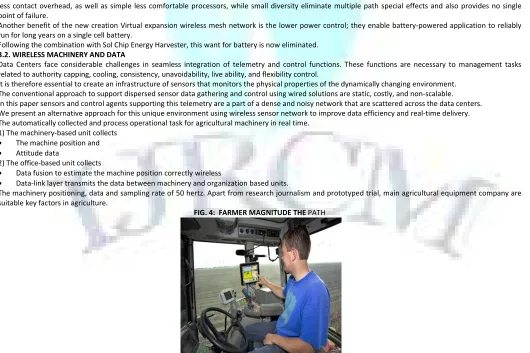
It is therefore essential to create an infrastructure of sensors that monitors the physical properties of the dynamically changing environment. The conventional approach to support dispersed sensor data gathering and control using wired solutions are static, costly, and non-scalable. In this paper sensors and control agents supporting this telemetry are a part of a dense and noisy network that are scattered across the data centers. We present an alternative approach for this unique environment using wireless sensor network to improve data efficiency and real-time delivery. The automatically collected and process operational task for agricultural machinery in real time.
1) The machinery-based unit collects
• The machine position and
• Attitude data
2) The office-based unit collects
• Data fusion to estimate the machine position correctly wireless
• Data-link layer transmits the data between machinery and organization based units.
The machinery positioning, data and sampling rate of 50 hertz. Apart from research journalism and prototyped trial, main agricultural equipment company are suitable key factors in agriculture.
VOLUME NO.5(2015),ISSUE NO.04(APRIL)
One drawback to spraying the seeds with the help of flying vehicles the plants are not in correct manner to growth. They presented an ultra low volume for a UAV helicopter.
The spraying seeds will in specific portion. Production management focused on the use of a combinati filters.
Successful test were performed on ten varieties of wheat grain in trail micro The monitoring environmental and soil conditions can make farming more
and disease control (It is estimated that the overall efficiency of water use for agriculture is less than 25 per cent).
Improved operation and management of Water for irrigation can lead to significant savings and to a more sustainable use of water resources, as well as improved soil efficiency.
The some following tools can be used in agricultural and soil monitoring to enhance the farming system and increase the produ Alone Sensors: These sensors measure air temperature, atmospheric pressure and humidity.
The data is further transmitted to other servers for data analysis via a wired Internet connection. A decision support system together with other information. Based on this information, farmers can take different actions and vary the amount of fertili sensors are further used for precision irrigation, and systems developed for
Sensors assume, for example, the tasks of irrigation control and irrigation scheduling using sensed data together with additi Sensors are used to assist in precision fertilization.
4. ALGORITHM AND WORKFLOW OF THE SYSTEM
A. ALGORITHM OF SYSTEM WORKING
1) Start
2) Detect the constraint from various sections of the sensor network 3) Feed the collected information to the record
4) Then access and procedure the data
5) If process parameter exceeds their boundary then send command to set alert system 6) Send the GPS data over GSM
7) If the parameter does not exceeds the limit it will continued. 8) Exit
B. WORK FLOW OF THE SYSTEM
5. CONCLUSION
In general, sensors and sensor networks significantly contribute to a more sustainable use of natural resources. However, gro accuracy agriculture is in an early stage and sensor applications tend to be expensive.
deciding on whether they should rely on precision agriculture. Farmers to identify the environmental measurement by pointing
improved soil and pasture quality as well as reduced applications of fertilizers and pesticides. Finally this study will helps to understand briefly on Far methods in WSN and Applications and its Research issues.
Indiabeing an agricultural country needs some becoming increasingly
for unknown thermal suitable places like forest, river, dams… etc. This can be achieves scheming the entire conservatory yiel technologies which support computing, the necessities in the aspect of WSN based crop
WSN suit for monitoring system functions can be mainly summarized. Technologies have become a backbone for modern people populations increase year by year.
So this WSN techniques are very helpful to the farmer to gain more cost depend on the climate situation. After we concentrate on machineries replacement and sensor signal and also cost of ma
data are created.
REFERENCES
1. Stephanotis.A. , Nittel.S ”GeoSensor Networks”;CRC Press: Boca Raoton,FL,USA,2005. 2. Tyson.I.”Agriculture In The InformationSociety”.J.Agric.Eng.Res.2002
3. Cao, Chen Zhang. Sun, “Development Of An Integrated Wireless Sensor Network Micro
the seeds with the help of flying vehicles the plants are not in correct manner to growth. They presented an ultra low volume The spraying seeds will in specific portion. Production management focused on the use of a combination of simple digital photographic cameras with spectral Successful test were performed on ten varieties of wheat grain in trail micro-plots can seen using a tractor mechanism.
The monitoring environmental and soil conditions can make farming more profitable and sustainable, for instance, through better water management and pest and disease control (It is estimated that the overall efficiency of water use for agriculture is less than 25 per cent).
rrigation can lead to significant savings and to a more sustainable use of water resources, as well as The some following tools can be used in agricultural and soil monitoring to enhance the farming system and increase the produ
Alone Sensors: These sensors measure air temperature, atmospheric pressure and humidity.
The data is further transmitted to other servers for data analysis via a wired Internet connection. A decision support system together with other information. Based on this information, farmers can take different actions and vary the amount of fertili sensors are further used for precision irrigation, and systems developed for remotely restricted, automatic irrigation. Sensors assume, for example, the tasks of irrigation control and irrigation scheduling using sensed data together with additi
4. ALGORITHM AND WORKFLOW OF THE SYSTEM
2) Detect the constraint from various sections of the sensor network
cess parameter exceeds their boundary then send command to set alert system 7) If the parameter does not exceeds the limit it will continued.
FIG. 4: FLOWCHART OF SYSTEM WORKING
In general, sensors and sensor networks significantly contribute to a more sustainable use of natural resources. However, gro
accuracy agriculture is in an early stage and sensor applications tend to be expensive. As on date, farmers only take economic benefits into consideration when deciding on whether they should rely on precision agriculture. Farmers to identify the environmental measurement by pointing
ity as well as reduced applications of fertilizers and pesticides. Finally this study will helps to understand briefly on Far methods in WSN and Applications and its Research issues.
being an agricultural country needs some becoming increasingly concentrated on monitoring andinnovation in the field of agriculture. The tractor is used for unknown thermal suitable places like forest, river, dams… etc. This can be achieves scheming the entire conservatory yiel
s which support computing, the necessities in the aspect of WSN based cropcommunication and control within devices ad solar. WSN suit for monitoring system functions can be mainly summarized. Technologies have become a backbone for modern
So this WSN techniques are very helpful to the farmer to gain more cost depend on the climate situation.
After we concentrate on machineries replacement and sensor signal and also cost of machinery. By using back propagation algorithm with neural network the
;CRC Press: Boca Raoton,FL,USA,2005. .J.Agric.Eng.Res.2002
“Development Of An Integrated Wireless Sensor Network Micro-Environmental supervise plan”.
ISSN 2231-5756
the seeds with the help of flying vehicles the plants are not in correct manner to growth. They presented an ultra low volume sprayer on of simple digital photographic cameras with spectral
profitable and sustainable, for instance, through better water management and pest rrigation can lead to significant savings and to a more sustainable use of water resources, as well as The some following tools can be used in agricultural and soil monitoring to enhance the farming system and increase the production, which includes: Stand-The data is further transmitted to other servers for data analysis via a wired Internet connection. A decision support system maps the temperature distribution together with other information. Based on this information, farmers can take different actions and vary the amount of fertilizer and pesticide used. Wireless Sensors assume, for example, the tasks of irrigation control and irrigation scheduling using sensed data together with additional information, e.g. weather data.
In general, sensors and sensor networks significantly contribute to a more sustainable use of natural resources. However, growth of sensors and networks for As on date, farmers only take economic benefits into consideration when deciding on whether they should rely on precision agriculture. Farmers to identify the environmental measurement by pointing out the economic benefits of ity as well as reduced applications of fertilizers and pesticides. Finally this study will helps to understand briefly on Farming innovation in the field of agriculture. The tractor is used for unknown thermal suitable places like forest, river, dams… etc. This can be achieves scheming the entire conservatory yielding process. During recent
communication and control within devices ad solar.
WSN suit for monitoring system functions can be mainly summarized. Technologies have become a backbone for modernprecision agriculture monitoring. Our
chinery. By using back propagation algorithm with neural network the
VOLUME NO.5(2015),ISSUE NO.04(APRIL) ISSN 2231-5756
INTERNATIONAL JOURNAL OF RESEARCH IN COMMERCE, IT & MANAGEMENT
A Monthly Double-Blind Peer Reviewed (Refereed/Juried) Open Access International e-Journal - Included in the International Serial Directories
http://ijrcm.org.in/
23
4. Miskam and Inzarulfaisham.”Wireless Sensor Network Cropping Monitoring application in India”. Abd.,2010.
5. Narasimhan,T.Saravanan,”Green House Asset Management Over Wireless Sensor-Actor Networks External Modulations,”Journal Of Science and Technologies. 2013.Bever,2007
6. Nadeau,C.;When,H.http://www.memsic.com “On Mobile everywhere compute, Systems” Eachen,2008. Broad dated.
7. Crossbow Technologies., 2005. Xmesh 2.0” Medical Measurements And Applications Proceedings (Memea)” Manual Technology.(Draft)Revision A,E-mail attachment from Alan 7.Teo,A.,G.Singh,and Mc Eachen,2008. Broad dated.
8. Kerana Hanirex,D. And K.P.Kaliyamurithie,2012.”Wireless Sensor Networks, International Journal Of Pharmacy And Biosystems”,2009. 9. Girão,MárioRibeiro,Fernando”Advanced Diagnostics And E Health Research Group”.http://www.tinyos.net.2010.
10. Teilet,P.M.; Shankaie,A.;et al. “An Integrated Earth sense Sensor web For Improved Crop And Rangeland Yield Predictions” 2005. 11. Tilman,D.;“Agricultural ustainability And precise Manufacture Practices”. Nature 2007.
12. Octavian Postolache, Pedro S. Girão, Mário Ribeiro,Fernando Santiago, and António Pena “Enabling Telecare Assessment With persistent Sensing And Android OS Smartphone”, 2012 IEEE International Workshop,288-293, May 2013.
13. Ralph Morelli, Emmet Murphy, and Trishan Lanerolle “An Release Resource Mobile App For Assisting Health And Agricultural Aid In Haiti” Global Humanitarian Technology Conference (GHTC), 2012 IEEE , pp. 102-107, Oct-Nov 2011.
14. Eko Supriyanto,:Head of Advanced Diagnostics and e health Research Group ”A Suitable Telehealth Model For Developing Countries” 2011 International Conference on Instruments, interactions, Information Technology and Biomedical Engineering,414, 8-9 November 2013.
15. Carl Hartung, Richard Han, Carl Seielstad, and Saxon Holbrook. Firewxnet: “A multitier portable wireless system for monitoring weather conditions in wildland fire environments”. In Proc. 7th international conference on Mobile systems, applications and services MobiSys 2013.
16. Prabal Dutta, Jay Taneja, Jaein Jeong, Xiaofan Jiang, and David Culler, "A Building Block advance to Sensor net Systems", In Proceedings of the Ninth ACM discussion on Embedded Networked Sensor Systems (SenSys'10), Nov. 5-7, 2010. © ACM, 2011
17. D.Prabakar, Dr.M.Marikkannan, Dr.S.Karthik,” A relative study of a variety of Routing protocol in Wireless Sensor Networks”, ISSN: 2250-3501, Vol.2, No6, December 2013.
18. Mr. S. P. Santhoshkumar , Mr. D. Prabakar, Dr. S. Karthik,” Frequent Data Updating Using Random Check pointing Arrangement in Decentralized Mobile Grid Computing” , IJEA, ISSN : 2278-7844,Novemeber 2013.
19. King, B. A., J. C. Stark and R.W. Wall (2013), “Comparison of Site-Specific and Conventional Uniform Irrigation Management for Potatoes”, Applied Engineering in Agriculture, 22 (5), 2677-688.,2014.
20. Arun roy,. Pande, Bhushan G. Jagyasi, Sanjay Kimbahune, Pankaj Doke, Ajay Mittal, Dineshkumar Singh, Ramesh Jain, “Mobile telephone based Agro-Advisory System for Agricultural Challenges in pastoral India,” IEEE Conference on Technology for Humanitarian Challenges, August 2013, Bangalore, India.
21. S. Neelamegam, Dinesh kumar, roy., C.P.R.G. Naveen, M. Padmawar, U.B. Desai, S.N. Merchant, N.G.Shah,and V. Kulkarni ; AgriSens: “Wireless antenna network for Agriculture” - A Sula Vineyard Case Study, 5th International Workshop on Wireless Sensor Network Deployments in conjunction with International Conference on Distributed Computing in Sensor Systems (DCOSS 2012),Santa Fe, New Mexico, U.S.A. June, 18 - 20, 2013.
VOLUME NO.5(2015),ISSUE NO.04(APRIL) ISSN 2231-5756
REQUEST FOR FEEDBACK
Dear Readers
At the very outset, International Journal of Research in Commerce, IT & Management (IJRCM)
acknowledges & appreciates your efforts in showing interest in our present issue under your kind perusal.
I would like to request you tosupply your critical comments and suggestions about the material published
in this issue as well as on the journal as a whole, on our E-mail
for further
improvements in the interest of research.
If youhave any queries please feel free to contact us on our E-mail
.
I am sure that your feedback and deliberations would make future issues better – a result of our joint
effort.
Looking forward an appropriate consideration.
With sincere regards
Thanking you profoundly
Academically yours
Sd/-
Co-ordinator
DISCLAIMER
VOLUME NO.5(2015),ISSUE NO.04(APRIL) ISSN 2231-5756
INTERNATIONAL JOURNAL OF RESEARCH IN COMMERCE, IT & MANAGEMENT
A Monthly Double-Blind Peer Reviewed (Refereed/Juried) Open Access International e-Journal - Included in the International Serial Directories