IMPACT ON THE PERFORMANCE OF CONCRETE MIXTURE WITH SILICA FUME AND FLY ASH: AN ANALYTICAL STUDY
Kalidindi VenkateswaraRaju1, Dr.Pradeep Kumar2 Department of Civil Engineering
1,2,
Himalayan University, Arunachal Pradesh (India) Abstract
Mechanical repercussions, for example, Silica Fume (SF) and Fly Ash (FA) can be used to improve the
quality and water porousness attributes of High Performance Concrete (HPC). The use of these
modern by items is getting to be distinctly prevalent all through the world due to the minimization of
their potential unsafe consequences for condition. This paper investigates the individual effects of
Silica Smoke and Fly Powder as a midway substitution of Ordinary Portland Cement (OPC) on water
permeability, compressive quality, split flexibility and flexural unbending nature of High Performance
Concrete (HPC). To research these properties of cement, the aggregate examination was classified
into two fundamental test bunches - SF Group for Silica Fume and FA Group for Fly Ash. Seven sorts
of blend extents were utilized to cast the test examples for both gatherings. The substitution levels of
OPC by Silica Fume were 0%, 2.5%, 5%, 20%, 15%, 10% and 7.5% where substitution levels of OPC by
Fly Ash were 0%, 5%, 10%, 15%, 20%, 25% and 30%. 1% super-plasticizer was utilized as a part of all
the test examples for High Performance (i.e., high workability at lower water-cover proportion) and
to recognize the sharp impacts of Silica Fume and Fly Ash on the properties of cement.
Index Terms—High Performance Concrete, Silica Fume, Fly Ash, WaterPermeability, Mechanical
Properties of Concrete, Replacement Levels
1. INTRODUCTION
High Performance Concrete (HPC) is currently
generally utilized overall in view of its high
workability, high thickness with high modulus
of flexibility, high dimensional dependability
with great scraped area and effect resistance,
high quality and cavitation resistances. As
showed by American Concrete Institute (ACI),
HighPerformance Concrete is characterized
as,"a solid that meets special combinations of
execution and consistency prerequisites that
can't generally be accomplished routinely
utilizing traditional constituents and typical
blending, putting, and curing rehearses". To
maintainable development strategies, HPC
has awesome popularities [1].
The noteworthy specialized information and
research discoveries on elasticity and water
entrance rate are very constrained. It is
consequently necessary to research all the
quality properties like compressive quality,
split rigidity, flexural elasticity and water
penetrability attributes of elite cement for
various dose (rate as substitution of bond). In
particular, elite and strong cement ought to
have qualities of chlorine and sulfate
resistance which can be guaranteed by
expanding the imperviousness to entrance of
water. This sort of cement is being utilized as
a part of numerous huge undertakings asit
iseconomical and in addition sturdy and it
guarantees security [2].
Be that as it may, the making of High
Performance cement with maintainable
solidness is not a simple assignment in light of
the fact that the measurement furthest
reaches of admixtures (fly fiery debris or silica
smoke or mixing of fly slag and silica smolder)
assume a vital part and from many
investigates it is as of now demonstrated that
lower rates of those admixtures or higher
rates can't bring more quality or can't make
the solid more tough. The point of this review
is to discover the 'individual impacts' as
opposed to the 'mixing of fly powder and
silica seethe together' on water penetrability
and quality attributes of elite cement to get
ideal blend rates which can guarantee tough
concrete and in addition sparing method for
guaranteeing practical improvement [3].
2. EXPERIMENTAL PROGRAM AND
APPROACH
A. Material of Specimen
To acquire the best rates of blend extents in
both cases (Fly Ash and Silica Fume) isolate
throwing of the test examples were led.
Mixing of Silica Fume (SF) and Fly Ash (FA)
were stayed away from as the individual
impacts of SF and FA were seen in this review.
Solid materials were blended according to
standard of ASTM C 192M-07. OPC was
utilized and its physical and mechanical
properties are arranged in Table I. Evaluated
stream sand (Sylhet Sand) going through
1.18mm sifter with fineness modulus of 3.0
was utilized which were free from natural
chemicals and undesirable mud.
Neighborhood squashed stone total going
through 12.5 mm strainer and held on
4.75mm sifter with fineness modulus 4.01
Indian Standard. Crisp clean water, free from
chlorine, suspended solids, acids and having
pH esteem 7.0 was utilized for blending
reason [4].
Silica smoke was provided by Rainbow
Holdings Ltd., Dhaka, Bangladesh which fulfills
the prerequisites of ASTM C 1240. The
physical andchemical examination
constituents of SF are arranged at Table I.
High Calcium fly cinder was gotten from
Rainbow Holdings Ltd., Dhaka, Bangladesh
which fulfills the prerequisite of ASTM class C.
The synthetic extents of fly powder are
organized at Table I.
Super-Plasticizers (SP) can influence the solid
quality even at consistent water–cement
proportion [5]. The quality of both bond glue
and cement can be influenced by the dose of
SP [6]. Therefore, the dose of SP was
keptconstant for all the example blends to
distinguish the sharp impacts of silica smoke
and fly cinder. On the off chance that the
dose of SPis differed with the silica smoke and
fly cinder substitution rate, thenthe varieties
in the solid quality will happen not just dueto
varieties in the silica smoke or fly powder
substance additionally because of progress in
the measurement of SP [6]. Since the
SPcontent of all the blends was kept
consistent, to minimizevariations in
workability,the compaction energywas
variedfor acquiring legitimate compaction[7].
Toensure great dispersionof the silica seethe
at such factor measurements, highbinder
content and an ideal dose of SP were utilized
withconstant blending times. As the SP dose
was kept constant,while conforming the
fastener content, it was viewed as that the
mixshould not isolate athigher water–binder
proportions, nor itshould be unworkable at
lower water–binder proportions. The
mixingprocedure and time were kept steady
for all the solid blends researched [8]. As
stated by I. B.Muhit (2013), the most
extraordinary quality for bond is procured
from a settled estimation rate of
super-plasticizer and it is absolutely 1.0% by weight
of concrete and the compelling dose
rangesbetween 0.6% and 1.0% [9].Sikament®
R2002 was utilized as SP in light of the fact
that it is not just a high range water lessening
admixture for advancing high early and
extreme qualities additionally is non-perilous
and non-lethal under important security and
medical problem [10]. It is a very viable
super-plasticizer with a set hindering impact for
delivering free streaming cement in hot
atmospheres. It fits in with ASTM C 494 Sort G
Table I: Physical and chemical properties of OPC, silica fume and fly ash Ordinary
Properties Portland Silica Fume Fly Ash
Cement
Physical properties
Specific Gravity 3.15 2.21 3.1
Initial Setting
115 - -
Time (Min)
Final Setting
229 - -
Time (Min)
Fineness as
Surface Area 370 20,000 420
(m2/kg)
Chemical Properties Silicon Dioxide
21.02% 91.4% 53.92%
(SiO2) Aluminium Oxide
5.68% 1.1% 21%
(Al2O3) Ferric Oxide
3.53%
0.3% - 3.9% -
(Fe2O3) 0.5% 4.3%
Magnesium
1.1% 1.3% 2.2%
Oxide (MgO) Calcium Oxide
62.25% 0.7% 4%
(CaO) Sulphur Trioxide
3.0% 0.4% 0.6%
(SO3) Sodium Oxide
0.15% 0.8%
0.4% -
(Na2O) 0.6%
Potassium Oxide
0.35% 0.5% 0.2%
(K2 O)
B. Mix Proportions of Specimen
The blend extents of all examples for
substitution of Silica Fume and Fly Ash are
classified individually at Table 2 and Table 3.
The substitution levels of bond by SF were
chosen as 0% (control blend), 2.5%, 5%, 7.5%,
10%, 15% and 20%. What's more, the
substitution levels of rates of concrete by FA
were chosen as 0% (control blend), 5%, 10%,
15%, 20%, 25% and 30%. For all examples,
water/cover (w/b) proportion was kept
steady and it was 0.42where the aggregate
sum ofbinder substance was 480 Kg/m3for
each example. Here cover alludes the blend of
Cement and Silica Fume for SF examine
gathering and blend of Cement and Fly Ash
for FA ponder bunch. The blend extents of
Binder: Fine Aggregate: Coarse Aggregate was
taken as 1: 1.28: 2.2.
C. Casting of Specimen and Curing
Four sorts of examples were thrown to lead
all kind of test in regards to quality and water
porousness. Standard Sample (measurement
120mm x 200mm x 200mm) for water
porousness test, Standard Cube example
(measurement 150mm x 150mm x 150mm)
for compressive quality test, Cylinder example
(measurement 150mm distance across with
300mm stature) for split rigidity test and bar
example (100mm x 100mm x 500mm) for
flexural elasticity test were threw. Amid
curing period, thesamples were put away in a
place free from vibration and in moderately
clammy air at a temperature ranges from
25ºC to 27ºC[10]. Following 2 days, themold
was expelled and set apart with image to
distinguish later lastly cured under clean new
water.
D. Testing of Specimen
To measure the workability of concrete,lump
Test [11, 12, 13, 14] and Compacting Factor
Test (Derived by Road Research Laboratory
U.K) were led. Through Noise 1048 (Section
5), the permeability of solid example was
resolved. The resistance of cement against
the infiltration of water applying weight
means that penetrability. Over 28 days and
under 35 days matured cement were
uncovered either from above or underneath
to a water weight of 5 bars acting ordinary to
the shape filling bearing for a time of three
days. The weight was kept consistent all
through the test were exposed either from
above or below to a water pressure of 5 bars
acting normal to the mold-filling direction for
a period of three days. The pressure was kept
Table. IIMix proportions for SF (Silica Fume) study group
Specimen w/b Ratio
Cement Silica Fume Aggregates (Kg/m3) Water
SP (%)
ID (Kg/m3) % Kg/m3 Fine Coarse (Kg/m3)
SF-I 0.42 480 0 0 616 1058 201.6 1.0
SF-II 0.42 468 2.5 12 616 1058 201.6 1.0
SF-III 0.42 456 5.0 24 616 1058 201.6 1.0
SF-IV 0.42 444 7.5 36 616 1058 201.6 1.0
SF-V 0.42 432 10 48 616 1058 201.6 1.0
SF-VI 0.42 408 15 72 616 1058 201.6 1.0
SF-VII 0.42 384 20 96 616 1058 201.6 1.0
TABLE. III. MIX PROPORTIONS FOR FA (FLY ASH) STUDY GROUP
Specimen w/b
Ratio
Cement Fly Ash Aggregates (Kg/m3) Water
SP (%)
ID (Kg/m3) % Kg/m3 Fine Coarse (Kg/m3)
FA-I 0.42 480 0 0 616 1058 201.6 1.0
FA-II 0.42 456 5 24 616 1058 201.6 1.0
FA-III 0.42 432 10 48 616 1058 201.6 1.0
FA-IV 0.42 408 15 72 616 1058 201.6 1.0
FA-V 0.42 384 20 96 616 1058 201.6 1.0
FA-VI 0.42 360 25 120 616 1058 201.6 1.0
FA-VII 0.42 336 30 144 616 1058 201.6 1.0
3. RESULTS & DISCUSSION
Effects on Water Permeability of High
Performance Concrete
The water porousness (greatest infiltrated
water profundity) of cement for SF thinks about
gathering (for various supplanting levels of OPC
with silica seethe) and for FA consider
aggregate (for various supplanting levels of OPC
with fly powder) is spoken to at Fig. 1 and 2
independently. From Fig. 1 it is evident that low
entrance of water is permitted in SF-V sort
example where 10% OPC was supplanted with
silica smolder. With no silica seethe, the
entrance profundity was 28mm and with 10%
silica smolder it was 11mm, which
demonstrates that, over 60%
Decrease of water infiltration can be
accomplished by blending 10% silica rage. Silica
seethe contains fine size particles which fill the
little spaces between the bond particles and it
without silica rage. Thus, ideal measurement of
silica smoke diminishes the penetrability
essentially however over the top silica smolder
can't.
From Fig. 2 clearly, low invasion of water is
allowed in FA-V sort illustration where 20% OPC
was supplanted with fly red hot remains. With
no fly cinder the infiltration profundity was
28mm and with 20% fly fiery debris it was
15mm, that implies over 46% diminishment of
water entrance can be accomplished by
blending 20% fly slag.
Effects on Compressive Strength of High
Performance Concrete
For replacement of OPC by Silica Fume
Silica seethe has solid impacts in compressive
quality of cement for 7, 14 and 28 days of age.
The variety of compressive quality for various
substitution levels of OPC by silica seethe for 7,
14 and 28 days is appeared in Fig.3. For 7 days
solid it was watched that most extreme
compressive quality (42 N/mm2) was shown by
SF-IV sort example, which contains 7.5% silica
smolder with 92.5% OPC. The compressive
quality augmentations appropriate around 17%
for SF-IVtype case stood out from the control
mix (SF-I) for 7 days. For 14 and 28days the
most extreme compressive qualities were
gotten 53 N/mm2 for SF-IV sort example and 65
N/mm2 for SF-IV sort example individually.
Along these lines, plainly most extreme
compressive quality can be acquired by
supplanting 7.5% OPC with silica smolder.
For replacement of OPC by Fly Ash
And silica rage, fly cinder has solid impacts in
compressive quality of cement for 7, 14 and 28
days of age. The variety of compressive quality
for various substitution levels of OPC by Fly Ash
for 7, 14 and 28 days are appeared in Fig. 4. For
7 days solid it was watched that most extreme
compressive quality (49.5 N/mm2) was shown
by FA-IIItype case, which contains 10% fly
blazing trash with 90% OPC. The expansion in
compressive quality is 37.5% for theFA-IIItype
example contrasted with the control blend
(FA-I) for 7 days. For 14 and 28days the most
extreme compressive qualities were acquired
55.5 N/mm2 for FA-III sort example and 66
N/mm2 for FA-IIItype example individually. In
this way, it can be presumed that most extreme
compressive quality can be gotten by
supplanting 10% OPCwith fly red hot remains.
Effects on Split Tensile Strength of High
For replacement of OPC by Silica Fume:
Ideal level of silica smoke can play an awesome
rolein expanding the split rigidity. Part elasticity
for various substitution level of OPC by silica
smolder for 7, 14 and 28 days matured cement
are appeared in Fig. 5. Most extreme split
elasticity (4.0 N/mm2) for 7 days was acquired
from SF-V sort example. For 14 days a similar
example i.e., SF-V sort example showed most
extreme split elasticity (4.5 N/mm2). Be that as
it may, for 28 days, most extreme split rigidity
(5.2 N/mm2) was gotten from SF-IV sort
example which was set up by 7.5% silica seethe
substitution for OPC. Along these lines,
eventually it can be chosen that the halfway
substitution of 7.5% OPC by silica smoke was
observed to be ideal and 33% split rigidity was
expanded from control blend (SF-I) at 28 days.
For replacement of OPC by Fly Ash:
Optimum level of fly ash can play a significant
role in increasing the split tensile strength of
concrete. Split tensile strength for different
replacement level of OPC by fly ash for 7, 14
and 28 days aged concrete are shown in Fig. 6.
Maximum split tensile strength (3.9 N/mm2) for 7 days was obtained fromFA-III type specimen.
For 14 and 28 days same case were observed
that, FA-III type specimen exhibited maximum
split tensile strength and for 28 days itwas 5
N/mm2. So, ultimately it can be decided that the partial replacement of 10% OPC by fly ash was
found to be optimum and more than 28% split
tensile strength was increased from control mix
(FA-I) at 28 days.
Effects on Flexural Tensile Strength of High
Performance Concrete
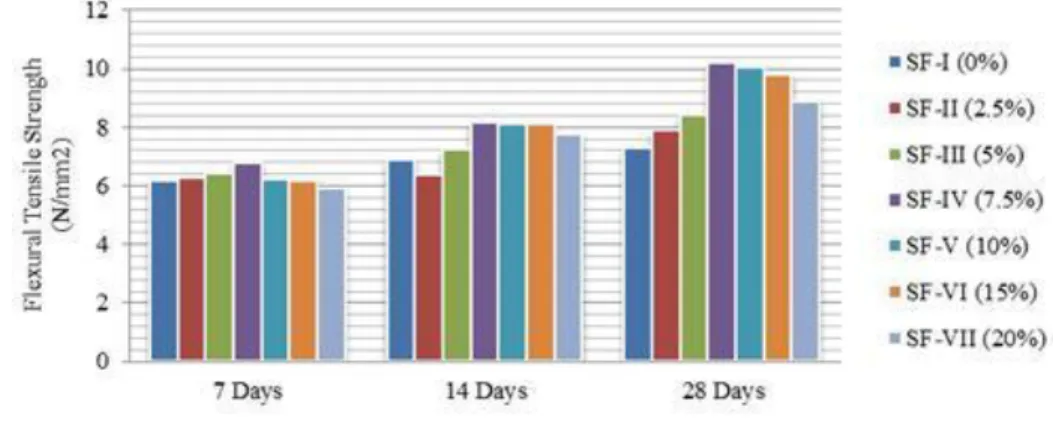
For replacement of OPC by Silica Fume:
Silica seethe has solid impacts in flexural rigidity
of cement for 7, 14 and 28 days. The variety of
flexural rigidity for various substitution levels of
OPC by silica smolder for 7, 14 and 28 days are
appeared in Fig. 7. For 7 days solid it was
watched that most extreme flexural elasticity
(6.8 N/mm2) was displayed by SF-IV sort
example which contains 7.5% silica smolder
with 92.5% OPC. For 14 and 28days the most
extreme flexural rigidity were gotten 8.15
N/mm2 for SF-IV sort example and 10.2 N/mm2
for SF-IV sort example separately [15]. In this
way, inevitably it can be chosen that the
incomplete substitution of 7.5% silica smoke
was observed to be ideal and more than
39%flexural rigidity was expanded from control
Figure 1. Compressive Strength fluctuation for different levels of Silica Fume for 7, 14 and
28 days
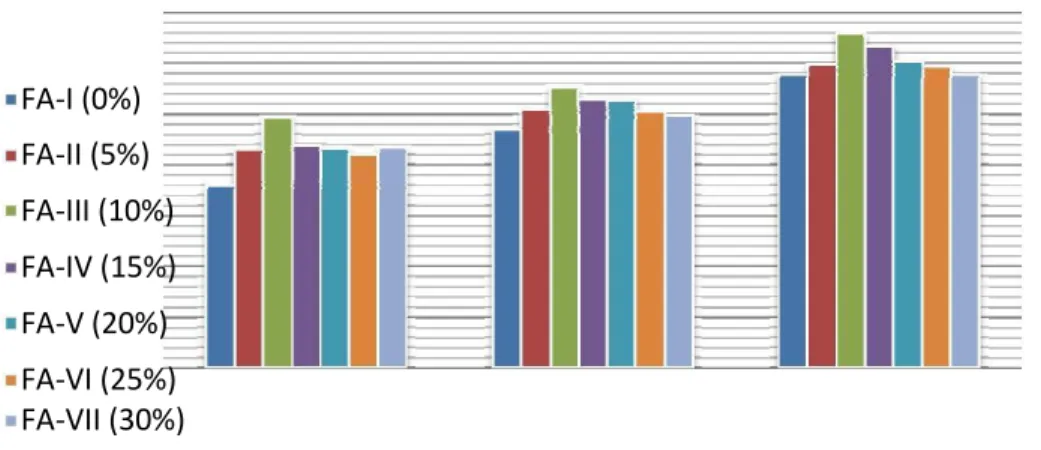
Figure 2. Compressive Strength fluctuation for different levels of Fly Ash for 7, 14 and 28 days
FA-I (0%) FA-II (5%) FA-III (10%)
FA-IV (15%) FA-V (20%) FA-VI (25%) FA-VII (30%)
Figure 4. Flexural Tensile Strength fluctuation for different levels of Silica Fume for 7, 14 and 28 days
Figure 5.Flexural Tensile Strength fluctuation for different levels of Fly Ash for 7, 14 and 28 days
Fly Ash has solid impacts in flexural rigidity of
cement for 7, 14 and 28 days. The assortment
of flexural versatility for different substitution
levels of OPC by fly red hot trash for 7, 14 and
28 days are showed up in Fig 8. For 7 days solid
it was watched that greatest flexural rigidity
(6.75 N/mm2) was shown by FA-III sort example
and it contains 10% fly fiery debris with 90%
OPC. For 14 and 28days the most extreme
flexural elasticity was acquired 8.0 N/mm2 for
FA-III sort example and 10.1 N/mm2 for FA-III
sort example separately. Along these lines, at
last it can be chosen that the fractional
substitution of 10% fly cinder was observed to
expanded from control blend (FA-I) at 28 days
[16].
4. CONCLUSION
From the whole investigations and research the
following conclusion can be drawn:
Pozzolanic materials have critical
impact on water penetrability and
mechanical properties of cement.
10% by weight silica rage displayed
most minimal infiltration of water
(11mm), where least water
porousness (15mm) for fly slag was
acquired at 20% by weight.
65 N/mm2 was the greatest
compressive quality which was
gotten for 7.5% by weight silica
seethe. 10% by weight fly fiery
debris demonstrated most extreme
compressive quality and it was 66
N/mm2.
5.2 N/mm2 was the most extreme
split rigidity which was acquired for
7.5% by weight silica smolder. 10%
by weight fly fiery debris
demonstrated greatest split rigidity
and it was 5 N/mm2.
In instance of flexural rigidity, 7.5%
by weight of silica smoke and 10% by
weight of fly slag turned out to be
ideal for most extreme quality 10.2
N/mm2, 10.1 N/mm2 individually.
The water penetrability and quality
attributes of elite cement can be
enhanced significantly by
supplanting the Ordinary Portland
Cement with either silica smoke or
fly powder.
From writing survey and from this
examination it can be prescribed
that mixing of silica smoke and fly
fiery debris is not fundamental to
expand the water porousness and
quality attributes of cement. Either
silica smoke or fly fiery debris alone
is sufficient to upgrade the quality.
REFERENCES
1. Sensale GR. (2006), "Quality advancement of cement with rice husk fiery debris", Cement and Concrete Composites, 28(2), 158-160.
2. Mohammad Iqbal Khan and
RafatSiddique (2011), "Use of silica
smoke in solid: Review of strength properties", Resources, Conservation and Recycling, 57, 30–35
(ICACE 2012), CUET, Chittagong, Bangladesh
4. A.M. Neville (1996), "Properties of Concrete", fourth ed., ELBS with Addison Wesley Longman, England
5. X. Cong, S. Gong, D. Darwin, S.L. McCabe (1992), "Part of silica smoke in compressive quality of bond glue, mortar, and cement," ACI Mater. J. 89 (4) 375– 387.
6. S. Bhanja, B. Sengupta (2003), "Ideal silica rage substance and its method of activity on cement", ACI Mater. J. 100 (5)407–412.
7. S. Bhanja, B. Sengupta (2002), "Examinations on the compressive quality of silica smoke solid utilizing measurable methods",Cem. Concr. Res. 32 (9) 1391 to 1394.
8. B. Muhit (2013), "Measurements
Limit Determination of
Superplasticizing Admixture and Effect Evaluation on Properties of Concrete," International Journal of Scientific& Engineering Research, Volume 4, Issue 3, March-2013
9. Song, P.S. what's more, Hwang, S. (2004). "Mechanical Properties of High Strength Steel Fiber-Reinforced Concrete", Construction
10. and Building Materials," November, 18 (9):669-673.
11. Marsh, B.K., Day, R.L. what's more, Bonner, D.G. (1985). "Pore Structure Characteristics Affecting the Permeability of Cement Paste Containing Fly Ash". Bond Concrete Res., 15 (6):1027-1038.
12. ASTM C 192, (2000) "Standard Practice for Making and Curing Concrete Tests Specimens in the
Laboratory Concrete", Philadelphia, PA: American Society for Testing and Materials.
13. ACI Committee 211.4R.93, (2001) "Guide for Selecting properties for High Strength Concrete with Portland Cement and Fly fiery debris" ACI manual of solid Practice.
14. ASTM C 109, (1999), "Standard Test Method for Compressive Strength of Hydraulic Cement Mortars (utilizing 2-in. then again [50-mm] Cube Specimens)", Philadelphia, PA: American Society for Testing and Materials.
15. ASTM C 136, (2001) "Standard Test Method for Sieve Analysis of Fine and Coarse Aggregates", Philadelphia, PA: American Society for Testing and Materials.