Confidential Data with Safeguard Access Control in distributed
Cloud Computing
Kota Anusha #1, K L V G K Murthy #2
#1Student of M.Tech (CSE) and #2 Asst.Prof, Department of Computer Science and Engineering, St.Marys Group Of Institution, Guntur
Abstract:
Cloud computing is a safeguard technology which means that privileging permissions for the users and stowing of data on world wide web. Mainly cloud computing focus on Protection and mystery represent major concerns in the acceptance of cloud technologies for data insertions . A major issue is how to safe access control policies such that 2 layer encryption can be achieved internally. Solve these problem by using this proposed in the decentralization process in two layer broadcast encryption schema, by eliminate the group manager preliminary unit of the set, with an advantage of the addition of supporting members to the coordination, does not want any central authorization. Our model is represent AES method for secrecy data management purpose and it will provide accuracy data for authorised person only .That person get main key for access the data this key will be produced by key generation algorithm. In this we are having like search engine. This engine defends on cloud previous engines not provide accurate info and also previous technologies provides inaccurate info and secure data retrieved unauthorised also. Our coordination assures the confidentiality of the data and preserves the privacy of users from the cloud although delegating most of the access power enforcement to the cloud. Existing market inclination need Products to be developed at elevated swiftness. To meet those requirements sometimes it requires collaboration between the organizations. Since of the proficient services that are being obtainable by the cloud service providers today, lots of business organizations started compelling advantage of cloud services. Specifically, Cloud computing enables a new form of service in that a service can be realized by components provided by different enterprises or entities in a collaborative manner. Contributing parties are commonly loosely connected and they are responsible for managing and protecting resources/data consign to them. Such situation demands advanced and modern mechanisms for better security and privacy protection of data shared among multiple participating parties. In this, we are presented access control policy. This policy is included priveligation function and accurate info function. Our contribution is mainly focus on assures the confidentiality of the data and preserves the privacy of users.
I. Introduction:
Nowadays every organization perform RESEARCH in cloud computing is receiving a lot of
attention from both academic and industrial worlds. In cloud computing, users can outsource their computation and storage to servers (also called clouds) using Internet. This frees users from the hassles of maintaining resources on-site. It will
access control polices (ACPs) means “which users can access which data or records”; these access
control policies can be expressed in the terms of user property, called as identity attribute, using access control language. Such an approach, called as Attribute basis Access Control, maintain fine-grained access control which is indispensable for high-assurance data security and confidentiality On the one hand, to meet the effective data retrieval need, the large amount of documents demand the cloud server to perform result relevance ranking, instead of returning undifferentiated results. Thus by switching to the cloud, corporate resources can be virtualized, enabling individuals to access the documents they need regardless of location or
device. Several cloud’s web-based tools are developed to reduce communication barriers by helping people connect to the organizations cloud and get relevant and timely responses with stake holders within every project so that everyone involved in their project is on the same page. Moreover, cloud service providers also collaborate among themselves in order to provide better services to their customers. For example, Apple
Inc. collaborates with amazon’s AWS and Microsoft’s Azure to host its iCloud services. Oracle teams up with Amazon AWS to extend its services to customers. Oracle collaborated with Microsoft for providing Microsoft Azure customers with oracle software services. Cloud computing collaboration and communication suite of Sales force and Google Apps enables users of Sales force and Google Apps to collaborate more effectively using the 2 cloud. Hewlett-Packard (HP) team up with Sales impose cloud service provider. Sales impose thus runs a dedicated example of HP’s
coverage infrastructure on its cloud, providing a
parties are usually loosely connected and they are responsible for managing and protecting resources/data entrusted to them. Such scenario demands advanced and innovative mechanisms for better security and privacy protection of data shared among multiple participating parties. In this paper, we propose an access control delegation approach that achieves federated security services and preserves autonomy and privacy sharing preferences of involved parties. We cast our solution in the context of the eXtensible Access Control Mark-up Language (XACML) [2] framework. XACML is a general purpose access control policy language which defines a request/response language and framework to enforce authorization decisions. We have chosen XACML because of its widespread adoption as 3 a language of choice for enforcing access control in traditional and distributed environments [7]. In a typical XACML framework, there is a policy enforcement point (PEP) and a policy decision point (PDP). The PEP is responsible for issuing requests and enforcing the access control decisions. The PDP receives requests from the PEP and evaluates policies applicable to the requests and sends a decision back to the PEP. To support collaborative access control, we extend the XACML reference architecture by introducing
multiple PDP’s that communicate with a
centralized PEP through a request
dispatcher/decision coordinator. If the PDP’s are at
different hierarchical level, then that PDP will have
child PDP’s. A global policy is thus decomposed
into local policies for each PDP according to availability/ sensitivity requirements of each party. Given a request, the central PEP modifies the request and dispatches it to corresponding PDPs, and then combines the decisions.
The other issue which we are focusing in this thesis is, generally even if a single policy in a global policy is modified or even if a single resource location has been modified, then the entire global policy will be re-evaluated which will incur with modified resource locations or modified policies instead of evaluating whole global policy. Our Recommend guidelines decomposition approach crumbles a global policy that needs to be enforced among participating collaborators. After the decomposition, the access control rights will be delegated to corresponding parties based on information available at each local party. Given a request to access certain information, the request will be evaluated locally at respective participating parties. Then, the local decisions will be assembled to make the final decision.
II. Traditional Encryption Approach
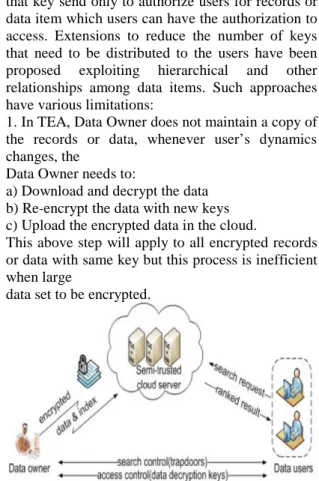
In this section, the existing system is briefly discussed. Fig show Traditional Encryption Approach (TEA), where records or data items are combined together is based on access control policies and using different symmetric key every
combined records or data items are encrypted after that key send only to authorize users for records or data item which users can have the authorization to access. Extensions to reduce the number of keys that need to be distributed to the users have been proposed exploiting hierarchical and other relationships among data items. Such approaches have various limitations:
1. In TEA, Data Owner does not maintain a copy of
the records or data, whenever user’s dynamics
changes, the
Data Owner needs to:
a) Download and decrypt the data b) Re-encrypt the data with new keys c) Upload the encrypted data in the cloud.
This above step will apply to all encrypted records or data with same key but this process is inefficient when large
data set to be encrypted.
Fig. 1: Traditional Encryption Approach 2. Data owner needs to be establishing a private communication channels with the users for issuing new keys.
3. User’s identity attributes confidentiality is not
considered. So the cloud can learn user private information and
their organization.
4. TEA does not support fine-grained ABAC policies.
TEA is based on broadcast key management scheme, addresses some of the above limitations, but it still require data owner to enforce all ACPs by fine-grained encryption whenever user dynamics changes due to all these encryption activities perform at Data Owner that needs high communication and computation expenditure. For e.g., whenever user added or revoked in the system, the data owner need to download the affected data from the cloud, generate new encryption key, re-encrypt the downloaded data with new key, and then upload the re-encrypted data to the cloud server.
III. Hybrid Encryption Approach
the records or data items from the cloud server and then second way carried out by cloud server, where cloud server performs the complete access control related encryption on the top of the data owner encrypted data or records. But challenging issue in this approach is how to decompose the ACPs so that it supports fine-grained ABAC policies while at same time the confidentiality of the identity attributes of users and records or data are assured [5]. However, performing two ways of encryption is new and provides a superior result than Traditional Encryption Approach. Fig. 2 show general ideas behind data under HEA, where initially data is encrypted by Data Owner and then again encrypted data is encrypted by Cloud server.
Fig. 2: Data under HEA
Consider the hospital example, where hospital acts as a Data Owner support access control on medical records and makes these records available to hospital employees acts as Users, and Users have different roles as an attribute such as receptionist (rec), cashier (cas), doctor (doc), nurse (nur), pharmacist (pha) and system administration (admin).
IV. Performance Analysis
In this section first present experimental results concerning the policy decomposition algorithms. Then present an experimental comparison between the TLE and TLE Dynamic broadcast encryption approaches. Utilized the AB-GKM scheme with the subset cover optimization. Then used the complete subset algorithm introduced by Naor et. al. as the subset cover. Figure 2 shows the size of the attribute condition cover, that is, the number of attribute conditions the data owner enforces, for systems having 100 attribute conditions as the number of attribute conditions per policy is increased. In all experiments, the Dynamic Subset-Cover algorithm performs better than greedy search cover algorithm, as the number of attribute conditions per policy increases; the size of the attribute condition cover also increases.
VI. RELATED WORK Searchable Encryption: Search in encrypted data is a privacy preserving technique used in the outsourced storage model where a user's data is stored on a third-party server and encrypted using the user's public key. The user can use a query in the form of an encrypted token to retrieve relevant data from the server, whereas the server does not learn any more information about the query other than whether the returned data matches the search criteria. There have been
efforts to support simple keyword queries [30], [5], conjunctive keyword queries [17] and more recently complex ones involving conjunctive, subset and range queries [7]. The primary focus of such work is to protect the confidentiality of the published data from the third-party servers. Issues related to fine-grained access control (FGAC), such as key management, are not considered and the servers are trusted to preserve the privacy of the users who query the encrypted content. Further, these approaches are not able to support general monotonic access control policies. There have been some recent attempts to provide keyword based searches in the cloud [31], [10], [21]. While these approaches provide different capabilities, such as fuzzy keyword search [21], ranked keyword search [31] and multi-keyword search [10], they do not provide authenticated search capabilities and do not address key management issues. Attribute Based Encryption: The concept of attribute-based encryption (ABE) has been introduced by Sahai and Waters [28]. ABE can be considered as a generalization of identity based encryption [6], [13] (IBE), where the encryption is based on some identity. Thus, ABE is more expressive than IBE. In an ABE system, the plaintext is encrypted with a set of attributes. The key generation server, which possesses the master key, issues different private keys to users after authenticating the attributes they possess. Thus, these private keys are associated with the set of attributes each user possesses. In its basic form, a user can decrypt a ciphertext if and only if there is a match between the attributes of the ciphertext and the user's key. The initial ABE system is limited only to threshold policies where there should be at least k out of n attributes common between the attributes used to encrypt the plaintext and the attributes users possess. Pirretti et al. [26] gave an implementation of such a threshold ABE system using a variant of the Sahai-Waters Large Universe construction [28]. Since the initial threshold scheme, a few variants have been introduced to provide more expressive ABE systems. Goyal et al. [18] introduced the idea of key-policy ABE (KP-ABE) systems and Bethencourt et al. [4] introduced the idea of ciphertext-policy ABE (CP-ABE) systems. Even though these constructs are expressive and provably secure, it is hard to support group management, especially to provide forward security when a user leaves the group (i.e. attribute revocation) and to provide backward security when a new user joins the group. Some of the above schemes suggest using an expiration attribute along with other attributes. However, such a solution is not suitable for a dynamic group where joins and departures are frequent.
Fine-grained Access Control:
FGAC can be categorized into two dissemination models: push based and pull-based models. In a push-based system, content publishers push the content to users either by broadcasting or making the content available in a public location. In a pull based system, every time users want to access some content, they login to the content provider and retrieve based on the access control policies. Our work focuses on the pull based model, but the techniques introduced can be used to construct push-based systems supporting FGAC. Under the push-based model, the database and security communities have carried out research concerning techniques for the selective dissemination of documents based on access control policies [3], [22]. In all such work, subdocuments are encrypted with different keys, which are provided to users at the registration phase, and broadcast the encrypted subdocuments to all users. However, such approaches require all [3] or some [22] keys be distributed in advance during user registration phase. This requirement makes it difficult to assure forward and backward key secrecy when user groups are dynamic with frequent join and leave operations. Further, the rekey process is not transparent, thus shifting the burden of acquiring new keys on existing users when others leave or join. In contrast, our approach makes rekey transparent to users by not distributing actual keys during the registration phase.
V.PROPOSED ARCHITECTURE
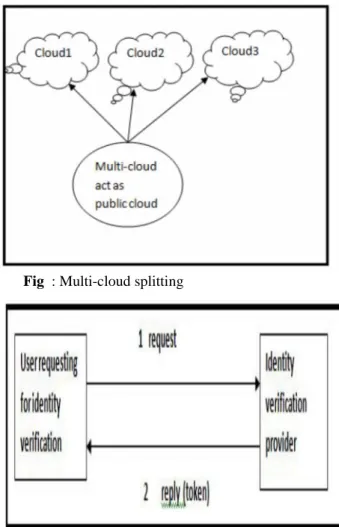
In this paper, we are using two-layer encryption for storage of data across multi-clouds rather than a single public cloud. This two layer enforcement helps one to reduce the load on the Owner and delegates access control enforcement over the cloud. Especially, it provides a better way for various updates, user locations, and modifications of the data. The system goes through one additional phase compared to the existing system. Also, it provides several functions based on the decomposition or splitting of data to store across various clouds, which are finally retrieved by the user with the help of keys.
Fig : Multi-cloud storage
Fig : Multi-cloud splitting
Fig : Two layer encryption in multi-cloud Environment
VII. Conclusion:
VIII. Reference :
[1] X. Zhang, S. Oh and R. Sandhu, “PBDM: a flexible delegation model n RBAC,” In
proceedings of the eighth ACM symposium on Access control models and technologies (SACMAT), New York, NY, USA, pp. 149–157, 2003.
[2] M. Moniruzzaman, M.S. Ferdous and R. Hossain, “A study of privacy policy enforcement in access control models,” In proceedings of 13th
International Conference on Computer and Information Technology (ICCIT). Dhaka, Bangladesh, pp. 352 – 357, 2010. DOI:10.1109/ICCITECHN.2010.5723883.
[3] M. Jafari, P. W. L. Fong, R. Safavi-Naini, K.
Barker, and N. P. Sheppard, “Towards Defining
Semantic Foundations for Purpose- Based Privacy
Policies,” In proceedings of the First ACM
Conference on Data and Application Security and Privacy (CODASPY), San Antonio, Taxas, USA, 213-224, 2011.
[4] N. Shang, M. Nabeel, F. Paci, and E. Bertino,
“A privacy-preserving approach to policy-based
content dissemination,” in ICDE ’10: Proceedings
of the 2010 IEEE 26th International Conference on Data Engineering, 2010.
[5] Thuraisingham, “Towards privacy preserving access control in the cloud,” in Proceedings of the
7th International Conference on Collaborative Computing: Networking, Applications and
Work-sharing, ser. Collaborate Com ’11, 2011, pp. 172–
180.
[6] M.Nabeel, N.Shang, and E.Bertino, “Privacy
preserving policy based content sharing in public
clouds,” IEEE Transactions on Knowledge and
Data Engineering, 2012.
[7] Cecile Delerablee, Pascal Paillier, and David Point cheval. Fully collusion secure dynamic broadcast encryption with constant-size cipher texts or decryption keys. In T. Takagi et al., editor, Pairing 2007, volume 4575 of LNCS, pages 39-59. Springer, 2007.
Authors:
KOTA ANUSHA is a
student of Computer Science Engineering from ST.MARYS GROUP OF INSTITUTION , GUNTUR Presently pursuing M.Tech from this college.