837
A WIRELESS SENSOR NETWORK ROUTING ALGORITHM
BASED ON ANT COLONY ALGORITHM
1CHEN XIANG, 2LI YUN
1Department of Computer & Information Engineering, Guangxi Vocational & Technical Institute of
Industry, Nanning 530001, Guangxi, China
2
Department of Electronic Engineering, Guilin University of Aerospace Technology, Guilin 541004, Guangxi, China
ABSTRACT
This article proposed one kind based on the ant colony algorithm routing algorithm in wireless sensor networks. According to the election of cluster head node energy, and the use of ant colony algorithm is simple and easy to implement, support for multiple path characteristics, through the adjacent cluster-heads mutual exchange between the respective distances and residual energy value information, resulting in the entire network to establish and update the cluster heads of pheromone concentration, then according to the pheromone concentration calculation adjacent cluster is selected as the next hop routing. Finally, this paper makes use of NS2 simulation tools to test the algorithm.The simulations results show that compared with LEACH algorithm, the algorithm in energy consumption and prolong the network lifetime and have better performance.
Keywords: WSN, Ant Colony Algorithm, Routing Algorithm
1. INTRODUCTION
In wireless sensor networks, generally comprises one or more nodes as a data sink node ( node Sink ), network sensor node collecting data, through multi-hop transmission to node Sink, the Sink node will fusion data via a wired or wireless way to transmit to the observer.
Wireless sensor network routing technology is the core of the communication layer technology. The existing network of many technology can’t be directly applied to the wireless sensor network, will in many ways facing challenges, the key technologies including time synchronization, positioning technology, security technology, data management[1].
Wireless sensor network routing protocol in the design process must be to save energy as a primary goal and the compromise mechanism, so that users can extend the network survival time and decrease communication delay. This determines the traditional routing protocols are not suitable for running in a WSN environment, and it needs to be improved or made applicable to a WSN network routing protocol.
1.1 Wireless Sensor Network Structures
838 Figure 1: WSN System Architecture
1.2 Wireless Sensor Network Protocol
Architecture
Figure 2 shows the architecture of wireless sensor network protocol. This architecture has a hierarchical network communication protocol, the application layer; transport layer, network layer, data link layer, physical layer, and the internet protocol layer five protocol corresponding. As well as the protocol architecture also includes three management platforms, respectively, ---- energy management platform, mobile management platform and mission management platform. Among them, energy management platform to the control node to the use of energy plays a main role. Certain application conditions, some nodes may be mobile.
[image:2.612.332.504.424.523.2]Mobile management platform for detection and control of mobile node, the maintenance of the converging point of the route can make the sensor node to trace its neighbors. Mission management platform is the role of balancing and scheduling of a particular area of assigned tasks[3].
Figure 2 Network Protocol Architecture
2. NETWORK PROTOCOL
ARCHITECTURE
In the wireless sensor network, because the sensor node energy support and communication bandwidth is limited, the transmission of data packets through a plurality of communication destination which to sensor network design and management presents many challenges, so routing algorithm network layer design of the main task. In the literature, we propose the ant colony algorithm.
2.1 Ant colony algorithm
Ant colony algorithm is affected by the nature of real ant colony behavior Nature ant colony through mutual cooperation to find from nest to food in the shortest path, and can change with the environment (such as sudden changes of obstacles), quickly find the shortest path[4].
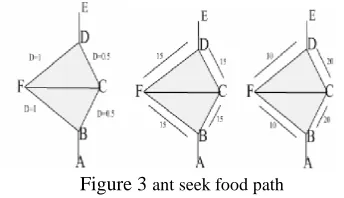
Let A be a nest, E is a food source, FC as an obstacle. Because of obstacles, the ant only through the F or C from A to E, or by E to A, the distance between points as shown in the figure. For each unit of time 30 ants from A to B, there are 30 ants from E to D, ant after leaving the hormone content quality (hereinafter called information). For the convenience of computation, the dwell time of material. At the initial time, the path to the BF, BC, DF, DC were no information exists, is located in the B and E ants can randomly select path. From a statistical point of view can view them with the same probability of selection of BF, BC, DF, and DC. After a time unit, in the path of the amount of information on the BCD is the path BHD information content two times. T red moment, there will be 20 ants by B and D reached C, 10 ants by B and D to F. With the passage of time, the ants will be more and more big probability to choose the path BC. Eventually, route choice, D, from nest to food source to find the shortest path.
Figure 3 ant seek food path
At initialization time, ants are placed in different city.
( ) ( )
( ) ( ) ( ) ,
0 ,
ij ij k
ij ir tr k
t t
P t t t j allowed
otherwise
α β
α β
τ η
τ η
= ∈
∑
(1)After a moment, the ants go all cities, to complete a cycle. With the passage of time, the following pheromone faded, parameter expressed pheromone dies, the ants to complete one cycle later, the path information to the following adjustment:
Standard 1: (local adjustment criteria): local adjustment means that none of the ants in the setting of a solution process, after an hour, two cities between local pheromone quantities according to the type adjustment;
Internet & Satellite
Sink nodes
Task manager
APPLICATION
TRANSFORM NETWORK
DATA LINK
[image:2.612.92.266.448.616.2]839 Standard 2 :( local adjustment criteria): only generating a global optimal solution of the ants has a chance of global adjustment.
Ant colony algorithm, single ant has only simple functions and connects together by certain rules, whereas in the wireless sensor networks, node energy and computing power is very low, which requires the agreement is designed to be as simple as possible, so the ant colony algorithm applied to the wireless sensor network will make the routing algorithm simpler.
We will combine the features of wireless sensor network; the concrete analysis of ant colony algorithm can be applied to the wireless sensor network cause:
(1) Dynamic topology[5]
In wireless sensor networks, the nodes with limited energy, often appear a node due to energy depletion and death phenomenon, or the presence of new nodes to join the phenomenon, so that the entire network topology may be changing dynamically, thereby making a path failure, resulting in data transmission failure. In the ant colony algorithm is to rely on every ant to work independently by indirect communication to accomplish a task. When the colony of certain individual cannot work and the environment changes, other individuals or according to some predetermined rules to keep running, without other individuals and the disturbance of the external environment. Therefore, the ant colony algorithm for network topology changes has good adaptability, and is suitable for wireless sensor networks.
(2) Simple person
As mentioned before, the wireless sensor network nodes in the compute, storage capacity and energy etc are very limited, therefore, the routing design must be simple, in order to reduce the amount of calculation and storage, consumption reduction. In the ant colony algorithm in individual ants have very simple functions, according to simple rules together to accomplish a task. Through this idea to design routing algorithm, inevitable meeting is very simple.
(3) Part of working
As mentioned before, sensor nodes in computing, storage capability, limited, in general can only be stored neighbor node information, but like the traditional routing algorithms that at each node are stored in the network routing tables and updated approach is not applicable. In the routing algorithm based on ant colony algorithm, each node needs only local information can be recorded to establish
the route, without considering the global information.
(4) Energy efficiency
In ant colony algorithm, pheromone is a very important media; ant is the adoption of certain pheromone concentration to choose the path. In wireless sensor networks, energy efficiency is a measure of a routing algorithm is an important index, therefore, we can convert the energy into the pheromone concentration formula, thereby routing formula to calculate a certain probability to select the path.
3. NS2 SIMULATIONS
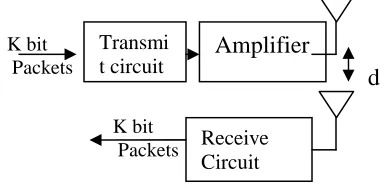
In this algorithm, the receiving, transmitting model as shown in Figure 5.1, this model is based on two assumptions:
[image:3.612.321.514.335.429.2](1) The network nodes (node) exactly the same. (2) The radio signal in all directions on the same energy consumption.
Figure 4 Signal Transmission Model
In this model, receiving and transmitting circuit to work when consumed energy is:
50 / elec
E = nJ bit (2)
Transmitting amplifier working energy consumption is:
2
100 / /
amp pJ bit m
ε = (3)
The algorithm flow chart is shown as follows:
Transmi
t circuit
Amplifier
Receive Circuit
d
K bit Packets
840 Figure 5 Flowchart Of Algorithm
In order to make the Sink node to obtain sensor network topology and energy, as well as nodes know distance Sink node jump number (or distance ) and a neighbor node information, in the cluster building, first by the Sink node broadcasts an msg_qur query information, through the node forwarding information and node sending, forwarding ack response information, the result is about Sink sensor node and node jump number ( or distance ) and a neighbor node information, Sink node acquires the network topology and energy information, for the cluster provides a condition.
After the network initialization or round before the end of hair to send data information, Sink obtains the current network surviving node number N and network total energy is:
1
n total i
i
E E
=
=
∑
(4)The network average energy is:
/ average total
E =E n (5)
Step 1:By Sink radio one began clustering information, the information contains the network average energy information.
Step 2:Network sensor node receives a Sink radio cluster information, computing yourself if you have the election of cluster head qualification.
Step3:Competitive cluster head node will own qualification information broadcast out, announced their competitive cluster head qualification.
Step4: Based on the TDMA MAC layer
mechanism can effectively reduce the cluster nodes to transmit the data to the cluster head conflict.
Randomly select a tuft of hair to send data to a Sink node. Here, the random selection of cluster heads is mainly considered to send data to a Sink node is a process of energy consumption, node from the Sink nearest cluster head will consume a lot of energy, so the random selection of hair to send data can be shared across the network to the network load.
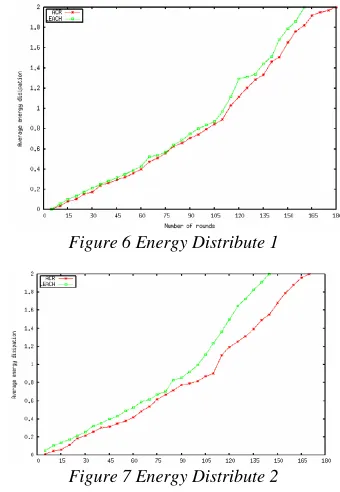
[image:4.612.336.506.393.639.2]NS2 is a network for the study of discrete event simulator. In this experiment, to test the network scale on routing protocol performance influence setting 100 nodes network scene. In addition, in order to explain the regional expansion of network routing algorithm performance, we set up two scenes. Scene I, randomly distributed nodes in 100 × 100m2 in area; scene II, randomly distributed nodes in a 200 x 200 region. Each of the wireless sensor nodes of the initial energy is 2J, for a total of 3600 seconds, 20 seconds per a cluster head election. During the simulation, setting network has a source and a Sink node, node Sink nearest node at least 75m.
Figure 6 Energy Distribute 1
Figure 7 Energy Distribute 2
In the scene I, shows that ant colony algorithm based on wireless sensor network routing algorithm may be to prolong the network life cycle, while the energy consumption is more evenly distributed to all nodes. This is mainly because the ant colony algorithm based on wireless sensor network routing algorithm by the cluster head node is evenly
Create new record
No
StartInitialization
Clusterin
Routing table exist adjacent
cluster
Update information
number
End
841 distributed throughout the network, thus balancing the network load.
Based on the ant colony algorithm routing algorithm in wireless sensor networks, node number of survival in the average energy consumption and prolong the network lifetime than the LEACH algorithm have good performance. Furthermore, with the expansion of network scale, the algorithm shows better performance, showing a good scalability.
4. CONCLUSION
Make it in the aspects of the design and research limited as sensor networks own nature. Especially the energy consumption problem, restricted the development of sensor network is a key problem to solve this problem, first to consider sensor network applications in different fields. Therefore, how to design effective and energy saving for sensor networks routing algorithm of sensor network is one of the key problems.
This paper introduces the concept of wireless sensor network, system structure, application field. Based on the existing protocols and typical routing protocol comparison analysis, which draw on the advanced algorithm, wireless sensor network routing protocol design requirements, based on the LEACH algorithm, from saving energy, prolong the network life cycle perspective on the LEACH algorithm, proposed one kind based on the ant colony algorithm in wireless sensor network routing algorithm. The algorithm of LEACH cluster head random distribution as well as the cluster head node and Sink direct communication problems, ant colony algorithm based on wireless sensor network routing algorithm has been improved. First of all, in the cluster head election is a no longer random election, but the energy of the node into account, thus ensuring the election of cluster head adequacy. Secondly, the algorithm uses the inter-cluster routing mechanisms, and biological intelligence algorithm ant colony algorithm incorporated therein, the network makes the algorithm more simple and robust.
This algorithm exchanges between the respective distances and residual energy value in order to establish entire network and update the pheromone concentration on the path. Forming and updating pheromone into the distance and the residual energy of two factors, and then calculate the adjacent nodes corresponding to the probability to select the next hop routing selection, namely not only to consider the shortest path, but also as far as possible to choose the path of residual energy.
Using NS2 simulation tool for simulate experiment in order to evaluate the performance of the algorithm. The simulation results show that, in the energy efficiency or extending the life cycle of the network based on ant colony algorithm, wireless sensor network routing algorithm can be basically balanced, its performance was superior to the LEACH algorithm.
The routing algorithm design also has many is worth studying and needs to be improved. Pheromones can also be formed to consider more factors, such as the link quality; in addition, how to combine the specific application scenes and sensor characteristics, how to consider the physical equipment to the network data fusion, optimization, management, security and other issues, in order to design better able to meet the practical application of the routing algorithm, is our next step to deeply research topic.
REFERENCES:
[1] L. Girod, “Locating tiny sensors in time and space: A case study”, Proceedings of International Conference on Computer Design, February 25-28, 2002, pp. 195-204.
[2] K.Wong, “Physical layer considerations for wireless sensor networks networking”, Proceedings of International Conference on Sensing and Control, October 20-28, 2004, pp. 312-318.
[3] J.QiangFeng, D.Manivannan, “Routing protocols for sensor networks”, Proceedings of
International Conference on consumer
communications and Networking, March 30-26, 2004, pp. 343-350.