IJPSR (2016), Vol. 7, Issue 7 (Research Article)
Received on 10 January, 2016; received in revised form, 21 June, 2016; accepted, 28 June, 2016; published 01 July, 2016
HPTLC METHOD DEVELOPMENT AND VALIDATION FOR STANDARDIZATION OF AYURVEDIC FORMULATION: MAHASHANKH VATI
Vineeta Khanvilkar * and Nishigandha Chalak
Bharati Vidyapeeth’s College of Pharmacy, C.B.D Belapur, Navi Mumbai - 400614, Maharashtra, India
ABSTRACT: Ayurveda is the primeval complete serving system in medical field. However, one of the barriers in the acceptance of the Ayurvedic formulation is the paucity of standard quality control outline. World health organization (WHO) in 1999 has given a detail procedure for the standardization of herbal drugs comprising of a single content but not for standardization of polyherbal formulations. Mahashankhvati is official in Ayurvedic Formulary of India and is prescribed for treatment of haemorrhoids, malabsorption syndrome, dyspepsia and indigestion. In the proposed work, attempt has been made for standardization of Mahashankh Vati by developing chromatographic method. Piperine from
Piper longum and Piper nigrum, Umbelliferone from Ferula asafoetida
and Gallic acid from Terminaliachebula present in formulation were selected as marker compounds. A new, rapid, simple, precise, selective HPTLC method was developed for marketed preparation of Mahashankhvati. The separation was performed on TLC aluminium plates precoated with silica gel 60 F254, using toluene: ethyl acetate:
methanol: formic acid (7:2:2.5:0.5 v/v/v/v) as mobile phase. The densitometric analysis was carried out at the detection wavelength of 290 nm. The Rfvalues of piperine, umbelliferone and gallic acid was found to
be 0.65, 0.52 and 0.32 respectively.The developed method has been validated as per ICH guidelines.
INTRODUCTION: Being resurrecting of interest in natural drugs, especially plants derived, started in the last few decades mainly because of widespread belief that green medicines are healthier and safer than the synthetic once.1 Standardization of herbal materials and their formulations is essential in order to assess quality of the drugs.
QUICK RESPONSE CODE
DOI:
10.13040/IJPSR.0975-8232.7(7).3012-20
Article can be accessed online on: www.ijpsr.com DOI link: http://dx.doi.org/10.13040/IJPSR.0975-8232.7 (7).3012-20
The quality assessment of herbal formulations is most important in order to justify their acceptability in modern system of medicine. 2 One of the major problems faced by the herbal industry is the deficit of rigid quality control profiles for herbal materials and their formulations.
The World Health Organization (WHO) has appreciated the importance of medicinal plants for public health care in developing nations and has evolved guidelines to support the member states in their efforts to formulate national policies on traditional medicine and to study their potential usefulness including evaluation, safety and efficacy.3 Mahashankh Vati is official in Ayurvedic formulary of India. It is a polyherbal formulation;
Keywords:
Piperine, Umbelliferone, Gallic acid, Standardization,
HPTLC, Mahashankhvati Correspondence to Author: Vineeta V. Khanvilkar
Associate Professor
Department of Quality Assurance Bharati Vidyapeeth's College of Pharmacy, Sector 8, C.B.D. Belapur, Navi Mumbai - 400 614, India
which is consists of ten ingredients of plant origin chitraka (Plumbagozeylanica), maricha (Piper nigrum), pippali (Piper longum fruit), pippalimoola (Piper longum root), ginger (Zingiber officinale), hing (Ferula asafoetida), dantimool (Baliosper mummontanum), hard a (Terminalia chebula),
Chincha (Tamarindus indica), ajwain (Trachy spermumammi) shankh bhasma and panchalavana (vida, Sauvarchala, samudra, audbhida, Saindhava). It is widely used for the treatment of irritable bowel syndrome, rheumatoid arthritis and loss of appetite.4
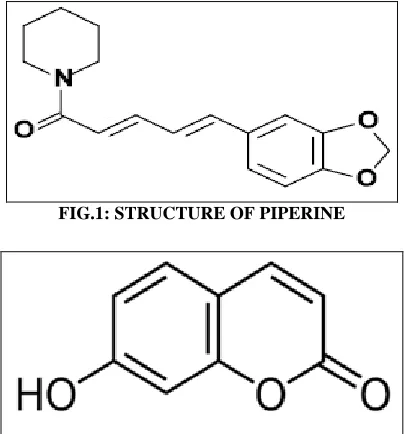
[image:2.612.343.532.51.161.2]Literature and market survey states that the above formulation available in market is product of numerous companies. Modern analytical methods are not yet reported for standardization of Mahashankh Vati. As it is difficult to estimate each and every ingredient for its chemical constituents, piperine (Fig.1) from Piper longum and Piper nigrum; umbelliferone (Fig.2) from Ferula asafoetida and gallic acid (Fig.3) from Terminalia chebula present in formulation were selected as marker compounds. Literature survey reveals that few HPTLC, RP-HPLC and UV methods are reported for estimation of piperine 5, 6, 7, 8, umbelliferone 9, 10 and gallic acid 11 individually as well as in combination with other constituents. However, no analytical method has been reported for simultaneous estimation of piperine, umbelliferone and gallic acid; which can be further applied for standardization of Mahashankh Vati.
FIG.1: STRUCTURE OF PIPERINE
FIG. 2: STRUCTURE OF UMBELLIFERONE
FIG. 3: STRUCTURE OF GALLIC ACID.
The present research work deals with development of HPTLC method for standardization of Mahashankh Vati by detection and quantification of markers piperine, umbelliferone and gallic acid simultaneously from in-house and marketed formulations. The proposed method was validated on the basis of its linearity, accuracy, specificity, precision, limit of detection (LOD), limit of quantification (LOQ) and robustness according to ICH guidelines.
MATERIALS AND METHODS: Materials:
Raw materials used for the preparation of MahashankhVati and two different marketed brands (M1, M2) of Mahashankh Vati were procured from Ayurvedic medical shop, Mumbai and stored in air tight containers at room temperature. The stationary phase used was TLC plates precoated with silica gel 60 F254 (20×20 cm) of 0.2 mm thickness obtained from E. Merck Ltd. Mumbai, India.
Standards and reagents:
The organic solvents and chemicals of analytical grade were procured from S.D Fine chemicals Pvt. Ltd. Mumbai, India. Standard piperine, umbelliferone and gallic acid were procured from Sigma Aldrich Pvt. Ltd. Mumbai, India.
Instrumentation:
Camag Linomat 5 semiautomatic sample applicator equipped with a 100μl Hamilton syringe (Camag, Switzerland) and winCATS software (CAMAG Ver.1.4.1), Camag TLC Scanner 3, Twin trough chamber.
Method:
Preparation of standard solution:
[image:2.612.72.274.507.724.2]by dissolving 10 mg of accurately weighed standard in 10 ml of methanol. From this stock solution, 100μg/ml solution was prepared by transferring 1 ml stock solution to 10 ml volumetric flask then volume adjusted with methanol.
Preparation of In-house formulation:
All the ingredients were collected, dried and powdered separately, passed through 100 # sieve and then mixed together in specified proportions in a geometrical manner to get uniform mixture. To this mixture citrus juice (Citrus aurantium) was added and grounded well to form a homogenous blend and compressed into tablets. The tablets were dried and packed in air tight containers for further analysis.
Extraction of piperine, umbelliferone and gallic acid from marketed and in-house formulations:
Vati equivalent to 5g were triturated and extracted with 25ml methanol, reflux for 30 min, filtered through Whatmann filter paper no. 41 and this procedure was repeated consecutively for three times using fresh 25ml of methanol. The final volume was then made up to 100 ml with methanol. This solution was used for quantification of piperine, umbelliferone and gallic acid.
Chromatographic conditions:
Chromatographic separation was achieved on HPTLC plates (10×10 cm) pre-coated with silica gel 60 F254 of 0.2 mm thickness with aluminium sheet support. Standard solutions of markers and extracts were applied to the plates as bands 6.0 mm wide, 10.0 mm from the bottom edge of the same chromatographic plate by using of a Camag (Muttenz, Switzerland) Linomat 5 sample applicator equipped with a 100μl Hamilton syringe. Ascending development to a distance of 80 mm was performed at room temperature (24 ± 2°C) with mobile phase, in a Camag glass twin-trough chamber previously saturated with mobile phase vapour for 30 min. After development, the plates were dried and then scanned at 290 nm with a Camag TLC Scanner 3 using the deuterium lamp with win CATS software.
Optimization of Mobile phase:
The standard stock solution containing 100μg/ml of piperine, umbelliferone, gallic acid was spotted on
to TLC plate and developed in different solvent systems. Many preliminary trials were carried out for selection of mobile phase. Mobile phase composition was optimized to provide accurate, precise and reproducible results for the determination of piperine, umbelliferone and gallic acid.
Assay:
For assay purpose standard and sample (extract) solutions were applied on TLC plate in triplicates. Standard solutions of piperine, umbelliferone and gallic acid 100μg/ml were applied. Calibration curves constructed from peak areas obtained from standard solutions of piperine, umbelliferone and gallic acid. Sample (extract) solution was used for quantification of markers. The amount of piperine, umbelliferone and gallic acid present per gram of formulation was calculated by comparison of the areas measured for the sample with the calibration curves.
Method validation: 12
In accordance with ICH guidelines Q2 (R1) the optimized HPTLC method was validated with respect to following parameters.
Linearity:
The linearity of an analytical procedure is its ability (within a given range) to obtain test results which are directly proportional to the concentration of analyte in the sample. It was determined by plotting a graph of peak area v/s concentration of standards to obtain correlation coefficient (r2) and equation of the line.
Specificity:
Specificity is the ability to assess the analyte in the presence of components that may be expected to be present in the sample matrix. The specificity of the method was ascertained by comparing the Rf value and the peak purity was assessed by comparing the spectrum of standard piperine, umbelliferone and gallic acid with sample.
Precision:
statistically significant number of samples. As per the ICH guidelines precision should be performed at three different levels low quality control (LQC), medium quality control (MQC) and high quality control (HQC). Repeatability expresses the precision under the same operating conditions over a short interval of time. Repeatability is also termed as intra-assay precision. It was assessed by using minimum of 9 determinations covering the specified range for the procedure. The intra-day assay precision was performed 3 times on same day, while inter-assay precision was performed on 3 different days.
Limit of Detection (LOD) and Limit of Quantification (LOQ):
Limit of detection (LOD) is the lowest amount of an analyte in a sample that can be detected, but not necessarily quantitated, under the stated experimental conditions. Limit of Quantification (LOQ) is the lowest amount analyte in a sample that can be determined with acceptable precision and accuracy under the stated experimental conditions. LOD and LOQ were determined by k x SD/s where k is a constant (3.3 for LOD and 10 for LOQ), SD is the standard deviation of the analytical signal and s is the slope of the calibration curve.
Accuracy:
Accuracy should be reported as percent recovery by the assay of known added amount of analyte in the sample or as the difference between the mean and the accepted true value together with the confidence intervals. Accuracy should be assessed using a minimum of 9 determinations over a minimum of 3 concentration levels covering the specified range (e.g. 3 concentrations /3 replicates each of the total analytical procedure). The percent recovery was calculated by performing recovery studies in triplicates of three concentration levels viz. 80%, 100%, 120% by adding known amount of standard mixture of piperine, umbelliferone and gallic acid. These samples were then analyzed and the results obtained were compared with expected results.
Robustness:
The robustness of an analytical procedure is a measure of its capacity to remain unaffected by
small, but deliberate variations in method parameters and provides an indication of its reliability during normal usage. It was studied in triplicate at 300 ng/spot and 400 ng/spot by making small changes in mobile phase composition and the mobile phase saturation time. The final results were examined by calculation of %RSD of concentration.
RESULTS AND DISCUSSION:
In situ HPTLC spectral overlain of piperine, umbelliferone and gallic acid were taken. Isoabsorptive point was found at 290 nm and was selected as scanning wavelength (Fig. 4).
FIG. 4: HPTLC IN SITU OVERLAIN SPECTRA OF PIPERINE, UMBELLIFERONE AND GALLIC ACID.
Good resolution and sharp peaks with minimum tailing were obtained with mobile phase consist of toluene: ethyl acetate: methanol: formic acid 7:2:2.5:0.5 (v/v/v/v). Piperine, umbelliferone and gallic acid were satisfactorily resolved with Rf values at 0.65 ± 0.02, 0.52 ± 0.02 and 0.32 ± 0.02 respectively (Fig. 5).
FIG. 5: CHROMATOGRAM OF STANDARD PIPERINE [Rf:
0.65 ± 0.02], UMBELLIFERONE [Rf: 0.52 ± 0.02] AND
[image:4.612.314.565.259.407.2] [image:4.612.315.565.553.713.2]HPTLC Method Validation: Linearity:
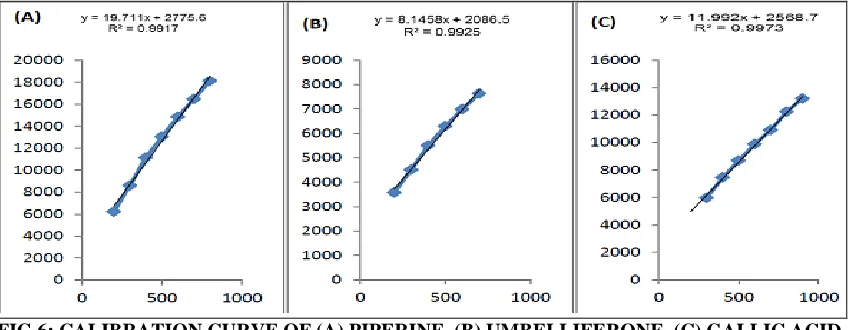
Linear relationship was observed by plotting drug concentration against peak area for each compound. Piperine, umbelliferone and gallic acid showed linear response in the concentration range
of 200-800 ng/spot, 200-900 ng/spot and 300-900 ng/spot, respectively (Fig.6A, 6B and 6C). The linearity was validated by the high value of the correlation coefficients. The results are tabulated in (Table 1).
FIG.6: CALIBRATION CURVE OF (A) PIPERINE, (B) UMBELLIFERONE, (C) GALLIC ACID.
TABLE 1: LINEAR REGRESSION DATA FOR CALIBRATION PLOT FOR PIPERINE, UMBELLIFERONE AND GALLIC ACID
Parameters Piperine Umbelliferone Gallic Acid
Linearity (ng/spot)
200-800 200-700 300-900
Equation y=19.71x+2775 y=8.15x+2086 y=11.99x+2568
Correlation coefficient (r2 ± SD)
0.9917 ± 0.003493 0.9925 ± 0.004903 0.9973 ± 0.002601
Slope ± SD 19.71 ± 0.3080 8.15 ± 0.0918 11.99 ± 0.004002
Intercept ± SD 2775 ± 175.5055 2086± 61.3137 2568 ± 0.006152
SD = Standard Deviation
Specificity:
When the spectra of standard piperine, umbelliferone and gallic acid were overlayed (Fig. 7A, 7B and 7C) or compared with extracts of Mahashankh Vati it was observed that constituents
present in the extract did not interfere with the peaks of piperine, umbelliferone and gallic acid. Thus the proposed method was proved to be specific.
[image:5.612.95.520.146.311.2]FIG.7B: OVERLAY SPECTRA OF STANDARD UMBELLIFERONE AND UMBELLIFERONE FROM VATI EXTRACT.
FIG. 7C: OVERLAY SPECTRA OF STANDARD GALLIC ACID AND GALLIC ACID FROM VATI EXTRACT.
Precision:
Intraday precision is used to describe the variation of the method, at three different concentration levels within the same day while interday precision
is for variation between different days. The % RSD values for both intraday and interday precision were found within acceptable limit as shown in
[image:6.612.49.561.564.724.2]Table 2.
TABLE 2: INTRA-DAY AND INTER-DAY PRECISION RESULTS OF PIPERINE, UMBELLIFERONE AND GALLIC ACID.
Concentration (ng/spot)
Interday Intraday
Mean Area
S.D. %RSD Mean
Area
S.D. %RSD
Piperine 300 8650.3 61.89 0.53 8610.37 98.79 0.71
500 13039.3 250.79 1.24 13033.9 117.6 1.92
700 16083.2 31.79 1.86 16093.2 55.43 1.44
Umbelliferone 300 4382.8 80.83 1.50 4429.97 79.99 1.82
500 6261.3 39.10 1.76 6250.42 88.93 1.96
600 7019.52 105.4 0.71 7079.39 134.88 0.67
Gallic Acid 400 5446.5 55.32 0.45 6446.57 35.33 0.84
600 10065.5 67.99 0.88 10016.5 8.01 0.55
Limit of detection (LOD) and Limit of quantification (LOQ): LOD and LOQ results of piperine, umbelliferone and gallic acid are as shown in Table 3.
TABLE 3: LOD AND LOQ RESULTS OF PIPERINE, UMBELLIFERONE AND GALLIC ACID.
LOD (ng/spot)
LOQ (ng/spot)
Piperine 19.97 60.52
Umbelliferone 31.24 94.68
Gallic Acid 37.82 114.61
Accuracy:
Accuracy of the method is reported as percent recovery of known added amount of analyte in the sample. The percent recovery was calculated by performing recovery studies in triplicates of three concentration levels viz. 80%, 100%, 120% by adding known amount of standard mixture of piperine, umbelliferone and gallic acid. Results obtained were given in Table.4, 5, 6.
TABLE 4: ACCURACY DATA FOR PIPERINE.
Compound Level of % Recovery Amount added (ng) Measured amount (ng) Recovery (%) RSD (%) Mean Recovery (%) Marketed Formulation (M1)
80 1370 1354.7 98.916 1.26 99.40
100 1520 1525.2 103.6 0.94
120 1670 1666.8 99.47 1.39
Marketed Formulation
(M2)
80 1300 1298.1 99.80 0.27 99.16
100 1440 1426.5 98.67 0.25
120 1590 1588.2 99.12 0.38
In-house Formulation
80 1340 1338.9 99.15 0.61 98.84
100 1480 1466.81 98.63 0.52
120 1630 1610.6 98.74 0.68
TABLE 5: ACCURACY DATA FOR UMBELLIFERONE.
Compound Level of %recovery Amount added(ng) Measured amount(ng) Recovery (%) RSD (%) Mean Recovery (%) Marketed Formulation (M1)
80 666 657.3 98.10 0.44 98.87
100 740 731.6 98.75 0.99
120 810 808.1 99.75 0.43
Marketed Formulation
(M2)
80 580 569.9 98.25 0.61 99.15
100 640 636.2 99.3 0.63
120 700 678.8 99.82 0.36
In-house Formulation
80 660 653.3 98.98 0.63 99.02
100 700 688.8 98.4 0.92
120 770 768.1 99.78 0.53
TABLE 6: ACCURACY DATA FOR GALLIC ACID.
Compound Level of % recovery Amount added (ng) Measured amount (ng) Recovery (%) RSD (%) Mean Recovery (%) Marketed Formulation (M1)
80 130 128.99 99.10 0.82 99.45
100 140 138.94 99.03 1.83
120 160 160.64 100.41 0.62
Marketed Formulation
(M2)
80 120 135 136.69 0.29 99.79
100 130 150 149.88 0.49
120 150 165 161.73 0.87
In-house Formulation
80 140 139.41 99.59 0.61 99.39
100 160 159.61 99.75 0.52
120 180 177.94 98.84 0.68
Robustness:
The % RSD of the peak area was calculated in triplicate for changes in mobile phase composition and duration of saturation time for 300 and 400
TABLE 7: ROBUSTNESS RESULTS OF PIPERINE, UMBELLIFERONE AND GALLIC ACID.
Parameters Piperine Umbelliferone gallic acid
300ng/spot 400ng/spot 300ng/spot 400ng/spot 300ng/spot 400ng/spot
%RSD %RSD %RSD %RSD %RSD %RSD
Mobile phase composition toluene: ethyl acetate:
methanol: formic acid 6.8:2:2.5:0.5 (v/v/v/v)
0.89 0.22 0.93 1.72 0.34 1.53
toluene: ethyl acetate: methanol: formic acid 7:3:1.5:0.5 (v/v/v/v)
0.92 1.55 0.63 0.85 1.23 0.67
Saturation time
+ 5 min 0.33 1.33 0.18 0.27 0.5 0.37
- 5 min 0.46 0.72 0.55 1.51 0.98 0.25
Estimation of piperine, umbelliferone and gallic acid in marketed and In-house formulations:
The developed method was applied for the detection and quantification of piperine, umbelliferone and gallic acid from marketed and in-house formulations of Mahashankh Vati. The
peaks for piperine, umbelliferone and gallic acid were observed at Rf0.65 ±0.02, 0.52 ±0.02 and 0.32 ±0.02 respectively in the densitogram of extracts. The test samples of marketed formulations and in-house formulation were compared with the ingredients Fig. 8.
FIG. 8: HPTLC FINGERPRINTING PROFILE OF EXTRACT OF MAHASHANKH VATI AND ITS INGREDIENTS AT 254 nm AND 366 nm RESPECTIVELY.T1, T5-STANDARD PIPERINE, UMBELLIFERONE AND GALLIC ACID; T2-MARKETED FORMULATION (M1); T3-MARKETED FORMULATION (M2); T4-INHOUSE FORMULATION.
There was no interference from other compounds present in the Vati. The total content of piperine, umbelliferone and gallic acid in marketed
[image:8.612.134.482.323.619.2]TABLE 8: PIPERINE, UMBELLIFERONE AND GALLIC ACID CONTENT IN POLYHERBAL FORMULATIONS.
Formulation Piperine
content (% w/w)
umbelliferone content (% w/w)
gallic acid content (% w/w)
Marketed Formulation (M1) 0.20 0.079 0.015
Marketed Formulation (M2) 0.15 0.067 0.018
In-house Formulation 0.18 0.071 0.02
CONCLUSION: The HPTLC method was developed for standardization of Mahashankh Vati using piperine, umbelliferone and gallic acid as marker constituents. The HPTLC method was found to be simple, precise, accurate, specific and reproducible for standardization of Mahashankh Vati. The method based on simultaneous estimation of piperine, umbelliferone and gallic acid could be applied for both marketed and in house formulation as well as for routine quality control to check quality and batch-batch variations.
ACKNOWLEDGEMENT: Authors are thankful to Bharati Vidyapeeth's College of Pharmacy for providing facilities to complete this work successfully.
CONFLICT OF INTEREST: The authors do not have any conflict of interest.
REFERENCES:
1. Govil GN, Singh VK: Recent Progress in Medicinal
Plants: Standardization of herbal / Ayurvedic formulations, Studium Press LLC Publisher, Vol. 24, 2009:46.
2. Rasheed A, Reddy SB, Roja C.: A Review on
Standardisation of Herbal Formulation. International Journal of Phytotherapy 2012; 2(2): 74-88.
3. Organisation Mondiale De La Sante.: Quality control
methods for medicinal plant materials, 559, (1) Original English, World Health Organisation1992: 159.
4. The Ayurvedic Pharmacopoeia of India, Govt. of India,
Ministry of health and Family Welfare, Department of Indian Systems of Medicine and Homeopathy, Published by The Controller of Publications, Civil Lines, New Delhi,1989, 1(1):133-136.
5. Jain KL, Patel RK, Patel HP: HPTLC method for
simultaneous determination of piperine, embeline, and
carvone in the ayurvedic formulation
Catpusphadhyachurna. J AOAC Int. 2014; 97(3):773-7.
6. Upadhyay V, Sharma N, Joshi H, Malik A, Mishra M,
Singh BP, Tripathi S : Development and Validation of Rapid RPHPLC Method for Estimation of Piperine in Piper nigrum L. International Journal of Herbal Medicine 2013; 1 (4): 6-9.
7. Singh N, Kumar P, Gupta D, Singh S, Singh V :
UV-spectrophotometric method development for estimation of piperine in Chitrakadi Vati. Scholars Research Library 2011; 3(3): 178-182.
8. Vishvnath G and Jain U. K: Quantitative analysis of
piperine in ayurvedic formulation by UV
Spectrophotometry, International Journal of Pharma Sciences and Research 2011; 2(2): 58-61.
9. Siddique N, Mujeeb M, Aamir M, Husain A: Simultaneous
Quantification of Umbelliferone and Quercetin in
Polyherbal Formulations of Aegle Marmelos by HPTLC.
American Journal Pharm Tech Research 2012; (2):569.
10. Malik A, Kushnoor A, Saini V, Singhal S, Kumar S,
Yadav Y:Analytical Method Development of
Nutraceutical: Umbelliferone. Pharma Science
Monitor2012; 3 (1): 67.
11. Patil S, Jadhav V, Kadam V: Method Development and
Validation for Simultaneous estimation of Gallic Acid and Piperine in Herbal Extract and Polyherbal Formulation by HPTLC. World Journal of Pharmacy and Pharmaceutical Sciences 2014, 4(1):738-748.
12. ICH Q2b, ICH Harmonised Tripartite Guideline,
Validation of Analytical Procedures: Methodology, Recommended for Adoption at Step 4 of the ICH Process on 6 November 1996, by the ICH Steering Committee.
All © 2013 are reserved by International Journal of Pharmaceutical Sciences and Research. This Journal licensed under a Creative Commons Attribution-NonCommercial-ShareAlike 3.0 Unported License.
This article can be downloaded to ANDROID OS based mobile. Scan QR Code using Code/Bar Scanner from your mobile. (Scanners are available on Google Playstore)
How to cite this article:
Khanvilkar V. and Chalak N.:HPTLC Method Development and Validation for Standardization of Ayurvedic Formulation: Mahashankh