A case study on supervised classification of Swedish pseudo-coordination
Malin Ahlberg, Peter Andersson, Markus Forsberg, and Nina Tahmasebi Spr˚akbanken, Department of Swedish, University of Gothenburg
{firstname.lastname}@svenska.gu.se
Abstract
We present a case study on super-vised classification of Swedish pseudo-coordination (SPC). The classification is attempted on the type-level with data col-lected from two data sets: a blog cor-pus and a fiction corcor-pus. Two small ex-periments were designed to evaluate the feasability of this task. The first experi-ment explored a classifier’s ability to dis-criminate pseudo-coordinations from ordi-nary verb coordinations, given a small la-beled data set created during the experi-ment. The second experiment evaluated how well the classifier performed at de-tecting and ranking SPCs in a set of un-labeled verb coordinations, to investigate if it could be used as a semi-automatic dis-covery procedure to find new SPCs.
1 Introduction
This paper describes a case study on supervised classification of Swedish complex predicate con-structions, namely pseudo-coordinations (SPCs). SPCs are light verb constructions of the formV1 och V2 ’V1 andV2’, with a semantically lightV1. An example of an SPC isHan st˚ar och stirrar bort ¨over havetwhich could be literally translated into ’He stands and stares away over the sea’, but a more correct translation would be ’He is staring away over the sea’, i.e., the first verb mainly adds a progressive/durative aspect to the second verb. This example illustrates one of the reasons why SPCs, as well as constructions in general, may be worth studying from a practical language technol-ogy perspective – to improve machine translation. We use the term ’construction’ as it is used within the theoretical paradigm of construction grammar. The main tenet of construction grammar is that our grammatical knowledge is made up of
a taxonomic network of constructions, i.e., pair-ings of form and meaning (Croft, 2001; Goldberg, 2006). Moreover, no level of grammar is con-sidered autonomous (Fried and ¨Ostman, 2004). Constructions include all dimensions of language, form includes syntax as well as phonological as-pects, and meaning includes semantics and prag-matics. Early works on construction grammar re-strict the notion of constructions to form-meaning pairings with some non-predictable aspect (Gold-berg, 1995), but today the concept of construction has been expanded to also include pairings with compositional meaning, which ”are stored as con-structions even if they are fully predictable, as long as they occur with sufficient frequency” (Gold-berg, 2006). SPCs are complex constructions with a partially non-compositional meaning.
Previous work on automatic identification of Swedish constructions, e.g., Forsberg et al. (2014), focus on unsupervised classification of all con-structions in a language. Forsberg et al. (2014) do this by using information-theoretic measures to rank automatically generated hybrid n-grams, where the constituents of an n-gram are either lem-mas or a syntactic phrases. In this paper we are interested in a particular class of constructions, namely SPCs, where we explore the use of su-pervised methods that rely on available linguistic knowledge about SPCs in the classification pro-cess.
1.1 Swedish pseudo-coordination (SPC)
Pseudo-coordination is not unique to Swedish, it appears in all Scandinavian languages, as well as in other languages, such as English. If we turn our attention to pseudo-coordination in Swedish, the standard grammar reference for Swedish, Teleman et al. (1999), list five classes of SPC, based on the properties of the first verb (V1).
Kristianst˚ar och stirrarbort ¨over havet. ’Kristian is staring (lit. ’stands and stares’) out over the sea.’
2. V1is a verb of movement, e.g.,kom hit’come here’, ˚aka ’go’, g˚ar ut ’go out’, kryper in ’crawl inside’ ...
Jag tror jagkryper in och str¨acker ut migett slag.
’I think I will crawl inside and stretch myself out for a while.’
3. V1 is a verb denoting different phases of an action, e.g., b¨orja ’begin’, forts¨atta ’con-tinue’, h˚alla p˚a ’keep on’, sluta ’stop’ ... Folkh˚aller p˚a och tar nersina parasoller. ’People keep on (lit. ’and’) taking down their umbrellas.’
4. V1 is a verb preceding a politeness expres-sion, e.g.,vara (hygglig)’be (so kind)’. Kan du intevara hygglig och k¨opahem mat? ’Could you be so kind and buy home some food?’
5. V1 is a verb denoting the channel of com-munication, e.g.,skriva’write’,ringa ’call’, telegrafera’telegraph’ ...
Skriv och ber¨attaom dina glada upplevelser. ’Write and tell me about your happy experi-ences.’
1.2 Linguistic properties of SPC
Central work related to SPCs are Teleman et al. (1999), Wiklund (2007), Kvist Darnell (2008), Blensenius (2014), and Hilpert and Koops (2008). SPCs are not as well understood as similar con-structions, e.g., auxiliary concon-structions, which have been more extensively studied. Below you find the most prominent properties that distinguish SPCs from ordinary verb coordinations, as de-scribed in the litterature.
1. It is possible to front an object or bound ad-verbial ofV2that is not compatible withV1:
Hon satt och skrev en bok. ’She sat and wrote a book.’
⇒
Det var en bok som hon satt och skrev. ’It was a book that she sat and wrote.’
2. The order ofV1andV2is fixed:
Mona satt och skrev ’Mona sat and wrote.’
⇒
?Mona skrev och satt. ’Mona wrote and sat’
3. Some paraphrasings are blocked: Mona satt och sydde
’Mona sat and sewed.’
⇒
?Mona satt och hon sydde. ’Mona sat and she sewed’
4. b˚ade V1ochV2’bothV1andV2’ is blocked: ?Mona b˚ade satt och sydde
’Mona both sat and sewed.’
5. There are usually no or few arguments be-tweenV1andoch.
6. Both verb forms have identical tense, with a few exceptions whereV1 is a modal auxil-iary: m˚aste och handla ’lit. must (present) and shop (infinitive)’ andvill och bada ’lit. want (present) and bath (infinitive)’.
Other criteria are based on our own observa-tions, or a result of discussions with colleagues. An example of what came out of these discussions is the negation test: If an SPC has a negation in-serted afterV1, it also negatesV2. Hon satt inte
och skrev en bok ’She did not (sit and) write a book’. This stands in contrast to ordinary verb co-ordination where the negation does not affectV2.
Hon skrattade inte och sade ingenting’She did not laugh and said nothing’. Another example of what came out of these discussions was that frequency counts are very important, especially the count of theV2 verb types; when theV1 verb is light, it is more likely to occur with a large number ofV2 types.
Moreover, different SPCs seem to behave some-what differently and the dividing line between SPCs and other complex predicates are not dis-tinct. Both lexicalized verb constructions, such as tycka och t¨anka, ’think and reflect’, and auxiliary constructions, such as sluta och (att) spela, ’lit. stop and (to) play’, behave similarly with respect to syntactic and semantic features (Teleman et al., 1999). In fact, since ’och’ and ’att’ are typically pronounced in the same way, verb chains with a V1 denoting the phase of an action are often pro-nounced in the same way both as SPCs and aux-iliaries. Wiklund (2007) calls this group of verb chains an informal and dialectal class of SPCs.
2 Methodology
The experiments are designed for supervised clas-sification on the type level, i.e., we do not try to decide whether a particular verb coordination in a given context is an SPC, but rather whether the verb coordination, given all its contexts, tends to function as a pseudo-coordination. For this we need a labeled data set and a suitable set of fea-tures. These features were derived from previous work and adapted to our settings. The values for each feature are based on all evidence for a verb coordination in the current data set.
Once we have trained and tested our classifier on the labeled data set, we then apply the classifier on unknown instances and evaluate the top SPC candidates according to the classifier, i.e., try to use the classifier as an SPC discovery procedure.
2.1 A random forest classifier
Using the Weka tool (Hall et al., 2009), we exper-imented with different types of machine learning algorithms, all with similar results. A requirement was that the classifier should be able to produce a real-valued classification to enable ranking. For no other strong reason, we ended up using a ran-dom forest classifier (Breiman, 2001). A ranran-dom forest classifier consists of a combination of deci-sion trees where features are randomly extracted to build a set of decision trees. A decision tree is a tree-structured graph where each node corre-sponds to a test on a feature. A path from the root to a leaf represents a classification rule.
The features are decided upon beforehand and the values for each node are learned based on training data, with the aim to best separate the pos-itive instances from the negative instances. In our
case, the instances to be classified are the verb co-ordinations,(Vi,Vj), that are considered positive if
they are in the class SPC, and negative if they do not.
The classifier is trained and tested on labeled data from both the positive and negative class. Training and testing are performed on mutually exclusive parts of the labeled data in a stratified ten-fold cross validation. The classification results are then averaged over all ten folds.
The result according to the test data is presented in a confusion matrix with four classes: true pos-itive (TP), true negative (TN), false pospos-itive (FP), and false negative (FN). The true positive and true negative classes contain those instances that have been correctly classified. The false positive class contains all non-SPC instances that have been mis-classified as SPC, and conversly, the false negative class contains all SPC instances misclassified as non-SPC.
2.2 The feature set
For each verb coordination (Vi,Vj), we derived a
set of features based on the evidence in our data set. Our features were derived from Hilpert and Koops (2008), Teleman et al. (1999), Tsvetkov and Wintner (2011) (a work on classifying multi-word expressions, a task similar to this one), as well as our own observations.
The features generally measured closeness and order, as well as represented negative tests, and the features were real-valued features rather than bi-nary, i.e., a test like “is the wordb˚ade’both’ used before the verb coordination?” was translated into “how often is the wordb˚adeused before the verb coordination?”. In particular when working with unedited text such as blogs, real-valued features can help reduce the effects of noise.
The features used by our classifier are described below.
1. frequencyFrequency of(V1,V2), normalized by
• the maximum frequency of any verb co-ordination
• the average frequency of all verb coor-dinations
2. closenessHow often areV1andV2 separated by words other thanoch’and’?
4. inverse frequency Frequency of (V2,V1), normalized using the maximum frequency of any verb coordination.
5. inverse closeness Similar to test 2, but for
(V2,V1).
6. bothHow often isb˚ade’both’ used in con-junction to the verb coordination?
7. betweenHow many words appear on average betweenV1andV2?
8. spreadHow many differentV can be found withV1? Normalized by the maximum spread of allV1.
9. PMI Pointwise mutual information as log(p(V1,V2)/(p(V1)∗p(V2))) where p(Vi)
is the relative frequency of verb Vi and p(V1,V2)is the relative frequency of the verb coordination.
10. notHow often does the word inte’not’ fol-lowV1:V1inte och V2?
11. tenseHow often doV1andV2share the same tense?
12. pos tags beforeDistribution of the three most common pos-tags before the verb coordina-tion.
13. pos tags afterDistribution of the three most common pos-tags after the verb coordination.
Since the classification is done on the type level, it is unavoidable that we sometimes misclassify individual instances. Moreover, since the extrac-tion of verb coordinaextrac-tions is currently done with-out any sophistication, some chains of verb coor-dinations can be misinterpreted, e.g., Jag var ute och gick och hittade min bok ’I was out walking and found my book’ will probably be misclassi-fied as SPC, sincegick och hittadeis erroneously extracted, a verb coordination that tends to be an SPC.
3 Two SPC experiments
The aim of our experiments is twofold. First, we want to know how well the known properties of SPCs can be utilized for classification, i.e., can we build a classifier that can separate known SPCs from other verb coordinations? Secondly, we want to explore if a classifier trained on labeled data can
be used to detect SPCs from a set of unknown verb coordinations. We do this by labeling all unknown verb coordinations as non-SPCs and feeding them to the classifier. If the classifier judges them as SPCs, they end up in the class of false positives, with confidence scores that we can use for rank-ing. We then evaluate if the method can be used as a semi-automatic SPC discovery procedure by investigating the top candidates of the ranking.
The experiments are performed on two different kinds of modern Swedish data sets: a blog corpus and a fiction corpus.
3.1 The data
The blog corpus, Bloggmix,1 is a collection of Swedish blog texts consisting of around 505 mil-lion tokens spanning 16 years, starting in 1998. The data has been annotated automatically using the LT tools in the Korp pipeline (Borin et al., 2012).
Since blog texts are typically informal and unedited, they contain a high degree of noise, i.e., misspellings and ungrammatical language. How-ever, since the language of blogs typically is closer to spoken language than edited texts, and SPCs tend to be more frequent in spoken language, they contain many SPCs as well as new SPC-like con-structions.
The fiction corpus,Bonniers Romaner I&II,2is some decades older and contains a more standard-ized language use. It consists of around 11 million tokens of Swedish fiction published between 1976 and 1981.
From each of these data sets we have extracted a training set of verb coordinations occuring at least twice in the data, manually labeled as SPC or non-SPC. The SPC instances all haveV1listed as typ-ical SPC-verbs by Teleman et al. (1999,§17–22), such assitta’sit’ andringa’call’. In the negative training set, we collected instances of the sameV1, but used withV2 that will force a non-SPC read-ing, such asringa och skriva’call and write’ and sitta och ligga ’sit and lie down’. The negative examples also consist of verb coordinations with first verbs randomly selected from the data set. To
1Browsable at http://spraakbanken.gu.se/ korp/, and downloadable (in a sentence-scrambled format) at http://spraakbanken.gu.se/eng/ resources/corpus.
SPC Non-SPC
SPC 492 (TP) 55 (FN)
[image:5.595.103.261.64.114.2]Non-SPC 71 (FP) 598 (TN)
Table 1: Confusion matrix for the blog data set
Precision Recall Class
0.874 0.899 SPC
0.916 0.894 Non-SPC
0.897 0.897 Weighted avg
Table 2: Classification results for the blog data set.
capture slight variations, we allow a maximum of three words separatingV1andV2, e.g.,sitteri sof-fanoch l¨aser’sits in the sofa and reads’.
The created data sets were small, but for our ex-plorative purposes, sufficiently large to get an idea of the feasibility of the task. For the blog texts we had 669 verb coordinations marked as non-SPC with 298 uniqueV1, and 547 verb coordinations marked as SPC with 16 uniqueV1 that were col-lected from Teleman et al. (1999). For the fiction data set we had 193 verb coordinations marked as non-SPC with 121 uniqueV1, and 121 verb coor-dinations marked as SPC with 11 uniqueV1.
3.2 SPC classification: the blog data set
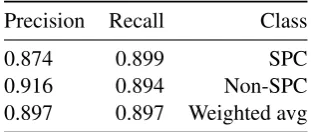
In order to investigate how well the classifier per-forms on the blog data set, we evaluated using a stratified 10-fold cross validation on the labelled data. Tables 1 and 2 show the results. The clas-sifier was able to correctly identify 89.9% of all SPCs and 89.4% of all non-SPCs, giving us an F1-measure of 0.897.
3.3 SPC ranking of unknowns: the blog data set
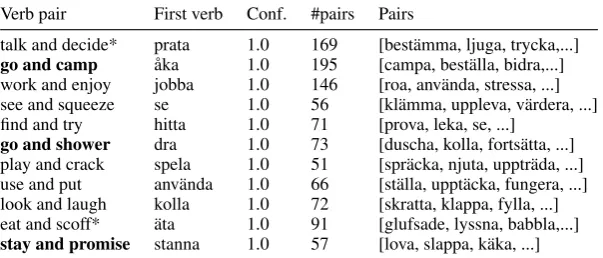
In our second experiment we tested the classifier, trained on the labeled data set, on previously un-known verb coordinations that we added as non-SPC. Table 3 shows the top ranking of verb coor-dinations that ended up in the false positive, i.e., the verb coordinations in the unknown set that the classifier deemed SPC. We found a few SPCs in this manner, for example, V1 such as ˚aka ’go’, stanna’stay, stop’,dra’(slang) go’ andfara ’(for-mal) go’ are all examples ofV1-verbs that occur in SPCs.
After having analyzed the ranking, we found
many of the verb coordinations interesting, even though not necessarily typical SPCs. To investi-gate this further, we conducted a manual analysis of the results and classified each verb coordination into one of five classes, defined as follows:
1. Class 0 No SPCs, or incorrectly extracted verb coordination, e.g., V2 is the first word in phrasal verb.
2. Class 1Additive lexicalized verb coordina-tion, e.g.,¨ata och dricka’eat and drink’.
3. Class 2Lexicalized SPC-like verb coordina-tion, whereV2 is semantically more promi-nent thanV1, e.g., fnysa och s¨aga’snort and say’.
4. Class 3Verb coordination with a strong ten-dency to be SPC.
5. Class 4Support verb constructions, whereV1 is a support verb. The most common use of V1 och V2 in informal texts is actually incor-rectly written, and should have been V1 att
V2. E.g.,f¨ors¨oka och tr¨ana ’try and (meant: to) exercise’.
Since this task is hard in the general case, we decided to only evaluate a few verb coordinations, and to do it through a consensus discussion among at least three evaluators. When in doubt, sentences that contained the verb coordination were used to support a decision. For the blog data, we evalu-ated in total 78 of the top-ranked verb coordina-tions. The majority of the verb coordinations, 53 of 78 was marked as class 0, and for the remaining classes, class 1: 5, class 2: 2, class 3: 12, and class 4: 6. With the exception of class 0, the SPC class was the largest with its 12 verb coordinations. In total, 25 of the 78 verb coordinations were of in-terest for further analysis.
3.4 SPC classification: the fiction data set
[image:5.595.103.259.149.215.2]Verb pair First verb Conf. #pairs Pairs
talk and decide* prata 1.0 169 [best¨amma, ljuga, trycka,...]
go and camp ˚aka 1.0 195 [campa, best¨alla, bidra,...]
work and enjoy jobba 1.0 146 [roa, anv¨anda, stressa, ...] see and squeeze se 1.0 56 [kl¨amma, uppleva, v¨ardera, ...] find and try hitta 1.0 71 [prova, leka, se, ...]
go and shower dra 1.0 73 [duscha, kolla, forts¨atta, ...]
play and crack spela 1.0 51 [spr¨acka, njuta, upptr¨ada, ...] use and put anv¨anda 1.0 66 [st¨alla, uppt¨acka, fungera, ...] look and laugh kolla 1.0 72 [skratta, klappa, fylla, ...] eat and scoff* ¨ata 1.0 91 [glufsade, lyssna, babbla,...]
[image:6.595.149.451.65.194.2]stay and promise stanna 1.0 57 [lova, slappa, k¨aka, ...]
Table 3: An extract of highly ranked verb coordinations in the blog data set.Verb coordinationsinbold
have a strong tendency to be SPCs, and * marks interesting verb coordinations from class 1, 2 or 4.
SPC Non-SPC
SPC 163 (TP) 17 (FN)
[image:6.595.104.259.341.407.2]Non-SPC 21 (FP) 172 (TN)
Table 4: Confusion matrix for the fiction data set
Precision Recall Class
0.886 0.906 SPC
0.91 0.891 Non-SPC
0.898 0.898 Weighted avg
Table 5: Classification results for the fiction data set.
3.5 SPC ranking of unknowns: the fiction data set
Table 6 shows all verb coordinations that are clas-sified by the algorithm as a false positive with a confidence higher than or equal to 0.6.
There is one movement SPCV1, ˚aka ’go’, and one phasal SPC,V1: stanna’stay, stop’. Further-more, we find verb coordinations that show a ten-dency of acting in an SPC-like way, e.g., v¨anda och g˚a’turn around and go’. The top candidates, kunna ’be able to’ and ha ’have’, are errors oc-curing because of faulty coordination extraction – clausal coordinations have been misinterpreted as verb coordinations. For further discussion, see section 4.
We evaluated this data set in the same manner as for the blog data, through consensus voting of at least three evaluators. Again, we only evaluated a small data set, 61 verb coordinations. We found 31 of 61 in class 0; 7 in class 1; 7 in class 2; 14 in class 3; and 1 in class 4. In total, 30 of the 61 verb coordinations were of interest for further
analysis. In comparison with the same experiment on blog texts, we get 20% more, however, since we are dealing we such small sets of data, it is not possible to conclude that the difference is statisti-cally significant.
4 Discussion
Teleman et al. (1999) list a few more SPC tests. One such important test is whether the pronoun-ciation of the first verb is stressed, but such fea-tures are unavailable in our data sets. Neither do we take into account features that require a correct parse tree, such as object extraction (see 1.2). This test was used by Hilpert and Koops (2008) in their manual classification, but the cor-rectness of the syntactic parses available to us was not deemed high enough to measure this correctly, especially for the unstandardized language found in blog texts. Hilpert and Koops (2008) also con-sider adverb placement, which is a feature approx-imated by feature 7, see section 2.2.
verb coordination First verb Conf. #coordinations Verb coordinations
can and take kunna 1.0 12 [ta, b¨ora, se. . . ]
have and put ha 0.9 4 [l¨agga, ge, ha. . . ]
go and pick up ˚aka 0.8 5 [h¨amta, h¨alsa, spela,. . . ]
stay and buy stanna 0.7 8 [k¨opa, lyssna, ta, v¨anta. . . ]
smile and say* le 0.7 2 [s¨aga, verka]
say and feel s¨aga 0.7 8 [k¨anna, dra, visa,. . . ]
see and feel se 0.7 4 [k¨anna, l¨ara, erfara,. . . ]
laugh and say* skratta 0.6 1 [s¨aga]
live and must leva 0.6 1 [m˚aste]
[image:7.595.332.500.252.312.2]turn around and go* v¨anda 0.6 1 [g˚a]
Table 6: Ranking of unknown verb coordinations in the fiction data set with a confidence higher than or equal to 0.6. Verb coordinationsinboldhave a strong tendency to be SPCs. * marks interesting verb coordinations from class 1, 2 or 4.
fall’, fara ’to go’, resa’to travel’, mejla ’email’, maila ’email (different spelling)’, trilla ’to fall’, varda (vart)’to be’,v¨anda’turn’, andtesta’test’.
The verb coordination mejla och fr˚aga ’email and ask’ falls into the same category asringa och fr˚aga ’call and ask’ or telegrafera och skicka ’to telegraph and send a message’. Further down the list we find the Swedish words for emailing, googling, commenting, and blogging, i.e., new forms of communication. We also find more lexi-calized verb coordinations such as: ramla och sl˚a (sig) ’to fall and hurt oneself’, v¨anda och g˚a ’to turn around and go’.
Similar analysis on the fiction data set did not change the ranking substantially, probably due to it being a smaller data set, possibly because the language use is more formal and less spoken-like than in blogs. This hypothesis remains to be fur-ther investigated.
Since the data sets are small, it is important to note that our results are indicative rather than con-clusive. When building the labeled data set we aimed at including well-known SPCs, as described in the reference literature, into our data. To re-duce the bias of the frequency ofV1in the data set, we added verb coordinations whereV1both occurs in SPCs and non-SPCs. E.g., both SPCs such as sitta och titta’sit and look’ and non-SPCs such as sitta och ligga’sit and lie down’ are included in our training data to reduce this bias. We also ran-domly sampled verb coordinations while exclud-ing theV1 occuring in known SPCs. A more fair sample could be created, and will be created in fu-ture work, by sampling the negative examples ac-cording to the frequency distributions ofV1andV2 for the SPCs.
Precision Recall Class
0.853 0.797 SPC
0.843 0.888 Non-SPC
0.847 0.847 Weighted avg
Table 7: Cross validation results for the blog data set without the spread feature.
Precision Recall Class
0.729 0.822 SPC
0.821 0.715 Non-SPC
0.772 0.767 Weighted avg
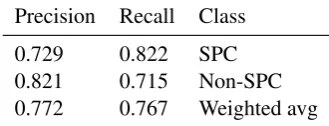
Table 8: Cross validation results for the fiction data set without the spread feature.
5 Conclusion and future work
We presented a case study on supervised classifi-cation of Swedish pseudo-coordination. The clas-sification results with F1 measures of 0.9 based on two separate data set indicate that it is possible to automatically separate known SPCs from other verb coordinations. When applying the classifiers on unknown verb coordinations, we found that quite a few interesting verb coordinations could be captured semi-automatically using a simple dis-covery procedure. However, when evaluating the result manually, it became clear that many verb co-ordinations had as many positive as negative SPC instances, which suggests that individual instances often cannot be estimated using general tenden-cies. Therefore, our next step is to explore how to do the classification on the instance-level instead of the type-level, like we do here.
[image:7.595.333.498.361.424.2]Verb pair First verb Conf. #pairs Pairs
go and camp ˚aka 1.0 120 [campa, best¨alla, bidra,...]
wake and see* vakna 1.0 63 [se, leva, ligga, ...]
stay and eat stanna 1.0 65 [k¨aka, st¨ada, s¨aga,...]
pack and prepare packa 1.0 19 [f¨orbereda, v¨anta, ˚aka, ...]
eat and listen ¨ata 1.0 35 [lyssna, fixa, titta, ...]
fall and break* ramla 1.0 9 [bryta, sl˚a, skrapa, skada, skylla, ...]
go and check dra 1.0 47 [kolla, storhandla, gymma, ...]
nod and say* nicka 1.0 4 [s¨aga, se, komma, ...]
go and eat fara 1.0 30 [k¨aka, fixa, fika, ...]
google and find googla 1.0 9 [titta, hitta, uppt¨acka, ...]
mail and ask maila 1.0 13 [vilja, tipsa, fr˚aga, ...]
stand and wait stog 1.0 7 [v¨anta, titta, kolla ...]
comment and share* kommentera 0 14 [dela, motivera, fr˚aga, ...]
mail and tell mejla 1.0 7 [ber¨atta, s¨aga, kolla, ...]
text message and ask messa 0.9 6 [vilja, undra, s¨aga, ...]
[image:8.595.127.473.64.245.2]talk and decide* prata 0.9 25 [best¨amma, r¨akna, l˚atsas, ....]
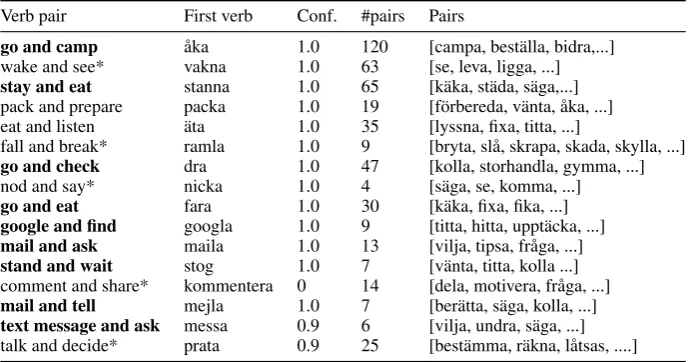
Table 9: An extract of highly ranked verb coordinations in the blog data set, without the spread feature.
Verb coordinationsinboldhave a strong tendency to be SPCs. * marks interesting verb coordinations from class 1, 2 or 4.
is to investigate how to capture constructional change of SPCs by introducing a temporal dimen-sion to the classification. If successful in this task, we will continue by investigating if we can construct a classifier that captures constructional change in general, e.g., by trying to target con-structions that in some ways are similar to SPCs. An interesting question in this context becomes: given that we do not know anything at all about the existence and/or emergence of a class of SPC, is there a way to discover them?
When adding a temporal dimension, the most interesting cases are the ambiguous ones, together with the SPC-likeness of other complex predicate constructions, which may represent an ongoing change, e.g., a grammaticalization in a contin-uum starting from ordinary verb coordination to auxiliary-like SPCs.
Acknowledgments
The research presented here was supported by the Swedish Research Council (through the projects Swedish FrameNet++, contract no 2010-6013, To-wards a knowledge-based culturomics, dnr 2012-5738), and by the Bank of Sweden Tercente-nary Foundation (grant agreement P12-0076:1) (through A Swedish Constructicon, dnr 2010-6013), the University of Gothenburg through its support of the Centre for Language Technology and its support of Spr˚akbanken.
References
Kristian Blensenius. 2014. Maintaining contact with pseudoprogressive pseudocoordinations: Swedish verbal coordinations with ’sit’, ’stand’, and ’lie’ from a spatial perspective. Ms. Dept. of Swedish, University of Gothenburg.
Lars Borin, Markus Forsberg, and Johan Roxen-dal. 2012. Korp – the corpus infrastructure of Spr˚akbanken. InProceedings of LREC 2012, pages 474–478, Istanbul. ELRA.
Leo Breiman. 2001. Random forests. In Machine Learning, pages 5–32.
William Croft. 2001. Radical construction grammar : syntactic theory in typological perspective. Oxford University Press, New York.
Markus Forsberg, Richard Johansson, Linn´ea B¨ackstr¨om, Lars Borin, Benjamin Lyngfelt, Joel Olofsson, and Julia Prentice. 2014. From construction candidates to constructicon entries: An experiment using semi-automatic methods for identifying constructions in corpora. Constructions and Frames, 6(1):114–135.
Mirjam Fried and Jan-Ola ¨Ostman. 2004. Construc-tion grammar in a cross-language perspective. John Benjamins Pub., Amsterdam.
Adele E. Goldberg. 1995. Constructions : a con-struction grammar approach to argument structure. Univ. of Chicago Press, Chicago.
Adele E. Goldberg. 2006. Constructions at work : the nature of generalization in language. Oxford Univ. Press, New York.
2009. The weka data mining software: An update.
SIGKDD Explor. Newsl., 11(1):10–18, November.
Martin Hilpert and Christian Koops. 2008. A quantita-tive approach to the development of complex pred-icates. The case of Swedish Pseudo-Coordination with sitta “sit”. Diachronica, 25(2):242–261.
Ulrika Kvist Darnell. 2008. Pseudosamordningar i svenska : s¨arskilt s˚adana med verben sitta, ligga och st˚a. Institutionen f¨or lingvistik. Stockholms univer-sitet, Stockholm.
Ulf Teleman, Staffan Hellberg, and Erik Andersson. 1999. Svenska Akademiens grammatik. Stockholm: Norstedts.
Yulia Tsvetkov and Shuly Wintner. 2011. Identifica-tion of multi-word expressions by combining mul-tiple linguistic information sources. InProceedings of the Conference on Empirical Methods in Natu-ral Language Processing, EMNLP ’11, pages 836– 845, Stroudsburg, PA, USA. Association for Com-putational Linguistics.