LRscore for Evaluating Lexical and Reordering Quality in MT
Alexandra Birch University of Edinburgh
United Kingdom
Miles Osborne University of Edinburgh
United Kingdom [email protected]
Abstract
The ability to measure the quality of word order in translations is an important goal for research in machine translation. Cur-rent machine translation metrics do not adequately measure the reordering perfor-mance of translation systems. We present a novel metric, the LRscore, which di-rectly measures reordering success. The reordering component is balanced by a lexical metric. Capturing the two most im-portant elements of translation success in a simple combined metric with only one parameter results in an intuitive, shallow, language independent metric.
1 Introduction
The main purpose of MT evaluation is to de-termine “to what extent the makers of a system have succeeded in mimicking the human transla-tor” (Krauwer, 1993). But machine translation has no “ground truth” as there are many possi-ble correct translations. It is impossipossi-ble to judge whether a translation is incorrect or simply un-known and it is even harder to judge the the degree to which it is incorrect. Even so, automatic met-rics are necessary. It is nearly impossible to collect enough human judgments for evaluating incre-mental improvements in research systems, or for tuning statistical machine translation system pa-rameters. Automatic metrics are also much faster and cheaper than human evaluation and they pro-duce reproducible results.
Machine translation research relies heavily upon automatic metrics to evaluate the perfor-mance of models. However, current metrics rely upon indirect methods for measuring the quality of the word order, and their ability to capture re-ordering performance has been demonstrated to be poor (Birch et al., 2010). There are two main ap-proaches to capturing reordering. The first way
to measure the quality of word order is to count the number of matching n-grams between the ref-erence and the hypothesis. This is the approach taken by the BLEU score (Papineni et al., 2002). This method discounts any n-gram which is not identical to a reference n-gram, and also does not consider the relative position of the strings. They can be anywhere in the sentence. Another com-mon approach is typified by METEOR (Banerjee and Lavie, 2005) and TER (Snover et al., 2006). They calculate an ordering penalty for a hypoth-esis based on the minimum number of chunks the translation needs to be broken into in order to align it to the reference. The disadvantage of the second approach is that aligning sentences with very dif-ferent words can be inaccurate. Also there is no notion of how far these blocks are out of order. More sophisticated metrics, such as the RTE met-ric (Pad´o et al., 2009), use higher level syntactic or even semantic analysis to determine the quality of the translation. These approaches are useful, but can be very slow, require annotation, they are lan-guage dependent and their parameters are hard to train. For most research work shallow metrics are more appropriate.
Apart from failing to capture reordering perfor-mance, another common criticism of most cur-rent automatic MT metrics is that a particular score value reported does not give insights into quality (Przybocki et al., 2009). This is because there is no intrinsic significance of a difference in scores. Ideally, the scores that the metrics re-port would be meaningful and stand on their own. However, the most one can say is that higher is better for accuracy metrics and lower is better for error metrics.
We present a novel metric, the LRscore, which explicitly measures the quality of word order in machine translations. It then combines the re-ordering metric with a metric measuring lexical success. This results in a comprehensive
ric which measures the two most fundamental as-pects of translation. We argue that the LRscore is intuitive and meaningful because it is a simple, decomposable metric with only one parameter to train.
The LRscore has many of the properties that are deemed to be desirable in a recent metric eval-uation campaign (Przybocki et al., 2009). The LRscore is language independent. The reorder-ing component relies on abstract alignments and word positions and not on words at all. The lex-ical component of the system can be any mean-ingful metric for a particular target language. In our experiments we use 1-gram BLEU and 4-gram BLEU, however, if a researcher was interested in morphologically rich languages, a different met-ric which scores partially correct words might be more appropriate. The LRscore is a shallow met-ric, which means that it is reasonably fast to run. This is important in order to be useful for train-ing of the translation model parameters. A final advantage is that the LRscore is a sentence level metric. This means that human judgments can be directly compared to system scores and helps re-searchers to understand what changes they are see-ing between systems.
In this paper we start by describing the reorder-ing metrics and then we present the LRscore. Fi-nally we discuss related work and conclude.
2 Reordering Metrics
The relative ordering of words in the source and target sentences is encoded in alignments. We can interpret alignments as permutations. This allows us to apply research into metrics for or-dered encodings to our primary tasks of measur-ing and evaluatmeasur-ing reordermeasur-ings. A word alignment over a sentence pair allows us to transcribe the source word positions in the order of the aligned target words. Permutations have already been used to describe reorderings (Eisner and Tromble, 2006), primarily to develop a reordering model which uses ordering costs to score possible per-mutations. Here we use permutations to evaluate reordering performance based on the methods pre-sented in (Birch et al., 2010).
The ordering of the words in the target sentence can be seen as a permutation of the words in the source sentence. The source sentencesof length N consists of the word positionss0· · ·si· · ·sN.
Using an alignment function where a source word
at positioniis mapped to a target word at position jwith the functiona:i → j, we can reorder the source word positions to reflect the order of the words in the target. This gives us a permutation.
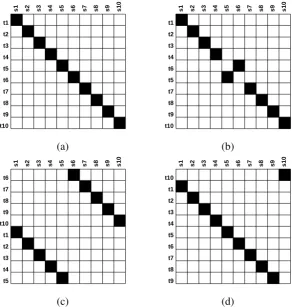
Apermutationis a bijective function from a set of natural numbers1,2,· · · , N to itself. We will name our permutationsπ andσ. The ith symbol of a permutation π will be denoted as π(i), and the inverse of the permutation π−1 is defined so that ifπ(i) = jthenπ−1(j) =i. The identity, or monotone, permutation id is the permutation for whichid(i) = ifor all i. Table 1 shows the per-mutations associated with the example alignments in Figure 1. The permutations are calculated by iterating over the source words, and recording the ordering of the aligned target words.
Permutations encode one-one relations, whereas alignments contain null alignments and one-many, many-one and many-many relations. For now, we make some simplifying assumptions to allow us to work with permutations. Source words aligned to null (a(i) → null) are assigned the target word position immediately after the target word position of the previous source word (π(i) = π(i−1) + 1). Where multiple source words are aligned to the same target word or phrase, a many-to-one relation, the target ordering is assumed to be monotone. When one source word is aligned to multiple target words, a one-to-many relation, the source word is assumed to be aligned to the first target word.
A translation can potentially have many valid word orderings. However, we can be reason-ably certain that the ordering of reference sentence must be acceptable. We therefore compare the or-dering of a translation with that of the reference sentence. The underlying assumption is that most reasonable word orderings should be fairly similar to the reference. The assumption that the reference is somehow similar to the translation is necessary for all automatic machine translation metrics. We propose using permutation distance metrics to per-form the comparison.
de-t1
t2
t3
t4
t5
t6
t7
t8
t9
t10
s1 s2 s3 s4 s5 s6 s7 s8 s9 s10
(a)
t1
t2
t3
t4
t6
t5
t7
t8
t9
t10
s1 s2 s3 s4 s5 s6 s7 s8 s9 s10
(b)
t6
t7
t8
t9
t10
t1
t2
t3
t4
t5
s1 s2 s3 s4 s5 s6 s7 s8 s9 s10
(c)
t10
t1
t2
t3
t4
t5
t6
t7
t8
t9
s1 s2 s3 s4 s5 s6 s7 s8 s9 s10
[image:3.595.153.446.64.372.2](d)
Figure 1: Synthetic examples: a translation and three reference scenarios. (a) is a monotone translation, (b) is a reference with one short distance word order difference, (c) is a reference where the order of the two halves has been swapped, and (d) is a reference with a long distance reordering of the first target word.
pends on the task at hand. We choose a few metrics which are widely used, efficient to calcu-late and capture certain properties of the reorder-ing. In particular, they are sensitive to the num-ber of words that are out of order. Three of the metrics, Kendall’s tau, Spearman’s rho and Spear-man’s footrule distances also take into account the distance between positions in the reference and translation sentences, or the size of the reordering. An obvious disadvantage of this approach is the fact that we need alignments, either between the source and the reference, and the source and the translation, or directly between the reference and the translation. If accuracy is paramount, the test set could include manual alignments and the sys-tems could directly output the source-translation alignments. Outputting the alignment informa-tion should require a trivial change to the decoder. Alignments can also be automatically generated using the alignment model that aligns the training data.
Distance metrics increase as the quality of trans-lation decreases. We invert the scale of the
dis-(a) (1 2 3 4 5 6 7 8 9 10) (b) (1 2 3 4•6•5•7 8 9 10) (c) (6 7 8 9 10•1 2 3 4 5) (d) (2 3 4 5 6 7 8 9 10•1)
Table 1: Permutations extracted from the sentence pairs shown in Figure 1: (a) is a monotone permu-tation and (b), (c) and (d) are permupermu-tations with different amounts of disorder, where bullet points highlight non-sequential neighbors.
tance metrics in order to easily compare them with other metrics where increases in the metrics mean increases in translation quality. All permutation distance metrics are thus subtracted from 1. Note that the two permutations we refer toπandσare relative to the source sentence, and not to the ref-erence: the source-reference permutation is com-pared to the source-translation permutation.
2.1 Hamming Distance
permutations. The Hamming distance for permu-tations was proposed by (Ronald, 1998) and is also known as theexact match distance. It is defined as follows:
dH(π, σ) = 1−
Pn i=1xi
n wherexi =
0 ifπ(i) =σ(i) 1 otherwise
Where π, σ are the two permutations and the normalization constant Z is n, the length of the permutation. We are interested in the Hamming distance for its ability to capture the amount of ab-solute disorder that exists between two permuta-tions. The Hamming distance is widely utilized in coding theory to measure the discrepancy between two binary sequences.
2.2 Kendall’s Tau Distance
Kendall’s tau distance is the minimum number of transpositions of two adjacent symbols nec-essary to transform one permutation into an-other (Kendall, 1938; Kendall and Gibbons, 1990). This is sometimes known as theswap dis-tanceor theinversion distanceand can be inter-preted as a function of the probability of observing concordant and discordant pairs (Kerridge, 1975). It is defined as follows:
dτ(π, σ) = 1−
Pn
i=1 Pn
j=1zij
Z
wherezij =
1 ifπ(i)< π(j) andσ(i)> σ(j) 0 otherwise
Z = (n
2−n)
2
The Kendall’s tau metric is possibly the most in-teresting for measuring reordering as it is sensitive to all relative orderings. It consequently measures not only how many reordering there are but also the distance that words are reordered.
In statistics, Spearman’s rho and Kendall’s tau are widely used non-parametric measures of as-sociation for two rankings. In natural language processing research, Kendall’s tau has been used as a means of estimating the distance between a system-generated and a human-generated gold-standard order for the sentence ordering task (La-pata, 2003). Kendall’s tau has also been used in machine translation as a cost function in a re-ordering model (Eisner and Tromble, 2006) and an MT metric called ROUGE-S (Lin and Och,
2004) is similar to a Kendall’s tau metric on lexical items. ROUGE-S is an F-measure of ordered pairs of words in the translation. As far as we know, Kendall’s tau has not been used as a reordering metric before.
3 LRscore
The goal of much machine translation research is either to improve the quality of the words used in the output, or their ordering. We use the reordering metrics and combine them with a measurement of lexical performance to produce a comprehensive metric, the LRscore. The LRscore is a linear in-terpolation of a reordering metric with the BLEU score. If we use the 1-gram BLEU score, BLEU1, then the LRscore relies purely upon the reorder-ing metric for all word orderreorder-ing evaluation. We also use the 4-gram BLEU score, BLEU4, as it is an important baseline and the values it reports are very familiar to machine translation researchers. BLEU4 also contains a notion of word ordering based on longer matching n-grams. However, it is aware only of very local orderings. It does not measure the magnitude of the orderings like the reordering metrics do, and it is dependent on ex-act lexical overlap which does not affect the re-ordering metric. The two components are there-fore largely orthogonal and there is a benefit in combining them. Both the BLEU score and the reordering distance metric apply a brevity penalty to account for translations of different lengths.
The formula for calculating the LRscore is as follows:
LRscore=α∗R+ (1−α)BLEU
Where the reordering metricRis calculated as fol-lows:
R =d∗BP
Where we either take the Hamming distance dH
or the Kendall’s tau distancedτ as the reordering
distancedand then we apply the brevity penalty BP. The brevity penalty is calculated as:
BP =
1 ift > r
e1−r/t ift≤r
system level lexical score. The Lexical metric is the BLEU score which sums the log precision of n-grams. In our paper we set the n-gram length to either be one or four.
The only parameter in the metricαbalances the contribution of reordering and the lexical compo-nents. There is no analytic solution for optimizing this parameter, and we use greedy hillclimbing in order to find the optimal setting. We optimize the sentence level correlation of the metric to human judgments of accuracy as provided by the WMT 2010 shared task. As hillclimbing can end up in a local minima, we perform 20 random restarts, and retaining only the parameter value with the best consistency result. Random-restart hill climbing is a surprisingly effective algorithm in many cases. It turns out that it is often better to spend CPU time exploring the space, rather than carefully optimiz-ing from an initial condition.
The brevity penalty applies to both the reorder-ing metric and the BLEU score. We do not set a parameter to regulate the impact of the brevity penalty, as we want to retain BLEU scores that are comparable with BLEU scores computed in pub-lished research. And as we do not regulate the brevity penalty in the BLEU score, we do not wish to do so for the reordering metric either. It there-fore impacts on both the reordering and the lexical components equally.
4 Correlation with Human Judgments
It has been common to use seven-point fluency and adequacy scores as the main human evalua-tion task. These scores are intended to be absolute scores and comparable across sentences. Seven-point fluency and adequacy judgements are quite unreliable at a sentence level and so it seems du-bious that they would be reliable across sentences. However, having absolute scores does have the ad-vantage of making it easy to calculate the correla-tion coefficients of the metric with human judge-ments. Using rank judgements, we do not have absolute scores and thus we cannot compare trans-lations across different sentences.
We therefore take the method adopted in the 2009 workshop on machine translation (Callison-Burch et al., 2009). We ascertained how consis-tent the automatic metrics were with the human judgements by calculating consistency in the fol-lowing manner. We take each pairwise compari-son of translation output for single sentences by a
Metric de-en es-en fr-en cz-en
BLEU4 58.72 55.48 57.71 57.24
LR-HB1 60.37 60.55 58.59 53.70
LR-HB4 60.49 58.88 58.80 57.74
LR-KB1 60.67 58.54 58.46 54.20
[image:5.595.317.517.61.146.2]LR-KB4 61.07 59.86 58.59 58.92
Table 2: The percentage consistency between hu-man judgements of rank and metrics. The LRscore variations (LR-*) are optimised for consistency for each language pair.
particular judge, and we recorded whether or not the metrics were consistent with the human rank. Ie. we counted cases where both the metric and the human judged agree that one system is better than another. We divided this by the total umber of pair-wise comparisons to get a percentage. There were many ties in the human data, but metrics rarely give the same score to two different translations. We therefore excluded pairs that the human anno-tators ranked as ties. The human ranking data and the system outputs from the 2009 Workshop on Machine Translation (Callison-Burch et al., 2009) have been used to evaluate the LRscore.
We optimise the sentence level consistency of the metric. As hillclimbing can end up in a local minima, we perform 20 random restarts, and re-taining only the parameter value with the best con-sistency result. Random-restart hill climbing is a surprisingly effective algorithm in many cases. It turns out that it is often better to spend CPU time exploring the space, rather than carefully optimis-ing from an initial condition.
Table 2 reports the optimal consistency of the LRscore and baseline metrics with human judge-ments for each language pair. The table also reports the individual component results. The LRscore variations are named as follows: LR refers to the LRscore, “H” refers to the Hamming distance and “K” to Kendall’s tau distance. “B1” and “B4” refer to the smoothed BLEU score with the 1-gram and 4-gram scores. The LRscore is the metric which is most consistent with human judge-ment. This is an important result which shows that combining lexical and reordering information makes for a stronger metric.
5 Related Work
com-ponent. They propose a type of F-measure which uses a matching functionM to calculate precision and recall. M combines the number of matched words, weighted by their tfidf importance, with their position difference score, and finally sub-tracting a score for unmatched words. Includ-ing unmatched words in the in M function un-dermines the interpretation of the supposed F-measure. The reordering component is the average difference of absolute and relative word positions which has no clear meaning. This score is not intu-itive or easily decomposable and it is more similar to METEOR, with synonym and stem functional-ity mixed with a reordering penalty, than to our metric.
6 Conclusion
We propose the LRscore which combines a lexi-cal and a reordering metric. This results in a met-ric which is both meaningful and accurately mea-sures the word order performance of the transla-tion model.
References
Satanjeev Banerjee and Alon Lavie. 2005. Meteor: An automatic metric for MT evaluation with improved correlation with human judgments. InWorkshop on Intrinsic and Extrinsic Evaluation Measures for MT and/or Summarization.
Alexandra Birch, Phil Blunsom, and Miles Osborne. 2010. Metrics for MT Evaluation: Evaluating Re-ordering. Machine Translation (to appear).
Chris Callison-Burch, Philipp Koehn, Christof Monz, and Josh Schroeder. 2009. Findings of the 2009 Workshop on Statistical Machine Translation. In
Proceedings of the Fourth Workshop on Statistical Machine Translation, pages 1–28, Athens, Greece, March. Association for Computational Linguistics.
Jason Eisner and Roy W. Tromble. 2006. Local search with very large-scale neighborhoods for optimal permutations in machine translation. In Proceed-ings of the HLT-NAACL Workshop on Computation-ally Hard Problems and Joint Inference in Speech and Language Processing, pages 57–75, New York, June.
Richard Hamming. 1950. Error detecting and error correcting codes. Bell System Technical Journal, 26(2):147–160.
M. Kendall and J. Dickinson Gibbons. 1990. Rank Correlation Methods. Oxford University Press, New York.
Maurice Kendall. 1938. A new measure of rank corre-lation.Biometrika, 30:81–89.
D Kerridge. 1975. The interpretation of rank correla-tions.Applied Statistics, 2:257–258.
S. Krauwer. 1993. Evaluation of MT systems: a pro-grammatic view. Machine Translation, 8(1):59–66.
Mirella Lapata. 2003. Probabilistic text structur-ing: Experiments with sentence ordering. Compu-tational Linguistics, 29(2):263–317.
Chin-Yew Lin and Franz Josef Och. 2004. Auto-matic evaluation of machine translation quality us-ing longest common subsequence and skip-bigram statistics. In Proceedings of the 42nd Meeting of the Association for Computational Linguistics (ACL’04), Main Volume, pages 605–612, Barcelona, Spain, July.
Sebastian Pad´o, Daniel Cer, Michel Galley, Dan Juraf-sky, and Christopher D. Manning. 2009. Measur-ing machine translation quality as semantic equiva-lence: A metric based on entailment features. Ma-chine Translation.
Kishore Papineni, Salim Roukos, Todd Ward, and Wei-Jing Zhu. 2002. BLEU: a method for automatic evaluation of machine translation. In Proceedings of the Association for Computational Linguistics, pages 311–318, Philadelphia, USA.
Mark Przybocki, Kay Peterson, S´ebastien Bronsart, and Gregory Sanders. 2009. The nist 2008 metrics for machine translation challengeoverview, method-ology, metrics, and results. Machine Translation.
S Ronald. 1998. More distance functions for order-based encodings. Inthe IEEE Conference on Evolu-tionary Computation, pages 558–563.
Matthew Snover, Bonnie Dorr, R Schwartz, L Micci-ulla, and J Makhoul. 2006. A study of translation edit rate with targeted human annotation. InAMTA.