Aryabhatta Journal of Mathematics and Informatics (Impact Factor- 5.856)
Double-Blind Peer Reviewed Refereed Open Access International e-Journal - Included in the International Serial Directories
Aryabhatta Journal of Mathematics and Informatics
http://www.ijmr.net.in
email id- [email protected]
Page 575The Effect of Hall-Currents on MHD Flow Over an Oscillating Vertical Plate in a Rotating System
U.S. Rajput and Mohammad Shareef
Department of Mathematics and Astronomy, University of Lucknow, Lucknow-226007, India
ABSTRACT
An unsteady MHD flow of a viscous, incompressible and electrically conducting fluid past a vertical oscillatory plate with Hall current in a rotating system filled with a porous medium is studied. Exact solution of the energy equation is obtained in closed form by Laplace transform technique, and solution of momentum equation is obtained by defining a complex variable. The expression for the shear stress at the plate due to the primary and secondary flows is obtained. The results obtained are shown by graphs and table. Applications of the study arise in planetary and solar plasma fluid dynamics systems, rotating MHD induction machine energy generators, magnetic field control of materials processing systems etc.
KEYWORDS: Rotation, MHD, Porous medium, Hall current, Heat Transfer.
1. INTRODUCTION:
Double-Blind Peer Reviewed Refereed Open Access International e-Journal - Included in the International Serial Directories
Aryabhatta Journal of Mathematics and Informatics
http://www.ijmr.net.in
email id- [email protected]
Page 576 medium with Hall current, such as Agarwal et al. [1] analysed the combined influence of dissipation and Hall effect on free convective flow in a rotating fluid and they analysed that the primary shear stress increases and secondary shear stress decrease with increase in magnetic and hall parameters. Also, Mazumdar et al. [8] studied the hydrodynamic study flow with the effect of Hall current. The present study is carried out to examine the effects of Hall currents and rotation on an unsteady convective flow of a viscous, incompressible and electrically conducting fluid past a vertical oscillatory plate in a porous medium under the influence of transversely applied uniform magnetic. The problem is solved analytically using the Laplace Transform technique. A selected set of graphical results illustrating the effects of various parameters involved in the problem is presented and discussed. The numerical values of skin-friction have been tabulated.2. MATHEMATICAL ANALYSIS:
Consider an unsteady MHD flow of a viscous, incompressible, electrically conducting fluid past a vertical infinite flat plate with oscillation in a porous medium. Let x-axis be chosen along the plate in the direction of flow, the z-axis normal to the plate, the y-axis normal to the x-z plane and the plate is assumed to be lie in the x-y plane. The fluid and the plate rotate as a rigid body with a uniform angular velocity about the z-axis. A uniform magnetic field is applied along the z-axis and the plate is taken to be electrically non-conducting. Initially, at time 0, the fluid and the plate are at rest and at a uniform temperature . At time (small), the plate starts to oscillate with a velocity in its own plane and the temperature of the plate is raised to . The fluid motion is induced due to the oscillation of the plate as well as the free convection due to heating of the plate. As the plate occupying the plane = 0 is of infinite extent, all the physical quantities depend only on and only and hence continuity equation identically becomes zero. As the fluid is electrically conducting whose magnetic Reynolds number is very small and hence the induced magnetic field produced by the fluid motion is negligible in comparison to the applied one. Also, the conservation of electric charge gives (current density along z direction) constant. Since = 0 at the plate which is assumed to be non-conducting and hence can be assumed to be zero everywhere. So, under the above assumptions, the governing equations with Boussinesq’s approximation are as follows:
2 2
2 ( ) o ,
y B
u u
v g T T J u
t z K
(1)
2 2
2 o ,
x B
v v
u J v
t z K
(2)
2 2 .
T T
t z
(3)
Aryabhatta Journal of Mathematics and Informatics (Impact Factor- 5.856)
Double-Blind Peer Reviewed Refereed Open Access International e-Journal - Included in the International Serial Directories
Aryabhatta Journal of Mathematics and Informatics
http://www.ijmr.net.in
email id- [email protected]
Page 5772
0 0 0
0 0 0
0 0 0
o
o w
t : u ,v ,T T z,
u
t : u u sin t,v ,T T ( T T ) t at z ,
u ,v ,T T as z .
(4) where the symbols are: temperature of the fluid, temperature of the fluid far away from the plate, temperature at the plate, external magnetic field, primary velocity of the fluid along x direction, secondary velocity of the fluid along y direction, –permeability parameter, volumetric coefficient of thermal expansion, α thermal diffusivity, g acceleration due to gravity, ρ
density of the fluid, kinematic viscosity, m Hall current parameter σ Stefan-Boltzmann constant, current density along x-axis and current density along y-axis .
Taking Hall current into account and the electron pressure gradient (for partially ionised gas), the ion slip & the thermo-electric effects are neglected. As the plate is electrically non-conducting, so assuming
there is no electric field. Hence by generalised Ohm’s law, we have ( 2 ), ( 2 )
1 1
o o
x y
B v mu B mv u
J J
m m
and equations (1) and (2) becomes
2 2
2 2
2 ( ) ( ) ,
(1 ) o B
u u
v g T T mv u u
t z m K
(5) 2 2 2 2
2 ( ) ,
(1 ) o B
v v
u v mu v
t z m K
(6)
To obtain the equations in dimensionless form, the following non-dimensional quantities are introduced:
2 2
2 2
2 2 2 3
( )
, , , , , ,
( )
( )
, P , , ,
o o o
o o w
o w
r r
o o o o
u u u T T
u v
u v t t K K z z
u u T T
B g T T
M G
u u u u
(7)
where ̅ is dimensionless primary velocity of the fluid, ̅ dimensionless secondary velocity of the fluid, ̅ dimensionless spatial coordinate normal to the plate, θ dimensionless temperature, –Prandlt number Grashof number ̅ dimensionless time, ̅ dimensionless rotation parameter, ̅ dimensionless frequency of oscillation, ̅ dimensionless porosity of the porous medium and M magnetic field parameter. The equations (3), to (6) become:
2
2 2
2 ( ) ,
(1 ) r
u u M u
v mv u G
m
t z K
Double-Blind Peer Reviewed Refereed Open Access International e-Journal - Included in the International Serial Directories
Aryabhatta Journal of Mathematics and Informatics
http://www.ijmr.net.in
email id- [email protected]
Page 5782
2 2
2 ( ) ,
(1 )
v v M v
u v mu
m
t z K
(9) 2 2 1 r P t z (10)
0 : 0, 0, 0 ( ),
0 : sin , 0, ( 0),
0, 0 ( ).
t u v z
t u t v t at z
u as z
(11)
After dropping the bars, equations 8 –11 can be written as-
2
2 2
2 ( ) ,
(1 ) r
u u M u
v mv u G
t z m k
(12) 2 2 2
2 ( ) ,
(1 )
v v M v
u v mu
t z m K
(13) 2 2 1 . r
t P z
(14)
0 : 0, 0, 0 ( ),
0 : sin , 0, ( 0),
0, 0 ( ).
t u v z
t u t v t at z
u as z
(15)
To solve above system, takeV u iv.Then using equations (12) and (13), we get,
2
2 b Gr ,
t z
V V
V
(16)
whereb Mi 1 2i m i K
,
The boundary conditions (15) are reduced to:
0 : 0, 0 ( ),
0 : sin , ( 0), 0, 0 ( ).
t z
t t t at z
as z V V V (17)
Aryabhatta Journal of Mathematics and Informatics (Impact Factor- 5.856)
Double-Blind Peer Reviewed Refereed Open Access International e-Journal - Included in the International Serial Directories
Aryabhatta Journal of Mathematics and Informatics
http://www.ijmr.net.in
email id- [email protected]
Page 579
2 2
1 1
1 1 1
1 2
1 1 2 1 2 2
1 1 1 3 2 1
3 2 1 1 2 1
2 2
2
2
b z b z
i t i t i t
b z b z
i t
a z a z tB
tB a z
z,t e cosh( b z ) e cosh( b z ) e e erf ( b t ) e erf ( b t )
e e erf ( b t ) e erf ( b t ) t cosh( a z )
t e erf ( a t ) e erf ( a t ) e cosh( a z )
e e erf
V
2 1 1
2 2
4 1
5 5
1
2 2 4 1 1
4 1 5 4 4 2 5
2 6 4 6 4 2 1 4
2 2 2
2 1
a z a z a z
a tB
a z a z
tB
( a t ) e erf ( a t ) z e erf ( a t ) e erf ( a t )
z sinh( a z ) z e t za erfc( a ) e cosh( a z )
e e erf ( a t a ) e erf ( a t a ) ( B t )erfc( a )
(18) r
r
r P P z t P erfc t P z e t z r 2 2 ) ( 2 1 ) , ( 2
(19) Skin Friction:The dimensionless form of skin-friction components and are obtained as:
0 x y z i z V
3. RESULT AND DISCUSSION:
Double-Blind Peer Reviewed Refereed Open Access International e-Journal - Included in the International Serial Directories
Aryabhatta Journal of Mathematics and Informatics
http://www.ijmr.net.in
email id- [email protected]
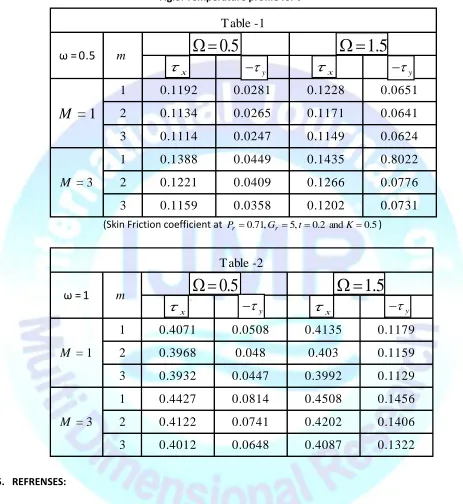
Page 580 Table -1 and 2 shows the variation of skin friction coefficient with the magnetic field, Hall current and rotation parameter at the different oscillation frequency. It is found that the value of increases when the values of M and Ω are increased, while it gets decreased with increase in m. On the other hand the decrease with M and Ω and it is increased m.4. CONCLUSION:
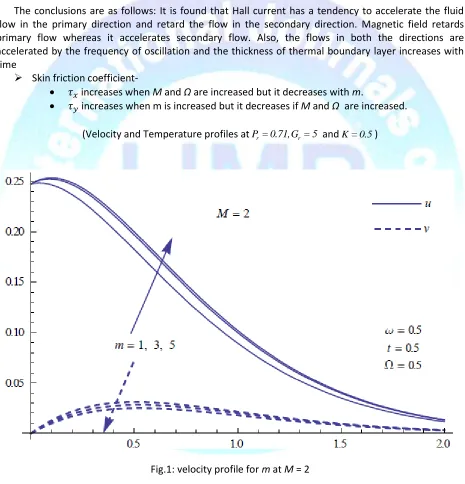
The conclusions are as follows: It is found that Hall current has a tendency to accelerate the fluid flow in the primary direction and retard the flow in the secondary direction. Magnetic field retards primary flow whereas it accelerates secondary flow. Also, the flows in both the directions are accelerated by the frequency of oscillation and the thickness of thermal boundary layer increases with time
Skin friction coefficient-
increases when M and Ω are increased but it decreases with m.
increases when m is increased but it decreases if M and Ω are increased.
(Velocity and Temperature profiles atP = 0.71, G = 5 r r andK = 0.5)
Aryabhatta Journal of Mathematics and Informatics (Impact Factor- 5.856)
Double-Blind Peer Reviewed Refereed Open Access International e-Journal - Included in the International Serial Directories
Aryabhatta Journal of Mathematics and Informatics
Double-Blind Peer Reviewed Refereed Open Access International e-Journal - Included in the International Serial Directories
Aryabhatta Journal of Mathematics and Informatics
http://www.ijmr.net.in
email id- [email protected]
Page 582Aryabhatta Journal of Mathematics and Informatics (Impact Factor- 5.856)
Double-Blind Peer Reviewed Refereed Open Access International e-Journal - Included in the International Serial Directories
Aryabhatta Journal of Mathematics and Informatics
Double-Blind Peer Reviewed Refereed Open Access International e-Journal - Included in the International Serial Directories
Aryabhatta Journal of Mathematics and Informatics
Aryabhatta Journal of Mathematics and Informatics (Impact Factor- 5.856)
Double-Blind Peer Reviewed Refereed Open Access International e-Journal - Included in the International Serial Directories
Aryabhatta Journal of Mathematics and Informatics
Double-Blind Peer Reviewed Refereed Open Access International e-Journal - Included in the International Serial Directories
Aryabhatta Journal of Mathematics and Informatics
http://www.ijmr.net.in
email id- [email protected]
Page 586Aryabhatta Journal of Mathematics and Informatics (Impact Factor- 5.856)
Double-Blind Peer Reviewed Refereed Open Access International e-Journal - Included in the International Serial Directories
Aryabhatta Journal of Mathematics and Informatics
http://www.ijmr.net.in
email id- [email protected]
Page 587Fig.8: Temperature profile for t
(Skin Friction coefficient at Pr 0.71,Gr 5,t0.2 andK0.5)
5. REFRENSES:
[1] Agarwal H.L.,Ram P.C. and singh V. Combined influence of dissipation and hall effect on free convective in a rotating fluid. Indian J. Pure appl.Math.14(3):314-32, March 1983.
[2] Chamkha, A. J. & Khaled, A. R. Similarity solutions for hydromagnetic mixed convection heat and mass transfer for Hiemenz flow through a porous medium. .Int.J.Numerical Methods for Heat and Fluid Flow, 10, 94-115.
[3] Greenspan, H.P. The theory of rotating fluids. London: Cambridge Univ. Press.
1
0.1192
0.0281
0.1228
0.0651
2
0.1134
0.0265
0.1171
0.0641
3
0.1114
0.0247
0.1149
0.0624
1
0.1388
0.0449
0.1435
0.8022
2
0.1221
0.0409
0.1266
0.0776
3
0.1159
0.0358
0.1202
0.0731
T able -1
ω = 0.5
m
M
= 1
M
= 3
x
y
x
y0.5
1.5
1
0.4071
0.0508
0.4135
0.1179
2
0.3968
0.048
0.403
0.1159
3
0.3932
0.0447
0.3992
0.1129
1
0.4427
0.0814
0.4508
0.1456
2
0.4122
0.0741
0.4202
0.1406
3
0.4012
0.0648
0.4087
0.1322
T able -2
ω = 1
m
M
= 1
M
= 3
x
y
x
y0.5
Double-Blind Peer Reviewed Refereed Open Access International e-Journal - Included in the International Serial Directories
Aryabhatta Journal of Mathematics and Informatics
http://www.ijmr.net.in
email id- [email protected]
Page 588 [4] Hossain, M. A. and Takhar, H. S. Radiation effect on mixed convection along a vertical plate withuniform surface temperature, Heat and Mass Transfer, 31(1996), 243-248.
[5] Ibrahim, S. Y. and Makinde, O. D. Chemically reacting MHD boundary layer flow of heat and mass transfer over a moving vertical plate with suction. Scientific Research and Essays Vol. 5(19), pp. 2875-2882,4 October, 2010.
[6] Ibrahim, S. Y. and Makinde, O. D. Radiation effect on chemically reacting MHD boundary layer flow of heat and mass transfer through a porous vertical flat plate. International Journal of the Physical Sciences Vol. 6(6), pp. 1508-1516, 18 March, 2011.
[7] Jha, B. K. Prasad, R. and Rai, S. Mass transfer effects on the flow past an exponentially accelerated vertical plate with constant heat flux. Astro - physics and Space Science, 181(1991), 125-134.
[8] Mazumdar, B.S. Gupta, A.S. and Dattaa, N. Flow and heat transfer in hydrodynamic ekman layer on a porous plate with Hall effects. Int.j.heat mass Transfer,19,523.
[9] Mutthuswami, R., Ganesan, P. and. Soundalgeker. V.M. Heat and mass transfer effect on flow past impulsively started vertical plate. Acta mathematica 146,1-8(springer varlag 2001).recieved November 23, 1999 revised January 13,2000.
[10]Ostrach, S. An analysis of laminar free convection flow and heat transfer along a flat plate parallel to the direction of the generating body force. NACA report TR-1111, 63-79.
[11] Prasad, R.V., Bhaskar, Reddy, N., and Muthucumaraswamy, R. Radiation and mass transfer effects on two-dimensional flow past an impulsively started infinite vertical plate. International Journal of Thermal Sciences 46 (2007) 1251–1258.
[12]Rajput, U. S. and Kumar, S. Rotation and radiation effects on MHD flow past an impulsively started vertical plate with variable temperature, Int. Journal of Math. Analysis, 5(24) (2011), 1155-1163.
[13]Singh, Sharma, P. R. and Chamkha, A. J. Effect of thermally stratified ambient fluid on MHD convective flow along a moving non-isothermal vertical plate. International Journal of Physical Sciences Vol.5(3), pp. 208-215,March 2010.
[14]Soundalgekar, V. M. Effects of Mass Transfer and Free-Convection Currents on the Flow Past an Impulsively Started Vertical Plate. J. Appl. Mech 46(4), 757-760 (Dec 01, 1979) (4 pages) doi:10.1115/1.3424649 History: Received October 01, 1978; Revised March 01, 1979; Online July 12, 2010.
[15]Stewartson, K. On the Impulsive Motion of a Flat Plate in a Viscous Fluid. Part 1, Quart. J. Mech. Appl. Math., 4(1951), 2, pp. 182-198.
[16]Stewartson, K. On the Impulsive Motion of a Flat Plate in a Viscous Fluid. Part 2, Quart. J. Mech. Appl. Math., 22 (1973), 2, pp. 143-152
Appendix:
1 1 1
1
2 ,
1 1
r
r r
G
M i b
b i , A , B ,a b
m i K P P
2 1 3 r 4 r 5 1 r 6 1
a bB , a P , a P , a B P , a B ,
1
1 1 1
1 2 1 2 2 3 4 5
1 1 1
1 1
4 2 2 4 2 2
r
A P
A A A
i z
b b i , b b i , , , , , , .
B a B
B B t