Even-Mansour Cipher Against Multi-Key and
Related-Key Attacks
Ping Zhang and Honggang Hu
Key Laboratory of Electromagnetic Space information, CAS University of Science and Technology of China, Hefei, China, 230027
[email protected],[email protected]
Abstract. Cogliati et al. introduced the tweakable Even-Mansour cipher constructed from a single permutation and an almost-XOR-universal (AXU) family of hash functions with tweak and key schedule. Most of previous papers considered the security of the (iterated) tweakable Even-Mansour cipher in the single-key setting. In this paper, we focus on the security of the tweakable Even-Mansour cipher in the multi-key and related-key settings. We prove that the tweakable Even-Mansour cipher with related-key-AXU hash functions is secure against multi-key and related-key attacks, and derive a tight bound using H-coefficients technique, respectively. Our work is of high practical relevance because of rekey requirements and the inevitability of related keys in real-world implementations.
Keywords: Tweakable Even-Mansour, almost-XOR-universal hash func-tions, multi-key attack, related-key attack, H-coefficient technique.
1
Introduction
A tweakable blockcipher (TBC) is a generalization of a traditional block cipher, which adds a tweak as an extra public input on the basis of the usual inputs (a plaintext and a key). Tweakable blockciphers (TBCs) with distinct tweaks refer to distinct block ciphers, which makes that the cost of tweaks’ update is lower than that of rekeys. The original application scenarios of TBCs focus on storage encryptions, especially the disk sector encryption [17] (Each disk consists of fixed-length sectors. The size of a sector is usually 512 bytes. In the disk sector encryption, we need to encrypt a plaintext x under the sector locationt ∈ T
and obtain the corresponding ciphertexty=EK(t, x), whereK is a key andEK
a permutation [13]. The third approach is based on a keyed-function (hash function) [27]. The tweakable Even-Mansour cipher [11] is a permutation-based tweakable blockcipher, which is constructed from ann-bit public random permutation P and an almost XOR-universal (AXU) family of hash functions
H= (HK)K∈K from some setT to{0,1}n, and defined as
y=T EMKP(t, x) =P(x⊕HK(t))⊕HK(t),
whereK∈ Kis a key,t∈ T is a tweak,x∈ {0,1}nis a plaintext, andy∈ {0,1}n is a ciphertext.
According to the different key settings in the applications, Mouha and Luykx [24] described three attack settings: single-key, multi-key, and related-key settings. In the single-related-key setting, an adversary has access to the encryption and decryption oracles under a fixed keyKchosen uniformly and randomly from the key space. Most of previous papers considered the security in the single-key setting. The tweakable Even-Mansour cipher is no exception. The security of the tweakable Even-Mansour cipher in the single-key setting was studied by Cogliati, Lampe, and Seurin [11], and was proved secure up to the birthday bound (this construction ensures security up to 2n/2 adversarial queries, in the random permutation model (RPM) forP :{0,1}n→ {0,1}n).
In the multi-key setting, an adversary has access to the encryption and de-cryption oracles under many keysKi(i≥2) chosen independently and randomly
from the key space. Multi-key setting has many applications in the real-world implementations. The multi-key setting can be seen as a generalization of the multi-user [8] and broadcast [23] settings. There exists many related researches in the multi-key, multi-user, and broadcast settings, such as [23,8,15,24]. In the related-key attack setting, the key Ki satisfies the relationship Ki = ϕi(K),
where K is a key, and the related-key deriving (RKD) functions ϕi are chosen
by the adversary. Related-key attack (RKA) was firstly presented by Biham et al. [4,5] for block ciphers [6,31] and then extended to other cryptographic algorithms such as stream ciphers [9], permutation-based ciphers [12], hash functions [32], MACs [26,3], AE schemes [14], etc. Multi-key security and related-key security have become the important criterion in cipher designs. The security of the tweakable Even-Mansour cipher in the multi-key and related-key settings are still an open problem.
Our Contributions.This paper focuses on the security of the tweakable Even-Mansour cipher in the multi-key and related-key settings. Due to the weakness of almost-XOR-universal (AXU) hash functions in the related-key setting, the tweakable Even-Mansour cipher in here is reconstructed by related-key-almost-XOR-universal (RKA-AXU) hash functions presented by Wang et al. [32]. We prove that the tweakable Even-Mansour cipher is secure against multi-key and related-key attacks.
In the multi-key setting, a small number of plaintexts are encrypted under multiple independent keys. The tweakable Even-Mansour cipher with (ϵ, δ )-AXU-hash functions is secure up to 2D(T+D(1−1/l))δ+ (D−l+ 1)(D−l)ϵ
queries (data complexity),T is the complexity of internal permutation queries (time complexity), andl is the number of keys.
In the related-key setting, a small number of plaintexts are encrypted under multiple related keys. The tweakable Even-Mansour cipher with (ϵ, δ )-RKA-AXU-hash functions is secure up toD(D−1)ϵ+2DT δqueries against related-key attack, whereDis the complexity of construction queries (data complexity) and
T is the complexity of internal permutation queries (time complexity).
The tweakable Even-Mansour cipher is a secure cryptosystem with a lighter key schedule and higher key agility in the multi-key and related-key attack settings. It is very useful, not only because of the simplicity of its design and proof (Patarin’s H-coefficients technique), but also because of fast and secure implementations. If the underlying block cipher is replaced with the tweakable Even-Mansour cipher, then encryption, authentication, and authenticated encryption modes may be designed more efficiently.
We leave it as an interesting open problem to settle the security of two-round iterated tweakable Even-Mansour cipher in the multi-key and related-key settings. Does further extend it for anyr-round iterated tweakable Even-Mansour cipher?
Organizations of This Paper. Notations and H-coefficients technique are
presented in Section 2. The multi-key security of the tweakable Even-Mansour cipher is derived in Section3. The related-key security of the tweakable Even-Mansour cipher is derived in Section 4. Finally, this paper ends up with a conclusion in Section5.
2
Preliminaries
2.1 Notations
Letnbe an integrity and{0,1}n denote the set of all strings whose lengths are
n-bit. IfX is a finite set, thenx←$ X is a value randomly chosen fromX, and
|X|stands for the number of elements inX.
A tweakable blockcipher with key space K, tweak space T, and plaintext space{0,1}n is a functionEe:K × T × {0,1}n→ {0,1}n such that for any key
K ∈ K and a tweak t ∈ T, EeK(t,·) = Ee(K, t,·) is a permutation of {0,1}n.
Similarity, its inverse is denoted byDeK =EeK−1. LetP erm(n) be the set of all
permutations on{0,1}n. LetP erm^(T, n) be the set of tweakable permutations,
i.e., the set ofP erm(n) indexed witht∈ T. In this work, we focus on a tweakable
blockcipherEeP
K based on a public random permutationP
$
←P erm(n).
An adversary is a probabilistic algorithm with access to certain oracles. Let
AO = 1 be the event that an adversaryA outputs 1 after interacting with the
oracleO. Without loss of generality, we assume that the adversary doesn’t make redundant queries, that is, i) it doesn’t repeat prior queries for each oracle, ii) the adversary does not ask the decryption oracle DeK after receiving a value in
encryption oracle EeK after receiving a value in response to a decryption query
e
DK.
A related-key deriving (RKD) function is a map that takes a keyK∈ K as an input and returns a related key ϕ(K) ∈ K. A RKD set Φ is a set of RKD functions, which is formalized as Φ={ϕ:K → K}. Two typical RKD sets are enumerated as follows:
Φid={ϕ:K→K};
Φ⊕={ϕ:K→K⊕△|△∈ K},
whereK ∈ K. Throughout the paper we assume that membership in RKD sets can be efficiently decided.
2.2 The H-Coefficients Technique
Patarin’s H-coefficients technique [25] is a vital tool widely used in the field of provable security. We briefly summarize this technique as follows.
Consider an information-theoretic adversaryA whose goal is to distinguish a real worldX and a ideal world Y, then the advantage ofAis denoted as
Adv(A) =|P r[AX = 1]−P r[AY = 1]|.
Without loss of generality, we can assume A is a deterministic adversary. The interaction with X or Y is summarized in a transcriptτ, which is a list of queries and answers. Denote by DX the probability distribution of transcripts
when interacting withX, and byDY the probability distribution of transcripts
when interacting withY.
A transcriptτ is attainable if P r[DY =τ]>0, meaning that it can occur
during interaction with Y. Let Γ be the set of attainable transcripts. The H-coefficients lemma is presented as follows.
Lemma 1 (H-Coefficients Lemma). Fix a deterministic adversary A. Let
Γ =Γgood
∪
Γbad be a partition of the set of attainable transcripts. Assume that there existsε such that for anyτ∈Γgood, one has
P r[DX=τ]
P r[DY =τ] ≥
1−ε.
Then
Adv(A)≤ε+P r[DY ∈Γbad].
3
Multi-Key-Security of the Tweakable Even-Mansour
Cipher
3.1 (ϵ, δ)-Almost XOR Universal (AXU) Hash Functions [20]
Definition 1 ((ϵ, δ)-AXU Hash Function Family [20]). LetH={H :K ×
1) For any elementX∈ D and any elementY ∈ R,
P r[K← K$ :HK(X) =Y]≤δ;
2) For any two distinct elementsX, X′∈ D and any elementY ∈ R,
P r[K← K$ :HK(X)⊕HK(X′) =Y]≤ϵ.
Examples of AXU hash function families are presented as follows.
1) LetH1 ={HK(x) =K·x| K, x∈GF(2n)∗}. ThenH1 is a (2−n,2−n )-AXU hash function family from{0,1}n\ {0n} to{0,1}n.
2) LetH2 = {HK(x1, x2,· · ·, xt) =K·x1+K2·x2+· · ·+Kt·xt | K ∈
GF(2n)∗, xi∈GF(2n),1≤i≤t,(x1, x2,· · ·, xt)̸= (0,0,· · · ,0)}. Then H2 is a (t/2n, t/2n)-AXU hash function family from{0,1}tn\ {0tn} to{0,1}n.
3) Let H3 = {Hk1,k2,···,kt(x1, x2,· · ·, xt) = k1 ·x1+k2 ·x2 +· · ·+kt ·
xt|ki ∈GF(2n), xi∈GF(2n),1≤i≤t,(k1, k2,· · · , kt)̸= (0,0,· · ·,0),(x1, x2,
· · · , xt)̸= (0,0,· · ·,0)}. Then H3 is a (1/2n,1/2n)-AXU hash function family from{0,1}tn\ {0tn} to{0,1}n.
3.2 Multi-Key-Security Model
LetEeKP :T × {0,1}n → {0,1}n be a tweakable blockcipher based on a random permutationP ←$ P erm(n), where K∈ K. Let eπ←$ P erm^(T, n) be a random tweakable permutation. Let l denote the number of keys Ki under which the
adversary performs queries, that is, there is at least one query for every keyKi
for 1≤i≤l. The multi-key-security ofEeis formalized with a distinguisher that has adaptive oracle access to either (EeP
K1,Ee
P
K2,· · · ,Ee
P
Kl;P) with Ki
$
← K for
i= 1,· · ·, l, (Real WorldX), or (eπ1,πe2,· · ·,eπl;P) with eπi
$
←P erm^(T, n), i= 1,· · · , l(Ideal WorldY). In this paper, we consider the adversary that has access to the encryption and decryption queries forX orY. The definition of multi-key security is presented as follows.
Definition 2 (Multi-Key Security). Let K ← K$ and EeKP be the tweakable
block cipher based on a random permutationP ←$ P erm(n). Given an adversary
A, the multi-key advantage of Awith respect tol keys is
Advmke
EP
K
(A) =|P r[AEePK1,Ee
P K2,···,Ee
P
Kl;P = 1]−P r[Aeπ1,πe2,···,eπl;P = 1]|,
where the keys K1,· · ·, Kl are independently and uniformly drawn from K, and
e
3.3 Security Proofs of the Tweakable Even-Mansour Cipher in the Multi-Key Setting
Let Hbe an (ϵ, δ)-AXU hash function family defined in Definition 1, then the tweakable Even-Mansour cipher with key spaceKand tweak spaceT is written
T EMKP(t, x) =P(x⊕HK(t))⊕HK(t),
where P is an n-bit public random permutation,HK
$
← H, K ∈ K is the key,
t∈ T is the tweak, andx∈ {0,1}n is the plaintext.
The multi-key security of the tweakable Even-Mansour cipher is presented as follows.
Theorem 1 (Multi-Key Security of the Tweakable Even-Mansour
Cipher). Let T EMP
K be the tweakable Even-Mansour cipher with (ϵ, δ)-AXU hash function family, then for all adversaries A making at most D queries toT EMP
K1, T EM
P
K2,· · ·, T EM
P
Kl (resp.eπ1,eπ2,· · · ,eπl) or their inverses and at mostT queries toP orP−1, we have
AdvT EMmk (A)≤2D(T+D(1−1
l))δ+ (D−l+ 1)(D−l)ϵ.
Our proof is similar to that of the Even-Mansour cipher in the multi-key setting [24], except that we need to consider the tweak of TEM and the properties of hash functions in the multi-key setting. The result of Theorem 1is in fact a generalization of [24]. The proof uses Patarin’s H-coefficients technique [25]. For a detailed explanation of this technique, you can refer to [10].
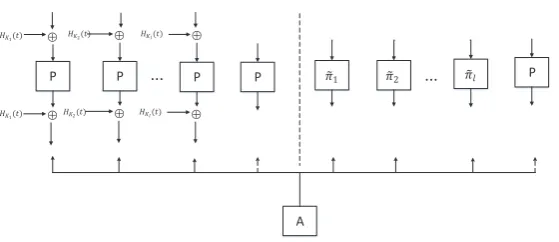
As shown in Fig. 1, we consider an adversary A that has bidirection-al access to l + 1 oracles (O1,· · ·, Ol+1). In the real world X, these are
(T EMKP1, T EMKP2,· · ·, T EMKlP;P) with Ki
$
← K for i = 1,· · ·, l, P ←$ P erm(n), and in the ideal world Y, these are (eπ1,eπ2,· · ·,eπl;P) with πei
$
←
^
P erm(T, n), i = 1,· · · , l and P ←$ P erm(n). Without loss of generality, we assume thatAis a deterministic adversary. It makesDiqueries to oracleOi for
i= 1,· · · , l, andT queries toOl+1. LetD=
∑l
i=1Di. (Letmbe the number of
distinct tweaks,Dtbe the number of queries for thet-th tweak, 1≤t≤m, using
an arbitrary ordering of the tweaks. Note that m may depend on the answers received from the oracles, yet one always has D=∑mt=1Dt.)
The interaction of A with the oracles can be described by a transcript
τ = (K1,· · ·, Kl, τ1,· · ·, τl+1). We assume that the list of queries to Oi for i=
1,· · · , lis defined byτi={(ti1, x1i, y1i),· · · ,(t Di
i , x
Di
i , y
Di
i )}, wheret1i,· · ·, t Di
i ∈
T, and to Ol+1 by τl+1 = {(u1, v1),· · ·,(uT, vT)}. We assume that A never makes duplicate queries, so that (tji, xji)̸= (tij′, xji′),(tij, yji)̸= (tji′, yij′), uj̸=uj′,
andvj̸=vj′ for alli, j, j′ wherej̸=j′.
LetDX denote the probability distribution of transcripts in the real world
X, andDY denote the probability distribution of transcripts in the ideal world
P Å Å P Å Å P Å Å
... P ... P
ܪܭͳሺݐሻ ܪܭͳሺݐሻ ܪܭʹሺݐሻ ܪܭʹሺݐሻ ܪܭ݈ሺݐሻ ܪܭ݈ሺݐሻ ߨͳ ߨʹ ߨ݈ A
Fig. 1.Multi-Key Security of the Tweakable Even-Mansour Cipher.Left of dashed line: Real world X = (T EMKP1, T EM
P
K2,· · ·, T EM
P
Kl;P) with Ki $
← K for i =
1,· · ·, l, P ←$ P erm(n). Right of dashed line: Ideal world Y = (eπ1,π2,e · · ·,πel;P)
witheπi $
←P erm^(T, n), i= 1,· · ·, landP←$ P erm(n). The goal ofAis to distinguish
the real world X from the ideal world Y. If the distinguishable advantage of A is negligible, the scheme is multi-key-secure. Although only one direction is shown, inverse oracles can be accessed as well. The number of queries by the adversaryA to any of the firstloracles is denoted byD, the number of queries to the last oracle byT.
Definition 3. We say that a transcript τ is bad if two different queries would result in the same input or output toP, whenAinteracting with the real world. Put formally, τ is bad if one of the following conditions is set:
Bad1: ∃(tji, xji, yji)∈ τi, tji ∈ T, and (uj′, vj′)∈ τ
l+1, such that xji ⊕uj ′
=
HKi(t j
i), where 1≤i≤l,1≤j≤Di,1≤j′≤T;
Bad2: ∃(tji, xij, yij)∈ τi,tji ∈ T, and (uj′, vj′) ∈ τl+1, such that y
j
i ⊕v
j′ =
HKi(t j
i), where 1≤i≤l,1≤j≤Di,1≤j′≤T;
Bad3:∃(tji, xji, yij)= (̸ tji′, xji′, yij′)∈τi, andtji, tij′ ∈ T, such thatxji ⊕xji′ =
HKi(t j
i)⊕HKi(t
j′
i ), where1≤i≤l,1≤j ̸=j′ ≤Di;
Bad4:∃(tji, xji, yji)= (̸ tji′, xji′, yij′)∈τi, and tji, tij′ ∈ T, such thatyji ⊕yji′ =
HKi(t j
i)⊕HKi(t
j′
i ), where1≤i≤l,1≤j ̸=j′ ≤Di; Bad5: ∃(tji, xji, yij) ∈ τi,(tj
′ i′, x
j′ i′, y
j′
i′) ∈ τi′,(tji, x j i, y
j
i) ̸= (t
j′ i′, x
j′ i′, y
j′ i′), and
tji, tji′′ ∈ T, such thatxji ⊕x j′
i′ =HKi(t
j
i)⊕HKi′(t j′
i′), where 1≤i̸=i′ ≤l,1≤
j≤Di,1≤j′ ≤Di′;
Bad6: ∃(tji, xji, yij) ∈ τi,(t j′ i′, x
j′ i′, y
j′
i′) ∈ τi′,(t j i, x
j i, y
j
i) ̸= (t
j′ i′, x
j′ i′, y
j′ i′), and
tji, tji′′ ∈ T, such that yij⊕y j′
i′ =HKi(t
j
i)⊕HKi′(t j′
i′), where 1≤i̸=i′ ≤l,1≤
j≤Di,1≤j′ ≤Di′.
Otherwise we say thatτ is good. We denoteΓgood (resp.Γbad) the set of good (resp. bad) transcripts. LetΓ =Γgood∪Γbadbe the set of attainable transcripts.
We firstly upper bound the probability of bad transcripts in the ideal world
Lemma 2. Let H be an (ϵ, δ)-AXU hash function, l be the number of keys Ki, andT EMKP be the tweakable Even-Mansour construction, then
P r(DY ∈Γbad)≤2D(T+D(1−
1
l))δ+ (D−l+ 1)(D−l)ϵ.
Proof. In the ideal world Y, τ is an attainable transcript generated indepen-dently of the dummy key Ki ∈ K for i = 1,· · ·, l. Assume an adversary A
makes at most D construction queries and at most T primitive queries. For (tji, xji, yij)∈τi, tji ∈ T, (u
j′, vj′)∈τ
l+1, where 1≤i≤l,1≤j ≤Di,1≤j′≤T,
andD=∑li=1Di, by the properties of the (ϵ, δ)-AXU hash functionH, we have
P r[Bad1] =P r[Bad2]
=P r[Ki
$
← K:HKi(t j
i) =C]
≤
l
∑
i=1
DiT δ=DT δ,
whereC=xji⊕uj′ in Bad1 orC=yj
i ⊕vj
′
in Bad2.
Fix any distinct queries (tji, xji, yji) ̸= (tij′, xji′, yij′) ∈ τi, tji, t j′
i ∈ T, where
1 ≤i≤l,1≤j ≠ j′ ≤Di. By the properties of the (ϵ, δ)-AXU hash function
H, we have
P r[Bad3] =P r[Bad4]
=P r[Ki
$
← K:HKi(t j
i)⊕HKi(t j′
i ) =C]
≤ l ∑ i=1 ( Di 2 ) ϵ,
whereC=xji⊕xji′ in Bad3 orC=yji ⊕yij′ in Bad4.
As there is at least one query for every keyKi, we consider the maximum
case: the adversary makes (D−l+ 1) queries for some key, one query per key for anotherl−1 keys. Therefore, we have
P r[Bad3] =P r[Bad4]≤
l ∑ i=1 ( Di 2 ) ϵ ≤ (
D−l+ 1 2
)
ϵ
=(D−l+ 1)(D−l)ϵ
2 .
For any distinct queries (tji, xji, yij) ∈ τi,(tj ′ i′, x
j′ i′, y
j′
i′) ∈ τi′,(tji, x j i, y
j
i) ̸=
(tji′′, xj ′ i′, y
j′ i′), t
j i, t
j′
D =∑li=1Di =
∑l
i′=1Di′, by the properties of the (ϵ, δ)-AXU hash function
H, we have
P r[Bad5] =P r[Bad6]
=P r[Ki, Ki′
$
← K2:H
Ki(t j
i)⊕HKi′(t j′
i′) =C]
= ∑
ai,bi∈R2
P r[ai⊕bi =C|HKi(t j
i) =ai, HKi′(t j′ i′) =bi]·
P r[Ki, Ki′ ← K$ 2:HKi(t j
i) =ai, HKi′(t j′ i′) =bi]
≤ ∑
ai∈R
P r[Ki, Ki′
$
← K2:H
Ki(t j
i) =ai, HKi′(t j′
i′) =C−ai]
≤ ∑
ai∈R
P r[Ki
$
← K:HKi(t j i) =ai]·
P r[Ki′
$
← K:HKi′(t j′
i′) =C−ai] (Key Independence)
≤2n(
( D 2 ) − l ∑ i=1 ( Di 2 )
)δ2 (Cauchy Inequality)
≤D2(1−1/l)δ,
whereC=xji⊕xij′′ in Bad5 orC=yji ⊕y j′
i′ in Bad6,δ∈[2−
n,2−(n−1)]. Therefore,
P r[DY ∈Γbad] =P r[
6
∪
i=1
Badi]≤ 6
∑
i=1
P r[Badi]
≤2D(T+D(1−1
l))δ+ (D−l+ 1)(D−l)ϵ.
This completes the proof.
We then analyze good transcripts. For a good transcript, in the real world
X, all tuples in (K1,· · ·, Kl, τ1,· · ·, τl+1) uniquely define an input-output pair ofP, while in the ideal world it is not.
Lemma 3. For any good transcriptτ, one has
P r[DX=τ]
P r[DY =τ] ≥
1.
Proof. Consider a good transcriptτ∈Γgood. Denote byΩXthe set of all possible
oracles in the real world X and by ΩY the set of all possible oracles in the
ideal world Y. Let compX(τ)⊆ΩX andcompY(τ)⊆ΩY be the set of oracles
compatible with transcriptτ. According to the H-coefficients technique, we have
P r(DX=τ) = |
compX(τ)|
|ΩX| , where |ΩX|= 2 n!|K|l.
P r(DY =τ) = |
compY(τ)|
|ΩY| , where|ΩY|= (
∏
t2
Firstly, we calculate|compX(τ)|. Asτ ∈Γgood, there are no two queries inτ
with the same input or output of the underlying permutation. Any query tuple in
τ therefore fixes exactly one input-output pair of the underlying oracle. Because
τ consists ofD+T query tuples, the number of possible oracles in the real world
X equals (2n−D−T)!.
For the analysis in the ideal worldY, we define
Dti=|{(ti, xi, yi)∈τi|ti∈ T, xi, yi∈ {0,1}
n,1≤i≤l}|.
By a similar reason, the number of possible oracles in the ideal world Y
equals∏li=1∏t(2n−D ti)!(2
n−T)!, whereD=∑l i=1
∑
tDti. It follows that,
P r(DX =τ) =
(2n−D−T)! 2n!|K|l
P r(DY =τ) =
∏l i=1
∏
t(2
n−D
ti)!(2n−T)!
(∏t2n!)l·2n!|K|l
≤(2n−D−T)!
2n!|K|l .
Therefore, we have P rP r[[DXD =τ]
Y=τ] ≥1.
By Lemmas1,2, and 3, we have
AdvT EMmk (A)≤2D(T+D(1−1
l))δ+ (D−l+ 1)(D−l)ϵ.
The tweakable Even-Mansour cipher in the single-key setting is a special case of it in the multi-key setting wherel= 1. We prove that the security bound of the tweakable Even-Mansour cipher in multi-key setting is a straightforward extension of the single-key setting. Therefore, the bound that we derived for the tweakable Even-Mansour cipher in the multi-key setting is tight. If we replace the public random permutation with an ideal block cipher with the same characteristics (including block-size, AXU-hash functions, etc), we can obtain the similar security.
4
Related-Key-Security of the Tweakable Even-Mansour
Cipher
4.1 (ϵ, δ)-Related-Key Almost XOR Universal Hash Functions
Definition 4 ((ϵ, δ)-RKA-AXU Hash Function Family). Let H = {H :
K × D → R} be a family of hash functions. H is an (ϵ, δ) -related-key-almost-XOR-universal ((ϵ, δ)-RKA-AXU) hash function for the RKD set Φ, if the following two conditions hold:
1) For anyϕ∈Φ, X ∈ D, andY ∈ R,
P r[K← K$ :Hϕ(K)(X) =Y]≤δ;
2) For anyϕ, ϕ′∈Φ, X, X′∈ D,(ϕ, X)̸= (ϕ′, X′), andY ∈ R,
P r[K← K$ :Hϕ(K)(X)⊕Hϕ′(K)(X′) =Y]≤ϵ.
For anyϕ, ϕ′ ∈Φ, ϕ̸=ϕ′ means there exists a keyK∈ Ksuch thatϕ(K)̸=
ϕ′(K). If the RKD setΦid ={ϕ:K → K} is an identity transform, an (ϵ, δ
)-RKA-AXU hash function family is an (ϵ, δ)-AXU hash function family.
Restricting RKD Sets [32].The RKA-AXU-hash function family depends
on the choice of RKD sets. For some RKD sets, the RKA-AXU-hash function family may not exist. It is necessary that a RKD set is restricted to both output unpredictable and collision resistant. The restrictions on the RKD set are specifically presented as follows.
1) Output unpredictability. A ϕ ∈ Φ that has predictable outputs if there exists a constantS such that the probability ofϕ(K) =S is high. LetOU(Φ) =
maxϕ∈Φ,SP r[K← K:ϕ(K) =S] be the probability of output predictability. If
OU(Φ) is negligible, we say thatΦis output unpredictable.
2) Collision resistance. Two distinctϕ, ϕ′∈Φhave high collision probability if the probability ofϕ(K) =ϕ′(K) is hight. Let CR(Φ) =maxϕ̸=ϕ′∈ΦP r[K ←
K:ϕ(K) =ϕ′(K)] be the probability of collision. IfCR(ϕ) is negligible, we say that ϕ is collision resistant. More strictly, if for any two distinctϕ, ϕ′ ∈Φ and any keyK, we haveϕ(K)̸=ϕ′(K) orCR(Φ) = 0, we say thatΦis claw-free.
Instances. Wang et al. [32] constructed related-key almost universal hash functions: one fixed-input-length (FIL) UHF named RH1 and two variable-input-length (VIL) UHFs named RH2 and RH3. It is easy to obtain that RH1 and RH2 are both (ϵ, δ)-RKA-AXU hash functions for the RKD setΦ⊕.
1) RH1:{0,1}n×{0,1}n → {0,1}n,RH1
K(M) =M K⊕K3is (2/2n,2/2n
)-RKA-AXU for the RKD set Φ⊕.
2) RH2:{0,1}n× {0,1}n→ {0,1}n,pad(M) =M ∥0i∥ |M|
RH2K(M) =
{
Kl+2⊕P oly
K(pad(M)) l is odd
Kl+3⊕P oly
K(pad(M))K l is even
is ((lmax+ 3)/2n,(lmax+ 3)/2n)-RKA-AXU for the RKD set Φ⊕, where l =
⌈|M|/n⌉+ 1 is the number of blocks in pad(M), lmax is the maximum block
number of messages after padding, and P oly : {0,1}n× {0,1}nm → {0,1}n is
defined as follows:
4.2 Related-Key-Security Model
Let Φ be a set of RKD functions. For a tweakable block cipher Ee : K × T ×
{0,1}n → {0,1}n based on a public random permutation P ←$ P erm(n), we
define a related-key oracleRK[Ee] :K ×Φ× T × {0,1}n→ {0,1}n as
RK[Ee]P(K, ϕ, t, x) =RK[Ee]KP(ϕ, t, x) =EeϕP(K)(t, x),
where K ∈ K is the key, ϕ ∈ Φ is a RKD function, t ∈ T is the tweak, and
x∈ {0,1}n is the plaintext.
LetRKP erm^ (Φ,T, n) be the set of tweakable related-key permutations, i.e., the set of all families of permutations on{0,1}n indexed with (ϕ, t)∈Φ× T.
The security of the tweakable block cipher in the related-key setting is formalized with a distinguisher which has access to (EeϕP(K);P) with K ∈
K, ϕ∈ Φ, and P ←$ P erm(n) (Real World X), or (RK[πe];P) with RK[eπ] ←$ ^
RKP erm(Φ,T, n) and P ←$ P erm(n) (Ideal World Y). In this paper, we consider that an adversary is adaptive and can make encryption and decryption queries to each oracle. We present a definition of related-key security as follows.
Definition 5 (Related-Key Security). Let Φ be a RKD set, K ← K$ be a
key, andEeP
K be a tweakable block cipher based on a public random permutation
P ←$ P erm(n). Given an adversary A, the related-key advantage of A with respect to Φis
AdvrkEeP K
(A) =|P r[AEeϕP(K);P = 1]−P r[ARK[eπ];P = 1]|,
where RK[eπ]←$ RKP erm^ (Φ,T, n), ϕ←$ Φ, andP ←$ P erm(n). The adversary
Ahas access to the encryption and decryption oracles.
4.3 Security Proofs of the Tweakable Even-Mansour Cipher in the
Related-Key Setting
Given a restricting RKD setΦ, letHbe an (ϵ, δ)-RKA-AXU hash function family defined in Definition4, then the construction of tweakable Even-Mansour in the related-key setting is written as
T EMϕP(K)(t, x) =P(x⊕Hϕ(K)(t))⊕Hϕ(K)(t),
whereP is a public random permutation,H← H$ ,K∈ K is the key,ϕ∈Φis a RKD function,t∈ T is the tweak, andx∈ {0,1}n is the plaintext.
P
Å
Å
P P
ܪ߶ሺܭሻሺݐሻ
Ɏ
A ܪ߶ሺܭሻሺݐሻ
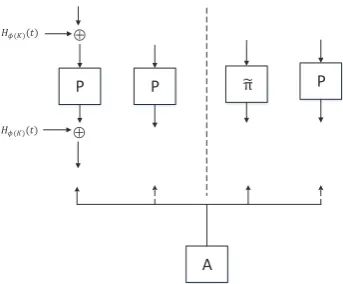
Fig. 2.Related-Key Security of the tweakable Even-Mansour Cipher.Left of dashed line: Real worldX = (T EMP
ϕ(K);P) withK $
← K, ϕ←$ Φ, andP ←$ P erm(n).Right of dashed line: Ideal worldY = (RK[πe];P) withRK[πe]←$ RKP erm^ (Φ,T, n) and
P ←$ P erm(n). The goal of Ais to distinguish the real world from the ideal world.
If the distinguishable advantage of A is negligible, the scheme is related-key-secure. Although only one direction is shown, inverse oracles can be accessed as well. The number of queries by the adversaryAto the first oracle is denoted byD, the number of queries to the last oracle byT.
Theorem 2 (Related-Key Security of the Tweakable Even-Mansour
Cipher). Let Φ be a restricting RKD set, ϕ ∈ Φ, t ∈ T, and T EMP
K(t, x) =
P(x⊕HK(t))⊕HK(t)be the tweakable Even-Mansour cipher with(ϵ, δ) -RKA-AXU hash function family, then for all adversariesAmaking at mostDqueries toT EMP
ϕ(K)(resp.RK[πe]) or their inverses and at mostT queries toP orP− 1,
the related-key advantage of Awith respect toΦis
AdvrkT EM(A)≤D(D−1)ϵ+ 2DT δ.
Our proof uses Patarin’s H-coefficients technique [25]. For a detailed expla-nation of this technique, we refer to [10].
As shown in Fig.2, we consider an adversaryAthat has bidirectional access to two oracles (O1, O2). In the real worldX, these are (T EMϕP(K);P) withK
$
← K, ϕ←$ Φ, andP ←$ P erm(n), and in the ideal worldY, these are (RK[eπ];P) withRK[eπ]←$ RKP erm^ (Φ,T, n) andP ←$ P erm(n). Without loss of generality, we assume thatAis a deterministic adversary.
The interaction of A with the oracles can be described by a transcript
τ = (K, τ1, τ2). We assume that the list of queries to O1 is defined by τ1 =
{(ϕ1, t1, x1, y1),· · · ,(ϕD, tD, xD, yD)}, where (ϕ1, t1),· · ·,(ϕD, tD) ∈ (Φ,T), and toO2byτ2={(u1, v1),· · ·,(uT, vT). We assume the adversary never makes duplicate queries, so that (ϕi, ti, xi)= (̸ ϕj, tj, xj),(ϕi, ti, yi)̸= (ϕj, tj, yj), ui ̸=
uj, vi ̸=vj for all i, j. LetDX be the probability distribution of transcripts in
Y. A transcript τ is attainable if P r[DY =τ] >0, meaning that it can occur
during interaction withY.
Definition 6. We say that a transcript τ is bad if two different queries would result in the same input or output toP, whenAinteracting with the real world. Put formally, τ is bad if one of the following conditions is set:
Bad1: ∃(ϕ, t, x, y) ∈ τ1, ϕ ∈ Φ, t ∈ T, and (u, v) ∈ τ2, such that x⊕u =
Hϕ(K)(t);
Bad2: ∃(ϕ, t, x, y) ∈ τ1, ϕ ∈ Φ, t ∈ T, and (u, v) ∈ τ2, such that y ⊕v =
Hϕ(K)(t);
Bad3:∃(ϕ, t, x, y)̸= (ϕ′, t′, x′, y′)∈τ1, ϕ, ϕ′∈Φ, t, t′∈ T, such that x⊕x′=
Hϕ(K)(t)⊕Hϕ′(K)(t′);
Bad4:∃(ϕ, t, x, y)̸= (ϕ′, t′, x′, y′)∈τ1, ϕ, ϕ′∈Φ, t, t′ ∈ T, such that y⊕y′=
Hϕ(K)(t)⊕Hϕ′(K)(t′).
Otherwise we say thatτ is good. We denoteΓgood, resp.Γbad the set of good, resp. bad transcripts,Γ =Γgood∪Γbad.
We firstly upper bound the probability of bad transcripts in the ideal world
Y by the following lemma.
Lemma 4. IfH is(ϵ, δ)-RKA-AXU for the RKD setΦandP is public random permutation, then
P r(DY ∈Γbad)≤D(D−1)ϵ+ 2DT δ.
Proof. In the ideal world Y, τ is an attainable transcript generated indepen-dently of the dummy key K ∈ K. Assume an adversary A makes at most D
construction queries and at most T primitive queries. For (ϕ, t, x, y)∈ τ1, ϕ∈
Φ, t∈ T, and (u, v)∈τ2, by the properties of the (ϵ, δ)-RKA-AXU hash function
H, we have
P r[Bad1] =P r[Bad2]
=P r[K← K$ :Hϕ(K)(t) =C]≤DT δ,
whereC=x⊕uin Bad1 orC=y⊕vin Bad2.
Fix any distinct queries (ϕ, t, x, y)̸= (ϕ′, t′, x′, y′) ∈ τ1, ϕ, ϕ′ ∈ Φ, t, t′ ∈ T. By the properties of the (ϵ, δ)-RKA-AXU hash functionH, we have
P r[Bad3] =P r[Bad4]
=P r[K← K$ :Hϕ(K)(t)⊕Hϕ′(K)(t′) =C]
≤
(
D
2
)
ϵ,
Therefore,
P r[DY ∈Γbad] =P r[
4
∪
i=1
Badi]≤ 4
∑
i=1
P r[Badi]
≤D(D−1)ϵ+ 2DT δ.
We then analyze good transcripts.
Lemma 5. For any good transcriptτ, one has
P r[DX=τ]
P r[DY =τ] ≥
1.
Proof. Consider a good transcriptτ∈Γgood. Denote byΩXthe set of all possible
oracles in the real world X and by ΩY the set of all possible oracles in the
ideal world Y. Let compX(τ)⊆ΩX andcompY(τ)⊆ΩY be the set of oracles
compatible with transcriptτ. According to the H-coefficients technique, we have
P r(DX=τ) = |compX|Ω (τ)|
X| , where |ΩX|= 2 n!|K|.
P r(DY =τ) = |
compY(τ)|
|ΩY| , where|ΩY|=
∏
ϕ,t(2
n!)·2n!|K|and (ϕ, t)∈(Φ,T).
Firstly, we calculate|compX(τ)|. Asτ ∈Γgood, there are no two queries inτ
with the same input or output of the underlying permutation. Any query tuple in
τ therefore fixes exactly one input-output pair of the underlying oracle. Because
τ consists ofD+T query tuples, the number of possible oracles in the real world
X equals (2n−D−T)!.
For the analysis in the ideal worldY, we define
Dϕ,t=|{(ϕ, t, x, y)∈τ1|(ϕ, t)∈(Φ,T), x, y∈ {0,1}n}|.
By a similar reason, the number of possible oracles in Y equals ∏ϕ,t(2n−
Dϕ,t)!(2n−T)!, where
∑
ϕ,tDϕ,t=D. It follows that,
P r(DX =τ) =
(2n−D−T)!
2n!|K|
P r(DY =τ) =
∏
ϕ,t(2
n−D
ϕ,t)!(2n−T)!
∏
ϕ,t(2n!)·2n!|K|
≤(2n−D−T)!
2n!|K| .
Therefore, we have P r[DX=τ]
P r[DY=τ] ≥1.
By H-coefficients technique, we have
AdvrkaT EM(A)≤D(D−1)ϵ+ 2DT δ.
The tweakable Even-Mansour cipher in the single-key setting is a special case of it in the related-key setting if a RKD set Φid ={ϕ:K →K} is an identity
5
Conclusion
This paper focuses on the tweakable Even-Mansour cipher in the multi-key and related-key settings. Multi-key and related-key settings occur frequently in real-world implementations, that is to say, a plaintext may be encrypted under different keys. The adversary can perform plaintext and chosen-ciphertext attacks under a set of unknown keys.
In the multi-key setting, these keys are independently and randomly chosen from the key space. We prove that the tweakable Even-Mansour cipher with (ϵ, δ)-AXU-hash functions is multi-key-secure up to 2D(T +D(1−1/l))δ+ (D−l+ 1)(D−l)ϵqueries, where D is the complexity of construction queries (data complexity), T is the complexity of internal permutation queries (time complexity), andl is the number of keys.
In the related-key setting, the adversary can observe the operation of a cipher under several different keys whose values are initially unknown, but where some mathematical relationship connecting the keys is known to the adversary. We prove that the tweakable Even-Mansour cipher with (ϵ, δ)-RKA-AXU-hash functions is related-key-secure up toD(D−1)ϵ+ 2DT δ queries, whereDis the complexity of construction queries (data complexity) andT is the complexity of internal permutation queries (time complexity).
The tweakable Even-Mansour cipher with RKA-AXU-hash function is secure in the single-key, multi-key, and related-key settings. The tweakable Even-Mansour cipher not only has a simple structure, but also it is based on a permutation, which makes it easier to generate fast and secure implementations. If we use the tweakable Even-Mansour cipher instead of the underlying block cipher, encryption modes, authentication modes, and authenticated encryption modes may be implemented more efficiently and may be more secure.
We leave it as an interesting open problem to settle the security of two-round iterated tweakable Even-Mansour cipher in the multi-key and related-key settings. Does further extend it for anyr-round iterated tweakable Even-Mansour cipher?
Acknowledgments. The heading should be treated as a subsubsection heading
and should not be assigned a number.
References
1. Andreeva, E., Bogdanov, A., Luykx, A., Mennink, B., Tischhauser, E., Yasuda, K.: Parallelizable and authenticated online ciphers. In: Sako, K., Sarkar, P. (eds.) ASIACRYPT 2013. LNCS, vol. 8269, pp. 424–443. Springer, Heidelberg (2013) 2. Bellare, M., Kohno, T.: A Theoretical Treatment of Related-Key Attacks:
RKA-PRPs, RKA-PRFs, and Applications. In: Biham, E. (ed.) EUROCRYPT 2003. LNCS, vol. 2656, pp. 491–506. Springer, Heidelberg (2003)
4. Biham, E.: New Types of Cryptoanalytic Attacks Using related Keys (Extended Abstract). In: Helleseth, T. (ed.) EUROCRYPT 1993. LNCS, vol. 765, pp. 398–409. Springer, Heidelberg (1993)
5. Biham, E.: New Types of Cryptanalytic Attacks Using Related Keys. J. Cryptology. 7(4), 229–246 (1994)
6. Biryukov, A., Khovratovich, D.: Related-key cryptanalysis of the full AES-192 and AES-256. In: Matsui, M. (ed.) ASIACRYPT 2009. LNCS, vol. 5912, pp. 1–18. Springer, Heidelberg (2009)
7. Chakraborty, D., Sarkar, P.: On modes of operations of a block cipher for authentication and authenticated encryption. Cryptography and Communications. 8(4): 455-511 (2016)
8. Chatterjee, S., Menezes, A., Sarkar, P.: Another Look at Tightness. In: Miri, A., Vaudenay, S. (eds.) SAC 2011. LNCS, vol. 7118, pp. 293–319. Springer, Heidelberg (2011)
9. Chen, J., Miyaji, A.: A new practical key recovery attack on the stream cipher RC4 under related-key model. In: Lai, X., Yung, M., Lin, D. (eds.) Inscrypt 2010. LNCS, vol. 6584, pp. 62–76. Springer, Heidelberg (2010)
10. Chen, S., Steinberger, J.P.: Tight Security Bounds for Key-Alternating Ciphers. In: Nguyen, P.Q., Oswald, E. (eds.) EUROCRYPT 2014. LNCS, vol. 8441, pp. 327–350. Springer, Heidelberg (2014)
11. Cogliati, B., Lampe, R., Seurin, Y.: Tweaking Even-Mansour ciphers. In: Gennaro, R., Robshaw, M. (eds.) CRYPTO 2015. LNCS, vol. 9215, pp. 189–208. Springer, Heidelberg (2015)
12. Cogliati, B., Seurin, Y.: On the provable security of the iterated Even-Mansour cipher against related-key and chosen-key attacks. In: Oswald, E., Fischlin, M. (eds.) EUROCRYPT 2015. LNCS, vol. 9056, pp. 584–613. Springer, Heidelberg (2015) 13. Cogliati, B., Seurin, Y.: Beyond-Birthday-Bound Security for Tweakable
Even-Mansour Ciphers with Linear Tweak and Key Mixing. In: Iwata, T., Cheon, H. (eds.) ASIACRYPT 2015. LNCS, vol. 9453, pp. 134–158. Springer, Heidelberg (2015) 14. Dobraunig, C., Eichlseder, M., Mendel, F.: Related-key forgeries for Prost-OTR.
In: Leander, G. (ed.) FSE 2015. LNCS, vol. 9054, pp. 282–296. Springer, Heidelberg (2015)
15. Fouque, P., Joux, A., Mavromati, C.: Multi-user Collisions: Applications to Discrete Logarithm, Even-Mansour and PRINCE. In: Sarkar, P., Iwata, T. (eds.) ASIACRYPT 2014. LNCS, vol. 8873, pp. 420–438. Springer, Heidelberg (2014) 16. Granger, R., Jovanovic, P., Mennink, B., Neves, S..: Improved masking for
tweakable blockciphers with applications to authenticated encryption. In: Fischlin, M., Coron, J. S. (eds.) EUROCRYPT 2016. LNCS, vol. 9665, pp. 263–293. Springer, Heidelberg (2016)
17. Halevi, S., Rogaway, P.: A tweakable enciphering mode. In: Boneh, D. (ed.) CRYPTO 2003. LNCS, vol. 2729, pp. 482–499. Springer, Heidelberg (2003) 18. Halevi, S., Rogaway, P.: A parallelizable enciphering mode. In: Okamoto, T. (ed.)
CT-RSA 2004. LNCS, vol. 2964, pp. 292–304. Springer, Heidelberg (2004)
19. Hellman, M.E.: A Cryptanalytic Time-Memory Trade-off. IEEE Transactions on Information Theory. 26(4), 401–406 (1980)
20. Kurosawa, K.: Power of a public random permutation and its application to authenticated encryption. IEEE Transactions on Information Theory. 5(10): 5366– 5374 (2010)
22. Liskov, M., Rivest, R.L., Wagner, D.: Tweakable block ciphers. In: Yung, M. (ed.) CRYPTO 2002. LNCS, vol. 2442, pp. 31–46. Springer, Heidelberg (2002)
23. Mantin, I., Shamir, A.: A Practical Attack on Broadcast RC4. In: Matsui, M. (ed.) FSE 2001. LNCS, vol. 2355, pp. 152–164. Springer, Heidelberg (2001)
24. Mouha, N., Luykx, A.: Multi-key Security: The Even-Mansour Construction Revisited. In: Gennaro, R., Robshaw, M. (eds.) CRYPTO 2015. LNCS, vol. 9215, pp. 209–223. Springer, Heidelberg (2015)
25. Patarin, J.: The “Coefficients H” Technique. In: Avanzi, R.M., Keliher, L., Sica, F. (eds.) SAC 2008. LNCS, vol. 5381, pp. 328–345. Springer, Heidelberg (2008) 26. Peyrin, T., Sasaki, Y., Wang, L.: Generic related-key attacks for HMAC. In: Wang,
X., Sako, K. (eds.) ASIACRYPT 2012. LNCS, vol. 7658, pp. 580–597. Springer, Heidelberg (2012)
27. Reyhanitabar, R., Vaudenay, S., Vizr, D.: Misuse-Resistant Variants of the OMD Authenticated Encryption Mode. In: Chow, S.S.M., Liu, J.K., Hui, L.C.K., Yiu, S. (eds.) ProvSec 2014. LNCS, vol. 8782, pp. 55C70. Springer, Heidelberg (2014) 28. Rogaway, P., Zhang, H.: Online ciphers from tweakable blockciphers. In: Kiayias,
A. (ed.) CT-RSA 2011. LNCS, vol. 6558, pp. 237–249. Springer, Heidelberg (2011) 29. Rogaway, P.: Efficient instantiations of tweakable blockciphers and refinements to modes OCB and PMAC. In: Lee, P.J. (ed.) ASIACRYPT 2004. LNCS, vol. 3329, pp. 16–31. Springer, Heidelberg (2004)
30. Rogaway, P., Bellare, M., Black, J.: OCB: a block-cipher mode of operation for efficient authenticated encryption. ACM Trans. Inf. Syst. Secur. 6(3), 365–403 (2003)
31. Sun, S., Hu, L., Wang, P., Qiao, K., Ma, X., Song, L.: Automatic security evaluation and (related-key) differential characteristic search: Application to SIMON, PRESENT, LBlock, DES(L) and other bit-oriented block ciphers. In: Sarkar, P., Iwata, T. (eds.) ASIACRYPT 2014. LNCS, vol. 8873, pp. 158–178. Springer, Heidelberg (2014)