ABSTRACT
SEMLER, JAMES JOSEPH. Design and Interfacial Activity of Copolymers with Controlled Monomer Sequence Distributions. (Under the guidance of Dr. Jan Genzer)
We study the bulk and interfacial behavior of A-B copolymers. Emphasis is placed upon addressing the role of the monomer sequence distribution in A-B copolymers on the copolymer’s mobility in confined geometries and its ability to recognize chemical patterns on surfaces.
Monte Carlo simulations are used to study the ability of block (A-b-B) and alternating (A-alt-B) copolymers to recognize chemical patterns on flat, impenetrable surfaces comprising two distinct chemical sites, C and D. The copolymer adsorption is driven by the repulsion between A and B segments along the copolymer chain and the attraction between B segments and D sites on the surface. The principle parameters that govern the ability of A-b-B and A-alt-B copolymers to recognize surface patterns are: the strength of the interaction between B segments and D surface sites, the A-B monomer sequence distribution, and the size and spatial distribution of adsorbing D sites. Our simulations reveal that both A-b-B and A-alt-B copolymers are capable of recognizing surface patterns and increasing the B-D attraction enhances the partitioning of A and B segments at the surface.
We introduce a novel “coloring” scheme to synthesize polystyrene-polybromostyrene (PS-co-PBrS) copolymers with statistically random (r-(PS-co-PBrS)) and random-blocky (b-(PS-co-PBrS)) monomer sequence distributions. Our results show that r-(PS-co-PBrS) and b-(PS-co-PBrS) copolymers with equivalent bromine contents possess different intrinsic viscosities and radii of gyration. We attribute this behavior to the ability of b-(PS-co-PBrS) coils to form globular structures in toluene where PBrS forms a dense core and PS remains predominantly in a loose corona. This behavior is in contrast to that of r-(PS-co-PBrS) coils where both the PBrS and PS are homogeneously distributed. The interfacial behavior of the random and blocky copolymers is also found to differ. Specifically, thin films of r-(PS-co-PBrS) deposited on top of flat silica substrates covered with a semifluorinated self-assembled monolayer are found to dewet at a faster rate than b-(PS-co-PBrS) of comparable thickness at the same T−Tg, where Tg is the bulk glass transition temperature of the PS-co-PBrS copolymer. To our knowledge, this is the first experimental evidence that supports claims from computational studies arguing that the sequence distribution of random copolymers affects the chain’s mobility on a surface.
This thesis is dedicated to the loving memory of my faithful companion
Nikita and her living successor Anya. They are true examples of loyalty and affection.
Biography
James Joseph Semler was born on November 15, 1974 at 12:40pm in the small town of Ironton, Ohio. As a young boy, he lived in Cheboygan, Michigan and for a short time in Manistique, Michigan. At the age of 8, he and his family moved to the place he considers home in LaCenter, Kentucky. James is a salutatorian graduate of Ballard Memorial High School. He received his Bachelor of Science degree in Chemical Engineering with honors (summa cum laude) at Michigan Technological University. While at Michigan Technological University he worked to develop computerized prediction tools for the advancement of the DIPPR (Design Institute for Physical Property Data) Database under the guidance of Dr. Tony Rogers. He also worked with Dr. Julie King to enhance the thermal and electrical properties of Nylon 6,6 using carbon based fillers.
During his time at Michigan Technological University, James also participated in several co-op programs. In 1996, James worked as a co-op student at MeadWestvaco Fine Papers Division located in Wickliffe, Kentucky. While there he worked as a process engineer in the Technical Services and Quality Control Department. The following year he worked at Oak Ridge National Laboratory (ORNL) in the High Temperature Materials Division under the guidance of Dr. Andrew Payzant. At ORNL, James developed software for the control of a high temperature x-ray diffractometer equipped with a position sensitive detector. After graduation, James again worked for MeadWestvaco in the pulp mill as a process engineer. He was responsible for the evaluation and redesign of the warm water tank system.
Acknowledgements
The two most notable lessons that I learned as a graduate student are that above everything else you must have patience and, most importantly, that you cannot do it alone. I can only hope that the words that follow truly express how much everyone at North Carolina State means to me and the appreciation I feel for all the help that I have received along the way. First and foremost, I want to extend my deepest gratitude to my mentor, Dr. Jan Genzer, for his inspiration and unfaltering faith in me. Thanks for giving me the freedom to express my imagination and being there when I needed assistance. You always recognized the difference between needing a little more motivation and needing a vacation or an ice cold beer. You are a true example of the kind of mentor that every professor should aspire to be.
Additionally, I would like to thank all the staff and researchers at NC State who have helped me with my research endeavors. Specifically, I am indebted to Dr. Hanna Gracz, Dr. Martin Beevers, Dr. Ramanan Krishnamoorti, and Ms. Angelica Sanchez for carrying out NMR, Kerr effect, SANS, and DSC measurements, respectively. Thanks to Dr. Alan Tonelli for his help in interpreting the Kerr effect measurements. I would also like to thank Drs. Carol Hall and John van Zanten for all their insightful discussions and constructive criticisms. Appreciation goes out to Joan O’Sullivan and everyone at the EGRC who taught me the ins and outs of the clean room facility. I am grateful to Larry Dufour and all the machinists at the instrument shop. Without their help and expertise my equipment designs would not have been realized. Thanks to all the ladies of the chemical engineering office staff. Hopefully, Keith and I will remain your favorites forever.
Courtney Smith for putting up with all of my late-night/early-morning phone calls, cheering me up with your beautiful smile and silly antics, and for just being you. Jeff Yerian you are a true friend and even though we are getting older now we can always reminisce about our game winning shots and road trips to exit 141. Thanks to my friend and volleyball partner, Joan Patterson. Your giddiness is absolutely refreshing. I cannot thank Angelica Sanchez enough for all the times she cooked me dinner and for her and Joan “spoiling” me. You are a true credit to your namesake. Thanks to Keith Gawrys for his keen sense of humor. It was many times unexpected, but always funny. Jeff Salm thanks for all the “Running of the Dogs” on Sunday mornings, the memorable Kegsgivings, and for showing up with a twelve-pack in hand when I needed a friend. Travis Shillings (or should I say Jeff Salm) thanks for all the intramural sports moments and Saucer outings. Regardless of what we may think we will probably remain the ever so popular wing men. Thanks to Brain Novick for all the great times on the golf course. Honestly, we were laughing with you when you hit the 186. I am grateful to Clint Miller for all the early morning coffee/hot chocolate runs and for letting me hone my carpentry, electrical, and landscaping skills using his house as the guinea pig. Granted, I still think your loyalties (OSU?) are misplaced (Go State!). Thanks to Alison Julson for all the lunch time chats and the mystery behind the “elusive” cheesecake. A very special thanks goes out to my life-long friends Chris Wood, Michael Wood, and Westbrook Chaney for all the great times. I could always count on you guys to lift my spirits. And of course, thanks to Joe Royer for all the memories at the Saucer. My saucer is up, where is yours?
little more bearable. Tao thanks for the proper introduction to the many delectable tastes of authentic Chinese cuisine. Julie thanks for all the deck parties and endless supply of compliments (p.s. the deck is guaranteed for 5 years with an open option to extend the warranty at a reasonable price). And of course, I want to thank Kirill for all the great conference trips and the many laughs along the way. Maybe next time the trip to Seattle will be a little easier on me.
A very special thanks to Laura Edwards for teaching me the importance of post-it notes, the difference between most and more, and the true value of honesty. No one else could have impacted my life as much as you. I am undoubtedly a better person for knowing you. Your “SMILE” will remain with me always.
Table of Contents
List of Tables ... x
List of Figures... xi
Chapter 1: Introduction ... 1
1.1 Introduction... 2
1.2 References... 7
Chapter 2: Polymer Adsorption ... 8
2.1 Polymer adsorption at flat impenetrable surfaces... 9
2.2 Strength of attraction and interaction of dispersion media ... 10
2.3 Polydispersity and molecular displacers... 16
2.4 Polymer monomer sequence distribution... 17
2.5 Size and distribution of surface domains ... 23
2.6 Polymer adsorption and pattern recognition ... 27
2.7 Concluding remarks ... 29
2.8 References... 30
Chapter 3: Monte Carlo Simulations of Copolymer Adsorption at Planar Chemically Patterned Surfaces: Effect of Surface Domain Sizes ... 36
3.1 Abstract... 37
3.2 Introduction... 38
3.3 The MC Model... 40
3.4 Molecular parameters... 41
3.5 Results and Discussion ... 43
3.6 Conclusions... 54
3.7 References... 56
Chapter 4: Monte Carlo Simulations of Copolymer Adsorption at Planar Chemically Patterned Surfaces: Effect of Interfacial Interaction ... 59
4.1 Abstract... 60
4.2 Introduction... 61
4.3 The MC Model... 63
4.4 Molecular parameters... 64
4.5 Results and Discussion ... 66
4.6 Conclusions... 79
4.7 References... 81
Chapter 5: Design and Interfacial Activity of Random-blocky Copolymers with Controlled Monomer Sequence Distribution ... 84
5.1 Abstract... 85
5.2 Introduction... 87
5.3 Experimental Section... 90
5.4 Results and Discussion ... 98
5.4.1 Characterization and bulk properties... 98
5.4.2 Interfacial properties ... 108
5.5 Conclusions... 112
5.6 References... 114
Chapter 6: Collapse Transition and Coloring Scheme for the Design of Statistically Controlled Monomer Sequence Distributions within Copolymers via Monte Carlo Simulations ... 118
6.1 Abstract... 119
6.2 Introduction... 120
6.3 The MC Model... 121
6.4 Molecular parameters... 122
6.5 Results and Discussion ... 124
6.6 Conclusions... 130
6.7 References... 132
Chapter 7: Summary and Outlook... 134
7.1 Summary ... 135
List of Tables
List of Figures
Figure 1.1.1 Illustration of hydrophilic-hydrophobic interactions based on dispersive medium, where a copolymer is represented a) in a hydrophilic environment, b) in a neutral environment, and c) in a hydrophobic environment. ... 5 Figure 2.2.1 Typical adsorption isotherms for polymers with different surface affinities. .... 12 Figure 2.2.2 Illustration of an adsorbed polymer chain at an impenetrable surface... 15 Figure 2.4.1 Copolymers adsorbed onto a surface illustrating the buoy and anchor regimes.19 Figure 2.4.2 Alternating copolymer adsorbed onto a surface... 21 Figure 2.4.3 Random copolymers adsorbed onto a surface with different sequential
distributions... 22 Figure 3.4.1 Three dimensional profiles of diblock (top) and alternating (bottom) copolymers adsorbed onto a heterogeneous surface with a checkerboard pattern of periodicity [12×12]. The corresponding segment density profiles for the adsorbing (B, closed symbols) and non-adsorbing (A, open symbols) segments are depicted on the right. ... 43 Figure 3.4.2 Planar x-y dimensional probability density profiles at the substrate interface (i.e. z = 1) for the adsorbing B segments of the diblock (middle) and alternating (bottom)
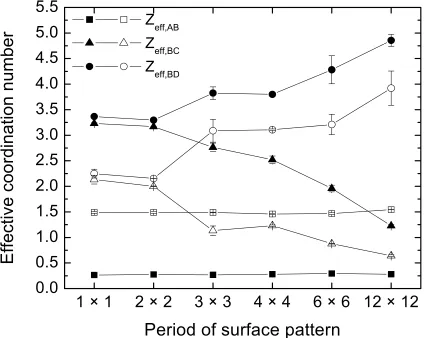
copolymer sequences on substrates with different pattern periodicities (top). The black regions on the substrates represent the adsorbing domains (D) and the white regions represent the neutral domains (C). The profiles range from 0 (white) to 1 (black)... 45 Figure 3.4.3 Effective coordination number for diblock (closed symbols) and alternating (open symbols) monomer sequences for A-B (squares), B-C (triangles), and B-D (circles) binary pairs as a function of the surface pattern periodicity... 47 Figure 3.4.4 Pattern transfer parameter of the diblock copolymer for substrate periodicities ranging from [1×1] to [12×12]... 49 Figure 3.4.5 Pattern transfer parameter of the alternating copolymer for substrate
left corner) represent the adsorbing domains (D) and the white regions represent the neutral
domains (C). The profiles range from 0 (white) to 1 (black)... 67
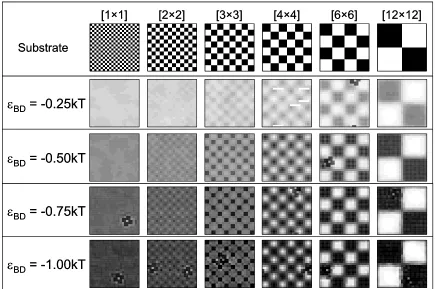
Figure 4.5.3 Diblock copolymer planar x-y dimensional probability density profiles at the substrate interface (i.e. z = 1) for adsorbing B segments on substrates with different pattern periodicities (top) as a function of B-D attractive strength from -0.25 kT (top middle) to -1.00 kT (bottom). The black regions on the substrate represent the adsorbing domains (D) and the white regions represent the neutral domains (C). The profiles range from 0 (white) to 1 (black). ... 68
Figure 4.5.4 Alternating copolymer planar x-y dimensional probability density profiles at the substrate interface (i.e. z = 1) for adsorbing B segments on substrates with different pattern periodicities (top) as a function of B-D attractive strength from -0.25 kT (top middle) to -1.00 kT (bottom). The black regions on the substrate represent the adsorbing domains (D) and the white regions represent the neutral domains (C). The profiles range from 0 (white) to 1 (black). ... 69
Figure 4.5.5 Pattern transfer parameter of the diblock copolymer for substrate periodicities from [1×1] (squares), [2x2] (circles), [3x3] (triangles), [4x4] (diamonds), [6x6] (stars), and [12×12] (pentagons) with the BD attractive potential ranging from 0.25 kT (top left) to -1.00 kT (bottom right)... 71
Figure 4.5.6 Pattern transfer parameter of the alternating copolymer for substrate periodicities from [1×1] (squares), [2x2] (circles), [3x3] (triangles), [4x4] (diamonds), [6x6] (stars), and [12×12] (pentagons) with the B-D attractive potential ranging from -0.25 kT (top left) to -1.00 kT (bottom right). ... 72
Figure 4.5.7 Difference in effective coordination number for B-D and B-C pairs for diblock copolymer (top) and alternating copolymer (bottom) as a function of substrate period and strength of the B-D potential... 74
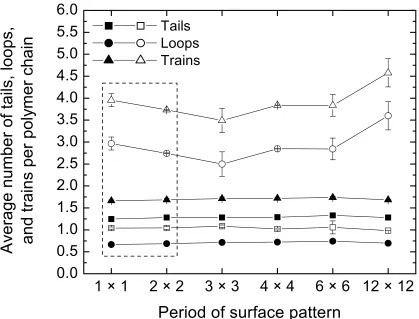
Figure 4.5.8 Average length of tails (squares), loops (circles), and trains (triangles) per adsorbed chain for diblock (top) and alternating (bottom) monomer sequences as a function of the B-D attraction energy. ... 76
Figure 4.5.9 Average number of tails (squares), loops (circles), and trains (triangles) per adsorbed chain for diblock (top) and alternating (bottom) monomer sequences as a function of the B-D attraction energy. ... 77
Figure 4.5.10 Average total length that tails (squares), loops (circles), and trains (triangles) contribute to the total copolymer chain length for diblock (top) and alternating (bottom) monomer sequences as a function of the B-D attraction energy. ... 78
Figure 5.2.1 "Coloring" process proposed by Khokhlov and Khalatur. ... 88
Figure 5.3.1 Schematic representation of the Kerr measurement system... 93
Figure 5.3.2 Schematic for the triple detector SEC system. ... 95
Figure 5.4.1 NMR spectra of PS... 99
Figure 5.4.4 Structures corresponding to peaks labeled in Figure 5.4.1, Figure 5.4.2, and Figure 5.4.3. ... 100 Figure 5.4.5 DSC curves for PS, PBrS, b-(PS-co-PBrS), r-(PS-co-PBrS), and a blend of PS/PBrS in a 28/72 wt-% ratio... 102 Figure 5.4.6 Kerr constant for PS, b-(PS-co-PBrS), and r-(PS-co-PBrS)... 103 Figure 5.4.7 Molecular weight and concentration distribution of PS, b-(PS-co-PBrS), and r-(PS-co-PBrS)... 104 Figure 5.4.8 Intrinsic viscosity and concentration distribution of PS, b-(PS-co-PBrS), and r-(PS-co-PBrS)... 105 Figure 5.4.9 Conformational structures suggested by Khokhlov and Khalatur of A-B
1.1 Introduction
The 21st century has marked the cornerstone of a new movement in specific areas of science and technology that involve the investigation of matter on the nanometer scale. On January 21, 2000, President Clinton announced the formation of the National Nanotechnology Initiative. This initiative represents a National Science Foundation (NSF) led effort to strengthen critical areas of research in nanotechnology and to encourage interdisciplinary research and education. The NSF proposed to focus its attention and investments on five interrelated areas of nanoscale science and engineering, which include: biosystems at the nanoscale, nanoscale structures, device and system architecture, nanoscale processes for the environment, and multi-scale, multi-phenomena modeling and simulation at the nanoscale. Examples of potential outcomes include: better physical and chemical properties of materials, quantum computing and mass storage at a fraction of the current physical sizes, improved drug delivery, and clean energy systems.[1] Based on the potential outcomes alone, one can see that the applicability of nanotechnology to both fundamental science and society is endless.
NSF, once said: “Exchange among seemingly unrelated disciplines, often turbulent in practice, can lead to an unexpected harvest of insights…Progress in one area seeds advances in another.”[2] It is this very thought that has brought about so many great discoveries in the past few decades. Researchers are realizing that the ideas that develop in one field of science can have extraordinary impact on other fields, thus bringing about a greater understanding of science as a whole. For example, adaptive optics was first developed in the field of astronomy to sharpen the images of cosmic entities captured from ground-based observatories. This technology is now being used in the field of medicine as a tool to study the arrangement of cones in the human eye, which could lead to better corrective measures for human vision.[3]
configurational bias and single move Monte Carlo techniques to look at how copolymers consisting of A and B units arrange themselves at planar, chemically heterogeneous surfaces.
Figure 1.1.1 Illustration of hydrophilic-hydrophobic interactions based on dispersive medium, where a copolymer is represented a) in a hydrophilic environment, b) in a neutral environment, and c) in a hydrophobic environment.
Obviously, the same idea can be accomplished using biological polymers and with exact sequence control. However, biological polymers represent very complicated structures that incorporate practically every possible type of intramolecular and intermolecular interaction. This complexity in turn limits the ability to systematically investigate the driving force that dictates the polymer’s adsorption process. It is for this reason that we focus our research on synthetic copolymers developed through a novel reaction scheme. This scheme allows us to control not only the statistical sequence distribution but also the molecular interactions through specific monomer functional groups. The ability to exchange the functional groups ultimately allows us to examine the effects that different intramolecular interactions have on the adsorption process in a systematic way. The experimental work presented here focuses on the effect of varying the statistical sequence distribution of the A and B units within the copolymer and the strength of the van der Waals forces between A and B units as well as the surface to which the copolymer adsorbs.
To begin, we start by outlining some of the seminal work that has contributed to our choice of direction. We follow this review with the results of our simulations focused on copolymer pattern recognition. The simulations help to set the groundwork of the document
a
b
c
1.2 References
1. NSF. Nanotechnology Fact Sheet in NSF: Office of Legislative and Public Affairs, Washington, D.C., (2000).
2. Colwell, RR. Crossing All Boundaries in Knowledge Wave 2003: The Leadership Forum, Auckland, (2003).
3. Roorda, A and DR Williams, Nature, 397(6719), 520, (1999).
2.1 Polymer adsorption at flat impenetrable surfaces
In this chapter, we review concepts related to the adsorption of flexible polymers on flat,
impenetrable surfaces. This review does not provide a comprehensive overview of the entire
field; there are multiple investigations involving the behavior of polymers at hard interfaces
that will not be addressed here. We simply offer this review as a guide into some of the
defining elements that dictate how a polymer partitions at and near surfaces. More
specifically, we focus on the equilibrium behavior of homopolymers and heteropolymers on
physically flat surfaces that are either chemically homogeneous or contain some in-plane
chemical heterogeneity. The ideas outlined here will establish the basis of the discussions
presented in later chapters where our concerns will shift from the basic idea of polymer
adsorption to the ability of structured copolymers to recognize surface patterns and the
development of a novel design strategy for the creation of the so-called “protein-like”
copolymers. For a more comprehensive review of polymer adsorption, the reader is referred
to published works by Kawaguchi, Fleer, Robb, Sanchez, Chakraborty, and others.[1-11]
Many different factors influence the conformations of homopolymers and
heteropolymers at the polymer-substrate interface. The equilibrium conformation of all
polymer chains in the system is determined by minimizing the system free energy through
balancing the effects of enthalpy gain and entropy loss. From an enthalpic standpoint,
adsorbing polymers will always seek to maximize the number of contacts between their
adsorbing units along the chain and the adsorbing domains on the surface. This, in turn,
limits the total number of possible conformations that the polymer chains can adopt as well
equilibrium, a balance between enthalpy and entropy is established that in turn determines
the equilibrium conformations of the adsorbing polymers.
The more dominant factors that influence the behavior of polymers as they approach flat,
impenetrable surfaces include: 1) the strength of the interaction between the adsorbing
segments along the chain and the adsorbing domains on the surface, 2) the polydispersity of
the polymer and/or presence of molecular displacers (i.e. higher affinity solvents), 3) the
sequence distribution of the monomers comprising the polymer chain, and 4) the size and
spatial distribution of the adsorbing domains on the surface. Some of these elements are
relevant only to certain systems, i.e. homopolymers at homogeneous surfaces (1-2),
homopolymers at heterogeneous surfaces (1, 2, 4), heterogeneous polymers at homogeneous
surfaces (1-3), and heterogeneous polymers at heterogeneous surfaces (1-4). In the sections
that follow we discuss how each factor can influence polymer behavior at an impenetrable
interface.
2.2 Strength of attraction and interaction of dispersion media
The major driver for polymer adsorption is the strength of attraction between the
adsorbing segments along the polymer and the adsorbing domains on the surface. In the
bulk, the polymer will have a three-dimensional range of motion. After adsorption onto a
surface, however, the polymer’s range of motion will be decreased. Adsorption of a polymer
onto an impenetrable surface will result in a loss of its conformational and translational
entropy. This adherence further reduces the mobility of the chain and in some cases
can be accompanied by a net gain in entropy. These are systems where the polymer chain
displaces many small molecules from the surface. While such systems are the exception
rather than the rule, they do illustrate the importance of the dispersion media on polymer
adsorption. When referring to the strength of attraction one must also discuss the interaction
of the polymer chain with the dispersion media, i.e. solvent, which can be a low molecular
weight liquid or polymer melt, since these interactions act hand-in-hand. Mathematically the
adsorption can be characterized in terms of a dimensionless energy parameter, χs, which is
defined as
(
U U)
kBTs = 1 − 2 /
χ , (2-1)
where U1 is the adsorption energy of the dispersion media, U2 is the adsorption energy of the
polymer, kB is the Boltzmann constant, and T is temperature. A positive value in χs results in
a net driving force for the polymer to adsorb at the surface. Likewise a negative value will
result in displacement of the polymer by the dispersion media. To characterize the effect that
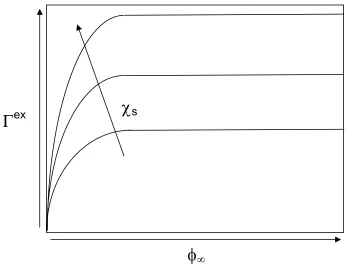
χs has on the adsorption process, we can examine the adsorption isotherm of the polymer.
First, we must define the surface excess Γex which is given as
( )
(
)
∫
∞ − ∞= Γ
0 z dz
ex φ φ , (2-2)
where φ(z) is the polymer volume fraction, z is the distance from the surface, and φ∞ is the
polymer volume fraction in the bulk. If Γex is plotted as a function of φ
∞, one obtains the
adsorption isotherm. In Figure 2.2.1, we show a typical polymer adsorption isotherm for
Figure 2.2.1 Typical adsorption isotherms for polymers with different surface affinities.
Based on Figure 2.2.1, we can see that the amount of adsorbed material also increases with
increasing χs. This increase in χs is a direct result of either a stronger attraction of the
adsorbing surface domains for the adsorbing segments within the polymer and/or a reduction
in the solubility of the polymer in the dispersion media.
Several experimental and computational studies illustrate the dominance of
polymer-surface and polymer-dispersion media interactions in polymer adsorption.[12-25] A brief
summary of some of the findings is offered. Oslanec et al. investigated a system consisting
of a diblock copolymer of polystyrene and poly(methyl methacrylate) (PS-b-PMMA)
submerged in a random copolymer matrix of polystyrene and poly-4-bromostyrene
(4-PBrS). The study focused on studying the effect of the amount of bromine within the
PS-co-4-PBrS on the adsorption of the two copolymers at the polymer-silica interface. They
φ
∞the level of 4-bromostyrene in the copolymer. These results were attributed to the surface
competition between the 4-PBrS and the PMMA.[26] At low bromine content, the strong
attraction of PMMA for the surface dominates since PMMA has a higher affinity for the
surface than PS. However at constant PS-b-PMMA loading, increases in the amount of
4-PBrS within the PS-co-4-4-PBrS allow for the PS-co-4-4-PBrS to displace the PS-b-PMMA.
Since the 4-PBrS has a higher affinity for silica than the PMMA, the increase in 4-PBrS
content allows the PS-co-4-PBrS copolymer to develop more adsorbing points along its
length giving the chain a higher total affinity for the surface than the PS-b-PMMA.
Other studies utilizing copolymers have shown the influence of polymer-substrate
interaction on polymer adsorption. Leermakers and Gast investigated the adsorption of
highly asymmetric poly(styrene-b-ethylene oxide) (PS-b-PEO) copolymers from solution.
They reported that when the substrate was exposed to a dilute solution of PS-b-PEO, both
segments of the copolymer readily adsorbed at the substrate. However, in concentrated to
moderately dilute solutions a fast initial chain deposition was observed followed by
displacement of PS segments located at the surface by PEO, which resulted in extended chain
configurations of the PS blocks.[27] In this case, the increases in copolymer concentration
resulted in lowering of the PEO block’s solubility thus forcing it to the surface. Later
investigations carried out by Tripp and Hair further supported the findings of Leermakers and
Gast. Using a PS-b-PEO copolymer Trip and Hair were able to identify three distinct
adsorption regimes. During the first regime, the adsorption of polymer onto vacant surface
sites proceeded without any chain rearrangement. After the surface was fully covered, newly
segregating polymers were accommodated by spatial rearrangement of the surface layer. In
identified by Tripp and Hair, a slow rearrangement of the surface chains occurred.
Specifically, more PS segments were sacrificed for the PEO, which resulted in an additional
rearrangement to extend the PS segments into a polymer brush.[28]
Pelletier et al. support these results even further with their work on ultra-thin layers of
poly(styrene-b-2-vinylpyridine) (PS-b-P2VP). Their studies showed that the P2VP layer
thickened as more chains were adsorbed onto the mica surface, while the PS segments
extended into solution. In addition, the volume fraction of P2VP in the anchored layer was
found to remain constant during the growing process which suggested a strong binding
efficiency with the surface.[29]
Even at heterogeneous surfaces, the effect of attractive interaction can be seen. Van der
Linden and coworkers used a self-consistent field theory to incorporate these effects. They
found that homopolymers adsorb onto heterogeneous surfaces if the average interaction
energy with the surface is below some critical adsorption energy. They further noted that this
is more likely to happen when the surface pattern consists of patchy patterns rather than
randomly distributed arrangements.[30] While the model of Linden and coworkers could also
be used for block copolymer adsorption onto heterogeneous surfaces where strong
segregation can occur, their investigation in this area was limited.
Since the adsorption of a polymer implies that conformational changes must occur it is
relevant to describe these changes. Clayfield and Lumb were among the first to study
polymer adsorption near attractive surfaces using computer-based experiments.[31, 32] Their
simulations on macromolecules near an attractive surface detail some of the effects that
predictions of Hoeve and Roe.[33-36] However, the mostly widely used description of polymer
conformations at an adsorbing interface is given by the work of Jenkel and Rumbach that is
depicted schematically in Figure 2.2.2.[37]
Figure 2.2.2 Illustration of an adsorbed polymer chain at an impenetrable surface.
This model depicts that the segments of an adsorbing macromolecule are present in one
of three major groups: loops, tails, and trains. The loops are represented by a series of
bonded chain segments that connect two trains but have no contact with the surface. The
trains comprise any segment that is in direct contact with the surface. Lastly, the tails are
non-adsorbed chain ends. Tail segments usually constitute a small portion of all chain
segments, but they are the entities that predominately determine the layer thickness of the
adsorbed polymer. The trains provide the enthalpy gain through contact of the adsorbing
segments of the polymer with the adsorbing domains on the surface. In contrast, the loops
and tails provide the means by which the polymer can relieve any frustrations in entropy.
loops
2.3 Polydispersity and molecular displacers
The synthesis of bulk amounts of purely monodisperse synthetic polymers, that is
polymers with a single molecular weight, is virtually impossible given the current state of
technology. There are some techniques, such as the one developed by Tirrell’s group, that
allow for the synthesis of monodisperse synthetic polymers but in extremely limited
quantities.[38] All synthetic polymers made in bulk amounts have some range of
polydispersity. These polymers must therefore be considered as multicomponent mixtures
rather than single molecular weight materials. It is for this reason one should be concerned
with how the molecular weight of the polymer will influence the adsorption of the chains.
[39-47] Similarly, if the system in question is a polymer solution, concerns of competitive
adsorption also apply not only from polydispersity issues but also because of small molecular
displacers such as solvent.[17, 48-50]
First, let us look at polymeric species and how competitive adsorption occurs. Consider
two monodisperse polymers mixed together, one with a low and the other with a high
molecular weight. Intuitively, one would think that the low molecular weight polymer is
more likely to adsorb to the surface over the higher molecular weight species due to mobility
issues. Alternatively, one might think that the higher molecular weight polymer would
preferentially adsorb due to an increase in the number of possible contact points along the
chain. However, neither case is entirely the preferred one. Kinetically speaking the lower
molecular weight polymer will adsorb faster than the higher molecular weight polymer but
over time, the smaller molecular weight polymer will be displaced. The displacement does
and high molecular weight polymers. Therefore, total adsorption energy per unit area
remains unaffected by polydispersity. If this is so, then where does the principle driving
force for displacement come from?
The principle driving force stems from entropic contributions. The fact is that the higher
molecular weight polymer will have a lower solubility than the low molecular weight
polymer, which will drive the displacement of the low molecular weight polymer at the
surface. The entropy of mixing in solution dramatically decreases as the length of the
polymer chain increases. Therefore, there is also a dependence on the concentration in
solution (or melt).
Although it is generally accepted that polymers adsorb strongly to surfaces, there are
instances where small molecules and oligomeric units can displace large polymers.[17, 48, 50, 51]
In such cases, the driving force is almost purely enthalpic. Displacement can occur when the
concentration of molecular displacers is large enough and the adsorption attraction is larger
than that of the polymer. Usually, the enthalpy contribution to the free energy must be
substantially larger to overcome the entropic penalty with forcing the polymer into solution.
2.4 Polymer monomer sequence distribution
In this section, we turn our attention to the effect of the sequence distribution of
adsorbing and non-adsorbing segments within a polymer chain on adsorption onto flat
surfaces. For simplicity, we restrict our discussion to copolymers consisting of only two
species (A and B). Furthermore, we limit ourselves to three classes of copolymers: diblocks,
alternating, and random. A diblock copolymer is represented by a series of A units followed
chain is the same, i.e. ABABAB. The random copolymer exhibits no correlation in monomer
positions along the length of the chain. This means that from one unit to the next there is an
equal probability of encountering an A or B unit.
The adsorption characteristics of these macromolecules are quite different as confirmed
by many researchers.[52-66] First, we examine how a diblock copolymer adsorbs onto a flat
surface. A diblock copolymer can be viewed as a species comprising two homopolymers
connected at a single juncture in which each block retains many of the properties of the
individual homopolymer. During the adsorption process, one of the two blocks has a greater
surface affinity than the other and thus adsorbs preferentially onto the surface. This block is
considered the anchor block (A). The other block will extend away from the surface,
forming a brush of freely dangling tails. This block is considered to be the buoy block (B).
This anchor/buoy type structure provides the fine balance between enthalpy and entropy.
While the anchoring block maximizes the number of more favorable contacts the buoy block
reduces the entropic penalty associated with surface confinement.
If we consider a non-selective solvent that dissolves both the A and B blocks equally
well, the key parameter in the adsorption behavior is the relative lengths of each block. One
situation occurs when the length of the A block is short compared to that of the B block. In
this case, the repulsion between the B blocks dominates the adsorption properties, resulting
in an under-saturated layer of A. As the number of A blocks that are in contact with the
surface increases, the adsorption is enhanced due to the availability of more A-surface
contacts. An optimum number of chains adsorbed at the surface is achieved when the energy
adopt conformations with a single long tail and a single short train with minor loop
fluctuations. Any further increase in the length of the A block will incite a change from the
buoy regime to the so-called anchor regime. This will occur when the number of chains that
can reach the surface is limited by the saturation of the anchored layer. In this regime the
adsorbed mass of A remains relatively constant despite any increase in A. Therefore, the
number of adsorbed chains will decrease, as does the number of B blocks, resulting in a
denser layer relative to that in the buoy regime. The end result is a conformation that
includes a short tail and a long train with a higher number of loop fluctuations than the buoy
regime. Figure 2.4.1 schematically illustrates both regimes.
Figure 2.4.1 Copolymers adsorbed onto a surface illustrating the buoy and anchor regimes.
Marques and Joanny support these ideas in their adsorption studies of an A-B block
copolymer in a nonselective solvent where the A segments exhibit preferential attraction to
the surface. Marques and Joanny report that for copolymers with small asymmetry, the A
segments formed a fluffy layer near the surface and the B segments extended out away from
the surface. However, when increasing the B block length while keeping the A block
constant, the A blocks became zipped to the surface.[20] Similar observations have been
adsorption of block copolymers from dilute solutions. Both researchers concluded that when
the A block was firmly adsorbed to the substrate the B block behaved similar to that of a
single chain terminally anchored to the substrate.[67, 68] Further support for these findings
also arose out of self-consistent field (SCF) modeling performed by Evers and coworkers.
[69-71]
Budkowski et al. demonstrated these effects by examining the competition between two
adsorbing copolymers of different lengths. In their studies, the short symmetric blocks
adsorbed at the polymer melt-surface interface while the long asymmetric blocks were found
primarily away from the interface.[12] The results of Budkowski and coworkers compared
well with the model developed by de Gennes and Leibler.[72, 73] This showed that the
anchoring regime was more favorable than the buoy regime since one would expect that the
longer polymer would displace the shorter polymer.
At the other extreme of the monomer sequence distribution spectra is the alternating
copolymer. In these copolymers, the adsorbing (A) and non-adsorbing (B) segments are
distributed evenly throughout the entire length of the chain. Provided that the non-adsorbing
segments do not have a large repulsion with the surface, the adsorption properties will be
similar to those of a homopolymer with some effective average of A and B homopolymer
properties. Loop, tail, and train conformations will be formed such that the number of A
segments in contact with the surface is maximized and the number of B segments extended
into the bulk is also maximized. This causes the chain to occupy a large amount of surface
area when adsorbed to the surface but maintain enough loops and tails to alleviate the
Figure 2.4.2 Alternating copolymer adsorbed onto a surface.
The random copolymer is a special case in that its adsorption properties will fall
somewhere between that of a diblock and an alternating copolymer. In these polymers
careful consideration must be made in terms of their monomer sequence distribution. The
extent to which the chain develops a purely random versus a random- blocky distribution is
important. If the segments are not distributed with equal probability but have some
preferential tendency for an A unit to follow an A unit or a B unit to follow a B unit, the
sequence is considered to be more blocky in nature. In purely random copolymers, the
presence of blocky structures containing 3-5 repeat units is not uncommon.[9] As the number
of segments per block increases, the behavior of the chain will approach that of a pure
diblock copolymer. First, consider a completely random copolymer consisting of two species
where one species is preferentially attracted to the surface. If the monomer sequence in this
chain is completely random, there will be both long and short lengths of consecutive
adsorbing blocks within the same chain. As the polymer adsorbs it can be expected that the
longer consecutive adsorbing blocks will be preferentially located at the adsorbing surface.
This allows the chain to increase the number of favorable adsorbing segment/surface
contacts. This behavior also results in the copolymer forming loops and tails that will not
necessarily contain only long sequences of non-adsorbing blocks but also adsorbing blocks
that help alleviate any tendency to completely zip the macromolecule to the surface. If the
relative increase in the size of the non-adsorbing block lengths. This, in turn, will allow the
copolymer to adsorb more strongly relative to a polymer with a purely random sequence; the
larger block lengths of adsorbing segments increase the probability of localization at the
surface. After one monomer adsorbs to the surface, the probability that its neighbor (or
neighbors) will also adsorb to the surface increases. The same applies for the longer
sequences of non-adsorbing segments. Increases there will result in larger loops and tails
available to counteract any entropic penalty associated with the polymer’s surface
localization. In Figure 2.4.3, we show representations of a copolymer with a random
sequence compared to that of a copolymer with a sequence with some blocky nature to it.
Figure 2.4.3 Random copolymers adsorbed onto a surface with different sequential distributions.
Although no experimental studies concern copolymers of different random distribution
types, one can clearly understand the effect of block location based on the work of Dorgan
and coworkers. Using diblocks and triblocks of PS and PEO, Dorgan and coworkers found
that symmetric and moderately symmetric diblocks followed the scaling relations proposed
by Marques and Joanny. However, triblocks of comparable asymmetry behaved more like
highly asymmetric diblocks where the adsorption was dominated by the non-adsorbing PS
block size.[74-76] In similar experiments, Griffiths and coworkers showed that chain
center of the polymer. However, it became a significant factor when the adsorbing blocks
were located at the ends of the polymer.[77]
The most notable changes in polymer adsorption properties due to differences in the
primary monomer sequence distribution are seen in the work presented by Khokhlov’s and
Chakrabarti’s groups. Khokhlov’s group developed a novel “coloring” scheme in which a
parent homopolymer of non-adsorbing units is forced into a globular state and the monomers
located at the corona are “colored” into adsorbing units. These polymers are termed
“protein-like” copolymers. These “protein-like” copolymers are then placed near a surface
and allowed to adsorb. The adsorption properties of these “protein-like” copolymers were
found to be different from those of purely random copolymers.[62, 78] Chakrabarti’s group
followed this idea and used a modified version of Khokhlov and coworkers “coloring”
scheme to examine the adsorption properties of different “protein-like” copolymers. The
investigation using molecular dynamic simulations looked at examining the spreading rate of
copolymers with different primary sequences. They found that the primary sequence
distribution can have a substantial effect in the spreading rate of the copolymer.[79] The
above discussion underlines the importance of the monomer sequence distribution on the
adsorption properties of copolymers.
2.5 Size and distribution of surface domains
The effect that size, shape, and spatial distribution of adsorbing domains on the surface
has on polymer adsorption has received fairly little attention relative to cases involving
chemically homogeneous substrates.[4, 30, 57, 64, 80-98] There are three cases to consider. The
mentioned phenomena concerning polymer adsorption onto homogeneous surfaces apply.
Regardless of whether the polymer is chemically homogeneous or heterogeneous it will
approach the surface and spread. This process increases the number of favorable adsorbing
segment contacts with the surface while allowing the polymer to relax into a favorable
surface conformation. As the size of the adsorbing domains decreases, issues of confinement
start to play a role in how the polymer adsorbs onto the surface. The interfacial area between
the adsorbing and non-adsorbing domains will begin to influence the conformations that the
polymers will adopt. The polymer will no longer have the ability to spread completely
without “paying” some energetic penalty. Therefore, it becomes more likely that the
polymer will start to form more loops and/or loops and tails that are longer in length. The
remaining two cases describe this situation. Specifically, the second case is where the size of
the adsorbing domain approaches the size of the adsorbing polymer. Here it can be expected
that the interfacial area between the adsorbing and non-adsorbing domains will play a role in
how a polymer adsorbs. The final case involves situations where the size of the adsorbing
domain is smaller than the dimensions of the adsorbing polymer coil. In this case bridging
and interaction strength will primarily dictate the conformations of the adsorbing polymers.
Many groups have considered the behavior of copolymer melts in contact with surfaces
that were patterned with some chemical arrays, such as stripes. Each domain of the surface
had a different preference for each of the blocks in the adsorbing copolymer. A competition
between the preferred bulk lamellar spacing, L0, and the periodic stripe spacing, L, was
reported. When the value of L0 is greater than L, the stripes have been found to induce
that the striped surface can induce inverted bilayers, i.e. an AB-AB pattern instead of the
usual AB-BA sequence.[93, 99-101]
Kielhorn and Muthukumar used the Cahn-Hilliard-Cook model to study the effects of
patterned surfaces on phase separation in polymer blends. In thin film geometries, they
observed pattern-induced spinodal waves perpendicular to the surface. For sufficiently thin
films, the surface pattern was transferred to the film material.[89] Balazs et al. examined a
similar system with a single component using Monte Carlo simulation techniques. The
surfaces in these studies were composed of two-component sites adopting stripe,
checkerboard, and random arrangements. The chains were tailored to have a higher binding
affinity for one type of surface site (S1) over the other surface site (S2). Balazs and
coworkers found that while holding the ratio of S1 to S2 sites constant, decreasing the size of
the S1 domains increased polymer adsorption.
Balazs and coworkers later expanded their work on A-B copolymers adsorbed onto
chemically heterogeneous surfaces composed of S1 and S2 sites. As with their previous
studies, the A segments were preferentially attracted to S1 sites and S2 sites remained
effectively neutral to all species. By changing the ratio of S1/S2 sites, Balazs and coworkers
were able to fine-tune the properties of the adsorbed polymer films. Balazs and coworkers
also showed that the surface site arrangement influenced the spatial distribution of the
adsorbed polymeric units and under certain circumstances, A-B copolymers were able to coat
the S1 sites more effectively than a homopolymer of pure A.[80]
Other groups have looked at irregular surface chemical patterns. For example, Van der
Linden and coworkers used self-consistent field theory to incorporate these types of surfaces.
if the average interaction energy with the surface was below some critical adsorption energy.
They noted that this is more likely to happen when the surface pattern consists of patchy
patterns rather than randomly distributed arrangements.[30]
Any further decrease in the domain size does not allow the polymer to adsorb onto a
single domain provided that the spatial distance between the domains is of the same order. If
the domains are located within a distance comparable to or less than the dimension of the
adsorbing coil, the polymer chain will have the ability to bridge between surface domains as
long as the bridging remains energetically favorable. If the domains are located far away
from each other and are smaller than the adsorbing polymer’s coil size, little or no adsorption
can be expected as long as the non-adsorbing segments are non-favorable contacts.
Mansky et al. recognized the importance of smaller domain sizes in polymer adsorption.
By using end-grafted random copolymer brushes made of PS and PMMA segments
(PS-ran-PMMA), Mansky and coworkers were able to tailor the interfacial and wetting behavior of
polymers at a solid interface. They found that for PS-ran-PMMA with a PS fraction of
approximately 0.60, the interfacial energy of the random surface with respect to both PS and
PMMA was equal.[102] Huang and coworkers later exploited these findings to drive
orientational displacement of PS-b-PMMA copolymers. In situations where one of the
blocks of a symmetric diblock copolymer exhibits a preferential wetting to the substrate, the
copolymer lamellae orient parallel to this surface. However, when the surface is coated with
the random copolymer, it becomes essentially neutral to both blocks, resulting in a crossover
2.6 Polymer adsorption and pattern recognition
Thus far, only the adsorption of polymers has been discussed and not its relation to
pattern recognition. Genzer has recently developed a three-dimensional (3D) self-consistent
field (SCF) model of polymer adsorption by extending the 1D SCF scheme of Scheutjens and
Fleer. He has used it to study the adsorption of A-B diblock, triblock, and alternating
copolymers from A homopolymer matrices onto planar substrates composed of two
chemically distinct sites (C and D), one of which had a preferential affinity for the B
segments of the copolymer.[57, 64, 85, 104] His results demonstrated that when the chemically
heterogeneous motifs on the substrate were detected by the copolymer adsorbing segments,
the copolymers were able to transcript them with high fidelity into three dimensions. The
way the surface pattern was transferred was dictated by the monomer sequence distribution.
Genzer showed that relative to alternating copolymers, block copolymers were better at
capturing the chemical pattern’s shape and transcribing it into the bulk mixture.
At present, Arup Chakraborty’s group at UC Berkeley has performed the only extensive
studies pertaining to copolymer pattern recognition involving copolymers with disordered
sequence distributions, so-called random heteropolymers (RHP), on multifunctional,
heterogeneous surfaces. Chakraborty and coworkers have shown that RHPs exhibit sharp
transitions in adsorption behavior which they suggest is sufficient (and necessary) to mimic
surface pattern recognition. Their models reveal that the origin of the adsorption transition
stems from the suppression of loop fluctuations due to disorder and competing
interactions.[55] Bratko et al. stipulate that for recognition to occur, exact matching between
the monomer sequence distribution and surface heterogeneities is not necessary; only
the recognition to occur.[63] In other simulations, Bratko et al. have shown that weak
adsorption of RHPs were observed when the fraction of surface sites was low.[55] Srebnik
and coworkers carried out non-dynamic ensemble growth Monte Carlo simulations to study
the effects of distinct segment-segment interactions on the adsorption of RHPs near a
disordered heterogeneous surface. It was found that when a certain threshold density of
adsorbing sites was reached, the RHP underwent a sharp transition from weak to strong
adsorption. However, when the segment-segment interactions were weak the threshold
density of sites increased. The trend reversed for strong segment-segment interactions. This
behavior was attributed to the entropic penalties associated with adsorption.[25] Based on the
group’s previous work and the work done with Golumbfskie and Pande, Chakraborty and
coworkers have shown that biomimetic recognition can occur by exploiting the competing
interactions between the adsorbing RHP and the multifunctional surface. They further
suggested that RHPs represent the hallmark of recognition by developing specific
distributions of loop lengths and/or shapes.[105] Simmons and Chakraborty applied their
previous work with RHP at surfaces to investigate the promotion of homopolymer adhesion.
In their investigation, the monomer sequence distribution of the RHP was varied as well as
the amount of promoter and the strength of the segment interactions and
segment-surface interactions. The optimal adhesion promoters were found to be RHPs with relatively
high fractions of adsorbed segments and long loops extending away from the surface. These
configurations help to induce entanglements between the RHPs and the homopolymers while
2.7 Concluding remarks
From this review, we can see that uncovering all of the phenomena associated with the
adsorption of polymers onto flat, impenetrable surfaces is not an easy task. The efforts of the
aforementioned research groups have been successful in identifying many factors that
influence the driving forces associated with polymer organization at a hard interface.
However, there is still much work to be done. It is now fairly well understood that the
principle driving force for a polymer chain to adsorb onto a surface is the symbiotic
relationship between enthalpy gain and entropy loss. However, these enthalpic and entropic
contributions are influenced by many factors, such as the strength of the interaction between
the adsorbing segments along the chain and the adsorbing domains on the surface, the
polydispersity of the polymer and/or the presence of molecular displacers, the monomer
sequence distribution along the length of the chain, and the size and special distribution of
the adsorbing domains on the surface.
Researchers are slowly starting to provide explanations as to how and why these factors
disturb or contribute to polymer adsorption. Computational studies are now beginning to
define the direction for further studies in polymer adsorption, especially with the
ever-increasing computational speed of computers. Experimental instruments experience
improvements in their sensitivity as well as their spatial resolution. As more and more
technological advances are made, we can expect to see many more exciting discoveries in the
2.8 References
1. Takahashi, A. and M. Kawaguchi, Advances in Polymer Science, 46, 1, (1982).
2. Stuart, M.A.C., T. Cosgrove, and B. Vincent, Advances in Colloid and Interface Science, 24(2-3), 143, (1986).
3. Kawaguchi, M. and A. Takahashi, Advances in Colloid and Interface Science, 37 (3-4), 219, (1992).
4. Chakraborty, A.K. and A.J. Golumbfskie, Annual Review of Physical Chemistry, 52, 537, (2001).
5. Chakraborty, A.K., Physics Reports-Review Section of Physics Letters, 342(1), 2, (2001).
6. Daoud, M., Comptes Rendus De L Academie Des Sciences Serie Iv Physique Astrophysique, 1(9), 1125, (2000).
7. Daoud, M., Polymer Journal, 23(5), 651, (1991).
8. Sanchez, I.C., Physics of Polymer Surfaces and Interfaces, Boston, Butterworth-Heinemann, 336, (1992).
9. Fleer, G.J., et al., Polymers at Interfaces, London, Chapman & Hall, 502, (1993).
10. Robb, I.D., Comprehensive Polymer Science, 2, 733, (1989).
11. Jones, R.A.L., et al., Faraday Discussions, (98), 149, (1994).
12. Budkowski, A., et al., Macromolecules, 28(25), 8579, (1995).
13. Daoud, M. and E. Leclerc, Acs Symposium Series, 532, 23, (1993).
14. Degennes, P.G., Macromolecules, 14(6), 1637, (1981).
15. Hoeve, C.A.J., Journal of Chemical Physics, 44(4), 1505, (1966).
16. Kawaguchi, M., A. Sakai, and A. Takahashi, Macromolecules, 19(12), 2952, (1986).
17. Kawaguchi, M., M. Chikazawa, and A. Takahashi, Macromolecules, 22(5), 2195, (1989).
21. Singh, C., G.T. Pickett, and A.C. Balazs, Macromolecules, 29(23), 7559, (1996).
22. Srebnik, S., Journal of Chemical Physics, 112(21), 9655, (2000).
23. Srebnik, S., Journal of Chemical Physics, 114(20), 9179, (2001).
24. Csempesz, F., M. Nagy, and S. Rohrsetzer, Colloids and Surfaces a-Physicochemical and Engineering Aspects, 141(3), 419, (1998).
25. Srebnik, S., A.K. Chakraborty, and D. Bratko, Journal of Chemical Physics, 109(15), 6415, (1998).
26. Oslanec, R., R.J. Composto, and P. Vlcek, Macromolecules, 33(6), 2200, (2000).
27. Leermakers, F.A.M. and A.P. Gast, Macromolecules, 24(3), 718, (1991).
28. Tripp, C.P., P. Kazmaier, and M.L. Hair, Langmuir, 12(26), 6407, (1996).
29. Pelletier, E., et al., Langmuir, 13(7), 1884, (1997).
30. Vanderlinden, C.C., et al., Macromolecules, 27(7), 1915, (1994).
31. Clayfield, E.J. and E.C. Lumb, Journal of Colloid and Interface Science, 47(1), 6, (1974).
32. Clayfield, E.J. and E.C. Lumb, Journal of Colloid and Interface Science, 47(1), 16, (1974).
33. Roe, R.J., Journal of Chemical Physics, 44(11), 4264, (1966).
34. Roe, R.J., Journal of Chemical Physics, 43(5), 1591, (1965).
35. Roe, R.J., Proceedings of the National Academy of Sciences of the United States of America, 53(1), 50, (1965).
36. Hoeve, C.A.J., Journal of Chemical Physics, 43(9), 3007, (1965).
37. Jenkel, E. and B. Rumbach, Zeitschrift für Elektrochemie, 55, 612, (1951).
38. Tirrell, D.A., Nature, 390(6658), 336, (1997).
39. Addad, J.P.C. and N. Morel, Comptes Rendus De L Academie Des Sciences Serie Ii, 320(9), 455, (1995).
40. Broseta, D., et al., Macromolecules, 23(1), 132, (1990).
42. Felter, R.E., Journal of Polymer Science Part C-Polymer Symposium, (34), 227, (1971).
43. Oslanec, R., et al., Macromolecules, 32(12), 4098, (1999).
44. Sakai, H. and Y. Imamura, Bulletin of the Chemical Society of Japan, 60(4), 1261, (1987).
45. Santore, M. and Z.L. Fu, Macromolecules, 30(26), 8516, (1997).
46. Silberbe.A, Abstracts of Papers of the American Chemical Society, (SEP), 47, (1970).
47. Stuart, M.A.C., J. Scheutjens, and G.J. Fleer, Journal of Polymer Science Part B-Polymer Physics, 18(3), 559, (1980).
48. Balastre, M. and J.M. Berquier, Langmuir, 15(25), 8691, (1999).
49. Nguyen, S.H. and D. Berek, Colloids and Surfaces a-Physicochemical and Engineering Aspects, 162(1-3), 75, (2000).
50. Vanderbeek, G.P., M.A.C. Stuart, and G.J. Fleer, Macromolecules, 24(12), 3553, (1991).
51. Kawaguchi, M., H. Kawaguchi, and A. Takahashi, Journal of Colloid and Interface Science, 124(1), 57, (1988).
52. Simmons, E.R. and A.K. Chakraborty, Journal of Chemical Physics, 109(19), 8667, (1998).
53. Yeung, C., A.C. Balazs, and D. Jasnow, Macromolecules, 25(4), 1357, (1992).
54. Yeung, C., A.C. Balazs, and D. Jasnow, Abstracts of Papers of the American Chemical Society, 203, 226, (1992).
55. Bratko, D., A.K. Chakraborty, and E.I. Shakhnovich, Computational and Theoretical Polymer Science, 8(1-2), 113, (1998).
56. Balazs, A.C., M. Gempe, and C.W. Lantman, Abstracts of Papers of the American Chemical Society, 200, 257, (1990).
57. Genzer, J., Macromolecular Theory and Simulations, 11(5), 481, (2002).
58. Balazs, A.C., M. Gempe, and C.W. Lantman, Macromolecules, 24(1), 168, (1991).
61. Leclerc, E., M. Daoud, and R. Douillard, Nuovo Cimento Della Societa Italiana Di Fisica D-Condensed Matter Atomic Molecular and Chemical Physics Fluids Plasmas Biophysics, 16(7), 641, (1994).
62. Zheligovskaya, E.A., P.G. Khalatur, and A.R. Khokhlov, Physical Review E, 59(3), 3071, (1999).
63. Bratko, D., A.K. Chakraborty, and E.I. Shakhnovich, Chemical Physics Letters, 280(1-2), 46, (1997).
64. Genzer, J., Advances in Colloid and Interface Science, 94(1-3), 105, (2001).
65. Gutman, L. and A.K. Chakraborty, Journal of Chemical Physics, 104(18), 7306, (1996).
66. Chakraborty, A.K. and D. Bratko, Journal of Chemical Physics, 108(4), 1676, (1998).
67. Shaffer, J.S., Macromolecules, 28(22), 7447, (1995).
68. Wang, W., et al., Physical Review E, 48(6), 4622, (1993).
69. Evers, O.A., J. Scheutjens, and G.J. Fleer, Macromolecules, 23(25), 5221, (1990).
70. Evers, O.A., J. Scheutjens, and G.J. Fleer, Journal of the Chemical Society-Faraday Transactions, 86(9), 1333, (1990).
71. Evers, O.A., J. Scheutjens, and G.J. Fleer, Macromolecules, 24(20), 5558, (1991).
72. Leibler, L., Makromolekulare Chemie-Macromolecular Symposia, 16, 1, (1988).
73. Degennes, P.G., Macromolecules, 13(5), 1069, (1980).
74. Stamm, M. and J.R. Dorgan, Colloids and Surfaces a-Physicochemical and Engineering Aspects, 86, 143, (1994).
75. Dorgan, J.R., et al., Macromolecules, 26(20), 5321, (1993).
76. Dorgan, J.R., M. Stamm, and C. Toprakcioglu, Polymer, 34(7), 1554, (1993).
77. Griffiths, P.C., et al., Langmuir, 14(7), 1779, (1998).
78. Khokhlov, A.R. and P.G. Khalatur, Physical Review Letters, 82(17), 3456, (1999).
79. Liu, H. and A. Chakrabarti, Polymer, 40(26), 7285, (1999).
80. Balazs, A.C., M.C. Gempe, and Z.X. Zhou, Macromolecules, 24(17), 4918, (1991).
82. Balazs, A.C., C. Singh, and E. Zhulina, Macromolecules, 31(18), 6369, (1998).
83. Balazs, A.C., E. Zhulina, and C. Singh, Abstracts of Papers of the American Chemical Society, 216, 078, (1998).
84. Chun, K.Y., Y.W. Huang, and V.K. Gupta, Journal of Chemical Physics, 118(7), 3252, (2003).
85. Genzer, J., Physical Review E, 6302(2), 022601, (2001).
86. Halperin, A., J.U. Sommer, and M. Daoud, Europhysics Letters, 29(4), 297, (1995).
87. Huang, K. and A.C. Balazs, Abstracts of Papers of the American Chemical Society, 201, 140, (1991).
88. Huang, K.L. and A.C. Balazs, Physical Review Letters, 66(5), 620, (1991).
89. Kielhorn, L. and M. Muthukumar, Journal of Chemical Physics, 111(5), 2259, (1999).
90. McNamara, J., C.Y. Kong, and M. Muthukumar, Journal of Chemical Physics, 117(11), 5354, (2002).
91. Pereira, G.G. and D.R.M. Williams, Physical Review E, 60(5), 5841, (1999).
92. Pereira, G.G. and D.R.M. Williams, Macromolecules, 32(3), 758, (1999).
93. Petera, D. and M. Muthukumar, Journal of Chemical Physics, 109(12), 5101, (1998).
94. Semler, J.J. and J. Genzer, Journal of Chemical Physics, 119(10), 5274, (2003).
95. Seok, C., K.F. Freed, and I. Szleifer, Journal of Chemical Physics, 112(14), 6443, (2000).
96. Seok, C., K.F. Freed, and I. Szleifer, Journal of Chemical Physics, 112(14), 6452, (2000).
97. Sumithra, K. and A. Baumgaertner, Journal of Chemical Physics, 109(4), 1540, (1998).
98. Sumithra, K. and K.L. Sebastian, Journal of Physical Chemistry, 98(37), 9312, (1994).
99. Pereira, G.G. and D.R.M. Williams, Macromolecules, 31(17), 5904, (1998).
103. Huang, E., et al., Macromolecules, 31(22), 7641, (1998).
104. Genzer, J., Journal of Chemical Physics, 115(10), 4873, (2001).
Chapter 3: Monte Carlo Simulations of Copolymer
Adsorption at Planar Chemically Patterned Surfaces:
Effect of Surface Domain Sizes
*3.1 Abstract
We present results of Monte Carlo simulation studies utilizing the bond fluctuation
model in conjunction with single and configurational biased Monte Carlo moves to
investigate the adsorption of diblock (A-b-B) and alternating (A-alt-B) copolymers at
physically flat surfaces made of an equal number of two chemically different sites, C and D.
The adsorption of the copolymer to the surface is driven by the repulsion between the A and
B segments along the copolymer and the attraction between the B segments and the D sites
on the surface. We address the critical role of the commensurability between the
copolymer’s monomer sequence distribution and the size and spatial distribution of the
surface adsorbing sites on the copolymer adsorption. We show that both copolymer
architectures have the ability to recognize the surface motif and transcribe it into the bulk
material. Diblock copolymers can transfer the pattern once the heterogeneous domain sizes
match the size of the parallel component to the radius of gyration, which is constituted
primarily of the adsorbing species. This behavior results from the ability of the diblock
copolymer to adopt a brush type conformation. In contrast to the diblocks, copolymers with
the alternating sequence distribution are more likely to “zip to” the surface since the
adsorbing species are evenly distributed along the copolymer. This chain conformation
creates an entropic penalty, which must be alleviated by the formation of loops and tails.
These conformational changes endow the alternating copolymer with the ability to recognize
patterns with periodicities much less than the parallel component to the radius of gyration
3.2 Introduction
Many technologically important applications of polymers involve phenomena associated
with copolymer adsorption. These include fiber-filled polymer composites, antireflection
coatings, lubricants, adhesives, sensors, structures based on nano-scale patterning and
masking, etc.[1-7] In order to further advance these technologies, a better understanding of the
key features governing polymer adsorption at surfaces is critical. To this end, there has been
a plethora of both theoretical/computational and experimental work investigating the
organization of copolymers at planar, chemically homogeneous surfaces and homopolymers
at planar, chemically heterogeneous surfaces.[8-25] These reports have provided insight into
the basic phenomena governing polymer adsorption. It has now been well established that
the driving force for polymer adsorption involves an interplay between: i) the gain in energy
due to the adsorption of the binding monomers of the macromolecule to the attractive
surface, and ii) the loss in chain entropy associated with the reduction in the number of
possible configurations of the adsorbed chain relative to that of a free chain in the bulk.
In many real systems the substrates onto which copolymers adsorb are not chemically
homogeneous. Rather, the surfaces comprise multiple chemical species either due to
impurities or by design. These chemical heterogeneities affect the copolymer organization at
the substrate-copolymer interface. Multidimensional systems such as these are often
encountered in biological situations, for example: pathogen-host interactions and biopolymer
adhesion for transmembrane signaling.[26-33] As with systems containing homogeneous
![Figure 3.5.1 Three dimensional profiles of diblock (top) and alternating (bottom) copolymers adsorbed onto a heterogeneous surface with a checkerboard pattern of periodicity [12×12]](https://thumb-us.123doks.com/thumbv2/123dok_us/1326051.1165510/58.612.151.504.273.599/dimensional-profiles-alternating-copolymers-adsorbed-heterogeneous-checkerboard-periodicity.webp)

![Figure 3.5.4 Pattern transfer parameter of the diblock copolymer for substrate periodicities ranging from [1×1] to [12×12]](https://thumb-us.123doks.com/thumbv2/123dok_us/1326051.1165510/64.612.122.514.210.528/figure-pattern-transfer-parameter-diblock-copolymer-substrate-periodicities.webp)
![Figure 3.5.5 Pattern transfer parameter of the alternating copolymer for substrate periodicities ranging from [1×1] to [12×12]](https://thumb-us.123doks.com/thumbv2/123dok_us/1326051.1165510/65.612.125.515.71.388/figure-pattern-transfer-parameter-alternating-copolymer-substrate-periodicities.webp)

![Figure 4.5.2 Alternating copolymer planar x-y dimensional probability density profiles for the 1st, 3rd, and 5th planes away from a [12×12] patterned surface for the adsorbing (left panel) and non-adsorbing (right panel) segments](https://thumb-us.123doks.com/thumbv2/123dok_us/1326051.1165510/82.612.102.533.72.356/alternating-copolymer-dimensional-probability-patterned-adsorbing-adsorbing-segments.webp)